Brian Balfour January 8, 2023 @ American Institute for Economic Research
''The vast majority of commercial and industrial establishments are now working not for the free market but for the government.” V.I. Lenin, State and Revolution; 1917
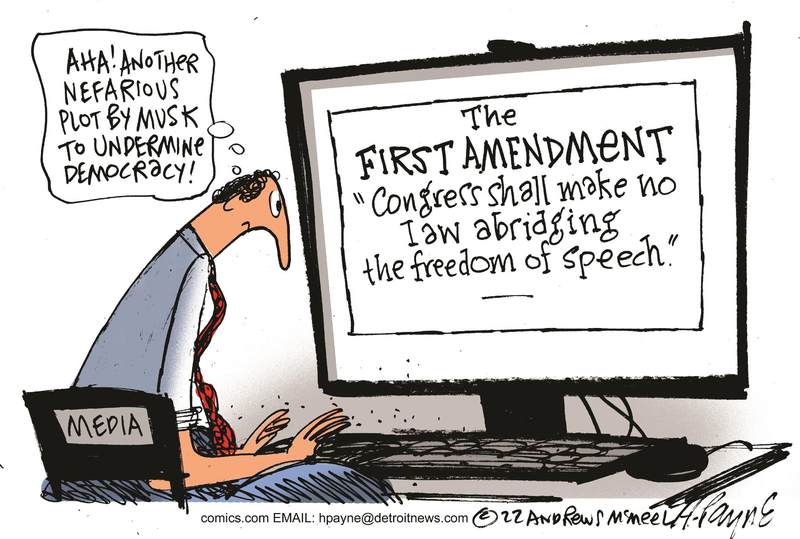
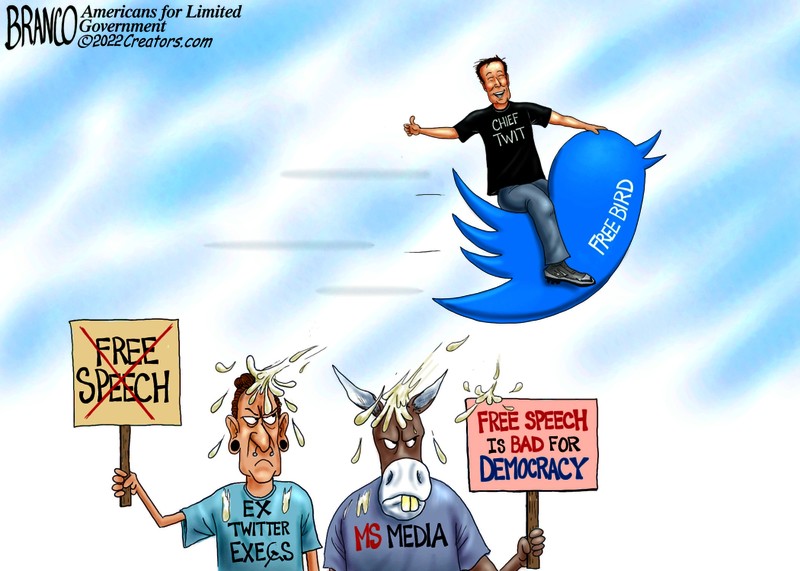
This Lenin quote leapt to mind amid the recent revelations coming from the “Twitter files”
and exposed over the past several weeks. Among other disclosures, the
files revealed direct lines of communication between government
agencies, including the FBI and Department of Defense, and the social
media company.
Twitter was found to not only be a landing spot for many agents in
the government intelligence community, but also doing the bidding of
agencies to suppress information deemed to be antithetical to the
agencies’ goals and preferred narratives. Indeed, journalist Matt Taibbi
went so far as to describe Twitter as an “FBI subsidiary.”
And it wasn’t just Twitter that the government targeted. Late last month Elon Musk tweeted
“*Every* social media company is engaged in heavy censorship, with
significant involvement of and, at times, explicit direction of the
government,” illustrating his point by saying, “Google frequently makes
links disappear, for example.”
Such revelations undercut many defenders of tech giants, who insist
“they’re private companies, they can do what they want.” Instead, we
must ask: are these truly ‘private companies’ in any meaningful sense?
Indeed, Lockheed Martin, Raytheon and Northrup Grumman are all
nominally “private companies.” But they are private in name only because
they are in reality appendages of the state, relying on defense
contracts (not market transactions) for their success.
We should treat big tech companies with the same skepticism we apply
to tools of the military industrial complex. Certainly so after the
“Twitter file” revelations.
In his quote above, Lenin was, of course, bragging about the progress
made toward complete nationalization of industry in the Soviet Union of
the time.
But we can also consider his statement as descriptive. When your main
mission is to do the bidding of the state, rather than serving
consumers in the voluntary marketplace, you are not really a private
company in the true sense of the term. Your company is not a market
phenomenon.
It’s no longer possible to defend social media corporations on the
basis of private property rights, because big tech are what Michael
Rectenwald would describe as “governmentalities,” not private companies.
Michael Rectenwald, former professor of liberal studies at New York
University and author of the book “Google Archipelago: The Digital Gulag
and the Simulation of Freedom,” provided context for how he believes
tech goliaths like Google and Twitter come to do the state’s bidding in a
November 2020 lecture.
“In a series of lectures entitled Security, Territory, Population, the postmodern theorist Michel Foucault introduced the term ‘governmentality’
to refer to the distribution of state power to the population, or the
transmission of governance to the governed,” Rectenwald noted.
“Foucault referred to the means by which the populace comes to govern
itself as it adopts and personalizes the imperatives of the state, or
how the governed adopt the mentality desired by the
government—govern-mentality,” he added.
Rectenwald, however, went even further than Foucault. “I adopt and
amend the term to include the distribution of state power to
extragovernmental agents—in particular to the extension and transfer of
state power to supposedly private enterprises.”
What transpires, then, is a form of ‘governmentalization’ of
nominally private enterprises, rather than the privatization of
government functions that free market advocates prefer.
How intertwined with the government are the tech giants? The
relationship predates the more recent phenomena revealed by Elon Musk’s
divulgences.
“First, both Google and Facebook received start-up capital—both
directly and indirectly—from US intelligence agencies,” Rectenwald
informs us. In their early days, Google in particular was heavily
reliant on CIA contracts and deals with other U.S. intelligence
agencies.
As Lenin boasted, “The vast majority of commercial and industrial establishments are now working not for the free market but for the government.” And work for the government, including shutting down dissident voices, is what big tech has indeed been doing for years.
As a result, they can no longer be defended with cries of “but
they’re private companies,” and instead be called out for what they
really are: tools of state oppression.

Brian Balfour is Senior Vice President
of Research for the John Locke Foundation, where he oversees the
organization’s research and analysis on a variety of issues. He
previously worked for the Civitas Institute for 13 years, and has a
master’s degree in economics from Wayne State University in Detroit, MI. Get notified of new articles from Brian Balfour and AIER. SUBSCRIBE


 By
By 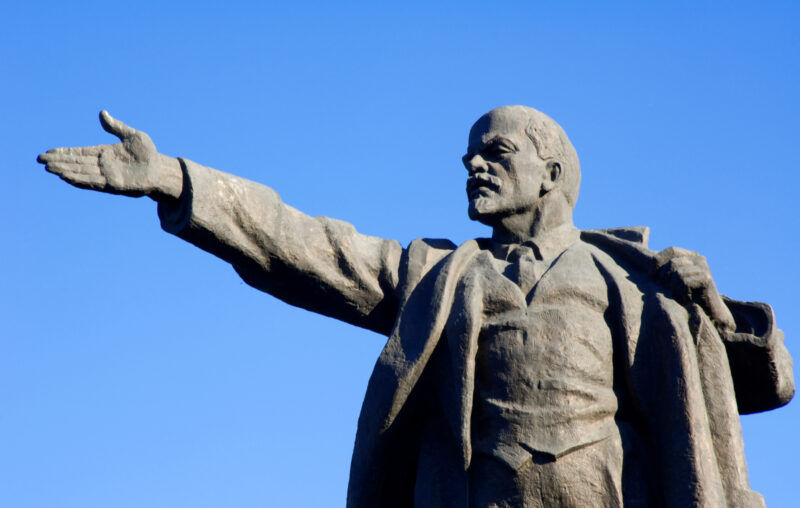


 By Rich Kozlovich