Judicial Watch, Corruption Chronicles, Feb. 23, 2018
Illustrating how government hides information from the American public, former Attorney General Loretta Lynch used a fake name to conduct official Department of Justice (DOJ) business in agency emails obtained by Judicial Watch. As the nation’s chief law enforcement officer Lynch, Barack Obama’s second attorney general, skirted public-records laws by using the alias Elizabeth Carlisle in emails she sent from her official DOJ account. In the records provided to Judicial Watch, the DOJ explains it as necessary to “protect her security and privacy and enable her to conduct Department business efficiently via email.”
This begs the question of how many other government officials use fake names and whether those aliases are searched when agencies process Freedom of Information Act (FOIA) requests. Besides Lynch, we have only discovered the use of such aliases among government operatives to conduct official business at the Environmental Protection Agency (EPA). Obama’s EPA administrator, Lisa Jackson, famously used the alias Richard Windsor in a government email account to conduct official business and communicate with staff. Jackson even took required EPA computer training under the fake identity with the handle Windsor.Richard@epa.gov. She eventually resigned over the scandal, which brought to light the agency’s violations of federal open-records laws.
In Lynch’s case, Judicial Watch requested the records as part of an investigation into the Obama administration’s involvement in a United Nation’s international law enforcement coalition called Strong Cities Network (SCN). The purported mission of the global coalition was to build social cohesion and community resilience to counter violent extremism.
The DOJ masterminded the agreement and Americans found out about the U.S.’s participation when Lynch announced it during a U.N. speech on September 29, 2015. Lynch referred to SCN as a “truly groundbreaking endeavor” and assured the notoriously corrupt world body that the Obama administration was deeply committed to the new initiative. “The government of the United States is fully invested in this collaborative approach and we have seen the value of empowering local communities by promoting initiatives they design and lead themselves,” Lynch said.........To Read More.....
Tuesday, March 6, 2018

Trump Aide Tells Mueller Where to Shove His Subpoena in Defiant Rant
While the rest of the nation is humoring the misguided Mueller team, former Trump Aide Sam Nurnberg isn’t having it. At all. There was a moment during the 2016 presidential election in which you could sense the fear within Hillary Clinton’s team. The Podesta gang, bolstered by a millennial army of miscreants, believed that they could simply hitch a spot on the Obama express, and ride the rails directly into the Oval Office without incident. After all, Hillary Clinton believed that she had it all going for her............it became clear that Hillary Clinton was a liability for the nation. Her recklessness was unkempt and catastrophic, and there was no way that the American people were willing to gamble like that with their Commander in Chief..........
Then, as we approached that fateful day when Clinton got “the vapors” and passed out during a somber moment at the 9/11 memorial in New York City, the former Secretary of State dropped the bomb: Donald Trump was a Russian agent.........To Read More.....
Jeff Sessions -- Ninja or Nincompoop
By Brian Joondeph March 5, 2018
Conventional wisdom, as shaped by the mainstream media, is becoming more and more schizophrenic.
Conventional wisdom, as shaped by the mainstream media, is becoming more and more schizophrenic.
- President Trump is a Russian stooge, doing Putin’s bidding, yet he is reigniting the cold war via new Russian sanctions.
- His White House is in chaos, yet the left is apoplectic over his barrage of policy initiatives.
- Special Counsel Robert Mueller is shooting blanks and at the same time is circling the Oval Office, ready to pounce and indict.
- Then there is Attorney General Jeff Sessions. Lurking in the weeds, moving with stealth and deception like a ninja.
- Or playing Rip Van Winkle, taking a nap, ignoring the waves of corruption engulfing the DOJ and FBI.
Monday, March 5, 2018
Quote of the Day
"To be a progressive is to be committed to perpetual reform in the name of perpetual grievance for perpetual power." - Daniel Greenfield
Who Supports Alternative Energy?
If you answered: “the Sierra Club and their allies,” you’d be right.
By John Droz, Jr., Physicist
This is a commentary based on breaking news of international importance. Please give careful consideration to these key energy questions. Who is it that wants:
Consider the fact that when it comes to energy policy, there is an almost identical agenda between these two groups.
Here is last week’s amazing Congressional Report about this collusion.
This is not new news, but information that the national media has (for some reason) not been interested in pursuing and publicizing. Consider this report last year. And a similar report back in 2014.
You would think that anyone concerned about purported collusion between Russia and President Trump would be extremely concerned about documented proof that the Russians are purposefully trying to undermine our economy and national security by supporting the environmental movement’s six-point energy agenda (above).
Fossil fuel exports account for around 16% of Russian GDP, 52% of government revenue and 70% of Russian exports (see here), so it makes sense that Russian propaganda efforts would be focused on protecting their fragile economy.
The US is the biggest threat to China’s political and economic aspirations, so it makes perfect sense that they would also love to see our economy and national security undermined — and a frivolous, counter-productive national energy policy would be a very effective way to do that.
Right now this is playing out regarding US offshore drilling. For example, in North Carolina, environmentalist are aggressively opposing any and all offshore fossil fuel exploration (e.g. here and here and here).
So, in summary, one side wants US fossil fuels to stay in the ground, so that our costs will go up, and that we will be forced to rely on expensive and unreliable sources of electricity (like wind energy). This will harm our economy.
The other, pro-American side, wants us to get more energy independence, to expand our economy by having lower cost reliable electricity, and to be able to give our European allies an alternative to Russian natural gas.
The wind energy matter is a proxy fight over these issues.
Lastly, if you know anyone involved in the offshore anti-drilling fight for America, please let me know - John Droz aaprjohn@northnet - and I’ll be glad to pass along our new ten-point Position Paper on that issue, which should be ready soon.
Update 3/5/18 7:15 AM: Originally this was a correspondence from John, and I asked for permission to publish it in an article form. Requests to publish came in from many of those to whom he sent this correspondence. Here are his comments and the replies he received showing how broad and insidious this issue truly is. RK
My correspondence about the overlapping of interests between Communists and the leaders of some mainstream environmental movements, clearly hit a nerve and resulted in an unusually high response rate. (I was correctly reminded that this is not just a fight going on in America.) At this point over 95% are in agreement.
Regarding this collusion, I cited three sources of
references, and here are three more:
#5 — Natalie Grant was an expert in Soviet
propaganda (see here).
Way back in 1998, she wrote “Gorbachev and
Global Enviro-Communism”— which is about the Marxist roots of the
Global Warming issue, which in-turn spawned the renewable energy craze.
In a nutshell there is strong evidence that ultimately the renewable energy, climate change, and education system clashes we are engaged in, are really about Communism vs Freedom.
Avoid being a victim by getting educated, keeping your eye on the ball, and defending your rights…
By John Droz, Jr., Physicist
This is a commentary based on breaking news of international importance. Please give careful consideration to these key energy questions. Who is it that wants:
- US nuclear energy facilities to close down?
- US fossil fuel reserves to stay in the ground (onshore and offshore)?
- the costs of fossil fuels to go up (e.g. with a carbon tax)?
- a high percentage of the US electric grid to be based on unreliable sources?
- the US to waste trillions of dollars on unreliable electricity?
- to have our national security weakened by wind energy interference with our military?
Consider the fact that when it comes to energy policy, there is an almost identical agenda between these two groups.
Here is last week’s amazing Congressional Report about this collusion.
This is not new news, but information that the national media has (for some reason) not been interested in pursuing and publicizing. Consider this report last year. And a similar report back in 2014.
You would think that anyone concerned about purported collusion between Russia and President Trump would be extremely concerned about documented proof that the Russians are purposefully trying to undermine our economy and national security by supporting the environmental movement’s six-point energy agenda (above).
Fossil fuel exports account for around 16% of Russian GDP, 52% of government revenue and 70% of Russian exports (see here), so it makes sense that Russian propaganda efforts would be focused on protecting their fragile economy.
The US is the biggest threat to China’s political and economic aspirations, so it makes perfect sense that they would also love to see our economy and national security undermined — and a frivolous, counter-productive national energy policy would be a very effective way to do that.
Right now this is playing out regarding US offshore drilling. For example, in North Carolina, environmentalist are aggressively opposing any and all offshore fossil fuel exploration (e.g. here and here and here).
So, in summary, one side wants US fossil fuels to stay in the ground, so that our costs will go up, and that we will be forced to rely on expensive and unreliable sources of electricity (like wind energy). This will harm our economy.
The other, pro-American side, wants us to get more energy independence, to expand our economy by having lower cost reliable electricity, and to be able to give our European allies an alternative to Russian natural gas.
The wind energy matter is a proxy fight over these issues.
Lastly, if you know anyone involved in the offshore anti-drilling fight for America, please let me know - John Droz aaprjohn@northnet - and I’ll be glad to pass along our new ten-point Position Paper on that issue, which should be ready soon.
Update 3/5/18 7:15 AM: Originally this was a correspondence from John, and I asked for permission to publish it in an article form. Requests to publish came in from many of those to whom he sent this correspondence. Here are his comments and the replies he received showing how broad and insidious this issue truly is. RK
My correspondence about the overlapping of interests between Communists and the leaders of some mainstream environmental movements, clearly hit a nerve and resulted in an unusually high response rate. (I was correctly reminded that this is not just a fight going on in America.) At this point over 95% are in agreement.
A sample comment:
“I watch Russia Today (RT) quite a bit as an antidote to the pro-EU propaganda of the BBC. I have long noticed RT’s support for every Luddite environmentalist group opposed to a realistic energy policy."
I got many requests to repost, and my answer to all was
that in this case I’d prefer anyone who would like to do that, to put this
important matter in their own words. None if this is about me anyway.
#4 — Please carefully read what this news report which
is about a Congressional effort to require leaders of certain environmental
organizations to register as foreign agents! In part it says:
“U.S. environmental activists who are working to halt the production and use of fossil fuels could be required to register as foreign agents if Congress gets serious about enforcing an existing law… An international campaign known as “Keep It in the Ground” has been pushing an anti-fossil fuel agenda that advances Russia’s geopolitical interests at the expense of the U.S. and America’s allies. The campaign claims support frommore than 400 organizations across the globe, with a sizable percentage operating inside the U.S. The campaign is opposed not just to the extraction of fossil fuels, but to any fossil fuel-related project including pipelines, rail transportation, refineries, and energy exploration. These groups include Greenpeace, the Sierra Club, 350.org, etc.”
#6 — So what’s really going on? IMO the movie Grinding
America Down gives the answer: this is all about sabotaging the country leading
the free world. Please watch this five minute
trailer that succinctly explains it all better than I can.
A solid understanding of who the coalition is,
and what their agenda is, makes it crystal clear why they hate President Trump.
Any leader promoting “Make America Great Again” is an arch-enemy to the
forces that want the US to regress to an agrarian age (e.g. with our
economy crippled by a high dependence on antiquated, unreliable, expensive
electrical energy sources like windmills, that unrelentingly spit out an
unpredictable and uncontrollable output).
Oh, and if that isn’t bad enough, wind energy (“the gift
that keeps on taking”) also inexorably divides many communities, pitting
neighbor against neighbor. Who benefits from that divisiveness in the free
world?
[Note: be particularly sensitive to terminology, as the Left has mastered this art. For example, there is no such thing as a wind "farm" (which is dishonestly trying to convey that an industrial facility is pastoral and benign). For example, when you hear the word "sustainability" this is code for extracting the rights from unwitting citizens. Etc.]
In a nutshell there is strong evidence that ultimately the renewable energy, climate change, and education system clashes we are engaged in, are really about Communism vs Freedom.
Avoid being a victim by getting educated, keeping your eye on the ball, and defending your rights…
Everything You Need to Know about Federal Spending in Five Charts
March 1, 2018 by Dan Mitchell @ International Liberty
I write constantly (some would say incessantly and annoyingly) about entitlement spending. And I occasionally write about discretionary spending.
It’s time to address the budget in a comprehensive fashion. Let’s look at five charts to put everything in context and to show how we got into our current mess.
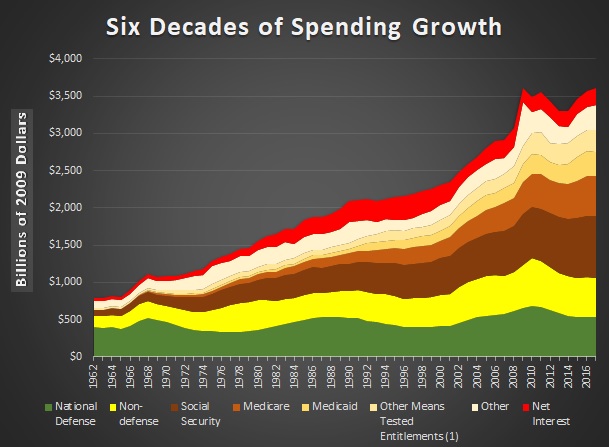
Our first chart (based on Table 8.2 from the Office of Management and Budget’s Historical Tables) shows what has happened to major spending categories from 1962 to 2017. And all the data is in inflation-adjusted dollars (2009 benchmark) to accurately gauge how and why the burden of federal spending has grown.

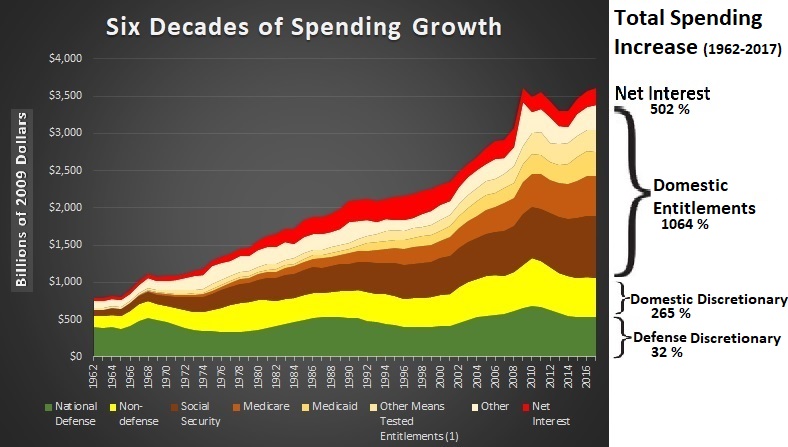
This next chart shows the actual percentage increases in the major spending categories during this time period. The two big takeaways are that 1) the defense budget is not the cause of our long-run fiscal problems (though that doesn’t mean it should be exempt from cuts), and 2) entitlement expenditures have exploded.

And if you look at the data I shared from the Congressional Budget Office’s long-run forecast, you would see that these same trends will prevail for the next three decades.
In other words, our fiscal problems start with entitlements and end with entitlements.
If you want to look at the problem with a broader lens, this next chart shows that the problem is domestic spending (i.e., the combination of entitlement and domestic discretionary outlays).

If you’re pressed for time, you can stop reading now. You have the key information already.
But if you want to get a bit wonky, here are two other charts that help explain the intricacies of how budgets work (or don’t work!) in Washington.
The first thing to realize is that there are two budget processes in Washington. There are entitlement programs, which basically operate on autopilot. For all intents and purposes, the President and Congress could go on vacation for the next three years and programs such as Social Security,
Medicare, Medicaid, and Obamacare would mechanically continue. But there is also “discretionary” spending for the Pentagon and various domestic programs, all of which is determined through an annual “appropriations” process. Whenever you read about a government shutdown, it’s because politicians can’t agree on the level of funding for the discretionary part of the budget.

Now let’s get to my favorite part, which is figuring out how to limit the size of the federal leviathan.
This last chart shows that net interest spending is genuinely untouchable (unless one wants a Greek-style or Argentine-style default). The rest of the budget, however, can be addressed. Entitlements can be changed through “reconciliation”, which is a legislative process designed to minimize procedural roadblocks (in general, tax bills also use reconciliation legislation). And discretionary programs can be changed via annual appropriations legislation.

I should add that net interest may not be directly touchable, but interest payments can be reduced by controlling spending and thus reducing red ink.
Another thing to understand is that the budget caps (yes, the ones that were weakened in 2013, 2015, and earlier this year) only apply to discretionary spending.
And the most important thing to realize is that the only solution to our budget mess is genuine entitlement reform. Which is why we need constitutional (and comprehensive) limits on total outlays. Politicians will only do what’s right if every other option is off the table.
It’s time to address the budget in a comprehensive fashion. Let’s look at five charts to put everything in context and to show how we got into our current mess.
Our first chart (based on Table 8.2 from the Office of Management and Budget’s Historical Tables) shows what has happened to major spending categories from 1962 to 2017. And all the data is in inflation-adjusted dollars (2009 benchmark) to accurately gauge how and why the burden of federal spending has grown.
This next chart shows the actual percentage increases in the major spending categories during this time period. The two big takeaways are that 1) the defense budget is not the cause of our long-run fiscal problems (though that doesn’t mean it should be exempt from cuts), and 2) entitlement expenditures have exploded.
And if you look at the data I shared from the Congressional Budget Office’s long-run forecast, you would see that these same trends will prevail for the next three decades.
In other words, our fiscal problems start with entitlements and end with entitlements.
If you want to look at the problem with a broader lens, this next chart shows that the problem is domestic spending (i.e., the combination of entitlement and domestic discretionary outlays).

If you’re pressed for time, you can stop reading now. You have the key information already.
But if you want to get a bit wonky, here are two other charts that help explain the intricacies of how budgets work (or don’t work!) in Washington.
The first thing to realize is that there are two budget processes in Washington. There are entitlement programs, which basically operate on autopilot. For all intents and purposes, the President and Congress could go on vacation for the next three years and programs such as Social Security,
Medicare, Medicaid, and Obamacare would mechanically continue. But there is also “discretionary” spending for the Pentagon and various domestic programs, all of which is determined through an annual “appropriations” process. Whenever you read about a government shutdown, it’s because politicians can’t agree on the level of funding for the discretionary part of the budget.

Now let’s get to my favorite part, which is figuring out how to limit the size of the federal leviathan.
This last chart shows that net interest spending is genuinely untouchable (unless one wants a Greek-style or Argentine-style default). The rest of the budget, however, can be addressed. Entitlements can be changed through “reconciliation”, which is a legislative process designed to minimize procedural roadblocks (in general, tax bills also use reconciliation legislation). And discretionary programs can be changed via annual appropriations legislation.

I should add that net interest may not be directly touchable, but interest payments can be reduced by controlling spending and thus reducing red ink.
Another thing to understand is that the budget caps (yes, the ones that were weakened in 2013, 2015, and earlier this year) only apply to discretionary spending.
And the most important thing to realize is that the only solution to our budget mess is genuine entitlement reform. Which is why we need constitutional (and comprehensive) limits on total outlays. Politicians will only do what’s right if every other option is off the table.
#1 best seller!
The Politically Incorrect Guide to Climate Change

$22.99$16.99
The Politically Incorrect Guide to Climate
Change gives a voice — backed by statistics, real-life stories, and incontrovertible evidence — to the millions of “deplorable” Americans skeptical about the multibillion dollar “climate change” complex, whose claims have time and time again been proven wrong.
Order Here
Change gives a voice — backed by statistics, real-life stories, and incontrovertible evidence — to the millions of “deplorable” Americans skeptical about the multibillion dollar “climate change” complex, whose claims have time and time again been proven wrong.
Order Here
Warm friends / Canadian Chill
March 4, 2018 by Craig Rucker, 0 Comments @ CFACT
Canada is experiencing a cold spell — not just with respect to the weather.
 He pushed for a national carbon tax, or cap and trade equivalent, to meet its Paris objectives — even over the objections of reluctant provinces like Saskatchewan and Manitoba.
 But there are positive developments taking place in the Great White North as well. One of these included a gathering of concerned citizens, political leaders and public policy experts that took place in Calgary, Alberta last weekend.
Canada is experiencing a cold spell — not just with respect to the weather.
The country is set to fall into tough economic times with its business climate going into deep freeze.
As noted recently in the Economist magazine:
“Oil and vehicles, Canada’s two biggest exports, are both declining, and may continue to do so. The workforce is shrinking as aging baby-boomers retire. Economists worry that consumers, who have built up record levels of debt, will spend less as interest rates rise … [and] without changes, GDP will grow by an average of 1.5% over the next 50 years, half the rate of the previous 50. The economy grew 3% last year. But the government forecasts a slowdown to 2.2% this year and to 1.6% in 2019.”
Much of this gloomy forecast can undoubtedly be linked to the Green, high tax policies now being undertaken by Canada’s Prime Minister Justin Trudeau and his Liberal majority.
Since sweeping into power in 2015, Trudeau has made no bones about his desire to “decarbonize” and Green the Canadian economy.
He pushed for a national carbon tax, or cap and trade equivalent, to meet its Paris objectives — even over the objections of reluctant provinces like Saskatchewan and Manitoba.
This year his ambitious Green-inspired plan is actually being rolled out nationwide, with the “price per ton” of carbon kicking off “modestly” at around $10 a ton, and then increasing dramatically to around $50 a ton by 2022 (provinces can also opt for a hefty cap and trade system if they want to go down that problematic road instead).
Add to this his party’s desire to heavily subsidize and push renewable energy, as well as an alarming suspicion his hitherto unqualified support for the Oil Sands in Alberta is wavering (he recently remarked about “phasing out” the Oil Sands – then walked back), there is real reason to believe Canada is steering its economic dogsled uphill and against the wind.
 But there are positive developments taking place in the Great White North as well. One of these included a gathering of concerned citizens, political leaders and public policy experts that took place in Calgary, Alberta last weekend.
Organized by the Economic Education Association of Alberta, this conference hosted a number of excellent activists and thinkers, including the Hon. Stockton Day, social media guru Kim Purdy, film maker John Robson, Peter Holle of the Frontier Center for Public Policy, and many others. I was very please to also be invited to speak and share CFACT’s ideas on how to better advance free market, pro-liberty values throughout North America — especially focusing on Millennials. I think everyone who attended would agree this meeting was a wonderful success.
CFACT strongly believes our movement needs to both pay attention to, and network with, pro-liberty movers-and-shakers in other parts of the world. We believe many of the issues we face are similar if not identical in nature to theirs.
Another good reason to network is because our common ideological adversaries (the UN, Greens, etc) also network and operate across international borders. Of course, they do so to spread eco-darkness — which CFACT is committed to oppose.
How good it is to know that in opposing them, we too have allies standing with us!
About the Author: Craig Rucker Craig Rucker is the executive director and co-founder of CFACT.
Will Congress finally get tough on junk science?
House hearing investigates a UN
cancer agency accused of misusing US taxpayer funds
Paul Driessen
A growing problem for modern
industrialized Western societies is the legion of government agencies and
unelected bureaucrats and allied nongovernmental organizations that seem
impervious to transparency, accountability or reform. Their expansive power often
controls public perceptions and public policies.
Prominent among them are those
involved in climate change research and energy policy. In recent years, they
have adjusted data to fit the dangerous manmade climate chaos narrative, while
doling out billions of taxpayer dollars for research that supports this
perspective, and basing dire predictions and policy demands primarily on climate models
that assume carbon dioxide now drives climate and weather (and the sun, water
vapor, ocean currents and other powerful natural forces have been relegated to
minor roles).
Reform is essential. Meanwhile,
another troubling example underscores the scope of the problem and the
difficulties Congress and other government administrators face when they try to
rein in rogue agencies.
In November 2017, the U.S. House of
Representatives Committee on Science, Space and Technology sent the UN’s
International Agency for Research on Cancer (IARC) a letter raising questions about scientific bias, secrecy and
corruption at the agency. When IARC obfuscated the issues, the committee sent a second letter, seeking answers within a week.
Otherwise, the Committee said, it
would consider “whether the values of scientific integrity and transparency are
reflected in IARC monographs and if future expenditures of federal taxpayer
dollars need to continue.” The United States is the IARC monograph program’s
biggest contributor, having given it nearly $50 million to date.
Agency director Dr. Christopher Wild
bided his time four weeks before replying (many would say rather testily and
condescendingly) and concluding: “IARC would be grateful if the House Science
Committee would take all necessary measures to ensure that the immunity
of the Organization, its officials and experts, as well as the inviolability
of its archives and documents, are fully respected.” [emphasis added]
Refusing to be cowed, on February 6
the committee held a hearing, “In Defense of Scientific Integrity: Examining
the IARC Monograph Programme and Glyphosate Review.” Evidence presented
revealed that the monograph program is an antiquated approach that simply tries
to determine from laboratory studies whether a particular chemical might cause
cancer in test animals, even if only at ridiculously high levels that no human
would or could ever be exposed to in the real world.
IARC performs no actual risk
assessments that examine the potency of a substance to humans or the
level of exposure at which the substance might actually have an adverse
effect on people. It thus places bacon, sausage, plutonium and sunlight
together in Group 1, its highest risk category: “definitely carcinogenic.” This
provides no useful information from a public health perspective, but does give
ammunition to activists who want to stoke fear and get chemicals they dislike
banned.
IARC’s Group 2B carcinogens include
caffeic acid, which is found in coffee, tea, and numerous healthy, must-eat
fruits and vegetables, including apples, blueberries, broccoli, kale and
onions. This group also includes acetaldehyde, which is found in bread, ginkgo
balboa and aloe vera, lead Science Committee witness Dr. Timothy Pastoor noted in his testimony.
As Pastor also pointed out during
the hearing, countless chemicals could theoretically cause cancer in humans at
extremely high doses – but are completely harmless at levels encountered in our
daily lives.
But it’s not just IARC’s overall
approach that raises questions. As investigative journalists David Zaruk and Kate Kelland discovered, serious allegations have also been
raised regarding the integrity of IARC’s review process. These include evidence
that IARC deleted or manipulated data – and covered up major conflicts of
interest by agency panel members who were employed by environmental activists
and mass tort plaintiff attorneys who are targeting the very chemicals the
panelists were reviewing and judging.
IARC’s latest quarry is glyphosate,
the world’s most widely used herbicide. The principal ingredient in the weed
killer RoundUp, glyphosate is vital in modern agriculture, especially no-till farming.
The European Food Safety Authority,
European Chemicals Agency, German Institute for Risk Assessment, US
Environmental Protection Agency and other experts all found that glyphosate is
safe and non-carcinogenic. So did the 25-year, multi-agency US Agricultural Health Study (AHS), which analyzed data on more
than 89,000 farmers, commercial applicators, other glyphosate users and their
spouses.
IARC alone says glyphosate is likely
a cancer-causing agent – contradicting every other regulatory and reputable
scientific body around the world. How could it possibly reach such a different
conclusion?
According to Zaruk, Kelland and
committee members, IARC deliberately ignored the AHS analysis. The chairman of
the IARC working group on glyphosate later admitted in a sworn deposition that
this study would have “altered IARC’s analysis.”
When an animal pathology report
clearly said researchers “unanimously” agreed glyphosate had not caused
abnormal growths in mice they had studied, IARC deleted the problematical
sentence.
In other cases, IARC panelists
inserted new statistical analyses that effectively reversed a study’s original
finding, or quietly changed critical language exonerating the herbicide.
Meanwhile, Dr. Christopher Portier,
the “consulting expert” for the working group that labeled glyphosate as
“probably” cancer-causing, admitted in his own sworn testimony that – just a
few days after IARC announced its guilty verdict – he signed a contract to
serve as consultant to a law firm that is suing the chemical’s manufacturer
(Monsanto) based on that verdict. Portier collected at least $160,000 just for
his initial preparatory work.
Adding to the confusion and
collusion, say Committee members, Linda Birnbaum’s $690-million-per-year
National Institute for Environmental Health Sciences (in the National
Institutes of Health) has been collaborating with the same government agencies,
pressure groups, trial lawyers and yet another anti-chemical activist
organization, the Ramazzini Institute in Italy.
This is not science. It is
corruption distortion and fraud – supported by our tax dollars and used to get
important chemicals off the market.
The end result, if not the goal, is
to undermine public confidence in science-based risk assessments,
lend credibility to activist campaigns claiming numerous chemicals contaminate
our foods and poison our bodies, and enable predatory tort lawyers to get rich
suing manufacturers and driving them into bankruptcy.
Dr. Wild’s letters clearly suggest
that IARC views the Science Committee’s concerns about the agency’s lack of
scientific integrity and transparency as irrelevant – as a mere irritant, a
minor threat to his agency’s unbridled power … and something the US government
will ultimately do nothing to correct.
We will soon find out whether IARC
is right – or if Congress is finally ready to play hardball with this unethical
UN agency.
It’s also an important test for
congressional oversight, spine and intestinal fortitude on holding other deep
state agencies accountable for how they spend our money, what kind of science
or pseudo-science they support and conduct, and how they will affect or even
determine the public policies that in so many ways are the foundation of our
economy, livelihoods and living standards.
PS: The Science Committee has also
discovered that Vladimir Putin’s Internet Research Agency engaged in
significant hacking, to inflame social media and instigate discord over US energy development and climate change policies
– while Putin cronies laundered millions to fund radical green
organizations. That too must be addressed by Congress and administrative
agencies, including the Justice Department.
Paul Driessen is senior policy analyst for the Committee For
A Constructive Tomorrow (www.CFACT.org) and author
of books and articles on energy and environmental policy.
Is China the World Leader in Biomedical Fraud?
Xi Jinping should be promoting evidence-based medicine, not quackery.
February 28, 2018 By Alex Berezow (This appeared here)
In 2015, a 6-year-old diabetic child died in Australia. Instead of giving him insulin, his parents had taken him to Hongchi Xiao, an itinerant self-proclaimed healer who performs “slap therapy” — known as paida lajin in traditional Chinese medicine. As the name implies, the child was slapped in an attempt to cure his illness.
This isn’t the first death to which Xiao, who runs workshops all over the world, may have contributed. A 71-year-old British woman, also a diabetic, died in October 2016 after attending one of Xiao’s workshops in England. According to the Sydney Morning Herald, Xiao has been charged with manslaughter in the boy’s death, along with the child’s parents and grandmother.
These deaths are horrifying because they were entirely predictable and preventable. Yet, if the Chinese government has its way, the world will see many more of them.
Traditional Chinese medicine is deeply embedded in the culture of contemporary mainland China. As Foreign Policy’s Asia editor, James Palmer, wrote for Aeon in 2013, it is not simply a matter of a few medical holdouts clinging to the remnants of a long-forgotten tradition. On the contrary, traditional Chinese medicine is thoroughly institutionalized: Every major city has a traditional medicine hospital and university. A special government department exists to administer it, and the traditional Chinese medicine industry is a massive business. Its advocates in the West often contrast its supposed purity to the pharmaceutical industry, but in China traditional medicine is Big Pharma.
To grasp the scope of this problem, imagine that every major European city had a university that taught that the Earth is flat and merely 6,000 years old and a hospital that practiced bloodletting and aura cleansing. And then imagine that health professionals across Europe didn’t see much difference between prescribing Viagra for impotence or horny goat weed. Citizens would rightfully complain that their universities were teaching nonsense and their doctors were practicing witchcraft.
But this is standard operating procedure in China. Although some traditional practices are centuries or millennia old, there is little evidence to support the vast majority of them. When scrutinized in clinical trials — the gold standard for the testing of medical therapies — most traditional practices, such as acupuncture, fail. At best, traditional Chinese therapies might trigger a placebo effect; at worst, they can cause severe side effects, despite a widespread belief in China that traditional medicine is inherently harmless. And yet, Chinese President Xi Jinping wants to share these placebos with the world. The Economist reported that Xi wants traditional Chinese medicine to be given equal status with “Western medicine.” By 2020, he wants all 1.4 billion Chinese people to have easy access to it. Worse, the Chinese government is spreading traditional Chinese medicine across the globe, including in the United Kingdom and the United States, by subsidizing branches of the Confucius Institute that teach traditional medical techniques in addition to courses on Chinese language and culture. Due to their potential for spreading Chinese government propaganda, Confucius Institutes in the United States are now being monitored by the FBI. Traditional Chinese medicine has a long history as propaganda. The modern concept of it originated in the 1950s under Mao Zedong, at a time when cultural pride and foreign-directed propaganda demanded the invention of a powerful Chinese tradition. The range of traditional Chinese healing practices was sold as “scientific” to gullible foreigners and the Chinese public alike. In a still desperately poor country, traditional medicine was better than nothing for the masses.
Now, traditional healing has been mixed with the Chinese Communist Party’s new determination to promote the country’s cultural supremacy around the world, in opposition to the dangerous lures of Western influence. Xi has demanded that government institutions promote “cultural confidence.” With most other forms of China’s premodern culture destroyed by the ravages of Maoism and modern-day materialism, traditional Chinese medicine stands almost alone among the ruins.
One may be tempted to believe that if patients are still given modern medicine, traditional medicine is simply a harmless “add-on” — like a stuffed animal or bouquet of flowers — that might make people feel better. But that is a dangerous conclusion. Traditional Chinese medicine thrives, in part, because charlatans encourage the public to be suspicious of modern medicine. Similar fraudulent claims have already resulted in catastrophe. Andrew Wakefield, the British medical doctor who faked a study linking vaccines to autism, is the primary culprit behind the falling vaccination rates in the developed world. As a result, outbreaks of measles and other vaccine-preventable diseases have occurred. In 2017, measles cases in Europe spiked 400 percent.
A Brief Quackery Primer
By Marvin Schissel — February 27, 2018
"The Quack is a personage too essential to the comfort of society to be deprived of his vocation. He is, in fact, the Physician of the Fools, a body whose numbers and respectability are by far too great to admit of anything of the kind." ("Punch", 1845)
Many well-educated, skeptical people suffer from a failure of logic when it comes to matters of health. Some studies even suggest that the more educated the person, the more likely they are to fall for some form of quackery. A major logical failing of the educated, although it is rarely recognized for what it is, is instead simply prejudice. Too many believe they have gained some secret insight because of their wealth or reading and decide that everything "organic" is good, while conventional "chemicals" are somehow unhealthy, that "natural" is good, and "artificial" is bad.
This is just prejudice. The wise question is not whether something is "natural" or "artificial", "new" or "old", "organic" or "conventional", but simply whether something is good or bad. Not all chemicals are bad, and not everything natural is good. And all that is original and novel is not necessarily good.
It's easier to be original and foolish than original and wise (Liebnitz)...........To Read More....
Nicholas Kristof's Latest Screed on Chemicals- Scary Rather Than Informative
By Chuck Dinerstein — February 26, 2018
The New York Times, specifically pundit Nicholas Kristof, has once again demonstrated their flair for hyperbole at the price of scientific honesty. In his current column, What Poisons are In Your Body, Kristoff recounts his concern about chemicals in his environment and the recent testing of his urine for chemicals [1].
Kristof has drunk deeply from the organic, pesticide-free, endocrine disruptor-free Kool-Aid of chemical fear. In his own words,
“So I’ve tried for years now to limit my exposure to endocrine-disrupting chemicals. Following the advice of the President’s Cancer Panel, I eat organic to reduce exposure to endocrine disruptors in pesticides. I try to store leftover meals in glass containers, not plastic. I avoid handling A.T.M. and gas station receipts. I try to avoid flame-retardant furniture.”To evaluate his current exposure he utilized the “Detox Me Action Kit” which tests your urine for chemical metabolites. In his first, but not last moment of playing fast and loose with the truth he describes the urine test, which costs $300, as a way for consumers to learn “what harmful substances are in their body.” The Silent Spring Institute [2], the maker of the urine test kit is a bit more circumspect in their claims. First, the “Detox Me Action Kit” is
“..part of a scientific study run by Silent Spring Institute, a 501(c)(3) non-profit organization. We’re crowdfunding this study to get a better sense of our collective exposure to harmful environmental chemicals.”More telling is the real disclaimer,
“These 10 chemicals [the ones tested for in the urine] have been detected at different levels in people throughout the U.S., but detecting these chemicals in your urine doesn’t mean you will get sick. It is not known if exposure levels in the general population are above or below levels that cause health effects.”...........To Read More....
Sunday, March 4, 2018
Legacy for Our Children
By
James A. Marusek
@ Impact 2009
(Editor's Note: James A. Marusek is a retired nuclear physicist who has allowed me to publish is work for many years. I think This 2009 presentation is as profound today as it was eight years ago. This link will introduce you to other pieces he's done over the years. RK)
There is a lot of talk these days about the legacy we will leave our children and our grandchildren. When I stare into the immediate future, I see a frightening legacy caked in darkness and famine. Instead of intelligently preparing, we find ourselves whittling away this precious time chasing fraudulent theories. We have a decade to prepare, but have a misguided sense of direction and urgency.
Climate change is primarily driven by nature. It has been true in the days of my father and his father and all those that came before us. Because of science, not junk science, we have slowly uncovered some of the fundamental mysteries of nature. Our Milky Way galaxy is awash with cosmic rays. These are high speed charged particles that originate from exploding stars. Because they are charged, their travel is strongly influenced by magnetic fields. Our sun produces a magnetic field that extends to the edges of our solar system.
This field deflects many of the cosmic rays away from Earth. But when the sun goes quiet (minimal sunspots), this field collapses inward allowing cosmic rays to penetrate deeper into our solar system. As a result, far greater numbers collide with Earth and penetrate down into the lower atmosphere where they ionize small particles of moisture (humidity) forming them into water droplets that become clouds. Low level clouds reflect sunlight back into space. An increase in Earth's cloud cover produce a global drop in temperature. These periods of quiet sun are referred to as a Grand Minima.
The Maunder Minimum (1645-1715) and the Dalton Minimum (1790-1830) are examples.
During a Grand Minima the Earth begins to slowly cool. The start of the planting season is delayed and in the fall early frost limits the harvest. Earthʼs abundant bounty is put on hold and starvation takes its ghastly grip. Historian, John D. Post, referred to the last Grand Minima, the Dalton Minimum, as the “last great subsistence crisis in the Western world”. With the cold came massive crop failures, food riots, famine and disease. Several scientists including David Hathaway (NASA), William Livingston & Matthew Penn (National Solar Observatory), and Khabibullo Abdusamatov (Russian Academy of Science) have forecasted that the sun may enter a Grand Minima a decade from now in Solar Cycle 25.
A few scientists including David C. Archibald (Australia) and M. A. Clilverd (Britain) have warned this might even begin in Solar Cycle 24. We are at the transition into Solar Cycle 24 and this cycle has already shown itself to be unusually quiet. The number of spotless days (days without sunspots) during this solar minimum appears to be tracking 3 times the typical number observed during the last century (Solar Cycles 16-23).
There are some that urge North America follow Europeʼs lead. On January 13, 2009, the European Parliament adopted a regulation dramatically restricting the number of pesticides allowed. This move is based on the precautionary principle and on junk science. According to Dr. Colin Ruscoe, chairman of the British Crop Production Council, "If farmers are forced to stop using certain products, crop yields would halve.
There would be such huge losses in the yields of potatoes, carrots, peas and parsnips that it would become uneconomical to farm them." Is this the kind of lead we should be following? Europe is also leading in another area - in its opposition to genetically modified (GM) crops. In Europe, environmentalist have driven fear into the hearts of their citizens by labeling GM food as “Frankenfood”.
In our country, we have been using GM crops for almost two decades without any ill effects. GM crops hold the promise of helping us survive the next Grand Minima by offering crops that can grow under extreme weather conditions. North America is currently a leader in this technology. Should we follow Europeʼs lead and ban GM crops? And in ten years from now when the next solar cycle begins, if the sun goes quiet, who will comfort the starving children who cry out in the middle of the night for a small piece of bread? These will be our children.
So what legacy will we leave behind?


Circular reasoning with climate models
March 1, 2018 by David Wojick, Ph.D., 102 Comments

Climate models play a central role in the attribution of global warming or climate change to human causes. The standard argument takes the following form: “We can get the model to do X, using human causes, but not without them, so human causes must be the cause of X.” A little digging reveals that this is actually a circular argument, because the models are set up in such a way that human causes are the only way to get change.
The finding is that humans are the cause of global warming and climate change is actually the assumption going in. This is circular reasoning personified, namely conclude what you first assume.
This circularity can be clearly seen in what many consider the most authoritative scientific report on climate change going, although it is actually just the most popular alarmist report. We are talking about the Summary for Policymakers (SPM), of the latest assessment report (AR5), of the heavily politicized UN Intergovernmental Panel on Climate Change (IPCC). Their 29 page AR5 SPM is available here.
The “smoking gun” of circularity lies in just two figures, specifically Figures 5 and 6.
First look at Figure 5 on page 14. It is a bit technical, but as the caption says in the first line, these are “the main drivers of climate change” (according to the IPCC that is). There are just eleven of these main drivers, each with a colorful horizontal bar, although some are broken down into components.
The length of each bar represents the IPCC’s best guess at how much each driver has done since 1750 (and through 2011), which they call a “forcing.” So any observed climate changes over that 261 year period must be due to these drivers and this is just what the climate models assume.
In fact the modelers are required to assume it if they want to feed their results into the IPCC assessment. About 100 major climate models are used to do this modeling, in a huge coordinated effort that takes several years to pull off. That effort is coordinated by the US Department of Energy.
The smoking gun begins with the fact that 10 of these 11 drivers are from human causes. The only one that is natural is changes in solar energy input (called “irradiance”) and that bar is so small that it basically does not count. In fact you can barely see it in the figure.
So for all practical purposes, the IPCC assumes that all of the drivers of climate change are human caused. There are many other drivers that are discussed in the scientific literature but they are simply ignored, here and in the models.
Obviously, if all the drivers of climate change are human caused, then all the observed changes must also be caused by humans. And this is just what we see in Figure 6, on page 18.
This figure shows 18 separate little pictures. Each picture shows three things:
(1) An observed climate change.
(2) What the model output looks like without human forcing.
(3) What the model output looks like with human forcing.
Given that the only significant forcing allowed is human, it is no surprise that the model output only matches the observations when human forcing is included. How could it be otherwise? The 18 model outputs without human forcing do not change, indeed they cannot change, because no natural drivers are allowed.
But rather than seeing that this result simply follows from the initial assumptions, the IPCC amazingly claims that it proves that human are the sole cause of climate change. It proves nothing of the sort and this completes the smoking gun of circularity.
The simplicity of this fallacy is stunning. If you assume that only humans can cause climate change then of course it follows that all climate change is caused by humans. But this is just true by assumption, not by science. The reasoning is perfectly circular.
A legitimate assessment of the science would consider the many other drivers that are presently under consideration. Legitimate scientific modeling would explore these drivers, to see what contribution they may be making to the observed climate changes.
Unfortunately neither the IPCC nor the extensive, expensive modeling that is done to support it is legitimate. That the US Department of Energy is at the center of all this politicized non-science is especially bad and needs to change.
As it is, all of this modeling is just junk, because it assumes a false answer going in. There is no such thing as science by assumption. If the models are not going to do science then they should not be running.
About the Author: David Wojick, Ph.D.
Trump’s Spending Splurge Is a Long-Run Recipe for Higher Taxes and Less Prosperity
February 28, 2018 by Dan Mitchell @ International Liberty
I sometimes sardonically comment about Democratic politicians playing Santa Claus, but Republicans can play that game as well.
Trump and his allies in Congress recently agreed on a big-spending budget deal that lavishes more money on both the Pentagon and domestic programs, and that was only a few weeks after agreeing on a tax reform plan that lower taxes (though only for nine years).
Even if I like part of what’s been happening, that kind of populist approach at some point becomes unsustainable. And when the D.C. swamp ultimately has to choose between lower taxes or higher spending, they’ll go with the latter and make things even worse by jacking up the tax burden.
My frustration is apparent in this recent interview.
And I’m not the only one who sees the long-run dangers.
In a column for the Wall Street Journal, Professor Edward Lazear of Stanford explores the economic damage of ever-expanding government.
And this approach can lead to a downward spiral.
Since we’re on the topic, let’s look at some additional evidence. Three economists from Australia and the United Kingdom did a meta-analysis of studies on the relationship between government spending and economic growth. Here are some of the findings.
What’s primarily holding back those countries is weak rule of law, excessive regulation, and protectionism.
But I’m digressing. The study also acknowledges the Rahn Curve, though they call it the Armey Curve.
Sadly, some people mistakenly conclude that if a little bit of government is associated with more prosperity, then a bloated public sector must be even better.
On a related note, Professor Alexander Salter dismisses the assertion (pushed by international bureaucracies) that big government is a pre-condition for prosperity. Here’s some of what he wrote.
In a column last year on the emerging micro-state of Liberland, I tried to square the circle. Here’s some of what I wrote after looking at the literature on state capacity.
So I’ll end on a pessimistic note by observing that we normally get bad fiscal policy from Democrats and worse fiscal policy from Republicans (Reagan being the only modern-era exception).
Trump and his allies in Congress recently agreed on a big-spending budget deal that lavishes more money on both the Pentagon and domestic programs, and that was only a few weeks after agreeing on a tax reform plan that lower taxes (though only for nine years).
Even if I like part of what’s been happening, that kind of populist approach at some point becomes unsustainable. And when the D.C. swamp ultimately has to choose between lower taxes or higher spending, they’ll go with the latter and make things even worse by jacking up the tax burden.
My frustration is apparent in this recent interview.
And I’m not the only one who sees the long-run dangers.
In a column for the Wall Street Journal, Professor Edward Lazear of Stanford explores the economic damage of ever-expanding government.
He looks at some of the cross-country evidence.The budget deal President Trump signed earlier this month will send federal spending and the deficit skyrocketing. On top of this spending explosion, the administration now plans to add a $500 billion infrastructure bill. …over time high spending necessitates high taxes, and high taxes reduce work and restrain growth. Economic trends in developed nations consistently show that low taxes and hard work are linked to robust growth.

European countries trail the U.S. in working hard and controlling taxes, and their economies have lagged in comparison. France has a tax-to-GDP ratio of about 44%, and in Italy it’s 43%. The French and Italians work almost 30% fewer hours per person than Americans. Notably, the French economy has flatlined since 2010 while Italy’s has contracted. …Data from the Organization for Economic Cooperation and Development suggests that a 1% increase in a nation’s tax rate is associated with a 1.4% decrease in hours worked per person in the working-age population.Here’s the part that resonated with me. It’s excessive spending that ultimately is the problem.
…taxes are ultimately dictated by spending. Countries can borrow to finance short-run spending, but they must eventually levy taxes to repay the loans. Whether a government raises taxes now or later to pay for expenditures is a minor consideration compared with its decision to spend in the first place. …Higher spending goes hand in hand with higher taxes, higher deficits, fewer worked hours and less growth. The international comparisons suggest that a 4% increase in spending is associated with a decrease of roughly 0.5 percentage point in the average annual growth rate. Furthermore, it is spending—rather than the deficit—that correlates with sluggish growth. …Deficits often coincide with low growth because deficit increases are usually caused by heightened spending, not reduced taxes. Raising taxes, or keeping them high without lowering spending, stifles growth.Heck, even the OECD has produced research on the negative impact of government spending on economic performance.
And this approach can lead to a downward spiral.
To the extent that government spending goes to programs such as welfare that directly discourage work, it has an additional growth-reducing effect. When fewer people work, those who do must be taxed even more to cover public expenses. These heightened taxes on labor discourage work in turn, pushing more potential workers toward government support.In other words, if we stay on this path, we’ll eventually become Greece. Not a good idea, to put it mildly.
Since we’re on the topic, let’s look at some additional evidence. Three economists from Australia and the United Kingdom did a meta-analysis of studies on the relationship between government spending and economic growth. Here are some of the findings.
Here’s what they found.One of the most contentious issues in economics is whether ‘big government’ is good or bad for economic growth. …Theoretically, big government can have both negative and positive effects on growth. …In this study, we include all effect-size estimates reported by empirical studies that examine the direct effect of government size on growth.

… findings indicate that: (i) total government expenditures have a medium and adverse effect on per-capita income growth in developed countries only; (ii) the effect of government consumption on per-capita income growth is also medium in developed countries and in developed and LDCs pooled together; and (iii) neither total expenditures nor government consumption has a significant effect on per-capita income growth in LDCs.I’m not surprised that they didn’t find a strong link in poor nations. The data show that those countries are generally too mismanaged and corrupt to collect much revenue. Therefore, as I noted in my recent analysis of Indian economic policy, they can’t spend much.
What’s primarily holding back those countries is weak rule of law, excessive regulation, and protectionism.
But I’m digressing. The study also acknowledges the Rahn Curve, though they call it the Armey Curve.
…government size tends to have a negative effect on per-capita income growth as the level of income increases. This finding ties in with the Armey curve hypothesis (Armey, 1995), which posits an inverted-U relationship between government size and economic growth. The theoretical argument here is that government size may be characterised by decreasing returns. Another theoretical argument relates to the distortionary nature of taxes, which is minimal for low levels of taxation, but beyond a certain threshold, they grow rapidly and become extremely large.Quite true.
Sadly, some people mistakenly conclude that if a little bit of government is associated with more prosperity, then a bloated public sector must be even better.
On a related note, Professor Alexander Salter dismisses the assertion (pushed by international bureaucracies) that big government is a pre-condition for prosperity. Here’s some of what he wrote.
But there’s a competing theory.Why are Western countries like the United States and Germany so much richer today than other countries around the world? …One explanation for the success of the West is, in a word, liberty. Over the last few hundred years, classical liberal ideas such as the rights of man and the rule of lawput constraints on European governments’ power, which resulted in a strong protection of private property rights. This resulted in meteoric economic growth, which delivered the modern cornucopia of wealth. …Free countries get rich; unfree countries stay poor.

…another explanation — state capacity…is the idea that economic development requires strong, centralized states to uphold the rule of law and provide crucial public goods. …The state capacity literature in economics…places heavy emphasis on a single, strong, central legal authority. In this framework, the fractured and decentralized legal authorities in medieval and early modern Europe are now seen as antithetical to economic development.Salter is skeptical of the second theory.
…it is undeniable that economic growth in the West did not take off until the rise of modern nation-states. … While governance institutions obviously began centralizing at the beginning of the modern era, …that’s insufficient as a causal explanation. …the state capacity literature has a hard time dealing with a very troubling counterexample: the totalitarian states of the 20th century: like the USSR and China. These states had plenty of capacity, as evidenced by their ability to murder millions of their own citizens… Needless to say, these kinds of things aren’t conducive to economic development.So he concludes that the first theory must be the answer, at least in part.
…whatever is “doing the work” of promoting economic growth, it is upstream of the creation of states. …State capacity may or may not be a valuable steppingstone to an explanation, but it is not itself an explanation that social scientists should accept. …it seems the old hypothesis — that the big ideas of classical liberalism created Western economic growth — is worth another look!My bottom line, for what it’s worth, is that the classical-liberalism approach is the necessary condition, but that doesn’t automatically make it a sufficient condition.
In a column last year on the emerging micro-state of Liberland, I tried to square the circle. Here’s some of what I wrote after looking at the literature on state capacity.
…the key to prosperity is having a state strong enough and effective enough to provide rule of law, but to somehow constrain that state so that it doesn’t venture into destructive redistribution policies. This is why competition between governments played a key role in the economic development of the western world. When governments have to worry about productive resources escaping, that forces them to focus on things that help an economy (i.e., rule of law) while minimizing the policies that hinder prosperity (i.e., high taxes and spending). …America’s Founding Fathers dealt with the same issues… Their solution was a constitution that explicitly limited the size and scope of the federal government. …that system worked reasonably well until the 1930s.I find this issue fascinating, but I suspect most people are more concerned about the real-world consequences rather than the theoretical underpinnings.
So I’ll end on a pessimistic note by observing that we normally get bad fiscal policy from Democrats and worse fiscal policy from Republicans (Reagan being the only modern-era exception).
Subscribe to:
Posts (Atom)