Search This Blog

De Omnibus Dubitandum - Lux Veritas

Showing posts with label Big Tech Corruption. Show all posts

Friday, April 26, 2024

China Biotech Giants Invading US Communities

China’s business largesse is a powerful pull for lawmakers on both sides of the aisle. 

By @ Liberty Nation News, Apr 25, 2024 Tags: Articles, Business News, Opinion

A pair of biotech behemoths are shedding light on the aggressive courting of Chinese corporate money by local US elected officials despite clear-cut dire national security concerns. The China cash chase has thus far not had serious political ramifications, but all that may be about to change in the radioactively partisan atmosphere of Election Year 2024.

“For more than a decade, Chinese biotech pioneers WuXi AppTec and BGI Group have forged close scientific and financial relationships developed by US drugmakers, research scientists, and start-ups around Philadelphia and across the United States,” The Philadelphia Inquirer reported April 16. “Now, Congress is threatening to cut off federal funding to companies that do business with WuXi and BGI, citing links to the Chinese military that some US officials say makes it hard for such companies to keep the data of their US customers private and therefore creates a national-security risk.”

The extent of the Chinese biotech footprint in America is alarming. And it’s not just Philadelphia.

‘Welcomed as Job and Revenue Generators’

“WuXi AppTec and WuXi Biologics have also received millions of dollars in tax incentives to build sprawling research and manufacturing sites in Massachusetts and Delaware that local government officials have welcomed as job and revenue generators,” The New York Times reported April 15.

GettyImages-1953524113 China

(Photo credit should read CFOTO/Future Publishing via Getty Images)

“WuXi AppTec said it has about 1,900 US employees,” The Times added. “Officials in Delaware gave the company $19 million in tax funds in 2021 to build a research and drug manufacturing site that is expected to employ about 1,000 people when fully operational next year, public records and company reports show.”

State and municipal elected officials pining for China investment largesse heedless of the grave threat posed to the nation at large are a dirty secret of American politics that may finally fully come out in 2024. The Philadelphia Inquirer, a Democrat-aligned ruling progressive establishment media outlet, has discovered the beat at a very convenient time for its purposes. Dave McCormick, who has just captured the Republican nomination for a US Senate seat, has a track record on the issue that is astonishing, yet hardly unique.

Mitch McConnell’s Senate China Dolls

As Liberty Nation documented on April 8, outgoing Senate Majority Leader Mitch McConnell (R-KY) “has cleared a path for GOP nomination for not one but two former top executives of Bridgewater Associates, a private equity behemoth so deeply invested in China that it manages state money for the Asian communist superpower.”

Along with McCormick, the former CEO of Bridgewater, the firm’s ex-chief financial officer Nella Domenici, daughter of longtime GOP Sen. Pete Domenici, is expected to claim the party’s Senate nod in New Mexico.

GettyImages-1396939326 Dave McCormick

Dave McCormick (Photo by Michael M. Santiago/Getty Images)

Democrats and their big-box media allies are ready to pounce. The Inquirer launched a journalism nuclear strike against McCormick on April 12.

“Republican US Senate candidate Dave McCormick led a hedge fund that invested millions in Chinese companies that produced military equipment,” the paper related. “While McCormick was CEO or co-CEO of Bridgewater Associates, the hedge fund held more than $200 million in stock in at least 20 Chinese companies that were later sanctioned by the United States for being part of China’s military industrial complex, Bloomberg Government reported.”

Shockingly, active involvement with industrial branches of Chinese military expansionism has been par for the course in US politics for years. Democrats and Republicans are both involved. Perhaps the most outrageous examples in recent years involve prominent governors for each party.

Rocketry, Aerospace, Mining, and Ores

Washington Gov. Jay Inslee, who ran for the Democrat presidential nomination in 2020, gave an interview in 2015 with China state-run media outlet CGTN in which he begged Chinese companies to come to the Evergreen State and take advantage of its high-tech offerings, including rocketry.

“Because of our great growth in computer science, we now have biotechnology, bioinformatics, aerospace, rocketry, global health, video gaming. And what we’re finding [is] we’re reaching critical mass where those industries are giving you a portfolio of intellectual talent that’s really unsurpassed,” Inslee crowed in his sales pitch to the Asian communist superpower.

Not to be outdone, Arizona Republican Gov. Doug Ducey in 2017 sought to woo China by touting the Grand Canyon State’s vital military-grade natural resources.

“We just had a great meeting with the Chinese Chamber of Commerce just now,” Ducey told state-affiliated publication China Daily. “And, very exciting, lots of opportunities, including public-private partnerships. I’ve mentioned semiconductors, electronics, aerospace, our defense industry, mining and ores that we do … So I think from the franchise business to the aerospace and defense business, we would like to do more business with China, with Chinese business people.”

McCormick replied to the blistering Inquirer report on his China canoodling by saying it is up to US government officials to take the lead on shutting down this dangerous business activity.

“The private sector follows the government’s lead, and in the case of Bridgewater, once the government issued its executive orders, Bridgewater complied with all its terms,” McCormick told the paper. “I continue to fully oppose US investments in Chinese companies that the US government has determined are threats to US national security and I think we now need to decouple our economy from China’s in strategically sensitive industries.”

But what happens when the people running the government are also grabbing the Chinese money as fast as it is being doled out?

 
Read More From Joe Schaeffer


Sunday, April 23, 2023

Big Tech's Disinformation Billionaire

By April 19, 2023 @ Sultan Knish Blog

From Russia smears to fake news to a lawsuit accusing former President Trump of rape, the money behind some of the dirtiest Dem tactics come from an obscure Big Tech billionaire.

When E. Jean Carroll first accused Trump of rape, the media quickly backed away. It didn’t help that she told media outlets that “most people think of rape as being sexy” and “it’s the responsibility of the woman, too. It’s equal. Men can’t control themselves.” But after a fitful attempt at using the story to sell books, Carroll vanished and then returned with a lawsuit.

In a deposition last year, Carroll claimed that no one else was paying her legal fees. That was not true. The money was allegedly coming from American Future Republic: an anti-Trump group funded by Reid Hoffman. A filing by Trump’s attorneys alleges that, “previously, Hoffman contributed more than $600,000 to the legal defense fund of Bean LLC6—otherwise known as Fusion GPS, the company responsible for the creation of the Steele Dossier.”

The Steele Dossier was the founding hoax document for Russiagate and Spygate.

Reid Hoffman bought his way into being a Democrat power broker by throwing around tech industry money. Before the last election, he was peddling a $250,000 Zoom “private, off-the-record conversation with President Obama, hosted by me.” But he’s also become notorious for having his name attached to dirty Democrat figures and dirtier operations.

How concerned is Hoffman about sexual assault? In 2015, he invited Jeffrey Epstein to a dinner that he was hosting. The notorious pedophile was even honored with a replica of a ‘Disobedience Award’: a social justice award funded by the Big Tech billionaire. (The award was shut down after it was given to BethAnn McLaughlin for her #MeToo activism despite threatening to stab another woman. McLaughlin was accused of pretending to be a bisexual Indian geologist and faking her death making her only the second most embarrassing recipient.)

Reid Hoffman has gone from dining with Epstein to covertly funding a rape lawsuit because of his obsession with Trump and his penchant for political dirty tricks. The LinkedIn co-founder had donated $2 million to pro-Biden PACs and has been the money behind a variety of false flag operations from an anti-Trump cartoon coordinated with the Lincoln Project, whose former press secretary went to work for one of Hoffman’s campaigns to fight ‘disinformation’, to an effort to convince conservatives to turn on Justice Kavanaugh by using fake Republicans.

Like many of the billionaire tech industry ‘disruptors’ in politics, Reid Hoffman came out of the ‘PayPal Mafia’ before co-founding LinkedIn. Aside from being a major tech investor, Hoffman used his billions to become a Democrat megadonor pumping millions into the Democrats. But as the tech guru son of a Black Panther lawyer, Hoffman was not satisfied with straight politics.

The best way to understand Hoffman is as a younger, more tech-savvy George Soros, who has used his Silicon Valley skills to finance operations that “disrupt” American politics. Beginning with ‘Investing In US’, with a mission of bringing “entrepreneurs and investors to join the resistance”, he backed ACRONYM which created fake sites pretending to be local papers.

MotiveAI, another setup backed by Hoffman, had its own fake news operation targeting Republicans: one of which, titled, ‘Drain The Swamp’, aimed to sabotage the Kavanaugh nomination by trying to convince Republicans that the Supreme Court nominee had “helped Bill and Hillary Clinton cover up the murder of a White House aide.”

MotiveAI then took credit for “28 districts flipped and the highest Democratic margin since 1972”.

Such digital dirty tricks have become a signature of groups funded by Hoffman.

During the 2017 Alabama Senate special election, New Knowledge, a lefty tech project, came after Republican candidate Roy Moore to, in its own words, orchestrate “an elaborate ‘false flag’ operation that planted the idea that the Moore campaign was amplified on social media by a Russian botnet”. The funding for the ‘Alabama Project’ came from Reid Hoffman.

Hoffman apologized for the “disinformation” campaign. “I find the tactics that have been recently reported highly disturbing,” an official statement from the Big Tech billionaire claimed. “I am embarrassed by my failure to track AET—the organization I did support—more diligently as it made its own decisions to perhaps fund projects that I would reject.”

This was quite unconvincing since Hoffman had a history of funding digital dirty tricks.

New Knowledge had gone into business flagging “disinformation” and produced a report on it for the Democrat Senate Intelligence Committee. It also worked with Fusion GPS which had produced the Steele Dossier.

Hoffman, like fellow ‘PayPal Mafia’ member Pierre Omidyar had also taken to funding anti-Trump groups and candidates claiming to be Republicans, including Evan McMullin, Liz Cheney and Republican Women for Progress. The common denominator of all of these false flag operations was the conviction that the best way to manipulate Republicans was through fake Republicans.

The Carroll lawsuit was also meant to appear natural and apolitical, when it was not. Once again a Hoffman-funded group was the money behind the political facade. And most investigative journalists have learned to look for Hoffman’s money behind false flags, disinformation campaigns and dirty tricks. They haven’t worked, but they have helped slowly make him infamous. And now, with the Trump rape lawsuit, people outside the tech industry finally know who the rotund leftist billionaire is.

Hoffman isn’t stopping though. And when he can’t be satisfied with manipulating voters, he has been accused of trying to buy elections in a more direct fashion.

Before the 2020 election, Vox reported that, “Hoffman’s team has also told people they are exploring some initiatives that sources feel could prove to be legally dicey, Recode is told: They have looked into what a donor could legally do to help with the collection and delivery of mail-in ballots, expected to be at record highs this year. They have also considered whether Hoffman’s team could directly pay activists who convince others to commit to vote in North Carolina — rather than funding a go-between, like an outside group, as donors traditionally do.”

Disrupting systems, breaking the rules, is celebrated in Silicon Valley, and as Big Tech’s ‘Masters of the Universe’ keep breaking our society, they may discover that the damage from disrupting countries is not an abstraction measured in private equity fund returns. 

Daniel Greenfield is a Shillman Journalism Fellow at the David Horowitz Freedom Center. This article previously appeared at the Center's Front Page Magazine.  Click here to subscribe to my articles. And click here to support my work with a donation.  Thank you for reading.

Tuesday, October 4, 2022

We own the science': U.N. official boasts of collusion with Big Tech

'Becoming much more proactive' in control of narrative on social media

Art Moore By Art Moore October 3, 2022 

Amid further revelations of the Biden administration's collusion with media and Big Tech to suppress viewpoints that counter its narrative on the COVID-19 pandemic and issues such as climate change and election integrity, a top United Nations official boasted the global elites "own the science," acknowledging the world body is partnering with Google in an information war.

Melissa Fleming, the U.N.'s under-secretary for global communications, was speaking at an event hosted by the World Economic Forum in New York City from Sept. 19 to 23 called the Sustainable Development Impact Meetings...........To Read More....

Thursday, September 8, 2022

Court Rules that Biden Administration Must Turn Over Documents on Collusion with Big Tech

On Tuesday, a U.S. District Court ordered the Biden Administration’s Department of Justice (DOJ) to hand over all documents involving communication between Biden White House officials and various social media companies, following allegations of government pressure on such platforms to deliberately censor political dissidents.

According to the Daily Caller, a lawsuit was filed against the Biden White House by Attorneys General Jeff Landry (R-La.) and Eric Schmitt (R-Mo.) back in May, over the White House’s alleged coordination with Big Tech platforms to systematically silence content that disagreed with Biden politically. These efforts saw many such bans, with many of them justified by such terms as “disinformation” or “misinformation.”

In his ruling, District Judge Terry Doughty declared that the administration must turn over all communications between National Institute of Allergy and Infectious Diseases (NIAID) Director Anthony Fauci, White House Press Secretary Karine Jean-Pierre, and representatives of any social media platforms......... To Read More...

Friday, May 6, 2022

Attorneys for Laura Loomer Announce Major RICO Lawsuit Against Big Tech Giants FAKEBOOK and Twitter! The “MOST BANNED WOMAN IN THE WORLD” Fights Back!!

By Cara Castronuova May 2, 2022

This is directly from the official press release: (San Jose, California) May 2, 2022 — Today, conservative attorneys John Pierce and former United States Congressman Bob Barr (R-GA) announced the filing of a major, $10 billion-plus federal civil RICO lawsuit against Facebook, Twitter, Mark Zuckerberg, and Jack Dorsey on behalf of Florida congressional candidate Laura Loomer. The Complaint, filed in the United States District Court for the Northern District of California, alleges what millions of Americans already know – that these social media giants have long engaged in a pattern of racketeering activity, including extortion, all designed to stifle free speech based on political viewpoints under the pretext of upholding “community guidelines.”............ To Read More....

Tuesday, March 29, 2022

Tulsi Gabbard Says She’s Being ‘Shadow Banned,’ Shows Examples, Blames ‘Cowardly Leaders’ for Inaction

By Craig Bannister | March 25, 2022

“I’ve gotten some questions from people who are not familiar with the term ‘shadow banning’ and are asking exactly what it is. So, I want to take a minute to show you,” former Democrat Congresswoman Tulsi Gabbard (D-HI) says in a video posted to social media Friday.

In the video, Gabbard shows screenshots of how her account didn’t show up in an Instagram search, how attempting to “@” her account yielded a “misinformation” warning, and of how an attempt to tag her resulted in an error message saying the activity is restricted in order to protect the Instagram community.

“What are they protecting their community from? Nobody knows,” Gabbard says, claiming that she and those posting to her account haven’t been given examples of the misinformation or dangerous content the platform believes she’s posted...............To Read More....


Rep. Jim Jordan Blasts Biden-Big Tech Censorship: ‘If You Can’t Talk, What Do the Rest of Your Rights Mean?’

 By Craig Bannister March 25, 2022

Recalling White House Press Secretary Jen Psaki’s revelation that the Biden Administration is working with Big Tech social media platforms to limit free speech, Rep. Jim Jordan (R-Ohio) warned Friday of the threat to Americans’ First Amendment rights.

Last July, Press Secretary Psaki announced at a press conference that the Biden Administration is “flagging posts for Facebook" that the administration would like censored, a comment Sen. Josh Hawley called “really scary,“ given that it came from the federal government:

"I think it's really scary to have the federal government of the United States, the White House, compiling lists of people, organizations, whatever, and then going to a private company that, by the way, is a monopoly, Facebook, and saying: You need to censor. You need to do something about this. You need to tell these users, these private users on a private company what they can or cannot say."

At a press event on Friday, Rep. Jordan recalled that, at the time, he thought Psaki’s comment didn’t seem right to him. But now, he considers her words “very scary,” because, if free speech on social media can be denied, other types of free speech and liberties are at risk, as well:..............To Read More.....


Tuesday, December 14, 2021

BOMBSHELL: In court filing, Facebook admits "fact checks" are nothing more than opinion

Facebook has admitted in a court of law that such fact checks are not factual at all, but merely opinions.

Anthony Watts 21 Comments  

People send me stuff.  People send me stuff.  As we have previously reported, journalist John Stossel is suing Facebook after Facebook’s ‘fact checkers’ labeled climate change information that Stossel posted as “false and misleading”. In the middle of all this is the nefarious website “Climate Feedback” which has a bunch of climate zealots that write up what they claim are “fact checks” for articles, videos, and news stories they disagree with.

Facebook just blew the “fact check” claim right out of the water in court.

In its response to Stossel’s defamation claim, Facebook responds on Page 2, Line 8 in the court document (download it below) that Facebook cannot be sued for defamation (which is making a false and harmful assertion) because its ‘fact checks’ are mere statements of opinion rather than factual assertions.  Opinions are not subject to defamation claims, while false assertions of fact can be subject to defamation. The quote in Facebook’s complaint is ........To Read More...

Sunday, June 13, 2021

House Lawmakers Introduce Antitrust Package to Limit Power of Tech Giants

By Mimi Nguyen Ly June 11, 2021
 
Lawmakers in the House of Representatives on Friday unveiled an antitrust package composed of five bills aimed at providing regulators more power to rein in Big Tech companies and potentially force their break up.

The bipartisan initiative is being led by the House Judiciary Antitrust Subcommittee leadership, with each of the five bills having a Republican and Democratic co-sponsor. Each of the bills target different ways that tech companies maintain market dominance by potentially abusing their power.........To Read More....

Saturday, June 5, 2021

Big Tech's 'No Free Speech' Amendment

June 03, 2021 @ Sultan Knish Blog

A few years ago the Computer and Communications Industry Association (CCIA) was demanding government regulations that would force internet providers to carry the content of members like Amazon, Google, Facebook, and Twitter. Now it's suing Florida to fight regulations that would force some of those same members to carry the content of ordinary Americans.

Net Neutrality, or forcing cable and DSL companies to carry all content without picking and choosing, "helps preserve free speech, access to information — and democracy," former CCIA boss Ed Black argued two years ago.

But when Governor Ron DeSantis signed a law barring Big Tech monopolies from deplatforming candidates for public office and journalists, and forcing Big Tech to adopt clear and consistent standards for how they treat users, including deplatforming, as is the norm in every other industry, the CCIA went to war against free speech, access to information -- and democracy.

Governor DeSantis says that Big Tech is suppressing free speech. Big Tech argues that DeSantis is taking away its free speech which it defines as censoring people’s speech.

“We are bringing this suit to safeguard the industry’s free speech," current CCIA boss Matt Schruers claimed. “A digital service that declines to host harmful content is exercising its own First Amendment rights.”

Does Facebook have free speech? And can speech consist of denying service to conservatives? Should Mark Zuckerberg’s speech nullify the speech of millions of Americans?

In 1948, the first program ran on a computer. It was also the year that George Orwell finished 1984 with its infamous slogan, “Freedom is Slavery” and “Slavery is Freedom.” Big Tech’s version of it is, “Free Speech is Censorship” and “Censorship is Free Speech.”

When Big Tech censors millions of Americans, it’s engaging in free speech. And when those Americans rise up and fight back against their illegal monopolies, that’s censorship.

But Big Tech already dismantled all the arguments it’s putting forward with Net Neutrality.

If a digital service picking and choosing its content is a First Amendment right, then why don’t cable companies have the same right to bar access to the harmful content on Twitter?

A trade association whose members include Twitter and Facebook insists they have a right to ban the President of the United States and any conservatives because that’s free speech, but that AT&T or Comcast don’t have the right to ban access to Twitter because of free speech.

If censorship is also free speech then that cuts both ways. Otherwise it’s free speech for me, but not for thee, which is exactly the argument that Big Tech’s lobbies and front groups are making.

Amazon, Google, Facebook, and Twitter want to force internet service providers to have no choice about carrying them, but they want to pick and choose whose speech they carry. And yet Google, Amazon, and Facebook have much broader monopolistic powers than internet service providers. The cable provider market has too little choice, but it’s incredibly diverse compared to an e-ecosystem with Google, whose search engine controls 80% of the market, Facebook, which controls 80% of the social media market, and Amazon’s massive ebook dominance.

If any aspect of the ‘net’ needs more neutrality, it’s the platforms, not the providers.

If Comcast’s control of 40% of the broadband market gives it so much power that it can’t be allowed to pick and choose what content it carries, what about Facebook’s 80% control?

And if Comcast potentially deciding not to carry Twitter is an assault on “free speech, access to information — and democracy”, then why isn’t Twitter’s decision not to carry President Trump and other conservatives an assault on “free speech, access to information — and democracy”?

Twitter, Facebook, and the rest of the Big Tech crew want to argue that denying access to platforms is an attack on free speech, but that platforms denying access to users isn’t.

Big Tech’s position is that only its monopolies have free speech and they should use that speech to deny everyone else free speech. That’s a surreal mockery of the First Amendment.

Big Tech’s trade group is relying on the same compelled speech argument that Christian bakers have used to avoid baking a cake for a gay wedding. But there’s a multitude of bakeries, most of whom will be happy to bake a cake for anything if you pay them enough.

How many Facebooks and Googles are there?

Christian bakers and photographers argued that they’re artists and taking part in a gay wedding would compel their speech. Are Mark Zuckerberg and Jack Dorsey artists? Are Facebook and Twitter their artistic creations that would be spoiled by allowing conservative speech?

And yet the same media that ridiculed the idea that a Christian baker should be allowed to pick and choose which cakes he bakes is insisting that telling a social media monopoly not to censor candidates for public office is a violation of Zuckerberg and Dorsey’s free speech rights.

But if the speech on Facebook and Twitter is the speech of these billionaires, then they can be held accountable for it. If it’s not their speech, then free speech isn’t an issue. The CCIA is in the absurd position of arguing that speech on platforms is and isn’t really theirs speech. And that platforms express their speech by taking away the ability of others to speak.

Call it the No Free Speech version of the First Amendment.

If Big Tech speaks by eliminating the speech of others, then maybe we would be better off without this novel black hole theory of speech on whose basis it’s going to war against Florida.

The CCIA was advocating for the so-called “Save the Internet Act” to impose Net Neutrality. But the internet appears to be in no particular danger from the lack of Net Neutrality. Despite all the alarmism about the end of the internet and even death threats (one activist was sentenced for threatening to kill the family of Trump’s FCC Chairman Ajit Pai), little has actually changed.

That’s not the case with Big Tech censorship which silenced millions of people from POTUS on down, influenced the outcome of a national election, and defined the national debate. Net Neutrality advocates could not point to any measurable harm caused to them, but opponents of Big Tech censorship can easily point to the harm being done to them and to the United States.

Florida is bringing real Net Neutrality to the table. Unlike Net Neutrality, which was an effort by platforms to enlist the government and dumber lefty internet users into their war against broadband providers, real Net Neutrality begins with monopolistic platforms not providers.

“The internet has been historically neutral. After decades of legal battles by those who want to either make money from discrimination or look the other way, we are glad to see legislation to protect consumers’ and businesses’ access to the open internet," the CCIA argued a mere two years ago in defense of Net Neutrality and the “Save the Internet Act”.

Unfortunately the internet hasn’t been neutral. It’s dominated by a speech cartel which deploys the rhetoric of an open internet and free speech when it serves its business interests, but is fighting tooth and nail when Governor DeSantis and Florida asked Big Tech to be neutral.

Conservatives looked the other way while Big Tech consolidated its control over the internet. They’ve gotten tired of looking the other way, but Big Tech is just as eager to gaslight them, to hire Republican lobbyists to argue that speech is censorship and censorship is speech.

We need a real Net Neutrality and a real Save the Internet Act.

The CCIA has unintentionally made some great points over the years. Americans paid for the internet, from the earliest networks down to Google. We put our economy and our political system on the internet. Now Big Tech monopolies are consuming our wealth and our freedom.

Americans deserve an open and neutral internet. Consumers and businesses need access to an open internet, but so do elected officials, journalists, and anyone who cares about the way that our country is run and has an opinion about government, culture, and education.

Big Tech engaged in blatant election rigging and voter suppression in the 2020 election. And it’s marginalizing and suppressing the views of half the country from the marketplace of ideas.

Its front group laughably claims that it’s suppressing half the country in the name of free speech.

A true net neutrality applied to the CCIA’s Big Tech bosses would "preserve free speech, access to information — and democracy." Florida’s move is a good first step in the war to take back free speech on the internet and force platforms to host political speech in an open and neutral way.

Big Tech claims that it loves free speech. Governor DeSantis and Florida are showing what real free speech looks like.

Daniel Greenfield is a Shillman Journalism Fellow at the David Horowitz Freedom Center. This article previously appeared at the Center's Front Page Magazine.

Click here to subscribe to my articles. 

Thank you for reading.

Tags: , ,
  Author Image

About Daniel Greenfield
Daniel Greenfield is a journalist investigating Islamic terrorism and the Left. He is a Shillman Journalism Fellow at the David Horowitz Freedom Center

 

Monday, April 5, 2021

Big Tech's Greatest Threat

"They leave no paper trail for authorities to trace. They are the perfect weapon for changing... the outcome of elections"

By April 4, 2021

"Ephemeral experiences": You might never have heard this phrase, but it's a very important concept. These are brief experiences you have online in which content appears briefly and then disappears, leaving no trace. Those are the kinds of experiences we have been preserving in our election monitoring projects. You can't see the search results that Google was showing you last month. They're not stored anywhere, so they leave no paper trail for authorities to trace. Ephemeral experiences are, it turns out, quite a powerful tool of manipulation.............
 
I have real concerns here about what the future is going to be like. The tech companies might be able to consolidate their power over the next four to eight years. We might never be able to fight them after that..........To Read More....

Sunday, April 4, 2021

Big Tech to Americans: Option to Dislike Biden Not Available

https://www.libertynation.com/wp-content/uploads/2019/04/One-Gen-Headshots-013.jpg By: Joe Schaeffer Articles, Privacy & Tech @ Liberty Nation

What’s a Big Tech giant to do when a popular feature on one of its leading platforms is utilized to express public opposition to the establishment politician it helped install in the White House? If you’re Google, you eliminate the feature and deal with any need for apologies down the road.

Video sharing goliath YouTube, owned by Google, has announced that it is working to hide the number of “dislikes” a video receives. The “like” and “dislike” counts are an especially valued aspect for most YT users when deciding whether a video is worth watching. YouTube fully understands that this move will be wildly unpopular.

At the same time, it would be impossible for anyone paying attention not to notice that one particular prominent account has been having a serious “dislike” problem. Since he became president in January, videos of Joe Biden posted by the Official White House YouTube channel have uniformly registered a lopsided “dislike” to “like” ratio. A March 23 video titled “President Biden Delivers Remarks on the Anniversary of the Affordable Care Act” is typical. As of this writing, it had 226 “likes” and 1.3K “dislikes.”

YouTube is thinly disguising its intentions by pretending its gesture to protect Biden is nothing more than the latest lab work in its constant efforts to improve its product. “In response to creator feedback around well-being and targeted dislike campaigns, we’re testing a few new designs that don’t show the public dislike count,” YT tweeted on March 30. “If you’re part of this small experiment, you might spot one of these designs in the coming weeks.”

Nobody is buying it, of course, and that is not a problem for the company. They know it’s a bad look. And they’re okay with your snarky reaction to these kinds of things. So long as they can keep doing them. Because the manipulations, no matter how ham-fisted they may be, do serve a purpose worth pursuing. The full-court press to hide Joe Biden’s unpopularity must be maintained.

That’s How They Roll

The marriage of Big Tech and the Democratic Party has allowed these mega-corporations to inject long-standing business practice into partisan politics. Here’s an interesting paragraph from an article on Google by CBS News:

“There’s an old saying: It’s easier to ask for forgiveness than permission. Few companies embody the concept more thoroughly than Google. Boldly undertaking business and dealing later with consequences is as much a part of Google as search algorithms. However, the tactic takes as much from the company as it gives.”

The year that was written? 2010. Back then, if Google wanted to do something, such as scanning and indexing copyrighted books, it went ahead and did so and dealt with the fallout later. Applying this amoral approach to the cutthroat world of politics was as natural as putting peanuts in a chocolate bar.

Big Tech colleague Twitter exemplifies the tactic. Last October, as the 2020 presidential election neared, the social media behemoth ruthlessly cracked down on any sharing of a bombshell New York Post article revealing damning material found on a laptop owned by Joe Biden’s son Hunter Biden. Emails on the laptop detailed the younger Biden’s shady financial ties to Ukrainian energy company Burisma.

The material had all the makings of a classic October Surprise. Except Twitter helped bury it. Two weeks after the election, the Blue Bird was willing to chirp that it may have made a boo-boo. “We recognize it as a mistake that we made, both in terms of the intention of the policy and also the enforcement action of not allowing people to share it publicly or privately,” Twitter CEO Jack Dorsey told a Senate Judiciary Committee hearing on Nov. 17.

Act first. Apologize later.

Joe Biden is indeed in the Oval Office, so it can be argued that this hatchet strategy works. But it comes at a very high price. The cost grows every time a company like YouTube angers its customer base on behalf of its ideological interests. “Americans largely think tech giants are too big and should be regulated, and mostly don’t believe the news media is good for U.S. society, according to a poll from YouGov and the Center for Growth and Opportunity,” Axios reported in February. “Two-thirds of those polled say big tech companies are too big,” the website reported.

Big Tech’s “punch first and then offer a handkerchief” business approach stoked lawsuits and all kinds of corporate friction 10-15 years ago. Implementing these unsavory methods against the American people and their freedom of personal expression is fueling a public dislike that can’t be covered up by hiding a button.

~

Read more from Joe Schaeffer.


Monday, January 18, 2021

Welcome to the Endarkenment

Big Tech, Big Media, Pandemic

By —— Bio and Archives--January 13, 2021

American Politics, News, Opinion | 18 Comments | Reader Friendly | Subscribe | Email Us

For the past few decades Western culture has gradually drifted toward totalitarian rule. This trend is now accelerating in an astonishing manner, as three factors, Big Tech, the legacy media and the Pandemic, are presenting an opportunity to restructure societies in such a way as to restrict free thought as well as the free movement of people.

This new Endarkenment is made possible through the stunning tech advances of the past two decades and is being heralded by Big Tech, which is in the act of seizing control of peoples’ freedom of speech, and soon to come, peoples’ freedom of thought. They will establish the tenor of what individuals are allowed to say and think, as they now have near absolute control over most forms of communications, giving them the power to control what individuals are allowed to see, read and hear.

It’s no accident that that the ‘five devils’ are actively censoring and quashing alternative on-line media................

When George Orwell wrote 1984 the prevalent message to the populace was that “Big Brother is watching.” As a result, any thought, action or behavior inconsistent with official orthodoxy would result in a conviction for “thought crime.”

As you are reading this Big Tech is watching to ensure no thought crimes take place. Take for example, Twitter boss Jack Dorsey’s decision to suspend the New York Post’s account over reporting that President-elect Joe Biden’s son is under investigation for tax fraud and possibly other, more sordid crimes. While indeed, the Hunter Biden story was legitimate, censoring its distribution across the Internet reeks of election tampering.......To Read More....


Sunday, January 17, 2021

This Is How Conservatives Get Erased From the Internet

And this is how we can change it. 

Wed Jan 13, 2021 Daniel Greenfield 413

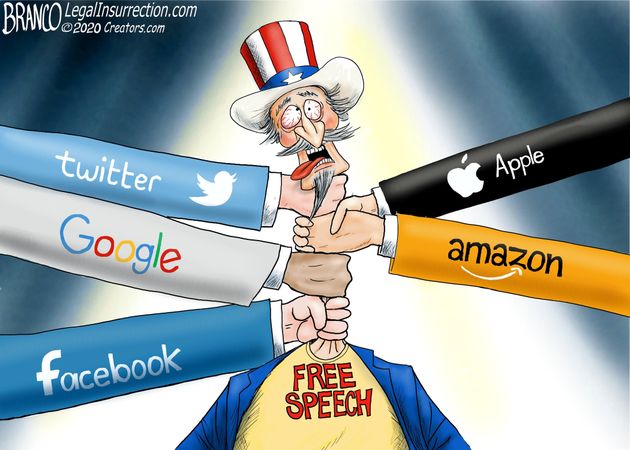
Two companies, Google and Apple, each control about half of the smartphone market. So when the two companies made a move against Parler, the conservative social media alternative, it effectively erased its app from existence. Joining the party was a third member of the FAANG Big Tech consortium, Amazon, which deplatformed Parler from Amazon Web Services.

AWS controls a third of the cloud marketplace. Microsoft and Google are in 2nd and 3rd place.

Blocking an app doesn’t permanently kill a social networking service, though it places it at a structural disadvantage, but Apple and Google can flag sites as unsafe through their browsers.

Google’s Chrome commands 45% of the browser market in America while Apple’s Safari has a little under 40%. While browser flags can be currently bypassed, it would add a further structural disadvantage that would make people less likely to use the service, and there’s nothing stopping Apple and Google from permanently blocking access to any conservative site.

There are other browsers, but Google and Apple could kick any browser off their app stores that doesn’t comply with a blocklist of ‘unsafe’ sites, further narrowing the potential browser options.

With desktops and laptops, Microsoft and Apple can block access to sites at the operating system level by using their built-in antivirus software. That can also be turned off. For now.

Google controls over 80% of search traffic. Facebook controls some 80% of social media. Being delisted and deplatformed by them can be all but fatal to any site trying to attract new users.

Some conservatives take refuge in the illusion of alternatives from smaller companies, but in the oligarchy, smaller companies usually directly or indirectly rely on services from Big Tech..............To Read More.....

Wednesday, December 16, 2020

Venezuela Uses Hate Laws to Target Political Opponents

Articles, Culture Rot, International, Politics, Social Issues

The Coronavirus pandemic has reminded us of just how important our personal and constitutional liberties are, and how essentially easy it is to take them away – or at least dwindle and restrict them. Without freedom of speech and the right to assemble, people feel (and essentially are) powerless against their governments. Venezuelans have been suffering through starvation, giving up their firearms, civil unrest, revolutions, and now being arrested for hate crimes simply for expressing disagreement about the country’s rulers.

In 2017, Venezuela’s Law Against Hate passed, but it wasn’t enforced too often until this year. In a horrifying display of what can happen when government officials censor the people, offenders have been taken from their homes, sometimes at gunpoint, and put into jail cells for days, weeks, and even months.

Giovanni Urbaneja, 54, is a former lawmaker who has been very vocal in his criticism against a party mayor, Francisco Belisario, and President Nicolás Maduro. He and Belisario have had many clashes, including one last year when Urbaneja was discussing the public health system at a private local radio station. While on air, he claimed Belisario had not addressed the recent malaria outbreak. Within minutes, a “local councilman and ally of Belisario burst into the studio and punched Urbaneja repeatedly, yelling that he was tired of the criticism,” Reuters reported. He was beaten to the point of unconsciousness and then reported the assault to the state prosecutor, Jairo Gil. The councilman was never charged.

Belisario, 70, who serves as a powerful mayor as well as a retired general and a member of the ruling Socialist Party, sought to put an end to what he considered a “ferocious smear campaign.” He beseeched the prosecutor, Gil, via a letter in August to charge Urbaneja with hate crimes, saying the former lawmaker not only insulted him and the president but also violated Venezuela’s Law Against Hate, which makes it a criminal act to “incite hatred.”

According to Reuters, just a few days later, “several dozen masked officers raided Urbaneja’s home and took him at gunpoint for a ‘chat.’” As of Dec. 14, Urbaneja remains in jail, still waiting for formal charges and a trial. In a letter to his attorney, he said the guards were keeping him “totally isolated” to “keep him from becoming a bad influence” and that the guards “prevent him from speaking with other inmates.” Legal experts say the detention is illegal since suspects can not be held longer than 45 days without being formally charged with a crime. Urbaneja said his arrest is because of “desperation among officials concerned by corruption. They are trying to silence my voice.”

This is not an isolated incident. Reuters investigated 43 recent hate-law arrests and found that “in each case, authorities intervened against Venezuelans who had criticized Maduro, other ruling party officials or their allies.” The report continued:

“In most of the 43 cases examined by Reuters, police or intelligence agents seized suspects on false premises, claiming they wanted to discuss unrelated issues. And lawyers, spouses and relatives of those arrested typically said they went days or weeks unable to contact detainees, with little or no documentation from police or prosecutors.”

Urbaneja’s wife said it took two months before she was able to see him.

The hate law is being used to highly censor social media and anything that may make President Maduro not shine in the brightest light. As Reuters explained:

“The crackdown is low-tech. Targets are identified not by tracking software or other technology, but by loyalists and government technicians who point out disagreeable social media posts or text messages to prosecutors. Still, the effort is quashing discussion online and in messaging platforms that until recently were safe venues for Maduro critics.”

If convicted of breaking the hate law, the penalty could see the perpetrator behind bars for up to 20 years – in contrast, some murder convictions are only 18 years.

Coming to American Shores?

More often than not, Americans tend to see or hear happenings in other parts of the world with little concern because that is something that happens elsewhere, not in the free United States. That would never happen here, Americans would not allow it, right?  But if 2020 has taught us anything, it’s that we are not as immune to government control and censorship as we thought.

Is Venezuela a vision of what Americans may face? The similarities are astounding. Facebook, Twitter, YouTube, and even Instagram have been silencing the conservative voice for a while. If you’re naughty, you only get put into Facebook jail, but how long before Maduro’s edits are copycatted here?

Read more from Kelli Ballard.


Monday, December 14, 2020

Dominion Software Intentionally Designed to Influence Election Results: Forensics Report

By Zachary Stieber December 14, 2020 Updated: December 14, 2020

A forensic audit of Dominion Voting Systems machines and software in Michigan showed that they were designed to create fraud and influence election results, a data firm said Monday.

“We conclude that the Dominion Voting System is intentionally and purposefully designed with inherent errors to create systemic fraud and influence election results,” Russell Ramsland Jr., co-founder of Allied Security Operations Group, said in a preliminary report.

“The system intentionally generates an enormously high number of ballot errors. The electronic ballots are then transferred for adjudication. The intentional errors lead to bulk adjudication of ballots with no oversight, no transparency, and no audit trail. This leads to voter or election fraud. Based on our study, we conclude that The Dominion Voting System should not be used in Michigan. We further conclude that the results of Antrim County should not have been certified,” he added.........To Read More.....

Sunday, December 6, 2020

The Great Disruption

December 05, 2020 @ Sultan Knish Blog

Of the 10 wealthiest men and women in America, 8 of them made their money in the tech industry. Of these, only 3 made their fortunes from companies that predated the internet era. The rest made it the 'new-fashioned' way, by developing and deploying internet platforms.

The great disruption of the internet made college dropouts into the wealthiest men in America, made the West Coast, for the first time, the equal of the East, and transformed the economy from manufacturing tangible items to reselling access to data and outsourcing manufacturing.

The men of the great disruption were libertarians, if not necessarily by politics then by cultural inclination. The original disrupters had been engineers and hackers who didn’t fit into conformist environments like IBM and were chasing the dream of doing their own thing. They set up shop in garages and basements, in small California, Oregon, and Washington towns, and a few cities, dressed casually, watched Star Trek, dreamed utopian ideals, and were bad at business.

The new disrupters were less interested in hardware or software applications than in using the power of the network to suck up the data of our interactions and turn it into a service. Their insights, building a search engine around link popularity, or a college face book by grabbing pictures of women, might be trivial, but were part of an emergent vision of the new data order.

The original disruptors had been concerned with empowering the end user to command the system, but the new disrupters were reversing the process that had taken users from terminals to personal computers, instead reducing a multitude of devices to terminals leaking data that made them easier to profitably manipulate. The early internet was empowering, but the internet of the Google, Amazon, and Facebook era is disempowering by design. It works by limiting your options and then using what it knows about you to push you in the direction it wants you to go.

Early computers had practically demanded programming skills. The new setup programs you.

As companies went public and college kids became billionaires, they stopped being disrupters and became concerned with maintaining the new order that they were building.

Every revolution ends with a pledge to make sure that no other revolution will happen again.

Google, whose empire was built on search because Yahoo, Netscape, Microsoft, and an array of other companies that allowed it to disrupt its way to power had failed to account for the importance of search, has spent a generation working its way from inside out, by building a browser and then an OS and devices, so that no upstart can do to it what it did to the industry.

The Google vision of its devices running its operating systems with its browser and search boxes built in is not disruptive: it’s the creation of a monopoly built to prevent another Google. Search, the core of Google’s business, is its worst maintained because having monopolized it, its focus is on expanding its hegemony outward to the farthest limits of the data economy.

The same is true of other Big Tech titans who exploited a niche, disrupted the existing setup, and then transformed their companies into the very thing they had been struggling against.

The Big Tech challenge was to manage the essential disruptiveness of the industry, stabilizing their power base, while finding other vulnerable points in the country to disrupt. And when there were fewer economic vulnerabilities to disrupt, they turned to the cultural and the political ones.

Like every past ruling class, the new one set out to remake the country in its own image by disrupting other sectors of society, some, such as politics, consciously, while others, such as culture, unconsciously, out of noblesse oblige, lust for power, and a sense of insecurity.

Every previous national transformation had come from ever narrower areas of the country and the great disruption had been the narrowest yet. The old visionary ideas of computer literacy, long since an outdated term, had given way to ‘learn to code’ as an obsolescence taunt. Most Americans would not be included in the revolution, not because they couldn’t be, but because the revolution was far too small to encompass more than a fraction of the population.

The economic momentum of the new disrupters was built on stock booms that were powered by the conviction of investors that these new titans would keep on growing until they took it all over. If investors thought otherwise, there would be 5 or 8 other wealthiest men in the United States. The vast frontiers of the computer revolution had passed through the range war stage and were gated off by giant monopolies using investor cash to strangle each other and their industry.

Compared to the challenge of disrupting the old economy, disrupting politics appeared simple, but the problem was that, unlike computers, the disrupters were also the thing they were disrupting. Society had no artificially neat separations between man and machine, code and flesh, and the disrupters were amplifying a cycle of disruption that was also disrupting them.

Big Tech had worked to exercise political power to stave off the very reaction it was inciting.

The disrupters turned leftward because from the commanding heights of the economy they tended to see society as a machine that was broken and needed fixing. Having few political ideas of their own, they adopted the leftist politics of their surrounding environment. Its reduction of society to a machine and men as moving parts in need of balancing out appealed to them.

The old disrupters had seen men and women on their own terms, struggling to reach their dreams, but that perspective, from the ground level of the world, had been lost to them.

The new disrupters could only envision their kind of world, diverse, urban, and with a mostly useless population whose grievances and inability to contribute to the new world order would have to be met with welfare checks and patient lessons on the dangers of intolerance.

And, most of all, control.

The original computer revolution had been built on freedom, but the titanic internet platforms depended on control. The control was meant to be unseen. The user would be manipulated into thinking it was his idea to click on that link, watch that show, search for that keyword, and buy that product by a series of invisible constraints and prompts to maintain the illusion of control.

The illusion of control, the myth of user agency, was at the heart of the new internet of platforms. The end user had never had less control over his virtual environment, even as it assured him that he could do anything he wanted. Once the user rebelled against the algorithm, the illusion of freedom collapsed leaving a choice between obedience or loss of access.

The system seemed to work as Big Tech amassed vast amounts of wealth and power, but on a social level, it was a disaster, albeit one that was invisible to the manipulators. In the tech industry, the engineers often don’t understand the end users. And vice versa. And the old conflict over system design was now playing out on the vast scale of human civilization.

The disrupters had broken the economy and the social system, and began trying to put it back together on their terms, buying up the media and elections, censoring the platforms they had built, bringing to an end the last of the open information frontier, and building a new order oriented around the technocratic imperatives of managing a global society. But the more they tried to control the human element, the more the societies began to fall apart and turn on them.

Greater control did not lead to greater trust, but an almost incoherent mistrust in which conspiracy theories became the one thing that everyone was coming to believe. The theories were mostly wrong, but in their own inchoate way, they were right because there was a loss of freedoms, because most of what the media broadcast was a lie, and there was an agenda, and though many of the conclusions were wrong, they were reacting to a real loss of agency.

Conspiracy theories thrive when people lose control over their lives, but can’t localize the blame. Big Tech built the conspiracy theories that it keeps trying to rein in by conspiring to control the public without understanding, as most tyrannies don’t, that it is the cause of its own problems.

The disrupters envision a society of useless people with few functions except binging Netflix originals and commenting on photos on Facebook to be subsidized with welfare checks so they can pay their subscription fees, click on ads, and buy Chinese junk from Amazon. But a welfare state is a signal that there is no future and it’s time to fight over the scraps that can be seized.

There’s no better formula for racial tensions, street violence, and bitter multicultural infighting than the combination of a welfare state and diversity. American diversity worked to the extent that there was upward mobility. When social mobility stalled, as it occasionally did in cities, brutal violence soon followed by people who had nowhere to go and nothing to live for.

The disrupters had wanted to find a middle ground short of full Marxism, but instead they were propelling the conditions for both leftist radicalism and a rightward reaction, while striving to hold on to their power and remake the world along the lines that they thought were best.

Their disruption of politics, childishly simple for men and women with enormous wealth and data insights, who could find a dozen ways to hack a system, didn’t move the country their way, but oscillated it back and forth between the extremes that were breaking it. Trying to control the country, they were crashing it instead, because organic life reacts, instead of waiting for input.

Unlike computers, organic life isn’t passive. And people are the least passive of all creatures.

The men and women who had been disrupters wanted a predictable world they could control, but were instead bringing into being an uncontrollable world that was reacting to their efforts, as society often does, the way that a body’s immune system reacts to a viral infection. Society was responding to Big Tech’s efforts at control by raising the temperature to kill the controlling virus.

And in the process it was wreaking the kind of havoc on society that a fever wreaks on the body.

The great disruption had interconnected the world in unprecedented ways. This vast interconnection had made the world more efficient in some ways, at the expense of becoming more interdependent and more vulnerable to disruptions. The internet had been built, in its earliest days, to allow the command and control functions of the military to survive a nuclear war. But the extension of the internet into everything made society less likely to survive.

What had been a means to an end had become its own end. Being online had become its own purpose. Big Tech companies existed to furnish that world with convenient services. The old hacker dream of a digital polis had become real and in its realization had killed the dream. A wired society wasn’t utopia, but a dystopia throbbing with the raw nerves of a lost frontier.

The disrupter elite were the first to leave their own digital prison, keeping their kids away from the services that had made them billionaires, and trying to disconnect from their connections. They took up eastern philosophies, hiked, bought homes in the woods in different states, and tried to get in touch with something real only to find that they carried the unreality inside.

Power is a practical and a philosophical problem. The old disrupters had mastered machines and then come to think of the world as a big machine. The new disrupters had layered machiavellian interfaces over that old heresy, making a collectivist machine with a human face. But the human face was stuck in the uncanny valley, both real and unreal, and so were they.

The new disrupters had reduced all of society to interfaces, external visual inputs that had originally been meant to allow the user to manipulate the world within the machine, but that had been reversed and were being used by the machine to manipulate the user. And in doing so, they had made the world an unreal place and raised generations of users to feel manipulated by an illusory world, lashing out with the one thing that no machine could cope with, unreason.

The great disruption of machines was meeting at last the great disruption of man. And society was shattering in the collision between the real and the unreal. It is no coincidence that the acolytes of the disrupters have adopted science as their slogan. They often claim to follow the science or the data, as if these were oracles instead of ideas only as valid as their proofs.

Human beings need to believe in things and commit to things, in order to feel real. And the men and women who built an unreal world had come to believe in that world as its own moral order. The world of the disrupters is not a world of science, no more than a warlord with a gun is an engineer because his power comes from a mechanical device, but it is a faith in the source of their power. And that power is disruption. It can in the end, like a gun, only disrupt.

The unreal disrupters of the real strive for control, but their control is, like everything about the unreal world they made, an illusion. They can disrupt what is real, but like all the disrupters of ideas who came before them, all that they replace it with is an unreality that does not stand. The revolutions collapse and what comes after them is not the future, but the return of the past.

Daniel Greenfield, a Shillman Journalism Fellow at the Freedom Center, is an investigative journalist and writer focusing on the radical Left and Islamic terrorism.
 
Tags: , ,
Author Image

About Daniel Greenfield
Daniel Greenfield is a journalist investigating Islamic terrorism and the Left. He is a Shillman Journalism Fellow at the David Horowitz Freedom Center

Saturday, October 31, 2020

Conservatives Must Fight Big Tech or Lose

October 26, 2020 @ Sultan Knish Blog  

Long before, “In Soviet Russia, television watch you” became a staple of Cold War comedy routines, George Orwell’s 1984 novel had telescreens that broadcast propaganda and watched their citizens. Behind the satire is the core question of the struggle against Big Tech today.

Is technology going to be a tool of individual choice or social control?

Facebook and Twitter’s desperate attempts to block a damaging story about Joe and Hunter Biden is the culmination of four years of work to transform social media into the media. Under the guise of false claims about disinformation, foreign election interference, bots, networks, deepfakes, public health risks, and assorted tech paranoia, free speech died on the internet. 

The moment when the White House Press Secretary had her account locked for tweeting a damaging news story about Joe Biden brought home the Big Tech reality to most Republicans.

Just like the media, Big Tech is the Democrat Party, and the Democrat Party is Big Tech. But, unlike the media, Big Tech controls the marketplace of ideas to an unprecedented degree.

Facebook controls 80% of social media and Google controls 80% of internet search traffic.

And that’s bad news because Democrats see the internet in the same terms as Xi, Putin, or your average dictator just about anywhere in the world, as a dangerous system spouting disinformation, damaging social ideas, and disruptive political rhetoric that must be controlled using a combination of economic and social pressures, along with government regulation.

Republicans and Democrats are both unhappy with the internet. Republicans are upset because there’s too much censorship and Democrats are upset because there isn’t enough censorship.

That Democrats, who once championed a free internet, now view it the same way all totalitarians do, speaks volumes not only about the death of liberalism but also about the transformation of the internet from a vox populi to a walled garden controlled by a handful of Big Tech monopolies whose cultural views and politics closely align with those of the Democrats.

‘Bigness’ has its own political and economic gravity. Big cities are more likely to have big governments and their inhabitants are more likely to vote for big government policies. They’re also more likely to use and generate the core companies and cultures that make up Big Tech.

The old political alignments based on questions of philosophy are being tossed aside and replaced with a new alignment based on the primevally simple questions of size and power.

The struggle is less defined by abstractions, than by the question of how much power you have.

In the Trump era, the more proximity to power you have, the more likely you are to be a Democrat, and the less proximity to power you have, the more likely you are to be a Republican.

The most striking thing about the Never Trumpers and the Rust Belt and Southern Democrats voting for Trump is how much power the former have and how little power the latter do.

Politics is being reduced to naked power.

Democrats shifted their stance on the internet because they gained control of core national institutions, in no small part through the growing fortunes pouring out of Silicon Valley which have tilted elections, financed political movements, and transformed public perspectives on social issues. And they are using their newfound power to do what the powerful always do, dismantle the safeguards of an open society so that there are no more threats to their power.

They’re doing this under the guise of fighting for equality and justice, and of waging a revolution for the oppressed, but so did most modern tyrants from Stalin to Hitler to Mao.

The Democrats are no longer interested in a free internet, for the same reason that they’ve tossed away free speech, the filibuster, or any institution or procedure that isn’t serving their interests this very minute. This isn’t due to a new progressive enlightenment, Republican obstinacy, grave new threats to democracy, or any of the other talking points they serve up.

The simple answer is that they won.

The Democrats of the 90s who welcomed an open internet were waging an uphill struggle against the open institutions of a generally conservative country. The country is now much less conservative, the institutions are much less open, and every major institutional force, from the biggest companies to the media, is unreservedly and uncritically backing them every step of the way, while suppressing any suggestion that they shouldn’t rule unopposed for all eternity.

All that’s left is collecting their winnings by shutting down the opposition.

Support for free speech is a matter of principle and practical politics. America was built on principle, but the Founding Fathers had a common-sense assessment of human nature. Free societies may be built on principles, but they survive through a balance of power. Every major faction must go on believing that it is in its interest to maintain free speech, checks and balances, and other protections against tyranny because it might end up needing them.

The Democrats have accumulated enough power that they no longer think that they need firewalls because if they play their cards right, the future, the right side of history, is their own.

That’s the fundamental development that explains the current crisis, not only of free speech, but of free elections, and a free country. The internet, like any society’s marketplace of ideas, is a symptom. Free countries have a robust marketplace of ideas. Unfree ones are obsessed with censoring speech and monitoring their citizens, all the while spinning paranoid fantasies about foreign interference, the threat of dangerous ideas, and the risk to political stability from speech.

Anyone who came out of a coma and spent an afternoon listening to CNN (owned by AT&T), reading the Washington Post (owned by the CEO of Amazon), and perusing the latest round of Democrat complaints about election interference and disinformation would know what we are.

The problem isn’t simply radicalism. It’s power.

Democrat radicalism isn’t being driven by the powerless, but by the powerful. That’s why Democrats with PhDs are more radical than those with a high school diploma. The problem of Big Tech can’t be separated from the problem of a political movement with too much power.

The culture of political censorship isn’t merely radical, it’s powerful. Cancel culture by college students or Big Tech censorship aren’t disparate phenomena, they’re the same phenomenon, often practiced on the same platforms by members of the same inbred ruling class.

America has been reconstructed to favor some classes at the expense of others. This new machine combining political institutions, activist groups, and corporations controls public life.

Conservatives can combat it or, like Soviet citizens, make jokes, and wait for it to collapse.

Big Tech is at the nexus of the political, economic, and cultural power of this new machine. That’s why breaking its power must be the objective of any winning conservative movement.

The massive monopolies control political discourse and as they tighten the noose around conservatives, political speech on the internet will consist of media narratives, a few tame conservatives, and little else. Imagine the high point of media dominance with no talk radio or cable conservative news. That’s the future. And it’s not going to arrive a year from now, it may already be here by Election Day. And if not, certainly when the next presidential election arrives.

But Big Tech also holds the key to the radical money machine. AOC and the Squad wouldn’t exist without a founding engineer from Stripe. The founder of eBay is responsible for everything from The Intercept to The Bulwark, the former is the media arm of the Sanders campaign and the latter of the Never Trumpers. The Washington Post was transformed from a fussy government paper into a den of furious radicals by the CEO of Amazon. Google money financed the Bernie Sanders campaign. Big Tech has poured a massive fortune into Black Lives Matter, from Steve Jobs’ widow, to Jeff Bezos’ ex-wife, to Jack Dorsey, the founder of Twitter.

And that’s the tip of the iceberg considering Facebook’s Chan-Zuckerberg Initiative.

The cultural power of Big Tech is even vaster. Google and Facebook determine what most people see on the internet. Amazon and Netflix are swallowing the entertainment industry. In a decade, a handful of vast, mostly, tech companies, Apple, Amazon, AT&T, Disney, Google, Netflix, and Verizon will control the culture far more than the old entertainment industry ever did.

By then it will be much too late to do anything except huddle in a few dark web outposts and mutter hate speech like the controversial words of the First Amendment.

If conservatives don’t fight Big Tech now, they will lose. And they will lose everything.

Big Tech’s power is growing exponentially, but it’s still vulnerable. The companies that will become immovable oligarchies in a decade can still be brought down and broken up. The internet and the marketplace of ideas can rise again from the ruins of those monopolies.

Now is the time. If we don’t fight Big Tech now, America has no future.


Daniel Greenfield, a Shillman Journalism Fellow at the Freedom Center, is an investigative journalist and writer focusing on the radical Left and Islamic terrorism.
 
Tags:

The Two Necessary Approaches for Ending Big Tech Dominance

Roger L. Simon October 30, 2020 

The captains of Big Tech who appeared before a Senate committee a few days ago revealed once again what a pernicious force they are.</p> <p>Moral narcissists of the highest order, they are all the more dangerous because they think they are good. They are convinced they are helping the world, making sure we in the great unwashed are not propagandized by what they deem disinformation or misinformation, when in actuality they are making a frontal assault on free speech via various forms of censorship.

This reached the level of Theater of the Absurd when Twitter’s Jack Dorsey, 

responding to Senator Cory Gardner (R-Colo.), testified that Holocaust denial did not meet Twitter’s definition of misinformation while, evidently, the New York Post’s reporting on Tony Bobulinski’s widely-authenticated emails did.

Dorsey also told Senator Marsha Blackburn (R-Tenn.) his site had not censored tweets from the president when they had done so literally dozens of times.

The most flagrant Orwellian prevarication, however, was when Dorsey stated Twitter had no influence on elections. (Why then would he bother to censor the New York Post?)  Google and Facebook are at least as disturbing and arguably vastly more powerful.

In a manner even the Chinese might envy, “The ends justify the means” has come to America via unseen algorithms dictating what is displayed on our laptops, cellphones and, soon, just about everything else.

But what do we do about it?..........To Read More....