Search This Blog

De Omnibus Dubitandum - Lux Veritas

Showing posts with label Administrative State. Show all posts

Tuesday, July 1, 2025

Trump, the Federal Judiciary, and The Government of the United States

By Rich Kozlovich

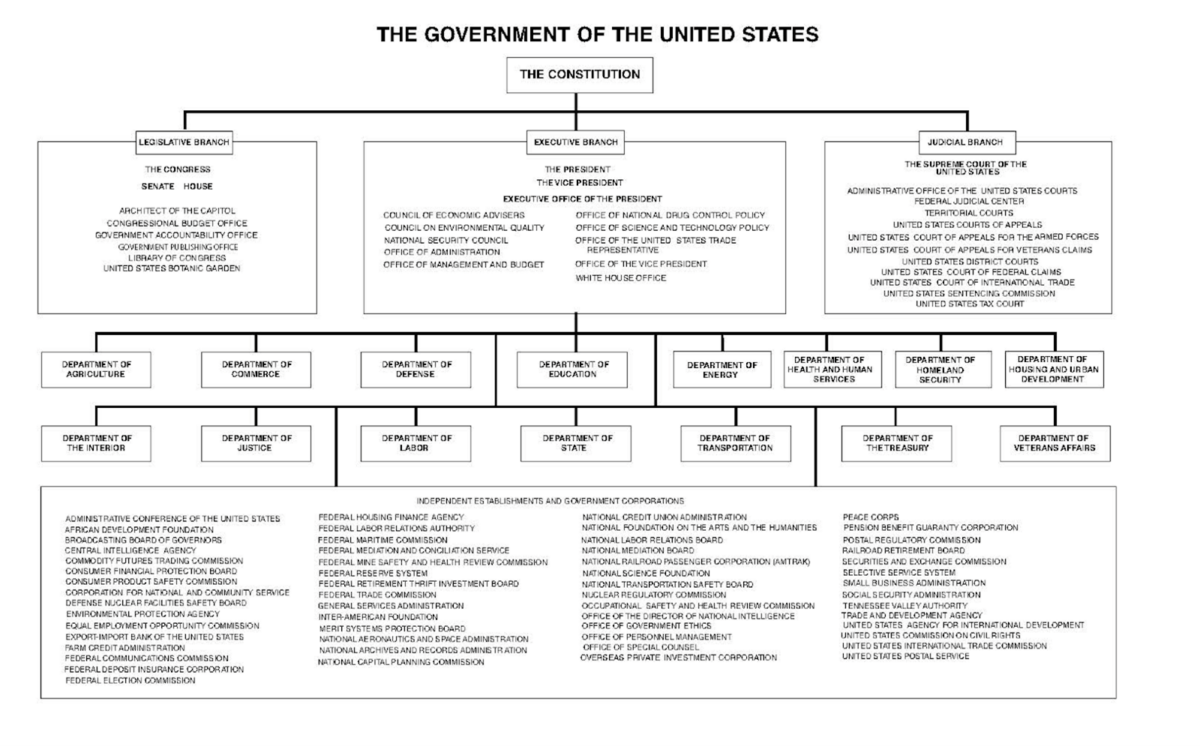
Since there's all this foofaraw about the federal courts setting themselves up as mini Presidents, and the recent SCOTUS ruling telling them they're not, I think this chart is important.  

 https://img.theepochtimes.com/assets/uploads/2025/06/30/id5880187-US_Govt_Chart-1200x746.png?_gl=1*1av9mvi*_gcl_au*NDcyMzQyMzczLjE3NDg4NjI1NjI.*_ga*MTg4NTUzMzE5Ni4xNzQ4ODYyNTYy*_ga_RD0QM5H02Q*czE3NTEzMjMzOTkkbzU3JGcxJHQxNzUxMzI0NjAzJGo2MCRsMCRoMA..

As Jeffrey Tucker notes in his article The Curbing of the Administrative State regarding the SCOTUS ruling: 

The opinion could not be plainer: “Universal injunctions likely exceed the equitable authority that Congress has given to federal courts.” That principle applies not only to this case but to the whole panoply of cases that have tethered the ability of the president to manage executive branch operations. The courts have presumed authority over the president that the Constitution plainly does not grant.

He goes on to state the government as it's been configured is in effect contrary to the intent of the Constitution.  The elected officials are supposed to be in charge, not unelected bureaucrats saying: 

The answer has been hiding in plain sight all this time. It took a dramatic and domestic exercise of administrative power, one that hit us all our lives personally, to reveal the extent of the problem. It comes down to the approximately 425 agencies with millions of permanent employees that are the real government in the United States........In 2014, just two years before Trump’s first term, the scholar Philip Hamburger wrote “Is Administrative Law Unlawful?” His argument was that this machinery does not exist in the Constitution. There is no such thing as an agency that is independent of presidential control................

All these court issues are predicated on the fact Trump is exposing to the America people how corrupt it all has become,  which is the lesson he learned after his first term after being stabbed in the back by people who were disloyal, and bureaucrats who undermined everything he was attempting to do.  So he issued executive orders and triggered a fight that was long overdue.  

The chart shows who in charge of the federal government, and it's not the legislature, and it's not the judiciary.  It's the Chief Executive, and that's the President of the United States. 

Harry Truman flew to Wake Island to confront Douglas MacArthur over their differences regarding the Korean War, and protocol demanded MacArthur stand at the stairs to greet the President of the United State.  He didn't, and that went on for 45 minutes.  Finally when they were alone he told MacArthur, and I'm paraphrasing here, "I don't care what you think about Harry Truman, but don't you ever disrespect the President of the United States that way again. "

Well, that's Trump's view of reality.  He doesn't much care what you think about Donald Trump, but they're not gong to get away with disrespecting and disregarding the President of the United States.  

Unfortunately, the battle is far from over, just as one district judge Brian Murphy openly defied the court refusing to follow the ruling of the Supreme Court, there are two other ways these radical leftist judges and attorneys can subvert the ruling an the obvious intent of the Constitution.  Class action lawsuits, which normally aren't so easy to bring into being, but if the jurists are corrupt, and we already know a bunch of them are, that will not be a deterrent, since like Ketanji Brown Jackson, they could care less about the rule of law.  However, the  Administrative Procedure Act of 1946 will clearly be problematic, as the wording is an open ended invitation for abuse by district courts, and is an issue either the Congress, SCOTUS, or both will be forced to address.  Make no mistake, this is far from over.  

Thursday, April 11, 2024

Royko’s People to Congress: You Have Forgotten Your Place

What happens when radical becomes mainstream

By Rich Kozlovich

If you're paying any attention to the news you can't help but notice just how radical and....quite frankly.... how stunningly stupid so many are in the media.  One of the nitwits on The View, Sunny Hostin, claimed global warming caused the "solar eclipse, a recent earthquake, and the impending cicada breeding season".  Even Whoopie knew better, and since she's about the dullest pebble in the brook, and she got it right, you have to wonder who picks these nitwits for this show?   Well, actually, for that matter, you could say that about MSNBC, and the rest of the mainstream media. 

That wasn't always true.  

I've written about Mike Royko in the past, and truth be told, the more I see going on, the more I miss him.  For those who aren’t old enough to remember Mike Royko let me tell you about him. Mike Royko, who died in 1997, was a syndicated columnist out of Chicago where he grew up. Royko was an ethnic kid of Polish/Ukrainian origin, and was the voice of “everyman Chicago”. He was sarcastic, caustic, and totally skeptical of elitists and their thinking. Royko took the view, as Studs Terkel pointed out"

“Somebody’s up against it”! Royko wanted to make sure there was someone who would do something about it. Him! A healthy attitude in my opinion!

It was clear that Royko had very little respect for politicians and hated political correctness. He hated hypocrisy, special privileges for special people, and had little tolerance for them.  Royko was all about basic fair play. 

Everything had become about superficial imagery and money and he hated it. But, Mike’s gone now and the problems he was so concerned about have only become exacerbated by time, and if Mike had lived he's be 88 now, and I have no doubt if he was still capable he'd be taking a stand against the insanity.   Sadly, he's no longer here, and for a number of reason, there just hasn't anyone who could take his place in the minds of Americans.   

So where does that leave "Royko's people"? 

Royko was sensitive to people who were suffering, and he had a way of cutting right past the smoke screen of nonsense spewed out by those who are prominent and powerful and right into the fire. Have we lost sight of the need for that? Are we capable of seeing past the activity that has become a substitute for accomplishment? Are we capable of standing up on our hind legs and saying:

“I’m mad as hell and I’m not going to take it anymore?” As someone once said: “It’s a falsehood; history doesn’t repeat itself; people just fail to grasp the lessons of history”.

We have the world’s governments spending billions and billions of dollars on projects that they claim are to save the world’s environment. Money they don’t have! They pass laws to make the world change from perfectly operating power generation systems to systems that are completely incapable of meeting current energy needs, let alone future needs.

Eleven years ago people in Eastern Europe froze to death due to a lack of sufficient energy production. All due to their governments desire to reduce CO2 emissions, based on the false premise that CO2 is causing global warming. Yet all these ‘alternative’ power generating schemes are failures. They have always been failures. And they will always be failures unless there is some kind of massive technological breakthrough that currently isn’t even on the horizon. Result; people die, people suffer and people pay through the nose for the energy they are supplied. All based on lies from the green movement.

We have placed unaccountable bureaucrats in charge of determining what pesticides are to be used even when we know, and have known from the very beginning, they are basing their rules on ideology and not science. We shouldn’t have to be even discussing this reality. We now know the EPA has sweetheart deals with the green movement called “Sue and Settle”.

The greenies sue the EPA and the EPA gives a half hearted attempt to defend itself and then settles with the activists to get power they want that Congress never intended for them to have. The result? We have people suffering all over the world from the lack of inexpensive, effective chemistry that saves lives from diseases and starvation. In the U.S. we suffer from an ever growing bed bug plague, yet the EPA and the green movement continue going down their insane path with speculative claims that pesticides represent grave dangers; speculations that have no relationship to reality.

We have bureaucrats impose serious limitations on people’s use of their own property in total violation of their Constitutional rights based on the whim of some self important government employee. And then they claim they have no legal recourse because the courts have no jurisdiction over their actions.  That's called the administrative state, and finally, the courts are taking this up and saying there's nothing in the constitution that permits Congress to transfer their power and responsibilities to bureaucrats.

When radical thinking becomes mainstream this is what happens to “Royko’s people”. Because it’s average people just trying to live their lives who suffer from the actions of the elite, the arrogant and the insane. Becky Gerritson told Congress:

“I’m not here as a serf or a vassal. I’m not begging my lords for mercy. I’m a born free American woman. Wife, mother, and citizen. And I’m telling my government that you’ve forgotten your place. It’s not your responsibility to look out for my wellbeing and to monitor my speech. It’s not your right to assert an agenda. Your post, the post that you occupy, exists to preserve American liberty. You’ve sworn to perform that duty, and you have faltered…”You have forgotten your place”....... 

That sent electric waves through anyone who heard it. Aren’t you glad someone said it?  Royko thrived on confrontation more than willing to stand up for what's right, and I'm just sorry that Royko wasn't here to see that.  He would have loved it!

When rulers forget their oaths April 11, 2024 by Richard C. Lyons - Such people have the perfect moral chemistry to engage in tyranny.  In self-governing societies, choosing a leader of the nation is the most important responsibility a citizen has.  In our United States, where the presidency has grown to be so powerful an office, it is even more so.  Through time immemorial, whether in Greece or Rome, in England, or among native Americans, a few vital questions have always been foremost when questioning those who sought powerful office: will they obey their oath to follow the constitution?  Will they faithfully execute the law and obey the law themselves?  Do they believe in a higher moral calling, a higher power, as in God?

The reason for these questions is perhaps not obvious.  But if a person in power does not perceive himself as being bound by his oath or by a constitution of law, the powerful tend to change from humans into wolves.  And if one does not believe in a higher moral authority there is no moral code or power he will respect between here and hell. .............And it is why this alliance of the Democrat party, its Administrative State, and its subsidiary media is so dangerous.  In pursuit of absolute power, the Democrat party is prepared to wrench the Constitution out of existence and break any law or faith they have to, if it stands in their way.  The Democrat party literally holds to no oath, no law, no altar...


Monday, August 7, 2023

A Century of Impotency: Conservative Failure and the Administrative State

This essay is adapted from edited by Arthur Milikh (Encounter Books, 328 pages, $32.99) Conservatives have failed to restrain the administrative state because they have accepted that it is a necessary governmental innovation required by the complexity of modern society.

James Landis is widely credited with crafting the theoretical architecture supporting President Roosevelt’s radical reconstruction—and expansion—of the federal government. Landis shrewdly both established and legitimized the regulatory state, including Roosevelt’s creation of new federal administrative agencies, by offering the regulatory state as the solution to the problem of modern governance: the administrative state “is, in essence, our generation’s answer to the inadequacy of the judicial and legislative process.” The Landis premise took concrete shape through Roosevelt’s expansion of the regulatory state, and in doing so, it brought to fruition Woodrow Wilson’s progressive intellectual project: rule by experts, insulated from the popular will

Landis believed the “the administrative process” for which he advocated would “spring from the inadequacy of a simply tripartite form of government to deal with modern problems” because modern problems were simply too large and complex to be entrusted to the system based on the separation of powers instituted by our nation’s founders. Landis framed this innovation as consistent with separation of powers principles because he believed the separation of powers called both for separation but also coordination among the branches, and he saw the administrative state as essential to creating that coordination:............ To Read More....

Monday, July 24, 2023

Conservative failure and the Administrative State

July 21, 2023 By John Dale Dunn

Conservatives have failed their fiduciary and political duty to stop and reverse the Administrative State growth and tyranny because they were tricked into believing that these things are necessary for a modern society.  Theo Wold, Trump policy aide, now solicitor general for Idaho, in this American Greatness essay, explains the origin of the socialist Administrative State project under FDR aide James Landis.

Wold asserts that Landis aggressively and massively expanded the federal government on his belief that socialism and a powerful Administrative State were the solution for modern societal problems.  FDR agreed with Landis.  Landis's position was that a strong Executive Branch is the solution for ineffective legislative and judicial branches.  His solution was an executive agency system that made laws, regulated, and had administrative judicial processes to enforce regulations. 

What the tripartite branches could not coordinate among them directly, Landis believed administrative agencies could coordinate as a substitute. Landis then aimed to create administrative agencies that themselves combined the three aspects of government.  

Wold describes the effects of the Administrative State from his experience in the Trump administration.  Bureaucrats have their own agenda.  They refused to implement Trump's policies promised to the electorate whenever and wherever they could, and they could — a lot,  on the border wall, education, and immigration.  "The idea that the federal bureaucracy is accountable to the president is a mirage."...............To Read More....


Tuesday, February 21, 2023

How the creation of the administrative state led to today's political crisis

By Tim Jones February 19, 2023

Unmasking the Administrate State: The Crisis of American Politics in the Twenty-First Century is a must-read for anyone wanting to understand today's political crisis at the federal level.  In a way, it is an ongoing constitutional crisis brought on by the progressive revolution in American governance that originated with President Woodrow Wilson.  The book describes how governance has been distorted beyond all recognition from the founding principles in the Constitution.  It was Wilson, the first progressive president, who believed that the Constitution should be more flexible in creating a better society without adhering to a strict interpretation of the Constitution's original text.  Rather, it should be a "living Constitution" that adapts to current circumstances.  What this essentially did was to nullify many of the timeless principles in the Constitution.

Woodrow Wilson is probably one of the most transformative presidents in American history by initiating this process of revolutionizing the way the federal government works.  He basically changed the mission of government from creating and maintaining the conditions for people to create better lives for themselves to directly intervening in the lives of citizens in theoretically making their lives better. 

Decades later, FDR implemented the beginnings of the administrative state based on Wilson's progressivism with his New Deal programs.  And decades following FDR, Lyndon Johnson solidified the triumph of the administrative state through his Great Society program, which essentially made the federal bureaucracy a government unto itself, removed from direct accountability to American citizens.

The following is a passage from Unmasking the Administrative State that precisely identifies this problem:.........To Read More.........


Tuesday, November 15, 2022

EPA Administrator: Elections Won’t Change our Power to Regulate, Our Regulations Were Enhanced under Biden

Ian Hanchett

On Thursday’s broadcast of Bloomberg’s “Surveillance,” EPA Administrator Michael Regan stated that he doesn’t think the 2022 midterms will change the fact that the agency has been given power “to pursue the reduction of greenhouse gas emissions to protect public health and protect the planet” through regulations and that the agency got a boost in its goals from the passage of the Inflation Reduction Act.

Co-host Tom Keene asked, “How does EPA’s job change with the election, including a big Republican win in your North Carolina? I’m fascinated how the oil and gas industry that has a GOP bent will change and amend coming off this election.”

Regan said, “Well, the president has had a historic two years in passing historic legislation, with the bipartisan infrastructure law, the Inflation Reduction Act, resources coming to EPA to help with and enhance the regulations that we are required to put in place by law. So, I don’t think the elections will change the fact that EPA has legislative authority or authority provided by the legislature or Congress, to pursue the reduction of greenhouse gas emissions to protect public health and protect the planet. We’re going to continue to move forward and do our job, but the resources that flow from the Inflation Reduction Act [do] help with that public-private partnership to pursue these reductions. So, we’re not solely reliant on regulations alone.” 

How The Left Views Administrative Law: A Highlight From The Federalist Society Convention

/

You may have seen that the Federalist Society has been holding its annual convention in Washington. I was there on Thursday and Friday. They have recorded all the presentations. If you want to watch some, go to this link and see what interests you.

There was not a lot of moaning about the election results. Rather, the focus was on high-minded issues, mostly of constitutional and administrative law.

I have selected a highlight that you may find interesting. One of the lunchtime panels on Thursday was titled “Render Law Unto Congress and Execution Unto the Executive: The Supreme Court Rebalances Constitutional Power.” Here is the description of the subject of the panel:

The Roberts Court is recasting the administrative state according to its view of the separation of powers. It is giving the President more authority to fire his subordinates and creating a hierarchical executive where the President and his principal officers have more authority over appointments and decision making. It is forcing the legislature to speak clearly when it wants to vest agencies with major powers and expressing interest in reinvigorating limits on some delegations of legislative power. It is strengthening the judiciary’s interpretative role, declining to give as much deference to regulatory interpretations by agencies. Is its view coherent and sound? Should the Court square its vision with a modern government that was formed on different principles? If so, how?

The full video of the panel, 1:23:30 in length, can be found at this link. The panel featured four speakers (Nicholas Parrillo of the Yale Law School, Aditya Bamzai of the Virginia Law School, Thomas Griffith, formerly Judge of the DC Circuit, and Sally Katzen of NYU Law School) describing and debating the merits of recent Supreme Court cases that have articulated something called the Major Questions Doctrine as a limit on administrative agency power to promulgate regulations of sweeping import without clear statutory basis. The most important of the cases under discussion was West Virginia v. EPA, the June 30 Supreme Court decision that held that EPA’s Clean Power Plan — a mechanism to shut down all generation of electricity using fossil fuels — exceeded the agency’s authority under the Clean Air Act.

As is typical on Federalist Society panels, the majority were conservative scholars or judges, who thus were generally supportive of the Court’s approach, although offering a variety of perspectives. However, the fourth panelist, in this case Ms. Katzen of NYU, was a die-hard left-winger. It fell to Ms. Katzen to defend the position that EPA was well within its powers under the CAA to promulgate a regulation that would force the closure of all coal power plants in a short period of time, followed in short order by all natural gas power plants over the next decade or so.

In her opening remarks (beginning about the 31 minute mark of the video at the link) Ms. Katzen described Congress as having become a completely dysfunctional institution that has been paralyzed by partisanship and can barely pass a spending bill to keep the government operating, let alone address any serious policy issue with major legislation. Meanwhile, she noted that since adoption of the Constitution the country had become huge, wealthy, and enormously complex. Thus Congress has seen fit to delegate the problems of dealing with the great complexities to specialists and experts in various fields. But now, said Ms. Katzen, her voice dripping with scorn, the Supreme Court has decreed that only the dysfunctional Congress can address the most critical issues facing us. She was particularly critical of the Court having struck down the Clean Power Plan, which in her view was well within the authority granted to EPA under the CAA, as well as being a subject that could only properly be dealt with by people with the necessary expertise, such as the bureaucrats at EPA.

Before reading on, you might consider whether those arguments appear persuasive to you.

After the panelists’ remarks, there was a period for questions from the audience. I managed to maneuver myself into a position to get to the microphone and ask the first question. I’m going to transcribe my question and Ms. Katzen’s response. This begins at 1:04:24 of the video:

Question: Thank you. My name is Francis Menton. My affiliation is Manhattan Contrarian. That’s my blog; many people here may read it. So out there we have the Clean Air Act, and the Clean Air Act basically gives the EPA the authority to regulate “pollutants.” And then a decade or so ago the EPA decided that carbon dioxide was a pollutant. And I guess this question is mainly for Professor Katzen. So carbon dioxide has been declared a pollutant by the EPA. They’re an “expert.” 

Does that mean, could the EPA then, on its own authority, say, well, airplanes all generate carbon dioxide, we hereby say they must be all grounded? Oh, and industry must be ended, that generates carbon dioxide. And 80% of our electricity generation is fossil fuel, generates carbon dioxide. And of course all automobiles, so you can’t drive them any more. Can the EPA do that? Or does that go beyond what they’ve been authorized to do? And if it goes beyond, what is the limiting principle? Do you have one, or are you completely fine with that if EPA does that?

Professor Katzen: I’m not sure I completely followed because there’s a lot of distracting noise out there. But the Congress clearly gave the EPA authority to specify those pollutants that are dangerous and should be regulated, and to set limits for them based on that which is necessary to protect the public health, with an adequate margin of safety and all that. There are standards to be applied. They can’t just say “no cars.” I don’t think that would survive any kind of judicial review.

Me: What’s the standard?

Professor Katzen: (Several seconds delay) The standard as set forth in the Clean Air Act is the scientific basis for levels to be set. That’s not — I’m not an environmental lawyer, and maybe there are others here who could provide the exact terminology. But the EPA is not able to and does not do whatever it has a whim to do when it wakes up in the morning. It bases it normally through rule-making through notice and comment, cost/benefit analysis, scientific determinations, that are subject to the critique and then response by the agency. 

You may not be happy with the answer any more than I was not happy when they stayed the Clean Power Plan in the first place, even though it had not yet gone through the courts. It was an extreme action taken to shut down rule-making in this area. And I thought that was unfortunate that we were never able to develop the kind of record that would enable sensible people to see if the agency was acting within its authority as granted by Congress. 

I am not saying that the organic statute or the authorizing statute is meaningless. It survives. But if it is granted authority, then the agency should be able to use it, even if the pollutant is something that they didn’t think of when they passed the statute, or weren’t aware of when they passed the statute. Any more than under the FCC Act, it was radio, that was in 1933, it was radio, but it was interpreted to mean television. It wasn’t a big step.

It’s too bad this wasn’t a cross examination, because Professor Katzen was trapped, and it would have been fun to keep pressing. The next obvious question would have been:  

“My question was, what’s the limiting principle? You haven’t answered. Please state the limiting principle. Do you have one or not?”

So Professor Katzen was completely outraged that the Supreme Court had struck down the Clean Power Plan (“it was an extreme action taken to shut down rule-making in this area”). Yet she couldn’t come up with any reason why, if EPA could force the shut down of all fossil fuel burning power plants, it could not also ban all burning of fossil fuels for airplanes, cars, industry, agriculture, home heat, etc. She flatly asserted “there are standards” without being able to specify any of them. (There are no meaningful standards in the statute that would constrain EPA in these circumstances, if the courts approved the Clean Power Plan.). 

The best she came up with was “notice and comment rule-making,” which is not a standard, but rather a procedure. It can be a time-consuming and burdensome procedure, and may generate thousands or even millions of comments, but at the end of that the EPA can just go ahead and implement the rule it started with and planned to implement all along. When Professor Katzen says that “EPA is not able to and does not do whatever it has a whim to do when it wakes up in the morning,” she is just plain wrong.

If you are wondering what the Clean Air Act may actually have to say on this subject, I would point out that the Act is lengthy and nearly incomprehensible. However, in the West Virginia litigation EPA had to come up with something in the CAA to point to as its authority for promulgating the Clean Power Plan, and the best it could do was Section 111(d) of the Act. Here is the text of that section:

(d) Standards of performance for existing sources; remaining useful life of source

(1) The Administrator shall prescribe regulations which shall establish a procedure similar to that provided by section 7410 of this title under which each State shall submit to the Administrator a plan which (A) establishes standards of performance for any existing source for any air pollutant (i) for which air quality criteria have not been issued or which is not included on a list published under section 7408(a) of this title or emitted from a source category which is regulated under section 7412 of this title but (ii) to which a standard of performance under this section would apply if such existing source were a new source, and (B) provides for the implementation and enforcement of such standards of performance. Regulations of the Administrator under this paragraph shall permit the State in applying a standard of performance to any particular source under a plan submitted under this paragraph to take into consideration, among other factors, the remaining useful life of the existing source to which such standard applies.

(2)The Administrator shall have the same authority—

(A) to prescribe a plan for a State in cases where the State fails to submit a satisfactory plan as he would have under section 7410(c) of this title in the case of failure to submit an implementation plan, and

(B) to enforce the provisions of such plan in cases where the State fails to enforce them as he would have under sections 7413 and 7414 of this title with respect to an implementation plan.

In promulgating a standard of performance under a plan prescribed under this paragraph, the Administrator shall take into consideration, among other factors, remaining useful lives of the sources in the category of sources to which such standard applies.

Make of all that mumbo jumbo what you will. What is certainly not there is any limiting principle or standard that constrains what EPA may do to effectively ban use of fossil fuel energy in all sectors, once it is accepted that EPA can regulate CO2 as a “pollutant.” Instead what is found in that section is blanket authority to EPA to set “standards of performance.” And in the Clean Power Plan EPA has set those “standards” in a way to make all use of fossil fuels in electricity generation non-compliant over time. If the courts allowed EPA to do that under this section, there would be nothing to stop it, if it wanted, from setting “standards” to make fossil fuels non-compliant in other sectors.

Here’s the bottom line: Under a statute that gives EPA general authority to set “standards of performance” with respect to “pollutants,” the progressives (including the liberal wing of the Supreme Court) are totally OK with allowing EPA to declare CO2 a “pollutant” 40 years after the statute was enacted, and then set “standards of performance” to ban CO2 and shut down the entire economy one sector at a time. Fortunately, with our current Supreme Court, we’ll get to see how this plays out in places like Germany and the UK before our federal government can impose it on all of us by executive fiat.
 

Thursday, November 3, 2022

The Supreme Court Has A Chance To Save The Economy From The FTC’s Wrecking Bal

By: Asheesh Agarwal

Next week, the Supreme Court will have a chance to save the free market economy from the Federal Trade Commission (FTC). Even as the court reins in the administrative state, the FTC is advancing new rules and novel theories that stretch the limits of its mandate. Under its progressive chair, Lina Khan, the FTC wants to cancel the gig economy, cripple the ad-supported internet, and address racial justice, rather than simply protect consumers.

In Axon Enterprise v. FTC, the court could take a big step toward cabining the FTC within its statutory and constitutional authority. Axon itself involves a narrow procedural question of whether someone can raise certain constitutional challenges to the FTC directly in federal court, without having to wade through years of administrative processes.

As explained in a new paper, however, the case’s import is much broader. If companies can bring the FTC into court anytime the agency exceeds its authority, the courts can prevent the FTC from imposing illegal rules at the outset — a critical tool given the scope of the FTC’s agenda. Even more importantly, the court could lay the groundwork to revisit the constitutionality of the FTC and much of the administrative state............To Read More....


Monday, August 22, 2022

The Administrative State Moves To Show Who's Boss On Energy Policy

Last Thursday, June 30, the Supreme Court issued its decision in West Virginia v. EPA, holding that, absent a further explicit statute from the Congress, the EPA did not have the authority to orchestrate its planned fundamental restructuring of the electric power generation sector of the economy. More generally, the Supreme Court stated that in cases involving “major questions,” including regulations that affect large portions of the economy, the government must demonstrate “clear congressional authorization” to support a sweeping effort to regulate.

Do you think that such a Supreme Court decision might cause the various regulatory bureaucracies to slow down and reconsider a little before plowing ahead with other dubious plans for fundamental economic restructurings? That’s not how these bureaucracies work. And such is most particularly the case with regard to regulators of the energy sector, sometimes known as “climate change” arena, where the bureaucrats are burning with a righteous religious fervor that they believe entitles them to cast the evil sinners into the fires of hell.

And thus, contemporaneous with the Supreme Court’s decision, several agencies promptly doubled down on efforts to strangle the oil and gas industries with regulatory restrictions, essentially daring the courts or anyone else to stop them. Thousands of pages of statutes give them thousands of arguments to claim they have the “clear congressional authorization,” any one of which arguments might stick. They are now out to show who’s boss.

EPA Administrator Michael Regan wasted no time in getting a statement out on the afternoon of June 30. Excerpt:

[W]e are committed to using the full scope of EPA’s authorities to protect communities and reduce the pollution that is driving climate change. . . . EPA will move forward with lawfully setting and implementing environmental standards that meet our obligation to protect all people and all communities from environmental harm.

In other words, we will just have to find other ways to implement the restrictions that we want to implement. The very next day, July 1, David Blackmon at Forbes reported that “EPA Targets Permian Basin, Widening Biden’s War On Oil And Gas.” The Permian Basin is currently the most productive oil and gas region in the United States, providing about 40% of the oil production and 15% of the gas of the entire country. The Permian Basin is also the site of about 40% of the nation’s active drilling rigs. And so it seems that EPA is gearing up to declare the Permian Basin a so-called “non-attainment area” with respect to ozone. Blackmon:

[T]he Environmental Protection Agency (EPA) announced [this week that] it may soon issue a ruling declaring that vast parts of the Permian Basin are in “non-attainment” status under the agency’s ozone regulations. If such a declaration is made, it will constitute a direct governmental assault on what is by far America’s most active and productive oil-producing region and its second most-productive natural gas area.

What would be the effect of such a declaration on current and future U.S. domestic oil and gas production? Blackmon again:

Placing the Permian Basin in non-attainment status would force a significant reduction in the region’s rig count, severely limiting the domestic industry’s efforts to increase U.S. oil production at a time when the global oil market is already severely under-supplied.

Texas Governor Greg Abbott promptly called on the Biden Administration to back off, saying that an EPA “non-attainment declaration “could interfere in the production of oil in Texas which could lead to skyrocketing prices at the pump by reducing production, increase the cost of that production, or do both.” But Blackmon notes that the plan comes from an office headed by a Biden-appointed anti-fossil-fuel activist, and thus is likely a core element of the administration’s program:

Mr. Biden appointed Joe Goffman, another of the many anti-fossil fuel activists that now hold senior posts at his various agencies, to head up EPA’s Office of Air and Radiation on an acting basis. That appointment might have been made with this specific policy action in mind.

Meanwhile, over at the Interior Department, July 1 was also the day for issuance of a statutorily-mandated five-year off-shore oil and gas leasing plan. Nicholas Groom at Reuters has a summary here. The bottom line is, we’re going to completely shut down leasing off both the Atlantic and Pacific coasts, but maybe we’ll allow a little in the Gulf of Mexico or the Cook Inlet (Alaska). The number of auctions over the five-year period will be in the range of “zero to eleven,” and supposedly we’ll take public input as to which way to go. But Interior Secretary Deb Haaland in a statement left no doubt as to where she wants and expects this to come out:

"From Day One, President Biden and I have made clear our commitment to transition to a clean energy economy," Haaland said in a statement. "Today, we put forward an opportunity for the American people to consider and provide input on the future of offshore oil and gas leasing. The time for the public to weigh in on our future is now."

There is a 90 day period for public comment. You can be sure that environmental activist groups will flood the zone with thousands of comments to support the approach of the “zero” option of ceasing all further off-shore leases.

Other agencies were eerily silent in the aftermath of the Supreme Court’s June 30 decision. Notable among those were the SEC and the Federal Reserve, both of which have recently ventured into adding “climate change” to their missions with only the most questionable of statutory support. Neither has given any indication of an intention to slow down.

And then on July 2, President Biden issued his now-famous tweet blaming the rising price of gas at the pump on gas station owners:

My message to the companies running gas stations and setting prices at the pump is simple: this is a time of war and global peril. Bring down the price you are charging at the pump to reflect the cost you’re paying for the product. And do it now.

A bureaucracy-wide campaign is ongoing under this guy’s direction to suppress oil and gas production in any way they can think of, and yet he has the gall to blame high prices on “companies running gas stations,” the majority of which are small independent businesses. At this point Biden has become malicious.


Monday, July 25, 2022

Report: Donald Trump Plots Purging Administrative State Employees if Reelected

Wendell Husebø

“The impact could go well beyond typical conservative targets such as the Environmental Protection Agency and the Internal Revenue Service,” the report explained. “Trump allies are working on plans that would potentially strip layers at the Justice Department — including the FBI, and reaching into national security, intelligence, the State Department and the Pentagon, sources close to the former president say.”

The term administrative state specifically describes the phenomenon of unaccountable and unelected administrative agencies exercising power to create and enforce their own rules..........To Read More...


Monday, July 11, 2022

Supreme Court EPA Ruling Reins in Tyranny by Regulatory Regimes

by | Jul 8, 2022

The West Virginia v. EPA ruling comes at a particularly critical time when the current Biden administration is routinely using federal agencies under its control to unilaterally usurp and/or ignore congressional powers and authority in other major policy arenas. The West Virginia ruling should not, however, be viewed as exclusively a conservative victory, American democracy is the sure winner..........To Read More....

Wednesday, June 1, 2022

New Civil Liberties Alliance Pushes Back Against Administrative Overreach

@ Manhattan Contrarian

Last week I had a post titled “A Chink In The Armor Of The Progressive Administrative State.” The post discussed a recent case out of the Fifth Circuit Court of Appeals, Jarkesy v. SEC, where the Fifth Circuit ruled that an SEC prosecution of Mr. Jarkesy before its own Administrative Law Judge violated the Constitution for, among other things, denying Mr. Jarkesy his right to a jury trial, and giving the SEC unfettered discretion to decide which of its prosecutions can avoid federal District Court jurisdiction.

In the Jarkesy case, a relatively new organization called the New Civil Liberties Alliance played a significant role as amicus. Founded only five years ago (2017) by Philip Hamburger, a constitutional law professor at Columbia Law School, the NCLA has quickly made a big mark for itself in the field of constitutional litigation. Hamburger was the author of the 2014 book Is Administrative Law Unlawful?, which, although perhaps addressed to a somewhat narrow audience of nerds such as myself, nevertheless has created shock waves in the complacent world of federal bureaucrats who had for decades engaged in rampant unconstitutional practices without effective challenge.

The NCLA specifically focuses its efforts on areas where the administrative state has somehow until now managed to insulate the most blatantly unconstitutional practices from judicial scrutiny. If you start looking at these things, it is truly amazing what the bureaucracies have been able to get away with for years and often decades. The NCLA does not confine itself to filing amicus briefs in important cases, but also in many instances acts itself as lead or co-counsel to many of the parties challenging unconstitutional administrative actions. For today, I’ll highlight just three recent matters where the NCLA itself acts as counsel to the non-government parties:

  • Cochran v. SEC. As in Jarkesy, Ms. Cochran is being prosecuted by the SEC before its own Administrative Law Judge. Why does any defendant tolerate being subject to such an obviously unconstitutional procedure? It turns out that, under a provision of the Securities Exchange Act of 1934 and the doctrine of “administrative finality,” multiple of the courts of appeal have held that a defendant prosecuted by the SEC in such a proceeding cannot go to court to enjoin the proceeding, but rather must go through the proceeding to the end, and suffer the inevitable loss in this rigged forum, before he can have access to a court. The NCLA took on Ms. Cochran’s case, and took it to the Fifth Circuit Court of Appeals, which had not previously ruled on the issue of whether a defendant in an SEC Administrative proceeding could challenge that proceeding in court before going all the way through to the end. In an en banc decision in December 2021, the Fifth Circuit ruled that Ms. Cochran has the right to challenge the constitutionality of the administrative procedure before undergoing the full administrative adjudication. In light of the split among the circuits, the Supreme Court granted certiorari in Ms. Cochran’s case on May 16.

  • FDRLST Media v. National Labor Relations Board. FDRLST Media is the entity that publishes the Federalist website, a right-leaning site that is home to some excellent reporting on issues that have recently including such things as the Hunter Biden laptop and the Fairfax County parents’ protests against their school board. In June 2019, after media reports that reporters at left-leaning site Vox had walked off the job during union contract negotiations, Ben Domenech, executive officer of the Federalist, tweeted “FYI @fdrlst first one of you tries to unionize I swear I’ll send you back to the salt mine.” A member of the public with no relationship to the Federalist promptly filed an “unfair labor practices” complaint with the NLRB — and the NLRB staff in response initiated complaint against Domenech, again prosecuted before its own ALJ. It appears that the NLRB staff thinks its mission includes silencing conservative speech critical of unionization, particularly anything that might involve humor. In November 2020 the ALJ ruled that Domenech’s tweet constituted an unfair labor practice under the National Labor Relations Act, because it was “an obvious threat” to the employees. NCLA represented FDRLST Media and Domenech in taking the case to the Third Circuit Court of Appeals. On May 20 the court ruled for FDRLST and Domenech. The court held that the complainant was not “aggrieved” within the meaning of the NLRA, and also that the best reading of Domenech’s tweet was that it was humor rather than a “threat.”

  • Romeril v. SEC. In 2003 Mr. Romeril settled a case with the SEC. The SEC requires, as part of any settlement with the Commission, that the defendant agree to a permanent lifetime ban on

    “ever even ‘indirectly’ leaving the ‘impression’ that ‘any allegation’ in the Commission’s original complaint is ‘without factual basis.’” 

    Some sixteen years after agreeing to those conditions, Mr. Romeril now wants to speak about the circumstances of the case where the SEC pursued him. He took his claim to the Southern District of New York, and then to the Second Circuit, where he lost both times. The NCLA now represents him in a petition for certiorari to the Supreme Court. The final briefs on that petition were just filed on Friday May 27. As NCLA points out in the brief in support of its cert. petition, 

    “As a result of the SEC’s gag policy, Mr. Romeril has been unable for over 18 years fully to discuss his case publicly, a sanction that, as a matter of well- established First Amendment law, could not have been imposed on someone convicted of treason or of murdering the highest-ranking federal officials.”

These are just a small sample of what the NCLA is up to. A complete list of their current cases can be found at this link. It’s about time that someone is giving some effective pushback against some of the worst practices of the administrative state.


Monday, May 6, 2019

The Administrative State's Threat to the American Constitution


The just powers of the government were to be derived from the consent of the governed. This affirmation of popular sovereignty and limited government can be examined quite simply. Should the people control government, or should government control the people? The founders opted for government of the people.

A major concern of the drafters of the new Constitution was the danger of tyranny and the avoidance of paths to inadvertently slide into tyranny.  They feared tyrants such as King George III, but also worried about the “tyranny of the majority,” the downfall of democratic initiatives over the ages.
In Federalist #47, James Madison wrote:............Read more

Friday, March 29, 2019

Be careful what you cry for, Bad Karma is a bitch!

Mar 28, 2019 Posted by

For over two years now, the Democrats have not accepted the results of the 2016 election.  Their lack of acceptance fueled a panic leading to the hiring of operatives intent on removing, by innuendo, media blitzkrieg and hoax narratives, a duly elected President. 
 
They weaponized letter agencies, carried out wiretaps, raids, arrests, confiscated records, phones, computers and had an Army of Attorneys descend upon defenseless citizens and members of the President’s administration.
 
This was gonna be it. Hopes of uncovering possible links to a narrative that they’ve hung their hats on, that President Trump colluded with Russia to steal an election away from Hillary Clinton.  The problem though, was that there was never any there there. It’s been a hoax. So all their digging could only come up empty, like a dry well in a Texas oil field. 
 
What’s so shocking and sad is that It didn’t matter if they ruined lives or financially devastated their targets.  This Democrat cabal could care less about people who became casualties at the behest of their power grab.  They assured their donors, armed the media and leaked documents that hopefully would fuel their narrative.
 
 It all failed..............

Now it appears that they are uncovering lies and finding that all roads are leading back to the Obama administration and Hillary Clinton.  They are the ones who colluded, not with Russia, but with Ukraine. Stay tuned...............To Read More.... 

Saturday, June 23, 2012

It Really is About the Basics!

By Rich Kozlovich

As those who work in highly regulated industries can tell you....the bureaucrats are all about the process....not the outcome....and that process is maddening.  The higher you go with any bureaucratic structure; the more maddening it becomes. Why? Because those at the very top are completely unaware about how the businesses they are regulating work.  They have never worked in those businesses; they have never run those businesses; they have never asked what those who actuallly know about those businesses think about their rules and whether they are worthwhile or not.

In the pest control industry we have state regulators that are far more intimate about the details of our work than those at EPA making the rules.  They make rules seem almost irrational.  For example; recently the EPA changed the rules regarding the use of pyrethroids in structural pest control. They are limiting the amount of material and how it is to be applied to a structure in order to make sure there is as little run off as possible.

On the surface that may seem reasonable, except those same regulations allow me to treat a home two feet up and ten feet out from the foundation in a continuous band. And they are worried some small amount of material that will come off the house when it rains! Where is it going to go? Right into the area treated around the house......where I was already allowed to treat up to ten feet away and two feet up from the foundation...in a continuous band.

We have to understand....we have now turned over all authority and power to the Fourth Branch of Government.....the bureaucracy. An unaccountable absolute authority that is filled the people who went to college and into government and believe that government is the be all and end all.   Mussolini stated that "Everything in the State, nothing outside the State, nothing against the State", and the world ultimately went to war because of it. Mussolini won! Below are some examples of the folly of big government, big budgets, big taxes and stupid political leaders and their lackeys.
  • French Taxing, Italian Regulating, Greek Mooching, and IMF Economic Illiteracy - Daniel J. Mitchell - Every day brings more and more evidence that Obamanomics is failing in Europe. I wrote some “Observations on the European Farce” last week, but the news this morning is even more surreal. Compared to his foolishness on tax policy, Hollande is a genius when it comes to determining what time it is. Let’s start with France, where I endorsed the explicit socialist over the implicit socialist precisely because of a morbid desire to see a nation commit faster economic suicide. Well, Monsieur Hollande isn’t disappointing me. Let’s look at some of his new initiatives, as reported by Tax-News.com.
  • Supposedly Bankrupt Greek Government to Reward Pedophiles with Disability Payments (January 2010) - By Dan Mitchell - I don’t know whether to laugh or cry when I write about insanely stupid government policies. But I know I get more motivated to fight big government. How can anyone want to give more money and power to politicians, for instance, after reading these comparisons of dumb government policy in the United States and United Kingdom? Or how can anyone think it’s a good idea to expand the public sector after reading these examples of bureaucratic incompetence?
  • I Always Suspected Greek Bureaucrats Were Useless Pieces of S**t, but even I’m Surprised to Learn that They’re Actually Collecting the Stuff - February 24, 2012 by Dan Mitchell - I’ve been having fun in recent months by comparing some of the foolish decisions of politicians and bureaucrats in the United States and United Kingdom. Here’s part of what I wrote in early January………But I think I understated the problem. Brainless policy choices are probably the inevitable result of having so many bureaucrats that they resort to asking for stool samples to justify their pointless and empty lives.