Search This Blog

De Omnibus Dubitandum - Lux Veritas

Showing posts with label Woodrow Wilson. Show all posts

Tuesday, January 2, 2024

December 31, 1912

(What does the future hold? Let's turn back the clock to the end of a year over a century ago.)  

ByDecember 31, 2023 @ Sultan Knish Blog

(Posting this article has become an annual tradition ever since the grim end of 2012. It's a reminder that the end of each year ushers in unknowns, but also opportunities for heroism. History does not stand still, and we should never assume that we know how it will come out.)  

The next year  sweeps around the earth like the hand of a clock, from Australia to Europe and across the great stretch of the Atlantic it rides the darkness to America. And then around and around again, each passing day marking another sweep of the hours.

While the year makes its first pass around the world, even if it doesn't feel like there is much to celebrate, let us leave it behind, open a door in time and step back to another year, a century past.

December 31, 1912.

The crowds are large, the men wear hats, and the word 'gay' means happy. Liquor is harder to come by because the end of the year has fallen on a Sunday. 

There are more dances and fewer corporate brands. Horns are blown, and the occasional revolver fired into the air, a sight unimaginable in the controlled celebrations of today's urban metropolis.

The Hotel Workers Union strike fizzled out on Broadway though a volley of bricks was hurled at the Hotel Astor during the celebrations. New York's Finest spent the evening outside the Rockefeller mansion waiting to subpoena the tycoon in the money trust investigation. And the Postmaster General inaugurated the new parcel service by shipping a silver loving cup from Washington to New York.

On Ellis Island, Castro, a bitter enemy of the United States, and the former president of Venezuela, had been arrested for trying to sneak into the country while the customs officers had their guard down. Gazing at the Statue of Liberty, Castro denied that he was a revolutionary and bitterly urged the American masses to rise up and tear down the statue in the name of freedom.

Times Square has far fewer billboards and no videos, but it does have the giant Horn and Hardart Automat which opened just that year, where food comes from banks of vending machines giving celebrating crowds a view of the amazing world of tomorrow for the world of 1912 is after all like our own. We can open a door into the past, but we cannot escape the present.

The Presidential election of 1912 ended in disaster. Both Taft and Roosevelt lost and Woodrow Wilson won. In the White House, President Taft met with cabinet members and diplomats for a final reception.

Woodrow Wilson, who would lead America into a bloody and senseless war, subvert its Constitution, and begin the process of making global government and statism into the national religion of his party, was optimistic about the new year. "Thirteen is my lucky number," he said. "It is curious how the number 13 has figured in my life and never with bad fortune." 

In Indianapolis, the train carrying union leaders guilty of the dynamite plot was making its secret way to Federal prison even while the lawyers of the dynamiters vowed to appeal.

The passing year, a century past, had its distinct echoes in our own time. There had been, what the men of the time, thought of as wars, yet they could not even conceive of the wars shortly to come. There were the usual dry news items about the collapse of the government in Spain, a war and an economic crisis in distant parts of the world that did not concern them. The Federal Reserve Act would be signed at the end of 1913, partly in response to the economic crisis. 

Socialism was on the march with the Socialist Party having doubled its votes in the national election.  All three major candidates, Wilson, Roosevelt and Taft, had warned that the country was drifting toward Socialism and that they were the only ones who could stop it. 

"Unless Socialism is checked," Professor Albert Bushnell Hart warned, "within sixteen years there will be a Socialist President of the United States." 
Hart was off by four years. Hoover won in 1928. FDR won in 1932. 

At New York City's May Day rally, the American flag was torn down and replaced with the red flag, to cries of, "Take down that dirty rag" and "We don't recognize that flag."

The site of the rally was Union Square, one of the locations where Black Lives Matter hangs out, taking over from Occupy Wall Street and generations of radicals.

There was tension on the Mexican border and alarm over Socialist successes in German elections. An obscure fellow with the silly name of Lenin had carved out a group with the even sillier name of the Bolsheviks. China became a Republic. New Mexico became a state, the African National Congress was founded and the Titanic sank.  

There was bloody fighting in Benghazi where 20,000 Italian troops faced off against 20,000 Arabs and 8,000 Turks. The Italians had modern warships and armored vehicles, while the Muslim forces were supplied by voluntary donations and fighters crossing from Egypt and across North Africa to join in attacking the infidels.

The Italian-Turkish war has since been forgotten, except by the Italians, the Libyans and the Turks, but it featured the first strategic use of airships, ushering in a century of European aerial warfare. 

There was a good deal going on while the horns were blown and men in heavy coats and wet hats made their way through the festivities.

World War I was two years away, but the Balkan War had already fired the first shots. The rest was just a matter of bringing the non-phosphorus matches closer to the kindling. The Anti-Saloon League was gathering strength for a nationwide effort that would hijack the political system and divide it into dry and wet, and, among other things, ram through the personal income tax.

Change was coming, and as in 1912, the country was no longer hopeful, it was wary.

The century, for all its expected glamor, had been a difficult one. The future, political and economic, was unknown. Few knew exactly what was to come, but equally few were especially optimistic even when the champagne was flowing.

If we were to stop a reveler staggering out of a hotel, stand in his path and tell him that war was five years away and a great depression would come in on its tail, that liquor would be banned, crime would proliferate and a Socialist president would rule the United States for three terms, while wielding near absolute power, he might have decided to make his way to the recently constructed Manhattan Bridge for a swan dive into the river.

And yet we know that though all this is true, there is a deeper truth. For all those setbacks, the United States survived, and many of us look nostalgically toward a time that was every bit as uncertain and nerve-wracking as our own.

December 31, 1912 was a door that opened onto many things.

Our December 31 is likewise a door, and if a man in shiny clothes from the year 2120 were to stop us on the street and spill out everything he knew about the next century, it is likely that there would be as much greatness as tragedy in that tale.

As the year sweeps across the earth, let us remember that history is more than the worst of its events, that all times bear the burden of their uncertainties, but also carry within them the seeds of greatness. Looking back on this time, it may be that it is not the defeats that we will recall, but how they readied us for the fight ahead.
 
America has not fallen, no more than it did when the clock struck midnight on December 31, 1912. Though it may not seem likely now, there are many great things ahead, and though the challenges at times seem insurmountable and the defeats many, another year and another century await us.

is a columnist, an investigative journalist and a Shillman Journalism Fellow at the David Horowitz Freedom Center.

Monday, September 18, 2023

The Roaring Twenties — Die Harding and Keep Cool With Coolidge

How did the most underrated presidents launch an exceptional economic boom?

ByAndrew Moran September 17, 2023@ Liberty Nation News

The US electorate kicked off the Roaring Twenties by averting a bombardment of progressive possibilities. President Woodrow Wilson, the incumbent who foisted World War I and the Federal Reserve on the public, could not seek a third term due to his significant physical and mental disabilities. Former President Theodore Roosevelt died before he could accept a Republican nomination. Gov. James Cox (D-OH), a student of Woodrownomics, suffered defeat in the 1920 election. These events culminated in the presidencies of Warren Harding and Calvin Coolidge, two GOP leaders who would oversee one of the greatest economic periods in the nation’s history.  

Warren Harding and the Roaring Twenties

Despite serving only a couple of years in the White House, Harding put together an exceptional record for economic historians to study. In March 1921, the United States was in the middle of a 14-month post-war decline, also known as the Forgotten Depression. The stock market crashed by 50%, corporate profits cratered by 90%, unemployment rose to nearly 12%, and the gross national product fell 6.9%. Harding was behind the eight-ball almost immediately, but this did not stop his presidency from ushering in the Roaring Twenties.

During his time in office, Harding signed legislation that slashed the top marginal tax rate from 73% to 25% and reduced or eliminated tax burdens for lower brackets. Treasury Secretary Andrew Mellon advocated for even lower tax rates, but Harding had to compromise with lawmakers. In addition to tax cuts, Harding punctured federal spending by as much as 66%, accounting for about 3% of the gross domestic product. The only government response to the 1920-21 downturn was an emergency tariff bill which promised in September 1921 that no federal money or legislation would be afforded to businesses.

The results? The annual GDP gains averaged above 5% during the decade, the jobless rate plummeted to around 2%, tax revenues climbed (thanks, Laffer Curve), and production boomed even with the eight-hour workday becoming commonplace. With fresh cash in hand and a limited government, Harding started paying down the national debt.

It was not only the economy where Harding excelled. He championed equal political rights for blacks, pardoned war opponents (socialists, too!), appointed economic conservatives to the courts, and engaged frequently with the public. Because of this record, it is safe to say that he would have easily won re-election if not for his heart attack in the summer of 1923 at the age of 57.

Coolidge Kept the Cool

GettyImages-625141760 Calvin Coolidge - Roaring Twenties

Calvin Coolidge (Photo by: Photo12/Universal Images Group via Getty Images)

Vice President Calvin Coolidge became the 30th president and overwhelmingly won the 1924 election against Democrat John Davis and Progressive Robert La Follette. Despite ranking in the bottom half of US presidents by historians, he advanced free-market economics, civil rights, and small government. He essentially continued Harding’s crusade.

The Coolidge administration enjoyed several achievements that would be unheard of in today’s environment. He slashed income tax rates for the wealthiest 2% of taxpayers, abolished income levies for the rest of the nation, kept federal spending flat, and retired one-fourth of the national debt. Despite fierce lobbying, he refrained from supporting farm subsidies.

Like his predecessor, he advanced the civil rights of black Americans. However, he took a different approach to the immigration file, encouraging the public to tolerate differences, help immigrants, and abandon their prejudices. In addition, because of his indifference to world affairs and belief in US exceptionalism, Coolidge advocated a non-interventionist foreign policy.

If you were unaware of these details and now have fallen in love with Coolidge, you should read his statement to reporters about choosing not to run in the 1928 election: “If I take another term, I will be in the White House till 1933. Ten years in Washington is longer than any other man has had it – too long!” Some might think that Coolidge was a conservative (or libertarian) who should be the very model of a modern major Republican.

Wastin’ Away in Hooverville

GettyImages-551888251 Herbert Hoover

Herbert Hoover (Photo by PhotoQuest/Getty Images)

Ugh. Herbert Hoover, the 31st president and Republican born in Iowa. Yay? Coolidge refrained from endorsing Hoover, remarking that “for six years, that man has given me unsolicited advice – all of it bad.” This reluctance was indeed justified as Hoovernomics was a dark period in history. Although historians contend that he championed the same laissez-faire principles as Harding and Coolidge and took a hands-off approach to the US economy, the reality was much different. In fact, according to some of the pioneers behind the New Deal, like economist Rexford Tugwell, Hoover’s policies were the inspiration behind President Franklin Delano Roosevelt’s response to the Great Depression.

The national economy was in some hard times in 1929 and 1930. However, after a year or two of Hoover’s expansion of the Leviathan and the implementation of government programs, the situation metastasized. Or, as libertarian historian Tom Woods described it, “the downturn-within-the-downturn.”

One of his first acts was the institution of price controls in the agricultural sector by propping up farm prices. This was unsurprising, considering that he had repeatedly recommended government assistance for farmers since the end of World War I as director of the US Food Administration and Commerce secretary. He would later raise tariffs by signing the devastating Smoot-Hawley Tariff Act, effectively raising taxes on the country. Hoover dramatically increased income tax rates on the public, bolstered surtaxes from 25% to 63% for high-income individuals, and announced new or higher taxes on corporations, automobiles, gasoline, electric energy, and telephones.

Nothing worked. But Hoover looked back at his administration with rose-colored glasses, telling the crowd in his 1932 Republican nomination acceptance speech:

“Two courses were open to us. We might have done nothing. That would have been utter ruin. Instead, we met the situation with proposals to private business and to the Congress of the most gigantic program of economic defense and counterattack ever evolved in the history of the Republic. We put that program in action.”

Big Government Wins

Although the Harding-Coolidge connection was red hot throughout the 1920s, not everyone shared this enthusiasm among the national electorate. Many states had adopted big government programs that countered the administration. And, of course, with the Great Depression entrenched in America’s consciousness, FDR’s enormous expansion of the federal government resulted in a long-term victory for the statists. Sure, there has been an ebb-and-flow trend in Washington for the last several decades, as some Republicans might trim the size and scope of the government which is then offset by an increase by Democrats. But the statists were the winners and have remained the victors for nearly a century. Overall, the magnitude of the US government will never return to what it was during the Roaring Twenties. All America has left of this bygone era is a Keep Cool With Coolidge button – a reminder of what government was before the statists took over.

 
Read More From Andrew Moran

Monday, September 4, 2023

FDR: Worse than Barack Obama, Maybe even Worse than Woodrow Wilson

June 1, 2016 by Dan Mitchell @ International Liberty

Who is the worst President in U.S. history?

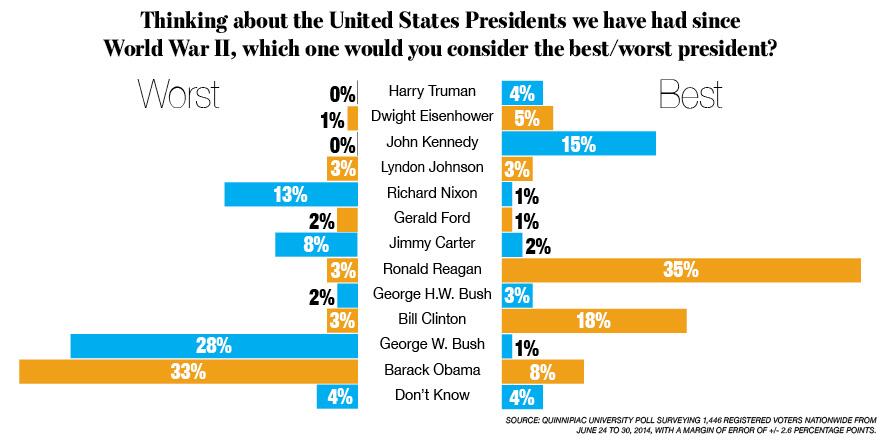
No, regardless of polling data, the answer is not Barack Obama. Or even Jimmy Carter. 

 https://pbs.twimg.com/media/BrkGDEIIQAAlcaE.jpg:large

Those guys are amateurs.

At the bottom of the list is probably Woodrow Wilson, who gave us both the income tax and the Federal Reserve. And he was a disgusting racist as well.

However, Wilson has some strong competition from Franklin Delano Roosevelt, who advocated and implemented policies that exacerbated the bad policies of Herbert Hoover and thus deepened and lengthened the Great Depression.

Today we’re going to look at a new example of FDR’s destructive statism. Something so malicious that he may actually beat Wilson for the prize of being America’s most worst Chief Executive.

Wilson, after all, may have given us the income tax. But Roosevelt actually proposed a top tax rate of 99.5 percent and then tried to impose a 100 percent tax rate via executive order! He was the American version of Francois Hollande.

These excerpts, from an article by Professor Burton Folsom of Hillsdale College, tell you everything you need to know.

Under Hoover, the top rate was hiked from 24 to 63 percent. Under Roosevelt, the top rate was again raised—first to 79 percent and later to 90 percent. In 1941, in fact, Roosevelt proposed a 99.5 percent marginal rate on all incomes over $100,000. “Why not?” he said when an adviser questioned him. After that proposal failed, Roosevelt issued an executive order to tax all income over $25,000 at the astonishing rate of 100 percent. Congress later repealed the order, but still allowed top incomes to be taxed at a marginal rate of 90 percent. …Elliott Roosevelt, the president’s son, conceded in 1975 that “my father may have been the originator of the concept of employing the IRS as a weapon of political retribution.”

Note that FDR also began the odious practice of using the IRS as a political weapon, something that tragically still happens today.

For more detail about Roosevelt’s confiscatory tax policy, here are some blurbs from a 2011 CBS News report.

When bombers struck on December 7, 1941, taxes were already high by historical standards. There were a dizzying 32 different tax brackets, starting at 10% and topping out at 79% on incomes over $1 million, 80% on incomes over $2 million, and 81% on income over $5 million. In April 1942, just a few short months after the attack, President Roosevelt proposed a 100% top rate. At a time of “grave national danger,” he argued, “no American citizen ought to have a net income, after he has paid his taxes, of more than $25,000 a year.” (That’s roughly $300,000 in today’s dollars). Roosevelt never got his 100% rate. However, the Revenue Act of 1942 raised top rates to 88% on incomes over $200,000. By 1944, the bottom rate had more than doubled to 23%, and the top rate reached an all-time high of 94%.

And here are some excerpts from a column that sympathized with FDR’s money grab.

FDR proposed a 100 percent top tax rate. …Roosevelt told Congress in April 1942, “no American citizen ought to have a net income, after he has paid his taxes, of more than $25,000 a year.” That would be about $350,000 in today’s dollars. …lawmakers would quickly reject FDR’s plan. Four months later, Roosevelt tried again. He repeated his $25,000 “supertax” income cap call in his Labor Day message. Congress shrugged that request off, too. FDR still didn’t back down. In early October, he issued an executive order that limited top corporate salaries to $25,000 after taxes. The move would “provide for greater equality in contributing to the war effort,” Roosevelt declared. …lawmakers…ended up attaching a rider repealing the order to a bill… FDR tried and failed to get that rider axed, then let the bill with it become law without his signature.

Regarding FDR’s infamous executive order, here are the relevant passages.

In order to correct gross inequities…, the Director is authorized to take the necessary action, and to issue the appropriate regulations, so that, insofar as practicable no salary shall be authorized under Title III, Section 4, to the extent that it exceeds $25,000 after the payment of taxes allocable to the sum in excess of $25,000.

And from the archives at the University of California Santa Barbara, here is what FDR wrote when Congress used a debt limit vote to slightly scale back the 100 percent tax rate.

First, from a letter on February 6, 1943.

…there is a proposal before the Ways and Means Committee to amend the Public Debt Bill by adding a provision which in effect would nullify the Executive Order issued by me under the Act of Oct. 2, 1942 (price and wage control), limiting salaries to $25,000 net after taxes. …It is my earnest hope that the Public Debt Bill can be passed without the addition of amendments not related to the subject matter of the bill.

And here are excerpts from another letter from FDR later that month.

When the Act of October 2, 1942, was passed, it authorized me to adjust wages or salaries whenever I found it necessary “to correct gross inequities…” Pursuant to this authority, I issued an Executive Order in which, among other things, it was provided that in order to correct gross inequities and to provide for greater equality in contributing to the war effort no salary should be authorized to the extent that it exceeds $25,000 net after the payment of taxes.

Even though Congress was overwhelmingly controlled by Democrats, there was resistance to FDR’s plan to confiscate all income.

So Roosevelt had a back-up plan.

If the Congress does not approve the recommendation submitted by the Treasury last June that a flat 100 percent supertax be imposed on such excess incomes, then I hope the Congress will provide a minimum tax of 50 percent, with steeply graduated rates as high as 90 percent. …If taxes are levied which substantially accomplish the purpose I have indicated, either in a separate bill or in the general revenue bill you are considering, I shall immediately rescind the section of the Executive Order in question.

And, sadly, Congress did approve much higher tax rates, not only on the so-called rich, but also on ordinary taxpayers.

Indeed, this was early evidence that tax hikes on the rich basically serve as a precedent for higher burdens on the middle class, something that bears keeping in mind when considering the tax plans of Bernie Sanders and Hillary Clinton (or, tongue in cheek, the Barack Obama flat tax).

Let’s close by considering why FDR pushed a confiscatory tax rate. Unlike modern leftists, he did have the excuse of fighting World War II.

But if that was his main goal, surely it was a mistake to push the top tax rate far beyond the revenue-maximizing level.

That hurt the economy and resulted in less money to fight Nazi Germany and Imperial Japan.

So what motivated Roosevelt? According to Burton and Anita Folsom, it was all about class warfare.

Why “soak the rich” for 100 percent of their income (more or less) when they already face rates of 90 percent in both income and corporate taxes? He knew that rich people would shelter their income in foreign investments, tax-exempt bonds, or collectibles if tax rates were confiscatory. In fact, he saw it happen during his early New Deal years. When he raised the top rate to 79 percent in 1935, the revenue into the federal government from income taxes that year was less than half of what it was six years earlier when the top rate was 24 percent. …First, FDR, as a progressive, believed…that “swollen fortunes” needed to be taxed at punitive rates to redistribute wealth. In fact, as we can see, redistributing wealth was more important to FDR than increasing it. …Second, high taxes on the rich provided excellent cover for his having made the income tax a mass tax. How could a steelworker in Pittsburgh, for example, refuse to pay a new 24 percent tax when his rich factory owner had to pay more than 90 percent? Third, and possibly most important, class warfare was the major campaign strategy for FDR during his whole presidency. He believed he won votes when he attacked the rich.

In other words, FDR’s goal was fomenting resentment rather than collecting revenue.

And there are leftists today who still have that attitude. Heck, there’s an entire political party with that mentality.

Tuesday, February 21, 2023

How the creation of the administrative state led to today's political crisis

By Tim Jones February 19, 2023

Unmasking the Administrate State: The Crisis of American Politics in the Twenty-First Century is a must-read for anyone wanting to understand today's political crisis at the federal level.  In a way, it is an ongoing constitutional crisis brought on by the progressive revolution in American governance that originated with President Woodrow Wilson.  The book describes how governance has been distorted beyond all recognition from the founding principles in the Constitution.  It was Wilson, the first progressive president, who believed that the Constitution should be more flexible in creating a better society without adhering to a strict interpretation of the Constitution's original text.  Rather, it should be a "living Constitution" that adapts to current circumstances.  What this essentially did was to nullify many of the timeless principles in the Constitution.

Woodrow Wilson is probably one of the most transformative presidents in American history by initiating this process of revolutionizing the way the federal government works.  He basically changed the mission of government from creating and maintaining the conditions for people to create better lives for themselves to directly intervening in the lives of citizens in theoretically making their lives better. 

Decades later, FDR implemented the beginnings of the administrative state based on Wilson's progressivism with his New Deal programs.  And decades following FDR, Lyndon Johnson solidified the triumph of the administrative state through his Great Society program, which essentially made the federal bureaucracy a government unto itself, removed from direct accountability to American citizens.

The following is a passage from Unmasking the Administrative State that precisely identifies this problem:.........To Read More.........


Monday, January 23, 2023

Blast From the Past, April 6, 2017: Why we entered World War I 100 years ago today

By Christopher Kelly 4/6/17 

Editor's  Notes:  For some reason this has been hit recently, which appeared here in P&D, and with interesting comments, so be sure to go to the original post.    Considering current events, I thought it worthwhile to re-post it.  RK

One hundred years ago this month, Woodrow Wilson ended America's longstanding policy of isolation and led us into World War I on the Allied side. Over two and a half million Americans were shipped "over there" to Europe and served in the American Expeditionary Force (AEF). By war's end, more than 100,000 Americans would join the ranks of what British Prime Minister Lloyd George termed, without a trace of irony, "the glorious dead."

Why did Wilson make his fateful decision to enter the "War to end all wars?" Two of the principle reasons behind Wilson's decision were the German policy of unrestricted submarine warfare and the Zimmerman Telegram.  Unrestricted submarine warfare........ the RMS Lusitania, which was destined to be sunk by a German U-boat off the coast of Ireland in 1915, killing around 1,200 passengers, including at least 125 Americans.......To Read More.....

Friday, December 16, 2022

Leftist Rights and Wrongs - or - Fixing Education is Job One in America

What do all of the following have in common? 

  • I have a right to practice recreational oblivion (drug use). 
  • I have a right to steal “stuff” from stores and not get prosecuted. 
  • I have a right to believe my “facts” are equal to yours, and then I can make you live by mine. 
  • I have a “right” to come to America, and then you must support me to become a citizen.
  •  I have a right to wealth equal to yours, and if that means taking it from you, that’s okay. 
  • I have a right to say whatever I want, but you don’t because you are irredeemably White.  
  • I have a right not to work if I don’t want to because the government is obligated to support me.

They’re all modern attitudes that are totally antithetical to a structured and sound thought process!.........one dares not call out certain classes of people on their logic, sense, truth, or perception of reality for fear of being called any of several powerful, nasty, and socially irredeemable names.  Indeed, the power of the law backs up this craziness more every day as our society begins to buy into the belief in “thought crime.”

This didn't just come about overnight.  This has been under construction by the left for 125 years in America, with the goal of destroying all the foundational values and intellectual constructs that made America great, and it started with education.  The goal of the socialists who created organized education was to make sure the apple fell as far away from the tree as possible.  

[Starting with] John Dewey, leftists have been feverishly working to politically destroy the United States. Mr. Dewey and his like-minded followers understood, in order to change the United States into a lesser nation under international dominance, Americans would have to be weaned off of the principles that made her great. So, the gradual turning away from school education toward globalist-oriented indoctrination began. The evil father of the indoctrination system of government schools producing misguided fools began in earnest in the latter half of the nineteenth century.............Think about it. Today, almost half of American students hate God. They are also willing to take on the mantle of socialism, despite the horrors of it displayed in our hemisphere via Venezuela, and so many more failed countries.

The goal was to make the state the final and ultimate moral arbiter for the children, not their parents, not the churches.  The state!  We're there now, and they did it with the help of two Presidents, Teddy Roosevelt and Woodrow Wilson, both of whom believed in two concepts:  "l'etat se moi", I am the state, and the Constitution is an impediment to human progress.  

All this is now supported by a totally corrupted education system in America. and the false history that's promoted and touted by the left is causing America to commit suicide, destroying us with out own values.  All outlined by Saul Alinsky in his Rules for Radicals.  

We know their goals and their means, now we have to have the courage and fortitude to confront them and transform education in America.  That starts with understanding education must become Job One in America.  It's been totally taken over by leftists, Marxists, socialists, communists, Democrats ..... sorry .... I'm repeating myself ..... and if America is to survive education at all levels must be totally transformed, and that has to start at the local school boards.  These school boards must be forced to realize the parents exercising their Constitutional rights are the power, and they're just hired help.  Hired help that can be thrown out of office, and that needs to start now.

And that mentality needs to be expanded to the state boards of education.  To fix this it must become an organized national effort, which is clear Trump is forcing the Republican party to adopt and promote, including the elimination of the Department of Education and any funding to universities, and taxing their endowments that are worth billions of dollars.  

Force them to become for profit institutions that have to compete without government grant money or student loans.  Then as totally private businesses, it they wish to push their leftist agenda and compete for student dollars in an open market, that's their business.  But the government must be forced to stay out of it and not force these insane diversity, inclusion and equity programs that are doing nothing more than destroying the nation. 

We must recognize and understand all the "rights" demanded by leftists are "wrongs", all promoted by losers who through the years imposed:

  1. The totalitarian brutality in nations that (so far) have murdered and starved 100 million people?
  2. The economic illiteracy of a system that has anywhere and everywhere produced misery and poverty?
  3. The moral abomination of an ideology that assumes individuals are abjectly subservient to the state.

That's history and that history is incontestable, and that's the history that needs to be taught and it needs to be taught now, and as I've stated, Trump is forcing the Republican Party to embrace that concept, and vigorously promote it, because parents in America are now being awakened to the tyranny and corruption at the school board level.  All it takes is some leadership to create a national agenda and definitive corrective action, and I believe that would expand into all aspects of American life. 

The base has been awakened!  Will the leadership act?  We'll see.

Tuesday, February 15, 2022

It's time to end the progressives' love affair with the Wilson Doctrine

One of the most incongruous things about leftists is that, even as they decry both colonialism and "neo-colonialism," it is they who believe that it's America's responsibility to meddle in every upset around the world — provided, of course, that doing so provides no benefit to America.  The latest to articulate this worldview, albeit in the most ignorant way, is Bill Kristol, an erstwhile "conservative," who has now emerged as a full-blooded progressive.  George Washington, the first and, arguably, greatest American president, famously warned in his Farewell Address against getting involved in Europe's politics and disputes:.......To Read More.....

My Take - Good article I have only one objection.  Woodrow Wilson was an Anglophile, and while he publicly took a position he wanted to keep America out of the war, he was in fact working behind the scenes to push America into the war.  The Lusitania and Mexico/Germany scenarios were excuses, just that excuses.  They knew there was no way Germany could help Mexico and the Lusitania was a British ship illegally carrying contraband to support England, and in no way justified war just because there were Americans on board.  He should have beat up on the Brits who knew this ship was a legitimate target because of it's cargo, not used it as an excuse to help push America into WWI, the greatest disaster of human history as it created the framework for everything that's happened since. 

Thursday, January 6, 2022

December 31, 1912

January 01, 2022 @ Sultan Knish Blog

 (Posting this article has become an annual tradition ever since the grim end of 2012. It's a reminder that the end of each year ushers in unknowns, but also opportunities for heroism. History does not stand still, and we should never assume that we know how it will come out.)

The next year  sweeps around the earth like the hand of a clock, from Australia to Europe and across the great stretch of the Atlantic it rides the darkness to America. And then around and around again, each passing day marking another sweep of the hours.

While the year makes its first pass around the world, even if it doesn't feel like there is much to celebrate, let us leave it behind, open a door in time and step back to another year, a century past.

December 31, 1912.

The crowds are large, the men wear hats, and the word 'gay' means happy. Liquor is harder to come by because the end of the year has fallen on a Sunday. 

There are more dances and fewer corporate brands. Horns are blown, and the occasional revolver fired into the air, a sight unimaginable in the controlled celebrations of today's urban metropolis.

The Hotel Workers Union strike fizzled out on Broadway though a volley of bricks was hurled at the Hotel Astor during the celebrations. New York's Finest spent the evening outside the Rockefeller mansion waiting to subpoena the tycoon in the money trust investigation. And the Postmaster General inaugurated the new parcel service by shipping a silver loving cup from Washington to New York.

On Ellis Island, Castro, a bitter enemy of the United States, and the former president of Venezuela, had been arrested for trying to sneak into the country while the customs officers had their guard down. Gazing at the Statue of Liberty, Castro denied that he was a revolutionary and bitterly urged the American masses to rise up and tear down the statue in the name of freedom.

Times Square has far fewer billboards and no videos, but it does have the giant Horn and Hardart Automat which opened just that year, where food comes from banks of vending machines giving celebrating crowds a view of the amazing world of tomorrow for the world of 1912 is after all like our own. 

We can open a door into the past, but we cannot escape the present.

The Presidential election of 1912 ended in disaster. Both Taft and Roosevelt lost and Woodrow Wilson won. In the White House, President Taft met with cabinet members and diplomats for a final reception.

Woodrow Wilson, who would lead America into a bloody and senseless war, subvert its Constitution, and begin the process of making global government and statism into the national religion of his party, was optimistic about the new year. "Thirteen is my lucky number," he said. "It is curious how the number 13 has figured in my life and never with bad fortune." 

In Indianapolis, the train carrying union leaders guilty of the dynamite plot was making its secret way to Federal prison even while the lawyers of the dynamiters vowed to appeal.

The passing year, a century past, had its distinct echoes in our own time. There had been, what the men of the time, thought of as wars, yet they could not even conceive of the wars shortly to come. There were the usual dry news items about the collapse of the government in Spain, a war and an economic crisis in distant parts of the world that did not concern them. The Federal Reserve Act would be signed at the end of 1913, partly in response to the economic crisis. 

Socialism was on the march with the Socialist Party having doubled its votes in the national election.  All three major candidates, Wilson, Roosevelt and Taft, had warned that the country was drifting toward Socialism and that they were the only ones who could stop it. 

"Unless Socialism is checked," Professor Albert Bushnell Hart warned, "within sixteen years there will be a Socialist President of the United States." 

Hart was off by four years. Hoover won in 1928. FDR won in 1932. 

At New York City's May Day rally, the American flag was torn down and replaced with the red flag, to cries of, "Take down that dirty rag" and "We don't recognize that flag."

The site of the rally was Union Square, one of the locations where Black Lives Matter hangs out, taking over from Occupy Wall Street and generations of radicals.

There was tension on the Mexican border and alarm over Socialist successes in German elections. An obscure fellow with the silly name of Lenin had carved out a group with the even sillier name of the Bolsheviks. China became a Republic. New Mexico became a state, the African National Congress was founded and the Titanic sank.  

There was bloody fighting in Benghazi where 20,000 Italian troops faced off against 20,000 Arabs and 8,000 Turks. The Italians had modern warships and armored vehicles, while the Muslim forces were supplied by voluntary donations and fighters crossing from Egypt and across North Africa to join in attacking the infidels.

The Italian-Turkish war has since been forgotten, except by the Italians, the Libyans and the Turks, but it featured the first strategic use of airships, ushering in a century of European aerial warfare. 

There was a good deal going on while the horns were blown and men in heavy coats and wet hats made their way through the festivities.

World War I was two years away, but the Balkan War had already fired the first shots. The rest was just a matter of bringing the non-phosphorus matches closer to the kindling. The Anti-Saloon League was gathering strength for a nationwide effort that would hijack the political system and divide it into dry and wet, and, among other things, ram through the personal income tax.

Change was coming, and as in 1912, the country was no longer hopeful, it was wary.

The century, for all its expected glamor, had been a difficult one. The future, political and economic, was unknown. Few knew exactly what was to come, but equally few were especially optimistic even when the champagne was flowing.

If we were to stop a reveler staggering out of a hotel, stand in his path and tell him that war was five years away and a great depression would come in on its tail, that liquor would be banned, crime would proliferate and a Socialist president would rule the United States for three terms, while wielding near absolute power, he might have decided to make his way to the recently constructed Manhattan Bridge for a swan dive into the river.

And yet we know that though all this is true, there is a deeper truth. For all those setbacks, the United States survived, and many of us look nostalgically toward a time that was every bit as uncertain and nerve-wracking as our own.

December 31, 1912 was a door that opened onto many things.

Our December 31 is likewise a door, and if a man in shiny clothes from the year 2120 were to stop us on the street and spill out everything he knew about the next century, it is likely that there would be as much greatness as tragedy in that tale.

As the year sweeps across the earth, let us remember that history is more than the worst of its events, that all times bear the burden of their uncertainties, but also carry within them the seeds of greatness. Looking back on this time, it may be that it is not the defeats that we will recall, but how they readied us for the fight ahead. 

America has not fallen, no more than it did when the clock struck midnight on December 31, 1912. Though it may not seem likely now, there are many great things ahead, and though the challenges at times seem insurmountable and the defeats many, another year and another century await us.
 
Author Image 

About Daniel Greenfield
Daniel Greenfield is a journalist investigating Islamic terrorism and the Left. He is a Shillman Journalism Fellow at the David Horowitz Freedom Center

Monday, September 20, 2021

What Progressives Wrought

A concise new volume will help Americans make sense of the stark divisions that confront us. 

Mike Sabo September 16, 2021 @ City Journal

America Transformed: The Rise and Legacy of American Progressivism, by Ronald J. Pestritto (Encounter Books, 288 pp., $28.99)

It is no secret that American public life is fracturing. The fissures can be seen in our gladiatorial-like Supreme Court nomination hearings, the collapse of confidence in our institutions, and the mounting sense that many have that elections won’t change the country’s fundamental trajectory. These disputes are merely symptoms, however, of a broader problem, the roots of which extend back decades.

As Ronald J. Pestritto, graduate dean and professor of politics at Hillsdale College, argues in America Transformed, our present-day clashes reflect a fundamental “divide over first principles,” which he traces to the rise of the Progressive Movement in the late nineteenth century. Pestritto makes a convincing case that the Progressives—including Woodrow Wilson, Theodore Roosevelt, Herbert Croly, and John Dewey—sought to “revolutionize both the theory and practice of American government.”

The Progressives had their differences and factions: consider the fierce 1912 presidential campaign between Wilson and Roosevelt. Yet they adhered to a “coherent set of principles, with a common purpose.” They unleashed a “direct assault on the core ideas of the American founding,” openly rejecting the natural rights teachings of the Declaration of Independence. Wilson once told an audience that “if you want to understand the real Declaration of Independence, do not repeat the preface”—the same preface that contains the most concise articulation of the Founders’ political theory.

Pestritto argues that, for progressives like education reformer Dewey, the Founders’ “great sin” was to think that principles such as a natural human equality in rights and government by consent transcended “the particular circumstances of that day.” Influenced by Hegel’s philosophical idealism, they argued that historical progress had shown that what the Founders thought were universal truths were in fact simply ideas of their time. In fact, the principles of the American Founding, and the Constitution built to reflect them, actively prevented government from taking the swift action that the public now demanded.

Pestritto suggests that “native influences” had already compromised the American immune system by the time the Progressive Movement emerged. A toxic mix of Social Darwinism, pragmatism, and the rejection of social compact theory in New England and the antebellum South prepared American intellectuals and politicians to accept an alternative account of politics that seemed better able to meet the challenges of modern society. The Progressives claimed that historical progress necessitated a dynamic and perfectible human nature, an idea that the Founders rejected. James Madison’s claim in Federalist 10 that the prevention of majority tyranny would always be a problem in political life was simply false, they believed. Thus Woodrow Wilson and political scientist Frank Goodnow sharply criticized the Constitution’s separation of powers and the slow, methodical lawmaking process the Framers had put in place, which they saw as hopelessly out of step with the public will and too often stymied by a combination of political machines, big business, and other special interests.

Pestritto maintains that the progressives worked toward “democratizing and unifying national political institutions,” though they sometimes differed on the means to achieve this end. Ever the radical, Theodore Roosevelt proposed policies such as overturning judicial decisions and the recall of recalcitrant judges who resisted heavy regulation of business. Herbert Croly, a cofounder of The New Republic, wanted to eliminate political parties altogether.

To make politics fully democratic, the Progressives insisted that political leaders accountable to the people needed to find means of breaking the constitutional logjam—think of Roosevelt’s “bully pulpit.” Roosevelt and Wilson frequently enlisted (and refashioned) the memory of American statesmen such as Abraham Lincoln, John Marshall, and Daniel Webster, men who, in their rendering, had supposedly discerned history’s centralizing trends.

Pestritto argues that as the Progressives seemingly brought politics closer to the people, they simultaneously moved “policymaking power away from popular institutions,” handing it to “educated elites.” They essentially established a fourth branch of government, a vast bureaucracy that wields legislative, executive, and judicial powers—what Madison considered the very definition of tyranny—that would fully bloom during Franklin Delano Roosevelt’s presidency. What we know today as the administrative state (a phrase coined by the political scientist Dwight Waldo in the 1950s) had its genesis in the Supreme Court’s ruling in J.W. Hampton v. United States, which granted broad powers to supposedly nonideological experts insulated from the corrupting effects of electoral politics.

Pestritto notes that this new conception of government—the sharp split between politics and administration—originated in the “laboratories of democracy” of state and local governments. There, Progressive governors such as California’s Hiram Johnson and Wisconsin’s Robert La Follette pushed direct democracy: the ballot initiative, recall, referendum, the direct election of senators, and electoral primaries. Through the establishment of government by unelected commission and the rise of nonpartisan city managers, the notion of expert administration permeated state governments in Oregon, South Dakota, Texas, and Illinois, as well as cities such as Galveston, Cincinnati, Des Moines, and Cleveland.

The Progressives’ strong belief in the notion of historical progress also guided their foreign policy. History had demonstrated that modern democracy was the “permanent and most advanced form of government,” Wilson once wrote. To make the world safe for democracy, the Progressives’ idealistic foreign policy necessitated an aggressive series of interventions in Haiti, Santo Domingo, Cuba, Mexico, and the Philippines.

History had chosen the United States to lead the “children” (as Wilson described other sovereign nations) so that they could someday reach the heights of democratic governance. And should certain “barbaric races” fail to do what they were told, Progressive historian Charles Merriam wrote in a particularly appalling passage, they “may be swept away.”

Some Progressives saw historical progress as the will of God Himself. Marshaling rhetoric that today would be regarded as extreme Christian nationalism, Roosevelt told the Progressive Party convention in 1912, “We stand at Armageddon, and we battle for the Lord.”

Adherents of the Social Gospel, the Progressive Movement’s religious wing, were liberal Protestants who worked to reconcile life “on earth as it is in heaven.” They turned away from concerns over individual salvation and other orthodox theological concerns and instead inculcated a social ethic that sought to use the modern state to equalize economic conditions. Pestritto observes that in one of his more moderate moments Baptist pastor Walter Rauschenbusch called for the “public ownership of essential industries.” By following God’s unfolding plan, which history was revealing to mankind, human beings would someday experience the Eden that our ancestors had failed to maintain.

Pestritto concludes America Transformed by noting that, thanks to the Progressives’ handiwork, “citizens of two different regimes [are] occupying the same country.” The regime that today opposes that of the Founders is far different from what the original Progressives intended, but by uncoupling America from its natural rights foundations, they can justly be credited (or rather, blamed) for inaugurating our current crisis. Pestritto’s concise volume, the best available overview of progressive political thought and practice, will help Americans make sense of the stark divisions that confront us.

Photo: Lingbeek/iStock

City Journal is a publication of the Manhattan Institute for Policy Research (MI), a leading free-market think tank. Are you interested in supporting the magazine? As a 501(c)(3) nonprofit, donations in support of MI and City Journal are fully tax-deductible as provided by law (EIN #13-2912529).


Wednesday, July 8, 2020

Ranking Presidents: Was Woodrow Wilson the Worst of the Worst?

July 7, 2020 by Dan Mitchell @ International Liberty

(Editor's Note:  I usually list Teddy Roosevelt as the worst because he gave personality to the progressive movement.  He laid the intellectual, emotional and psychological groundwork for the fascist policies later imposed by Woodrow Wilson, using America's unnecessary involvement in WWI as a justification, or excuse if you like. 

Both Teddy and Woodrow believed the Constitution was an impediment to human progress.  But it was Wilson who actually imposed and  applied those fascist principles during WWI, and for that, he's the worst President in American history, hands down. RK)

I certainly don’t intend to do this for everyone who has made it to the White House, but I have produced big-picture economic assessments of several presidents.
Today, let’s go back farther in history and take a look at Woodrow Wilson.  At the risk of understatement, he did a very bad job. Indeed, it’s quite likely that he ranks as America’s worst president, at least when judging economic policy. His mistakes were either huge or disgusting.

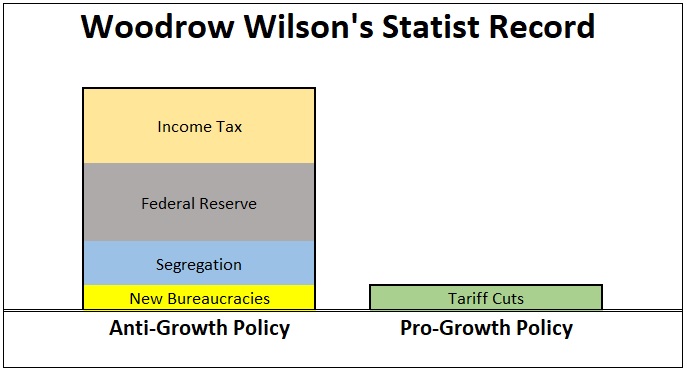
Creating the income tax – The internal revenue code began when Wilson signed into law an income tax on October 3, 1913. The initial tax wasn’t overly onerous – with a top rate of just 7 percent – but it predictably evolved into the punitive levy that currently plagues America.
Creating the Federal Reserve – You don’t have to be a libertarian-minded advocate of competitive currencies to conclude that the central bank – also signed into law by Wilson in 1913 – has caused immense damage with its erratic, boom-bust approach to monetary policy.
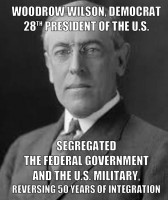
Segregating the federal government – Wilson was a reprehensible racist. To make matters worse, he turned that personal moral failing into a big policy mistake by overseeing rampant (and costly) discrimination and segregation in the federal government.

Those are just the highlights – though low lights would be a more accurate word to describe Wilson’s policies. The Encyclopedia Britannica has a description of some additional forms of intervention imposed during his tenure.
…he took up and pushed through Congress the Progressive-sponsored Federal Trade Commission Act of 1914. It established an agency—the Federal Trade Commission (FTC)—with sweeping authority. …because his own political thinking had been moving toward a more advanced Progressive position—Wilson struck out upon a new political course in 1916. He began by appointing Louis D. Brandeis, the leading critic of big business and finance, to the Supreme Court. Then in quick succession he obtained passage of a rural-credits measure to supply cheap long-term credit to farmers; anti-child-labour and federal workmen’s-compensation legislation; the Adamson Act, establishing the eight-hour day for interstate railroad workers; and measures for federal aid to education and highway construction.
Lawrence Reed of the Foundation for Economic Education put together a damning indictment of Wilson.
1913…was a disastrous year that we’re still paying a hefty, annual price for… Wilson, arguably the worst president…ordered the segregation of all departments within the executive branch and appointed ardent segregationists to high positions. …He locked up political dissidents right and left as he trampled on the Constitution’s guarantees of speech, assembly, and press freedoms. His wartime economic controls were hideously stupid and counterproductive. …the 16th Amendment to the Constitution was…Strongly supported by Wilson… Subsequent legislation set the top rate at a mere 7 percent. …When Wilson left office eight years later, the top rate was more than ten times higher. …Wilson’s signature enshrined into law the Federal Reserve Act, creating a central bank and more economic mischief than any other federal initiative or institution in the last 100 years. …In American history, 1913 should go down as a year that will live in infamy.
It’s also worth noting that Wilson was a believer in global governance, which adds to his awful legacy.  In a review of a biography about Wilson for the Claremont Review of Books, David Goldman mentions that unpalatable feature of his presidency.
So utterly utopian was Wilson’s vision that it is unfair to characterize the internationalism of Bill Clinton or George W. Bush as “Wilsonian.” Clinton and Bush threw America’s weight around after the collapse of the Soviet Union, but they did not propose—as Wilson did—to replace America’s sovereign decision-making with a global council. …He wanted to compromise American sovereignty and most of the Senate did not. …Wilson would have liked to impose a legal obligation from a foreign body upon the United States, but could not say so openly. …His obsession was the creation of a supranational agency able to dictate policy to national governments, an obsession that grew out of his lifelong hostility to the American political system… To make sense of his grand overreach in 1919, historians will need to give more attention to his rancor at the U.S. Constitution… The constitution in Wilson’s reading had become a relic of a bygone era. He proposed to jettison this putatively archaic document in favor of a government less burdened by checks and balances. …The same utilitarian criteria that Wilson applied to the Constitution guided his judgment about capitalism and socialism. …As economists Clifford Thies and Gary Pecquet have observed, “Wilson believed that the difference between socialism and democracy was a matter of means rather than ends.” …He eschewed mass expropriation of industry only because he thought it inefficient. …Although Wilson’s dudgeon came from the Deep South, his Progressivism came from Princeton and the Social Gospel.
Wilson’s hostility to the Constitution was part of the so-called progressive era. Unlike America’s Founders, proponents of this approach viewed the federal government as a positive force rather than something to be constrained.
The idea that government or “the community,” has “an absolute right to determine its own destiny and that of its members” is a progressive one. The difference between the Founders’ and progressive’s visions can be summarized this way: The Founders believed citizens could best pursue happiness if government was limited to protecting the life, liberty, and property of individuals. …Unlike the framers of the Constitution, progressives believed that…“communities” have rights, those rights are more important than the personal liberty of any one individual in that community. …they believed…government-sponsored programs and policies as well as economic redistribution of goods from the rich to the poor. …Wilson, who served as president from 1913-1919, advocated what we today call the living Constitution, or the idea that its interpretation should adapt to the times. …Wilson oversaw the implementation of progressive policies such as the introduction of the income tax and the creation of the Federal Reserve System to attempt to manage the economy.
Bre Payton, in an article for the Federalist, opined about Wilson and the changes during the progressive era.
…to understand The New Deal and how American life and government  changed in the twentieth century and beyond, it is vital to understand the Progressive Era… FDR cited progressive-minded presidents Theodore Roosevelt and Woodrow Wilson as his intellectual inspirations. …Progressives believed restricting government to only protecting citizens’ life, liberty, and ability to pursue happiness was simplistic. …Thus people should not fear the ever-expanding role of government… Wilson went on to say that modern European thinkers had declared that men were defined not by their individuality, but by their society. And one’s rights come from government.
Hostility to the Constitution and limited government was just one problem with the progressives.
Their views of minorities also were very troubling. In a column for National Review, Paul Rahe documented not only Wilson’s racism, but also his use of government power to harm the economic prospects for black Americans.
Wilson, our first professorial president, was…the very model of a modern Progressive…he shared the conviction, dominant among his brethren, that African-Americans were racially inferior to whites. …Prior to the segregation of the civil service in 1913, appointments had been made solely on merit as indicated by the candidate’s performance on the civil-service examination. Thereafter, racial discrimination became the norm. …The existing work force was segregated. Many African-Americans were dismissed. …Jim Crow had not been the norm before 1890, even in the deep South. …it became the norm there only when it received sanction from the racist Progressives in the North. …For similar reasons, Wilson was hostile to the constitutional provisions intended as a guarantee of limited government. The separation of powers, the balances and checks, and the distribution of authority between nation and state distinguishing the American constitution he regarded as an obstacle.
This article from the New Republic covers the same ground, starting with his time as head of Princeton University, but from a left-wing perspective.
Wilson not only refused to admit any black students, he erased the earlier admissions of black students from the university’s history. …Elected president in 1912, …Wilson appeared to be the quintessential Progressive Era leader. …the progressive ideology of the era was in many ways quite racist. …it quickly became known that the Wilson administration was instituting a major modification in the treatment of black workers throughout the federal government from what had been the case under postwar presidents. …the Civil Service began demanding photographs to accompany employment applications for the first time. It was widely understood that the only purpose of this requirement was to weed out black applicants. …He insisted that the segregation policy was for the comfort and best interests of both blacks and whites.
There’s more bad news about Wilson.  In a column for the Washington Post, Michael Beschloss, a presidential historian, writes about his authoritarianism as well as his racism.
His most disgraceful flaw was his racism. …Wilson especially stood out in his white supremacy. He was not a man of his time but a throwback. …Wilson, who preened as a civil libertarian, persuaded Congress to pass the Espionage Act, giving him extraordinary power to retaliate against Americans who opposed him and his wartime behavior. That same law today enables presidents to harass their political adversaries. Wilson’s Justice Department also convicted almost a thousand people for using “disloyal, profane, scurrilous or abusive language” against the government, the military or the flag. Wilson is an excellent example of how presidents can exploit wars to increase authoritarian power and restrict freedom.
All things considered, definitely one of America’s worst chief executives.
This tweet is an apt summary of Wilson’s presidency.
For readers who are interested in the quirks of history, Lawrence Reed of the Foundation for Economic Education bemoans the fact that an untimely death in 1899 probably led to the unfortunate election of Wilson.
Garret Augustus Hobart—known to his friends as “Gus”—was America’s 24th vice president. He served under William McKinley for two years and eight months until his death in office in November 1899 at the age of 55. With Hobart’s untimely passing, President William McKinley had to find a new running mate for the election of 1900. That man turned out to be Theodore Roosevelt, who became president upon McKinley’s assassination only six months into his second term. …Teddy…enter the presidential race in 1912 as a third-party nominee. That split the Republican vote and handed the presidency to Democrat Woodrow Wilson. Wilson won with just 42% of the popular tally and went on to become arguably the very worst of our 45 chief executives. …I greatly lament the sad fact that Gus Hobart wasn’t around to run again with McKinley in 1900. If he had lived, he instead of Teddy would have become our 26th President when McKinley died. And if there had been no Teddy Roosevelt presidency, there might never have been a philandering, racist, “progressive” Wilson in the White House to royally screw up the country with an income tax, a Federal Reserve, entry into World War I, and other mischievous adventures in statism.
In keeping with my traditional practice, here’s a visual depiction of the good and bad policies of the Wilson Administration.


And although it’s hard to measure, Wilson belongs in the presidential Hall of Shame because his administration was a turning point in America’s tragic evolution from Madisonian constitutionalism to modern statism.  For instance, Wilson almost surely paved the way for FDR’s ill-fated New Deal.

P.S. Now readers will hopefully understand why I wrote that Obama (who largely had a forgettable legacy) wasn’t nearly as bad at Wilson.