“If all men are created equal, that is final. If they are endowed with inalienable rights, that is final. If governments derive their just powers from the consent of the governed, that is final. No advance, no progress can be made beyond these propositions. If anyone wishes to deny their truth or their soundness, the only direction in which he can proceed historically is not forward, but backward toward the time when there was no equality, no rights of the individual, no rule of the people.” Calvin Coolidge on the 150th anniversary of the Declaration of Independence
Showing posts with label Calvin Coolidge. Show all posts
Showing posts with label Calvin Coolidge. Show all posts
Monday, May 4, 2026

Tuesday, July 16, 2024
Fear Is the Explanation
By Rich Kozlovich
I've said in the past I believe in historical cycles, and to a degree events, in a general way, are predictable and explicable. What we're seeing today has a lot of history behind it.
What we have here are the consequences of a long cycle from the 1890's until now, actually until about 25 years ago, and now the steam has built up to the point of explosion. Americans now know they've been lied to, badly!! The nation knows the education system is corrupted. The nation is now acutely aware the federal, state, and local governments are out of control. The nation is now aware spending has placed America in deep economic trouble. The nation is now aware all the scare mongering the activists and leftists in government unending promote is a lie. The nation is now aware the motive behind all this is to create a tyrannous form of world governance, and the elimination of the United States Constitution.
It's not just the history buffs and writers who are aware this any longer. Those who are becoming aware are growing exponentially. And in America, that means something.
In the 1890's the socialists started the take over of public education, they called themselves progressives to hide who and what they really were, atheistic socialists. Both Teddy Roosevelt and
Woodrow Wilson supported their motives and goals, believing the "apple should fall as far away from the tree as possible". The state, not the parents, and not the churches would be the ultimate arbiter of morality. They both believed the Constitution was an impediment to human progress, and promoted the idea of an educated elite ruling the world. Both subscribed to the idea "I am the state", and both acted accordingly. Wilson's fascist takeover of the federal government didn't end until Harding was elected, and Coolidge dismantled it.
It was reconstructed by FDR's New Deal, with many of the same operatives under Wilson heading up all these new agencies he created, all of which became infiltrated by communist agents, and we know that for sure since the release of the VENONA intercepts. The FDR administration was the most heavily infiltrated government in the history of the world, and FDR had to know it. The residual effects are still being felt.
There
were only three conservative Presidents in the 20th century, Harding,
Coolidge, and Reagan, and I've stated often that Calvin Coolidge was the
greatest of the them all. Sixteen years of conservative government
and 84 years of varying degrees of progressive government, and if you
include this century, it amounts to 20 years out of the last 124,
and the lasting damage of one hundred an four years of "progressivism"
may not be repairable, since "it's no small thing, to restore a republic after it has fallen into corruption."
Machiavelli outlined there were only two groups. The ruling class, and the ruled. The ruling class only want to maintain their privileges, and get more, and the ruled only want security, the ability to house, clothe, and feed their families, in safety.
According to him if either group feels threatened as a group, governments fall. But we find that's not always right away, and with total control of the instruments of propaganda, maybe never, as is true of N. Korea.
But America isn't N. Korea, and the Machiavellian principle applies here. The ruling elite are in fear as the ruled are now aware, and are resisting the crushing domination of their lives, and these leftists and elitists are resisting, destroying the rule of law, for political gain, and promoting violence, and if they don't get their way, they're threatening violence.
SCOTUS is over turning past decisions that gave unelected bureaucrats unconstitutional power over society, and the "elite" are using the same old vile tactics that's been in place since Julius Caesar destroyed the Roman Republic, which led to a multi-year civil war, to overcome these events.
Europe's recent elections are farce. Culture is king, and the entire European culture is predicated on an elite ruling class, and the French are the most hypocritical of them all. They love their class distinction, and find ways to incorporate it while claiming otherwise. The French Revolution merely changed who the elite were to be. But even in Europe, it's still all about three hots and a cot. Security! And they're now finally afraid, very afraid, and rightly so. These socialistic rulers have placed the European culture in serious jeopardy of extinction bowing to Muslim invaders, they're calling immigrants, a problem that's now become a crisis for the continuation of Western civilization.
First Rule of Geopolitics: All geopolitics is about four factors,
geographics, demographics, economics, and that most elusive factor of
all, the happiness factor. These elites are clueless about the happiness factor because they don't care. They've decided the masses don't need to be happy, just obedient, own nothing and eat bugs, and society had better like it or else. Now the masses are afraid, and are willing to fight the "obey and like it or else" battle.
The Homestead strike in 1892 at Carnegie Steel was caused by Carnegie cutting wages. At that point the workers felt they have nothing to lose and struck, and it ending up being a war and people died. When fear permeates a society it's because they now believe there's nothing left to lose, and things explode.
Fear, that's the cause. Fear, that's the explanation. And fear will have it's effect.
Monday, July 15, 2024
Coolidge’s Silent Recipe for Success: Less Federal Government
Luis Carlos Araujo Quintero July 12, 2024 @ American Institute for Economic Research

A century ago, the American marketplace of ideas provided the people with very different options in terms of public policy. The formal institutions looked similar. The same two political parties dominated the electoral system, benefiting from entrenched regional support. The Electoral College filtered the popular vote, which reflected the people’s will through decentralized and fraud-resistant elections.
Politicians, however, subscribed to different ideas. Limited government was the consensus among the political elites, who called for restrictions on government’s scope and scale. President Calvin Coolidge embodied this zeitgeist, given his reluctance to step into affairs beyond the constitutionally mandated functions of the federal government. Americans confidently elected him in 1924 by one of the biggest margins in American electoral history, after he had served for one year after President Harding’s sudden death. Silent Cal, a nickname that reflected his quiet demeanor and political restraint, empowered the American people in the interwar period.
The Roaring Twenties was a period of particular prosperity and modernization in the United States. The Coolidge Administration, whose respect of limited government created fertile soil for people to prosper in a free market, is partly responsible for the nation’s success prior to the Great Depression. This President delivered reforms that enhanced the life of Americans in many ways. He reduced taxes across the board, incentivizing productive economic activities that allowed free and enriching exchange.
Coolidge challenged a tax system designed to finance America’s intervention in World War I, fostering private American entrepreneurship and saving instead. This new economic boom did not have to navigate a complex federal regulatory regime, given that this president kept the federal government largely away from free enterprise. In fact, he reduced the federal budget consistently between 1923 and 1929.
The 1924 elections also demonstrate how relevant Coolidge’s philosophy of limited government was to the positions of other parties. The president ran as a Republican, when that party embodied the demands for greater federal government in the Progressive Era after the Civil War. Simultaneously, the Democratic Party pushed for greater power to the states as a means to enforce heavy regulations, some of which had racist and segregationist undertones.
Coolidge’s approach, which called for less federal government and better state and local government, dominated the Republican Party under his leadership. Radicals within his own party, led by Robert M. La Follette, left and ran a third candidacy with the Progressive Party. Americans deemed this party’s higher progressive taxes and state-owned companies as too radical to fit into the traditional two-party system,which tends to promotes moderation. On their side, Democrats reluctantly decided to run a moderate candidate in the form of John W. Davis to compete with Coolidge’s centrist and classical liberal platform.
His support for policies similar to the President’s proposals meant many southerners did not even vote, yielding the worst presidential election result for this party in history. Limited government was the political consensus of 1924, playing an important role in deciding who was to become president.
A century later, the political market offers very different policies. The institutions are still the same: electoral college, decentralized election mechanics, and a two-party system where the same parties dominate, even if they have switched positions ideologically. Politicians in 2024, however, embrace a very different principle: the necessity of government intervention in private affairs.
Regardless of the party or the candidates, the automatic answer seems to be bigger and, most worryingly, more invasive government. Issues like migration, labor, abortion, environmentalism, urban development, healthcare, education, transportation, safety, security, crime, investment, housing, voting rights and even citizenship are billed as having a single solution: tougher and more numerous governmental regulation, both federal and state.
The last hundred years have seen a remarkable change in political attitudes. Coolidge’s hands-off administration ended roughly three months before the Great Depression, the economic downturn that motivated the rise of the New Deal under President Franklin Delano Roosevelt. In his 14-year tenure, the longest of any American President, the federal government grew in scope and scale to manage the alleged issues generated by free markets.
The response to anything that doesn’t function optimally has too often been more government, regardless of level and, overwhelmingly since the New Deal, to the benefit of politicians’ electoral prospects. Many Americans seem to approve of this development, voting for the politicians willing to “do something,” even if they make things worse. As both parties prepare to officially select their candidates at conventions this summer, the centennial of Calvin Coolidge’s only presidential election in 1924 should serve to remind Americans that less federal government and better state and local government is the governance formula behind this country’s political success. When it means restraining big and bad government, silence really can be golden.
Luis Carlos Araujo Quintero
Luis Carlos Araujo Quintero holds an International Relations and Political Science double major from Universidad Francisco Marroquín in Guatemala. He is a teaching assistant at UFM, as well as a junior analyst of international affairs in a Guatemalan consultancy firm.He authors Public Choice research articles for the Centro para el Análisis de las Decisiones Públicas (CADEP) and takes part of his school’s research team on the Guatemalan Civil War. He is currently a research intern in the American Institute for Economic Research.
Tuesday, March 12, 2024
Calvin Coolidge Was the Greatest President of the 20th Century
Teddy
Roosevelt was in my opinion the worst President because he gave
credibility to the progressive movement, but Woodrow Wilson, who along
with TR felt the Constitution was an impediment to human progress, both
subscribing to the idea of "le estate ce moi" (I am the state) and acted
accordingly.
Wilson fleshed out that skeleton with policies
during WWI that were blatantly unconstitutional, and became known as
America's "first fascist President". Policies that were kept
in place even after the war ended, and weren't done away with until
Harding became President. All those policies were adopted and
rebranded as "The New Deal" under FDR, and many of the fascists who
worked in Wilson's government implementing his policies became leaders
of FDR's New Deal team.
But the implementation and practical application of American governmental fascism started with Wilson. Overcoming all that fascism was started by Harding, but it was Coolidge who really did what was necessary to restore constitutionality to the American government, and as I said, if he had run in 1928 Hoover wouldn't have been elected, and FDR would most likely never been President. Both of whom were disasters to the nation, and the Constitution, and the Deep State as we know it might not have come into being.
With the release of the VENONA Intercepts in 1996 we absolutely know The FDR administration was thoroughly infested with communists, Stalinist agents, socialists, and fellow travelers, and is considered the most heavily infiltrated government int history of the world, and FDR was a party to that.
We really do need a man like Calvin Coolidge again.
Monday, September 18, 2023
The Roaring Twenties — Die Harding and Keep Cool With Coolidge
How did the most underrated presidents launch an exceptional economic boom?


ByAndrew Moran September 17, 2023@ Liberty Nation News
The US electorate kicked off the Roaring Twenties by averting a bombardment of progressive possibilities. President Woodrow Wilson, the incumbent who foisted World War I and the Federal Reserve on the public, could not seek a third term due to his significant physical and mental disabilities. Former President Theodore Roosevelt died before he could accept a Republican nomination. Gov. James Cox (D-OH), a student of Woodrownomics, suffered defeat in the 1920 election. These events culminated in the presidencies of Warren Harding and Calvin Coolidge, two GOP leaders who would oversee one of the greatest economic periods in the nation’s history.
Warren Harding and the Roaring Twenties
Despite serving only a couple of years in the White House, Harding put together an exceptional record for economic historians to study. In March 1921, the United States was in the middle of a 14-month post-war decline, also known as the Forgotten Depression. The stock market crashed by 50%, corporate profits cratered by 90%, unemployment rose to nearly 12%, and the gross national product fell 6.9%. Harding was behind the eight-ball almost immediately, but this did not stop his presidency from ushering in the Roaring Twenties.
During his time in office, Harding signed legislation that slashed the top marginal tax rate from 73% to 25% and reduced or eliminated tax burdens for lower brackets. Treasury Secretary Andrew Mellon advocated for even lower tax rates, but Harding had to compromise with lawmakers. In addition to tax cuts, Harding punctured federal spending by as much as 66%, accounting for about 3% of the gross domestic product. The only government response to the 1920-21 downturn was an emergency tariff bill which promised in September 1921 that no federal money or legislation would be afforded to businesses.
The results? The annual GDP gains averaged above 5% during the decade, the jobless rate plummeted to around 2%, tax revenues climbed (thanks, Laffer Curve), and production boomed even with the eight-hour workday becoming commonplace. With fresh cash in hand and a limited government, Harding started paying down the national debt.
It was not only the economy where Harding excelled. He championed equal political rights for blacks, pardoned war opponents (socialists, too!), appointed economic conservatives to the courts, and engaged frequently with the public. Because of this record, it is safe to say that he would have easily won re-election if not for his heart attack in the summer of 1923 at the age of 57.
Coolidge Kept the Cool
Calvin Coolidge (Photo by: Photo12/Universal Images Group via Getty Images)
Vice President Calvin Coolidge became the 30th president and overwhelmingly won the 1924 election against Democrat John Davis and Progressive Robert La Follette. Despite ranking in the bottom half of US presidents by historians, he advanced free-market economics, civil rights, and small government. He essentially continued Harding’s crusade.
The Coolidge administration enjoyed several achievements that would be unheard of in today’s environment. He slashed income tax rates for the wealthiest 2% of taxpayers, abolished income levies for the rest of the nation, kept federal spending flat, and retired one-fourth of the national debt. Despite fierce lobbying, he refrained from supporting farm subsidies.
Like his predecessor, he advanced the civil rights of black Americans. However, he took a different approach to the immigration file, encouraging the public to tolerate differences, help immigrants, and abandon their prejudices. In addition, because of his indifference to world affairs and belief in US exceptionalism, Coolidge advocated a non-interventionist foreign policy.
If you were unaware of these details and now have fallen in love with Coolidge, you should read his statement to reporters about choosing not to run in the 1928 election: “If I take another term, I will be in the White House till 1933. Ten years in Washington is longer than any other man has had it – too long!” Some might think that Coolidge was a conservative (or libertarian) who should be the very model of a modern major Republican.
Wastin’ Away in Hooverville
Herbert Hoover (Photo by PhotoQuest/Getty Images)
Ugh. Herbert Hoover, the 31st president and Republican born in Iowa. Yay? Coolidge refrained from endorsing Hoover, remarking that “for six years, that man has given me unsolicited advice – all of it bad.” This reluctance was indeed justified as Hoovernomics was a dark period in history. Although historians contend that he championed the same laissez-faire principles as Harding and Coolidge and took a hands-off approach to the US economy, the reality was much different. In fact, according to some of the pioneers behind the New Deal, like economist Rexford Tugwell, Hoover’s policies were the inspiration behind President Franklin Delano Roosevelt’s response to the Great Depression.
The national economy was in some hard times in 1929 and 1930. However, after a year or two of Hoover’s expansion of the Leviathan and the implementation of government programs, the situation metastasized. Or, as libertarian historian Tom Woods described it, “the downturn-within-the-downturn.”
One of his first acts was the institution of price controls in the agricultural sector by propping up farm prices. This was unsurprising, considering that he had repeatedly recommended government assistance for farmers since the end of World War I as director of the US Food Administration and Commerce secretary. He would later raise tariffs by signing the devastating Smoot-Hawley Tariff Act, effectively raising taxes on the country. Hoover dramatically increased income tax rates on the public, bolstered surtaxes from 25% to 63% for high-income individuals, and announced new or higher taxes on corporations, automobiles, gasoline, electric energy, and telephones.
Nothing worked. But Hoover looked back at his administration with rose-colored glasses, telling the crowd in his 1932 Republican nomination acceptance speech:
Big Government Wins“Two courses were open to us. We might have done nothing. That would have been utter ruin. Instead, we met the situation with proposals to private business and to the Congress of the most gigantic program of economic defense and counterattack ever evolved in the history of the Republic. We put that program in action.”
Although the Harding-Coolidge connection was red hot throughout the 1920s, not everyone shared this enthusiasm among the national electorate. Many states had adopted big government programs that countered the administration. And, of course, with the Great Depression entrenched in America’s consciousness, FDR’s enormous expansion of the federal government resulted in a long-term victory for the statists. Sure, there has been an ebb-and-flow trend in Washington for the last several decades, as some Republicans might trim the size and scope of the government which is then offset by an increase by Democrats. But the statists were the winners and have remained the victors for nearly a century. Overall, the magnitude of the US government will never return to what it was during the Roaring Twenties. All America has left of this bygone era is a Keep Cool With Coolidge button – a reminder of what government was before the statists took over.
Friday, February 24, 2023
Coolidge: Last of the Founding-Era Presidents
Since it is President’s Day, I thought I might as well post up my prepared remarks presented last Friday in Washington at the Coolidge Foundation
conference that marked the centennial of Calvin Coolidge’s ascension to
the White House following the death of Warren Harding. Amity Shlaes,
Coolidge’s best biographer, challenged me to make the case that Coolidge
belongs on Mount Rushmore, which I was only too happy to accept. As
usual I departed substantially from my prepared text here, as is my
usual practice in conference settings, but I forgot to record it as I
had intended for use as a podcast. (C-SPAN recorded the event, but I
don’t think it has aired yet.)...........We could use presidents today who have this
disposition. If the United States had a Mount Rushmore for intrinsic
republican greatness, Coolidge would deserve to go up first..............To Read More
Tuesday, July 6, 2021
The Inspiration of the Declaration of Independence
Calvin Coolidge July 4, 2021
Editor’s note: This July 4, City Journal is proud to reprint President Calvin Coolidge’s memorable 1926 speech marking the 150th anniversary of American independence.
We meet to celebrate the birthday of America. The coming of a new life always excites our interest. Although we know in the case of the individual that it has been an infinite repetition reaching back beyond our vision, that only makes it the more wonderful. But how our interest and wonder increase when we behold the miracle of the birth of a new nation. It is to pay our tribute of reverence and respect to those who participated in such a mighty event that we annually observe the fourth day of July. Whatever may have been the impression created by the news which went out from this city on that summer day in 1776, there can be no doubt as to the estimate which is now placed upon it. At the end of 150 years the four corners of the earth unite in coming to Philadelphia as to a holy shrine in grateful acknowledgement of a service so great, which a few inspired men here rendered to humanity, that it is still the preeminent support of free government throughout the world.
Although a century and a half measured in comparison with the length of human experience is but a short time, yet measured in the life of governments and nations it ranks as a very respectable period. Certainly enough time has elapsed to demonstrate with a great deal of thoroughness the value of our institutions and their dependability as rules for the regulation of human conduct and the advancement of civilization. They have been in existence long enough to become very well seasoned. They have met, and met successfully, the test of experience.
It is not so much then for the purpose of undertaking to proclaim new theories and principles that this annual celebration is maintained, but rather to reaffirm and reestablish those old theories and principles which time and the unerring logic of events have demonstrated to be sound. Amid all the clash of conflicting interests, amid all the welter of partisan politics, every American can turn for solace and consolation to the Declaration of Independence and the Constitution of the United States with the assurance and confidence that those two great charters of freedom and justice remain firm and unshaken. Whatever perils appear, whatever dangers threaten, the Nation remains secure in the knowledge that the ultimate application of the law of the land will provide an adequate defense and protection.
It is little wonder that people at home and abroad consider Independence Hall as hallowed ground and revere the Liberty Bell as a sacred relic. That pile of bricks and mortar, that mass of metal, might appear to the uninstructed as only the outgrown meeting place and the shattered bell of a former time, useless now because of more modern conveniences, but to those who know they have become consecrated by the use which men have made of them. They have long been identified with a great cause. They are the framework of a spiritual event. The world looks upon them, because of their associations of one hundred and fifty years ago, as it looks upon the Holy Land because of what took place there nineteen hundred years ago. Through use for a righteous purpose they have become sanctified.
It is not here necessary to examine in detail the causes which led to the American Revolution. In their immediate occasion they were largely economic. The colonists objected to the navigation laws which interfered with their trade, they denied the power of Parliament to impose taxes which they were obliged to pay, and they therefore resisted the royal governors and the royal forces which were sent to secure obedience to these laws. But the conviction is inescapable that a new civilization had come, a new spirit had arisen on this side of the Atlantic more advanced and more developed in its regard for the rights of the individual than that which characterized the Old World. Life in a new and open country had aspirations which could not be realized in any subordinate position. A separate establishment was ultimately inevitable. It had been decreed by the very laws of human nature. Man everywhere has an unconquerable desire to be the master of his own destiny.
We are obliged to conclude that the Declaration of Independence represented the movement of a people. It was not, of course, a movement from the top. Revolutions do not come from that direction. It was not without the support of many of the most respectable people in the Colonies, who were entitled to all the consideration that is given to breeding, education, and possessions. It had the support of another element of great significance and importance to which I shall later refer. But the preponderance of all those who occupied a position which took on the aspect of aristocracy did not approve of the Revolution and held toward it an attitude either of neutrality or open hostility. It was in no sense a rising of the oppressed and downtrodden. It brought no scum to the surface, for the reason that colonial society had developed no scum. The great body of the people were accustomed to privations, but they were free from depravity. If they had poverty, it was not of the hopeless kind that afflicts great cities, but the inspiring kind that marks the spirit of the pioneer. The American Revolution represented the informed and mature convictions of a great mass of independent, liberty-loving, God-fearing people who knew their rights, and possessed the courage to dare to maintain them.
The Continental Congress was not only composed of great men, but it represented a great people. While its members did not fail to exercise a remarkable leadership, they were equally observant of their representative capacity. They were industrious in encouraging their constituents to instruct them to support independence. But until such instructions were given they were inclined to withhold action.
While North Carolina has the honor of first authorizing its delegates to concur with other Colonies in declaring independence, it was quickly followed by South Carolina and Georgia, which also gave general instructions broad enough to include such action. But the first instructions which unconditionally directed its delegates to declare for independence came from the great Commonwealth of Virginia. These were immediately followed by Rhode Island and Massachusetts, while the other Colonies, with the exception of New York, soon adopted a like course.
This obedience of the delegates to the wishes of their constituents, which in some cases caused them to modify their previous positions, is a matter of great significance. It reveals an orderly process of government in the first place; but more than that, it demonstrates that the Declaration of Independence was the result of the seasoned and deliberate thought of the dominant portion of the people of the Colonies. Adopted after long discussion and as the result of the duly authorized expression of the preponderance of public opinion, it did not partake of dark intrigue or hidden conspiracy. It was well advised. It had about it nothing of the lawless and disordered nature of a riotous insurrection. It was maintained on a plane which rises above the ordinary conception of rebellion. It was in no sense a radical movement but took on the dignity of a resistance to illegal usurpations. It was conservative and represented the action of the colonists to maintain their constitutional rights which from time immemorial had been guaranteed to them under the law of the land.
When we come to examine the action of the Continental Congress in adopting the Declaration of Independence in the light of what was set out in that great document and in the light of succeeding events, we can not escape the conclusion that it had a much broader and deeper significance than a mere secession of territory and the establishment of a new nation. Events of that nature have been taking place since the dawn of history. One empire after another has arisen, only to crumble away as its constituent parts separated from each other and set up independent governments of their own. Such actions long ago became commonplace. They have occurred too often to hold the attention of the world and command the admiration and reverence of humanity. There is something beyond the establishment of a new nation, great as that event would be, in the Declaration of Independence which has ever since caused it to be regarded as one of the great charters that not only was to liberate America but was everywhere to ennoble humanity.
It was not because it was proposed to establish a new nation, but because it was proposed to establish a nation on new principles, that July 4, 1776, has come to be regarded as one of the greatest days in history. Great ideas do not burst upon the world unannounced. They are reached by a gradual development over a length of time usually proportionate to their importance. This is especially true of the principles laid down in the Declaration of Independence. Three very definite propositions were set out in its preamble regarding the nature of mankind and therefore of government. These were the doctrine that all men are created equal, that they are endowed with certain inalienable rights, and that therefore the source of the just powers of government must be derived from the consent of the governed.
If no one is to be accounted as born into a superior station, if there is to be no ruling class, and if all possess rights which can neither be bartered away nor taken from them by any earthly power, it follows as a matter of course that the practical authority of the Government has to rest on the consent of the governed. While these principles were not altogether new in political action, and were very far from new in political speculation, they had never been assembled before and declared in such a combination. But remarkable as this may be, it is not the chief distinction of the Declaration of Independence. The importance of political speculation is not to be under-estimated, as I shall presently disclose. Until the idea is developed and the plan made there can be no action.
It was the fact that our Declaration of Independence containing these immortal truths was the political action of a duly authorized and constituted representative public body in its sovereign capacity, supported by the force of general opinion and by the armies of Washington already in the field, which makes it the most important civil document in the world. It was not only the principles declared, but the fact that therewith a new nation was born which was to be founded upon those principles and which from that time forth in its development has actually maintained those principles, that makes this pronouncement an incomparable event in the history of government. It was an assertion that a people had arisen determined to make every necessary sacrifice for the support of these truths and by their practical application bring the War of Independence to a successful conclusion and adopt the Constitution of the United States with all that it has meant to civilization.
The idea that the people have a right to choose their own rulers was not new in political history. It was the foundation of every popular attempt to depose an undesirable king. This right was set out with a good deal of detail by the Dutch when as early as July 26, 1581, they declared their independence of Philip of Spain. In their long struggle with the Stuarts the British people asserted the same principles, which finally culminated in the Bill of Rights deposing the last of that house and placing William and Mary on the throne. In each of these cases sovereignty through divine right was displaced by sovereignty through the consent of the people. Running through the same documents, though expressed in different terms, is the clear inference of inalienable rights. But we should search these charters in vain for an assertion of the doctrine of equality. This principle had not before appeared as an official political declaration of any nation. It was profoundly revolutionary. It is one of the corner stones of American institutions.
But if these truths to which the declaration refers have not before been adopted in their combined entirety by national authority, it is a fact that they had been long pondered and often expressed in political speculation. It is generally assumed that French thought had some effect upon our public mind during Revolutionary days. This may have been true. But the principles of our declaration had been under discussion in the Colonies for nearly two generations before the advent of the French political philosophy that characterized the middle of the eighteenth century. In fact, they come from an earlier date. A very positive echo of what the Dutch had done in 1581, and what the English were preparing to do, appears in the assertion of the Rev. Thomas Hooker of Connecticut as early as 1638, when he said in a sermon before the General Court that—
“The foundation of authority is laid in the free consent of the people.
The choice of public magistrates belongs unto the people by God’s own allowance.”
This doctrine found wide acceptance among the nonconformist clergy who later made up the Congregational Church. The great apostle of this movement was the Rev. John Wise, of Massachusetts. He was one of the leaders of the revolt against the royal governor Andros in 1687, for which he suffered imprisonment. He was a liberal in ecclesiastical controversies. He appears to have been familiar with the writings of the political scientist, Samuel Pufendorf, who was born in Saxony in 1632. Wise published a treatise, entitled “The Church’s Quarrel Espoused,” in 1710, which was amplified in another publication in 1717. In it he dealt with the principles of civil government. His works were reprinted in 1772 and have been declared to have been nothing less than a textbook of liberty for our Revolutionary fathers.
While the written word was the foundation, it is apparent that the spoken word was the vehicle for convincing the people. This came with great force and wide range from the successors of Hooker and Wise. It was carried on with a missionary spirit which did not fail to reach the Scotch-Irish of North Carolina, showing its influence by significantly making that Colony the first to give instructions to its delegates looking to independence. This preaching reached the neighborhood of Thomas Jefferson, who acknowledged that his “best ideas of democracy” had been secured at church meetings.
That these ideas were prevalent in Virginia is further revealed by the Declaration of Rights, which was prepared by George Mason and presented to the general assembly on May 27, 1776. This document asserted popular sovereignty and inherent natural rights, but confined the doctrine of equality to the assertion that “All men are created equally free and independent.” It can scarcely be imagined that Jefferson was unacquainted with what had been done in his own Commonwealth of Virginia when he took up the task of drafting the Declaration of Independence. But these thoughts can very largely be traced back to what John Wise was writing in 1710. He said, “Every man must be acknowledged equal to every man.” Again, “The end of all good government is to cultivate humanity and promote the happiness of all and the good of every man in all his rights, his life, liberty, estate, honor, and so forth.”
And again, “For as they have a power every man in his natural state, so upon combination they can and do bequeath this power to others and settle it according as their united discretion shall determine.” And still again, “Democracy is Christ’s government in church and state.” Here was the doctrine of equality, popular sovereignty, and the substance of the theory of inalienable rights clearly asserted by Wise at the opening of the eighteenth century, just as we have the principle of the consent of the governed stated by Hooker as early as 1638.
When we take all these circumstances into consideration, it is but natural that the first paragraph of the Declaration of Independence should open with a reference to Nature’s God and should close in the final paragraphs with an appeal to the Supreme Judge of the world and an assertion of a firm reliance on Divine Providence. Coming from these sources, having as it did this background, it is no wonder that Samuel Adams could say, “The people seem to recognize this resolution as though it were a decree promulgated from heaven.”
No one can examine this record and escape the conclusion that in the great outline of its principles the Declaration was the result of the religious teachings of the preceding period. The profound philosophy which Jonathan Edwards applied to theology, the popular preaching of George Whitefield, had aroused the thought and stirred the people of the Colonies in preparation for this great event. No doubt the speculations which had been going on in England, and especially on the Continent, lent their influence to the general sentiment of the times. Of course, the world is always influenced by all the experience and all the thought of the past. But when we come to a contemplation of the immediate conception of the principles of human relationship which went into the Declaration of Independence we are not required to extend our search beyond our own shores. They are found in the texts, the sermons, and the writings of the early colonial clergy who were earnestly undertaking to instruct their congregations in the great mystery of how to live. They preached equality because they believed in the fatherhood of God and the brotherhood of man. They justified freedom by the text that we are all created in the divine image, all partakers of the divine spirit.
Placing every man on a plane where he acknowledged no superiors, where no one possessed any right to rule over him, he must inevitably choose his own rulers through a system of self-government. This was their theory of democracy. In those days such doctrines would scarcely have been permitted to flourish and spread in any other country. This was the purpose which the fathers cherished. In order that they might have freedom to express these thoughts and opportunity to put them into action, whole congregations with their pastors had migrated to the colonies. These great truths were in the air that our people breathed. Whatever else we may say of it, the Declaration of Independence was profoundly American.
If this apprehension of the facts be correct, and the documentary evidence would appear to verify it, then certain conclusions are bound to follow. A spring will cease to flow if its source be dried up; a tree will wither if its roots be destroyed. In its main features the Declaration of Independence is a great spiritual document. It is a declaration not of material but of spiritual conceptions. Equality, liberty, popular sovereignty, the rights of man – these are not elements which we can see and touch. They are ideals. They have their source and their roots in the religious convictions. They belong to the unseen world. Unless the faith of the American people in these religious convictions is to endure, the principles of our Declaration will perish. We can not continue to enjoy the result if we neglect and abandon the cause.
We are too prone to overlook another conclusion. Governments do not make ideals, but ideals make governments. This is both historically and logically true. Of course the government can help to sustain ideals and can create institutions through which they can be the better observed, but their source by their very nature is in the people. The people have to bear their own responsibilities. There is no method by which that burden can be shifted to the government. It is not the enactment, but the observance of laws, that creates the character of a nation.
About the Declaration there is a finality that is exceedingly restful. It is often asserted that the world has made a great deal of progress since 1776, that we have had new thoughts and new experiences which have given us a great advance over the people of that day, and that we may therefore very well discard their conclusions for something more modern. But that reasoning can not be applied to this great charter. If all men are created equal, that is final. If they are endowed with inalienable rights, that is final. If governments derive their just powers from the consent of the governed, that is final. No advance, no progress can be made beyond these propositions. If anyone wishes to deny their truth or their soundness, the only direction in which he can proceed historically is not forward, but backward toward the time when there was no equality, no rights of the individual, no rule of the people. Those who wish to proceed in that direction can not lay claim to progress. They are reactionary. Their ideas are not more modern, but more ancient, than those of the Revolutionary fathers.
In the development of its institutions America can fairly claim that it has remained true to the principles which were declared 150 years ago. In all the essentials we have achieved an equality which was never possessed by any other people. Even in the less important matter of material possessions we have secured a wider and wider distribution of wealth. The rights of the individual are held sacred and protected by constitutional guaranties, which even the Government itself is bound not to violate. If there is any one thing among us that is established beyond question, it is self-government—the right of the people to rule. If there is any failure in respect to any of these principles, it is because there is a failure on the part of individuals to observe them. We hold that the duly authorized expression of the will of the people has a divine sanction. But even in that we come back to the theory of John Wise that “Democracy is Christ’s government.” The ultimate sanction of law rests on the righteous authority of the Almighty.
On an occasion like this a great temptation exists to present evidence of the practical success of our form of democratic republic at home and the ever-broadening acceptance it is securing abroad. Although these things are well known, their frequent consideration is an encouragement and an inspiration. But it is not results and effects so much as sources and causes that I believe it is even more necessary constantly to contemplate. Ours is a government of the people. It represents their will. Its officers may sometimes go astray, but that is not a reason for criticizing the principles of our institutions. The real heart of the American Government depends upon the heart of the people. It is from that source that we must look for all genuine reform. It is to that cause that we must ascribe all our results.
It was in the contemplation of these truths that the fathers made their declaration and adopted their Constitution. It was to establish a free government, which must not be permitted to degenerate into the unrestrained authority of a mere majority or the unbridled weight of a mere influential few. They undertook the balance these interests against each other and provide the three separate independent branches, the executive, the legislative, and the judicial departments of the Government, with checks against each other in order that neither one might encroach upon the other. These are our guaranties of liberty. As a result of these methods enterprise has been duly protected from confiscation, the people have been free from oppression, and there has been an ever-broadening and deepening of the humanities of life.
Under a system of popular government there will always be those who will seek for political preferment by clamoring for reform. While there is very little of this which is not sincere, there is a large portion that is not well informed. In my opinion very little of just criticism can attach to the theories and principles of our institutions. There is far more danger of harm than there is hope of good in any radical changes. We do need a better understanding and comprehension of them and a better knowledge of the foundations of government in general. Our forefathers came to certain conclusions and decided upon certain courses of action which have been a great blessing to the world. Before we can understand their conclusions we must go back and review the course which they followed. We must think the thoughts which they thought. Their intellectual life centered around the meeting-house. They were intent upon religious worship. While there were always among them men of deep learning, and later those who had comparatively large possessions, the mind of the people was not so much engrossed in how much they knew, or how much they had, as in how they were going to live. While scantily provided with other literature, there was a wide acquaintance with the Scriptures. Over a period as great as that which measures the existence of our independence they were subject to this discipline not only in their religious life and educational training, but also in their political thought. They were a people who came under the influence of a great spiritual development and acquired a great moral power.
No other theory is adequate to explain or comprehend the Declaration of Independence. It is the product of the spiritual insight of the people. We live in an age of science and of abounding accumulation of material things. These did not create our Declaration. Our Declaration created them. The things of the spirit come first. Unless we cling to that, all our material prosperity, overwhelming though it may appear, will turn to a barren sceptre in our grasp. If we are to maintain the great heritage which has been bequeathed to us, we must be like-minded as the fathers who created it. We must not sink into a pagan materialism. We must cultivate the reverence which they had for the things that are holy. We must follow the spiritual and moral leadership which they showed. We must keep replenished, that they may glow with a more compelling flame, the altar fires before which they worshipped.
Top Photo by Felix Koch/Cincinnati Museum Center/Getty Images
Tuesday, April 20, 2021
Celebrating Calvin Coolidge
April 19, 2021 by Dan Mitchell @ International Liberty
In my lifetime, the only good president has been Ronald Reagan, whose policies restored America’s economy and led to the end of the Soviet Union’s evil empire. But if we look at the past 100 years, Calvin Coolidge might rank even higher.
Amity Shlaes was the right person to narrate that video. She’s written the definitive biography of Coolidge. Indeed, I’ve previously cited her expertise on Coolidge’s fiscal restraint, as well as Silent Cal’s wisdom on tax policy.
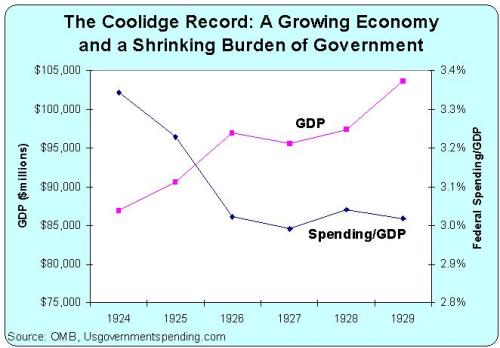
Given the tendency of politicians to buy votes with other people’s money, I’m especially impressed by his frugality. He followed my Golden Rule about 90 years before I ever proposed the concept.
Let’s further investigate his performance.
Larry Reed of the Foundation for Economic Education has two must-read articles about Coolidge’s track record. First, to illustrate Coolidge’s admirable philosophy of fiscal restraint, he shares these key passages from his 1925 inauguration.

I favor the policy of economy, not because I wish to save money, but because I wish to save people. The men and women of this country who toil are the ones who bear the cost of the Government. Every dollar that we carelessly waste means that their life will be so much the more meager. Every dollar that we prudently save means that their life will be so much the more abundant. Economy is idealism in its most practical form. …The wisest and soundest method of solving our tax problem is through economy…The collection of any taxes which are not absolutely required, which do not beyond reasonable doubt contribute to the public welfare, is only a species of legalized larceny. …They do not support any privileged class; they do not need to maintain great military forces; they ought not to be burdened with a great array of public employees…. I am opposed to extremely high rates, because they produce little or no revenue, because they are bad for the country, and, finally, because they are wrong. …The wise and correct course to follow in taxation and all other economic legislation is not to destroy those who have already secured success but to create conditions under which everyone will have a better chance to be successful.
Magnificent.
And you should also see what he said in 1926, when celebrating the 150th anniversary of America’s independence. Larry Reed also debunked the silly notion that Coolidge was responsible for the Great Depression of the 1930s.

So-called “progressives” tell us that Calvin Coolidge was a bad president because the Great Depression started just months after he left office. …Should Coolidge get any of the blame for the Great Depression? The Federal Reserve’s expansion of money and credit in the 1920s certainly set the country up for at least a mild fall, but that wasn’t Coolidge’s fault. He saw the Fed as the “independent” entity it was supposed to be and didn’t meddle with it. At least once he expressed concern that the Fed might be fostering a bubble but he otherwise didn’t make a stink about it. “Not my bailiwick,” he believed. We can legitimately say that Coolidge should have criticized the Fed’s easy money policy more loudly. …In any event, far worse than the Fed’s inflation was its deflation, which didn’t begin in earnest until the final weeks of the Coolidge administration. …Every good economist concedes that erratic monetary policy at the Fed was at least a minor cause of the 1920s boom and surely a major cause of the 1930s bust. You can’t blame that on Coolidge.
If you want more information about the Fed’s role in causing economic turmoil, I recommend this video presentation from George Selgin. Larry’s column points out that both Herbert Hoover and Franklin Roosevelt then imposed policies that lengthened and deepened the downturn.
Markets were, in fact, making a comeback in the spring of 1930 and unemployment had not yet hit double digits. Not until June 1930, when Congress and President Hoover raised tariffs and triggered an international trade war, did recession cascade into depression. Two years later, they flattened just about everybody who was still standing by doubling the income tax. …Franklin Roosevelt…then delivered…absurd interventions kept the economy in depression for another seven years.
What especially tragic about the Great Depression is that Warren Harding showed, just a decade earlier, how to quickly put an end to a deep downturn. I’ll close with by emphasizing this quote from Coolidge’s inaugural address. Every supporter of limited government should withhold support from any politician who is unable to echo this sentiment today.
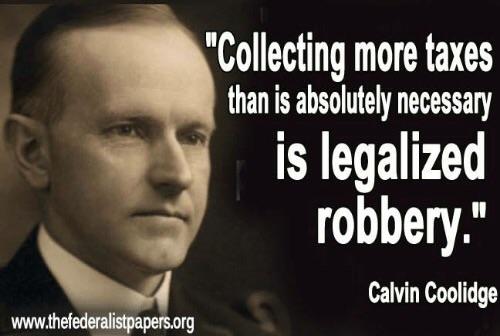
P.S. There is another president that I admire, though the number of good presidents is greatly outnumbered by the motley – and bipartisan – collection of bad presidents.
Tuesday, November 22, 2016
Quote of the Day!
“Nothing in the world can take the place of persistence.
- Talent will not: Nothing is more common than unsuccessful men with talent.
- Genius will not: Unrewarded genius is almost a proverb.
- Education cannot: The world is full of educated derelicts.
- Persistence and determination alone are omnipotent.
- The slogan, “press on” has solved, and always will solve, the problems of the human race.”
President Calvin Coolidge
Question: How many conservative Presidents served in that office in the 20th century, and who were they?
Thursday, November 10, 2016
Thought For The Day!
“Nothing in the world can take the place of persistence.
- Talent will not: Nothing is more common than unsuccessful men with talent.
- Genius will not: Unrewarded genius is almost a proverb.
- Education cannot: The world is full of educated derelicts.
Subscribe to:
Posts (Atom)
The problem is so little is known about what he stood for and what he accomplished, which was a great deal, and he had the same kind of petty Republican leadership to overcome Trump has had to deal with, so the Republican leadership has always had John McCain like mental issues going back over 100 years.
The worst thing that ever happened politically in the 20th century was that Coolidge, who hated being President, didn't run for his second term in 1928. That brought Hoover to the Presidency and that led to the Depression, which led to FDR being elected and he ushered in the Great Depression, and the New Deal, which wasn't new or a deal, but it was the foundation for what we're calling the Deep State.
Recommended reading Amity Schlaes book "Coolidge". If anyone refuses to buy from Amazon, there are other sources, but I highly recommend buying it, and reading it. Amity Schlaes is a great historian, but she's not a great story teller because her books are complicated, with a lot of cross referencing of characters and events, and don't lend themselves to story telling. In this book she tells good history and a good story.