Showing posts with label July 4th. Show all posts
Showing posts with label July 4th. Show all posts
Monday, July 4, 2022

Tuesday, July 6, 2021
George Foreman expresses patriotism amid athletes' protest of US flag
Byt Jeremy Beaman, Breaking News Reporter July 05, 2021
Boxing great George Foreman said he is "not ashamed" of his love for America in an Independence Day tribute, drawing a stark contrast with some professional athletes' recent protests of the U.S. flag.
"For about 54 years, people have ask[ed] me not to keep saying 'I love America,'" Foreman wrote in a tweet, accompanied by a photo of him wearing a Team USA boxing uniform and holding a U.S. flag that was taken after he won the Olympic gold medal in 1968. "Well I do and I'm not ashamed. Don't leave it; Love it. Happy 4th of July."
At 19 years of age, Foreman competed in the 1968 Olympics in Mexico City and nabbed the gold medal, beating Soviet boxer Jonas Cepulis to become heavyweight champion of the games. Foreman, who would later go on to become a world heavyweight champion, waved a U.S. flag as he paraded about the ring after his Olympic victor.........To Read More.....Our American Inheritance
We must not forget our forebears’ sacrifices.
As Independence Day dawns again, the United States seems disoriented and on edge. The one-two punch of Covid-19 and urban riots, coupled with a sense of economic fragility and impending inflation, has left many feeling drained and nervous about the future. Institutions that once served as the ballast for national well-being have shown themselves to be untrustworthy. Americans brace for the next wave of disruption.
When Twitter, Facebook, and cable news frame the issues of the day, it’s hard not to be discouraged. We are polarized and angry, and the radical Left is to blame—or maybe it’s the fascist Right. The despair is often accompanied by a self-righteous assurance that things would be better if only our political opponents would disappear.
But another America still exists, beyond the sound and fury of Twitter and the Beltway. It lives quietly in homes, where parents try to raise their children well. It exists in schools, where dedicated teachers show up day after day to teach. It flourishes in neighborhoods, community centers, and diners, where neighbors gather for conversation and a shared story. It pervades churches, synagogues, and mosques, where families pause from their busy lives to return thanks to God. Indeed, despite the turmoil and uncertainty, we have much to be grateful for.
If citizenship, properly understood, begins with gratitude, gratitude begins when we recognize that we are the beneficiaries of a great and multifaceted inheritance, as Edmund Burke understood. Writing at the outset of the French Revolution, Burke anticipated with remarkable clarity the disorder and devastation that was coming. Today, American society flirts with revolutionary sentiments that recall the attitudes that motivated the Jacobins. We would do well to listen to Burke’s warnings, for we risk squandering our inheritance—a fateful civilizational move.
Burke criticizes those revolutionaries who have learned “to despise all their predecessors.” Such despising led to “a great departure from the ancient course.” This wholesale rejection of the past represents, for Burke, the height of carelessness mixed with naïveté about the nature of human beings and human societies. He levels his attack at those who willingly ignore what they have inherited: “You began ill, because you began by despising everything that belonged to you.”
For Burke, common possessions—our social and political institutions—flow from an inheritance. To reject that inheritance is to reject the very ideas, forms, customs, practices, and institutions that constitute a people. It is a kind of social and political suicide. Ironically, such a rejection of the past in the name of a better future represents a serious threat to the future in whose name the rejection is made, for “people will not look forward to posterity, who never look backward to their ancestors.”
If we truly wish to secure a good, stable, and just future, we should begin with our inheritance: recognizing the good therein; lovingly improving upon that which has been received; and, in due time, passing that improved inheritance on to the next generation. In this way, “the idea of inheritance furnishes a sure principle of conservation, and a sure principle of transmission; without at all excluding a principle of improvement.”
What Burke describes is stewardship. When we understand ourselves as stewards, we see that we are inheritors of cultural and political goods that must be cultivated if they are to survive. Civilization is not automatic; a free society is not natural. In fact, political freedom is a remarkable achievement that required generations of sacrifice, experimentation, discipline, and practice. In America, we inherited an English tradition in self-government that developed over centuries. The Magna Carta and the English Bill of Rights—not to mention the Bible—stand behind the Declaration of Independence and Constitution. America’s founding documents are unimaginable apart from the principles and practices articulated and fostered by the Founders’ predecessors.
Today, we enjoy the blessings of freedom won by the sacrifices of our forebears, who hoped that their offspring would live free. When we take these things for granted, when we act as if political freedom is a natural occurrence, or a right that can simply be demanded; and when we believe that life in a free society entails only benefits to be enjoyed and no responsibilities to be shouldered, we are consuming finite cultural capital.
Stewardship of this cultural and political inheritance means living gratefully and responsibly in such a way that we strengthen our institutions and pass them along to the next generation. We must seek to inculcate in ourselves and our children the habits and practices necessary for sustaining and improving what we have been given. Ignoring this task means squandering the very things that make a free society possible.
On Independence Day, set aside some time to remember and celebrate America’s founding principles. Let us recommit ourselves to the responsibility of upholding those principles with fidelity and steadfastness born of gratitude. Let us take seriously the responsibilities, and not just the rights, of citizenship. Americans are inheritors of great but fragile gifts; gratitude should foster a commitment to steward them well.
The Inspiration of the Declaration of Independence
Calvin Coolidge July 4, 2021
Editor’s note: This July 4, City Journal is proud to reprint President Calvin Coolidge’s memorable 1926 speech marking the 150th anniversary of American independence.
We meet to celebrate the birthday of America. The coming of a new life always excites our interest. Although we know in the case of the individual that it has been an infinite repetition reaching back beyond our vision, that only makes it the more wonderful. But how our interest and wonder increase when we behold the miracle of the birth of a new nation. It is to pay our tribute of reverence and respect to those who participated in such a mighty event that we annually observe the fourth day of July. Whatever may have been the impression created by the news which went out from this city on that summer day in 1776, there can be no doubt as to the estimate which is now placed upon it. At the end of 150 years the four corners of the earth unite in coming to Philadelphia as to a holy shrine in grateful acknowledgement of a service so great, which a few inspired men here rendered to humanity, that it is still the preeminent support of free government throughout the world.
Although a century and a half measured in comparison with the length of human experience is but a short time, yet measured in the life of governments and nations it ranks as a very respectable period. Certainly enough time has elapsed to demonstrate with a great deal of thoroughness the value of our institutions and their dependability as rules for the regulation of human conduct and the advancement of civilization. They have been in existence long enough to become very well seasoned. They have met, and met successfully, the test of experience.
It is not so much then for the purpose of undertaking to proclaim new theories and principles that this annual celebration is maintained, but rather to reaffirm and reestablish those old theories and principles which time and the unerring logic of events have demonstrated to be sound. Amid all the clash of conflicting interests, amid all the welter of partisan politics, every American can turn for solace and consolation to the Declaration of Independence and the Constitution of the United States with the assurance and confidence that those two great charters of freedom and justice remain firm and unshaken. Whatever perils appear, whatever dangers threaten, the Nation remains secure in the knowledge that the ultimate application of the law of the land will provide an adequate defense and protection.
It is little wonder that people at home and abroad consider Independence Hall as hallowed ground and revere the Liberty Bell as a sacred relic. That pile of bricks and mortar, that mass of metal, might appear to the uninstructed as only the outgrown meeting place and the shattered bell of a former time, useless now because of more modern conveniences, but to those who know they have become consecrated by the use which men have made of them. They have long been identified with a great cause. They are the framework of a spiritual event. The world looks upon them, because of their associations of one hundred and fifty years ago, as it looks upon the Holy Land because of what took place there nineteen hundred years ago. Through use for a righteous purpose they have become sanctified.
It is not here necessary to examine in detail the causes which led to the American Revolution. In their immediate occasion they were largely economic. The colonists objected to the navigation laws which interfered with their trade, they denied the power of Parliament to impose taxes which they were obliged to pay, and they therefore resisted the royal governors and the royal forces which were sent to secure obedience to these laws. But the conviction is inescapable that a new civilization had come, a new spirit had arisen on this side of the Atlantic more advanced and more developed in its regard for the rights of the individual than that which characterized the Old World. Life in a new and open country had aspirations which could not be realized in any subordinate position. A separate establishment was ultimately inevitable. It had been decreed by the very laws of human nature. Man everywhere has an unconquerable desire to be the master of his own destiny.
We are obliged to conclude that the Declaration of Independence represented the movement of a people. It was not, of course, a movement from the top. Revolutions do not come from that direction. It was not without the support of many of the most respectable people in the Colonies, who were entitled to all the consideration that is given to breeding, education, and possessions. It had the support of another element of great significance and importance to which I shall later refer. But the preponderance of all those who occupied a position which took on the aspect of aristocracy did not approve of the Revolution and held toward it an attitude either of neutrality or open hostility. It was in no sense a rising of the oppressed and downtrodden. It brought no scum to the surface, for the reason that colonial society had developed no scum. The great body of the people were accustomed to privations, but they were free from depravity. If they had poverty, it was not of the hopeless kind that afflicts great cities, but the inspiring kind that marks the spirit of the pioneer. The American Revolution represented the informed and mature convictions of a great mass of independent, liberty-loving, God-fearing people who knew their rights, and possessed the courage to dare to maintain them.
The Continental Congress was not only composed of great men, but it represented a great people. While its members did not fail to exercise a remarkable leadership, they were equally observant of their representative capacity. They were industrious in encouraging their constituents to instruct them to support independence. But until such instructions were given they were inclined to withhold action.
While North Carolina has the honor of first authorizing its delegates to concur with other Colonies in declaring independence, it was quickly followed by South Carolina and Georgia, which also gave general instructions broad enough to include such action. But the first instructions which unconditionally directed its delegates to declare for independence came from the great Commonwealth of Virginia. These were immediately followed by Rhode Island and Massachusetts, while the other Colonies, with the exception of New York, soon adopted a like course.
This obedience of the delegates to the wishes of their constituents, which in some cases caused them to modify their previous positions, is a matter of great significance. It reveals an orderly process of government in the first place; but more than that, it demonstrates that the Declaration of Independence was the result of the seasoned and deliberate thought of the dominant portion of the people of the Colonies. Adopted after long discussion and as the result of the duly authorized expression of the preponderance of public opinion, it did not partake of dark intrigue or hidden conspiracy. It was well advised. It had about it nothing of the lawless and disordered nature of a riotous insurrection. It was maintained on a plane which rises above the ordinary conception of rebellion. It was in no sense a radical movement but took on the dignity of a resistance to illegal usurpations. It was conservative and represented the action of the colonists to maintain their constitutional rights which from time immemorial had been guaranteed to them under the law of the land.
When we come to examine the action of the Continental Congress in adopting the Declaration of Independence in the light of what was set out in that great document and in the light of succeeding events, we can not escape the conclusion that it had a much broader and deeper significance than a mere secession of territory and the establishment of a new nation. Events of that nature have been taking place since the dawn of history. One empire after another has arisen, only to crumble away as its constituent parts separated from each other and set up independent governments of their own. Such actions long ago became commonplace. They have occurred too often to hold the attention of the world and command the admiration and reverence of humanity. There is something beyond the establishment of a new nation, great as that event would be, in the Declaration of Independence which has ever since caused it to be regarded as one of the great charters that not only was to liberate America but was everywhere to ennoble humanity.
It was not because it was proposed to establish a new nation, but because it was proposed to establish a nation on new principles, that July 4, 1776, has come to be regarded as one of the greatest days in history. Great ideas do not burst upon the world unannounced. They are reached by a gradual development over a length of time usually proportionate to their importance. This is especially true of the principles laid down in the Declaration of Independence. Three very definite propositions were set out in its preamble regarding the nature of mankind and therefore of government. These were the doctrine that all men are created equal, that they are endowed with certain inalienable rights, and that therefore the source of the just powers of government must be derived from the consent of the governed.
If no one is to be accounted as born into a superior station, if there is to be no ruling class, and if all possess rights which can neither be bartered away nor taken from them by any earthly power, it follows as a matter of course that the practical authority of the Government has to rest on the consent of the governed. While these principles were not altogether new in political action, and were very far from new in political speculation, they had never been assembled before and declared in such a combination. But remarkable as this may be, it is not the chief distinction of the Declaration of Independence. The importance of political speculation is not to be under-estimated, as I shall presently disclose. Until the idea is developed and the plan made there can be no action.
It was the fact that our Declaration of Independence containing these immortal truths was the political action of a duly authorized and constituted representative public body in its sovereign capacity, supported by the force of general opinion and by the armies of Washington already in the field, which makes it the most important civil document in the world. It was not only the principles declared, but the fact that therewith a new nation was born which was to be founded upon those principles and which from that time forth in its development has actually maintained those principles, that makes this pronouncement an incomparable event in the history of government. It was an assertion that a people had arisen determined to make every necessary sacrifice for the support of these truths and by their practical application bring the War of Independence to a successful conclusion and adopt the Constitution of the United States with all that it has meant to civilization.
The idea that the people have a right to choose their own rulers was not new in political history. It was the foundation of every popular attempt to depose an undesirable king. This right was set out with a good deal of detail by the Dutch when as early as July 26, 1581, they declared their independence of Philip of Spain. In their long struggle with the Stuarts the British people asserted the same principles, which finally culminated in the Bill of Rights deposing the last of that house and placing William and Mary on the throne. In each of these cases sovereignty through divine right was displaced by sovereignty through the consent of the people. Running through the same documents, though expressed in different terms, is the clear inference of inalienable rights. But we should search these charters in vain for an assertion of the doctrine of equality. This principle had not before appeared as an official political declaration of any nation. It was profoundly revolutionary. It is one of the corner stones of American institutions.
But if these truths to which the declaration refers have not before been adopted in their combined entirety by national authority, it is a fact that they had been long pondered and often expressed in political speculation. It is generally assumed that French thought had some effect upon our public mind during Revolutionary days. This may have been true. But the principles of our declaration had been under discussion in the Colonies for nearly two generations before the advent of the French political philosophy that characterized the middle of the eighteenth century. In fact, they come from an earlier date. A very positive echo of what the Dutch had done in 1581, and what the English were preparing to do, appears in the assertion of the Rev. Thomas Hooker of Connecticut as early as 1638, when he said in a sermon before the General Court that—
“The foundation of authority is laid in the free consent of the people.
The choice of public magistrates belongs unto the people by God’s own allowance.”
This doctrine found wide acceptance among the nonconformist clergy who later made up the Congregational Church. The great apostle of this movement was the Rev. John Wise, of Massachusetts. He was one of the leaders of the revolt against the royal governor Andros in 1687, for which he suffered imprisonment. He was a liberal in ecclesiastical controversies. He appears to have been familiar with the writings of the political scientist, Samuel Pufendorf, who was born in Saxony in 1632. Wise published a treatise, entitled “The Church’s Quarrel Espoused,” in 1710, which was amplified in another publication in 1717. In it he dealt with the principles of civil government. His works were reprinted in 1772 and have been declared to have been nothing less than a textbook of liberty for our Revolutionary fathers.
While the written word was the foundation, it is apparent that the spoken word was the vehicle for convincing the people. This came with great force and wide range from the successors of Hooker and Wise. It was carried on with a missionary spirit which did not fail to reach the Scotch-Irish of North Carolina, showing its influence by significantly making that Colony the first to give instructions to its delegates looking to independence. This preaching reached the neighborhood of Thomas Jefferson, who acknowledged that his “best ideas of democracy” had been secured at church meetings.
That these ideas were prevalent in Virginia is further revealed by the Declaration of Rights, which was prepared by George Mason and presented to the general assembly on May 27, 1776. This document asserted popular sovereignty and inherent natural rights, but confined the doctrine of equality to the assertion that “All men are created equally free and independent.” It can scarcely be imagined that Jefferson was unacquainted with what had been done in his own Commonwealth of Virginia when he took up the task of drafting the Declaration of Independence. But these thoughts can very largely be traced back to what John Wise was writing in 1710. He said, “Every man must be acknowledged equal to every man.” Again, “The end of all good government is to cultivate humanity and promote the happiness of all and the good of every man in all his rights, his life, liberty, estate, honor, and so forth.”
And again, “For as they have a power every man in his natural state, so upon combination they can and do bequeath this power to others and settle it according as their united discretion shall determine.” And still again, “Democracy is Christ’s government in church and state.” Here was the doctrine of equality, popular sovereignty, and the substance of the theory of inalienable rights clearly asserted by Wise at the opening of the eighteenth century, just as we have the principle of the consent of the governed stated by Hooker as early as 1638.
When we take all these circumstances into consideration, it is but natural that the first paragraph of the Declaration of Independence should open with a reference to Nature’s God and should close in the final paragraphs with an appeal to the Supreme Judge of the world and an assertion of a firm reliance on Divine Providence. Coming from these sources, having as it did this background, it is no wonder that Samuel Adams could say, “The people seem to recognize this resolution as though it were a decree promulgated from heaven.”
No one can examine this record and escape the conclusion that in the great outline of its principles the Declaration was the result of the religious teachings of the preceding period. The profound philosophy which Jonathan Edwards applied to theology, the popular preaching of George Whitefield, had aroused the thought and stirred the people of the Colonies in preparation for this great event. No doubt the speculations which had been going on in England, and especially on the Continent, lent their influence to the general sentiment of the times. Of course, the world is always influenced by all the experience and all the thought of the past. But when we come to a contemplation of the immediate conception of the principles of human relationship which went into the Declaration of Independence we are not required to extend our search beyond our own shores. They are found in the texts, the sermons, and the writings of the early colonial clergy who were earnestly undertaking to instruct their congregations in the great mystery of how to live. They preached equality because they believed in the fatherhood of God and the brotherhood of man. They justified freedom by the text that we are all created in the divine image, all partakers of the divine spirit.
Placing every man on a plane where he acknowledged no superiors, where no one possessed any right to rule over him, he must inevitably choose his own rulers through a system of self-government. This was their theory of democracy. In those days such doctrines would scarcely have been permitted to flourish and spread in any other country. This was the purpose which the fathers cherished. In order that they might have freedom to express these thoughts and opportunity to put them into action, whole congregations with their pastors had migrated to the colonies. These great truths were in the air that our people breathed. Whatever else we may say of it, the Declaration of Independence was profoundly American.
If this apprehension of the facts be correct, and the documentary evidence would appear to verify it, then certain conclusions are bound to follow. A spring will cease to flow if its source be dried up; a tree will wither if its roots be destroyed. In its main features the Declaration of Independence is a great spiritual document. It is a declaration not of material but of spiritual conceptions. Equality, liberty, popular sovereignty, the rights of man – these are not elements which we can see and touch. They are ideals. They have their source and their roots in the religious convictions. They belong to the unseen world. Unless the faith of the American people in these religious convictions is to endure, the principles of our Declaration will perish. We can not continue to enjoy the result if we neglect and abandon the cause.
We are too prone to overlook another conclusion. Governments do not make ideals, but ideals make governments. This is both historically and logically true. Of course the government can help to sustain ideals and can create institutions through which they can be the better observed, but their source by their very nature is in the people. The people have to bear their own responsibilities. There is no method by which that burden can be shifted to the government. It is not the enactment, but the observance of laws, that creates the character of a nation.
About the Declaration there is a finality that is exceedingly restful. It is often asserted that the world has made a great deal of progress since 1776, that we have had new thoughts and new experiences which have given us a great advance over the people of that day, and that we may therefore very well discard their conclusions for something more modern. But that reasoning can not be applied to this great charter. If all men are created equal, that is final. If they are endowed with inalienable rights, that is final. If governments derive their just powers from the consent of the governed, that is final. No advance, no progress can be made beyond these propositions. If anyone wishes to deny their truth or their soundness, the only direction in which he can proceed historically is not forward, but backward toward the time when there was no equality, no rights of the individual, no rule of the people. Those who wish to proceed in that direction can not lay claim to progress. They are reactionary. Their ideas are not more modern, but more ancient, than those of the Revolutionary fathers.
In the development of its institutions America can fairly claim that it has remained true to the principles which were declared 150 years ago. In all the essentials we have achieved an equality which was never possessed by any other people. Even in the less important matter of material possessions we have secured a wider and wider distribution of wealth. The rights of the individual are held sacred and protected by constitutional guaranties, which even the Government itself is bound not to violate. If there is any one thing among us that is established beyond question, it is self-government—the right of the people to rule. If there is any failure in respect to any of these principles, it is because there is a failure on the part of individuals to observe them. We hold that the duly authorized expression of the will of the people has a divine sanction. But even in that we come back to the theory of John Wise that “Democracy is Christ’s government.” The ultimate sanction of law rests on the righteous authority of the Almighty.
On an occasion like this a great temptation exists to present evidence of the practical success of our form of democratic republic at home and the ever-broadening acceptance it is securing abroad. Although these things are well known, their frequent consideration is an encouragement and an inspiration. But it is not results and effects so much as sources and causes that I believe it is even more necessary constantly to contemplate. Ours is a government of the people. It represents their will. Its officers may sometimes go astray, but that is not a reason for criticizing the principles of our institutions. The real heart of the American Government depends upon the heart of the people. It is from that source that we must look for all genuine reform. It is to that cause that we must ascribe all our results.
It was in the contemplation of these truths that the fathers made their declaration and adopted their Constitution. It was to establish a free government, which must not be permitted to degenerate into the unrestrained authority of a mere majority or the unbridled weight of a mere influential few. They undertook the balance these interests against each other and provide the three separate independent branches, the executive, the legislative, and the judicial departments of the Government, with checks against each other in order that neither one might encroach upon the other. These are our guaranties of liberty. As a result of these methods enterprise has been duly protected from confiscation, the people have been free from oppression, and there has been an ever-broadening and deepening of the humanities of life.
Under a system of popular government there will always be those who will seek for political preferment by clamoring for reform. While there is very little of this which is not sincere, there is a large portion that is not well informed. In my opinion very little of just criticism can attach to the theories and principles of our institutions. There is far more danger of harm than there is hope of good in any radical changes. We do need a better understanding and comprehension of them and a better knowledge of the foundations of government in general. Our forefathers came to certain conclusions and decided upon certain courses of action which have been a great blessing to the world. Before we can understand their conclusions we must go back and review the course which they followed. We must think the thoughts which they thought. Their intellectual life centered around the meeting-house. They were intent upon religious worship. While there were always among them men of deep learning, and later those who had comparatively large possessions, the mind of the people was not so much engrossed in how much they knew, or how much they had, as in how they were going to live. While scantily provided with other literature, there was a wide acquaintance with the Scriptures. Over a period as great as that which measures the existence of our independence they were subject to this discipline not only in their religious life and educational training, but also in their political thought. They were a people who came under the influence of a great spiritual development and acquired a great moral power.
No other theory is adequate to explain or comprehend the Declaration of Independence. It is the product of the spiritual insight of the people. We live in an age of science and of abounding accumulation of material things. These did not create our Declaration. Our Declaration created them. The things of the spirit come first. Unless we cling to that, all our material prosperity, overwhelming though it may appear, will turn to a barren sceptre in our grasp. If we are to maintain the great heritage which has been bequeathed to us, we must be like-minded as the fathers who created it. We must not sink into a pagan materialism. We must cultivate the reverence which they had for the things that are holy. We must follow the spiritual and moral leadership which they showed. We must keep replenished, that they may glow with a more compelling flame, the altar fires before which they worshipped.
Top Photo by Felix Koch/Cincinnati Museum Center/Getty Images
Co-Dependence Day
Daniel Greenfield
July 04, 2021 @ Sultan Knish Blog
 The
old British entity that Washington, Hamilton, Jefferson, and a bunch of
other dead white men fought to be free of, has been recreated. The new
London is in Washington D.C. whose bureaucrats throw fits if they're
asked to leave the imperial city. The new social welfare empire is built
on redistribution.
The
old British entity that Washington, Hamilton, Jefferson, and a bunch of
other dead white men fought to be free of, has been recreated. The new
London is in Washington D.C. whose bureaucrats throw fits if they're
asked to leave the imperial city. The new social welfare empire is built
on redistribution.

Joe Biden is celebrating July 4th by proposing a massive expansion of the IRS. How better to celebrate the colonists who chased British tax collectors out than by replacing them with Biden's tax collectors.
But every progressive person knows that Independence Day is for extremists. The dream of the new post-national nation is Co-Dependence Day in which we all live happily together in a planned economy.

A few centuries ago, some young white men had refused to have their property and their political autonomy redistributed to an elite thousands of miles away.
The very idea of having a revolution over such a thing seems entirely absurd to today's wokies.
Or as another Englishman once again, "Imagine there's no countries". It's easy if you live in the EU.
All that the Crown really wanted was for the colonists to pay their “fair share”, a share that was determined thousands of miles away. All that the colonists wanted was the rights of Englishmen that they believed they were entitled to. After a great deal of bloodshed, the colonists won the right to be Americans instead—an odd series of consonants and vowels having to do with an Italian explorer but meaning personal freedom and limited government. Now we have free things, unlimited government, and our freedom shrinks in proportion to the growth of our free things and of the government that hands them out.
To the denizens of public housing watching the fireworks burn briefly in the sky, who get a free ride on everything from food to housing by taking away everyone else's freedom and future, the fireworks are just one more free thing in the sea of free things that they swim in.
To the Democrat voters of the welfare state, this is Fireworks Day. Every country has its fireworks days and this is the day that this one chooses to light up the night sky. The day means nothing to them because though they are surrounded by free things, they aren’t free. The difference between freedom and free things has been progressively erased so that many think that the American Revolution was fought because the British were racists or weren’t providing free transgender surgery to the colonies.
If only they knew about the NHS, they would vote to undo the American Revolution in a flash.
There is a big difference between a free country and a country of free things. You can have one or the other, but you can’t have both. A free country isn’t obsessed with free riders, only a country of free things obsesses with making everyone pay their fair share for the benefit of the people who want the free things. Rugged individualism has given way to stifling crowds, co-dependent on each other, lined shoulder to shoulder, clutching at each other’s wallets, crying, “Take from him and give to me."
We are a nation overflowing with the right to things paid for with other people’s money.
The
fireworks that shoot up in a wonderland of blue and red, silver and
gold, are a faint echo of the real thing, the gunpowder that blasted
back and forth between the lines of government troops, their Hessian
mercenaries and the rebel colonists who chose to ride free, rather than
bend their necks to the plans of an expanding empire. The faint smell of
gunpowder and the dark shapes of the barges only mime the war that was
fought here. A play of light and shadow whose meaning reaches fewer and
fewer people each year.
The expected speeches will celebrate some
notion of independence, but did so many men risk their lives just to
end up with a system that made the one they escaped seem positively
libertarian by comparison? If they had known that they were going to end
up with some version of the NHS, along with death panels, in a
co-dependent system where everyone is looted for the greater good of the
looters—they might have stayed home on their farms, sadly watching the
fighting from a distance.
JFK’s famous line, “Ask not what your country can do for you, ask what you can do for your country” was always a hollow lie. Half the country is expected to ask what their country can do for them, while the other half is expected to ask what they can do for their country. This simmering civil war is often pegged as a class war, but it isn’t about class. There are billionaires and paupers on both sides, and the divide cuts across the Middle Class, dividing those who derive their income from private business from those who receive it from government and government-subsidized employment.
The Fourth of July is Independence Day, but every other day is Co-Dependence Day, the days we celebrate our integration, our volunteerism and our compliance with a vast system which makes everyone dependent on the government and which makes the government dependent on everyone who still works for someone other than the government.
Empires function by draining every drop from their possessions to cover their costs. The British Crown tried to drain America to pay down its debt, resulting in growing protests from the population and eventually a revolution. Now the Empire of Co-Dependency is draining its independent subjects for the benefit of its dependent subjects and the dependency infrastructure that employs its numberless bureaucrats who govern it all.
A new crisis is always here to justify higher taxes and bigger government.
The
American Revolution was not a struggle for another nation, one of many,
but for a free nation. It was not split off to accommodate the national
strivings of an ethnic group or their historical destiny. Its guiding
idea, like its national holiday, was independence, but independence
means very little unless it reaches the individual.
A nation
where everyone is part of one great co-dependent community, a centrally
planned marketplace that can only be balanced if everyone is forced to
buy what they are told to buy, is not a free nation. It will not even be
independent for long. The logic of co-dependence is to expand that
dependency beyond the borders and make the region and then every part
the world dependent on one another to balance out the numbers.
Co-dependence required an end to states rights. It will eventually require an end to the rights of nations.
Like all pyramid schemes, the burden of dependency is passed on to greater and greater systems until its weight is more than that of the entire world. That burden of co-dependency is like a rock rolling downhill; it gathers more and more mass to itself, increasing its momentum, until it crashes.
The system attempts to stay ahead of the inevitable crash by making sure that every productive person pays his “fair share”. It hunts for individuals and nations who still aren’t rolling downhill, tips them over and pushes them off the mountain. All in the name of the greater good.
The new Crown is not a person, it is an idea. The throne at whose foot a formerly free people kneel is the golden seat of the welfare state. While the fireworks light up the sky, a counterrevolution undid the revolution. There is a new king and his face is on every magazine cover in the land. His bounty is a jagged bear trap that turns everyone into a ward of the state at their own expense.
As
the last wave of fireworks die out, the shooting stars sinking to earth
and vanishing into the darkness, the light of Independence Day fades
and the crowds slowly trudge away from the brief spectacle, past the
lines of police barricades, through narrow streets, past government
buildings, back to their co-dependent lives in a co-dependent nation
where the will of the people and the rights of the individual matter
less than the latest proposal to solve the problems of their
independence by making the country a more dependent place.
A few
hundred years ago in these streets, men and women celebrated the end of
tyranny, and in its darkest hour, lines of grim men marched along the
waterfront up to the highest point on the island to mount a final
defense. Sometimes the older buildings still wear their shadows on their
brick walls and by the golden light of the fireworks you can almost see
them, shadows moving in the darkness, their footsteps taking them
north, a faint song on their lips, muskets in their hands, their lives
lost and gained in defense of their freedom.
About Daniel Greenfield
Daniel Greenfield is a journalist investigating Islamic terrorism and
the Left. He is a Shillman Journalism Fellow at the David Horowitz
Freedom Center
Monday, July 5, 2021
July 4, 2021: Why America’s Founders Originally Rebelled & Their Thoughts Today
We Must Return to the Founder's Values to Save America the Beautiful
By Kelly O'Connell ——Bio and Archives--July 4, 2021 @ Canada Free Press
Cover Story | 7 Comments | Reader Friendly | Subscribe | Email Us
Somewhere between confusion and ignorance lies the teaching many Americans receive today on the motives of the Founders of the USA. The American Revolution was really a battle over ideas between the Old and New Worlds. And the chief idea being fought over in the 1770s was that of Liberty.
Colonists considered themselves heirs of the rights of freeborn Englishmen. This powerful conviction was torn-asunder by the decisions of mad King George and an arrogant Parliament. The English realized too late that principled Americans would be willing to fight and die for such beliefs as the right to representative government and the sanctity of private property.
I. Primary Goal of American Revolution: Preservation of Liberty
Amazingly, we again today must reassert our rights to such concepts as Life, Liberty and Property, against a tyrannical government or allow our children to eke out an existence as slaves of an all-powerful state.
The singular concern of American colonists—their overarching goal—was to maintain their liberty, according to Bernard Bailyn, Professor Emeritus of Early American History at Harvard. Bailyn’s The Ideological Origins of the American Revolution, won the Pulitzer and Bancroft prizes, and is considered the single most important work on this topic in the last half century. Bailyn claims the Founders exhibited “a cluster of convictions focused on the effort to free the individual from the oppressive misuse of power, from the tyranny of the state.”
II. Overview of American Revolutionary Influences
The general influences of Americans supporting the Revolution were as follows:
A. England’s “Unwritten Constitution” & Legal History: This includes Magna Carta, Bill of Rights and Parliamentary style of government.
B. Classical Thinkers - The American Founders read Classical authors. Writes one author:
The typical education of colonial times began at about age eight. Students lucky enough to attend school normally learned Latin and Greek grammar. They read the historians Tacitus and Livy, Greek historians Herodotus and Thucydides, and translated the Latin poetry of Virgil and Horace. They were expected to know the language well enough to translate from the original into English and back again to the original in another grammatical tense. Classical Education also stressed the seven liberal arts: Latin, logic, rhetoric (the “trivium”), as well as arithmetic, geometry, astronomy, and music (the “quadrivium”).
C. Enlightenment - Many Americans read widely in the European Enlightenment including the French philosophers, British empiricists—like Locke, and Scottish Enlightenment thinkers such as Frances Hutcheson.
D. British Puritan Revolution Pamphlets—(see below).
E. Christianity—Both the Constitution in general, and specifically the concept of Federalism—were based upon the Biblical concept of “Covenant.”
Says Bailyn, the Americans, already much adjusted to greater levels of freedom than their continental British brethren, had long suspected England was attempting to surreptitiously deny their English rights. Colonists suspected the Anglican clergy would be used to undermine the State’s religious freedoms; whereas petty bureaucrats sent from the mother country would succeed in taxing them to death. Other issues bedeviling the colonists included being under a foreign standing army.
III. Revolutionary Writers and Themes
Colonial mid-18th century American writers were influenced by the works of Classical thinkers and 17th century English Revolutionaries, like John Locke’s Second Treatise of Civil Government and John Milton’s political writings, such as his The Tenure of Kings and Magistrates. These thinkers hallowed ideals of natural rights and individual liberty. Colonial American Revolutionary tracts were massively influenced by such British libertarian articles and pamphlets, widely distributed in the American colonies.
For instance, American libertarianism was taught via Cato’s Letters, an English newspaper article series. These libertarian writers translated John Locke’s sublime political writings for a more general audience. Thus did some men learn they had natural rights of life, liberty, and property, which governments must not poach. Bailyn proved the American Revolution was both genuinely radical and revolutionary, calling it “the transforming libertarian radicalism” of the American Revolution.
III. Defining Events: Property Rights Versus Tax Acts
The tinder which helped spark the Revolution aflame was taxation. Many remember the war-cry: “No taxation without representation!” Yet the issue was larger than just taxes. According to the Revolutionary mindset, it was not just the amount of taxes taken, but the very fact that England deigned to do such a taking, period. In fact, one author argued smaller taxes were even more devilish since they were less likely to be protested, but still as much a subjugation.
There were many different tax acts which drew outcries:
- The Sugar Act- 1764—Strictly collected on molasses, a very common import, and placed taxes on other common goods, including sugar, silk, and wine.
- The Stamp Act—1765 - This tax had nothing to do with stamps, but rather taxed every printed document used in the colonies. This included licenses, newspapers, and fliers. If it was printed, it had a tax.
- The Townshend Acts- 1766- This series of acts put taxes on commonly used goods, including on tea, paint, paper, lead, almost everything used in daily life in the colonies.
The British taxation of American goods was seen as putting colonists in bondage…”Taxation without representation is slavery!”
It sparked the Boston Tea Party protest, a precursor to the War. When
such writers as John Locke stated that all men were free, he meant any
freeman could also own property.
IV. Constitutionalism
We must study the Constitution itself to understand what the Founders were trying to achieve in the Revolution. In TThe Origins of American Constitutionalism, Donald S. Lutz claims American constitutionalism begins with the charters and covenants forming the American colonies.
Lutz says the US Constitution was neither inherited from the British or simply invented by the Federalists in the summer of 1787, but influenced by both. He claims the Constitution comes from a tradition of American colonial charters and documents of political theory beginning 150 years prior to 1787. Lutz argues this via close textual analysis of such documents as the Mayflower Compact, the Fundamental Orders of Connecticut, the Rhode Island Charter of 1663, the first state constitutions, the Declaration of Independence, and the Articles of Confederation.
American Constitutionalism largely comes from radical Protestant interpretations of Judeo-Christian concepts first secularized into political agreements and incorporated into constitutions and bills of rights. This rich tradition also claims aspects of English common law and English Whig theory. Individual writers were also influential, such as Montesquieu, Locke, Blackstone, and Hume.
V. Values of the Founders & Their Use Today
The following ten ideals were used by the Founders to build the nation of America from whole cloth.
A. General Regime of Liberty.
Patriot Patrick Henry once said, “Give me liberty or give me death.” Yet, today, we see constant encroachment of government into every area possible, often in the name of “security.” But the Founders would never accept trading freedom for comfort!
B. Principled Government Stands Upon Popular Consent
The Declaration says, “Governments are instituted among Men, deriving their just powers from the consent of the governed...” Yet we see many government decisions, such as Open Borders, being forced upon the people with only a minority of support.
C. Rule of Law
Only a commitment to run a government upon the rule of law can help men overcome institutional despotism, according to Rutherford’s Lex Rex (Law is King) and the Founders. And yet, today, American justice often depends just upon irrelevant factors, like one’s race—such as when Biden’s government seeks to benefit non-White farmers, which the courts then struck down.
D. Limited Government
The Founder knew that without a limited government, kings become gods rather quickly. This is why the Constitution is established to be a law settling all disputes. Yet, today we have leaders like Maxine Waters traveling out of her district to encourage a race war in the US Midwest.
E. Free Speech
Freedom of expression was a presumption to all the Founders, who then enshrined the concept in the First Amendment. Yet across the US, universities are using speech codes as an excuse to enforce Political Correctness and sanction and expel students and fire faculty.
F. Freedom of Religion
Most Founders self-identified as Christian, and blocking a state-sanctioned church was important to them in the interest of encouraging all sects equally. But America’s war against faith by many public and private institutions has no precedent.
G. Capitalism
Against the default socialism of the current administration, America was established upon a premise of Capitalism. This is why the Constitution has a Contracts Clause...No State shall pass any Law impairing the Obligation of Contracts. (U.S. Constitution, Article I, Section 10). But Biden’s socialism can only be established when the rights of property are extinguished.
H. Federalism & State’s Rights
Federalism is the idea of separation of powers on a national, regional and local level. It is one of the reasons America has been so successful. Yet, Biden claims to have new insights, i.e. more federal control of states, like the border. This also explains the DOJ suing GA for voter laws which SCOTUS is upholding similar ones in other states.
I. Republicanism
One of the chief ideas of the Founders was leadership by wise elders within the context of a popularly elected government. This notion is seen in diffusion of power through many institutions across USA, such as the Electoral College. Yet Biden is attacking state legislatures and private businesses by forcing money into states for Covid aid after the virus is in retreat such that healthy workers are making more from Fed aid than their old jobs would pay. Governors have now decided to refuse the funds to help put their work-forces back on the job.
J. Separation of Powers
The Founders believed that power must be separated to avoid tyranny. But Democrats want to pack SCOTUS with extra judges to create a rubber stamp for all their policies.
K. Property Rights
The great insight of Locke into the nature of building wealth for an entire society was defending the rights of private property for all men. Yet Biden relishes the notion of “redistributing wealth.” Not only would the Founders be furious at such ignorant and un-American posturing, history proves economic and human rights disasters always follow hard on the heels of socialism and communism.
CONCLUSION:
Let’s celebrate our Freedoms while they still exist. Don’t forget the chief right – Freedom of Speech. Recall when Supreme Court Justice Benjamin Cardozo stated almost a century ago, “this is the matrix, the indispensable condition of nearly every other form of freedom.” We cannot run a healthy democracy without our freedoms. Each one is precious, and together they help guarantee liberty, prosperity and happiness.
Kelly O'Connell -- Bio and Archives
Kelly O’Connell is an author and attorney. He was born on the West Coast, raised in Las Vegas, and matriculated from the University of Oregon. After laboring for the Reformed Church in Galway, Ireland, he returned to America and attended law school in Virginia, where he earned a JD and a Master’s degree in Government. He spent a stint working as a researcher and writer of academic articles at a Miami law school, focusing on ancient law and society. He has also been employed as a university Speech & Debate professor. He then returned West and worked as an assistant district attorney. Kelly is now is a private practitioner with a small law practice in New Mexico.
Friday, July 5, 2019
What We Should Be Celebrating on the 4th of July
July 4, 2019 by Dan Mitchell @ International Liberty
For my annual Independence Day columns, I sometimes try to make serious points, such as last year when I shared the very wise words of Calvin Coolidge, who is probably America’s most-underappreciated president.
 Or when I wrote about the proper meaning of patriotism, as I did in 2010 and 2014.
Other years, I celebrate July 4 with some humor, such as my sarcastic Declaration of Dependency in 2011.
Or some cartoons about Obamacare vs. American principles the following year.
For 2019, let’s mix seriousness and satire.
We’ll start with the former. John Stossel’s column for Reason explains what Americans should be celebrating.
Reminds me of what Reagan said.
One of the key takeaways is that American ideals are inspiring, but government policies often leave much to be desired.
Harry Stewart, one of the famed Tuskegee Airmen, has a great essay in the Wall Street Journal on patriotism even when your government is flawed.
Now let’s enjoy some satire, though combined with a serious message.
Bryan Riley of the National Taxpayers Union has a July 4th-themed column on Trump’s destructive trade taxes.
Last but not least, here’s an alien learning about the long-term consequences of America’s fight for independence, which began as a tax revolt.

Taxation without representation wasn’t very appealing, but the cartoon makes a very good point about the downside of taxation with representation.
Which is a good opportunity to remind everyone why America’s Founders were wise to create a republic rather than a majoritarian democracy.
Too bad the Supreme Court, most recently with Obamacare, has failed in its job to protect economic liberty.
Or when I wrote about the proper meaning of patriotism, as I did in 2010 and 2014.Other years, I celebrate July 4 with some humor, such as my sarcastic Declaration of Dependency in 2011.
Or some cartoons about Obamacare vs. American principles the following year.
For 2019, let’s mix seriousness and satire.
We’ll start with the former. John Stossel’s column for Reason explains what Americans should be celebrating.
We have reason to celebrate. The Fourth honors the founding of America. It’s the anniversary of the day in 1776 that the Declaration of Independence was approved.

The Declaration was important.
It didn’t say that America would be the best country because it would have the biggest military, toughest leaders, most government giveaways, or tightest borders.
The great innovation that day in Philadelphia was the declaration that the United States would have a limited government, rooted in the idea that every individual has inalienable rights. …
It was America’s emphasis on limited government—wanting to make sure no one in government would ever again wield power like that of the British king—that made our revolution the greatest and most lasting success of recent centuries. …France created revolutionary committees that murdered dissenters. Russia replaced its czar with a communist police state that confiscated farms, killing millions. …
America happened—and continues to happen—spontaneously, when its leaders are smart enough to just stay out of our way.
America will do best if we remember that the Declaration of Independence talks about limited government and reminds us that every individual has inalienable rights.Amen.
Reminds me of what Reagan said.
One of the key takeaways is that American ideals are inspiring, but government policies often leave much to be desired.
Harry Stewart, one of the famed Tuskegee Airmen, has a great essay in the Wall Street Journal on patriotism even when your government is flawed.
On June 27, 1944, I graduated from Tuskegee Army Flying School, established in Alabama shortly before America’s entry into World War II to train young African-American men as Army combat pilots. …The train ride down South was eye-opening for a teenager who’d never traveled far from New York. When the train crossed the Mason-Dixon Line, the conductor came by and pointed at me: “Move to the colored car.” It was disconcerting, but I saw it as an unavoidable hurdle to earning my wings. I swallowed hard and kept going. …

You weren’t just learning to fly; you were serving your country, and you were going to fight. …I flew 43 combat missions with the 332nd Fighter Group… Our commander was the legendary Benjamin O. Davis Jr., who had endured four years of the silent treatment from white cadets at West Point but nevertheless managed to graduate 35th out of a class of 276. …
His convictions were encapsulated in his statement: “The privileges of being an American belong to those brave enough to fight for them.” …I am proud that I contributed to the cause. We called it winning the Double V, victory against totalitarianism abroad and institutional racism at home. July 4 is my birthday, but I celebrate my country’s birthday too. America was not perfect in the 1940s and is not perfect today, yet I fought for it then and would do so again.There’s a lesson in those words for Colin Kaepernick.
Now let’s enjoy some satire, though combined with a serious message.
Bryan Riley of the National Taxpayers Union has a July 4th-themed column on Trump’s destructive trade taxes.
…the next round of tariffs symbolizes just how un-American this trade war has become. …on $300 billion in imports, would include tariffs on tea and fireworks. They might as well be considering a tax on bald eagles. …the 1773 Boston Tea Party was a response to England’s 3 pence per pound tariff on tea imported from China.

As President John F. Kennedy observed, “When the people of Boston in 1773 threw cargoes of tea into the harbor, the American Revolution was in effect under way, symbolized by this revolution against a tariff–a tariff which meant taxation without representation.” …As we celebrate our country’s 243rd birthday, let’s also celebrate the American patriots who are following in the footsteps of our country’s founders by opposing costly new tariffs. …As we celebrate our country’s 243rd birthday, let’s also celebrate the American patriots who are following in the footsteps of our country’s founders by opposing costly new tariffs.Reminds me of the clever AAF visual on how government makes it more expensive to celebrate today.
Last but not least, here’s an alien learning about the long-term consequences of America’s fight for independence, which began as a tax revolt.
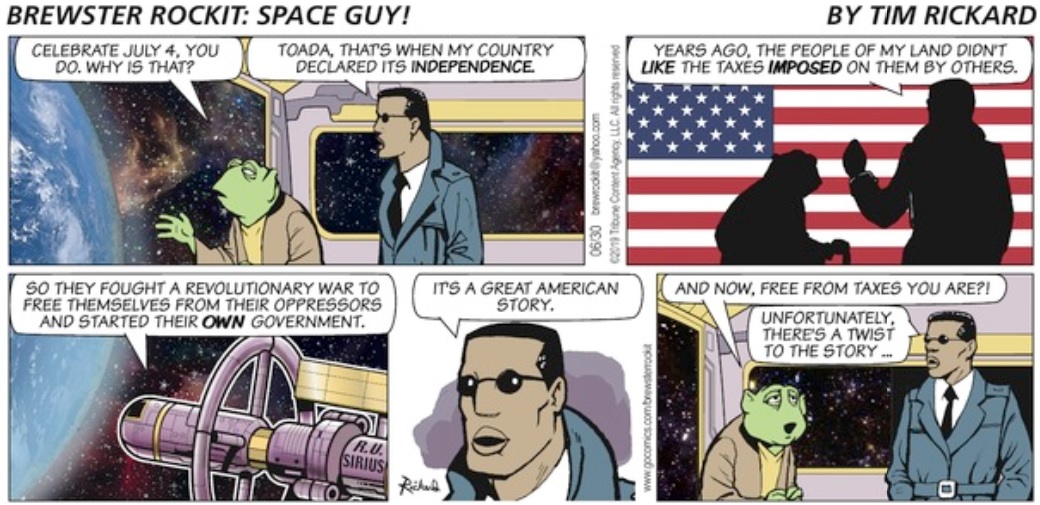
Taxation without representation wasn’t very appealing, but the cartoon makes a very good point about the downside of taxation with representation.
Which is a good opportunity to remind everyone why America’s Founders were wise to create a republic rather than a majoritarian democracy.
Too bad the Supreme Court, most recently with Obamacare, has failed in its job to protect economic liberty.
Subscribe to:
Posts (Atom)