Search This Blog

De Omnibus Dubitandum - Lux Veritas

Showing posts with label Scam. Show all posts

Monday, July 7, 2025

My Firsthand Knowledge about Anchor Babies

By Susan Daniels Jul 05, 2025 @ Susan's Newsletter 

There are two subjects on which I am extremely well versed: Barack Obama’s phony Connecticut Social Security number and anchor babies. I was schooled in both while working as a licensed private investigator, which I have done for more than thirty years.

One of my long-time clients is a company in Taiwan. For four years, I collected, with written permission, the medical records of more than eighty Chinese women who arrived in California to give birth.

Most of these women hired companies in China for $30,000, which arranged for help in getting tourist visas, arranging for living accommodations, and a hospital stay. They were also provided rides to doctors’ appointments. The companies advised them how to dress to disguise their pregnancy because women are not allowed to fly after a certain time, usually seven months.

The advantage for women to give birth in the U.S., whose babies were immediately considered citizens, included all the benefits Americans had, like access to social security and a path for the entire family to emigrate when the child turned eighteen.

A lengthy story in the NBC News explained how it worked.

Once I became fluent in reading doctors’ handwriting, it became easy. All the doctors with whom I came in contact were Chinese, but they, and their staff, were fluent in English and pleasant to work with. I also had to deal with about eight different hospitals in the Los Angeles area.

(I still laugh when I recall one of the doctors had written at the bottom of a page: “So far so good.”)

From the medical records I learned that few women had more than two weekly doctor visits before they gave birth. One woman gave birth the day after her first visit. The doctors charged between $2,500 to $3,500 and were paid in cash.

The doctors’ receptionists would complain to me about the anchor baby scam. They were working hard, while the women came in on tourist visas, gave birth, left a month later, but left with a baby who was entitled to everything they were working for. They resented how the women could afford to shop on Rodeo Drive.

A two-day hospital bill averaged $50,000. The women would sign a poverty pledge and the hospital would charge the women $5,000. The State of California coughed up the rest. I suspect no resident was aware of that. The women then filed with their insurance company to be reimbursed for their payment to the doctor and hospital.

The Chinese tradition was that women were to remain in bed for thirty days after birth, and, as part of the arrangement with the provider company, meals were delivered to them.

At no time were these women under the “jurisdiction” of the United States. They lied on their visas about the reason for coming here, and it violates the requirements of the 14th Amendment because they came as tourists.

My client, employed by various Chinese insurance companies, said the companies were angry because the policies required reimbursement to the women when there were doctors and hospitals in China that the women could have used.

That facet of my work for them came to an abrupt halt. A woman, who misjudged her due date, gave birth on the plane. The flight was diverted to Alaska. The woman was sent home on the next flight, the newborn was kept there, and she received a bill for $33,000 for the costs to the airline. I am unsure, but I suspect she had to pay if she wanted her baby.

The insurance companies rewrote their policies, and the scam was finished, as was my work. But I did learn some things that would interest a sociologist. I saw the passports of all the women. With few exceptions, they were all very attractive. Most were 5’3” and at almost nine months pregnant, weighed about 127 lbs. The only exceptions were a woman who was 5’7” and another who tipped the scale at 208 pounds.

If I recall correctly, there were three sets of twins, one baby born with six fingers on one hand, one stillborn, and a woman whose first child was stillborn but gave birth to a healthy boy. Births were almost equally divided by gender.

Dr. John Eastman in “Birthright Citizenship,” puts up a good argument against anchor babies when he was commenting on Trump v CASA, Inc.:

“In her dissenting opinion, Justice Sotomayor laughably contends that “the Order may even wrench newborns from the arms of parents lawfully in the United States, for it purports to strip citizenship from the children of parents legally present on a temporary basis.” “Those newborns,” she adds, “could face deportation, even as their parents remain lawfully in the country.” Had she bothered to look, she would have realized that the children of lawful, temporary visitors to this country, such as those on student or work visas, hold a “derivative nonimmigrant status” based on the parent’s nonimmigrant status.

And “Such evidence includes statements by the leading congressional sponsors of the 14th Amendment that the language “subject to the jurisdiction” means “a full and complete jurisdiction” and “not being subject to some foreign power.” In other words, it is not enough that a person is subject to the kind of partial jurisdiction that requires compliance with the laws; he must also be free from the jurisdiction of any other nation.

“In addition, there were the actions of the secretary (sic) of State in the decades following adoption of the 14th Amendment, denying citizenship to children born on U.S. soil to parents who were merely temporarily visiting the United States and therefore owed allegiance to a foreign power.”

DEI Justice Sotomayor, not known for her intellect, cherry-picked what was included in her dissenting opinion. It brings up an interesting question. Since both Sotomayor and DEI Elena Kagan are barren, whose children are they concerned about, since they have none of their own? Could it possibly be future Democrat voters?

The only time I was irritated by the work was because of the useless FBI. There was a story in the newspaper about their raid on some of the apartments where these women were staying. I called the Los Angeles office and told the agent who answered that I could provide the names of doctors treating these women. He told me to go to their website and put it there. I told him I could give him the information right then. He was not interested. They apparently just wanted the photo op but not more work.

https://m.media-amazon.com/images/I/61Tg652gkjL._SL1500_.jpg

Susan Daniels is a private investigator and the author of The Rubbish Hauler’s Wife versus Barack Obama: A True Story which is available on Amazon.com.

Politics like we have never seen.  Recommend Susan’s Newsletter to your friends. Also, there's a video here I can't reproduce.  Go to the original to view it.


Friday, May 12, 2023

Colonialism Redux


More and more “less-developed” countries are responding favorably to China’s political and financial offers of investment, conflict resolution, an alternative financial non-dollar system, and all-around benign, benevolent, Big Brotherhood.  The Chinese pitch is that it will help you by investing in your roads, ports, and resource development. China sells this in the name of trade: they will provide a market for the resources and pay you for them and you will use that money to buy manufactured products from China.

Trade generates prosperity and you will develop your country, they say. The resources, of course, are those China needs and the roads and ports are required to take the resources out of the country and ship them to China. The Chinese will send a lot of workers and technicians to direct, help, and train local workers to work efficiently on these projects, in order to keep costs low. Of course, to keep discipline among the Chinese workers and protect the locals from any Chinese miscreants, China will send a few military personnel and police to cooperate with local law enforcement to maintain order in the areas where they invest. ...................To Read More...

Wednesday, March 22, 2023

Is it a LOLR? No, It’s a Trap

Michael MungerMichael Munger March 20, 2023 @ American Institute for Economic Research

 n the 1983 film Return of the Jedi, Admiral Ackbar turns to the officers on the bridge and says what everyone already knew: “It’s a trap!” It had seemed a little too easy to be able to destroy the main threat, permanently and with no risk. Of course that turned out badly for the Alliance; they shouldn’t have been fooled.

Dodd-Frank and other new regulations were supposed to have fixed the banking system, permanently and without risk. But once again that was too good to be true, and it turns out that all that new regulation did was to set another trap, though not intentionally (although the benefits to large firms are at least partly intentional). The solution to effective banking regulation is to understand the role of the “Lender of Last Resort,” and to commit to doing nothing more, no matter what. As Richard Salsman and I argued more than a decade ago, the alternative, “Too Big to Fail,” has proven disastrous.

The Way to Regulate Banks: The Lender of Last Resort

Banks, and many other financial institutions, are brokers, mediating transactions between people who have money — depositors — and people who want to secure loans to do things with the money — borrowers. Brokers generally don’t hold on to the money that is deposited with them; the value of brokerage is connecting that money with an investment. In fact, the banking business was long described as a sleepy-but-safe activity, one that followed the “3-6-3 rule”:

  • 3 percent — the interest you pay on deposits
  • 6 percent — the rate you charge on loans
  • 3 pm — your daily tee time on the golf course, because this business runs itself

Banks package and sell a product called “liquidity.” Liquidity is a measure of how quickly and cheaply an asset can be used to buy something else. Importantly, liquidity is not money, but a measure of the demand to hold cash balances, rather than holding wealth in some other form. Still, cash is liquid. It is easy to agree on a price, and transferring ownership is cheap. Loans are (usually) illiquid. Loans (such as mortgages) are contracts that bind one party to another, requiring payments that are secured by an asset. In the case of a mortgage, for example, the loan is secured by the value of a home, meaning that it is possible to negotiate a much-lower interest rate than on an unsecured personal loan, because the risk to the lender is smaller.

It is possible to buy and sell loans, or stocks, or other equities, but it is much more expensive than paying cash. (This illiquidity was part of the reason that mortgage-backed securities seemed like such a good idea, because in theory at least those were liquid; in fact, it appears that mortgage-backed securities were pretty liquid, and held their value better than is sometimes described). Another form of loan is called a “bond,” which is a promise to make periodic payments for a term of time, and then repay the full amount of the loan, the principal, at the end of that term. Ten-year US Treasury bonds, for example, have a face value and an implied interest rate paid to the buyer of the bond.

As I said earlier, banks are brokers. They take in deposits, and then use those deposits to “buy” loans. The bank might be the originator of a loan, as in the case of many mortgages. Or the bank might literally buy bonds or other securities, financial instruments that generate a higher rate of return than just holding money.

The problem is obvious. There can be a mismatch in liquidity between the bank’s liabilities (depositors put in cash, and they want to be able to take cash out) and assets (loans, bonds, other securities of various kinds). It is easy to imagine situations where a bank will be technically solvent — the total value of all its assets exceeds the value of all its liabilities — but the bank can’t convert enough of those valuable assets into cash fast enough to let everyone pull out their money right now. And when everyone does want their cash, right now, that’s called a bank run.

A bank run is dramatic, and has been used in movies from It’s a Wonderful Life to Mary Poppins. (It can be fun to use these movies in class, as illustrations!) The reason folks hurry to get their money is that there isn’t enough, and if you snooze you lose. The policy problem is that  there is enough value, there just isn’t enough cash, today. That’s why the Lender of Last Resort (LOLR) function is so crucial. All that is required is a short-term loan so that there is enough cash today.

The cool thing about the LOLR solution — and note that the LOLR could be a private central clearinghouse, or store of cash that maintains value in liquid form for immediate disbursal—is that if people believe the LOLR will act immediately and effectively, then the LOLR entity never has to act at all. If I know that I can get my money out, today, or for that matter tomorrow or the next day because the bank won’t run out of money — it cannot run out of money — then I don’t try to get my money out in the first place.

Walter Bagehot (Lombard Street, 1873) made the very sensible argument that many financial crises are not problems of insolvency, but only of illiquidity. And illiquidity is only a problem if literally everyone wants to take their money out of the bank at the same time. That problem is that “everyone wants to pull their money out at the same time” is literally the definition of a bank run, where depositors rush to get their cash while there is still some cash left.

Bagehot (pronounced “BADGE-uht”) claimed that the LOLR must be fully committed to do three things, and never to do more than these three things:

1) Lend as much money as necessary directly to troubled (temporarily illiquid) banks; 2) At a penalty rate (far above the market interest rate) 3) But only against good collateral, as offered by a technically solvent bank.

Since there is immediate, unlimited cash available, there will be no bank runs. Since the interest rate is high, loans that are made will be very short-term. And since the bank has sufficient assets to cover its liabilities, there is no problem securing longer-term loans if that is necessary. Loaning to provide liquidity is cheap and effective, but it is not a bailout, because the bank has equity, it just lacks liquidity.

The drawback with relying solely on Bagehot’s LOLR solution is that it does nothing to address “financial contagion,” when problem banks suffer not just from a liquidity shortage but from full-on insolvency. I learned about “contagion” as part of my professor Hyman P. Minsky’s theory of “fragility” in a financial system, so I tend toward his definition of contagion as a cascade of failures, animated by one or more financial institutions failing to make good on its commitments. When these assets become worthless, other banks immediately become technically insolvent also, though they were solvent an hour ago. The failures propagate like falling dominoes, quickly causing massive financial failures.

The reader will likely notice that the US has abandoned the Bagehot rules in favor of trying to limit contagion. Our LOLR, a composite of the Federal Reserve and the Treasury Department, routinely and willfully misuses the discretion afforded central bankers. In their defense, though, the Bagehot criteria are not politically viable, because failing banks that lack good collateral are just as contagious, and maybe more contagious, than banks that have good collateral. 

If the job of the LOLR is to prevent contagion — and that is how the regulatory authorities describe their job — then it is logically impossible to hold to Bagehot’s third rule, lending only to banks that are solvent but need liquidity. But that changes everything. Without the constraint of requiring good collateral, the LOLR is an insurer of last resort — a backstop for depositors who have no reason to consider risk when deciding where to place their funds. This problem has been massively exacerbated by the “deposit insurance” guarantees, which have now been extended far beyond the $250,000 limit to be essentially unlimited.

And that’s what happened for the depositors of Silicon Valley Bank, and Signature Bank (and, by the time this appears, possibly more banks). All of the deposits were guaranteed by taxpayers, even though the banks were insolvent, not illiquid. The usual story has been that the deposits were guaranteed by “the government,” but that’s nonsense. Money is being taken from taxpayers and used to support depositors who made a bad bet about where to put their money.

Since our regulatory practice has gone beyond making loans to illiquid-but-solvent banks, to paying back all the deposits of insolvent banks, the result is that there is no reason for depositors to care about whether their bank is taking excessive risks. This is called “moral hazard,” because it encourages the very risk-taking that regulators are later asking taxpayers to pay for.  

The problem of moral hazard sounds arcane, but it’s a trap. In the case of Silicon Valley Bank, the risks in the bank’s weren’t even intentional, but revealed an astonishing lack of knowledge of basic financial principles regarding the capital value of bonds in times of inflation. To be fair, the stockholders of the bank itself have been punished by market forces (maybe, unless the Treasury loses its nerve, and succumbs to political pressure from union and state pension funds. Stay tuned!), because their equity is worthless. But the depositors should have been more careful. And they would have been more careful, except that deposits are insured by taxpayers who have no say in rewarding foolish risks. Worse, the fact that deposits of greater than the $250,000 statutory limit are being covered by taxpayers means that we are signaling other depositors that they should not look at their own banks, because taxpayers will cover those deposits, too.

The reason this is infuriating is that we are being told that taxpayers should be willing to double down, to reimburse even-more-careless depositors for their negligent inattention to risk. And I suppose you can see why, given that this dangerous assumption is now baked into expectations about how regulators will behave.

As Obi-Wan said to Luke, also in Return of the Jedi: “What I told you was true, from a certain point of view.”  But Luke was mad that he had been lied to, and you should be mad, too.

 
Michael Munger

 Michael Munger is a Professor of Political Science, Economics, and Public Policy at Duke University and Senior Fellow of the American Institute for Economic Research. His degrees are from Davidson College, Washington University in St. Louis, and Washington University.  Munger’s research interests include regulation, political institutions, and political economy.

Get notified of new articles from Michael Munger and AIER. 
 

Tuesday, March 21, 2023

UN Calls for Economic Ruin to 'Diffuse the Climate Time-Bomb'

Spencer Brown Spencer Brown  March 20, 2023 
 
The generally pointless and chronically hypocritically United Nations is back to preaching about climate change rather than taking meaningful action to punish bad actions by nations such as China, Russia, and Iran. This time, the global wokescolds at the UN are calling for massive acceleration of "climate" efforts that include ending oil, gas, and coal — and redistributing wealth on a global scale to achieve its goal of "net zero" emissions worldwide. 

The latest nonsense came on Monday from the UN's Intergovernmental Panel on Climate Change (IPCC) via a new report declaring that "[h]umanity is on thin ice – and that ice is melting fast" while also blaming humans for "virtually all global heating over the last 200 years" that has caused the "rate of temperature rise in the last half century" to become "the highest in 2,000 years."

According to the UN, the concentration of carbon dioxide is also at its "highest in at least two million years" and the "climate time-bomb is ticking." 

Conveniently, and by design, the UN claims to have the "survival guide for humanity" that will "diffuse the climate time-bomb." As always, the answer from the UN is more centralized nongovernmental control over nations of the world to inflict policies that will leave economies — including the United States' — in ruin.............To Read More....


Legalized climate grifting

Bill Gates and climatist collaborators are taking taxpayers and consumers on trillion-dollar rides 

Paul Driessen 

Grifters have long fascinated us. Operating outside accepted moral standards, they excel at persuading their “marks” to hand valuables over willingly. If they ever represented a “distinctly American ethos,” they’ve been supplanted by con artists seeking bank accounts for funds abandoned by Nigerian princes. 

Their artful dodging is epitomized by Frank Abagnale daring the FBI to “catch me if you can,” Anna Delvey inventing Anna Sorokin, Redford and Newman masterminding their famous Sting, and dirty, rotten scoundrels like Steve Martin, Michael Caine and Glenn Headly.

However, they were all pikers compared to the billion-dollar stratagems being carried off by Climate Armageddon grifters like Bill Gates, Al Gore, Elon Musk and Biden Climate Envoy John Kerry. 

Their long cons are not only unprecedented in size and complexity. They represent greatest wealth transfer in history, from poor and middle class families to the wealthiest on Earth. Most important, the plundering has been legalized by laws, regulations, treaties and executive orders, often implemented at the behest of the schemers and their lobbyists.

(You have to wonder how Mark Twain would update his suggestion that “there is no distinctly native American criminal class except Congress.”) 

They and their politician, activist, scientist, corporate and media allies profit mightily, but legally, if not unethically, from foundation grants, government payouts and subsidies, and taxpayer and consumer payments based on claims that Earth faces manmade climate cataclysms. That most of us are willingly giving money to mandated “renewable energy” schemes and other corrupt practices is questionable.

Microsoft co-founder Gates’ estimated 2022 post-divorce net worth of some $130 billion enables him to donate hundreds of millions to social, health, environmental and corporate media causes. That usually shields him from tough questions. 

But BBC media editor Amol Rajan recently asked Mr. Gates to answer charges that he’s “a hypocrite,” for claiming to be “a climate change campaigner” while traveling the world on his luxurious private jets – often to confabs where global elites discuss how we commoners can enjoy simpler, fossil-fuel-free lives: what size our homes can be, how and how much we can heat them, what foods we can eat and how we can cook them, what cars we can drive, whether we can fly anywhere on vacation, what our kids will learn in school, and more.

Caught flatfooted, Gates defended his use of fuel-guzzling, carbon-spewing jetliners by claiming he purchases “carbon credits” to offset his profligate energy consumption. He also said he visits Africa and Asia to learn about farming and malaria, and spends billions on “climate innovations.” 

Indeed, Gates’ book “How to Avoid a Climate Disaster: The solutions we have and the breakthroughs we need” calls for replacing beef with synthetic meat. Cattle emit methane, a greenhouse gas (00.00019% of Earth’s atmosphere) – so people should eat fake meat processed from vegetable oil, veggies and insects.

You may say, That’s disgusting. But Mr. Gates will profit mightily if his “recommendation” is adopted. He’s a major investor in farmland and the imitation meat company Impossible Foods, as is Mr. Gore.

How cool! Wealthy elites can save the world and get richer at the same time! 

Beyond Meat’s stock may be down more than 75% from its one-time high, but investors will likely bring in lots more cash via new “climate-saving” diktats, while consumers are left holding bags of rotting bug and lab-grown burgers. 

Carbon offsets? In the real world they’re part of the problem, not the solution. They don’t help Main Street; they too help rich Climate Armageddon Club members become wealthier. 

Gates Foundation grants could prevent extensive African misery, brain damage and death from malaria, by spotting disease outbreaks and eradicating Anopheles mosquito infestations – today. But it’s spending millions trying to engineer plasmodium-resistant mosquitoes, which may pay off a decade from now. 

Meanwhile, Elon Musk’s Tesla Inc. continues pocketing billions selling and trading carbon credits. In fact, between 2015 and 2020, the company received $1.3 billion from selling credits to other companies – more than twice what it earned from automotive sales. Times sure have changed since manufacturing tycoons got rich selling products, instead of hawking climate indulgences. 

Musk also loves flying in private jets. Last summer, he even took a 9-minute, 55-mile flight from San Francisco to San Jose, instead of driving a Tesla. Wags might say that goes well with the way he and others have made a science of lobbying government agencies to subsidize fire-prone electric cars. 

It’s all to protect the environment, of course – which is why Gore, Gates, Musk and Kerry think they’re entitled to travel by private jet and limousine. We’re also supposed to ignore how their cars and lifestyles are based on metals extracted and processed with African child labor and lakes of toxic chemicals. 

Since Al Gore left the vice president’s office, he’s hauled in some $330 million railing about “rain bombs” and “boiling oceans,” and shilling for government and corporate “investments” in “green energy” that’s also reliant on supply chains running through Africa and China. 

Never forget this fundamental rule: Wind and sunshine are clean, renewable and sustainable. However, harnessing these unreliable, weather-dependent energy sources to power modern economies requires millions of tons of metals and minerals extracted from billions of tons of ores, mostly using dirty, polluting processes in countries that are conveniently out of sight and mind.

In short, nothing about “renewable energy” is clean, renewable, sustainable, fair or equitable. 

Moreover, the “climate crisis” is based on computer models that predict hurricane, tornado, flood, drought, sea level rise and other disasters vastly greater than the world is actually experiencing. The models also ignore five great ice ages and interglacial periods, the Medieval Warm Period and Little Ice Age, the Anasazi and Mayan droughts, and other inconvenient climate truths. 

Topping it off, China, Russia and India are burning cheap coal to industrialize, lift people out of poverty, and leave climate-obsessed Western nations in the economic and military dust. Even if the West went totally Net Zero, it wouldn’t reduce atmospheric greenhouse gases even one part per million. 

The climate change movement’s deceptions and contradictions seem to have no bounds – and know no apparent limits to how much loot they can rake in by lobbying federal, state and local governments, banks and financial institutions; waging media warfare; and engaging in political science with similarly minded legislators and regulators who control climate and energy laws, mandates, grants and subsidies.
What about ESG, financial disclosure, SVB, Credit Suisse, fiduciary responsibility, and accountability?
How can the general public be so oblivious to all of this?

FTX founder and alleged fraudster Sam Bankman-Fried revealed the secret. He avoided media and regulator scrutiny by donating to influential media outlets, the way Bill Gates does. That garners favorable press and social media – which also ignore, cancel and deplatform critics and skeptics. 

  Fortunately, gutsy interrogators like Rajan are discovering and publicizing what most of the bought-and-paid-for “journalist classes” still won’t. This helps more people see behind the curtain and find the self-interest, self-dealing and pseudo-science that create the scary climate crisis monsters. 

Climate Armageddon Club games are costing us trillions of dollars, in the name of saving people and planet. Hopefully, more real journalists, troves of Twitter emails (this time kudos to Mr. Musk!) and congressional investigations will save taxpayers and families from additional costly, destructive policies. 

 Paul Driessen is senior policy advisor for the Committee For A Constructive Tomorrow (www.CFACT.org) and author of books and articles on energy, climate change, environmental policy and human rights.

Thursday, November 10, 2022

UN demands $2 trillion per year for climate!

|November 8th, 2022 | Climate | 33 Comments @ CFACT

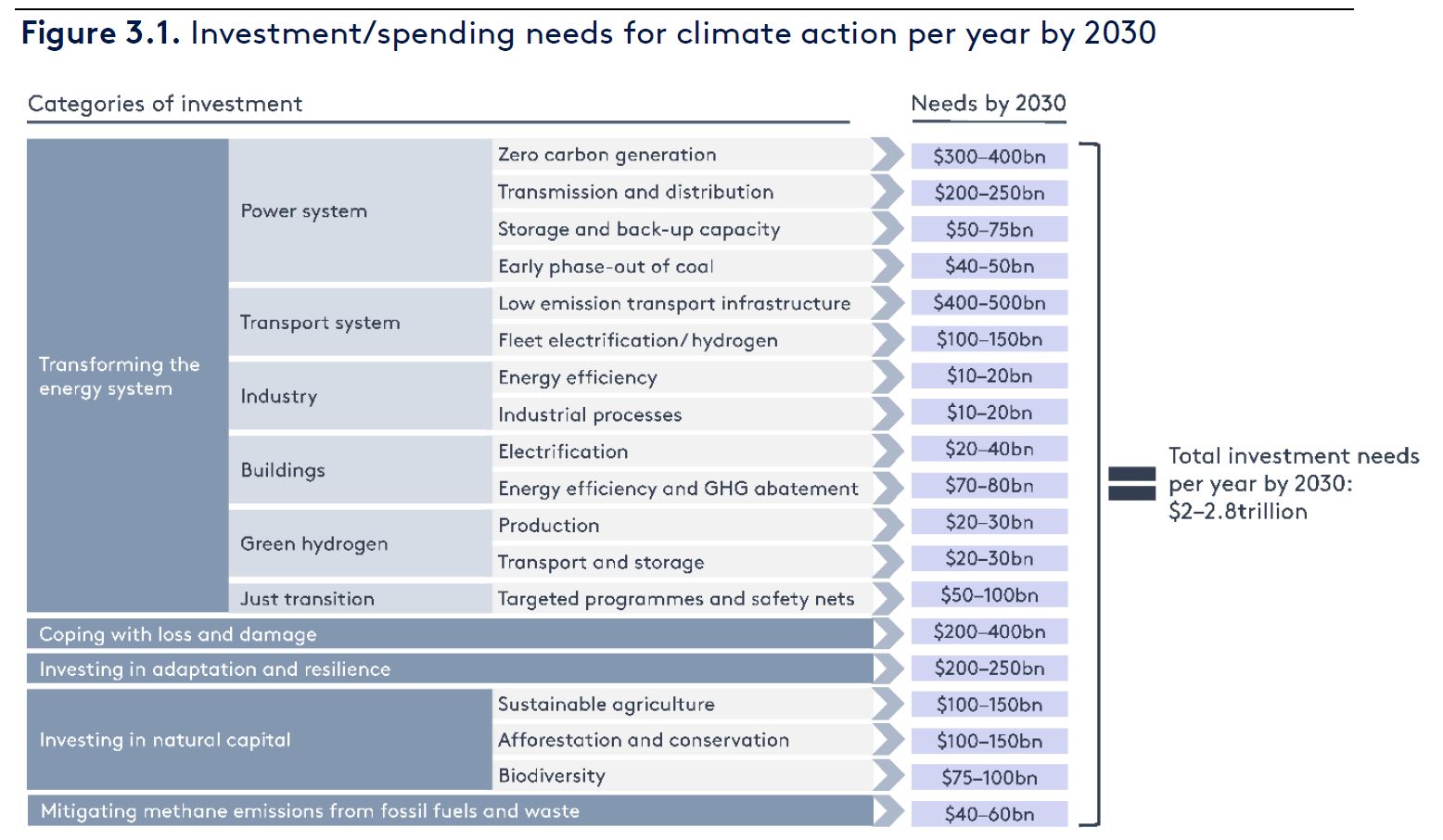
The UN released a report calling for $2 TRILLION PER YEAR in climate spending by 2030 here at COP 27, the big UN climate conference in Egypt.

CFACT’s delegation is hard at work at the COP.  We’d like to say we’re shocked, but we’re beyond that.  CFACT is the preeminent organization fully engaged in climate diplomacy from a free market perspective.  CFACT has been reporting diligently on the Left’s plans to seize control of the world economy in the name of climate since the Kyoto climate protocol was adopted way back in 1997.  CFACT was there too!

This is serious.  A bizarre combination of climate ideologues and profiteers has been laying the groundwork for this massive money grab for years.  Read the full, shocking, “High Level” finance report at CFACT.org and read for yourself the UN’s plans to spend trillions the free world does not have and cannot afford.

Here’s a table from the UN report breaking down some of their plans for climate spending:

Peter Murphy is a member of CFACT’s delegation to the UN climate conference in Egypt and writes at CFACT.org: “This is fantasy, and more so especially with U.S. and European economies experiencing the worst inflation in 40 years, and at or near recession, in large part due the imposition of climate policies that raised energy costs on consumers and businesses.”

There are three innocuously stated, yet absolutely crucial words that recur throughout the UN climate spending report.  They are this: “other than China.”  There is no way that China would allow a climate finance report calling for trillions of dollars to pass a UN subcommittee if it required China to contribute.  Pay no attention to the fact that China produces more than 2/3 more CO2 emissions than the U.S. and Europe COMBINED!

David Wojick makes an excellent point at CFACT.org, that when all else fails, the UN climate crowd turns to deliberate “vagueness” as a tactic.  They called it the Paris “Agreement,” rather than “Treaty,” to give President Obama a pretext to skip ratification in the Senate.  They say “other than China” as code for you pay, China gets rich.  Now David Wojick spotted the UN going quiet on the issue of liability as they push plans to have the free world pay when natural weather causes “loss and damage” to developing nations. 

Wojick reports that, “discussion of the impossibly expensive doctrine of ‘loss and damage’ is officially on the table at COP27. Certain big restrictions that make this discussion palatable to the developed countries have been announced, especially no mention of liability.”

In other words when weather strikes, it’s your fault.  We just won’t talk about it.

There is a furious push for money and power taking place at the UN climate conference in Sharm El Sheikh, Egypt.

The public needs to know.  CFACT is on the job.

Thank you to everyone who answered the call and sent a crucial donation to make CFACT’s work at the UN climate conference possible.  Our friends are the best!  We cannot do it without youPlease make the strongest contribution you can today.


Wednesday, August 3, 2022

The Covid ‘Vaccine’ Scam

“Emergency Use Authorization” (EUA) came into prominence with the “Right to Try” law.  This law was another way for patients who had been diagnosed with life-threatening diseases, who had tried all approved treatment options and who were unable to participate in a clinical trial, to access certain unapproved treatments.   What is the difference between FDA Approval and Emergency Use Authorization?

“FDA Approval” from the Food and Drug Administration is an independent, scientifically reviewed approval for medical products, drugs and vaccines.  Approval is based on substantial clinical data and evidence, the product is deemed safe, effective and able to be produced within federal quality standards.  Emergency Use Authorization (EUA) is a mechanism used by the FDA to facilitate making products available quickly during a public health emergency, when there is no other adequate and approved medical product available. 

Sen. Kamala Harris of California said during a vice presidential debate that she does not trust the Trump Administration’s push to rush a coronavirus vaccine into production.  When she was asked if Americans should take a vaccine, she responded with, “If the public health professionals, if Dr. Fauci, if the doctors tell us that we should take it, I’ll be the first in line to take it.  Absolutely.  But if Donald Trump tells us that we should take it.  I’m not taking it.”............To Read More...

Friday, June 18, 2021

Anti-biotechnology critics say the Genetic Literacy Project is a Monsanto-funded ‘corporate front’. It’s not true. Here is the documentation — and a review of the critics behind the disinformation

| June 15, 2021


Activist groups opposed to agricultural biotechnology (GMOs and gene edited crops and animals) repeatedly claim that the Genetic Literacy Project is a “corporate front group that was formerly funded by Monsanto” — a statement found on the SourceWatch site, for example. That’s not true. What is true is that these accusations are generated by a loose coalition of extremist activists with little to no standing among scientists and journalists. And they are financed in significant measure by the far left fringe of the organic community in partnership with the Church of Scientology. And they have taken many journalists in the mainstream press down their disinformation rabbit hole. Read on.

The facts? 

The GLP was not started with seed money from the agricultural industry or any corporation and has not received ‘secret’ or ‘disguised’ funds from Monsanto or any corporation over the history of its existence. 

There is no evidence behind those assertions, as they are untrue. 

The GLP is a ‘front’ group only in the fevered imagination of anti-biotechnology critics who reject, on ideological grounds, genetic engineering in agriculture (and in many cases in medicine as well, including for vaccine development to contain COVID-19…see below). Biotechnology rejectionist advocacy special interest groups know this but they continue to make false allegations in an attempt to damage the GLP’s ability to communicate science facts (and letting the scientific chips fall where they may) that challenge their ideological world view...........To Read More....

Friday, May 21, 2021

Beware the Rise of Scamerica


Scams, frauds, flim flams, and grifts are nothing new to America. In fact, confidence games were old hat when Clifton Wooldridge published his 1906 classic, The Grafters of America: Who They Are and How They Work, which describes common cons in fin de siecle Chicago. The recent death of notorious investment scamster Bernie Madoff should remind Americans that if it sounds too good to be true, it probably is. 

As America descends into policy disarray, the scamming of others is increasing. Wire fraud is rampant, as is the impersonation of government workers, apparently because Americans now expect government officials to accost them for quick cash at least occasionally. I focus here on a much more insidious type of scam that also seems to be on the rise, something that I will politely refer to as “substandard work,” but that in informal adult conversation usually goes by a fecal four-letter word followed by “job.”

Much of the substandard work being conducted across the country right now ultimately is the government’s fault, specifically a set of policies seemingly deliberately designed to induce Americans not to work: extra unemployment pay; major school systems remaining virtual until fall; bizarre summer camp masking requirements. The first entices lower income people to stay out of the labor market and the latter two make parents think twice, or thrice, about returning to work.

As a result, many usually reliable businesses cannot find any workers, much less good ones. Robin Jones, a regional manager for a major fast food chain in the Upper Midwest, recently told me that April and May of this year have been the tightest labor market he can remember in his 43-year restaurant career, which includes stints in Arkansas, Missouri, Montana, South Dakota, Tennessee, Texas, and Wyoming. His back is giving out because his desk job has turned into a role as a stopgap line worker in the cheap taco wars. While he does what he can, he is only one man. The extreme dearth of workers means much longer wait times than usual and substandard service overall.

A restaurant in a resort town in New Jersey recently purchased a robot called Peanut to deliver food to customers. It reportedly “can open kitchen doors, deliver orders to tables, and bus the dishes when everyone is done eating.” It works until it breaks down and doesn’t demand tips.

The labor shortage is hardly restricted to food services. The pool business pictured below, for example, had a good reputation until recently, when it charged a friend of mine $260 to remove the cover from her pool. Just a regular cover. U.S. dollars, not Zimbabwean ones. Inflation is relatively high, but it ain’t that high

If the company had added some suddenly hyper-expensive chlorine to the pool, maybe it would have been okay but it appears the workers were inexperienced newbs flummoxed by simple problems. They removed and stored the cover successfully (bravo!) but couldn’t figure out how to get the pump pumping, got frustrated, and left. But they didn’t want to tell their new boss about their pathetic failure so they charged for the full spring opening service even though they didn’t provide it. 

Not so smart.

help wanted sign

All manner of employee malingering and moral hazard appear to be on the rise because every low wage worker knows that they can get fired one morning but hired elsewhere that same day, usually at higher pay. Although full official statistics are available only through 2019, it appears that sexual harassment and other types of employment-related complaints have increased of late

 Some of the increase is due to stricter laws and enforcement and more awareness of workplace harassment issues but some may be due to employees hoping for a quick, lucrative settlement, confident that they will be able to find work elsewhere even if their claims are found meritless after investigation. Even remote workers are pressing harassment claims. Unwarranted harassment complaints are simply a more sophisticated type of pilfering than taking home office supplies or using Zoom rooms for personal use, which is also likely on the rise.

Unlike the hapless pool company described above, some companies deliberately overbill lots of their customers less flagrantly, in the hopes that many won’t notice or care enough to complain. When some inevitably ask for refunds, such companies stall repayment or simply credit customers on the next bill and thereby finagle free loans. Investment bank Morgan Stanley got spanked for overbilling in 2017 but if inflation increases nominal interest rates will rise along with it, or if lending tightens due to various new banking regulations now in the works, more companies may give in to the temptation of cheap short-term financing by overbilling.

Yet other companies with even deeper problems push boundaries between sharp business practices and outright fraud. They need to book business today or go under tomorrow and hence are unconcerned about bad reviews or negative publicity in the short run. 

One such company that I personally recently fell victim to is a long distance moving and storage broker based in America. A portion of my possessions eventually made the long trip from South Dakota to the east coast but pickup was two weeks late, which cost me dearly, and dropoff was delayed several times as well, which inconvenienced my poor, hard working spouse. 

Maybe some bad luck was actually involved but over the month it took to complete the job, the moving broker told me more half-truths than Fauci has about Covid. An industry insider revealed to me its original sin: when they get a mark, I mean customer, on the phone, they pretend like they have scheduled a pickup when in fact they have simply estimated when they expect to be able to sell the contract to a long-haul shipper, who then gets blamed for the inevitable delays.

Large, unexpected increases in the prices of inputs, from gasoline to timber, means that many construction contractors are also getting hit hard. They want to pass along the added costs, so owners need to watch out for “change order artistry,” sundry excuses contractors use to increase the contract price. When owners push back hard on change orders the contractor might not show up at all, or do substandard work/use substandard materials, so often it is better to negotiate a new price or not contract in the first place until some stability returns.

The recent ransomware attack on Colonial Pipeline is more malicious than substandard work but the purported perpetrator, a shadowy group called DarkSide, claims to be a business that gives its “customers” incentives to improve their cybersecurity protocols. While the precise vector of the ransomware infection remains unknown or under wraps, Covid restrictions and/or the tight labor market is likely the root cause of the colossal cluster. As AIER’s Peter C. Earle pointed out last year, lockdowns make countries more vulnerable to attack and, as freezing Texans learned this past winter, more vulnerable to natural shocks as well.

Natural immunity and vaccines have scotched Covid, at least in the U.S. If only Americans would develop immunities against overreaching government! Right now, Uncle Sam is more likely to stab you in the back than to have your back. Scamerica will grift ever more fraudulently until government sheds its paternalistic mask and once again lets children be children, employers employ, innovators innovate, teachers teach, and workers work.

Robert E. Wright

Robert E. Wright

Robert E. Wright is a Senior Research Fellow at the American Institute for Economic Research.

He is the (co)author or (co)editor of over two dozen major books, book series, and edited collections, including AIER’s The Best of Thomas Paine (2021) and Financial Exclusion (2019).

Robert has taught business, economics, and policy courses at Augustana University, NYU’s Stern School of Business, Temple University, the University of Virginia, and elsewhere since taking his Ph.D. in History from SUNY Buffalo in 1997.

Books by Robert E. Wright

Friday, May 4, 2018

2 Black Men Arrested at Philadelphia Starbucks Settle with City for $200,000 Youth Program

The shakedown includes a separate settlement from Starbucks for an “undisclosed amount.”

WPVI-TV 45 Comments
Two black men arrested for sitting at a Philadelphia Starbucks without ordering anything settled with the city Wednesday for a symbolic $1 each and a promise from officials to set up a $200,000 program for young entrepreneurs.  The men portrayed the twin settlements as an effort to make sure something positive came out of the April 12 incident, which touched off a furor around the U.S. over racial profiling.........To Read More....

My Take - And we're surprised why?  First the set up, and then, as always, the shakedown.  Starbuck's CEO is a disgrace.