by Dr. Jay Lehr and Tom Harris | Jun 8, 2021 | Climate Change, Politics
In his newly published book, “Green Fraud,” Marc Morano, publisher of the influential Washington DC-based Climatedepot.com, explains,
“Global warming hype and
hysteria dominate the news media, academia, schools, the United Nations,
and the U.S. government…School-skipping teen climate activists testify
before the U.S. Congress and the United Nations, and young children are
recruited for lawsuits against the U.S. government for its alleged
climate ‘inaction.’ The phrase ‘climate emergency’ has emerged as the
favorite for climate campaigners.
“But the arguments put forth
by the global warming advocates grossly distort the true facts on a host
of issues, ranging from rising sea levels and record temperatures to
melting polar caps and disappearing polar bears.
“In fact, there is no ‘climate
crisis’ or ‘climate emergency.’ The UN, climate activists, the media,
and academia are using the climate scare as an opportunity to lobby for
their alleged ‘solutions,’ which require massive government expansion
and central planning.”
Early in the 20th century, the famous American journalist
H.L. Mencken described what our nation is suffering through, perhaps now
more than ever, when he said,
“The whole aim of practical
politics is to keep the populace alarmed and hence clamoring to be led
to safety by menacing it with an endless series of hobgoblins, all of
them imaginary.”
Human-caused climate change/global warming can be considered the mother of all hobgoblins.
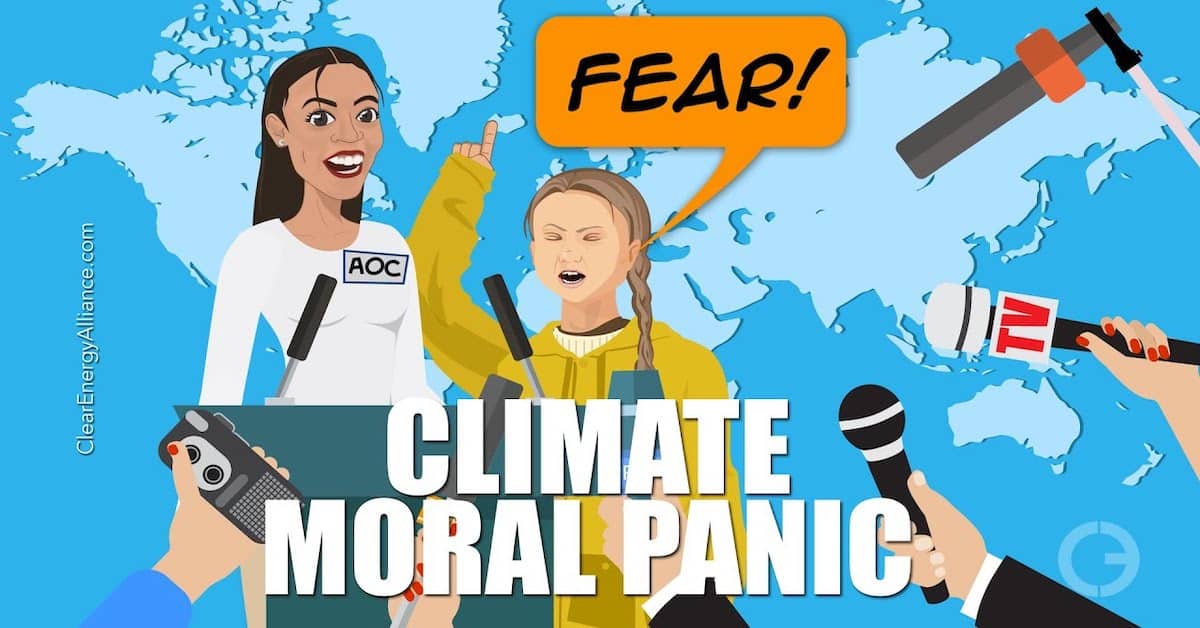
Greta Thunberg, AOC, and countless others tell us it’s time to panic about climate change!
We actually think the opposite. It’s time to calm down.
What we’re concerned about is the distinct possibility
that catastrophic man-caused climate change is now what sociologists
call a “moral panic.” In other words, the panic surrounding climate
change is far more dangerous than the issue itself.
It’s fascinating how human beings can whip themselves into a fervor over a supposed problem.
They don’t stop to consider the possibility that the
problem is likely to be manageable. Or that the problem…may not even be a
problem. It is just as British writer and publisher Tom Stacey explains in the “Prefatory Essay” to the late Professor Bob Carter’s 2013 book,
“Catastrophilia is ever with us, accompanied by wild-eyed summons to action.”
As far back as the 16th Century, we had a moral panic in
Europe, which led to the burning of thousands of innocent women claimed
to be witches responsible for crop failures. The Friends of Science Society write:
“’Weather Cooking’ was a crime
that witches were accused of in the Medieval and Little Ice Age
periods. When the weather got bad – it was clear to the ‘locals’ that
someone had been up to something. So – witches were executed for
‘cooking’ bad weather.”
No one has been burned today, but careers by the scores
have been destroyed for those in academia who admit to not believing
humans control the thermostat of planet Earth.
Let’s consider a couple of modern examples of moral panics that had huge costs in either funds wasted or lives lost (or both):
Y2K
When complicated computer programs were first written in
the 60s, software designers used a two-digit code for the year, omitting
the ‘19.’ As 2000 approached, the worry was that systems would not
interpret the 00 properly, therefore causing major problems in the
system.
In the late 1990s, nearly every tech expert agreed we
needed to spend hundreds of billions of dollars to avoid a so-called
‘Millennium Bug,’ or Y2K catastrophe. The Orlando Sentinel reported:
“The world spent an estimated $500 billion or so to keep the Y2K bug
from supposedly throwing us back into the stone age.”
Despite that huge expenditure, we fell far short of fixing everything. Yet, on the morning of January 1, 2000, practically nothing happened. Planes did not crash, trains did not collide, and life went on as normal. National Geographic explained:
“In the end, there were very
few problems. In Ishikawa, Japan, a nuclear energy facility had some of
its radiation equipment fail, but backup facilities ensured there was no
threat to the public. The U.S. detected missile launches in Russia and
attributed that to the Y2K bug. But the missile launches were planned
ahead of time as part of Russia’s conflict in its republic of Chechnya.
There was no computer malfunction.
“Countries such as Italy,
Russia, and South Korea had done little to prepare for Y2K. They had no
more technological problems than those countries, like the U.S., that
spent millions of dollars to combat the problem.”
Sentinel Staff member Ramsey Campbell summed up the situation well (“EXPENSIVE Y2K BUG NIBBLED AWAY MILLIONS,” January 12, 2000):
“It was all a big fuss over
nothing. It’s like that old joke about a gimmick for keeping elephants
away: “There aren’t any elephants in Florida,” says one guy. “See – it
works,” replies another.
“But that $500 billion did go
somewhere…Somebody ought to make a movie about it. I already have the
perfect title – Revenge of the Nerds: With a Vengeance.”
Fukushima
It has been almost a decade since a major earthquake, and a
devastating tsunami damaged the Fukushima Daiichi nuclear power plant
in Japan.
Approximately 160,000 people were evacuated from the
Fukushima nuclear power plant area shortly after it was damaged by the
March 11, 2011 earthquake and tsunami because of fear of radiation
exposure. It is estimated that 1,600 people died prematurely from
stress-related illness in the evacuation process. While there were
indeed thousands of lives tragically lost due to the tsunami and
subsequent pollution from wastewater, there was not a single case of radiation-induced illness or death due to escaped radiation.
The UN Scientific Committee on the Effects of Atomic Radiation issued a press release two years later that said:
“Radiation exposure following
the nuclear accident at Fukushima-Daiichi did not cause any immediate
health effects. Eight years later, still, none have appeared. It is
unlikely to be able to attribute any health effects in the future among
the general public and the vast majority of workers…To date, there have
been no health effects attributed to radiation exposure observed among
workers, the people with the highest radiation exposures.”
The ‘precautionary’ action, taken in response to hypothetical health risks, was more harmful than the risks themselves.
Moral Panics
Here’s what you need to know about moral panics. There are
five defining elements: Concern, Consensus, Hostility,
Disproportionality, and Volatility.
It begins when people become concerned about a problem
that they believe threatens community interests. The danger of a
changing climate meets that requirement.
A Consensus arises that there is an urgent crisis. This
“consensus” is typically not real, just a manufactured perception. The
absurd unsupportable claim that “97 percent” of scientists agree that
burning fossil fuels is creating a climate catastrophe fits nicely as a
moral panic phenomenon. The junior author of this article discussed this at The Heartland Institute’s rebuttal of the 2018 Global Climate Action Summit.
Anyone who disagrees with this so-called “consensus” is
met with hostility, and more, as we said above. No better example is
Senator Sheldon Whitehouse from Rhode Island wanting dissenters
imprisoned.
Sociologists call them folk devils, or in this case, ‘science deniers.’
The solution to the problem is Disproportionally out of scale with what is actually known.
Spending inconceivable amounts of money to change every aspect of how we live…yeah, that’s certainly disproportional.
And, finally, moral panics are typically volatile. They
flare up but then go away pretty quickly. Have you heard anything about
Y2K in recent years? This is where climate change doesn’t fit the model,
and it seems clear why.
There is always a storm, drought, flood, record high, or
even record low temperature in any given week. There’s always something
an alarmist can point to and say, ‘see⏤climate change!’
It doesn’t matter⏤those weather extremes are a constant in
nature……Or that there is no proof man’s activities are causing some
extreme, unnatural variation. The panic has become familiar… and…
predictably….valuable.
While there may be a legitimate cause for concern
initially, the panic gets amplified by people and organizations
capitalizing on the fear people feel.
The news media hypes the panic because exploiting fear and creating conflict is the foundation of their business model.
People who sell expertise or products designed to fix the problem encourage the hysteria.
Remember, during Y2K, lots of tech companies and software developers made a fortune.
Panic can be highly profitable.
Of course, those who seek power use the scare to seize as
much as they can, as fast as they can. Consider how Governors and
Premiers in the US and Canada jumped quickly to enforce draconian
lockdowns across society, ruining small businesses and doing far more
damage to the health and prosperity of their citizens than the Coronavirus likely ever could. Two papers that should be read by all politicians include:
Finally, this is the most important thing about many moral
panics… those pushing the hysteria often have the same goal in mind.
That goal is to create a compelling incentive for changes in public
policy that favor those stoking fear.
So, what do you think? Climate alarmists say there is no
time for debate or private sector innovation. They assert that we must
spend unfathomable amounts of money and blindly trust the politicians
and bureaucrats who will spend it. We must sacrifice many freedoms…
capitalism… even our way of life. We don’t know about you, but that’s
what we’re concerned about.
NOTE: We have Mark Mathis of the Clear Energy Alliance to thank for portions of this article. See Mark’s four-minute video on this at https://www.youtube.com/watch?v=qesALW45okw.

Dr.
Jay Lehr is a Senior Policy Analyst with the International Climate
Science Coalition and former Science Director of The Heartland
Institute. He is an internationally renowned scientist, author, and
speaker who has testified before Congress on dozens of occasions on
environmental issues and consulted with nearly every agency of the
national government and many foreign countries. After graduating from
Princeton University at the age of 20 with a degree in Geological
Engineering, he received the nation’s first Ph.D. in Groundwater
Hydrology from the University of Arizona. He later became executive
director of the National Association of Groundwater Scientists and
Engineers.
Tom Harris is Executive Director of the Ottawa, Canada-based
International Climate Science Coalition, and a policy advisor to The
Heartland Institute. He has 40 years experience as a mechanical
engineer/project manager, science and technology communications
professional, technical trainer, and S&T advisor to a former
Opposition Senior Environment Critic in Canada’s Parliament.