Search This Blog

De Omnibus Dubitandum - Lux Veritas

Showing posts with label Jon Entine. Show all posts

Wednesday, July 28, 2021

An activist-based PR campaign is poised to claim that the Earth faces a Silent Spring-like ‘insect armageddon.’ Will The New York Times and other media fall for the ‘hysteria con’ once again?

| July 27, 2021 

For the past four years, journalists and environmental bloggers have been churning out story after story that insects are vanishing, in the United States and globally. Limited available evidence lends credence to reasonable concerns not least because insects are crucial components of many ecosystems. 

But the issue has often been framed in catastrophic terms, with predictions of a near-inevitable and imminent ecological collapse that would undermine global biodiversity, destroy harvests and trigger widespread starvation. Most of the solutions would require a dramatic retooling of many aspects of modern life, from urbanization to agriculture.

Considering the disruptive economic and social trade-offs being demanded by some who promote the crisis hypothesis, it’s prudent to seperate genuine threats from agenda-driven hyperbole. How ecologically threatening are insect declines? Should we be in ‘catastrophic crisis’ mode? What should we as a collective society responsibly do? 

Roots of the crisis narrative

The recent hyper-focus on insects traces back to a 2017 study conducted by an obscure German entomological society that claimed that flying insects in German nature reserves had decreased by 76 percent over just 26 years. The study, co-authored by twelve scientists, lit a fire in advocacy circles and became the sixth-most-discussed scientific paper of that year, and remains popular.............Perhaps the inflammatory rhetoric, which continues today, is justified. Or maybe not. .........

Insectageddon is a great read. But what are the facts?

The Times essay read like a convincing polemic, but the ‘catastrophe narrative’ fell flat with the science community, which has spent much of the last four years trying to tame the consequent hysteria...........Of one of the major studies used to promote the apocalypse narrative (“Worldwide decline of the entomofauna: A review of its drivers”, by Sanchez-Bayo and Wychkhuys, discussed below), Sanders noted an appallingly selective and apparently willful misrepresentation and manipulation of the data:...................Professor Sanders has written a stunning 4-part series on what she sees as the manipulation by narrative-promoting journalists and scientists [see: Part 1Part 2Part 3Part 4].

Roots of the crisis narrative

It’s important to understand how we got from the consensus ‘there is fragmentary but concerning evidence’ of insect declines to ‘the world faces imminent collapse’. The global insect crisis narrative dates back more than a decade, and was originally focused on alarming reports beginning in 2006 of a surge in honeybee mortality............ By 2018, almost every major news organization, from the Washington Post (‘’Believe it or not, the bees are doing just fine”) to Slate (‘The Bees are Alright”) and including many environmental publications such as Grist (“Why the bee crisis isn’t as bad as you think’) were sheepishly acknowledging there never was an imminent worldwide honeybee catastrophe. The New York Times was conspicuously one of the few news outlets to not reconsider its crisis narrative..................

Are pesticides the problem?

Those exaggerations have been challenged repeatedly by high-quality papers and real-world evidence. But while claims of pending  “-pocalypses” occasionally have been walked back by the media, rarely has this been done with the same gusto with which they headlined each successive “Armageddon” ..................Dave Goulson has a controversial reputation in the science community. As the GLP has previously reported, he is an admitted scientist-for-hire, who has produced research with a promised, pre-determined conclusion for activist organizations.............

What do mainstream insect experts conclude?

................While threats to certain species do exist in certain locations, that doesn’t support claims that we face a broad, global population collapse among insects. 

North American insect populations are stable

The deficiencies of these studies when it came to identifying global trends encouraged a team of 12 researchers led by Matthew Moran at Hendrix College in Arkansas to examine the situation in North America................: “There is no evidence of precipitous and widespread insect abundance declines in North America akin to those reported from some sites in Europe.” ........In the press release announcing the study — “Insect Apocalypse May Not be Happening in the US” —  University of Georgia postdoctoral researcher Matthew Crossley stated, “No matter what factor we looked at, nothing could explain the trends in a satisfactory way.” ...........To Read More, Much More......


Sunday, January 24, 2021

Beepocalypse Myth Handbook: Assessing claims of pollinator collapse

  | January 22, 2021

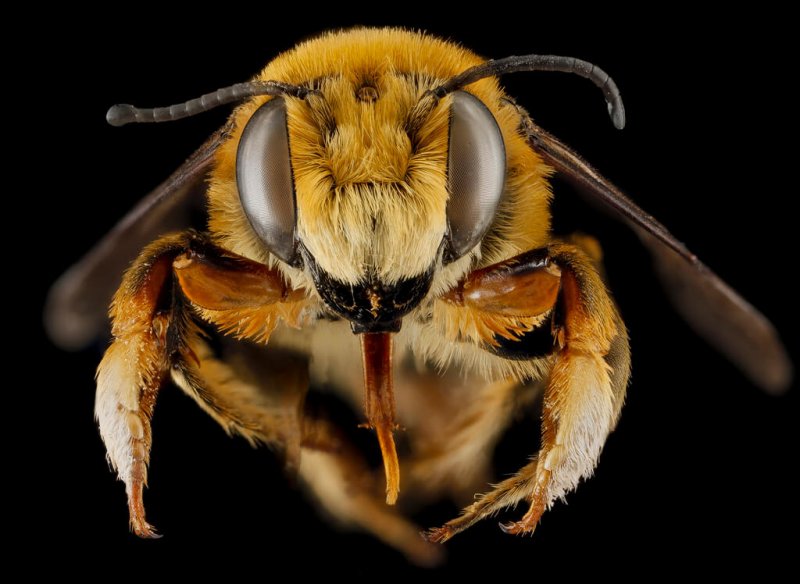
 https://geneticliteracyproject.org/wp-content/uploads/elementor/thumbs/tiger-bee-face-p1plbhq69ukliu667cdypbrno7670bazjkzukdvm4w.jpg

Myths and truths about bees: There is no ‘catastrophic decline’ in the global honeybee population, as many environmental groups continue to claim. In fact, honeybee hive populations are rising in North America and globally. The companion claim  that a class of pesticides known as neonicotinoids (or neonics for short) are fostering a global honeybee pollinator crisis is also not accurate. However, honeybees and perhaps bumble bees (whose wild nature make them difficult to catalogue) do face a range of health threats that are serious cause for worry, and they need to be addressed.

What are the facts?

Colony Collapse Disorder

The honeybee population did face what appeared to be a crisis in the mid-2000s when some United States’ beekeepers, mostly in California, began discovering that their honeybees had mysteriously abandoned many of their colonies, leaving behind the queen bee, attended by too few, immature worker bees to sustain the colony, yet with ample viable brood and stored food. The first report classified as CCD was in mid-November 2006 by a Pennsylvania beekeeper overwintering in Florida. By February 2007, large commercial migratory beekeepers wintering in California, Florida, Oklahoma, and Texas had reported heavy losses associated with CCD, with losses ranging from 30% to 90% of their bee colonies. This phenomenon was dubbed Colony Collapse  Disorder (CCD). What made CCD’s appearance in the United States stunning and alarming was that episodes were being reported from widely separated states across the continent..............To Read More....


Saturday, June 20, 2020

Are we facing an ‘Insect Apocalypse’ caused by ‘intensive, industrial’ farming and agricultural chemicals? The media say yes; Science says ‘no’

  June 16, 2020

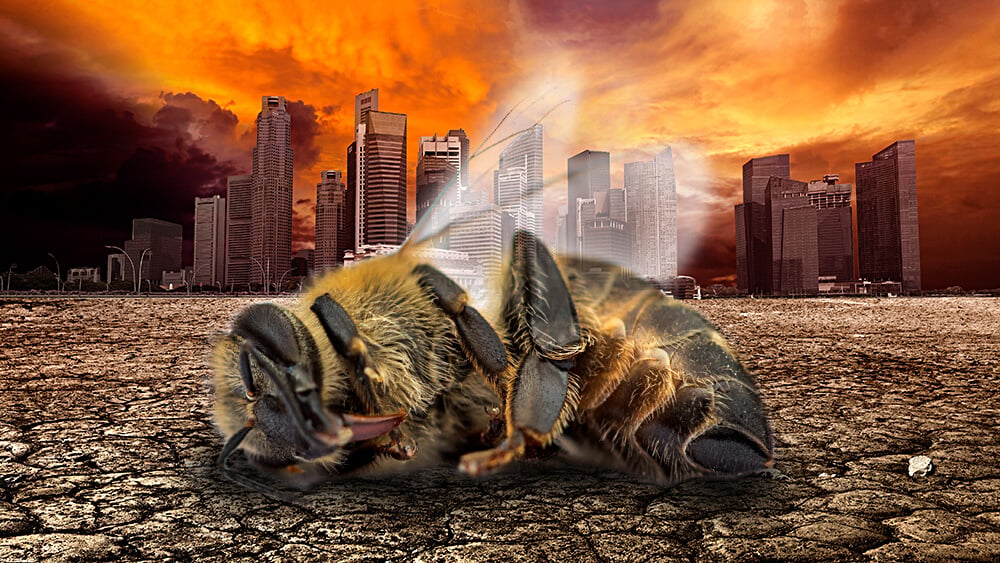
https://geneticliteracyproject.org/wp-content/uploads/2020/06/dead-bee-desolate-city.jpg

The media call it the “Insect Apocalypse”. In the past three years, the phrase has become an accepted truth of the journalism literati, and usually associated with such apocalyptic terms as “ecosystem collapse” and “food crisis”. The culprit: modern agriculture, which is often linked to the Brave Not-So-New World of GMOs and gene-edited crops and the chemicals purportedly used to support it.

As recently as last month, an opinion writer for the New York Times, Margaret Renkl, warned of the dark ages about to be ushered in by pesticides. She makes a case for preserving “weedy” backyards filled with blood-sucking mosquitoes and other human-threatening flying and crawling creatures of various species.
The global insect die-off is so precipitous that, if the trend continues, there will be no insects left a hundred years from now. That’s a problem for more than the bugs themselves: Insects are responsible for pollinating roughly 75 percent of all flowering plants, including one-third of the human world’s food supply.  
Insect Armageddon, another popular phrase, is now one of the most common tropes in science journalism. As I’ve chronicled numerous times in recent years, (including here, here and here), many journalists have echoed claims by environmental activists  advancing a succession of insect- and animal-related environmental apocalypse scenarios over the last decade—first honeybees, then wild bees and more recently birds. In each case they fingered modern, intensive farming, particularly crop biotechnology and pesticides, as the culprit, and warned of the terrible consequences in store for the Earth, including the mass extinction of pollinators and the global famine that would surely follow. In each case, small or poorly executed studies predicting imminent catastrophes were ballyhooed by many in the media; in each case, as more research came to the light, the hyped claims were eventually retracted or dramatically readjusted.............To Read More....


Monday, June 24, 2019

‘Children killer’ glyphosate found in Cheerios? Experts dismantle Environmental Working Group’s herbicide food residue study

, | June 17, 2019

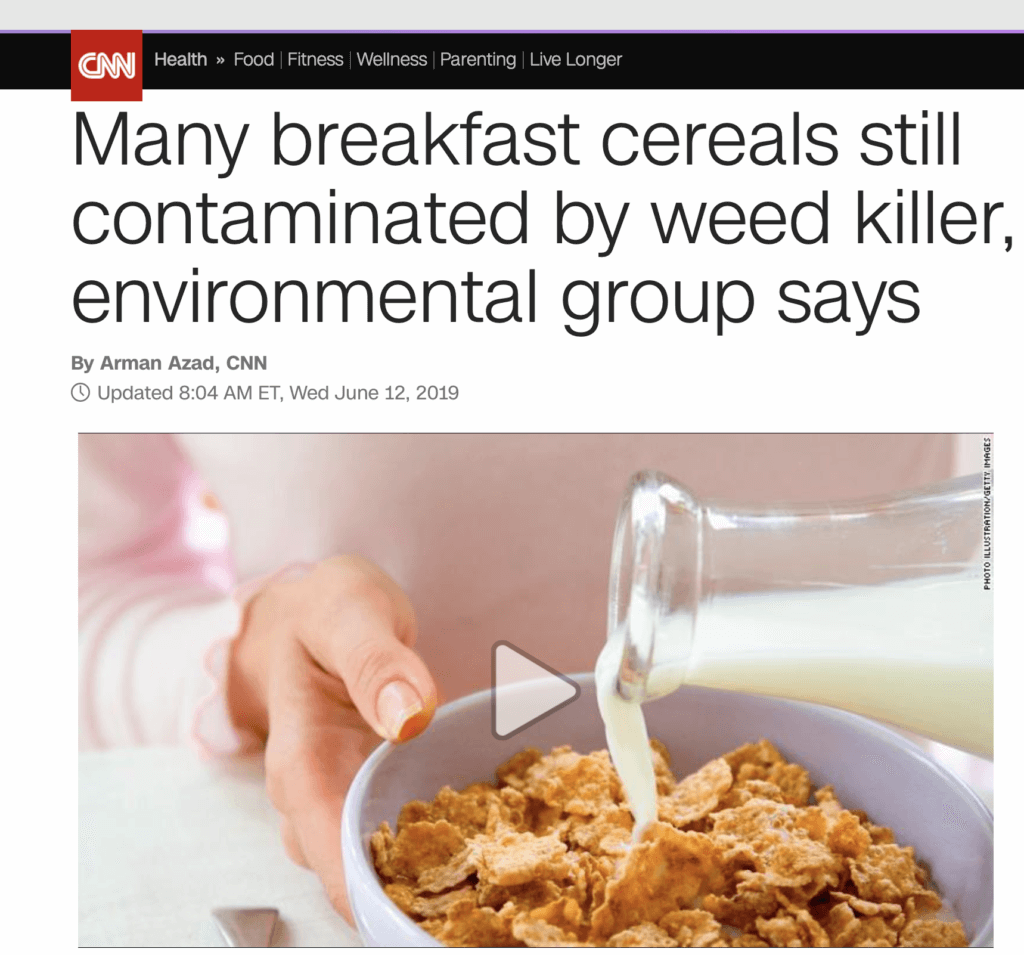
Last week, on June 12 2019, the organic industry-funded Environmental Working Group (EWG) issued a news release that claimed, “Major food companies like General Mills continue to sell popular children’s breakfast cereals and other foods contaminated with troubling levels of glyphosate, the cancer-causing ingredient in the herbicide Roundup.”

EWG’s announcement is the third of its kind focusing on the alleged dangers of glyphosate residues in our food. It was immediately trumpeted by fringe activist groups—that’s par for the course—but was also covered, almost entirely uncritically, by mainstream sources, such as CNN:

screen shot at am

What’s the news here?

Like its predecessors, released in July and October 2018, this EWG ‘study’ was based on a “round of tests” that was not peer reviewed by independent experts. Its scientists claimed that they found dozens of instances in which food it tested did not pass its “children’s health benchmark” for assessing potential exposure level hazards.

EWG did not mention that its ‘benchmark’ is entirely made up, has no clear scientific basis and is at odds with historically established and globally recognized benchmarks used by regulators in every country. The EWG “safety threshold” is 100 times lower than even the most conservative cut-off established by oversight agencies around the world, including the EPA. Curiously but not surprisingly considering EWG’s historical willingness to distort science, the threshold it settled upon just ‘happens’ to coincide with the infinitesimally trace amounts of glyphosate it found on Cheerios. ............To Read More....


Thursday, June 6, 2019

How NPR, Washington Post, Bloomberg and other media botched reporting on EPA’s ‘ban’ of 12 ‘bee-killing’ neonicotinoid insecticides

Cameron English, | June 5, 2019 @ Genetic Literacy Project


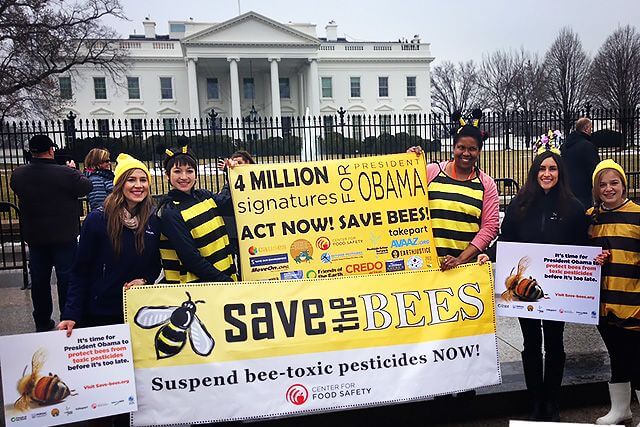
BeesObamaMAIN

If recent headlines are the measure, advocacy groups making a case that bees are endangered because of the misuse of pesticides just scored a significant victory. On May 20, the Environmental Protection Agency (EPA) announced that after a 6-year-long legal battle with anti-pesticide activists, it endorsed a voluntary withdrawal of 12 insecticides by a group of agri-chemical companies that a coalition of environmental groups had blamed for health problems in bees.

George Kimbrell, Center for Food Safety legal director and lead counsel in the case against the EPA, immediately claimed that that the settlement represented a massive victory in support of his claims that neonics from ‘harmful’ and ‘toxic’ chemicals. According to a post on the CFS site:
[The] cancellation of these …. pesticides is a hard-won battle and landmark step in the right direction,’ said …. Kimbrell …. ‘But the war on toxics continues: We will continue to fight vigilantly to protect our planet, bees, and the environment from these and similar dangerous toxins.
Facts aside—we will address that—Kimbrell’s casting of the court agreement as a victory for anti-pesticide campaigners was the narrative angle adopted by much of the media. According to reports that flooded the Internet, from the Washington Post to fringe activist sites, the EPA ‘banned’ 12 ‘dangerous’ neonicotinoids, a class of insecticides that environmental activists blame for bee health issues.

Unsurprisingly, CFS acolytes like Care2 crowed in its headline and blog about the success in bringing American regulators to heel. VICTORY! EPA Cancels 12 Bee-Killing Pesticides, Care2 wrote on its activist social community site:
The environmentalists, food safety organizations and beekeepers spent the last 6 years holding the EPA accountable for its lack of diligence in preventing or addressing bee Colony Collapse Disorder and to demand that the EPA protect livelihoods, rural economies and the environment.
Most mainstream media outlets parroted the CFS line. Business Insider’s Aria Bendix told readers, The US just banned 12 pesticides that are like nicotine for bees. Bloomberg reported, EPA Curbs Use of 12 Bee-Harming Pesticides. According to Washington Post energy reporter Dino Grandoni,”EPA now blocks a dozen products containing pesticides thought harmful to bees. The respected publication The Scientist headlined its article, EPA Cancels Registrations for 12 Neonicotinoid Pesticides, noting in the first line:
Out of concern for bees, the Environmental Protection Agency announced on May 20 that the registrations for 12 neonicotinoid-based products used as pesticides in agriculture would be canceled…
But not one of those articles, or dozens of others in news sites across the world, accurately represented what the EPA actually said or the actions that it took.

What did the EPA say and do............To Read More, Much More!!!!!

Wednesday, March 27, 2019

Latest ecological fake news scare: Like the ‘honeybee armageddon’ narrative, pesticide-driven ‘insect-pocalypse’ claim is collapsing

| | March 21, 2019


beebomb
Credit Image: The New York Times

unknownIt was only a few years ago that headlines in Europe and North America were screaming about the coming “bee armageddon”. Honeybees were going extinct, we were told, and because these vital pollinators are vital to our food supply, we were on the verge of global starvation. And pesticides were mostly to blame for the crisis.


The problem with that thesis was that honeybee populations aren’t declining, let alone headed for extinction. As I’ll explain below, the media have finally updated their doomsday reporting (years behind the Genetic Literacy Project, which has been documenting the faux crisis for years).

 However, no sooner does one apocalypse slip from the headlines than another springs up to take its place. Recently, news and advocacy groups sites have been afire with dire warnings that man’s days on earth are (once again) numbered, this time due to the accelerating extinction of all of the world’s insects.

More on the impending insect crisis below.  later. But let’s first review the botched narrative also known as the “bee-pocalypse.” Yes, bees do face some health challenges as the result of a variety of factors, most prominently their loss of habitat and the explosive growth of their mortal enemy, the Varroa mite. But balanced analysis by independent scientists put the use of pesticides way down on the list of pollinator threats. Even some advocacy groups finally abandoned the crisis rhetoric.
“Save the bees’ is a rallying cry we’ve been hearing for years now,” wrote the Sierra Club in a stunning reversal in 2018, abandoning its long held position, parroted by the press, that honeybee doomsday was upon us. “Honeybees are at no risk of dying off.”

While diseases, parasites and other threats are real problems for beekeepers, the total number of managed honeybees worldwide has risen 45% over the last half century.............To Read More...

Thursday, May 3, 2018

Global consensus finds neonicotinoids not driving honeybee health problems—Why is Europe so determined to ban them?

| | April 26, 2018

One of the more intriguing subplots in the melodramatic debate over neonicotinoids and the ‘future of bees’ is the apparent divergence of viewpoints by risk and regulatory agencies on the potential threat to pollinators posed by the insecticide.

There is no question that the health of bees is an issue––mostly, entomologists say, because of bee keeping practices, Varroa destructor mites (which vector roughly a dozen different diseases into beehives) and the widely prevalent gut fungus Nosema ceranae. But according to the Environmental Protection Agency, the US Department of Agriculture in a March 2018 report and recent studies from agencies in Canada and Australia, where neonicotinoids are also widely used, seed treatments, which is how the insecticide is most commonly applied, are not a major health threat to honeybees.

Unlike chemicals that are sprayed on plant surfaces and remain on the plant, neonicotinoids are usually applied as a seed coating and are taken up throughout the plant—in the roots, stems, leaves, flowers, pollen and nectar.

“I am not convinced that neonics are a major driver of colony loss,” said University of Maryland’s Dennis van Englesdorp, project director for the Bee Informed Partnership, and the entomologist who coined the term “Colony Collapse Disorder.”

This consensus is reflected in the trends of honeybee colonies, which have held steady or increased slightly in the US (22-year high in 2016) since the widespread adoption of neonics in the 1990s. Populations have increased significantly in Canada and Europe, reached a record high in Australia, and are at an all-time high worldwide..........To Read More....


Sunday, April 22, 2018

The Bee Apocalypse Was Never Real; Here's Why

By Jon Entine — April 17, 2018 @ American Council on Science and Health

If you were concerned after reading a sentence like “Populations of honeybees have crashed in recent years, and many researchers have pointed the blame at a class of widely used insecticides called neonicotinoids,” you are not alone. That’s how an otherwise excellent article in The Scientist summarizing a recent USDA study on honeybees’ molecular responses to neonicotinoids began.

But you needn't be. The narrative that honeybees, which are actually not even native to North America, Europe or Australia, face mortal danger and will take us down with them has been advanced by environmental groups for years and echoed in media, casual blogs and mainstream science sites. This twist on the news is so pervasive that it’s often accepted without question: bee populations are rapidly declining as a result of pesticide use, particularly the use of neonics, and the crucial pollinators could be edging towards extinction, plunging our entire food system into chaos.
  • "Declining honeybee population could spell trouble for some crops," blared a headline on Fox News last year.
  • "Death and Extinction of the Bees," was the banner claim on the activist Centre for Research on Globalization.
  • "Honey Bees in a Struggle for Survival," claimed a guest columnist writing earlier this month for a Tennessee newspaper.
The only problem is that it isn’t true.

Myth of Honeybee decline

Honeybee populations haven’t “crashed” in the United States or elsewhere. Honeybees are not going "extinct." Crops are not "in trouble."


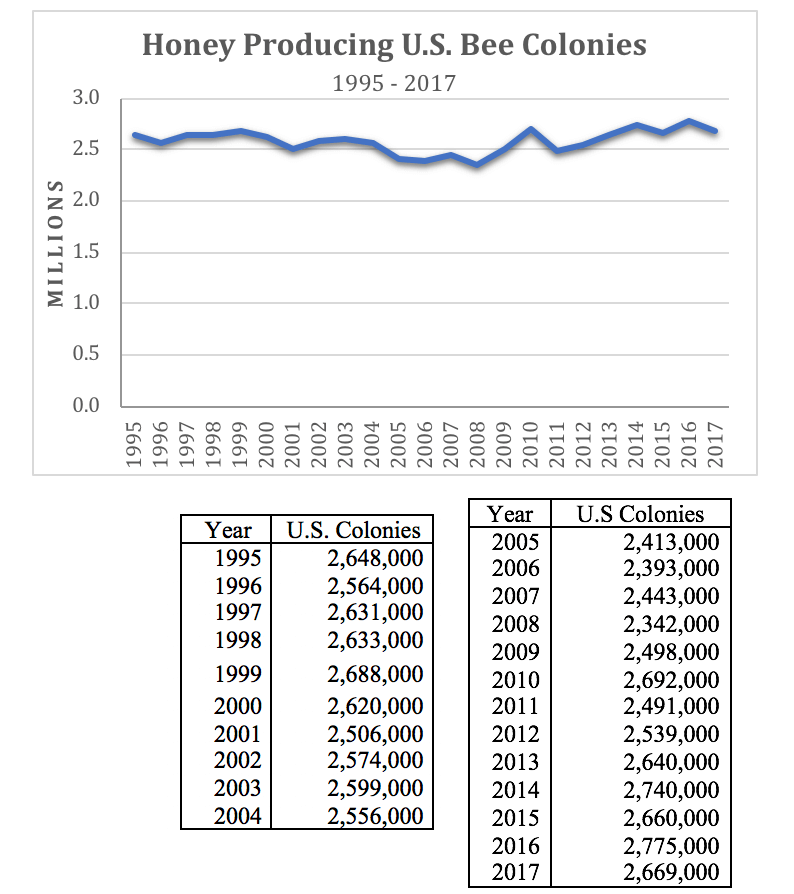
Source: USDA annual report on honey-producing colonies in the U.S. USDA publishes its final statistics one year after its preliminary estimates. USDA also collects a census, taken every five years in December, of honey-producing and non-honey-producing colonies. While not as valuable for tracking annual numbers, the census confirms the upward trend in managed bee colonies, with a 13.1% increase between 2007 and 2012.

The overall population of honeybees in the US, Canada and Europe has held steady or increased slightly since the widespread adoption of neonics in the 1990s. The US honeybee population hit a 22-year high in 2016, according to the figures released by the USDA before dipping slightly last year, and globally are at an all-time high.


So how did the meme of the honeybee, legs pointing to the sky, become so popular? As often happens with controversial issues such as food and chemicals, it’s complicated––and ideological.
First of all, honeybees aren’t the cute symbol of the natural world that environmentalists make them out to be. They’re actually a managed species, like livestock, bred by beekeepers to make honey and shipped around the country to pollinate crops like almonds. They’re also an exotic species in North America, brought over from Europe by early colonists. [Note: European honeybees originated in Asia 300,000 years ago.]

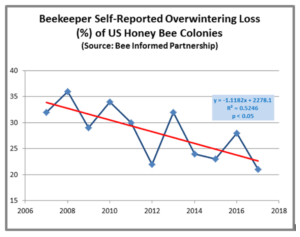
It’s not that honeybees aren’t having some problems — they are. Just not to the degree that environmental groups and the media suggest. And most of the problems, say entomologists and bee keepers, are linked to bee keeping practices, Varrora destructor mites (which vector roughly a dozen different diseases into beehives, and the widely prevalent gut fungus, Nosema ceranae. Seed pesticides, most experts say, play a minor if measurable role, with the miticides used to control the parasites presenting far more of a health threat than neonics. These problems have led to higher-than-average over winter losses. While beekeepers always lose some of their bees over the winter, winter losses of managed honey bee colonies in the US have averaged 28.7 percent since 2006, almost double the historical rate.

So what’s going on? How is the US honeybee population stable or rising despite a doubling of winter loss rates?

Colony Collapse Disorder is not the same as bee losses linked to diseases and chemicals
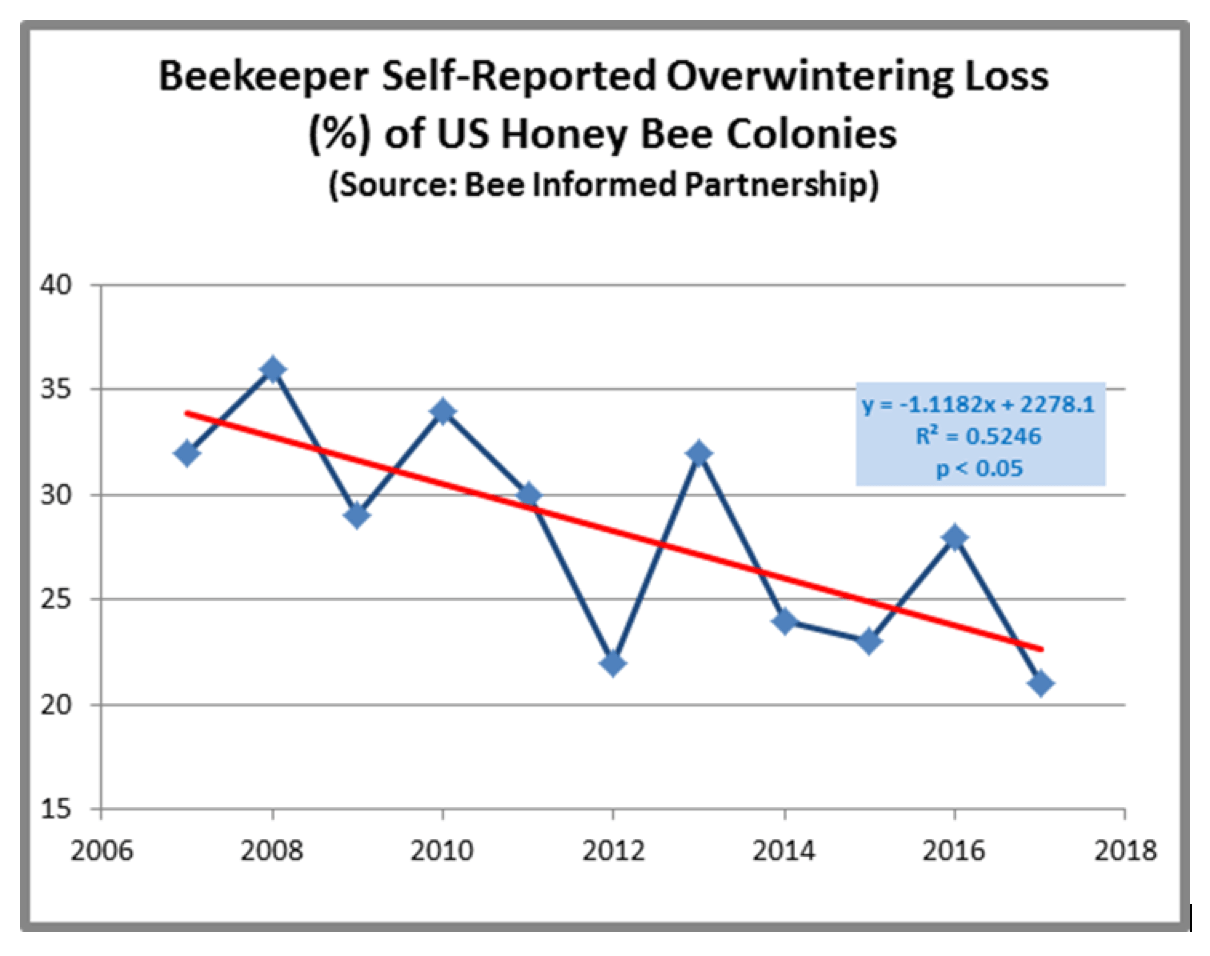
The independent Bee Informed Partership, which was founded by a grant from the US Department of Agriculture, reported that despite bee health problems in recent years, trends are favorable in tracking overwinter losses, considered the key statistic in evaluating bee colony health.


According to a recent USDA report on honeybee health, beekeepers have been able to adapt their managerial practices and repopulate their stocks when cold weather or virus-related losses occur. Winter losses can easily be replenished by splitting hives, but experts say that's not the optimal solution; it would be better for bee stocks for overwinter losses to continue their recent decline.
“The media have overstressed the mortality aspects and largely ignored the fact that the beekeeping industry is able to rebound,” Michael Burgett, professor emeritus of entomology at Oregon State University and a co-author of the report, told the GLP. “The honey bee is in no way endangered.”
Bee boxes set up at an almond grove in California (Image credit: Claire Brittain/University of California - Davis)Burgett has been studying bees since 1969, and has noticed a significant uptick in public interest in, and funding for, honeybee research since the onset of “Colony Collapse Disorder” first raised eyebrows when it appeared in California in 2006.

“As a practicing academic for the last 49 years, I’m always delighted when more money becomes available to do research and outreach programs," Burgett said. "However, it’s based on the falsehood that our honeybee industry is on the decline.”
CCD, which lasted for about 3-5 years, is a sudden phenomenon in which the majority of worker bees mysteriously disappear. That problem, which showed up most dramatically in California, abated by 2011. But reporters continue to use the term, erroneously, to describe other health challenges faced by bees since then, including the growing threat of mite infestations.

High prices are the solution to their own problem

The latest USDA report credits the market for crop pollination services as a key reason why, quoting the old adage, “high prices are the solution to their own problem.”

When winter bee loss rates increased in the mid-2000s mostly as a result of the temporary CCD threat, beekeepers’ bottom line was hurt. This incentivized them to replace their lost colonies and to move their “livestock” to farms that offered better rates. Beekeepers offset the higher winter losses primarily through a process called “splitting.” Splitting involves taking a portion of the eggs, larvae, pupae, adult bees and food stores from a healthy colony and creating a separate colony with a newly mated queen. During spring, both colonies will grow, replenishing the beekeepers' stocks.
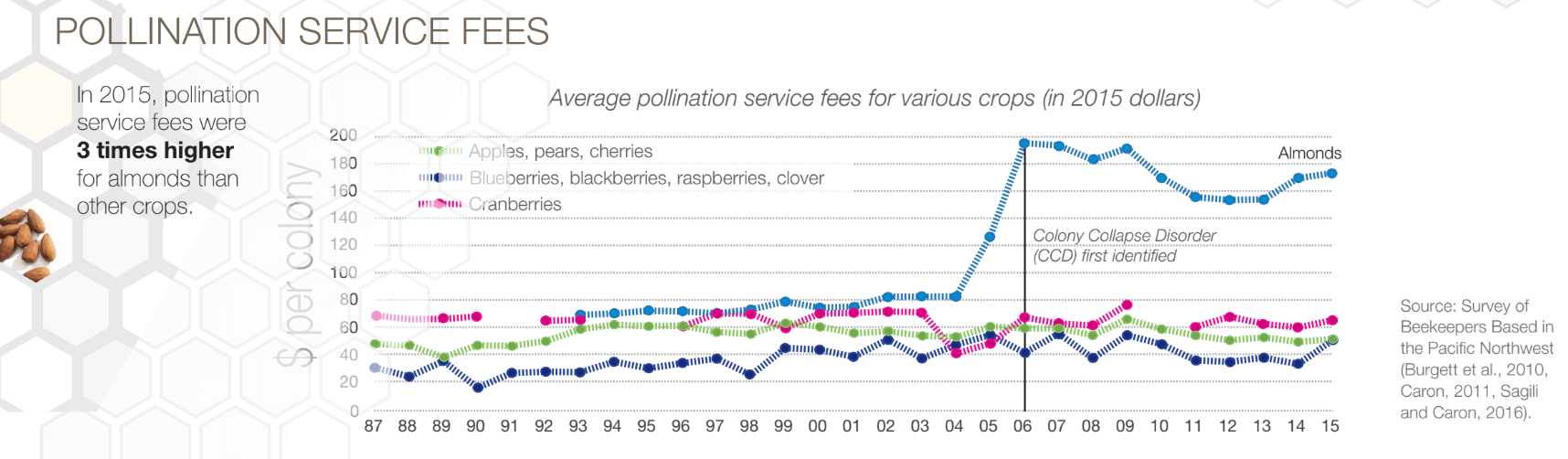
At the same time, pollination fees (mostly for California’s booming almond industry) and honey prices have increased in recent years, boosting the profitability of beekeeping and further incentivizing beekeepers to replace lost colonies. In 1988, honey sales accounted for 52 percent of beekeeper revenue while pollinator service fees made up less than 11 percent. Today, pollination service fees make up over 41 percent, the largest source of beekeeper revenue. Of that, 82 percent comes from almonds.


Click image to enlarge.

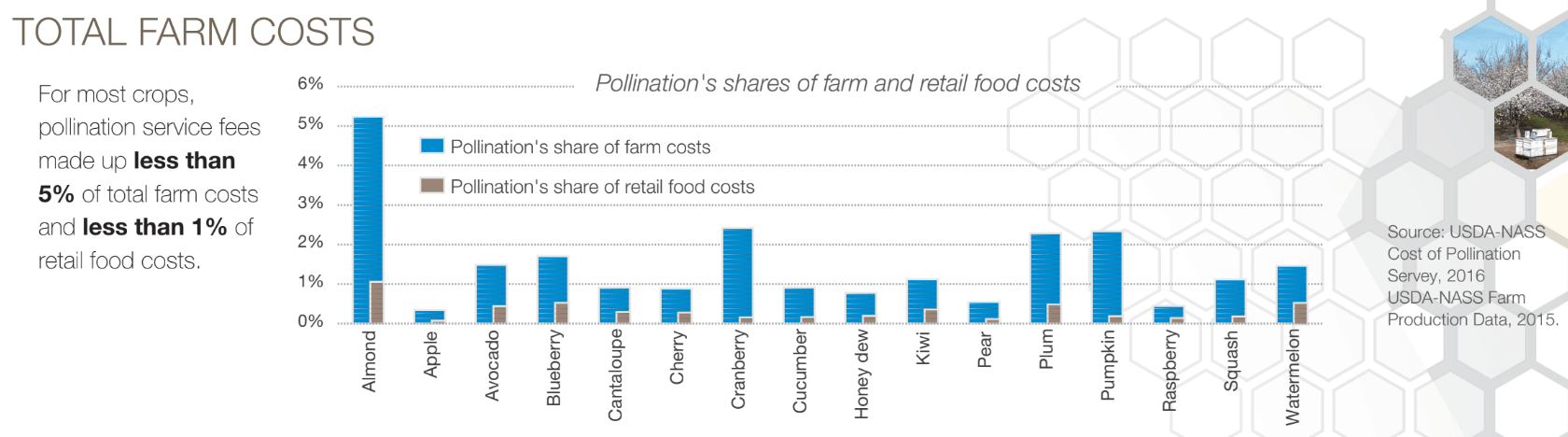
Aside from beekeepers ability to repopulate their colonies and move to fields that pay the highest rates, a third factor that has contributed to the US honey bee population’s stability is the fact that pollinator services make up a small percentage of total farm costs. While pollination services account for a little over five percent of the total cost of growing almonds, no other crop tops 3 percent. And when you consider what the product is sold for in grocery stores, it's even less, with pollination services for all crops (including almonds) making up just 1 percent or less of retail food costs. This means that pollination service cost increases don’t have a large impact on farmers’ costs or food prices.


Click image to enlarge.

USDA bee researcher: “If there’s a top ten list of what’s killing honey bee colonies, I’d put pesticides at number 11."

While it's great that beekeepers are able to rebound from increased loses, “it’s not fun having a lot of dead bees,” says Burgett. High loss rates mean more work and costs for beekeepers.
He says the cause of the increased loss numbers are multifactorial, but that varrora mites and the viruses they carry are likely the leading drivers. Nutrition is another big factor. With many colonies being transported to California’s almond groves for pollination, the bees’ diet isn’t very diverse. Burgett says bees need more than just almond pollen to stay healthy.

Varrora mites on honeybee.In the last five years, concerns over Colony Collapse Disorder have eased considerably. Surveys have shown that beekeepers only attribute around 20 percent of their losses to CCD, says Burgett.

And while still an issue, he says pesticides including neonics have become much less of a hazard in recent decades, and doesn’t see them as playing a significant role in the recent increase in losses.

“If there’s a top ten list of what’s killing honey bee colonies, I’d put pesticides at number 11,” he said.

When Burgett first came to Oregon State University, beekeepers would often tell him that pesticides were their number one issue. But things have improved significantly in the decades since.
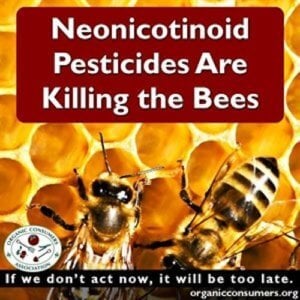
Organic Consumer Ass fund-raising campaign.“The agricultural industry has gotten much, much better,” he explained. “The pesticides we’re using have changed a lot from 30, 40 years ago to generally safer products for honeybees.”

As for neonicotinoids, the controversial class of insecticides commonly applied as a seed coating, Burgett says that despite over a decade of study, it’s still yet to be proven that they're playing a significant role in honeybee deaths.

But you rarely find that kind of nuanced reporting in the general media and even among the farm press. The anti-chemical meme targeting neonics with the not-all-that vulnerable honeybee as their symbol remains a powerful fund-raising tool for environmental advocacy groups, and often linked to the organic industry..

Jon Entine is the founder and executive director of the Genetic Literacy Project, where this article first appeared. Follow him on Twitter @jonentine

Monday, January 15, 2018

Rethinking the pesticides–neonicotinoids–bee health crisis narrative: Why the media get it wrong

 January 9, 2018  @ the  


Are bees endangered because of the use of insecticides, and in particular the class of chemicals known as neonicotinoids, which are used on many crops?

It’s a debate that’s played out in research laboratories and in the media over the past decade since the phenomenon known as Colony Collapse Disorder roiled the bee industry in California and elsewhere in North American and Europe beginning in 2006-7.

Needless to point out to those who have followed the neonics controversy, this is a highly politicized issue. Most people with a stake in this debate, including entomologists, farmers and beekeepers, are genuinely struggling to understand the complex factors behind why bees face a host of problems, from attacks from the killer Varroa destructor mite to the overuse of insecticides to kill them and the pervasive use of agricultural pesticides. But in the media and in cyberspace, hyperbole and ideology have come to eclipse rational discussion and the sometimes plodding pace of science. The highly-charged debate now pits activists, including some advocacy-minded scientists, against the agro-chemical industry and many scientists who view neonics as a relatively minor driving force in the health issues confronting honeybees and bumble bees.

One resource that has often been looked upon by the media as an objective source is the Bee Informed Partnership (BIP)—a US Department of Agriculture project developed in cooperation with University of Maryland entomologist  Dennis vanEngelsdorp. Each year in the spring it releases an annual U.S. ‘bee hive loss estimate’. Each year, it seems, the report frames the debate over whether the ‘bee crisis’ is accelerating or abating.

Media v Science?

The popular narrative among journalists and on the Internet in recent years has been that honey bees and wild bees face impending doom—it’s been dubbed a beepocalypse or beemageddon, with most of the ire focused on a class of pesticides, applied mostly as a seed coating, known as neonicotinoids. The insecticide was introduced in the 1990s in large part to replace chemicals that were demonstrably hurting bees and posed human health dangers as well.

Bee health is a genuine concern. After all they are trucked around from farm to farm as insect livestock. And entomologists and the USDA say that Varroa destructor mites have been infesting bee hives at an accelerating rate over the past few decades, and present a serious and on-going threat. Pesticides rank low as a likely cause of bee health problems, contend most entomologists, but that’s not the way the issue has played out in the media and online.

Anti-pesticide campaigners  have long rejected the conclusions of government agencies and scientists, deciding that bee health issues could not be driven by something as prosaic as a well-known parasite, and have focused instead on neonics.

The question of the relative role of neonics in bee health is fascinating because of the split in the science—some lab studies point to potential serious problems linked to one or more of the neonics but field research, meta-studies and the hard numbers worldwide—bee hives are at record numbers globally—tell a much different story.

The release of BIP’s death count has become a spring ritual followed closely by those invested in beepocalypse narrative; in years when the BIP loss numbers have been high, the media has generally taken them as confirmation that the disaster has finally arrived. Activists fill the social media echo chamber with scare blogs, which they often use as an anchor issue for fund raising or campaigns
But the most recent year’s survey results didn’t exactly support that narrative. Over-winter losses, which is when bees face severe threats from cold weather, were 21.1%, the lowest in the 10 years the survey has been in existence. Taken together with previous years’ findings, the 2016-17 number continues a downward trend of over-winter losses that, on the current path, will reach the 15% goal set in the 2015 National Pollinator Strategy by 2024.

 
Seven years ago, however, BIP began collecting survey responses on in-season (summertime) honeybee losses as well. However, combining in-season and over-winter losses can result in an alarming and spectacularly misleading loss number. For example, in 2016, it was 44%, making it appear that nearly half of all US honeybees had died, which is exactly how most of the media reported it.
 
In the latest reporting year, 2016-17, the combined result was lower: 33.2%. This was the second lowest in the seven years of reporting combined statistics, but it was still an occasion for apocalyptic headlines: “A third of the nation's honeybee colonies died last year,” headlined USA Today. Time, which ran a scare cover story years ago pondering “A World Without Bees”—an article criticized by numerous scientists -- stayed true to form, headlining: “Honeybee Deaths Are Down, But the Beepocalypse Continues.”

No beepocalypse

That’s shallow journalism. While the Bee Informed Partnership’s combined loss numbers generate media attention, they provide a very thin sliver of the picture bee health, and the numbers themselves are easily manipulated to fit a narrative. There three major reasons why this is true:

The first reason is that the macro statistics of the total bee population tell a different story than the BIP numbers. The previous year, when it was reported that “a third of the nation’s honeybee colonies died”, the US honeybee population actually reached a 22-year high. The untold story in the popular media, although reported on science-based websites like the GLP and on university and bee expert sites, is that despite some ups and downs, the number of honeybee colonies has remained remarkably stable since the mid-1990s, when neonicotinoids were introduced.

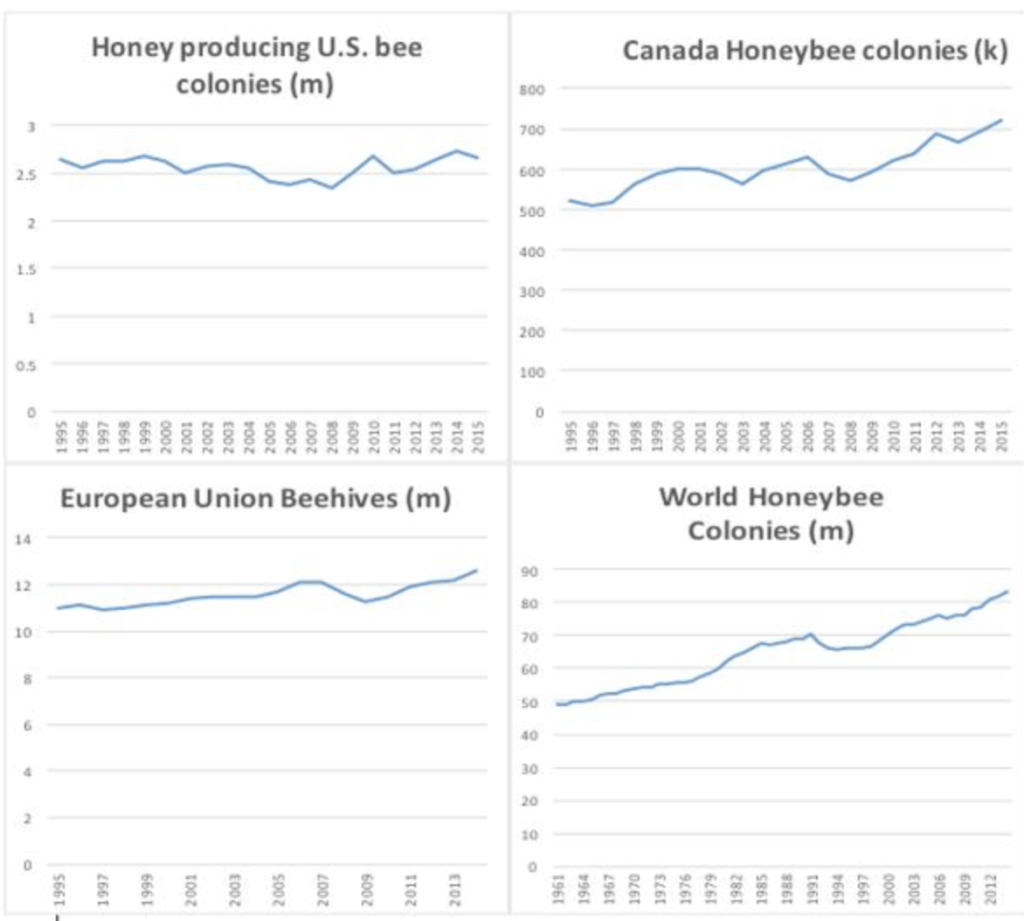
They’ve hovered around 2.5 million hives in the US, even through the challenges of Colony Collapse Disorder from 2006-2010, with the last five years seeing significant growth in bee numbers. There was indeed a sharp dive in US bee numbers in the eighties and early nineties, when the Varroa mite invaded the US, but those declines leveled off and eventually reversed in the years neonics have been on the market. Overall numbers are steady or increasing in Canada, Europe and on every continent except Antarctica (where there are no honeybees), over the last 20 years—the entire period that neonicotinoid pesticides have been on the market.
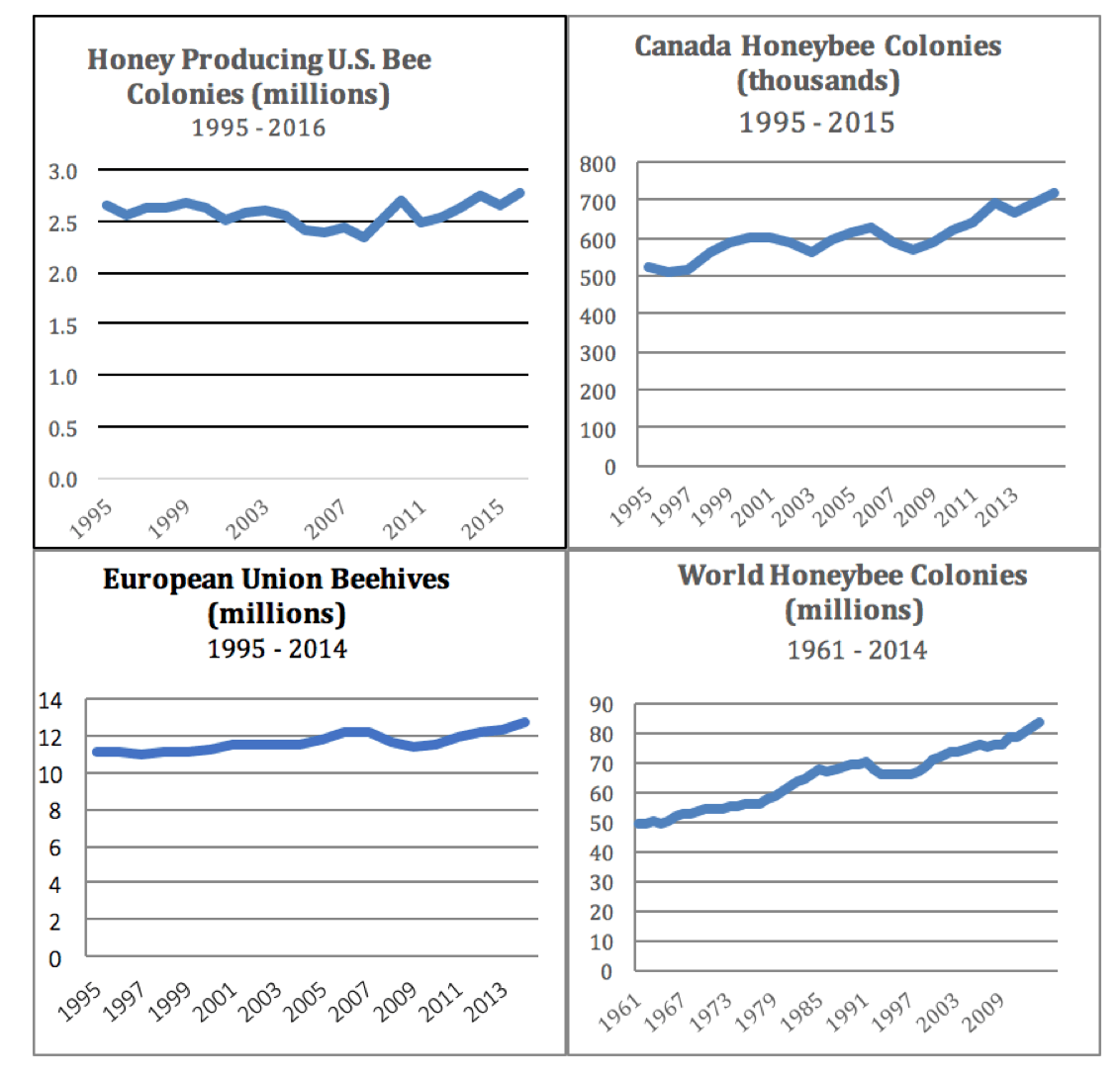
 

USDA annual report on honey-producing colonies in the U.S. (USDA publishes its final statistics one year after preliminary estimates); Canada; Global/FAO 1/FAO 2

Based on government statistics, bee population worldwide trend has been positive for over half a century. Between 1995 and 2014, we have seen the following increases in honeybee populations:
  • North America: +8%
  • Europe: +10%
  • Africa: +19%
  • South America: +43%
  • Asia: +43%
  • Ocenia: +30%
Despite these rising trends, inflammatory media stories and the NGO social media echo chamber have won the day in Europe, where politicians have put aside the findings of entomologists and appear to be preparing to not only extend their “temporary” 2013 ban, but expand it to almost all uses, even on crops bees never visit. The same activist groups – and of course the media – continue to exert enormous political pressure in the US to follow suit. So far, EPA appears to be resisting, as their recent draft assessments of the three largest selling neonics suggests, but many close observers of the agency believe the process has been touch and go for some time.

How and why bees naturally die off and beekeepers replenish hives

A new Bee Informed Partnership report will be out in a few months. It will be interesting to see if reporters make the distinction between the normal seasonal bee colony losses experienced by beekeepers, which have been a factor in beekeeping since time immemorial, and overall population trends.

Bees reproduce very rapidly—the normal life-span of a worker bee in the summer months is only 6 weeks—and so beekeepers can rebuild their hives very rapidly as well.  Not long ago, many beekeepers in northern latitudes, particularly in Canada, where intense cold makes keeping bees over winter a challenge, would empty their hives of bees, harvest all the honey in them, and start over with new queens and purchased ‘packaged bees’ the next spring. They had a self-inflicted 100% loss rate. But they had healthy, thriving bee populations throughout the summer and a stable, thriving beekeeping industry as well.

Colony losses, whether overwinter or in the spring, represent an economic cost to beekeepers, and they can provide clues to overall hive health. But the numbers we see in recent years do not portend calamity. In fact, they can, and do, rise and fall with little effect on the total number of beehives in the country, or in the world—which is almost entirely determined by how many bee colonies beekeepers decide to “grow.” This, in turn, is largely determined by economic considerations—the price of honey or the going rate for pollination services.

Predictably, however, every time the Bee Informed Partnership releases its headline-grabbing annual loss number, the media prophesizes doom. A rough analogy might be if a stock market survey only reported those stocks that had experienced losses at some point during the year, without bothering to mention that overall the market was steady or rising.

One might argue that it’s not BIP’s responsibility to ensure that the media doesn’t misinterpret or misuse its statistics. Fair enough. There’s also no question that Dennis vanEngelsdorp, who initiated the BIP, is someone dedicated to the welfare of honeybees and beekeepers. It was vanEngelsdorp and a co-author who conducted the first research into the mysterious disappearance of worker bees from the hive, a phenomenon they dubbed Colony collapse Disorder”, and he has been one of the nation’s foremost investigators of the many diseases afflicting bees today.

All of this, however, simply casts the problems with the bee loss survey into starker relief. Any scientist—or indeed any competent science reporter—taking a close look at the BIP’s methodology would have to acknowledge that it suffers from numerous limitations, and some of them are so severe that they make its results practically meaningless as a guide to the true state of bee populations.

Not all bee health data are created equal

This brings us to the second big problem: the BIP’s numbers are drawn from a voluntary survey, to which most beekeepers don’t bother to respond. In fact, BIP data typically represent only a small fraction of all beekeepers in the US—about 13% for 2016-17. That would be a large enough sample for a scientifically randomized poll, as we’ve grown accustomed to in politics. But BIP simply mails its questionnaire to beekeepers and tallies up the results of those who send it back. As the respondents are self-selected, one would intuitively assume that the results would be biased toward beekeepers with serious loss problems.

And indeed, this appears to be the case. The vast majority of respondents are small or hobby beekeepers, with only a vanishingly small fraction of commercial beekeepers—1.4%--participating. There are in fact many more hobby beekeepers in the US than commercial bee keepers, but they represent a small fraction of the overall bee colonies.

Why does this matter? It’s well known that many small and hobby beekeepers have the worst bee problems, most likely because of inexperience. They often neglect to treat for Varroa and other diseases and can have much higher losses. BIP’s survey, however, has no mechanism for adjusting for these biases and it performs no analysis of the data to make its conclusions more representative.
One sees this clearly as well in the enormous regional disparities. Twice as many honeybee colonies are located west of the Mississippi as east of it, but twice as many beekeepers are located east of the Mississippi. In other words, larger beekeeping operations in the west; smaller and backyard/hobbyist beekeepers in the east.  But the over-concentration of BIP respondents in one region – or even in certain states within regions—can easily skew the results. In the 2015-16 BIP survey, for instance, Ohio and Pennsylvania were heavily over-represented (with some colonies from those states being double-counted for Florida as well).

And the spotty, inconsistent nature of the survey can create huge distortions. In one case, a single queen breeder in California reportedly engaged the BIP investigators to survey his operations in California and Montana – yielding more than 10 times the number of BIP data points from his operations alone than for the entire remainder of California. In another instance in Montana, a single large operator who experienced devastating losses (due to error, carelessness or bad luck) caused the state to be depicted by BIP as a ‘heavy loss’ state even though none of the other beekeepers in the state experienced abnormal losses.

Given the BIP survey’s limitations, and particularly its skewed representation of the size and geography of the beekeeping operations responding, perhaps its findings would be more useful if they were portrayed not as national honey bee colony loss statistics, which they are not, but rather as the losses experienced by those sectors of the beekeeping industry that actually respond to the BIP survey.

Do other US bee hive data present a similar, problematic picture?

A third reason to be skeptical of the value of the BIP survey is that we have a more comprehensive survey conducted by USDA’s National Agricultural Statistics Service. Not surprisingly, it paints a very different picture of honeybees, and yields a much more dynamic picture of beekeepers’ operations over the course of the year. Unlike BIP, the NASS constructed a stratified sample of honey operations with which the Department has regular contact, backed up by telephone calls and, when necessary, enumeration for non-respondents. USDA charted colony losses, colonies added or renovated and total honeybee colonies in the U.S. by quarter, January 1, 2015 through March 1, 2016.
Over the course of those 15 months, the total number of U.S. honeybee colonies fluctuated dramatically from a high of 3.1 million to a low, in the survey’s last quarter, of 2.6 million, with most quarters registering more than 2.8 million colonies. Along with losses, the NASS also charts additions. For examples, a total of 662 thousand colonies were added and 693 thousand colonies were “renovated” in just the one quarter of April-June 2015.

In other words, normal beekeeping operations, in which operators decide to add or shed colonies in response to market conditions (demand and price, domestically and abroad, for different types and grades of honey, and/or anticipated commercial pollination needs and opportunities) can easily cause the total number of U.S. honey bee colonies to fluctuate by almost 20% within a 15-month period—even while populations compared year to year are steady or growing.

This underscores the mistake of imagining U.S. honeybee colonies as a sort of natural population subject only to declines caused by environmental factors (e.g., pesticides). Rather, state-by-state and nationally, farmers and beekeepers are constantly adding to, fine-tuning and sometimes deliberately reducing their numbers of honey bee colonies in response to economic incentives. BIP’s self-selected and less-inclusive survey data needs to be compared with more comprehensive USDA data to be seen in proper perspective.

Varroa challenge

One fortunate upshot of all of these survey efforts to assess honeybee losses of recent years is that they have thrown into relief the real, critical problem facing honeybees. It’s varroa mites—not pesticides, and particularly not neonicotinoiod pesticides that consistently rank among the least detected residues in honeybee colonies. Recent years’ Bee Informed Partnership surveys have correctly highlighted parasitic varroa and the dozen or more viruses and diseases that they vector into honey beehives as the #1 threat to honey bees.

USDA’s NASS survey points to the same conclusion. So, does the practical experience of beekeepers in Australia, where there are no varroa mites, and Alberta, Canada, where authorities have made varroa control the overwhelming priority for beekeepers. This conclusion has been further reinforced by the 2016 multi-year study of disease incidence in honeybees co-authored by none other than vanEngelsdorp.  It found varroa prevalence (as well as the bee gut fungus/parasite Nosema ceranae) among U.S. bee colonies far more extensive than previously thought and identified these, along with Deformed Wing Virus, as the principal scourges of honeybees today.

So, why aren’t we concentrating on addressing the acknowledged parasite threat? One reason is that the varroa mite problem is very hard to address—trying to ‘kill a bug on a bug’, keeping one of them safe, is incredibly challenging. That’s especially true since varroa have shown a remarkably rapid ability to develop resistance to different treatment methods as they’re developed. For another, pesticides, and the large corporations that manufacture them, make a convenient and tempting target.
One other thing is very clear from all these surveys—whether from the BIP, NASS, or various European efforts: bees are not facing an apocalypse or serious endangerment as the result of pesticide poisoning.

Jon Entine is the Executive Director of the Genetic Literacy Project. His biography is here. Twitter: @jonentine.

Wednesday, December 31, 2014

To Bee or Not to Bee? What is behind the bee colony collapse? Or is there one?

Posted on February 6, 2014 by admin

Even we at ACSH were surprised at this one. The discussion about the reasons behind the so-called “beepocalypse” has been entirely focused on its cause. Some suspects have been cell towers, pesticides, and infectious diseases—Tobacco Ringspot Virus being the latest theory.But if you follow some of the references in Jon Entine’s recent Forbes op-ed, entitled “Bee Deaths Reversal: As Evidence Points Away From Neonics As Driver, Pressure Builds To Rethink Ban,” you will end up here: A 2013 article entitled “Everyone calm down, there is no “bee-pocalypse,” which appeared on the Quartz website – a business news publication of the Atlantic Media Company. In this piece, author Shawn Regan, a research fellow at the Property and Environment Research Center in Bozeman, Montana drops a data bombshell from a USDA report — bee colonies are just fine.
The graph (below) clearly indicates that there has been no collapse.

Screen Shot 2014-02-06 at 1.48.39 PM

Furthermore, according to a 2010 report by the United Nations Environment Programme, except for a dip around 1990, bee colony populations have been steadily rising since 1960 (graph below)

Screen Shot 2014-02-06 at 1.52.21 PM

ACSH’s Dr. Josh Bloom comments, “Along with many other folks not deeply involved in this subject, I just assumed, based on the widespread media reports, that there were serious problems with bees dying en masse. Indeed, just being outside in the spring seemed to reinforce this. It sure looked like there were fewer bees around in the last few years. Or were my observations colored by the news? I guess, in the absence of any evidence to the contrary, this explanation is at least as plausible as any of the others. Maybe more so.”

This Appeared Here.....