Search This Blog

De Omnibus Dubitandum - Lux Veritas

Showing posts with label Sixth Mass Extinction. Show all posts

Thursday, March 16, 2023

What Species Decline?

This latest debunking of a cherished green scare is further bad news for publicity seeking climate catastrophists 

By ——--March 14, 2023

Two independent groups of scientists have destroyed the always improbable claim that vertebrates across the planet have declined by 69 percent since 1970 made by the World Wildlife Fund and the Zoological Society of London.  A group of Canadian biologists has shown that the figure is a statistical freak. They reveal that the estimate is driven by 2.4 percent of wildlife populations, adding, "If these extremely declining populations are excluded, the global trend switches to an increase."...............This extinction study is just the latest example of misuse and abuse of the scientific process designed to sow fear of an impending climate apocalypse.

Willis Eschenbach asks this question; what are the names of all the extinct birds and mammal supposedly gone? The record of continental (as opposed to island) bird and mammal extinctions in the last five centuries was analyzed to determine if 'species-area' relationship actually works to predict relationships. Very few continental birds or mammals are recorded as having gone extinct from habitat reduction alone. No continental forest bird or mammal is recorded as having gone extinct from any cause since the species-area relationship predicts that there should have been a very large number of recorded bird and mammal extinctions from habitat reduction over the last millennium shows that the species-area relationship gives erroneous answers to the question of extinction rate........To Read More............


Monday, July 11, 2022

Did You Know There Was a March for Science Day?

By Rich Kozlovich

Often times I find old posts are discovered by someone and receive a number of hits, which always surprises me.  I published the link to this one four years ago, Entomologists Urge Action, Advocacy After 2018 March for Science,  by Lina Bernaola and Ashley Kennedy in Entomology Today, with "My Take" on what was really going on with this March for Science Day horsepucky.  This May 7, 2018 piece starts out saying:

April 14 was a busy and beautiful day in Washington, DC. Thousands of people flocked to the capital city to partake in the Cherry Blossom Parade, the Walk for Epilepsy, the Emancipation Day Parade, and—last not but least—the 2018 March for Science. The latter event drew the two of us from near and far: Ashley took the Metro in from Northern Virginia, and Lina flew in from Louisiana just for the occasion. We met up in front of the Washington Monument during the pre-March rally.

Although the turnout this year was smaller than last year, the crowd’s energy and enthusiasm were palpable. Marchers carried signs with slogans such as “Science, Not Silence,” “No Science, No Beer,” “There Is No Planet B,” and—our favorite—”E.O. Wilson for President!” Among the various chants the crowd repeated along the march route was: “What do we want? Science-based policy! When do we want it? After peer review!” 

Two of the writer scientists who allow me to publish their work are Dr. Henry Miller of the Hoover Institute and Dr. Alex Berezow of the American Council on Science and Health.  Here's their article puncturing this March for Science balloon as nothing more than politics, and not science.  March for Science was just an excuse to attack Trump and Republicans.

Slogans and marches aren't science either.  Until this fraudulent pandemic hysteria promoted by these leftist misfits, anthropogenic global warming was the greatest fraud ever perpetrated on the public since the Piltdown man scandal and the DDT ban fraud. 

For these people anything that promotes the idea man is overwhelmingly evil and attacking everything that makes modern life possible, including modern agricultural practices is "sound science", irrespective of reality.  
 
Anything that stands in the way of that irrational, misanthropic and morally defective march is "junk science" according to them, which is a common tactic from the left, it's called projection, accusing opponents of doing the very things they're doing.  It all started with the fraud perpetrated by Rachel Carson in her science fiction book Silent Spring, which we should never stop attacking as that book brought about the unnecessary deaths of 100 million people and unnecessary illnesses of hundreds of millions every year since the ban on DDT, which is the intellectual, philosophical and economic foundation of the modern environment movement. . 

The real perpetrators of junk science is now, and has always been, the green movement.  That's history and that history is incontestable.  And we need to have the courage to say so and the fortitude to be the rock in the current to stand up against all this clabber they're calling science!  
 
And given the Democrat party, which styles itself as the "party of science", believes men can get pregnant, there are far more than two genders, and the world is on the verge of a , in spite of the fact the small amount of warming stopped 25 years ago, and all their are being exposed.
 
Insisting the world be vaccinated with genetic manipulating drugs that are experimental, which are and we need to have the courage to be rocks in the current standing against these irrational misanthropic misfits.  

As for A.0. Wilson for President?  Well, he might have been the world's greatest expert on ants, but his claims about awas a load of horsepucky.  He even claimed there were many species becoming extinct they didn't even know existed.  Really? Now, who could find fault with that kind of evidence????  
 
The fact is those "unknown" species were the electrons running around in his computer and when he shut it off, they became extinct. 

Sunday, October 3, 2021

Don’t waste time or money on ‘Silent Earth’

This new book is just another junk-science screed against modern civilization and technology 

Paul Driessen

Book reviews usually tell people, buy this new hardback. This article advises, don’t bother reading Silent Earth, much less purchasing a copy; it’s mostly a junk-science, anti-technology screed.

Dave Goulson’s book expands on Silent Spring, Rachel Carson’s polemic against pesticides that helped rid Europe and the USA of deadly malaria, and now protect crops that require so much land, water, work, fertilizer and energy to grow and harvest that we dare not sacrifice them to hordes of hungry insects.

Carson falsely blamed DDT for her cancer – and launched the practice of using conjecture, poetic prose, hyperbole and even fraud, instead of evidence-based science, to advance environmentalist agendas. The Environmental Defense Fund used her book to drive its campaign to ban DDT and give environmentalists “a level of authority they never had before.”

The EPA ban led to the deaths of millions of Africans and Asians from malaria, which could have been reduced dramatically by using this powerful spatial repellant in conjunction with modern insecticides and anti-malarial drugs. (See here here here and here.)

Relying mostly on inventive speculation, Goulson claims a silent spring devoid of chirping birds could soon become a silent planet devoid of insects that pollinate flowers and crops, and feed birds, amphibians, reptiles, mammals and (if former UN Secretary-General Kofi Annan has his way) billions of us humans.

It would take another book to address all the new book’s errors and problems, but here are a few.

Goulson transforms the supposed “bee-pocalypse” of a few years ago into a global apocalypse for all insects, and potentially all life on Earth. He blames modern agriculture, “greedy corporations,” free-market/personal-choice capitalism, too many humans who eat too much and live too well, urban light pollution and o course manmade climate change. Above all, he blames modern synthetic pesticides, though he does recognize that many “natural” “organic” chemicals are toxic to insects, wildlife and even humans.

Honeybee populations have been on a happy rebound for several years now, after being hit hard by Varroa destructor mites, Nosema, and other bee parasites and diseases. They were also harmed by beekeepers who tried to address these problems, but sometimes misused or overused mitacides. US Department of Agriculture surveys now show there are now over 150,000 more beehives than in 1995.

Studies in actual farmers’ fields have consistently shown no adverse effects on honeybees at the colony level from realistic exposures to neonicotinoid insecticides, one of Goulson’s primary scapegoats. In fact, bees thrive in and around neonic-treated canola, corn and other crops in the United States, Canada, Europe and elsewhere. As to wild bees, 98% don’t even pollinate agricultural crops – and the species that do are thriving, even though they have the greatest contact with neonics. That shouldn’t be surprising.

Neonicotinoids are used primarily to coat seeds. They are systemic pesticides that become part of the plant tissue and target only pests that actually feed on the crops, particularly during early growth stages. Sulfloxaflor is similar in that regard. Both are far safer for general insect populations than older pesticides or organic farming chemicals that are applied by air, hand or truck across entire fields – and often beyond.

Goulson ignores all this and advances his central claim that populations of all insects are in precipitous decline globally. He bases that largely on a 2017 study by him and several colleagues. They assert that insect populations plummeted by over 75% during a 25-year period in several German nature reserves – then extrapolate that and a few other studies to the entire planet.

But their study didn’t track the same areas from year to year and employed traps that capture insects only while they’re flying. That misses non-flying insects and is heavily dependent on rainfall and other weather.

There’s simply no reliable evidence of a general insect decline. Indeed, some 900,000 insect species have been identified around the world, though total estimates range from 2 million to 30 million species. That and extremely limited monitoring programs make it impossible to calculate global insect population trends. Moreover, an extensive insect population study published in 2020 found no overall decline in North America, with declines in some US areas offset by increases elsewhere. The verdict is still out.

Goulson also claims modern pesticides are vastly more toxic than their predecessors. However, an Agriculture Department analysis concluded that, between 1968 and 2008, overall US pesticide toxicity plunged by 98% – while the amount of pesticides (insecticides and herbicides) applied per acre declined by 60% and pesticide persistence in soils and waters was cut in half, as farmers used different, better, more-targeted pesticides more carefully and judiciously, and employed other measures to control pests. He pillories glyphosate, the active ingredient in the herbicide Roundup, claiming the chemical is harmful to bees, has been linked to other insect and even bird declines, and causes cancer in humans. For evidence he cites the International Agency on Research and Cancer. But as I explain in a medical journal paper, IARC has strong ties to American trial lawyers who have filed multiple lawsuits over glyphosate – and the agency’s claims have been roundly contradicted by a decades-long US National Cancer Institute Agricultural Health Study – and by more than 3,300 studies around the world that support glyphosate safety. Reliance on IARC puts Goulson on very thin ice.

He’s against synthetic fertilizers (and more CO2) that help us grow far more food from much less land – because they can allegedly reduce floral diversity, make other plants less palatable for insects, pollute aquatic systems and contribute to climate change. He wants children to learn more about ecology and nature in school (presumably only his lesson plans) – and applauds the UK’s Extinction Rebellion lunatics.

These errors, omissions, exaggerations, falsifications and biases shouldn’t be surprising. A widely published biology professor, Goulson is also a trustee for Pesticide Action Network, an ideologically driven anti-pesticide organization.

Goulson’s proffered solutions to his imagined insect Armageddon are equally fanciful. While acknowledging that organic farming uses nasty chemicals and produces 80-90% lower yields than conventional modern agriculture, he wants still more organic farms – even though plowing billions more acres for the same overall crop yields would have horrific impacts on insects and wildlife.

With millions of jobs disappearing, he says the newly unemployed could work on organic farms, in backyard plots and in urban community gardens (doing stoop labor, pulling weeds and picking bugs off vegetables). Ruling elites wouldn’t do such work, of course, but we commoners should.

Amid his concerns about climate change, the author likewise ignores how industrial-scale wind turbines would splatter birds and insects, solar panels would obliterate habitats, and converting forests into wood pellets for “biofuel” electricity generation would destroy still more habitats. Mining and processing for Green New Deal metals and minerals would drastically harm people, insects and planet.

Ultimately, Goulson concludes, we need fewer people, who eat less and “switch to a predominantly vegetable diet, supplemented by small amounts of sustainably-harvested fish and grass-fed meat” (and bugs). Ruling elites once again likely exempted.

It all looks lie part of the Green warriors’ mission to stamp out prosperity as we know it.

Silent Earth will undoubtedly get rave reviews from environmentalists, leftist journalists, Big Tech, teachers unions, and the rest of the Cancel Culture. The insanity will get foisted on our children. Parents and policymakers should be wary.

Paul Driessen is senior policy advisor for the Committee For A Constructive Tomorrow (www.CFACT.org) and author of many articles on the environment. 


Wednesday, July 28, 2021

An activist-based PR campaign is poised to claim that the Earth faces a Silent Spring-like ‘insect armageddon.’ Will The New York Times and other media fall for the ‘hysteria con’ once again?

| July 27, 2021 

For the past four years, journalists and environmental bloggers have been churning out story after story that insects are vanishing, in the United States and globally. Limited available evidence lends credence to reasonable concerns not least because insects are crucial components of many ecosystems. 

But the issue has often been framed in catastrophic terms, with predictions of a near-inevitable and imminent ecological collapse that would undermine global biodiversity, destroy harvests and trigger widespread starvation. Most of the solutions would require a dramatic retooling of many aspects of modern life, from urbanization to agriculture.

Considering the disruptive economic and social trade-offs being demanded by some who promote the crisis hypothesis, it’s prudent to seperate genuine threats from agenda-driven hyperbole. How ecologically threatening are insect declines? Should we be in ‘catastrophic crisis’ mode? What should we as a collective society responsibly do? 

Roots of the crisis narrative

The recent hyper-focus on insects traces back to a 2017 study conducted by an obscure German entomological society that claimed that flying insects in German nature reserves had decreased by 76 percent over just 26 years. The study, co-authored by twelve scientists, lit a fire in advocacy circles and became the sixth-most-discussed scientific paper of that year, and remains popular.............Perhaps the inflammatory rhetoric, which continues today, is justified. Or maybe not. .........

Insectageddon is a great read. But what are the facts?

The Times essay read like a convincing polemic, but the ‘catastrophe narrative’ fell flat with the science community, which has spent much of the last four years trying to tame the consequent hysteria...........Of one of the major studies used to promote the apocalypse narrative (“Worldwide decline of the entomofauna: A review of its drivers”, by Sanchez-Bayo and Wychkhuys, discussed below), Sanders noted an appallingly selective and apparently willful misrepresentation and manipulation of the data:...................Professor Sanders has written a stunning 4-part series on what she sees as the manipulation by narrative-promoting journalists and scientists [see: Part 1, Part 2, Part 3, Part 4].

Roots of the crisis narrative

It’s important to understand how we got from the consensus ‘there is fragmentary but concerning evidence’ of insect declines to ‘the world faces imminent collapse’. The global insect crisis narrative dates back more than a decade, and was originally focused on alarming reports beginning in 2006 of a surge in honeybee mortality............ By 2018, almost every major news organization, from the Washington Post (‘’Believe it or not, the bees are doing just fine”) to Slate (‘The Bees are Alright”) and including many environmental publications such as Grist (“Why the bee crisis isn’t as bad as you think’) were sheepishly acknowledging there never was an imminent worldwide honeybee catastrophe. The New York Times was conspicuously one of the few news outlets to not reconsider its crisis narrative..................

Are pesticides the problem?

Those exaggerations have been challenged repeatedly by high-quality papers and real-world evidence. But while claims of pending  “-pocalypses” occasionally have been walked back by the media, rarely has this been done with the same gusto with which they headlined each successive “Armageddon” ..................Dave Goulson has a controversial reputation in the science community. As the GLP has previously reported, he is an admitted scientist-for-hire, who has produced research with a promised, pre-determined conclusion for activist organizations.............

What do mainstream insect experts conclude?

................While threats to certain species do exist in certain locations, that doesn’t support claims that we face a broad, global population collapse among insects. 

North American insect populations are stable

The deficiencies of these studies when it came to identifying global trends encouraged a team of 12 researchers led by Matthew Moran at Hendrix College in Arkansas to examine the situation in North America................: “There is no evidence of precipitous and widespread insect abundance declines in North America akin to those reported from some sites in Europe.” ........In the press release announcing the study — “Insect Apocalypse May Not be Happening in the US” —  University of Georgia postdoctoral researcher Matthew Crossley stated, “No matter what factor we looked at, nothing could explain the trends in a satisfactory way.” ...........To Read More, Much More......


Monday, February 15, 2021

Suspect science threatens US farming – again

Environmentalists falsely claim weed-prevention chemical threatens 1,800 threatened species 

Paul Driessen

Modern American agriculture has wrought miracles over the past 70 years. Conventional farm production per acre and overall nearly tripled, corn (maize) production increased 500% from 20% less land – and farmers used less water, less fuel, less fertilizer, and fewer pesticides and other chemicals for every bushel of food they harvested. They did all this using hybrid and genetically engineered seeds, tractors guided by GPS, equipment that can space seeds precisely to the inch and apply chemicals in amounts suited to soil characteristics that can change every few feet, and numerous other high-tech advances.

By using weed control chemicals, they avoid having to till and break up the soil, thereby protecting soil organisms, conserving soil moisture, sequestering carbon, saving time and tractor fuel, allowing more land to be conserved as wildlife habitat instead of being planted in crops, and dramatically reducing erosion,. It’s thus surprising and troubling that environmentalist groups continue to attack the foundations of that success – especially GMO seeds and safe, effective, repeatedly tested, constantly monitored chemicals like glyphosate (Roundup) and neonicotinoid pesticides.

Another long-term target is atrazine, used to prevent the growth of broadleaf and grassy weeds among corn, sorghum, soybeans and sugarcane, on golf courses and lawns, and along highways. It is the second most widely used herbicide, after glyphosate , and controls glyphosate-resistant weeds. Over a dozen government studies since it was first introduced in 1958 have concluded it is safe for humans, animals and the environment.

The Center for Biological Diversity and other groups opposed to synthetic chemicals nevertheless sued the Environmental Protection Agency, claiming endangered species had not been properly considered during the pesticide review process. The courts gave EPA limited time to analyze possible effects on listed species and determine whether there is “moderate” or “strong” evidence that species and habitats on the Fish & Wildlife Service (FWS) “threatened or endangered” list (as well as candidates for listing) will likely be killed or otherwise adversely affected by commonly used herbicides and insecticides.

Once EPA finishes its “biological evaluation” of each chemical, it will pass the baton to the FWS for more in-depth, but still insufficient analyses of effects on each species – also under tight court deadlines.

Faced with a court-ordered deadline and lacking the data, funding and personnel for adequate evaluations of each listed species, EPA resorted to satellite imagery, statewide crop and atrazine use data, computer models, algorithms, extrapolations and best guesses – plus available toxicity studies of rats, hamsters, other lab animals, and plants tested for the pre-emergent weed control chemical’s effectiveness. Data were not available (or were not used) at the county level, and certainly not at the farm or habitat level.

It produced a document claiming 1,013 species and 328 endangered or threatened habitats are “likely to be adversely affected” by somehow encountering atrazine, if it is inadvertently sprayed on them, small amounts “drift” into their habitats, or animals wander into a sprayed yard, farmer’s field or golf course.

These numbers represent most of the endangered or threatened species and critical habitats in the continental United States. The numbers would have been higher, except that, as EPA notes, atrazine manufacturers “committed to limit use of atrazine products” to the continental USA.

Ultimately, the agencies must decide whether to let current rules stand – or restrict or ban atrazine nationwide, regionally, or near some or all of the species’ habitats and occasional stomping grounds.

EPA’s list includes 36 amphibians, 207 aquatic invertebrates, 190 fish, 47 reptiles, 108 birds, 99 mammals, 160 insects and invertebrates, and 948 plants. At least 8 of the species are already extinct, and dozens more live in mountains, deserts and other areas that will likely never be touched by atrazine.

It’s a commendable effort – maybe the best possible under the circumstances. It’s just not good enough, not for decisions with such monumental, far-reaching implications for America’s agriculture, especially since these evaluations are likely to be grounds for many more lawsuits against other vital chemicals.

Agency findings are presented in complex equations, over 100 pages of explanations of data and methodologies, and mind-numbing, almost incomprehensible spreadsheets that can involve over 1,800 rows and 30 columns. They’ll probably impress citizens and courts, politicians and journalists with the expertise, precision and detail they supposedly reflect. But in reality, in the end, it’s mostly GIGO: multiple uncertainties in, multiple black box analyses conducted, multiple faulty conclusions out.

The EPA analysis begins with species whose actual populations and presence in specific parts of possible ranges and habitats are mostly unknown. It then utilizes statewide crop planting and atrazine use data, averaged out and applied to possible habitats and individual plants or animals – which as individuals or a species may react very differently to different amounts of atrazine, and may contact them as direct or drifting spray, diluted promptly or over weeks in soil or water, ingested or contacting the skin.

Other unknown factors include number of sprays per year; by hand, tractor or aircraft; wind speed and direction and ambient temperature at time of spraying; distance to habitat or individual plant or critter; amounts actually making contact over time; and whether an individual or species reacts to some unknown amount of atrazine the same way a very different laboratory animal did, with lethal or sublethal effects.

Even assuming a wildly optimistic 90% confidence level for each of these 12-15 or more unknowns, calculating the ultimate “strongest” evidence of harmful impacts requires multiplying the 90% (0.9) confidence for each element – thus 0.9 x 0.9 twelve or more times. The best possible scenario ends up being a ridiculously low 28% or less confidence that the agency’s ultimate findings are valid. That is useless and unacceptable. Decisions affecting our farms, produce and dinner tables must not be made so cavalierly, on the basis of such patently insufficient evidence and rank guesswork.

But suppose they do ban atrazine. What guarantees will we have that this will prolong the existence of species that are already marginal and threatened by countless other human and natural factors? None.

And what next for conventional farmers? There is no substitute for atrazine or other modern herbicides, which are more effective, less toxic and more biodegradable than their predecessors. In their absence, corn yields would decline nearly 40% – and growers would have to control weeds by hand (by thousands of migrant workers and their children?) and by regularly tilling their fields. Food prices would soar.

Tilling means tractor mileage and fuel would skyrocket, crops would need far more water and irrigation, soils would lose their integrity and many organisms, carbon sequestration would plummet, and millions of tons of farmland would erode annually. Millions more acres would have to be planted to get today’s corn and other yields – and much of that acreage would come from land that is now wildlife habitat.

It’s the “precautionary principle” at its very worst: always focusing on alleged, highly speculative risks of using chemicals – never on the risks of not using them; always highlighting risks a technology allegedly might cause, but ignoring often far greater risks it would reduce or prevent. Finally, if environmentalists, courts and regulators truly are concerned about chemical threats to these and other species, they would not look only at conventional, synthetic chemicals – but at organic chemicals.

Atrazine has an LD50 of 3090 for rats, meaning it takes 3,090 milligrams per kilogram of body weight to kill half of a test group of rats that ingest it orally. Copper sulfate used on thousands of organic farms is ten times more toxic: an LD50 of 300. It is deadly to fish, hugely harmful to avian reproductive systems and highly toxic to humans. The LD50 for rotenone is 132; a little bit will kill every fish in your favorite woodland pond. Pyrethrin (LD50: 200-2600 mg/kg) and neem oil (LD50: 3540) positively slaughter bees! Yet they (and many more such nasties) are approved for organic farming all over the US, EU and world.

When will environmentalists sue to have dangerous organic pesticides banned? When will courts and federal agencies initiate studies of their effects on EPA’s list of 1,795 threatened and endangered species?

It’s time we all focused on how and where atrazine is actually used – and whether any endangered species would actually be exposed to it (and harmed by it) under conditions of actual use. If you want your voice heard,  submit your comments to docket number EPA-HQ-OPP-2020-0514 by February 19.

Paul Driessen is senior policy advisor for the Committee For A Constructive Tomorrow (www.CFACT.org) and author of books, reports and articles on energy, environmental, climate and human rights issues.

Saturday, June 20, 2020

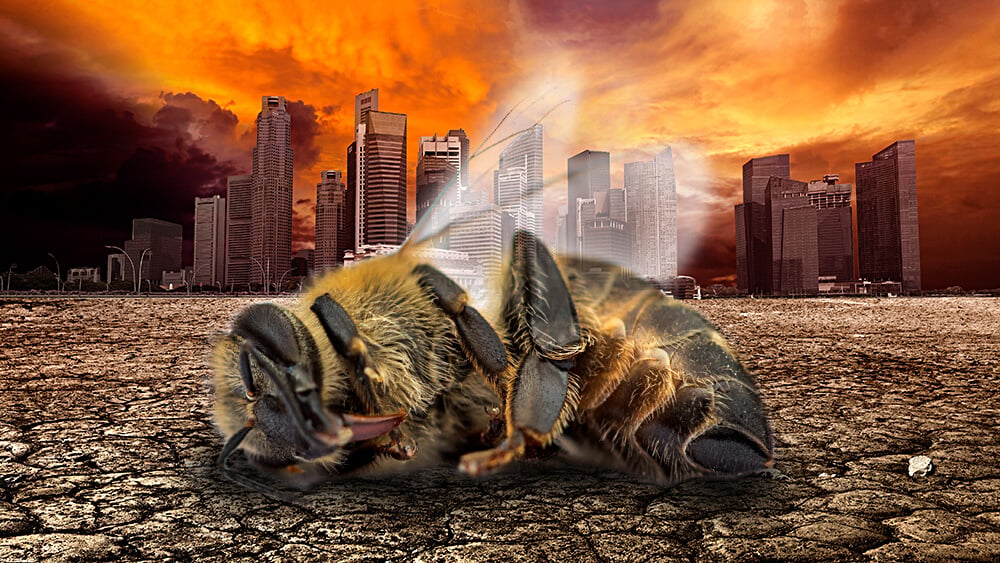
Are we facing an ‘Insect Apocalypse’ caused by ‘intensive, industrial’ farming and agricultural chemicals? The media say yes; Science says ‘no’

  June 16, 2020

https://geneticliteracyproject.org/wp-content/uploads/2020/06/dead-bee-desolate-city.jpg

The media call it the “Insect Apocalypse”. In the past three years, the phrase has become an accepted truth of the journalism literati, and usually associated with such apocalyptic terms as “ecosystem collapse” and “food crisis”. The culprit: modern agriculture, which is often linked to the Brave Not-So-New World of GMOs and gene-edited crops and the chemicals purportedly used to support it.

As recently as last month, an opinion writer for the New York Times, Margaret Renkl, warned of the dark ages about to be ushered in by pesticides. She makes a case for preserving “weedy” backyards filled with blood-sucking mosquitoes and other human-threatening flying and crawling creatures of various species.
The global insect die-off is so precipitous that, if the trend continues, there will be no insects left a hundred years from now. That’s a problem for more than the bugs themselves: Insects are responsible for pollinating roughly 75 percent of all flowering plants, including one-third of the human world’s food supply.  
Insect Armageddon, another popular phrase, is now one of the most common tropes in science journalism. As I’ve chronicled numerous times in recent years, (including here, here and here), many journalists have echoed claims by environmental activists  advancing a succession of insect- and animal-related environmental apocalypse scenarios over the last decade—first honeybees, then wild bees and more recently birds. In each case they fingered modern, intensive farming, particularly crop biotechnology and pesticides, as the culprit, and warned of the terrible consequences in store for the Earth, including the mass extinction of pollinators and the global famine that would surely follow. In each case, small or poorly executed studies predicting imminent catastrophes were ballyhooed by many in the media; in each case, as more research came to the light, the hyped claims were eventually retracted or dramatically readjusted.............To Read More....


Tuesday, May 14, 2019

Six Reasons Why You Should Ignore the UN’s Species Extinction Report

James Dilingpole, 7 May 2019 @ Breitbart

The United Nations has produced a report warning that a million species are threatened with extinction. Here is why you shouldn’t take it seriously.
It’s politics, not science

The Intergovernmental Science-Policy Platform on Biodiversity and Ecosystem Services (IPBES), which produced the report, is a political organisation not a scientific one. Just like its sister organisation the Intergovernmental Panel on Climate Change — IPCC — in fact.

As Donna Laframboise notes here, both exist purely to give a fig leaf of scientific credibility to the UN’s ‘sustainability’ agenda.
When the IPBES was established in 2010, we were informed point blank that its purpose was “to spearhead the battle against the destruction of the natural world.” 
In other words, there’s all sorts of deception here. This is no sober scientific body, which examines multiple perspectives, and considers alternative hypotheses. The job of the IPBES is to muster only one kind of evidence, the kind that promotes UN environmental treaties. 
That’s how the United Nations works, folks. Machinations in the shadows. Camouflaging its political aspirations by dressing them up in 1,800 pages of scientific clothing.
This is the usual suspects crying wolf. Again

No one would dispute that habitat loss is a problem for plants and animals. But it’s a big stretch from there to suggest that a million species are ‘threatened’ with actual extinction. The ‘E’ word has long been overplayed by environmentalists because it’s so dramatic and final and because everyone has heard of the dodo. There is no evidence whatsoever, though, that the world is heading for its so-called Sixth Great Extinction. As Willis Eschenbach once pertinently asked at Watts Up With That? – Where Are The Corpses?

Harvard ecologist EO Wilson once estimated that up to 50,000 species go extinct every year. How did he calculate this? Using the same method the IPCC uses for its junk-science prognostications on catastrophic climate change: computer models.
Greenpeace co-founder Patrick Moore exploded this myth long ago:
Moore said in 2000: “There’s no scientific basis for saying that 50,000 species are going extinct. The only place you can find them is in Edward O. Wilson’s computer at Harvard University. They’re actually electrons on a hard drive. I want a list of Latin names of actual species.” Moore was interviewed by reporter Marc Morano (now with Climate Depot) in the 2000 Amazon rainforest documentary:
Environmental activist Tim Keating of Rainforest Relief was asked in the 2000 documentary if he could name any of the alleged 50,000 species that have gone extinct and he was unable.
“No, we can’t [name them], because we don’t know what those species are. But most of the species that we’re talking about in those estimates are things like insects and even microorganisms, like bacteria,” Keating explained.
R-i-g-h-t. So there are all these species going extinct. But we don’t know what they are because we haven’t yet discovered them. Hmm. Sounds terrible. Let’s cancel Western Industrial Civilisation right now, just in case.
Seriously, these people are like a stuck record

Here – h/t Dennis Ambler at Homewood’s place – is the Independent from 2006:
Life on earth is facing a major crisis with thousands of species threatened with imminent extinction – a global emergency demanding urgent action. This is the view of 19 of the world’s most eminent biodiversity specialists, who have called on governments to establish a political framework to save the planet.
Scientists estimate that the current rate at which species are becoming extinct is between 100 and 1,000 times greater than the normal “background” extinction rate – and say this is all due to human activity.
Anne Larigauderie, executive director of Diversitas, a Paris-based conservation group, said that the situation was now so grave that an international body with direct links with global leaders was essential.
The scientists believe that a body similar to the Intergovernmental Panel on Climate Change could help governments to tackle the continuing loss of species.
They get away with presenting it as “news” every time because the mainstream media is so thoroughly compliant and dutifully bigs up each scare every time it appears.

“Nature is in its worst shape in human history’

This is exactly the kind of scaremongering claim the report was designed to generate. It gives environmental correspondents from on-message outfits like the BBC and CBC the excuse to put in a call to their favourite eco-alarmists, who helpfully respond with hysterical drivel like this:
“Humanity unwittingly is attempting to throttle the living planet and humanity’s own future,” said George Mason University biologist Thomas Lovejoy, who has been called the godfather of biodiversity for his research.
Actually, as Patrick Moore notes, there have been many worse times for species extinction.
Moore, in an interview with Climate Depot, refuted the claims of the species study. “The biggest extinction events in the human era occurred 60,000 years ago when humans arrived in Australia, 10-15,000 years ago when humans arrived in the New World, 800 years ago when humans found New Zealand, and 250 years ago when Europeans brought exotic species to the Pacific Islands such as Hawaii,” Moore explained.
“Since species extinction became a broad social concern, coinciding with the extinction of the passenger pigeon, we have done a pretty good job of preventing species extinctions,” Moore explained.
“I quit my life-long subscription to National Geographic when they published a similar ‘sixth mass extinction’ article in February 1999. This [latest journal] Nature article just re-hashes this theme,” he added. Moore left Greenpeace in 1986 because he felt the organization had become too radical.
Polar Bears and Tigers

By curious coincidence perhaps the two most overhyped of all doomed species are now enjoying a remarkable recovery, not least because – contrary to the claims of environmentalists – humans actually do care about flora, fauna and diversity and have made great strides in preserving them.
It has been a century since the last species of any significance – the passenger pigeon – died out. Almost all the species extinctions that have occurred in the last two centuries have been on islands, the result of predation by invasive species such as rats or cats accidentally introduced by sailors.
Polar bear populations have exploded from about 5,000 60 years ago to around 26,000 now – making a mockery of their status as an emblem of man-made environmental catastrophe.
Meanwhile, the number of tigers in India has risen dramatically in the last decade, according to the Irish Times:
The estimated population of the endangered big cat has increased from 1,411 in 2006 to 2,226 in 2014, according to the report published by the Indian government’s National Tiger Conservation Authority.
Read the small print

When you get to the bottom of the scaremongering report, the authors show their true colours.
Here is the BBC’s summary:
The study doesn’t tell governments what to do, but gives them some pretty strong hints.
One big idea is to steer the world away from the “limited paradigm of economic growth”.
They suggest moving away from GDP as a key measure of economic wealth and instead adopting more holistic approaches that would capture quality of life and long-term effects.
They argue that our traditional notion of a “good quality of life” has involved increasing consumption on every level. This has to change.
Yes, we’re back to our old friends – Agenda 21 and sustainability – the UN’s code phrases for a new world order in which technocrats of the international elite impose their globalist agenda of wealth redistribution, regulation, enforced renewables, higher taxes and enforced rationing on sovereign nations in the name of ‘saving the planet.’

If the UN really cared about species extinction, of course, it would be doing the exact opposite.
As Jo Nova points out:
1. The worst pollution is in countries with a low income per capita — when people are hungry they raze forests. The most polluted cities are in places like Ghana, Ukraine, Bangladesh, Zambia, Argentina, and Nigeria.  The most deforestation occurs in Brazil, Indonesia, Russia, and Mexico. The worst air is in India and China.
2. Only rich nations have the resources to save the environment.
3. Countries that produce more CO2 are richer.
Ignore everything the UN tells you about the environment. It’s drivel – and dangerous drivel at that.

More Below:
TwitterEmail

Saturday, May 11, 2019

The UN is making up claims about extinctions

May 10, 2019 By Jack Hellner

In early May, the United Nations put out another dire report saying humans will cause one million species to go extinct.  Here's what they were up to:
According to the new Report, entitled Intergovernmental Science-Policy Platform on Biodiversity and Ecosystem Services (IPBES), more than one million species of plants and animals are at risk of extinction (Figure 3A) — many of which are predicted to be pushed into extinction within just a few decades — thanks to decades of rampant poisoning, looting, vandalism and wholesale destruction of the planet's forests, oceans, soils, watersheds, and air.
As with most stories on climate change caused by humans, most of the news media are just feeding these predictions to the public without any questions.

Faunalytics, a group that helps save endangered animals, has only 3,000 animals on its endangered species list, so there's reason to ask questions. Start with this: where does the one million number come from?

The public has repeatedly been told that humans are causing thousands of animals to go extinct each year, yet a study by National Autonomous University of Mexico in 2015 found only 477 identified species that have gone extinct since 1900, or around four per year............ Isn't it time for journalists to do their job by doing some investigation and telling the public the truth instead of just repeating what they are told when previous predictions have been completely wrong? .............Read more

Tuesday, February 26, 2019

Greenpeace Co-Founder Slams Species Extinction Scare Study as proof of how ‘peer-review process has become corrupted’ – Study ‘greatly underestimate the rate new species can evolve’

Moore: 'I quit my life-long subscription to National Geographic when they published a similar 'sixth mass extinction' article in February 1999"

By: - Climate Depot March 4, 2011

Climate Depot Exclusive
Greenpeace Co-Founder and ecologist Dr. Patrick Moore, slammed a new study claiming a dramatic and irreversible mass species extinction. “This [journal Nature] article should never have made it through the peer-review process,” Moore told Climate Depot in an exclusive interview. “The fact that the study did make it through peer-review indicates that the peer review process has become corrupted,” Moore, the author of the new book “Confessions of a Greenpeace Dropout,” added.
“The authors [of the journal Nature study] greatly underestimate the rate new species can evolve, especially when existing species are under stress. The Polar Bear evolved during the glaciation previous to the last one, just 150,000 years ago,” Moore explained.
The new alarming species mass extinction study was described in an article in Yahoo News and AFP on March 4, 2011 titled: ‘World’s sixth mass extinction may be underway: study.’ The AFP article reported: Mankind may have unleashed the sixth known mass extinction in Earth’s history, according to a paper released by the science journal Nature. Over the past 540 million years, five mega-wipeouts of species have occurred through naturally-induced events. But the new threat is man-made, inflicted by habitation loss, over-hunting, over-fishing, the spread of germs and viruses and introduced species, and by climate change caused by fossil-fuel greenhouse gases, says the study. [End article excerpt.]
But Moore, in an interview with Climate Depot, refuted the claims of the species study. “The biggest extinction events in the human era occurred 60,000 years ago when humans arrived in Australia, 10-15,000 years ago when humans arrived in the New World, 800 years ago when humans found New Zealand, and 250 years ago when Europeans brought exotic species to the Pacific Islands such as Hawaii,” Moore explained.
“Since species extinction became a broad social concern, coinciding with the extinction of the passenger pigeon, we have done a pretty good job of preventing species extinctions,” Moore explained.
“I quit my life-long subscription to National Geographic when they published a similar ‘sixth mass extinction’ article in February 1999. This [latest journal] Nature article just re-hashes this theme,” he added. Moore left Greenpeace in 1986 because he felt the organziation had become too radical. Moore also challenges man-made global warming fears.

See: Greenpeace Co-Founder Dr. Patrick Moore Questions Man-Made Global Warming, Calls it ‘Obviously a Natural Phenomenon’
This is not the first time Moore has gone to battle over alarming claims of species extinction. In the 2000 documentary “Amazon Rainforest: Clear-Cutting The Myths”, Moore bluntly mocked species extinction claims made by biologist Edward O. Wilson from Harvard University. Wilson estimated that up to 50,000 species go extinct every year based on computer models of the number of potential but as yet undiscovered species in the world.
Moore said in 2000: “There’s no scientific basis for saying that 50,000 species are going extinct. The only place you can find them is in Edward O. Wilson’s computer at Harvard University. They’re actually electrons on a hard drive. I want a list of Latin names of actual species.” Moore was interviewed by reporter Marc Morano (now with Climate Depot) in the 2000 Amazon rainforest documentary:
Environmental activist Tim Keating of Rainforest Relief was asked in the 2000 documentary if he could name any of the alleged 50,000 species that have gone extinct and he was unable.
“No, we can’t [name them], because we don’t know what those species are. But most of the species that we’re talking about in those estimates are things like insects and even microorganisms, like bacteria,” Keating explained.
UK scientist Professor Philip Stott, emeritus professor of Biogeography at the University of London, dismissed current species claims in the 2000 Amazon rainforest documentary.
“The earth has gone through many periods of major extinctions, some much bigger in size than even being contemplated today,” Stott, the author of a book on tropical rainforests, said in the 2000 documentary.
“Change is necessary to keep up with change in nature itself. In other words, change is the essence. And the idea that we can keep all species that now exist would be anti-evolutionary, anti-nature and anti the very nature of the earth in which we live,” Stott said.
Bye Bye Global Warming Movement — Welcome to the Next Eco-Scare — Species?!
Many critics of the environmental movement believe that as man-made global warming fears continue to fade scientifically and politically, species extinction will be touted as the next environmental scare. See:
Species: ‘Seal was declared extinct in 1892. So what is it doing alive and well today? Why are there thousands of Guadalupe fur seals swimming off the coast of Mexico now?’ — ‘As naturalists gladly admit, reports of the species’ demise at the end of the 19th century were premature’
More on the ‘science’ behind the extinction claims:
UN trying to promote diminishing biodiversity as the NEXT BIG CRISIS – 2010: Excerpt: ‘It is hard to make definitive statements regarding loss of diversity when science can not even tell us how many different creatures there are on the planet. Nevertheless, the UN has launched the International Year of Biodiversity, warning that the ongoing loss of species around the world is affecting human well-being…The words of Henry Louis Mencken we quoted in The Resilient Earth put it best: “The fundamental aim of practical politics is to keep the populace alarmed, and hence clamoring to be led to safety, by menacing it with an endless series of hobgoblins, all of them imaginary.” This is a tactic that the UN has turned into an art form. Having succeeded with turning global warming into a “crisis” they are now giving biodiversity a go. Lack of proper science, contradictory claims by activists and experts, conflicts with the needs of average people just trying to live their lives—yes, this sounds like a UN generated, politically motivated “crisis.” After all, the bureaucrats and parasites at the UN rode the global warming gravy train for more than a quarter century. Now, with the panic over global warming all but vanished, they have started pushing a new biodiversity crisis.
‘Ten years’ to solve nature crisis, UN meeting hears – 2011: ‘The UN biodiversity convention meeting has opened with warnings that the ongoing loss of nature is hurting human societies as well as the natural world… ‘We are now close to a ‘tipping point’ – that is, we are about to reach a threshold beyond which biodiversity loss will become irreversible, and may cross that threshold in the next 10 years if we do not make proactive efforts for conserving biodiversity’
‘We Are Destroying Life on Earth,’ UN Conference Claims: ‘Scientists over the past decade have identified new species at an unprecedented rate. The 2008 World Wildlife Fund (WWF) study First Contact in the Greater Mekong reported that 1,068 species were discovered or newly identified by science between 1997 and 2007 — averaging two new species a week. And the Census of Marine Life — an ambitious, 10-year project to catalog the diversity of the world’s oceans — recently concluded, having identified more than 6,000 potentially new ocean-going species.