February 23, 2021 by
Dan Mitchell
@ International Liberty
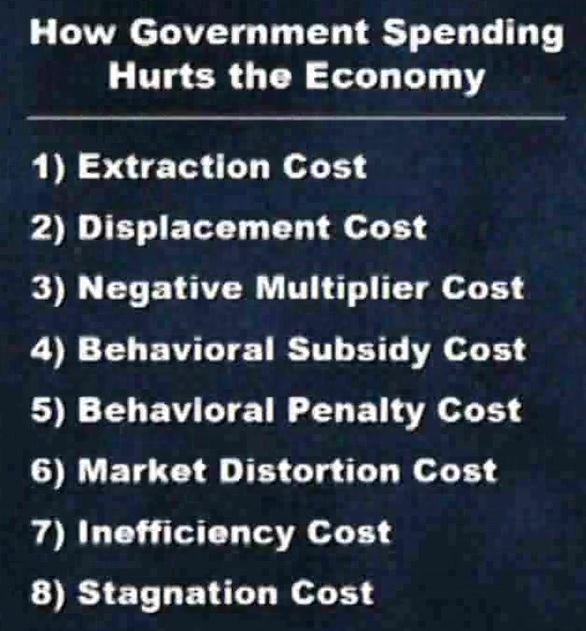
While it’s true that every penny in the budget requires money to
be diverted from the economy’s productive sector, not all government
spending is created equal when considering the impact on growth.
Some types of spending, such as redistribution programs, are doubly harmful to prosperity. The economy is first hurt by the taxes
needed to finance the programs, and then the economy is hurt because
the programs give people incentives to rely on the government rather than work. Other types of spending, however, require a cost-benefit analysis.
Consider the case of education. There are costs when politicians take
money out of the private sector to finance education, but there are
benefits from having an educated population. That doesn’t tell us how much to spend,
of course, and it also overlooks equally important questions such as
whether the money will generate better results if used to finance a government monopoly or a choice-based system. But I’m simply making the point that there are costs and benefits.
Now let’s apply this analysis to government-financed research and
development, which involves everything from the National Science
Foundation to NASA, and from global warming grants to weapons
development for the Pentagon.
Proponents argue that these are “public goods,” meaning that they produce economy-wide benefits and can only be handled by government. But that view seems to be based in large part on faith rather than evidence. Matt Ridley, the former science editor for the Economist, wrote about this topic for the Wall Street Journal back in 2015. If you only have time to read one article, this might be the best choice.
He starts by explaining that most breakthroughs come from private initiative.

Most technological breakthroughs come from technologists
tinkering, not from researchers chasing hypotheses. Heretical as it may
sound, “basic science” isn’t nearly as productive of new inventions as
we tend to think. …Politicians believe that innovation can be turned on
and off like a tap: You start with pure scientific insights, which then
get translated into applied science, which in turn become useful
technology.
So what you must do, as a patriotic legislator, is to ensure that there
is a ready supply of money to scientists on the top floor of their
ivory towers, and lo and behold, technology will come clanking out of
the pipe at the bottom of the tower. …this story…so prevalent in the
world of science and politics—that science drives innovation, which
drives commerce—is mostly wrong. It misunderstands where innovation
comes from. Indeed, it generally gets it backward. …It is no accident
that astronomy blossomed in the wake of the age of exploration. The
steam engine owed almost nothing to the science of thermodynamics, but
the science of thermodynamics owed almost everything to the steam
engine. …Technological advances are driven by practical men who tinkered
until they had better machines; abstract scientific rumination is the
last thing they do.
Government funding, by contrast, does not have a good track record.
It follows that there is less need for government to fund
science: Industry will do this itself. Having made innovations, it will
then pay for research into the principles behind them. Having invented
the steam engine, it will pay for thermodynamics. …For more than a half
century, it has been an article of faith that science would not get
funded if government did not do it, and economic growth would not happen
if science did not get funded by the taxpayer. …there is still no
empirical demonstration of the need for public funding of research and
that the historical record suggests the opposite. After all, in the late
19th and early 20th centuries, the U.S. and Britain made huge
contributions to science with negligible public funding, while Germany
and France, with hefty public funding, achieved no greater results
either in science or in economics. …public funding of research almost
certainly crowds out private funding. That is to say, if the government
spends money on the wrong kind of science, it tends to stop researchers
from working on the right kind of science.
Ridley doesn’t claim there are no benefits. Instead, he makes the
more practical point that government R&D has high costs with
relatively low benefits.
…the argument for public funding of science rests on a
list of the discoveries made with public funds, from the Internet
(defense science in the U.S.) to the Higgs boson (particle physics at
CERN in Switzerland). But that is highly misleading. Given that
government has funded science munificently from its huge tax take, it
would be odd if it had not found out something. This tells us nothing
about what would have been discovered by alternative funding
arrangements. And we can never know what discoveries were not made
because government funding crowded out philanthropic and commercial
funding.
Ridley’s analysis is backed up by scholarly research.
Here are some excerpts from a study by the Bureau of Labor Statistics.

This paper reviews the literature on R&D to provide
guidelines for recent efforts to include R&D in the national income
accounts. …The overall rate of return to R&D is very large, perhaps
25 percent as a private return and a total of 65 percent for social
returns. However, these returns apply only to privately financed R&D
in industry.
Returns to many forms of publicly financed R&D are near zero. …On
the basis of the evidence considered, privately financed R&D in
industry should be treated as an investment and included in the relevant
R&D stock. Returns to R&D are very high, but these high returns
accrue only to privately financed R&D. Many elements of university
and government research have very low returns, overwhelmingly contribute
to economic growth only indirectly, if at all, and do not belong in
investment.
And here are some passages from a 2003 report by the Organization for Economic Cooperation and Development.

…the pace of accumulation of physical and human capital
plays a major role in the growth process. Most notably, the estimated
impact of increases in human capital (as measured by average years in
education) on output suggests high returns to investment in education.
The results also point to a marked positive effect of business-sector
R&D, while the analysis could find no clear-cut relationship between
public R&D activities and growth
…there are significant differences in the returns of R&D
expenditure across sectors, and the private sector may be better able to
channel resources towards high return R&D activities …regressions
including separate variables for business-performed R&D and that
performed by other institutions (mainly public research institutes)
suggest that it is the former that drives the positive association
between total R&D intensity and output growth. …The negative results
for public R&D are surprising…they suggest publicly-performed
R&D crowds out resources that could be alternatively used by the
private sector, including private R&D. There is some evidence of
this effect in studies.
Terence Kealey’s 2017 testimony to the Senate’s Homeland Security and Governmental Affairs Committee also is worth perusing.

…the British Industrial Revolution of the 19th century,
like the British Agricultural Revolution of the 18th century, was
laissez faire… The US was laissez faire in science between 1776 and
1940, yet by 1890 it had overtaken the UK to become the richest
industrialized country in the world. Meanwhile
those European countries – including France and the German states –
whose governments invested most in science failed to converge on the UK
or the US, let alone overtake them. …as shown by the successes of the
Wright brothers, Thomas Edison and Nikola Tesla, to say nothing of the
great industries of Pittsburgh and Detroit – US science, technology and
industry flourished. …since 1830 the long-term rates of GDP per capita
and TFP (total factor productivity) growth in the US have been steady
(with GDP per capita, for example, growing at just under 2% per annum)
and the inauguration of the federal funding for science had the
following effect on long-term rates of GDP per capita and TFP growth:
none.
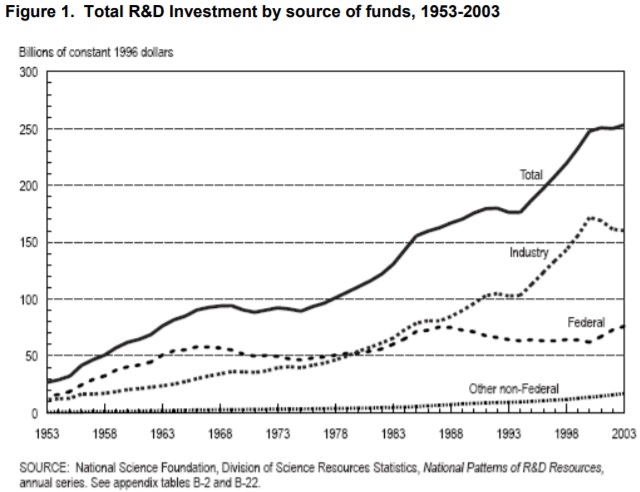
The good news, relatively speaking, is that the private sector now plays a very dominant role in R&D expenditures.
This was not always the case. This chart, from Iain Murray’s research, shows that government played the dominant role in the 1950s, 1960s, and 1970s.
Let’s close with two real-world examples of how private R&D drives progress.
First, here are some excerpts from a 2017 column in the Wall Street Journal by Tom Stossel.
He explains that progress in curing and treating diseases comes from
the private sector rather than the National Institutes of Health.

The assumption seems to be that the root of all medical
innovation is university research, primarily funded by federal grants.
This is mistaken. The private economy, not the government, actually
discovers and develops most of the insights and products that advance
health. The history of medical progress supports this conclusion.
…innovation came from physicians in universities and research institutes
that were supported by philanthropy.
Private industry provided chemicals used in the studies and then
manufactured therapies on a mass scale. …Practical innovation requires
incremental efforts. But the reviewers of grant applications for medical
research are obsessed with theory-based science and novelty for
novelty’s sake. …Academic administrators, operating under the delusion
that government largess would grow forever, have become entitled. …By
contrast, private investment in medicine has kept pace with the aging
population and is the principal engine for advancement. More than 80% of
new drug approvals originate from work solely performed in private
companies. …Great advances in health care have been made, but there are
still important challenges, from obesity to dementia. One step toward
addressing them would be for Washington to adopt the right approach to
medical innovation—and to stop simply throwing money at the current
inefficient system.
Second, here’s more of Terence Kealey’s work, in this case some commentary from last year that focuses on space exploration.

…all powered flight started in the private sector, for
the Wright brothers were not government‐funded researchers. …A team of
full‐time government‐funded researchers, operating out of the
Smithsonian Institution, were then also trying to launch
heavier‐than‐air machines. Even though the Smithsonian team enjoyed a
budget that was a hundred times larger than that of the Wrights, its
prototypes always crashed. Airplanes are but one of the many gifts that
private research and development has bestowed on humanity.
As are space rockets.
The great space‐rocket pioneer was Robert
“Moonie” Goddard (1882–1945), a professor at Clark College in
Massachusetts. Funded with $100,000 from the Guggenheims and $10,000
from the Hodgkins Fund, the projects that resulted in his achievements
were extraordinary: By 1925 he had created the first liquid‐fueled
rocket. By 1932 he had developed a gyro stabilizer… Elon Musk’s company,
SpaceX,…doing something — namely, putting humans into orbit — that
previously had been achieved only by governments.
NASA could now be seen
as only a temporary interruption of a process that had started in the
private sector. …If there is a science that proves the resilience of the
private sector, it is space science, including, of course, astronomy.
Time again, what at the time was the largest optical telescope in the
world was privately funded… Radio astronomy, moreover, was actually born
in the private sector, when Karl Jansky of Bell Labs discovered in 1931
that stars emitted radio waves. Grote Reber, a radio engineer, built
the first radio telescope, a parabolic dish reflector in his backyard in
Chicago in 1937.
The purpose of this column isn’t to argue that there shouldn’t be any government-funded research. Indeed, because there’s at least some hope of that such spending
generates benefits, I prefer R&D spending over almost all other
types of spending (it’s better than redistribution outlays, and also better than money that goes for the Department of Agriculture, Department of Education, Department of Housing and Urban Development, etc).
But “better than” other types of government spending is not the same
as “better than” leaving the money in the economy’s productive sector. The bottom line is that there simply isn’t any evidence that
government-financed R&D generally passes the cost-benefit test
described at the start of the column.
Which means that we should be very skeptical when politicians and interest groups plead for more funding (needless to say, evidence tells us we should be skeptical of any requests for bigger government, not just those for more R&D spending).