Search This Blog

De Omnibus Dubitandum - Lux Veritas

Showing posts with label Cost Benefit Analysis. Show all posts

Monday, March 20, 2023

A Proposal For Exposing The True Costs Of Getting Electricity From Wind And Sun

March 18, 2023 @ Manhattan Contrarian 

Every place that tries increasing the percentage of electricity generation that comes from wind and sun then experiences rapidly rising consumer electricity costs. The reasons why this happens are not complicated. Even at relatively low levels of wind and solar penetration, backup fossil fuel or other generation cannot be closed, so consumers must pay for two duplicate generation systems. At higher levels of wind/solar penetration, things like overbuilding, curtailment, and hugely expensive grid-scale energy storage come into play. In my post of February 8, 2023, I asked “Could anybody possibly be stupid enough to believe the line that wind and solar generators can provide reliable electricity to consumers that is cheaper than electricity generated by fossil fuels?”

And yet it is an endlessly-repeated mantra of wind/solar advocates that generating electricity from those sources is “cheaper” than generating the same electricity from fossil fuel sources like coal and natural gas. In this post I will make a proposal for a way to definitively expose the falsity of the claims that wind and solar are “cheaper” than fossil fuels for electricity generation.

First, here is a smattering of quotes from various climate advocates (often masquerading as journalists or politicians) making the “wind and solar are cheaper” claim. Note that these are not just some fringe crazies, but rather are prominent media and political voices — including the President of the United States — who you might think would know at least a little of what they are talking about.

  • From Bloomberg News, January 30, 2023: “Replacing US Coal Plants With Solar and Wind Is Cheaper Than Running Them. It now ‘unequivocally’ costs less to build new renewable energy projects than to operate existing coal plants, according to a new analysis.” 
  • From the World Economic Forum, July 5, 2021: “Renewables are now significantly undercutting fossil fuels as the world’s cheapest source of energy, according to a new report. Of the wind, solar and other renewables that came on stream in 2020, nearly two-thirds – 62% – were cheaper than the cheapest new fossil fuel, according to the International Renewable Energy Agency (IRENA).”
  • From Utility Dive, February 9, 2023: “Renewables would provide cheaper energy than 99% of US coal plants and catalyze a just energy transition. Investment in lower cost wind and solar resources is an economic opportunity worth up to $589 billion, providing jobs and tax base to coal communities.”
  • From the BBC, September 13, 2022: “Switching from fossil fuels to renewable energy could save the world as much as $12tn (£10.2tn) by 2050, an Oxford University study says. The report said it was wrong and pessimistic to claim that moving quickly towards cleaner energy sources was expensive.”
  • From President Biden in the State of the Union address, February 7, 2023: “Look, the Inflation Reduction Act is also the most significant investment ever to tackle the climate crisis. lowering utility bills, creating American jobs, and leading the world to a clean energy future.”

There is a virtually infinite supply of more where those came from. Not a one of those pieces, or hundreds more like them, ever mentions or explains that the “cheap” wind and solar power that they are talking about only includes the costs of an intermittent supply that does not work most of the time and cannot provide reliable and continuous electricity on its own; nor do any of these pieces mention that turning that intermittent supply into something reliable and continuous will entail additional large and unspecified costs.

The problem of exposing the true costs of getting electricity from wind and solar has been complicated by a large error, which is that state governments and utilities have allowed the structure of wholesale electricity markets to be altered to the advantage of the wind and solar generators. In particular, the wholesale electricity markets universally give priority of dispatch to the wind and solar generators, and also allow those generators to bid low prices in a spot market when the wind is blowing or sun shining. These rules have the effect of hiding the cost of covering for the intermittency of the wind and solar generators, and of giving the false impression that the cost of intermittency is not something caused by the addition of wind and solar facilities.

The people who set up this market structure have a fundamental misconception of what the product is that consumers need. Consumers do not want or need electricity that can go on and off from minute to minute. They want and need electricity that is very nearly 100% reliable all the time. The market should be set up to buy only the second product, not the first.

In a post back in July 2018, I made a very simple proposal for how to structure the wholesale electricity market to acquire the product that consumers want and need. Here was that proposal:

Scrap this ridiculous idea of grid priority for wind and solar.  Instead, the grid operator should seek only offers of power that are firm and reliable for some reasonable period, say 24 hours at a time.  If you want to sell wind power to the grid operator, it's then on you to also provide the mix of backup sources (could be fossil fuel power plants, could be batteries, could be whatever else you come up with) to make your offer reliable for the requisite period.

Now that wind and solar producers are experiencing geometric growth under crazy rules that favor them, this business is getting much more serious. It’s time to put some more detail on my 2018 proposal. First of all, the bids for a given service period should be taken and awarded well in advance of the period in question. For example, if the service period is April 1, 2023, then the bids should be taken and awarded some time in February at the latest, not on March 31. If you take the bids on March 31, that gives wind and solar operators a chance to game their bids based on weather forecasts. Second, although I suggested a service period for bid of only one day, I think a longer period would be better. A month or even a year would be fine. This would give bidders the chance to include wind and solar contribution based on average weather conditions over a period of time.

And here’s the most important new part of my proposal, this one intended to force the putting of a price on increasing penetration of wind and solar generation facilities on the grid. Ask for bids with minimum contributions from wind and solar generators at various levels: i.e., “your bid should include your price if a minimum of 20% of supply over the service period must come from wind/solar; and your price if a minimum of 30% must come from wind/solar; and similar for 40%, 50%, 60% and 70% minimum contributions from wind and solar.” I don’t think there’s any reason to go higher than 70% at this time, because nobody would be able to do it. For that matter, probably nobody can do greater than 30% anywhere in the U.S. today, but this bidding process would smoke that out.

A market structured in this way would make immediately clear that adding wind and solar generation to the mix increases the blended price to the utility; and it would also put quantitative numbers on the additional costs from each incremental addition of wind/solar generation.

I am not an expert on the regulation of electricity prices in the U.S., and I know that it is complicated. However, I do not know any reason why the public utility commission of each state would not have the authority to create and impose this structure on the wholesale electricity markets that impact its consumers. The blue states of course will never do this. But the red states could do it, and thereby give their consumers the benefits of far lower electricity costs, while also exposing how the blue states are damaging their own citizens in the pursuit of the climate religion.


Thursday, March 9, 2023

Battery Electric Vehicles are not the answer

By March 9th, 202 3 14 Comments @ CFACT

What will be the effect of 250 million Battery Electric Vehicles (BEVs) on America’s electric grid in 2050? What will it cost to allow the electric grid to safely supply 250 million BEVs with the power they need? And, is it even possible to transition the grid to accomplish this objective? This article will show it’s nearly impossible for the United States to increase the capacity of its electric grid to accommodate 250 million BEVs.

Each of the following components of the electric grid needs to be examined to determine the cost of providing the power needed by BEVs, and whether it’s even possible to make the changes. 

  • Charging stations
  • Distribution and substation transformers
  • New power plants
  • Transmission lines 
  • Underground and overhead lines

Charging Stations

Approximately 125,000 gasoline service stations in the United States, each with at least eight fueling pumps, are needed to service 250 million ICE vehicles.  While home charging may reduce the need for this many locations, the time required to charge each BEV is 30 minutes, or six times the amount of time required to fill an ICE vehicle’s gas tank. This increased delay could offset any reduction resulting from home charging.

Tesla has 1,772 supercharging locations, i.e., stations in North America, with around ten charging stalls at each location. On this basis, Tesla has approximately 17,720 charging stalls. Assuming the cost of supplying the power is $100,000 per station, and the cost for each stall is $20,000, Tesla’s current system would have cost around $530 million.  Providing the same number of locations as provided by 125,000 gasoline stations would require the equivalent of 71 Tesla systems at the cost of $37.5 billion.

Distribution and substation transformers

There are two distinct populations of distribution (DT) and substation transformers. 

  • First, there are the suburbs and small towns spread across the country, blanketed predominantly by single-family homes, with some apartment buildings and light industry. 
  • Next, are the big cities where most people live in apartment buildings and park their cars on the street.

This article will overlook the unique problems of big cities.

Approximately 25 million DTs serve single-family homes in suburban/rural America, and virtually all these DTs will have to be replaced to accommodate the charging of BEVs. For background, DTs typically serve four homes, so it is the combined load from all four homes that must be carried by the distribution transformer. Therefore, with four homes, eight BEVs will likely need to be recharged, more or less, nightly.

The cost of changing out one 50 KVA distribution transformer, a typical size, and replacing it with a 100 KVA unit is around $20,000. On this basis, the cost of replacing 25 million DTs is over $500 billion. Related apartment buildings in suburban America use larger DTs, which must also be replaced at an estimated cost of $41 billion.

Substation transformers supply distribution transformers, and as the load on the distribution transformers increases, the load on the substation transformers also increases. If only 15% of the 55,000 substation transformers become overloaded due to overloaded distribution transformers, the cost could be $9.9 billion to replace the overloaded substation transformers. Therefore, the cost to replace DTs and substation transformers in the continental United States, not counting DTs in large cities, is approximately $551 billion.

New power plants

The Electrification Futures Study, published by the National Renewable Energy Laboratory (NREL), estimated the amount of new generation capacity needed for all vehicles to be BEVs and for all heating of buildings to be electric. The portion of the NREL study that comes closest to reflecting the generating capacity required by 250 million BEVs showed that US power usage would increase from 4,127 TWh to 5,800 TWh. Assuming natural gas combined cycle (NGCC) power plants, rated 800 MW, with a capacity factor of 54.4%, and that cost $1,000 per KW, are built to provide the added capacity, it will require 439 new NGCC power plants costing $351 billion.

Transmission lines

Based on the Midcontinent Independent System Operator’s (MISO’s) transmission line cost estimating brochure, a short, 200-mile 230KV line will likely cost $600 million. Since NGCC plants can be placed relatively close to where the demand exists, longer lines probably won’t be required. Assuming that half the new NGCC power plants can be connected to existing transmission lines, the cost of new transmission lines, if the can be built, would be $132 billion. Underground and overhead lines There will undoubtedly be failures of these lines, but it’s not possible to estimate the cost of replacing them.

Summary

Upgrading America’s electric grid to accommodate 250 million BEVs will cost over a trillion dollars. However, will it be possible to upgrade the grid? Building transmission lines has been, and may continue to be a problem. Importantly, obtaining the DTs and substation transformers to upgrade the grid may not be possible. Nearly half of all DTs are imported, as are nearly all substation transformers. As a result, the annual availability of DTs is around one million units. At that rate, it would take twenty-five years to upgrade the grid. One substation transformers takes over a year to obtain.

Upgrading the electric grid to accommodate 250 million BEVs can’t be done in a year or two and could take decades. What can we conclude from this additional information when it’s considered with the earlier reports on material availability? Given that there are not enough materials to build all the BEVs, that importing the materials places the United States at a strategic disadvantage, that the cost of upgrading the grid is prohibitive, and that the upgrade could take decades, it’s fair to conclude, that banning the sale of ICE vehicles should be stopped.

Americans should be free to buy the type of car they prefer.

Author

  • Donn Dears

    Donn is an engineer and retired senior executive of the General Electric Company who spent his career in the power sector. He led organizations that provided engineering services for GE’s large electrical apparatus and spearheaded the establishment of GE subsidiary companies around the world. Donn actively participated in providing engineering services to a wide range of industries, including electric utilities, steel, mining, and transportation.


Thursday, August 5, 2021

Study: More Diversity, Equity, Inclusion Staff Than History Profs at Average Campus

  By Jarrett Stepman | August 3, 2021 

The woke revolution on college campuses is being bolstered by a vast network of “diversity, equity, and inclusion” staffers who gobble up school budgets and enforce left-wing orthodoxy.  A recently released paper by Jay Greene, a fellow at The Heritage Foundation’s Center for Education Policy, and James Paul, a doctoral fellow at the University of Arkansas, sheds light on the inflation of diversity, equity, and inclusion staff on modern college campuses. (The Daily Signal is the news outlet of The Heritage Foundation.)

The study examined the personnel at “65 universities representing 16 percent of all students in four-year institutions in the United States.” It found that a significant number of personnel at those universities are devoted solely to the task of promoting diversity, equity, and inclusion.  Of course, general administrative bloat on college campuses is nothing new. There has been a sustained growth in administration in recent decades that has contributed to a drastically higher cost of education and tuition. It certainly has outpaced by far the increase in the number of employees engaged in teaching students or conducting research.

That alone should be cause for concern as a college degree weighs more heavily on students, many of whom are saddled with enormous student loan debt and increasingly questionable job prospects.........To Read More.....


Monday, May 3, 2021

Materials Acquisition for Global Industrial Change (MAGIC)

Biden relies on adherence to climate crisis creed and belief in MAGIC to transform USA, world  

Paul Driessen 

Via executive orders, regulatory edicts and partisan Green New Deal legislation, President Biden intends to slash US carbon dioxide and other greenhouse gas emissions by 50% below their 2005 peak by 2030, and eliminate them (and fossil fuel use) by 2050. But as AOC’s former chief of staff noted, the GND is not just about transforming America’s energy system; it’s about changing the entire economy.  

This radical transformation is driven by three fundamental Articles of Faith, none of them based on reality.

1) The crisis of manmade climate cataclysms necessitates this GND. Team Biden believes natural forces no longer play a role; rising temperatures since the Little Ice Age ended two centuries ago are due solely to fossil fuel use and CO2 emissions, as are all extreme weather events over recent decades; and the 12-year absence of Category 3-5 hurricanes making US landfall (from Wilma in 2005 to Harvey in 2017) is irrelevant – as is the significant decline in violent (F3-F5) US tornadoes 1986-2020 compared to 1950-1985, and that for the first time in history not one violent twister hit the United States in 2018. 

(For a full reality check, read books by Gregory Wrightstone, Marc Morano, Indur Goklany, Patrick Moore, Roy Spencer, Jennifer Marohasy and Obama Energy Undersecretary of Science Steven Koonin.) 

2) American foreign policy must construct a values-based world order that can tackle humanity’s common problems in an organized, collegial manner. Team Biden believes such problems cannot be solved by national governments acting alone, so world leaders have no choice but to work together. Wall Street Journal global view columnist Walter Russell Means calls this the Biden Doctrine

However, China, India and many other countries don’t view climate change as an existential threat – much less a problem that justifies sacrificing their energy needs, economic growth, national security and geopolitical aspirations. They may give lip service to the alleged “climate crisis,” “decarbonization” and “green energy.” But they know their futures are inextricably tied to the abundant, reliable, affordable energy that only oil, natural gas and coal (plus hydroelectric and nuclear) can provide. They are not going to “work together” with leaders who expect them to undermine their most vital goals. 

The Biden Doctrine’s second inherent failing is that GND policies will inevitably hollow out America’s industrial and military might, destroy jobs, and reduce US leverage in future negotiations. China already controls the raw material supply chains for wind turbines, solar panels, battery modules for electric vehicles and backup power systems, and countless other technologies. Even our advanced military equipment relies on metals and minerals that are mined and/or processed by Chinese companies. GND policies would only worsen the situation. 

3) Replacing the 80% of US energy that now comes from fossil fuels can be accomplished quickly, easily, affordably and ecologically – with clean, green, renewable, sustainable, carbon-free wind and solar technologies that will create millions of good jobs, and save our planet from climate devastation

The foundation for this presumed global transformation is the Biden Administration’s Materials Acquisition for Global Industrial Change program – better known by its acronym: MAGIC. 

(This is not an official name. In fact, there is no such program, and no evidence that Team Biden has a clue about what would be required to transform America from fossil to green energy. MAGIC simply provides the most accurate description of how they expect to achieve this transformation.) 

The raw material requirements for a GND economy are astronomical, mind-numbing. To cite just one example of hundreds, Team Biden wants to install 30,000 megawatts of wind turbines off America’s Atlantic, Gulf of Mexico and Pacific coasts. Assuming 10,000 MW per coastline, total Atlantic coast wind capacity would barely meet three-fourths of peak summertime electricity demand for New York City – assuming full output 24/7/365. The entire 30,000 MW wouldn’t meet New York State’s current peak electricity needs. 

However, at 3.6 tons per megawatt, just this Phase 1 offshore wind scheme would require 108,000 tons of copper. At 0.8% metal in an average ore globally, that would involve mining, crushing and processing some 13,000,000 tons of ore, after removing millions of tons of rock to get to the ore bodies! 

14-MW Vesta, GE or Siemens-Gamesa turbines stand 815-850 feet above 30-100 foot deep ocean waters (160 feet higher than the Washington Monument). Each blade is 350 feet long. Every turbine weighs in at 2,000-3,000 tons of metals, plastics and composites, plus massive concrete-and-rebar bases. Phase 1 alone will involve tens of millions of tons of materials, billions of tons of ores and overburden. 

Add in materials for subsea electrical cables, onshore transmission lines, onshore wind turbines and solar panels, backup battery systems, electric vehicles, electric heating systems and other GND technologies – to run the entire USA – and we’re looking at tens of billions of tons of metals and minerals, trillions of tons of ores, and mines, processing plants and factories all over the world. 

Team Biden claims “renewable” energy is “carbon-free.” It gets away with this deception by looking only at electricity generation after turbines and panels are installed – and ignoring how the raw materials are extracted and processed and how the technologies are manufactured ... far from the United States ... using fossil fuels every step of the way ... under minimal to nonexistent laws for air and water pollution control, habitat and wildlife protection, mined land reclamation, child and slave labor, and workplace safety. 

Unencumbered by Paris climate treaty restrictions, emerging economies will gladly sell us “green, renewable” technologies that send electricity costs soaring to several times today’s prices and drive factories and industries out of business, unable to compete with China and India. 

The past winter’s Texas blackout will become commonplace. Wind electricity generation plummeted 93% – but natural gas generation rocketed 450% to make up the difference, even though pipelines could not supply enough fuel, because legislators and regulators had decreed that pipeline compressors run off the compromised grid, instead of on gas from the pipelines. Under the GND, though, there won’t be any gas generation backup – just freezing jobless in the dark. 

Climate czar and private jet setter John Kerry says unemployed oil and factory workers will get “good jobs” making solar panels. In reality, those jobs will be overseas. Americans workers will only assemble, install, maintain, repair, remove, recycle and landfill imported green tech. American families and businesses will be forced to rip out trillions of dollars of perfectly good gas furnaces, ovens, stoves, water heaters, vehicles and industrial systems – and spend more trillions replacing them with expensive new GND-approved equipment, backup batteries and upgraded electrical systems to handle the extra loads. 

And this entire, vastly expanded all-electric world will be expected to function with unreliable, weather-dependent wind and solar power. (All this in a USA where opinion surveys have found the average citizen is willing to pay a minuscule $2-50 per year to reduce US dependence on fossil fuels and (supposedly) keep global average temperatures from rising any higher.) 

President Biden’s inability to comprehend these realities may be due to his diminished mental capacity. But it could also be the result of rarely having to exercise his mind – in a political arena where woke, hard-green, climate-obsessed, cancel-culture ideologues permit no discussion, questions or dissent; where advisors, cabinet members, regulators and legislators are of the same mindset, or too timid to speak up; and where schools, news and social media, Big Tech, government agencies, corporate chiefs and even book publishers likewise silence, ignore, punish and banish anyone who offers differing views. 

We can only hope enough citizens pound enough sense into our ruling classes to eliminate their belief in MAGIC, climate monsters and other countries crazy enough to follow Mr. Biden into economic suicide. 

Paul Driessen is senior policy advisor for the Committee For A Constructive Tomorrow (www.CFACT.org) and author of books, reports and articles on energy, environmental, climate and human rights issues.


Saturday, February 27, 2021

The Weak Case for Government-Financed Research and Development

February 23, 2021 by Dan Mitchell @ International Liberty

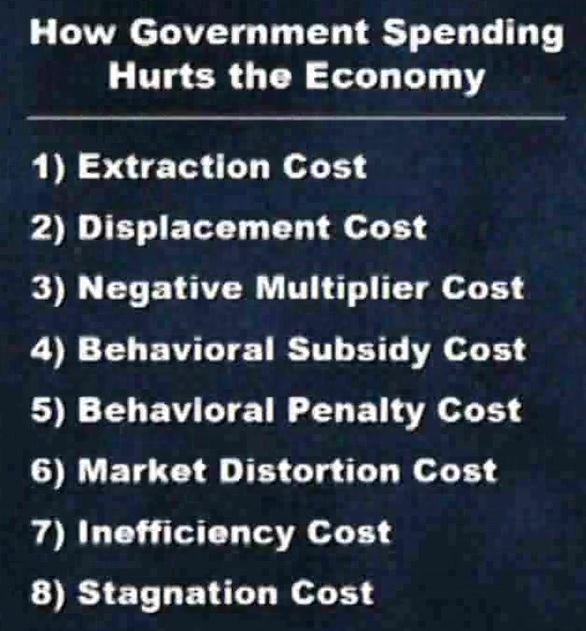
While it’s true that every penny in the budget requires money to be diverted from the economy’s productive sector, not all government spending is created equal when considering the impact on growth.

Some types of spending, such as redistribution programs, are doubly harmful to prosperity. The economy is first hurt by the taxes needed to finance the programs, and then the economy is hurt because the programs give people incentives to rely on the government rather than work. Other types of spending, however, require a cost-benefit analysis.


Consider the case of education. There are costs when politicians take money out of the private sector to finance education, but there are benefits from having an educated population.  That doesn’t tell us how much to spend, of course, and it also overlooks equally important questions such as whether the money will generate better results if used to finance a government monopoly or a choice-based system. But I’m simply making the point that there are costs and benefits.

Now let’s apply this analysis to government-financed research and development, which involves everything from the National Science Foundation to NASA, and from global warming grants to weapons development for the Pentagon.

Proponents argue that these are “public goods,” meaning that they produce economy-wide benefits and can only be handled by government. But that view seems to be based in large part on faith rather than evidence.  Matt Ridley, the former science editor for the Economist, wrote about this topic for the Wall Street Journal back in 2015. If you only have time to read one article, this might be the best choice.

He starts by explaining that most breakthroughs come from private initiative.


Most technological breakthroughs come from technologists tinkering, not from researchers chasing hypotheses. Heretical as it may sound, “basic science” isn’t nearly as productive of new inventions as we tend to think. …Politicians believe that innovation can be turned on and off like a tap: You start with pure scientific insights, which then get translated into applied science, which in turn become useful technology. So what you must do, as a patriotic legislator, is to ensure that there is a ready supply of money to scientists on the top floor of their ivory towers, and lo and behold, technology will come clanking out of the pipe at the bottom of the tower. …this story…so prevalent in the world of science and politics—that science drives innovation, which drives commerce—is mostly wrong. It misunderstands where innovation comes from. Indeed, it generally gets it backward. …It is no accident that astronomy blossomed in the wake of the age of exploration. The steam engine owed almost nothing to the science of thermodynamics, but the science of thermodynamics owed almost everything to the steam engine. …Technological advances are driven by practical men who tinkered until they had better machines; abstract scientific rumination is the last thing they do.

Government funding, by contrast, does not have a good track record.

It follows that there is less need for government to fund science: Industry will do this itself. Having made innovations, it will then pay for research into the principles behind them. Having invented the steam engine, it will pay for thermodynamics. …For more than a half century, it has been an article of faith that science would not get funded if government did not do it, and economic growth would not happen if science did not get funded by the taxpayer. …there is still no empirical demonstration of the need for public funding of research and that the historical record suggests the opposite. After all, in the late 19th and early 20th centuries, the U.S. and Britain made huge contributions to science with negligible public funding, while Germany and France, with hefty public funding, achieved no greater results either in science or in economics. …public funding of research almost certainly crowds out private funding. That is to say, if the government spends money on the wrong kind of science, it tends to stop researchers from working on the right kind of science.

Ridley doesn’t claim there are no benefits. Instead, he makes the more practical point that government R&D has high costs with relatively low benefits.

…the argument for public funding of science rests on a list of the discoveries made with public funds, from the Internet (defense science in the U.S.) to the Higgs boson (particle physics at CERN in Switzerland). But that is highly misleading. Given that government has funded science munificently from its huge tax take, it would be odd if it had not found out something. This tells us nothing about what would have been discovered by alternative funding arrangements. And we can never know what discoveries were not made because government funding crowded out philanthropic and commercial funding.

Ridley’s analysis is backed up by scholarly research.

Here are some excerpts from a study by the Bureau of Labor Statistics.


This paper reviews the literature on R&D to provide guidelines for recent efforts to include R&D in the national income accounts. …The overall rate of return to R&D is very large, perhaps 25 percent as a private return and a total of 65 percent for social returns. However, these returns apply only to privately financed R&D in industry. Returns to many forms of publicly financed R&D are near zero. …On the basis of the evidence considered, privately financed R&D in industry should be treated as an investment and included in the relevant R&D stock. Returns to R&D are very high, but these high returns accrue only to privately financed R&D. Many elements of university and government research have very low returns, overwhelmingly contribute to economic growth only indirectly, if at all, and do not belong in investment.

And here are some passages from a 2003 report by the Organization for Economic Cooperation and Development.


…the pace of accumulation of physical and human capital plays a major role in the growth process. Most notably, the estimated impact of increases in human capital (as measured by average years in education) on output suggests high returns to investment in education. The results also point to a marked positive effect of business-sector R&D, while the analysis could find no clear-cut relationship between public R&D activities and growth …there are significant differences in the returns of R&D expenditure across sectors, and the private sector may be better able to channel resources towards high return R&D activities …regressions including separate variables for business-performed R&D and that performed by other institutions (mainly public research institutes) suggest that it is the former that drives the positive association between total R&D intensity and output growth. …The negative results for public R&D are surprising…they suggest publicly-performed R&D crowds out resources that could be alternatively used by the private sector, including private R&D. There is some evidence of this effect in studies.

Terence Kealey’s 2017 testimony to the Senate’s Homeland Security and Governmental Affairs Committee also is worth perusing.


…the British Industrial Revolution of the 19th century, like the British Agricultural Revolution of the 18th century, was laissez faire… The US was laissez faire in science between 1776 and 1940, yet by 1890 it had overtaken the UK to become the richest industrialized country in the world. Meanwhile those European countries – including France and the German states – whose governments invested most in science failed to converge on the UK or the US, let alone overtake them. …as shown by the successes of the Wright brothers, Thomas Edison and Nikola Tesla, to say nothing of the great industries of Pittsburgh and Detroit – US science, technology and industry flourished. …since 1830 the long-term rates of GDP per capita and TFP (total factor productivity) growth in the US have been steady (with GDP per capita, for example, growing at just under 2% per annum) and the inauguration of the federal funding for science had the following effect on long-term rates of GDP per capita and TFP growth: none.

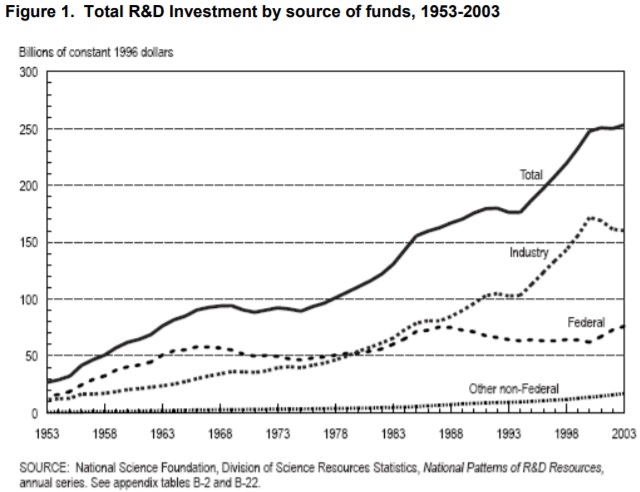
The good news, relatively speaking, is that the private sector now plays a very dominant role in R&D expenditures.

This was not always the case. This chart, from Iain Murray’s research, shows that government played the dominant role in the 1950s, 1960s, and 1970s.

Let’s close with two real-world examples of how private R&D drives progress.

First, here are some excerpts from a 2017 column in the Wall Street Journal by Tom Stossel.

He explains that progress in curing and treating diseases comes from the private sector rather than the National Institutes of Health.


The assumption seems to be that the root of all medical innovation is university research, primarily funded by federal grants. This is mistaken. The private economy, not the government, actually discovers and develops most of the insights and products that advance health. The history of medical progress supports this conclusion. …innovation came from physicians in universities and research institutes that were supported by philanthropy. Private industry provided chemicals used in the studies and then manufactured therapies on a mass scale. …Practical innovation requires incremental efforts. But the reviewers of grant applications for medical research are obsessed with theory-based science and novelty for novelty’s sake. …Academic administrators, operating under the delusion that government largess would grow forever, have become entitled. …By contrast, private investment in medicine has kept pace with the aging population and is the principal engine for advancement. More than 80% of new drug approvals originate from work solely performed in private companies. …Great advances in health care have been made, but there are still important challenges, from obesity to dementia. One step toward addressing them would be for Washington to adopt the right approach to medical innovation—and to stop simply throwing money at the current inefficient system.

Second, here’s more of Terence Kealey’s work, in this case some commentary from last year that focuses on space exploration.


…all powered flight started in the private sector, for the Wright brothers were not government‐​funded researchers. …A team of full‐​time government‐​funded researchers, operating out of the Smithsonian Institution, were then also trying to launch heavier‐​than‐​air machines. Even though the Smithsonian team enjoyed a budget that was a hundred times larger than that of the Wrights, its prototypes always crashed. Airplanes are but one of the many gifts that private research and development has bestowed on humanity. As are space rockets.

The great space‐​rocket pioneer was Robert “Moonie” Goddard (1882–1945), a professor at Clark College in Massachusetts. Funded with $100,000 from the Guggenheims and $10,000 from the Hodgkins Fund, the projects that resulted in his achievements were extraordinary: By 1925 he had created the first liquid‐​fueled rocket. By 1932 he had developed a gyro stabilizer… Elon Musk’s company, SpaceX,…doing something — namely, putting humans into orbit — that previously had been achieved only by governments.

NASA could now be seen as only a temporary interruption of a process that had started in the private sector. …If there is a science that proves the resilience of the private sector, it is space science, including, of course, astronomy. Time again, what at the time was the largest optical telescope in the world was privately funded… Radio astronomy, moreover, was actually born in the private sector, when Karl Jansky of Bell Labs discovered in 1931 that stars emitted radio waves. Grote Reber, a radio engineer, built the first radio telescope, a parabolic dish reflector in his backyard in Chicago in 1937.

The purpose of this column isn’t to argue that there shouldn’t be any government-funded research.  Indeed, because there’s at least some hope of that such spending generates benefits, I prefer R&D spending over almost all other types of spending (it’s better than redistribution outlays, and also better than money that goes for the Department of Agriculture, Department of Education, Department of Housing and Urban Development, etc).

But “better than” other types of government spending is not the same as “better than” leaving the money in the economy’s productive sector.  The bottom line is that there simply isn’t any evidence that government-financed R&D generally passes the cost-benefit test described at the start of the column.

Which means that we should be very skeptical when politicians and interest groups plead for more funding (needless to say, evidence tells us we should be skeptical of any requests for bigger government, not just those for more R&D spending).


Monday, November 26, 2012

Congress should look at EPA's cost benefits

The war on coal-fired power should be worth the price, and isn't

Charleston Daily Mail, Wednesday November 21, 2012

The Environmental Protection Agency proposed softening its limits on mercury emissions for new coal-fired plants, but industry officials say the proposal still will not ensure that coal is an alternative to natural gas.  Even John Walke, clean air director for the Natural Resources Defense Council, admitted that the changes are a "modest weakening" of the rules.  Apparently the EPA, in pushing its Maximum Achievement Control Technology on electric companies, wants to appear to be willing to listen to industry - and the customers who must pay for the administration's rules.  The agency will allow slightly higher levels of mercury.  "I'm not sure it's sufficient to fix the problem, even for new sources," said Scott Segal, director of the Electric Reliability Coordinating Council, an industry group.  The problem is that EPA has too much power and EPA officials do not consider the cost-effectiveness of its regulations. Indeed it wants the maximum control, not the best.  To Read More……

My Take – The question we should be asking is this; why did the Congress give them so much power?  The answer is that they didn’t.  A large chunk of EPA’s authority has now been derived from court decisions based on lawsuits from the green movement.  Lawsuits they didn’t defend properly because they wanted the decisions to go the way of the greenies in order for them to attain far higher levels of power than Congress ever intended for them to have.