Search This Blog

De Omnibus Dubitandum - Lux Veritas

Sunday, May 30, 2021

Biden’s Anti-Empirical Budgetary Philosophy

May 29, 2021 by Dan Mitchell @ International Liberty  

When I debate public policy with leftists, I frequently stump them by asking for an example of a country where their ideas have worked.


They get flummoxed for the simple reason that no nation has ever become rich with big government.

There are some rich nations that have big governments, to be sure, but they all became rich in the 1800s and early 1900s, back when government was a tiny burden (and there often were no income taxes).

That’s true for the United States. And it’s true for Western Europe.

It’s also worth noting that places that have become rich in the modern era, such as Hong Kong and Singapore, have small governments and low tax burdens.

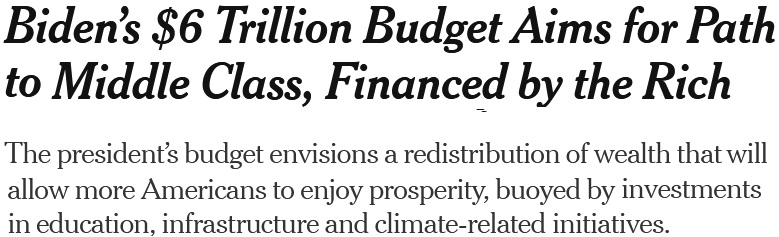
I’m making these points because Jim Tankersley of the New York Times has a thorough article on the Biden Administration’s budgetary philosophy.

And that philosophy is based on a completely different perspective. Indeed, the headline and subtitle are a very good summary of the entire article.

Here are some passages that further capture the Biden approach.

President Biden’s $6 trillion budget bets on the power of government to propel workers, families and businesses to new heights of prosperity…by redistributing income and wealth from high earners and corporations to grow the middle class. …it sets the nation on a new and higher spending path, with total federal outlays rising to $8.2 trillion by 2031… That spending represents an attempt to expand the size and scope of federal engagement in Americans’ daily lives… Mr. Biden also seeks to expand the government safety net in an effort to help Americans — particularly women of all races and men of color — work and earn more, rather than relying on corporate America to funnel higher wages to workers. …Mr. Biden is pushing what amounts to a permanent increase in the size of the federal footprint on the U.S. economy. Since 1980, annual federal spending has been, on average, about one-fifth the size of the nation’s economic output; under Mr. Biden’s plans, that would grow to close to one-fourth.

The article is definitely correct about one thing. As I wrote yesterday, Biden wants a big expansion of government spending.

But is he correct about the consequences? Will bigger government “help Americans” and allow more of them to “enjoy prosperity”?

If the evidence from Europe is any indication, adopting bigger welfare states is not a recipe for more prosperity.


For instance, OECD data on “actual individual consumption” show that people in the United States enjoy much higher living standards than their counterparts on the other side of the Atlantic Ocean.

There’s also very powerful data showing that poor Americans (those at the 20th percentile) have higher living standards than most middle-class Europeans.

There’s even data showing that very poor Americans (those at the 10th percentile) have living standards equal to most middle-class Europeans.

The bottom line is that Biden wants higher taxes and more redistribution, but that’s been a big failure in the part of the world that has tried that approach.

Not that we should be surprised. Both theory and evidence tell us that bigger government is bad for prosperity.

P.S. There’s a very sobering example of what happens when a rich nation decides to dramatically curtail economic liberty.


Paul Ryan’s Impotent Appeal

The Democrats, no less than the media, slobbered all over the former House speaker for his recent anti-Trump speech. But their love is strictly conditioned on Ryan remaining a pajama-boy conservative.

By

Of all the reactions to Paul Ryan’s speech Thursday at the Reagan Library in California, I thought the funniest was the one titled “Paul Ryan Begins to Re-emerge.” I found that idea funny because the speech I heard signaled the opposite: not burgeoning “re-emergence” on to the political stage but, on the contrary, an almost comical confirmation of obscurity. 

Ryan is a careful man, well-pressed, armed with all the best clichés, and utterly feckless. He salted his talk with plenty of gems calculated to appeal to conservatives. He appealed early and often to the ghost of Ronald Reagan—understandable given the auspices of his talk. And his speechwriters dropped all the right phrases about keeping government off the people’s backs, the evils of identity politics and political correctness, the desirability of low taxes, and economic prosperity. 

He was also careful to rehearse some of the achievements of the last four years, the years when his nemesis Donald Trump ran the roost. He was happy to associate himself with those triumphs......... Paul Ryan, I note, is hosting a fundraising event for—drum roll!—Liz Cheney.................  [who] actually represents Peggy Noonan and the republic of Georgetown. Spiritually, it’s the same constituency represented by Mitt Romney and his understudy, Paul Ryan. ...........To Read More....

  • Be gone, Paul Ryan, be gone! May 30, 2021 Paul Ryan, the last Republican Speaker of the House of Representatives, gave a talk at the Reagan Library in violation of Ronald W. Reagan's Eleventh Commandment:  "Thou shalt not speak ill of a fellow Republican.".......... And, still, Ryan had the chutzpah to call Biden "a nice guy."  There is Paul Ryan in a nutshell, excoriating a fellow Republican and complimenting Biden.


Ignoring the Albino, Dhimmi Elephant in the Room

Critical race theory’s central project is to make whites accept subservience, not socialism.

By
  “If you live in a majority-colored neighborhood you shouldn’t reside there because you’re a risk to those people—just like if a sex offender lived next to a school he would be a risk to those children,” she fulminated.

Johnson’s call for a “racial offenders register” for whites is a perfectly pragmatic application of the critical race theory rot.  And while critical race theory (CRT) was made-in-America—it has, like many a destructive American creed, been energetically exported around the world. British agitators are certainly improving upon the plans hatched for whites by their brothers-in-arms stateside.  To wit, Johnson had once pinned a tweet to her profile which read, “The white man will not be our equal, but our slave. History is changing. No justice, no peace #BLM.” 

Believe Johnson and her ilk, for they are deadly serious—and deadly..........To Read More....    

Kristen Clarke: No ordinary racialist radical

May 29, 2021 — Paul Mirengoff

want to give Christian Adams Power Line’s last word on Kristen Clarke’s fitness to head the Justice Department’s Civil Rights Division. Christian, after all, has had the misfortune of dealing with Clarke (I have not). And Christian’s assessment of Clarke encompasses the issue of voting — something I did not discuss in my many posts about her.

Here is some of what Christian has to say about Clarke:

Clarke is no ordinary racialist radical. . .She brings a reputation for being racially greedy. I have some personal experience with her on this point.

In 2007, I was working on what would become the Voting Rights Act case of United States v. Georgetown School Board. I was one of the lawyers who spent many days in South Carolina investigating violations of the Voting Rights Act. Georgetown had a voting-age black population of 34 percent but the at-large elections for school board resulted in no blacks ever being elected to the nine at-large seats. While there is no right to proportional representation, in theory, blacks could conceivably have won three of nine seats.

Regardless, they had none, and in a school district where the students were almost majority black, this created a system that stoked discontent and lack of responsiveness. . . .

The plan adopted in a DOJ settlement agreement created three majority-black districts out of seven (two seats remained elected at large) where it was likely a black preferred candidate would be elected. . . .

The DOJ team got wind that Clarke—representing the NAACP—was shadowing the DOJ lawyer interviews in the field with local African-American stakeholders, disrupting the progress the DOJ was making and urging locals to hold out for four or more black seats. Four seats out of seven (or nine) would have been well in excess of the general proportion of the black population. Clarke wanted more black seats than the law would allow and was willing to disrupt a settlement that created three black seats where none had existed before.

Christian expects more of the same from Clarke, now that she has the power of the U.S. government behind her:...........Garland has personally vouched for Clarke as “a person of integrity.” But Christian points out:

Garland hasn’t spent much time around her. Lawyers at the Voting Section who worked with her characterize her as a brutish and uncouth racial activist. She seethed racial animosity toward whites (who were not liberals) and Southerners.

................To Read More......

Saturday, May 29, 2021

P&D Today

By Rich Kozlovich


Five Reasons to Not Be a Cop These Days. #5 Will Infuriate You.

Political Cartoons by Michael Ramirez


Trump Rips Paul Ryan, Fox News

By Eric Mack Newsmax May 28, 2021 

It did not take long for former President Donald Trump to get wind and respond to anti-Trump comments Thursday night by former House Speaker Paul Ryan, R-Wis., at the Ronald Reagan Library.

Trump scoffed at Ryan's arrogance to suggest the failed "RINO" (Republican in Name Only) knows enough that he can tell Republicans "how to win elections," lumping the never Trumper in with Sen. Mitt Romney, R-Utah, the failed presidential candidate he served as running mate for in 2012.

Trump wrote in a statement of rebuke on his Save America Desk website:

"RINO Paul Ryan, who became a lame duck Speaker of the House, lost all vote-getting capability with the people he represented in Wisconsin, and was the single biggest factor, other than Romney himself, for the monumental Romney/Ryan loss in the presidential race of 2012 (I got more votes by far, 75M, than any sitting president in history!), and he is now speaking to other Republicans telling them how to win elections. Interestingly, I was in the Great State of Wisconsin when they booed him off the podium — I literally had to come to his rescue.

"Ryan should instead be telling them how to stop the cheating of elections and that we would have won if Republican leadership fought the way the Democrats did.

"It was the day that Ryan went on the board of Fox (Fox will never be the same!) that Fox totally lost its way and became a much different place, with millions of its greatest supporters fleeing for good. Paul Ryan has been a curse to the Republican Party. He has no clue as to what needs to be done for our Country, was a weak and ineffective leader, and spends all of his time fighting Republicans as opposed to Democrats who are destroying our Country.

"As a Republican, having Paul Ryan on your side almost guarantees a loss, for both you, the Party, and America itself!"

Ryan's remarks denounced Republicans for following the Trump doctrine, according to reports.


Will the Pandemic Promote Political Power in Perpetuity?

James Bovard James Bovard  – May 26, 2021 @ America Institute for Economic Research


“It’s like we created another industry in our state. The amount of money is staggering,” Andrew Schaufele, director of Maryland’s Bureau of Revenue Estimates, happily declared last week. The Biden stimulus plan is deluging governments across America with hundreds of billions of dollars of extra revenue that will allow politicians to stretch their power in ways that vex citizens long after the pandemic is over. 

One year ago writing for AIER, I asked, “Will the Political Class Be Held Liable For What They’ve Done?” Lockdowns at that point had already destroyed more than ten million jobs without thwarting the virus – a debacle that “should be a permanent black mark against the political class and the experts who sanctified each and every sacrifice.” No such luck. The article warned that “sovereign immunity… almost guarantees that no politician will face any personal liability for their shutdown dictates.”

The political class is coming out of the pandemic with far more power and prerogatives. Biden’s stimulus windfalls for lockdown governors is like giving $100,000 bounties to drunk drivers who crashed their cars. Government employees have been the ultimate privileged class during Covid-19, collecting full paychecks almost everywhere while many of them stayed home and did little or no work.  

Maryland will receive between $55 billion to $60 billion in federal stimulus funds – equal to “11 percent of the state’s entire economy.” The Maryland legislature “celebrated” by giving bonuses to government employees and by funding many new programs. Many other states have similarly used federal windfalls to launch new initiatives. 

Biden and his Democratic congressional allies are exploiting the pandemic to change the reality of work in America. Biden’s stimulus package included a $300 per week bonus for unemployment compensation that means that anyone who earned less than $32,000 is better off on the dole than taking a job. The unemployment bonuses were provided even while many states had canceled any requirement for claimants to actively seek a job. Alexa Tapia, the unemployment insurance campaign coordinator at the National Employment Law Project, a worker advocacy group, derided work search requirements as “just another barrier being put to claimants, and it can be a very demoralizing barrier.” To assume that people are too fragile to look for a job sounds like a vast expansion of the Americans with Disabilities Act. Federal “generosity” to individuals who choose not to work is devastating small businesses unable to hire employees. 

Schools are some of the biggest beneficiaries of Biden’s handout bonanza. Biden’s Education Department is stocked with zealots who will likely exploit federal funding to dictate new curricula and mandate “equity” rules that could undermine local control of education. The same thing happened during the Obama administration when federal aid was used to bribe states into adapting “Common Core” standards that undermine students’ math competence. 

Teachers’ unions used their clout to keep schools shut down long after it was clear that reopening was safe. The Chicago Teachers Union declared, “The push to reopen schools is rooted in sexism, racism, and misogyny,” while the president of the United Teachers of Los Angeles declared that reopening schools “is a recipe for propagating structural racism.” But many teachers are collecting windfall bonuses thanks to the profusion of federal aid regardless of their unions blocking schoolhouse doors. 

Politicians are also exploiting the pandemic to seek to abolish fares for public transit. The Washington Post noted last week, “Transit systems for decades have been saddled with an obligation to partly support themselves through chasing ridership to increase revenue.” “Chasing ridership” is a euphemism for persuading people to voluntarily pay for a service. Sen. Edward Markey (D-Mass.) is pushing the Freedom to Move Act for federal subsidies to end local transit fares. But this is simply “Freedom to Move At Other People’s Expense.” 

Free fares could quickly become a Trojan horse. Turning riders from customers into beggars would remove some of the last incentives to provide reliable service. If public transit is made “free,” then the only people that transit officials will need to please are federal bureaucrats, members of Congress, and transit union bosses. Transit systems won’t need to worry about keeping travelers safe; a survey of lapsed New York subway riders found that “nearly 90%… said crime and harassment were important factors in determining whether they return to the system.” 

Making subway rides free would also distract attention from the miserable performance of public transit systems that were losing ridership long before the pandemic. When the Washington Metropolitan Area Transit Authority received a huge boost in subsidies from the Maryland and Virginia state governments a few years ago, it promptly responded by shutting down many subway stations for seemingly eternal maintenance since it no longer needed fare revenue. Many of the same activists who want to make public transit zero cost for users also want to sharply curtail the use of private transit: citizens who refuse to abandon their cars for “free” transit could be next on the enemies list.  

The Biden administration is sparing no expense to make parents grateful to Washington. Beginning July 15, the feds will begin delivering up to $300 per child to Americans’ bank accounts and mailboxes. The Washington Post noted that the administration “estimates 88 percent of all American children are slated to receive new monthly payments — with no action required.” Congress enacted a temporary program scheduled to end after December. But a temporary handout shifts the argument: instead of debating whether a program that deluges non-needy families with cash, the question will be whether needy children can be thrown into the street by cutting off aid. The Post noted that the handouts could “have significant political consequences as the White House seeks to reshape the U.S. economy.” Actually, this is an attempt to vastly change the relationship of the federal government to the American people. 

Throughout history, rulers have used cash to buy submission. “Money is my most important ammunition in this war,” said Gen. David Petraeus, the supreme U.S. commander in Iraq. Presidents and members of Congress have long relied on “money as a weapon system” to buy votes or undermine resistance to Washington. 

Government restrictions almost always follow government handouts. In 1942, the Supreme Court ruled, “It is hardly lack of due process for the government to regulate that which it subsidizes.” Because the Roosevelt administration had decided to drive up wheat prices, the Secretary of Agriculture acquired veto power over the use of every acre of cropland in the nation. In 1991, in a case involving federal subsidies, Chief Justice William Rehnquist declared that “when the Government appropriates public funds to establish a program, it is entitled to define the limits of that program.” 

Every subsidy creates a power vacuum that will eventually be filled by bureaucratic or political ambition. The more things are financed by subsidies, the more activities become dependent on bureaucratic approval and political manipulation. To depend on government subsidies means either to be currently restricted – or to be only one Federal Register notice away from being restricted. Subsidies are the modern method of humane conquest: slow political coups d’etat over one swath of American life after another. The only way to assume that subsidies are compatible with individual liberty is to assume that politicians and bureaucrats do not like power. 

Biden’s profusion of new handouts put a halo over his tax hike proposals and, perhaps more importantly, his plans to unleash the IRS to be far more aggressive against Americans. The more politicians promise to give some people, the more they entitle themselves to seize from everyone else. French philosopher Bertrand de Jouvenal wrote, “Redistribution is in effect far less a redistribution of free income from the richer to the poorer, than a redistribution of power from the individual to the state.” “Reciprocal plunder,” in economist Frederic Bastiat’s phrase, becomes the soul of political life.

Post-pandemic policies are far more perilous because few Americans yet recognize how badly their rulers failed them. Instead, “temporary” programs will be extended and further divide Americans into two classes—those who work for a living and those who vote for a living. The more people who view government as their personal savior, the easier it becomes for politicians to demagogue to ever greater power. But as economist Warren Nutter warned, “The more that government takes, the less likely that democracy will survive.”

James Bovard

James Bovard

James Bovard is the author of ten books, including Public Policy Hooligan, Attention Deficit Democracy, The Bush Betrayal, and Lost Rights: The Destruction of American Liberty. He has written for the New York Times, Wall Street Journal, Playboy, Washington Post, New Republic, Reader’s Digest, and many other publications. He is a member of the USA Today Board of Contributors, a frequent contributor to The Hill, and a contributing editor for American Conservative

Get notified of new articles from James Bovard and AIER.


Lockdowns Need to Be Intellectually Discredited Once and For All

Ethan Yang Ethan Yang  – May 26, 2021 @ American Institute for Economic Research 

 

On May 19, 2021 the LA Times published a column that is representative of the basic arguments for endorsing lockdowns going forward titled “The evidence is clear — COVID lockdowns saved lives without harming economies.”

The column proclaims in large italic font,

“Lockdown should be considered as an effective public health intervention to halt epidemic progression.”

The piece certainly puts forward a case that may be somewhat plausible on its face but after further investigation might be able to pass as scholarly malpractice. The column lays out two major points. The first being that lockdowns played an important role in reducing caseloads. The second point is that the economic damage of lockdowns was relatively inconsequential as the voluntary actions of individuals were largely responsible for the economic downturn. 

These are not novel or fringe arguments but talking points that have been parroted throughout the pandemic. The column itself rightly notes that there has and will continue to be a heated debate about the efficacy of lockdown policies for the foreseeable future. Although Covid-19 lockdowns are behind us, the precedent has been set for lockdowns to be a new shiny tool to be used against future pandemics. This horrifying reality is exactly why lockdowns as an idea must not be forgotten. They must be thoroughly discredited, starting with this column.

Do Lockdowns Reduce Caseloads?

It should first be said that reducing deaths is a far more important objective than simply reducing cases, especially when it comes to a highly contagious but relatively mild disease like Covid-19 which only severely affects vulnerable populations. With this in mind, it seems that taking precautions to shield the vulnerable while allowing healthy individuals to live their lives with common sense would be a far better policy. Just look at this graph.

cumulative covid deaths and cases

However, let’s bite and say that it’s best that caseloads remain as low as possible if it is within our power to do so. 

The column relies on a series of studies that demonstrate a correlation with lockdown policies such as stay-at-home orders and business closures with drops in the daily increase of cases. It asserts,

“It makes sense, therefore to examine the evidence — or rather, gather ammunition for the coming debate.

Numerous studies from across the world have found that lockdowns succeeded in suppressing transmission rates.”

One of the first issues that arise is that studies the column uses to make its point are clearly cherry-picked as they’re not only dozens of studies saying the contrary, but clear methodological shortcomings. The first one is titled “The Efficacy of Lockdown Against COVID-19: A Cross-Country Panel Analysis.” The study asserts that lockdowns were effective in reducing caseloads after running an average of the performance of 202 countries from January 10, 2020, to May 10, 2020. This study was one of the first attempts at piecing together empirical evidence at the very start of the pandemic, which should tell you all you need to know. The study even has a disclaimer that reads,

“For these reasons, we highlight the importance of and need for further investigations on this topic, which may focus on more specific territorial or climatic subsamples, or on how governments have implemented lockdown policies.”

Plugging in hundreds of countries without any regard to context whether it be timing, geographic location, or even the types of policies involved at what would be just the beginning of the pandemic is a quick way to start a conversation, but nothing further. We now know much more. 

A similar issue comes up in the second study the author uses to prove his point. The study is titled “Is Lockdown Effective in Limiting SARS-CoV-2 Epidemic Progression?—a Cross-Country Comparative Evaluation Using Epidemiokinetic Tools.” It’s already off on the wrong foot as its timeline runs from February 23, 2020, to June 14, 2020. Furthermore, the study simply notes the initial fall in daily new cases in a number of countries that implemented lockdowns with Sweden and the United States as a comparison as a non-lockdown country and variable lockdown country respectively. 

Again no consideration for context when it comes to timing, social behavior, or government policy. Furthermore, as we all know the pandemic and the use of lockdowns didn’t end in the summer of 2020. Here is an expanded timeline with the countries included in the study alongside the addition of Belgium which I added as another example of a European country with strict lockdowns but a poor performance in mitigating Covid-19.

daily new confirmed covid-19 cases per million people

This brings us to the most important point regarding lockdown policies and what seems to be captured in these studies but not properly acknowledged, which is voluntary behavior to reduce the spread of Covid-19. The following data was pulled from a comprehensive analysis published by the Heritage Foundation that examined key statistics compiled throughout the pandemic.

mobility and shelter in place orders

As we can see, regardless of the implementation of stay-at-home orders, people voluntarily reduced their activity. States that implemented stay-at-home orders and other lockdown policies clearly saw greater (and unnecessary) reductions in movement. However the reductions in movement are nearly identical during peak spikes in cases and deaths. In other words, people voluntarily practiced social measures in response to spikes in deaths and cases. 

This is congruent with a study published by a team of Stanford researchers that compared 8 lockdown countries with two counterfactuals, South Korea and Sweden. The study found that there are certainly benefits to implementing policy interventions but the benefits of aggressive policies such as lockdowns compared to less intrusive policies undertaken by South Korea and Sweden are minimal. This is without factoring in the collateral damage and the fact that in some contexts, lockdown policies may actually increase caseloads because they force people to gather in private residences, which are often less well-ventilated and more cramped. 

This brings us to what is hopefully an emerging consensus that lockdowns, for whatever isolated marginal benefits they provide, are essentially swinging a sledgehammer to kill a spider. 

Are Lockdowns Safe for the Economy?

The second major point in the column, that lockdowns are not a major contributor to economic damage, may seem ridiculous at first glance but is actually a relatively common argument. Jack Nicastro and I co-wrote an article for AIER arguing against this assertion in detail here. Our main conclusion was that the past economic downturn was the largest recession in modern history. The one major thing that was different this time was lockdowns, which actively work against economic recovery. We quoted the International Monetary Fund by writing,

“Under the assumption that the pandemic and required containment peaks in the second quarter for most countries in the world, and recedes in the second half of this year, in the April World Economic Outlook we project global growth in 2020 to fall to -3 percent. This is a downgrade of 6.3 percentage points from January 2020, a major revision over a very short period. This makes the Great Lockdown the worst recession since the Great Depression, and far worse than the Global Financial Crisis.”

The main assertion that supports the idea that lockdowns are not responsible for the economic downturn is that voluntary behavior is largely the main causal factor in the recession. If you remember the mobility data I referenced previously to challenge the idea that lockdowns were necessary to contain the spread of Covid-19, you will have remembered that people voluntarily reduced activity. 

In order to support its case the column cites a working paper published by NBER titled “Fear, Lockdown, and Diversion: Comparing Drivers of Pandemic Economic Decline 2020.”

The paper notes that people voluntarily reacted to Covid-19 by reducing foot traffic before the lockdowns were implemented and did not increase significantly once lockdowns were lifted. This is congruent with the mobility data I referenced above. This would suggest that lockdowns had a minimal economic effect because people voluntarily stopped patronizing businesses. Of course, a closer look at the data reveals that some non-lockdown states had foot traffic return to normal as the summer came. 

The problem with this particular study is of course its timeline, which only measures data from March 1 – May 16. This is when fear and uncertainty about the virus were at an all-time high, which is why voluntary reductions in foot traffic were also high with or without lockdowns. If the timeline is expanded, voluntary behavior and state-mandated behavior begin to diverge, only reaching parity during spikes in deaths and transmission. We can see this divergence after May 16 when many states lifted their stay-at-home orders and saw increases in mobility. During major spikes in transmission and deaths, people voluntarily reduced mobility to parity with states that issued lockdowns. This is most observable during the past Winter season. 

  mobility retail and recreation

To further demonstrate the negative economic consequences of lockdowns, a working paper published by NBER in January of 2021 examines the effect of California’s nonessential business closures on sales data up to Q2 of 2020. The paper notes 

“The results suggest that local implementation and enforcement of lockdown restrictions and voluntary behavioral responses as reactions to the perceived local COVID-19 spread both played a role, but enforcement of mandatory restrictions may have had a larger impact on sales losses.”

Furthermore, Covid-19 is a less deadly disease than the 1957-1958 Asian Flu and especially the 1918 Spanish Flu which like all pandemics were handled without lockdowns. The late and great doctor Donald Henderson and colleagues published a paper on the US response to the Asian Flu which notes,

“Despite the large numbers of cases, the 1957 outbreak did not appear to have a significant impact on the U.S. economy.’’

An article published by two economists in VOX-EU, a policy portal of the Centre for Policy Research, notes that during the 1918 Spanish Flu the economy actually grew slightly. This was of course due to World War I and forced labor for the war effort but they ultimately conclude,

“What lessons can we glean from the 1918 pandemic for today? Obviously, we are not advocating for another war, or that workers be encouraged to work in unsafe conditions that may heighten their exposure to the virus. But it is useful to remember that a global pandemic doesn’t inevitably lead to a grave economic recession or depression. More specifically, a large expansion in government demand can go a long way in softening the economic impact of a crisis that clearly threatens to reduce consumption and private investment.”

So perhaps the government can help by providing financial aid to struggling businesses and families to soften the blow of a pandemic. Government after all does know how to cut checks. However, there is absolutely no reason to believe that the government can shut down the entire economy without catastrophic consequences. The Covid-19 pandemic is associated with the worst economic downturn in modern history, worse than the Spanish Flu and the initial stages of the Great Depression. It shouldn’t be that difficult to see that lockdowns were responsible for that.

Key Takeaways

This has essentially been a very long-winded way of saying what AIER has been saying since day one. Lockdowns do not provide any meaningful benefit and they cause unnecessary collateral damage. Voluntary actions and light-handed accommodations to protect the vulnerable according to comprehensive analysis, not cherry-picked studies with overly short timelines, provide similar, if not better, virus mitigation compared to lockdown policies. Furthermore, contrary to what many keep trying to say, it is lockdowns that are the causal factor behind the unprecedented economic and social damage that has been dealt to society. On top of that, we haven’t even addressed the role of inflammatory and counterproductive messaging to sow unnecessary fear into American society. Of course, that’s a topic for another day.

Humans for our entire existence have lived alongside diseases. Society has become increasingly healthier through improvements in living standards and advancements in technology. Unilaterally and arbitrarily shutting down all of economic and social life was never part of the solution, nor should it ever be. Covid-19 has been the first test for these experimental lockdown policies and no rational observer should look back at the results and conclude that this is all worth trying again. 

Ethan Yang

Ethan Yang

Ethan Yang is an Adjunct Research Fellow at AIER Ethan as well as the host of the AIER Authors Corner Podcast.

He holds a BA in Political Science with a concentration in International Relations with minors in legal studies and formal organizations from Trinity College in Hartford Connecticut. He is currently pursuing a JD from the Antonin Scalia Law School at George Mason University.

Ethan also serves as the director of the Mark Twain Center for the Study of Human Freedom at Trinity College and is also involved with Students for Liberty. He has also held research positions at the Cato Institute, the Connecticut State Senate, Cause of Action Institute and other organizations.

Ethan is currently based in Washington D.C and is a recipient of the 13th Annual International Vernon Smith Prize from the European Center of Austrian Economics Foundation. His work has been featured and cited in a variety of outlets from online media to radio broadcast.

Get notified of new articles from Ethan Yang and AIER.


Following the Politics, Not the Science

Scientists and journalists should reckon with their early dismissals of the lab-leak hypothesis. 

Joel Zinberg  May 27, 2021 @ City Journal. 
 
(Published with permission.  I recommend subscribing, it's free.  Some emphasis added by me. RK)
 
It is a disturbing prospect, like something out of a science fiction novel, but it’s appearing increasingly plausible nonetheless: the cause of the worldwide Covid-19 pandemic, which has killed millions and cost tens of trillions of dollars, may have been a viral escape from a Wuhan, China virology laboratory.

The latest indicator pointing toward a man-made catastrophe—that, until now, has been obscured with the aid of credulous media and scientists—comes from the Wall Street Journal, which reported that U.S. intelligence found that three researchers from the Wuhan Institute of Virology were hospitalized in November 2019 with symptoms consistent with Covid-19. That is well before the Chinese government’s claim that the first confirmed case occurred on December 8, 2019. This new report echoes a January 15, 2021 State Department fact sheet that reported several Wuhan Institute researchers became ill in autumn 2019. The steady accumulation of circumstantial evidence has prompted President Biden to order a review.

Early in the pandemic, conservative newspapers, like the Daily Mail and the Washington Times, and Senator Tom Cotton raised the possibility of a Chinese lab leak. The Washington Post dismissed such speculation as a debunked conspiracy theory. The New York Times labeled it a “fringe theory.”

The scientific establishment also weighed in, disregarding early papers from Chinese and American scientists with evidence that suggested a lab leak origin. One group, citing mostly Chinese sources, declared in The Lancet that the coronavirus originated in wildlife, not a laboratory, and praised Chinese scientists and public-health officials “who continue to save lives and protect global health.” Five other virologists in a letter to Nature Medicine stated that “SARS-CoV-2 is not a laboratory construct or a purposefully manipulated virus.” Anthony Fauci, in a May 2020 National Geographic interview, said the evidence indicated that the virus “evolved in nature and then jumped species” and had not escaped from a Chinese lab.

These early reassurances were based on surmise, not facts. They ignored that virologists in China—most prominently, the Wuhan Institute’s Shi Zhengli (“the Bat Lady”)—were actively engaged in gain-of-function research in which naturally occurring coronaviruses collected from bats were manipulated to acquire the ability to infect humans. They ignored that such research often utilizes serial viral passage through lab animals that mimics the process of a natural zoonotic jump between species. When a World Health Organization team visited Wuhan in February 2020, the institute’s staff refused to share data, safety logs, or lab records. Remarkably, that did not stop the WHO from concluding that a lab leak was “extremely unlikely.” Only four of the 313 pages of their report addressed the possibility of a lab accident.

More than a year has passed since then, with scientists assuring for most of that time that SARS-CoV-2, the virus responsible for Covid-19, emerged naturally. But no scientist, Chinese or Western, has produced a presumed bat source population, an intermediate species that functioned as a viral conduit between bats and humans, or evidence that the virus was present anywhere before it emerged in Wuhan. In contrast, during the 2003 SARS outbreak in China, researchers uncovered evidence of intermediate animal hosts and serologic signs of infections in animal traders within months. Analyses of SARS-CoV-2’s rate of mutation indicate that it likely began spreading several weeks earlier than the official first case date—December 8, 2019—a fact that makes the Covid-19-like illness of three lab workers in November so intriguing.

Scientists are finally beginning to take the possibility of Chinese negligence or malfeasance seriously. In a letter to the journal Science, 18 leading virologists wrote that accidental lab release remains a viable possibility and urged the Wuhan scientists to cooperate fully with additional investigations. One of the signatories, Ralph Baric, is the world’s leading expert on gain-of-function research in coronaviruses and had collaborated with Zhengli in the past. While he believes natural evolution is a more likely explanation than gain-of-function research and a lab leak, he is calling for an open, through investigation of the Wuhan Institute and its safety protocols. Other scientists point out that several peculiar characteristics of SARS-CoV-2 are inconsistent with a natural zoonotic origin and that a lab-leak origin should be investigated. Even Fauci has now admitted that he is “not convinced” Covid-19 developed naturally outside of the Wuhan lab.

Some journalists are also beginning to examine the issue. Science writer Nicholas Wade published an extensive examination of the competing natural-emergence and lab-escape hypotheses. He concludes there can be no definitive evidence for either without examining Chinese data, but that a lab leak is far more likely.

The Chinese authorities are unlikely to allow a thorough investigation, so the true origin of Covid-19 may never be known. But even more disturbing than the Chinese government’s attempts to obfuscate the pandemic’s origins is the way scientists and the media nearly uniformly insisted that a lab leak was out of the question.

Scientists may have been protecting Chinese colleagues that many had worked with and even funded. Perhaps, Western scientists feared that the possibility of Chinese culpability would reflect badly on them and their own viral-gain-of-function research.

Journalists, on the other hand, seemed intent on countering an anti-China, anti-WHO narrative advanced by President Trump and other conservatives. New York Times reporter Apoorva Mandavilli, for instance, recently tweeted (and later deleted) her hope that people would “stop talking” about the lab-leak hypothesis, on account of its “racist roots.” The scientists’ opinions in the early days of the pandemic gave such journalists cover to indulge in their usual Trump-bashing and assert that they were only “following the science,” in contrast to Trump’s allegedly baser motivations.

We’ve seen this pattern play out time and again over the past year. From the value of lockdowns and masks to the likelihood of speedy and safe vaccine development, scientists and experts based their opinions more on intuition than on facts—until the facts finally forced a reversal. And journalists seemed remarkably incurious about those expert opinions, especially when they presented them with an opportunity to criticize conservatives. Both groups, who have frequently decried official “misinformation,” ought to look first to their own failings.

Photo by HECTOR RETAMAL/AFP via Getty Images