Search This Blog

De Omnibus Dubitandum - Lux Veritas

Saturday, June 16, 2018

Peter Zeihan on Geopolitics


VISIT THE ARCHIVES TO RE-READ AND SHARE


I Think They Get It Now, Part Cinque: Italy

Read Part I, Part II, Part III and Part IV.

In any discussion of foreign affairs the same list of powerful countries have been bubbling up for decades, if not centuries. The order often shifts, but the countries themselves tend to hold on: the United States, Russia (aka the USSR), Japan, the United Kingdom (aka the British Empire), France, Germany (aka Prussia). There’s also a secondary list of largely regional powers: Iran, Turkey, India, Mexico, Brazil, Argentina and Sweden. Israel, Korea and Pakistan are relative newcomers to the second list while China has graduated from the latter list to the former.

One country that most don’t spare thoughts for, however, has been one of the world’s top ten economies ever since humanity developed sufficient command of statistics to come up with the list in the first place. That country is Italy, and it is about to crash back into the world as a significant player.

But first, it has to…crash. Hard.

Contemporary Italy is beyond dysfunctional.

  • The country is flat out broke -- only Japan and Greece have national debts that are higher in relative terms.

  • Its banking sector is arguably the most overextended in the world, with a relative weight of bad loans that is eighty times that of the United States at the height of the subprime crisis.

  • Unemployment is at a level that would spawn riots in the United States.

  • The birthrate collapsed thirty years ago and never recovered. Its population is one of the ten most rapidly aging on the planet, and already well past the point of meaningful recovery.

  • The country’s current pension overhang is already among the worst in the world, and that before the Italian Baby Boomer generation even begins to retire.

  • Italy suffered greatly during the European financial crisis and its economy hasn’t seen appreciable growth since 1998.

  • Citizen trust in government is so low as to barely register in opinion polls. And the political situation is an utter circus, complete with actual clowns or, more accurately, a populist comedian but you get the idea. The Italian equivalent of the Republicans and the Democrats have been gutted to the point of extinction, being displaced by an alliance that could only happen in Italy: a pair of parties that most closely resemble Texan secessionists (the Northern League) and Bernie Sanders…if Bernie Sanders was a career comedian who used a lot of racist jokes and opened rallies with the song “America-F*** Yeah” (the Five Star Movement).

What’s the way forward here? There isn’t one, except national collapse. Italy as a modern political economy is already over. The only reason it has not passed into history already is that it is lashed into the European Union. There are many structural issues embedded within the European system that could bring the entire edifice down. The United States withdrawing from the global order is one. The death of Italy is another. Weighing in at over $2 trillion dollars, the Italian system isn’t too big to fail -- it is too big to save.

But from the rot of the current system, from the end of a Europe that is united and free, something new is about to arrive. Or perhaps it is more accurate to say that something old is about to return.
The Italian core territory is unlike anything else in the world. The Po Valley is a rich land with a perfect climate nearly encapsulated by some of the world’s most rugged mountains. The Po’s entire northern horizon are the European Alps. Even with today’s technology and centuries of infrastructure building in what was until very recently the world’s richest continent, the Alps still remain a massive barrier to communication, much less armored columns. To the south the Apennine Mountains of the Apennine Peninsula are certainly less imposing, but the utter lack of large chunks of flat land (and the fact that southern Italy is a peninsula of peninsulas) make it both a non-challenge to the economic and political supremacy of the Po as well as an at best imperfect invasion route.

In the Po’s near neighborhood there are no meaningful threats. To the north -- across the Alps -- are Switzerland and Austria, a Germanic pair of countries far more concerned with issues on the Northern European Plain than in the Po. To the east are the minor and often failed states of the Western and Southern Balkans: Slovenia, Croatia, Bosnia, Serbia, Montenegro, Macedonia, Kosovo and Greece. None of which -- individually or in concert -- can hold a candle to Italy’s economic heft, and none of which -- individually or in concert -- pose even a modicum of a security threat. (If anything, their bickering chaos provides Italians with a massive strategic buffer.) To the south across the Mediterranean is Northern Africa, a region that has not posed a meaningful danger to Southern Europe since Christopher Columbus was a teenager.

That just leaves its western neighbor, France. The Italians may have some differences of opinions with the French, but since the Franco-Italian border is a chunk of the Alps and the Po’s window on the world lies far to France’s east via the Adriatic, it is rare for the pair to butt heads. Add in a moderate sized navy of moderate skill -- which the Italians have -- and the Po is if anything more secure than the United Kingdom.

And that’s how we must think of the Po -- as an island. Separate from Europe, separate even from the rest of Italy. Within that distinction lies the Italians’ future.

In the world before World War II the Po Valley was one of, and at many times the, economic powerhouse of the both Europe and the Greater Mediterranean. Its physical separation and inviolability made it the logical location to broker deals, to install infrastructure central to the economic health of the broader region, and to serve as trade middlemen for everything that mattered.

Part of the attraction of the Americans’ installation of a global security order was that geography mattered less, so countries with often-compromised geographies could shine -- in many cases for the first time. For the Po Italians whose geography was their ticket to centrality and wealth, this sort of sucked. Had they not been on the wrong side during the war and not already been issued an opinion on the matter, they may well have sat out membership.

As the Bretton Woods order expanded, as the European Continent unified under the aegis of the European Union, as stability spread, what made the Po special became less so. Italy as a whole saw its position slide. With the end of the Cold War the Po is little more than a rich backwater. Italy as a whole hasn’t seen meaningful economic growth in nearly two decades, and its end is nigh.

But Trump’s actions at the G7 indicate that the system that has so enriched the rest of the world and so stabilized Europe -- in part at Italy’s expense -- is at its end. Remove global stability, remove the European Union and NATO, break the supply chains that supply the global system with everything from cars to crude, and all of a sudden the Po’s island-but-not-an-island geography combined with its relative centrality makes it the place to be.

So what kind of place will the Po become? What does it have to offer?

First, a step back to frame the discussion:

Just as the Po Valley and “Italy” are not the same thing, the Po Valley itself isn’t one place. The cities of Northern Italy in many cases have identities and histories just as distinct from one another as full-blown European countries. Verona, Trento, Parma, Bologna, Milan, Venice, Turin, and Genoa were all independent players from the fall of the Roman Empire right up until Italian Unification in the 1870s. That means they only rarely act as a unit, and the emphasis of all things Italian has always been on diversification and differentiation.


In the world of energy it means the Italians maintain one of the most varied set of refineries in the world, able to take in any crude stream and process it into any end product. Today Italy boasts roughly double the refining capacity they need. Toss in the sort of economic adjustment that comes from state collapse and dollar to donuts the Italians’ surplus capacity will soon make them the largest source of available refined product within three thousand miles in a world where energy security for most is a long-faded dream.

In the world of manufacturing it means the Italians make things a bit differently. For Italians wares are not about assembly lines or efficiency -- that requires economies of scale and integration. The Italian cities compete with one another instead. They don’t share. They keep all the steps in house, so it is all about expression and perfection. The sort of long, gangly, multinational supply chains that can only survive in a world of stability and global market access are not the sort of things Italians do well. Think Fiat. So instead of mass producing serviceable items, the Italians hand-craft products that could easily be mistaken as art. Think Lamborghini and Versace. That sort of “manufacturing” does just fine when the world falls apart.

The problem with this machinery-as-art model is labor. It literally takes a lifetime to train a Ferrari craftsman. It is something the new manufacturing techniques that are sweeping the American industrial space cannot integrate into. The Italians don’t hate immigrants for simply the standard religious, ethnic and economic reasons, but also because immigrants simply cannot help with the problem the Po faces.

Nor is this new. Nor is it constrained to outsiders.

The Po Valley versus Italy’s south is a study of polar opposites; the Po’s sophistication and productivity contrasts sharply with the statist rot, civil breakdown, organized crime, and poverty of the South. Between unification and 1940, southern Italians moved en masse to work in northern factories. This was at a time when Northern Italian sentiments toward many in Southern Italy was racist in a generous sense. Even Mussolini's son-in-law is said to have privately mused that perhaps it would have been better to be born a Jew than a Sicilian in Fascist Italy (against the backdrop of the Holocaust, no less). Today, the south’s population is smaller, older and sicker relative to the north than ever before. It is already on the ragged edge of failed statedom, and northerners fear southern in-migration nearly as much as they resist boatloads of migrants from Africa.

Northern Italy doesn’t need Southern Italy for anything in the traditional sense: labor, market, capital, technology, food, even strategic depth. What the Po does need is free access to the Mediterranean for oil inflows and trade outflows (and perhaps the refineries that dot the southern coastlines). It needs Southern Italy to be in a box that also contains the Southern Italians and blocks would-be migrants from the world beyond. It needs to be able to treat the south as an occupied territory.

There’s really only one governing system that can fit that bill: Fascist. Again, this isn’t new. Fascism was well established in Italy a decade before Adolf Hitler’s rise to power in Germany for much of the same reasons.

Assuming the Italians of the Po can constrain and contain the Italians of the south, there is little need to venture further out. The Po will again become the lynchpin between the Middle East and Africa on one side, and Europe on the other. The Italians’ very lack of strategic ambition makes them the perfect middleman. About the only weakness in such a system is ensuring sufficient inflows of crude so that Italy can be a large refining center. There’s nothing new here either: The Northern Italian cities have been brokering deals with whoever controls the Eastern Mediterranean for the commodities of the day for over a millennium.

To paraphrase an old European saying: Italy is dead. Long live Italy.


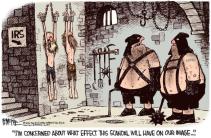
To Protect Non-Profit Donors from Government Persecution, Limit IRS Data Collection

June 15, 2018 by Dan Mitchell @ International Liberty

It’s a judgement call, of course, but I think the IRS’s suppression of the Tea Party was the worst of all the Obama-era scandals.

Some people say the green-energy scams like Solyndra should be at the top of the list, but steering taxpayer money to campaign donors was just routine corruption. And the fast-and-furious scandal at the BATF was reprehensible, but did not have systemic impact on society.

Lois Lerner and the other hacks at the IRS, however, did something profoundly worse. They actively used the coercive power of government to suppress political speech.

The bad news is that Lois Lerner didn’t get punished. She’s now enjoying a fat taxpayer-financed pension. And other IRS officials successfully stonewalled with no adverse consequences.

Heck, Republicans actually rewarded the IRS with a bigger budget. And the Trump Administration so far has been AWOL on curtailing IRS abuses

But that may be about to change. One of the President’s appointees has expressed support for protecting donors to nonprofit organizations.

The Wall Street Journal recently opined on this topic.
….a Congressional hearing this week offered potentially good news to nonprofits whose donors are under political threat. …Montana Republican Steve Daines asked Acting IRS Commissioner David Kautter whether the agency is considering the necessity of IRS 990 Schedule B. These are the forms that nonprofits must supply to the IRS listing donors who contribute more than $5,000. Schedule Bs are supposed to remain confidential, but AGs in New York and California have sought to require nonprofits to file them at the state level. Many Democrats see the form as a gift-wrapped list of donors to target, and a way to chill donations to conservative nonprofits. …Mr. Kautter acknowledged that he was “actively involved” along with Treasury Secretary Steve Mnuchin at offering more donor protection. …Nonprofits would still be required to keep their donor details, and if the IRS or other authorities had valid reason to suspect fraud they could demand to see the records. But requiring nonprofits to provide names each year to partisan AGs or tax bureaucrats is an invitation to repeat the scandal of the Obama years when Lois Lerner and the IRS targeted conservative nonprofits.
Brian Garst of the Center for Freedom and Prosperity also weighed in on the issue, pointing out that government has a sorry track record of persecuting political dissent.
…robust protections for speech were listed first among the Bill of Rights and have long been a cornerstone of our republic. …Like the secret ballot, respecting donor privacy and thus anonymous speech and association is essential to prevent majoritarian abuse and intimidation that subverts democracy. This was a lesson learned in the civil rights era after the shameful attacks on the NAACP and its supporters. …Lois Lerner was found to have illegally shared confidential Form 990 taxpayer information with the Federal Election Commission.
The solution is to not let the government get the information in the first place, especially since it isn’t needed to enforce any tax laws.
Unfortunately, invasive donor reporting requirements instituted by the Internal Revenue Service threaten to chill this critical democratic tool. …Schedule B requires 501(c) organizations to include certain contributors’ names and addresses with their annual Form 990 reports. Yet the IRS has acknowledged that this information has no enforcement value. Instead, its collection creates opportunities for abuse and chills speech and civic participation. …there’s good reason to question the ability of the government to protect sensitive taxpayer information given the history of inadvertent disclosures and information leaks at the IRS. …For minority viewpoints, public exposure can lead to intimidation… Several years ago, the IRS was said to be considering dropping the unnecessary Schedule B reporting requirement, which it was never required by statute to collect in the first place. Unfortunately, the agency did not follow through under President Barack Obama… The Trump administration should do what the Obama administration would not and ensure the right of Americans to participate in the political process without fear that they will be made vulnerable to targeting based on their political views.
Well said.

Though I think both Brian and the WSJ should have gone even farther and called for the abolition of the charitable deduction in the tax code as part of a shift to a simple and fair flat tax.

Then there would be zero rationale for the government to know about our donations. And since there’s plenty of evidence that nonprofits would prosper without a special preference in the tax code, this would be a win-win reform.

P.S. Privacy is an under-appreciated benefit of fundamental tax reform. Not only would donors and nonprofits no longer have to share information with the IRS under a flat tax, we also wouldn’t need to tell the government anything about our homes since the mortgage interest deduction would vanish.

And since the death tax and capital gains tax are abolished, the government would have no need to know about our assets. And since all capital income is taxed at the business level, we wouldn’t have to tell the government about any stocks, bonds, or bank accounts we own.

Many 1st-Time, Post-Op Users of Painkillers Stay on Them. But Addiction? Not Quite.

By Erik Lief — June 14, 2018


More than six percent of surgical patients who received opioid painkillers – but had never taken them previously – developed a "persistent habit" or addiction after the normal recovery period for taking them ended. That's a key finding from a newly-published paper that reviewed insurance claim data for a recent six-year period. This nationwide retrospective study focused on adults in the United States between the ages of 18 and 64 who underwent surgery and filled post-operative opioid prescriptions. Both major and minor surgeries were included in the project............. However, it's important to note an essential distinction between implying that this behavior is an addiction – which it isn't necessarily – as opposed to saying the medication is being used "beyond the normal recovery period." ............"Some of these surgical patients are going to have procedures – say, for example, disc fusion – that not only didn't work, but also made their pain worse," Dr. Bloom added. "Naturally, in these cases, the patient is going to be on the painkillers for longer because they will have more pain. So in the context of this study, it's important not to categorize prolonged opioid use as addiction.".......To Read More....

Sarah Sanders rips CNN’s Jim Acosta: ‘I know it’s hard for you to understand even short sentences’

Washington Times June 15, 2018

Biblical teachings, the U.S. southern border and the listening comprehension skills of CNN’s Jim Acosta all converged into a single debate this week during a White House press briefing.

White House Press Secretary Sarah Huckabee Sanders and CNN’s chief White House correspondent got into a testy exchange on Thursday over the incarceration of illegal immigrants crossing into the U.S. from Mexico. At issue were comments by Attorney General Jeff Sessions on “Apostle Paul and his clear and wise command in Romans 13 to obey the laws of the government because God has ordained them for the purpose of order.” ........Mrs. Sanders, seemingly frustrated with Mr. Acosta’s demand to talk about specifics instead of broader biblical principles, shot back: “That’s not what I said. I know it’s hard for you to understand even short sentences I guess, but please don’t take my words out of context.”...........To Read More.....

Bogus IG Report: Now It's Up to Freedom Watch

Larry Klayman has plan to try, convict, jail Clintons, Obama et al.

By Larry Klayman WND June 15, 2018

The long-awaited report of the inspector general (IG) of the U.S. Department of Justice was released Thursday, and predictably, it was a whitewash and cover-up.

While making certain factual findings that former FBI Director James Comey was "insubordinate" and that his henchmen such as "lovebirds" Peter Strzok and Lisa Page went after the presidential candidate Donald Trump to prevent him from becoming president, the IG report holds no one accountable to the bar of justice. To add insult to injury, current FBI Director Christopher Wray, a deep state swamp creature, says that all that will come of the IG's findings is that they will be forwarded to another DOJ agency, the Office of Professional Responsibility (OPR), for possible internal disciplinary action. In common terms, this means that no one will be criminally indicted and that the worst that can happen is that a few sacrificial lambs will be let go...........Continue Reading.....

Sex, Lies, and Betrayal at the FBI

Washington Times June 15, 2018

If Jeff Sessions and Christopher Wray want to clean house at the FBI, they’ll be well advised to pack a good lunch. Cleaning this house will be an all-day job. The agency under James Comey has been more corrupt than we thought.

The long-awaited findings of the inspector general at the Justice Department were finally released Thursday, and it reveals clearly that officials high up in the food chain were out to protect Hillary Clinton by any means necessary.

The inspector general discovered a smoking gun, and, if we are to believe our eyes, couldn’t see clearly whether there was a bullet in it. Peter Strzok, the FBI official who was a major player in the investigation into Mrs. Clinton’s private email server reveals just how the FBI was conducting the investigation.

It is not reassuring reading.

Three months before the election, when it was just beginning to dawn on Washington that Donald Trump might not be the clown that just about everyone in the media was saying he was, Lisa Page, an FBI lawyer and Mr. Strzok’s off-campus lover, was so worried that Mr. Trump might be elected, she couldn’t wait for reassurance in pillow talk. She sent a semi-desperate text message to the lover.

“Trump’s not ever going to become president, right? Right?”

Mr. Strzok replied: “No. No, he’s not. We’ll stop it.”..........To Read More.....

Jennifer Rubin: MSNBC’s Fake Conservative

by Larry Horist June 14, 2108

I have read a number of Jennifer Rubin’s opinion articles for the Washington Post. I have seen several of her appearances as a contributor, mostly on MSNBC. I have always considered her the personification of the snobby and bubble encased #NeverTrump journalist.

To get a sense of her perspective, here is the lead paragraph from a recent editorial.

“After President Trump’s atrocious and irrational behavior leading up to and at the Group of Seven summit, the disintegration of the liberal world order in place since the end of World War II and the potential for a serious international crisis no longer seem hard to imagine. The president, unmoved by history, ignorant of facts and guided by sycophants, has not been forced to grapple with the real world nor to hear views that don’t coincide with his twisted worldview, in which allies are ripping us off and aggressive strongmen are to be admired and accommodated.”

This is neither atypical nor even her harshest attack on President Trump. In her appearances on such shows as Lawrence O’Donnell’s “Last Word,” she pleases her host – and earns her invitations – by parroting what can only be described as the hyper-hyperbolic narrative of O’Donnell and his producers. She offers almost no new information or difference in perspective – but rather parrots screeds that fall on my ears like the sound effects for Godzilla. ........To Read More....

Friday, June 15, 2018

Peter Zeihan on Geopolitics


VISIT THE ARCHIVES TO RE-READ AND SHARE
 
I Think They Get It Now, Part Four: The UK

Read Part I, Part II and Part III.

The United Kingdom has been the United States’ firmest and most capable ally for over a half century. As such many often think of the British Prime Minster as a sort of Washington Whisperer. The Brits, so the thinking goes, are a civilized people who can bring the oftentimes erratic Americans around to a saner course of action.

As one of the United Kingdom’s great statesmen, Winston Churchill, famously put it: “You can always count upon the Americans to do the right thing… after trying everything else.” The quote is as much an homage to the immense power of the United States, as it is to the trademark patience, dry humor and stiff upper lip of the English.

And so it is with no surprise that many world leaders have called upon British Prime Minister Theresa May to intervene on humanity’s account with U.S. President Donald Trump. But it is no surprise to me that she has done nothing of the sort. Nor will she. It is all wrapped up in why the United Kingdom is a major power in the first place.

The United Kingdom matters not simply because Great Britain is an island, or because the Kingdom has the naval power to defend its island, but because the Kingdom has sufficient naval strength to project power well beyond its island. That enables the Brits to pick the time and place of the conflicts they choose to engage in. Even if they choose poorly, they can always pack up, sail away and try again later. Clashes that leave most in ruin at most force an early election in the Kingdom.

There are only two things that could undo this strength. First, the United Kingdom’s flexible strength could be overwhelmed by a more powerful navy. Since the only Atlantic Ocean navy that is more powerful is the American Navy, this is a low risk. Second, the United Kingdom could for whatever reason find its navy degraded to the point that it can no longer project power. And that is precisely the challenge facing the United Kingdom today.

Ironically, painfully, the UK’s current naval weakness comes directly from an attempt to generate strength.

It is difficult for any student of global strategy who is not willingly blind to ignore the role played by the American supercarriers. The Nimitz class carriers are not simply the largest combatants ever floated, as a rule they pack at least seven times the combat capabilities of any rival naval vessel – including the largest carriers floated by other countries. The Nimitz ships have enabled the Americans to project power not just anywhere on any ocean or coast, but in most cases several hundred miles inland as well. Without nuclear weapons they are the most powerful conventional weapons systems any country has ever fielded, and just one of them if nuclear-armed has more firepower than the entire military of France. (No, that is not a France slam. The supers are simply that cool.) The Americans have ten of them. The combined rest of the world? Zero.

So long as the Nimitz carriers (or their soon-to-be successors in the Ford class) are the top shelf of military capacity, anyone seeking to oppose the Americans has to find a way to push the Americans at least a thousand miles away from shore (ergo why the Chinese are so heavily invested into long range anti-ship missiles). And should any naval power seek to ally with the Americans, they will always be entirely in the shadow of the massive, raw American power that the Nimitz ships provide. So long as the Americans are the only people with fully-operational supercarriers, no one but the Americans gets a vote as to how the Americans and their allies perform global strategic policy – even if you are one of the allies.

There are a lot of non-blind students of global strategy in the United Kingdom, and about two decades ago they all came to the same conclusion: if the UK is to matter at all, we must have our own supercarrier. And since, like any other vessel, ongoing refits are part of the process, we must have at least two. The end result was the launching of the Queen Elizabeth carrier program. Weighing in at 65,000 tons displacement they will be the largest combat ships ever floated with the notable exceptions of their inspirations: America’s Nimitz and Ford classes. Fully operational, they will give the Brits exactly what they are after: a seat at a table for two, the only table that matters. When the first ship of the new class started sea trials in December 2017, a veritable army of bubbly erupted at Whitehall.

Just one problem. The Brits screwed it up a little bit.

Maintaining weapons development systems over multiple decades and multiple administrations is difficult. In the time since the plans for the Queen Elizabeth class were first floated, the Brits have had a dozen elections and five prime ministers (and unless my political tea-leaf reading has gone completely off the rails, they’ll have a sixth before long). With each change of leadership there is a change in priorities, and oftentimes life rudely intervenes. Financial crises of the Asian, European and global kind have competed with the British Navy for resources. The Iraq War, the Afghan War and the Libyan intervention ruthlessly pulled British defense prerogatives away from the sea and towards land. The Joint Strike Fighter development program has gone egregiously, criminally, hilariously over budget.

At each step the Queen Elizabeth carrier program had to re-justify itself and fight for funding anew. In the process the Brits found themselves forced to mothball their existing jump carrier fleet in total in order to funnel resources to the new supercarriers’ construction effort. The Brits had to transfer their navy aircraft, pilots and flight crews to the U.S. Navy in order to maintain any hint of naval aviation capacity. And now, with Brexit looming, they’re having to slim the rest of the naval force to keep their supercarrier program on track.

Which means the Brits no longer have sufficient ships to protect their new supers once they are fully operational.

Carriers are not just massive and massively capable combatants, they also represent years if not decades of investment into equipment and personnel, and while they cannot be sunk easily, sunk they most certainly can be. As such every carrier is but the nucleus of a battle group, with all the other vessels’ primary purpose to ensure the carrier does not sink. The British Navy has atrophied so much for so long that it can no longer assemble two credible battlegroups and still defend Great Britain itself.

For the Queen Elizabeths’ deployments, this is nothing short of a Charlie Foxtrot. The new British supercarriers dare not venture further away from shore than the reach of British air power, whether that air power be launched from the United Kingdom itself or from the territory of a trusted ally. Support ships can certainly be built up more quickly (and cheaply) than the supercarriers themselves, but ships don’t grow on trees. This will be the state of the British Navy for at least a decade. Probably two.

This presents London – the naval power par excellence of earlier eras – with a galling choice:
1.Abandon all hope of ever projecting power, and treat its shiny new supercarriers as the same sort of idiotic chest-beating paperweights the old Soviet “carrier” was,
2.Fold its supercarriers into the Americans’ battle groups and de facto merge with the United States on all strategic policy… and hope against experience, culture and hope itself that the Americans will listen to your strategic opinions because you contributed a couple big boats.
The decision has already been made. The Brits know better than to fly solo, and they certainly know better than to fly solo against the Americans. The key memory is the 1956 Suez Crisis.

At that time the Brits were certain when the Americans said under the Bretton Woods system all the empires would be disbanded, that it didn’t apply to the British Empire. The British assault on Egypt inadvertently forced the Americans to choose between maintaining the British Empire and their own new global order. It wasn’t a hard choice. The result was strategic castration – with the Americans using all their ample political, financial and military strength to force the United Kingdom into a permanent, subservient position within the alliance that has lasted ever since.

To underline how annoyed the Americans were, they also forced the Brits to stick to the letter of the deals signed to support the United Kingdom against Nazi Germany in the early days of World War II before the Americans themselves were involved. The terms of such loans were so onerous that the Brits didn’t finish paying them off until the 2000s.

And so the Brits have no choice but to stiffen that lip and march forward into the very much known.
•They will seek a direct bilateral trade deal with the Americans in order to replace the European Union at the core of their economic strategy. It may have fewer regulations, but it won’t enable the United Kingdom to be as wealthy as they have been, and the Americans will offer few concessions because the Brits are economically and strategically without options.
•They will surrender the financial centrality of London to New York City either as part of the trade negotiations in the hopes they can glean a few concessions on other topics, or because without a firm Brexit deal the financial sector will up and leave London anyway.
•Should the Trump administration manage to extract a final NAFTA deal from the chaos of the current negotiations, the Brits will grudgingly sign on knowing full well that direct competition from Mexico will do to the United Kingdom what Team Trump says Mexico has done to the United States. The alternative is to be a forgotten side deal only tenuously linked to the American market.  
•And no matter what military adventure the Americans go on, the Brits will be there. They know better than anyone it is far better to be in the Americans’ shadow than in the Americans’ way.
Put simply: what Trump wants, Trump gets. It’s that simple, because if the goal is security and stability for the British people, there is no other option.

This might sound humbling, horrible even. But it really is not. So the Brits don’t matter strategically on their own. They are still safe. They are still wealthy. With the world crumbling down there are worse sides of history to be on than being an adjunct to the Americans. And isn’t it the fate – if perhaps not the goal – of most parents to eventually move in with the kids?


BOOK PETER FOR YOUR NEXT EVENT
BUY A SIGNED COPY OF ABSENT SUPERPOWER
VISIT THE ARCHIVES TO RE-READ AND SHARE

Twitter

Website


Help Workers and the Economy with Lower Employment Taxes

June 14, 2018 by Dan Mitchell @ International Liberty

One of the core principles of economics is that prices are determined by supply and demand. That includes the price of labor – i.e., the wages received by workers.

Another core principle is that taxes create distortions by reducing demand and supply. Which is why it’s not a good idea to impose high tax rates on behaviors that contribute to prosperity, such as work, saving, investment, and entrepreneurship.

That’s the theory. Now let’s consider some real-world implications of taxes on work.
Here are some excerpts from new research by the European Central Bank.
Several reforms can be enacted to reduce the unemployment rate in the euro area. Among them is a permanent reduction in the labour tax. Typically, a decrease in labour taxes reduces labour costs to employers and increases the net take-home pay of employees, positively impacting both labour demand and labour supply. Reducing taxes on labour can contribute to increase employment and activity rates in the EA, by increasing incentives to hire, to look for, and take up, work. …In this paper we contribute to the debate on those issues by evaluating the macroeconomic effects of a fiscal reform in the EA countries.
The study look at what happens with employment-related taxes are lowered at either the employer level or the employee level.
Permanently reducing labour tax rates paid by Home firms would have stimulating effects on economic activity and employment, and would permanently reduce the unemployment rate. The same is true when tax rates paid by Home households are reduced.
Here are some of the specific estimates of the positive impact of lower labor taxes at the firm level.
The tax rate is reduced by almost 2 p.p. (trough level). The reduction of labour taxes paid by firms reduces the gross wage bill of firms and hence increases the value of having a worker. Workers are able to obtain part of the increase in firms’ surplus in the bargaining process, which results in a real wage increase. Nevertheless, the wage increase is not sufficient to undo the increase in the value of having a worker for firms, which leads to an increase in labour demand through vacancy posting. The number of matches increases as well and, consistently, the probability of finding a job and that of filling a vacancy increases and decreases, respectively. Employment increases (and unemployment rate decreases) by roughly 0.3 p.p. after two years and 0.4 p.p. in the medium and in the long run, respectively. …Home GDP increases by 0.5% after two years. Both consumption and investment increase. Consumption increases because of households’ larger permanent income, associated with the increase in employment, hours and production. Investment increases because firms augment physical capital to accompany the rising employment.
I’ve combined some of the key results from Figures 3 and 4, all of which show the benefits over time of lower tax rates on work (the horizontal axis is quarters, so 20 quarters equals five years).
And here are the specific estimates of the good outcomes when labor tax are reduced at the household level.
Qualitatively, results are similarly expansionary as those obtained when reducing labour taxes paid by firms. Hours worked, employment, matches, and the probability of finding a job increase, while the probability of filling a vacancy decreases. …hours worked now increase by 0.4% (0.3% in the previous simulation), employment by almost 0.5% (0.35% in the previous simulation), while the unemployment rate falls by almost 0.5 p.p. (0.4 p.p. in the previous simulation). …Home GDP increases by around 0.7% after two years.
Once again, let’s look at some charts showing the benefits over time of lower tax rates on workers.
Interestingly, it appears that there are slightly better outcomes if labor taxes are reduced for workers rather than employers, but the wage numbers are better if the tax cuts take place at the business level.

I’ll take either approach, for what it’s worth.

Let’s close with one additional excerpt. The study incorporated the impact of government employment, which can have a very distorting effect on private employment given the excessive size of the bureaucracy and above-market compensation for bureaucrats.
…we allow for public sector employment and for the possibility of directed search between the private and public sector labour market… In fact, a proper assessment of the impact of the labour market reforms on private-sector employment should take into account that a common characteristic of the EA labour market is the important share of the public employment in total employment, which is, according to OECD (2015), around 20% in France, 15% in Spain, Italy and Portugal, and 13% in Germany. Thus, this component is important to understand the labour market dynamics in the EA, given also that, during a crisis period, public and private labour markets tend to be more inter-related (when the unemployment rate is high, the number of applicants to the public sector is larger).
P.S. I’m periodically asked whether I’m exaggerating when I assert that something (such as taxes distorting the supply and demand for labor) is a “core principle” in economics. But I don’t think left-leaning economists (and there are plenty) would disagree about taxes impacting supply and demand. But they presumably would quibble about the “elasticity” of supply and demand curves (in other words, how sensitive are people to changes in tax rates). Moreover, they surely would claim in some instances that any “deadweight loss” would be offset by supposed economic benefits of government spending (and pro-market people acknowledge that’s possible, at least when government is small). And, when push comes to shove, some folks on the left would openly argue that it’s okay to have less prosperity if there’s more equality.

Islamic Insanity and Muslim Madness in the Netherlands

Posted by Daniel Greenfield 7 Comments Wednesday, June 13, 2018 @ Sultan Knish Blog

On a pleasant Wednesday in Schiedam, a Dutch city near Rotterdam’s sizable Islamic population, a 26-year-old Syrian refugee stood on a balcony waving an axe and shouting, “Allahu Akbar.”

The police arrived at the modernistic dark and gray building, limned in steel and glass, where the nameless Syrian was shouting about the supremacy of his religion and its axe to all others in Schiedam.

The Dutch cops tried to calm him down. Instead he attacked a police dog which later died of its injuries. After some failed attempts at negotiating his surrender, the Syrian was shot in the leg. Paramedics loaded him into one of two yellow ambulances dispatched for the occasion and maneuvering past a police Volvo took him off to be an even bigger burden on the taxpayers of the Netherlands.

Even before murdering a police dog, the Syrian refugee had been in contact with various aid agencies. By the time he’s done being treated, evaluated, counseled, tried, defended, prosecuted and judged, he will have cost the Netherlands enough money to feed an entire Syrian city for a day.

"It is certain that he had no religious motives," Mayor Lamers insisted. "The most important thing is that he first receives the right care, that also applies to his father. As soon as he is recovered, there will probably be a long-term admission to a clinic."

Make that two Syrian cities for a week.

But the most important thing isn’t stopping Allahu akbaring axmen. It’s seeing they get the right care.

"Honesty requires saying that there are more disturbed people walking around in Schiedam," the politician added. "That is why it is good that there is discussion at national level."

There’s a discussion. Just not the right one.

In May, Malek, a Syrian refugee, stabbed three people in The Hague while shouting, “Allahu Akbar.”

The attack happened on Liberation Day when the country commemorates its liberation from murderous thugs who shouted, “Heil Hitler” and celebrates its new occupation by murderous thugs who shout, “Allahu Akbar.”

The Syrian had previously thanked the Dutch people for their hospitality by shouting, “Allahu Akbar,” and throwing pieces of furniture out of the window of his apartment and into the street.

For months, he had terrorized his neighbors with loud Arabic music, “Allahu Akbar” cries and disturbing behavior. The police finally showed up, accompanied by police dogs and riot shields, and he was institutionalized. He was there for six weeks, married another patient, and was back on the street even though while in the hospital, the police had received a tip that he was planning a terrorist attack.

On the loose, Malek cut a man’s throat. He also stabbed two others.

Police shot him in the leg, ruled out terrorism and blamed mental illness. His family is suing the hospital because Dutch taxpayers haven’t paid enough blood money yet.

In December of last year, Saleh Ali, a Syrian refugee wearing a keffiyah and waving a terrorist PLO flag, went up to a Jewish restaurant in Amsterdam, shouted “Allahu Akbar” and began smashing the windows. The police stood by and watched until he was done. And then they arrested him.

Ali admitted to having fought with Jihadists in Syria. So the system decided that he needed a psychiatric evaluation because in the Netherlands, and the rest of Europe, smashing things while shouting, “Allahu Akbar” means that you need to spend some time in a white room talking about your mommy.

All three Syrian Muslim refugees had a habit of shouting, “Allahu Akbar” while doing threatening things in public. All three escalated their habits to violent attacks with weapons. Their violence, anger and threats were treated as signs of mental instability rather than religious fervor. But that may be because the former Calvinist stronghold has become an irreligious society incapable of understanding religion.

Less than a third of the Dutch believe in anything. Only 25% identify as Christian. 5% as Muslim. Only 13% of Catholics believe in the basic elements of Christianity. So the numbers are even smaller.

The vast majority of the younger native population has no concept of religion. So is it any wonder that the “Allahu Akbar” violence of Muslim migrants is met with incomprehension and psychiatry?

The Dutch were once on the front lines of religious wars. They still are today. But the difference is that much of the country no longer recognizes or understands religion.

Recent research claims that 40% of the Syrian refugees in the Netherlands are suffering from mental problems.

Among Dutch people, it tops out at 14%.

Are 40% of Syrian refugees really disturbed or verward, the Dutch term that loosely translates as confused? Or are Europeans unable to process behavior and values different from their own?

In Europe, brandishing an axe while shouting at the entire street would be a sign of mental illness. So would smashing restaurant windows or tossing furniture out of the window into the street.

But Syria isn’t the Netherlands. And the Middle East isn’t Europe.

Public displays of anger and violence are much less aberrant in the Middle East. The values of the burghers of Rotterdam are not those of a Syrian man in his twenties. Nor is their scrupulous lack of conviction in anything more than civility and good behavior a match for his religious convictions.

His cry of, “Allahu Akbar” is not mad, but a threat. He may be a penniless refugee here, but his religion is greater than theirs. And will subsume the tidy precincts of Schiedam, The Hague and Amsterdam.

Integration is not an option. But disintegration is.

78% of Syrians are unemployed and don’t intend to leave. The Dutch government solution is to improve mental health services at refugee centers. That raises the question of just who’s really crazy here?

Meanwhile in another experiment, Syrian refugees are being housed in empty prisons. At least until they commit enough crimes to be sent to an actual prison. Instead of more psychiatric evaluations.

Dutch voters have made it very clear that they don’t want more migrants. And relatively few asylum petitions are being approved. But that just means that Dutch cities are filling up with failed asylum seekers who can’t be deported, who will no longer be subsidized and are ticking time bombs.

If they want to stay, all they have to do is commit a crime and land in one of the famously cushy prisons.

The Netherlands boasts what its defenders call an innovative mental health system. And in its prisons, the inmates are getting keys to their own cells.

Again, who’s crazy here?

Given a choice between having to get a job or shouting, “Allahu Akbar” before taking an axe to a police officer, who is under orders to aim at the feet in the extreme scenario that he has to use his weapon, it’s an easy choice. And more of those Syrian refugees, who won’t be integrating, are making it.

Is it terrorism? Is it gaming the system? Why can’t it be both?

Islamic terrorists have shown a real talent for gaming the system. And gaming the system, like terrorism, is just finding chinks in the armor to exploit. Welfare fraud and suicide bombing are different sides of the same coin. And in Europe, Jihadists have been known to finance their plots with dole money.

Just don’t call it crazy. When 40% of a population group is deemed loopy, that’s not crazy, it’s the new normal.

(Thank you to everyone for their good wishes and prayers. I may not have time to reply, but I do appreciate them. And thank you also to those who have sent in donations. I do intend to thank you personally when the chaos and crisis dies down.... Daniel.)

Daniel Greenfield is a Shillman Journalism Fellow at the David Horowitz Freedom Center. This article previously appeared at the Center's Front Page Magazine.

Click here to subscribe to my articles. And click here to support my work with a donation.

Thank you for reading.

Caruba's Corner: The Other Cause of Terrorism

By Alan Caruba Tuesday, February 3, 2015 @ Warning Signs

I never fail to be astonished by the amount of corruption there is in the world. It is a very human trait whether it was royalty asserting that they ruled by God’s choice until their subjects rose up against them or modern day despots encountering the same fate.

Sarah Chayes has authored “Thieves of State: Why Corruption Threatens Global Security” ($26.95, W.W. Norton) and it is quite timely when you consider that corruption ignited the “Arab Spring”, first in Tunisia when a peddler grew so tired of the police asking for bribes that he set himself afire in protest. Its dictator’s wife openly displayed the nation’s stolen wealth for which they were driven from power. In Egypt there was a similar response when the public tired of the looting of the state treasury by Mubarak’s son. Revolts from Libya to Syria have been generated by the same cause.

Corruption in the Middle East has a long history, but it is worldwide and, depending on the nation, is either tolerated as part of the way the culture does business or resisted by governments who understand that it undermines their legitimacy. Throw a dart at the map of the world and you are likely to hit a nation where corruption is influencing current events. As Chayes notes, “Time and again U.S. officials are blindsided by major developments in countries where they work. Too often they are insensible to the perspectives and aspirations of population.”

A classic example is Afghanistan where both the Soviet Union and the U.S. ran into such ingrained corruption that it undermined their objectives, the former to turn it into a satellite and the latter to turn it into a modern, democratic government. Chayes cites Afghanistan as a classic example of why the Taliban emerged as a jihadist movement. Corruption in the form of bribes, kick-backs, cronyism, is so deeply engrained in Afghanistan that it generated a movement to replace it with sharia law by Islamists.

“If the very Afghan officials by whose sides they planned to combat extremists were generating those extremists themselves—by having men shake down travelers and taking a cut, or leaving bills unpaid, or by providing judiciously selected ‘intelligence’ to engineer a night-raid against a rival trafficking network—it was too big a paradox to take in. NATO officers,” said Chayes, “did not want to know.”

“The corruption networks” in Afghanistan, writes Chayes, “were just too vertically integrated: any move against any official, no matter how lowly, would reverberate all the way up the chain to Karzai.”

In the 1960s and 1970s, Afghanistan had been a constitutional monarchy with a national assembly and local elders affording a check on executive power. “Citizens expected a decent education from their government, health care, even employment in state-owned industries.” That changed when Hamid Karzai took over. At that point government became a criminal enterprise.

The 9/11 attack prompted the U.S. to invade to drive out al Qaeda, but it also led to its staying on to fight the perceived enemies of Afghanistan. They—otherwise known as the Taliban—were being generated in part by the desire to drive out the corrupt Karzai administration.

What we tend to forget about the “Arab Spring” was that “millions of Arabs chose a constructive way to force change. They chose political revolution—a peaceful, civic, inclusive, and responsible form of revolt—directed square at their own leaderships, not at Western countries, not even those seen as regime allies.”

This is not to suggest that Islamism hasn’t degraded from its opposition to widespread corruption into organizations seeking to take control over the nations where it has spread. It has and this is most evidence in the incredibly corrupt nation of Nigeria where since 2009 Boko Haram has developed terrorism to new heights of barbarity—if that is possible.

An oil-rich nation, the billions that it generates have gone missing thanks to the administration of Nigerian president, Goodluck Jonathan. The police in Nigeria are hated as much as Boko Haram and, as we have seen, have not demonstrated any ability to eliminate the terrorist organization.

Why would any police officer or member of the armed forces want to die for a corrupt, kleptocratic administration? This was true back in the days when the U.S. was fighting in Vietnam, true when the Iraqi armed forces fled from those of the Islamic State, and it explains why even the active participation of U.S. forces does not result in victory against the terrorist organizations.

Why then should we be surprised that many throughout the Middle East have turned to Islam to address the problems they encounter from the corruption of their governments? “Lured by militant advocates of a religious ordering of human affairs, they will seek to roll back four hundred years of political history.”

In the West, we regard those regions of the world where corruption is rampant as backward. We can be forgiven for forgetting that our ancestors in England, the Netherlands, and parts of France laid the groundwork for modern democracy by their efforts to curb the corruption of the monarchies that enjoyed the good life at the expense of their subjects.

By the time the Founders came together to create the U.S. Constitution, they had been well-schooled and experienced in what it would require to keep corruption at bay with a government whose powers were limited and divided among executive, legislative, and judicial branches.

We are their beneficiaries, but that does not mean we have defeated corruption. The vast entitlement programs are just one example of the way millions are secured illegally by deception and disbursement. Other forms of corruption are addressed in the Foreign Corrupt Practices Act that forbids the use of bribery by corporations doing business in foreign nations.

The U.S. is not alone, however. Just as occurred in 2008, the too close relationship of the banking community and government led to financial crises in Ireland and Iceland. The public’s rejection of corruption in Ukraine led to its current civil unrest.

The role of corruption in the nations experiencing Islamic terrorism cannot be underestimated. Its role in the conduct of the world’s affairs is huge and a constant threat whose many forms must be understood, addressed, and eliminated to the greatest degree possible.

© Alan Caruba, 2015

Editor's Note: My friend Alan Caruba passed on June 15, 2015. Alan's work is insightful, logical, factual, and has a timeless about it. Alan had given me blanket permission to publish his work when he was alive. I had intended to archive many of his articles, but like most of us, I got caught up in life. Well, that effort is long overdue, so every week I intend to publish one or more of of his old articles from Warning Signs starting from the last one published as a tribute to my friend, Alan Caruba. Please enjoy Caruba's Corner!