Search This Blog

De Omnibus Dubitandum - Lux Veritas

Showing posts with label Viruses. Show all posts

Friday, March 5, 2021

Are COVID 19, Chronic Fatigue Syndrome, And Autism Spectrum Disorder Linked?

By Michael D. Shaw March 1, 2020

A guest column by Michael J. Goldberg, MD

At present, there are around 74 million children (age 17 and under) in this country. Using the CDC’s one in 54 statistic, this means that nearly 1.4 million of them are afflicted with Autism Spectrum Disorder (ASD). The number is likely rising. ASD is a debilitating condition that renders each child completely dependent on family and/or government services to survive. The annual cost of these services was estimated at $268 billion (for 2015) with $461 billion projected for 2025. As large as these numbers may be, they do not address the emotional and functional devastation wrought on the families of these children, nor the welling threat to national security.

If one looks medically at Chronic Fatigue Syndrome aka Chronic Fatigue and Immune Dysfunction Syndrome (CFS/CFIDS) in adults and ASD in children, it is clear that there are several aspects of immune dysfunction and viral processes creating these conditions, and this observation is supported by many articles and researchers over the years. Regrettably, these concepts have not received the attention they deserve, yet they provide a pathway directly to an understanding of what is happening today with COVID-19.

Consider someone fighting chronic congestion, or a chronic lingering infection. They become a much more vulnerable target for further opportunistic infections. As such, anyone with chronic illness, or background immune or viral stress, also becomes more vulnerable to any other dangerous virus. Could it be that COVID-19 may not be acting strictly as a viral pneumonia? Instead, there is a large triggering of intense immune cascades (as in a series of sequential interactions), and that is the cause of death!

These immune cascades are not limited to COVID-19. They are already happening in many adults and children with CFS, ASD, and other related chronic immune and chronic viral related disorders. This immune disruption in COVID-19 mirrors the childhood missed medical pandemic that has existed for over 37 years. How many friends and family members know children or young adults labeled “autistic” who are not healthy, but are chronically ill, and are suffering multiple immune-related issues without real resolution or treatment? Sadly, over the last three decades, we have created–iatrogenically–a vulnerable, at-risk population.

Following the expenditure of untold hundreds of millions in research during those three decades, there are but two objective findings: First, no researcher can define a single gene or chromosome that explains this childhood disorder. Second, there are additional Immune markers, and immune-related discoveries that researchers speculate are indicative of some new form of immune-connected autism. A more objective conclusion would have been to consider an ASD phenotype. That is, an unidentified immune mediated disease manifesting with autistic-like symptoms.

Evidence of autoimmune factors and chronic viral activation can provide a rapid and complete understanding of how the SARS-CoV-2 virus operates. If one acknowledges the science and logic behind the ideas of complex immune system and viral interactions, then it is much easier to understand the real risks we are facing today, and how to deal with them effectively.

Failing to acknowledge the changing role of viruses has facilitated the explosion of serious diseases, including COVID-19. If we recognize the mistakes our medical system has made, we could begin to reverse the spiraling cost of healthcare, and see a reemergence of private care and preventive medicine.

Recognition of this underlying missed medical pandemic can and will completely change education. We are presently devoting a massive amount of our resources trying to care for, educate, and rehabilitate children whose brains–and very often bodies–are not working properly and are not receptive to learning. Imagine the difference if children were healthy again. Imagine the difference if families became a healthy “nuclear unit” once again. Nothing would be a greater win for our country and our citizens!

As a pediatrician, I passionately believe that now is the time to do everything possible to bring attention to the real problem, come together, and strongly encourage the White House to formally recognize that these ASD children are ill and not mentally defective. The mischaracterization of ASD is enormous with 1:54 children involved, and is much bigger than COVID-19. All of this deserves urgent investigation, focus, and solutions now, to avoid an even bigger crisis in our future.

People are always looking for ways to improve healthcare. Why don’t we start with examining how immune dysfunction and viral load are affecting so many of us?


Monday, September 7, 2020

Meet the woman who gave the world antiviral drugs

Fifty years ago, few scientists believed a drug could fight viruses with low side effects. Then Gertrude Elion showed the doubters "what I could do on my own."

By

When news broke in April that the drug remdesivir had been shown to speed recovery in patients hospitalized with COVID-19, Anthony Fauci, director of the U.S. National Institute of Allergy and Infectious Diseases, hailed the finding as “an important proof of concept” in the race to bring the pandemic to heel.

Unlike a vaccine, which prompts the body to mount a defense against invading viruses, remdesivir is an antiviral drug, which hampers the ability of a virus to replicate and spread. For now, results related to remdesivir are mixed, although some studies continue to suggest the drug can improve outcomes for patients with severe forms of COVID-19. Still, only a few decades ago, most scientists doubted such a thing was even possible—that a tiny, parasitic particle wholly reliant on a host cell to reproduce could be inhibited without harm to the cell itself...........To Read More....


Sunday, December 2, 2018

A Possible Chink In The Armor Of Satan's Bioweapon: Norovirus

By Josh Bloom — April 15, 2018 @ American Council on Science and Health

Quick quiz: What is the world's most deadly human pathogen for which there is no vaccine? Since the title, unfortunately, must precede the article, you already know the answer. Norovirus, which is incorrectly called the "stomach flu," isn't a virus that most people would associate with death (although you may prefer to be dead if you catch it), but its annual death toll is estimated to be 200,000, mostly due to dehydration in developing areas that lack clean water.
 
But a group at the Washington University School of Medicine in St. Louis may have discovered what makes the bug so nasty which may also represent a possible way to exploit this nastiness to help discover a badly-needed drug or vaccine.

To add to its splendid array of qualities, norovirus, which got its name from Norwalk, Ohio, where the virus was first isolated after a 1968 outbreak, is the most contagious virus of all. It only takes about ten virus particles to infect you (this is a crazy low number), and it can be shed to infect others long after the symptoms, nausea, vomiting, diarrhea, and head spinning around, are gone. As if this little monster isn't bad enough, it can be spread through the air, contaminated surfaces (it's also hard to kill) and food handlers (fecal-oral). Norovirus is the number one cause of food poisoning in the US.

So, it's a pretty safe bet that an overwhelming majority people would choose "NO" over "YES" if given the choice of whether they would like to catch the damn thing (1).

The Washington University researchers just published a paper in Science which explains why the virus is both so contagious and also why it sticks around so long. It loves a particular type of cell in your gut. According to Dr. Craig B. Wilen and colleagues, a rare cell called a tuft cell, found in the small intestine, provides the virus with a place to replicate as well as serving as a reservoir that causes some people to remain contagious weeks after they feel better. And since the gut microbiome plays a role in regulating tuft cells, this a rare case of antibiotics being able to impact a viral disease. At least in mice.

Adding to its treachery, norovirus, although it replicates like a madman in your gut, can't be grown in cells in a dish, which makes finding a drug to stop it very much more difficult to find (2). So the group used murine norovirus (MNoV), the mouse version of the human bug, and grew it in mice instead. As expected, the MNoV infected the mice, but only the tuft cells.
"In a single mouse, for example, maybe 100 cells will be infected, which is very few compared with other viruses such as the flu."
Craig Wolen, MD, PhD
Figures 1 is a representation of the intestinal epithelium. A number of different cells are embedded in the epithelium. Figure 2 is an actual image of mouse epithelial cells.


Figure 1. (Right) A schematic drawing of a section of the intestinal epithelium. (Center) Magnified image. The red arrows indicate tuft cells embedded in the epithelium. (Right) Cells that are embedded in the epithelium. The tan area is called the lamina propria, which is on the other side (the outside) of the epithelium contains various immune cells. Adapted from: Nature Mucosal Immunology volume 9, pages 1353–1359 (2016) doi:10.1038/mi.2016.68

Figure 2. A single tuft cell in the epithelium. The color comes from a fluorescent protein that specifically binds to these cells. Source: Nature

The role of the tuft cell is the essence of this discovery. These cells are a component of our gut immune system; they proliferate in the presence of intestinal parasites to fight off parasitic infections. In doing so, the proliferation triggers an immune response, which probably makes the symptoms of norovirus worse. The authors speculate that treatment of the mice with broad-spectrum antibiotics would kill multiple pathogens in the gut and alter the biome so that the proliferation of the tuft cells would be prevented. This is an unusual situation where antibiotics can have an impact, albeit an indirect one, on a viral infection.

But don't run out and stock up on antibiotics. Killing everything in your intestinal biome is a very poor idea. But the idea of blocking the infection of a very small subset of intestinal cells to prevent or minimize norovirus infection is intriguing. Let's hope this strategy points us to a vaccine or therapy for this very unpleasant viral infection.

NOTES:

(1) But they don't get that choice. 20 percent of the US will get it each year, making it the second most common infection after the cold. And getting it gives you little immunity. You can get the damn thing again the same year.
(2) Some viruses grow just fine in isolated cells, and some do not. The reason for this is unclear. For example, the inability to grow hepatitis C virus outside of a liver hampered research in this area. 


Thursday, January 4, 2018

Some Bad Flu News: H3N2 is a Major Player this Year

By Julianna LeMieux — January 2, 2018 @ American Council on Science and Health

Flu season is ramping up and the cases that have already occurred are being used to make predictions on what will be coming down the pike when it peaks in a month or two.

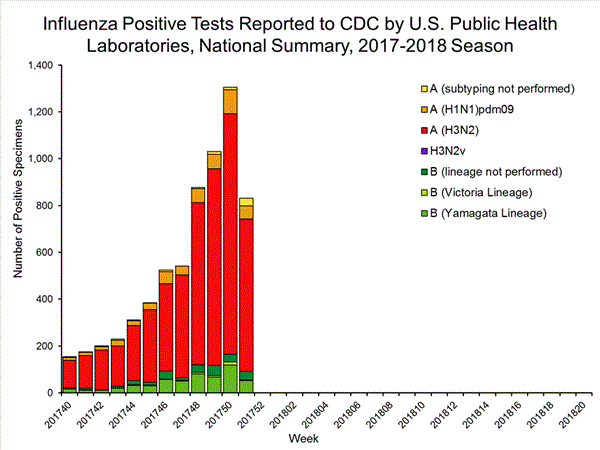
So far this flu season, influenza A (H3N2) viruses have been predominant in the United States (represented by the red bars in the graph below.) This information interests health officials as this particular strain is more concerning than others. Previous flu seasons when H3N2 led the pack were more severe, especially among young children and older adults. Between the years 2003 to 2013, the three flu seasons that were dominated by H3N2 strains of the flu had the highest mortality rates.

Flu season is ramping up and the cases that have already occurred are being used to make predictions on what will be coming down the pike when it peaks in a month or two.

So far this flu season, influenza A (H3N2) viruses have been predominant in the United States (represented by the red bars in the graph below.) This information interests health officials as this particular strain is more concerning than others. Previous flu seasons when H3N2 led the pack were more severe, especially among young children and older adults. Between the years 2003 to 2013, the three flu seasons that were dominated by H3N2 strains of the flu had the highest mortality rates.

What does the name H3N2 mean? There are many different flu strains and one place that they differ is in two major proteins on the outside of the virus - the Hemagglutinin (H) and Neuraminidase (N). For more on this, please read here.
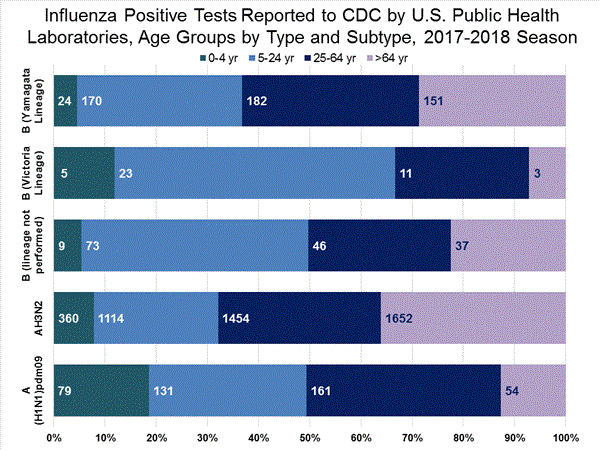
This news is most concerning to those affected by H3N2 which, according to the graph below, has been older people (shown in light purple.) The numbers of positive tests for H3N2 are shown on the fourth bar down and show that the group with the largest number of cases are in people greater than 64 years old (over 35%.)

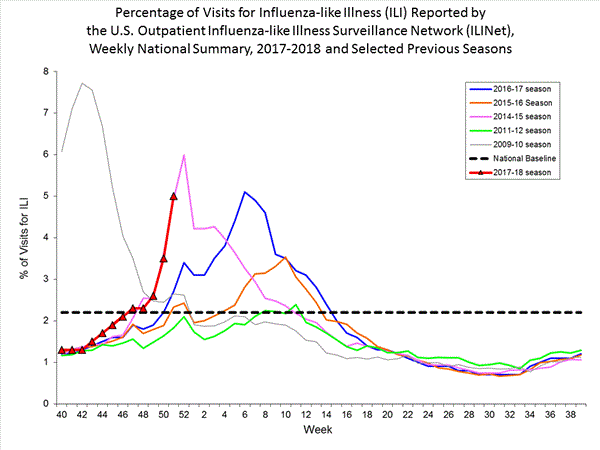
What should we expect in the next few months, then? Looking at the trends from the past few years, there is reason to be concerned. The graph below shows the number of visits for influenza-like illness (not confirmed cases) for the last few years. The bold, red line below shows the numbers for the current season - riding along the path of the early spiking 2014-2015 season. Only time will tell where the number of cases will take us from here, but, we're off to a very foreboding start.

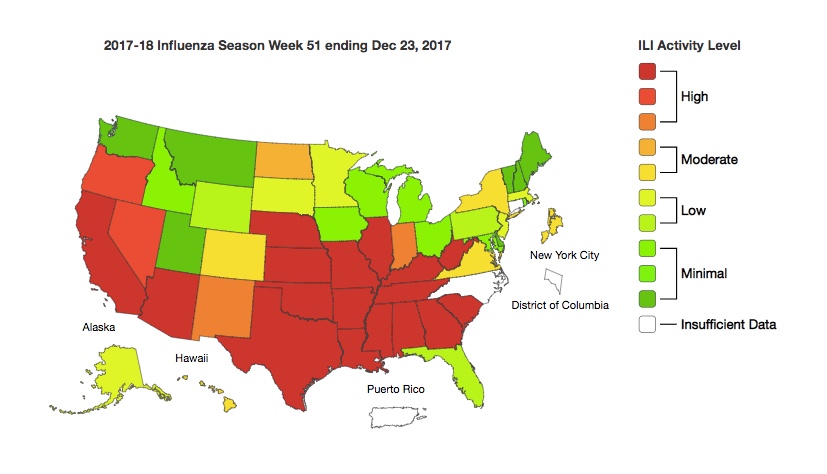
Other data shows that the southern region of the United States is reporting more flu-like activity so far. This may be because they are seeing more of it, but, it also could be simply that they are reporting more of it.

Lastly, there are the heartbreaking stories emerging on social media of children who are dying from the flu. The CDC reports that the majority of children who die from the flu are not vaccinated. Even though the vaccine is not perfect, and is not a guarantee against all flu-like illnesses, what is known is that it will offer protection and it will lessen the course of the disease, even if you or your child contract influenza. And, it is not too late! It takes about two weeks for your body to build up immunity the virus after vaccination. Being protected come mid-January is important as that is when cases tend to increase. We will keep the updates coming here at ACSH, but, in the meantime, please take another look at these graphs, realize that this looks like its going to be a rough flu season, and protect yourself and your children.

 H1N1? H2N5? What Do Flu Names Mean?
 
By Julianna LeMieux — October 4, 2016   @ American Council on Science and Health

Influenza virus
The fall brings with it cooler days, apple picking and flu season.
We know what the symptoms of the flu are, how it is spread and the importance of getting a flu shot. What we may not know is the difference between the strains of the influenza virus and why are they referred to by the letters H and N - followed by numbers.

This may be a bit "inside biology" for some, but, in case you are wondering what these names mean and how they come about, here is a look into the virology behind the influenza virus.

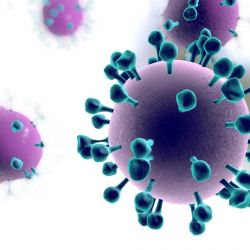
Strains of influenza are characterized by two proteins that are on the outer surface of the virus: hemagglutinin and neuraminidase. This is where the "H" and "N" in the name come from. The proteins can be seen in the picture above, represented by the blue "spikes" on the outside of the virus. Both of these proteins are required for the virus to cause an infection and perform complementary functions. The hemagglutinin is critical for the virus to be able to attach to, and then enter the cell. Without hemagglutinin, the entire process of infection could not be initiated.

Once in the cell, the virus takes over the normal cell machinery and uses it to make many copies of itself.

Then, the neuraminidase enzyme comes into play. Neuraminidase is required for the newly made viruses to escape the host cell, where they can then perpetuate the infection. It's role is to clip the newly made viruses from the membrane of host cell and release them. Without neuraminidase, the new viruses would stay attached to the host cell, unable to infect new cells.

When a person becomes infected with influenza virus, their body's immune system responds by making antibodies to the H and N proteins. Then the antibodies bind to the H and N proteins, and block them from doing their job, stopping the virus in its tracks.

However, with influenza virus, the situation is even more complicated.

Influenza's complexity starts with the fact that there are 14 versions of H protein and 9 versions of N which means that there are a total of 144 varieties of flu. Not all of these 144 are infective.

Additionally, there are two major processes that create a complicated situation even worse. These are called antigenic drift and antigenic shift.

Antigenic drift means that either H or N change in a particular strain. This results in new strains, and this trips up the immune system. When H and N mutate, it is possible that they change so much that the antibodies may not bind to them anymore, leaving the virus fully infective.

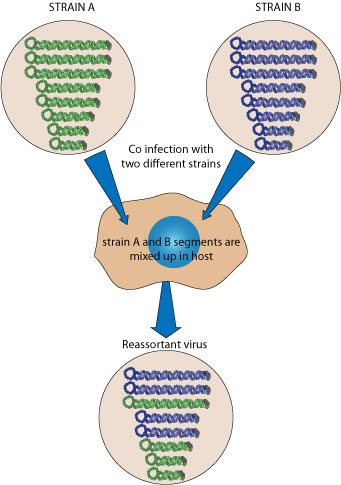
The concept of antigenic shift is more complicated, but, stay with me for a moment. In order to understand antigenic shift, first we must understand how the genome of influenza is stored inside the virus. Influenza belongs to the orthomyxoviridae family of viruses. This means that, unlike our genes, which are made up of DNA, the flu virus's genome is made up of RNA - eight separate pieces of RNA. Flu is an example of an RNA virus with the hemagglutinin and neuraminidase genes are found on different pieces of RNA.

When two different strains of flu infect a cell at the same time, the pieces of RNA (eight from each virus) mix together. This is called reassortment and results in a new strain.

In looking at the figure below, let's say that strain A (with the green RNA) is an H1N1 virus and strain B (with the blue RNA) is an H2N5. In the figure, both of these viruses are infecting the same cell at the same time. When in the cell, the 16 pieces of RNA mix together and the virus that is released from the cell is different (a combination of some green RNA and some blue RNA) from either of the original ones that went in.

This process makes pandemics more likely because the strain that results from the reassortment may be a more dangerous strain and also one that no one has been exposed to before.

courtesy of viralzone.expasy.org

Within the past century, there have been four flu pandemics (worldwide epidemics.) They occurred in 1918 (H1N1 - swine flu), 1957 (H2N2), 1968 (H3N2) and 2009 (H1N1) and experts agree that it is not a matter of if, but when, the next pandemic will strike. It is not simple to predict which flu strain will be wreaking havoc next and the flu vaccine varies in how effective it is from year to year.

Knowing about the complexity of the influenza virus's genome and its ability to undergo antigenic shift and drift help us understand, at least to some extent, what we are up against each year.


Tuesday, November 22, 2016

How Epstein-Barr Virus Causes Cancer

Editor's Note:  I've long believed viruses are the cause of all forms of cancer.  Cancer cells are formally healthy cells that become canabalistic.  That means changing the cell's coding.  That happens when something enters the cells introducing coding that's destructive to the body. Viruses do that by bringing it's DNA or RNA into cells in various ways. This article adds confidence to my thoughts.

By Josh Bloom

The concept of viruses causing cancer is not new. In fact, it has been more than 100 years since Francis Peyton Rous, working at Rockefeller University, uncovered the first pathogen-caused cancer. Rous discovered that a virus, now called the Rous sarcoma virus caused tumors in chickens. He proved the causation by extracting material from the tumors, and then using to it infect other chicken, which subsequently developed the same tumors. He earned the Nobel Prize in Medicine in 1965 for this work.

Since then, multiple pathogens, almost all of which are viruses, have been shown to cause a variety of cancers. Here are some:
  • Hepatitis B**- liver
  • Hepatitis C- liver
  • Human papilloma virus**- cervix, anus, penis, mouth, throat
  • HIV (indirectly)
  • Human herpesvirus 8- Kaposi sarcoma (almost exclusively in AIDS patients)
  • Human T-lymphotrophic virus (HTLV)- leukemia
  • Epstein-Barr virus (EBV), also called human herpesvirus 4 (HHV-4)- lymphoma
The last of these, the Epstein-Barr virus (EBV), has always been a bit mysterious. It is responsible for mononucleosis, and suspected of being a cause of chronic fatigue syndrome (CFS), although this disease remains poorly understood.

EBV has just given up some of its secrets. Dr. Michelle West and colleagues at the University of Sussex in the UK, discovered that the virus alters the function of two genes, MYC, and BCL2L11, which have different functions in the life cycle of cells. When MYC is activated, it promotes cell growth, leading to uncontrolled cell profliferation—the hallmark of cancer. BCL2L11 has the opposite job. This gene, when activated, promotes a process known as apoptosis - a series of events that result in the death of a cell. The mechanism by which these genes in cells— in this case B cells, a type of white blood cell— was previously unknown.

The Sussex group found that EBV infection alters the function of both genes. It does this by hijacking the cellular DNA, turning on MYC and turning off BCL2L11. Now the infected B cells have defective genes, in which two processes have been altered. Cell proliferation is turned on while programmed cell death is turned off.

Since EBV infects B cells, it is not surprising that it causes cancers of white blood cells, such as Burkitt’s lymphoma and Hodgkin’s disease.

With the nature of the binding interactions between EBV and the two affected genes in hand, the group is looking for ways to block them, and create new therapies for two problematic blood cancers.