Search This Blog

De Omnibus Dubitandum - Lux Veritas

Showing posts with label Julianna LeMieux. Show all posts

Tuesday, April 17, 2018

Hey Mainstream Media, Please Stop Promoting EWG's 'Dirty Dozen'

By Julianna LeMieux — April 12, 2018 @ American Council on Science and Health

Spring is in the air, flowers are blooming and the Environmental Working Group (EWG) has published their annual "Dirty Dozen."

The concept of the list is to help consumers decide, as they are choosing their produce, which types of produce should be given priority when buying the organic version.

But, the list should be ignored for a multitude of reasons. First of all, it promotes the idea that organic foods do not have pesticides (they do). In case you don't believe me, check out the National List of pesticides approved for organic certified farms.

EWG also makes some sweeping claims that are not backed up by scientific evidence. They publish their methods of list creation here. But, they fail to relate the pesticide amounts to health standards and not all pesticides are the same, of course.

They also claim that “consumers can lower their pesticide consumption by nearly four-fifths by avoiding conventionally grown varieties of the 12 most contaminated fruits and vegetables.” However, since they do not measure consumer exposure, there is no way to make this statement.
In 2011, a group published a paper in the Journal of Toxicology (1) to test whether the dirty dozen was, indeed, dirty. This is a peer-reviewed scientific paper - not a blog on a website.

They compared the amount of pesticides on samples of the foods listed in the Dirty Dozen to the chronic reference dose, which is the maximum amount that you can have if you are eating that food every day of your life. The level of the chronic reference dose is much higher than anything that would ever lead to a health effect (100 times higher than the amount that caused effects in animals.) However, none of the foods tested reached that level.
They concluded that
In summary, findings conclusively demonstrate that consumer exposures to the ten most frequently detected pesticides on EWG's “Dirty Dozen” commodity list are at negligible levels and that the EWG methodology is insufficient to allow any meaningful rankings among commodities. We concur with EWG President Kenneth Cook who maintains that “We recommend that people eat healthy by eating more fruits and vegetables, whether conventional or organic” [1], but our findings do not indicate that substituting organic forms of the “Dirty Dozen” commodities for conventional forms will lead to any measurable consumer health benefit.
So, that's it. The dirty dozen is just a list of twelve fruits and vegetables (we are not even going to post it the list because that would lend some credibility to it) that probably have some pesticides on them. So, please, mainstream media (CBS, CNN, and USA Today - we're looking at you) please stop promoting the false information that inherently comes along with this list. You can do better than that.

Source: Carl Winter and Josh Katz. Dietary Exposure to Pesticide Residues from Commodities Alleged to Contain the Highest Contamination Levels. Journal of Toxicology Published online 2011 May 15. doi:  10.1155/2011/589674

Monday, January 8, 2018

Viruses May Help in the Fight Against Hard-to-Treat Cancers

By Julianna LeMieux — January 4, 2018  

The movement over the last year that pushed immunotherapies into the realm of treatments for acute lymphoblastic leukemia (ALL) and large B-cell lymphoma have marked a new future for the treatment of those cancers.

But, other cancers remain with far fewer treatment options.

New research published in Science Translational Medicine this week introduced a new potential treatment for some of the most difficult to treat cancers - brain and triple negative breast cancer (TNBC).

The research, published in two side by side papers, shows that viruses enhance the use of checkpoint therapy in cancer treatment. But, to understand how viruses help in treatment utilizing immune checkpoint inhibitors (ICIs), we need first to understand what ICIs are.

Our immune system relies on its ability to distinguish self from non-self. This way, it can attack invaders (say, a bacterial cell that is causing strep throat) without attacking our own body (the cells in the throat.) This process relies on “checkpoints” which are molecules on some of our immune cells that need to be activated (or inactivated) to start an immune response.

The process of making this distinction becomes difficult for immune cells because cancer cells lie in a gray area of self and non-self. In addition, cancer cells can manipulate checkpoints to avoid being attacked by the immune system. One hot field of cancer research is to tweak this system so that cancer cells are more visible or recognizable to the immune system. In doing so, the immune system can be harnessed to target cancer cells and kill them. Drugs that target these checkpoints have held a lot of promise as cancer treatments.

And, anything that can help with this type of therapy is a welcome discovery - in addition to making this therapy applicable to types of cancers that it previously wasn't. It turns out that viruses may do this.

In both studies, the authors found that virus treatment given early, before surgical removal of the mass, alters the immune response and increases the effects of treatment with immune checkpoint inhibitors. Bourgeois-Daigneault et al. discovered this for TNBC and Samson et al. for brain tumors.

For TNBC, Maraba virus was used to promote antitumor immunity. For the brain, it was intravenous infusion of reovirus. The immune effects are different in each paper, but, the overarching finding is that viruses plus ICI did a better job than ICI alone.

It is important to mention that neither breast nor brain tumors are usually treatable with these drugs. So, in essence, these findings may have opened up an entirely new treatment option for these otherwise intractable cancers. For the people with TNBC (15% of all breast cancer patients) and brain cancer, it may be a lifesaver


Thursday, January 4, 2018

Some Bad Flu News: H3N2 is a Major Player this Year

By Julianna LeMieux — January 2, 2018 @ American Council on Science and Health

Flu season is ramping up and the cases that have already occurred are being used to make predictions on what will be coming down the pike when it peaks in a month or two.

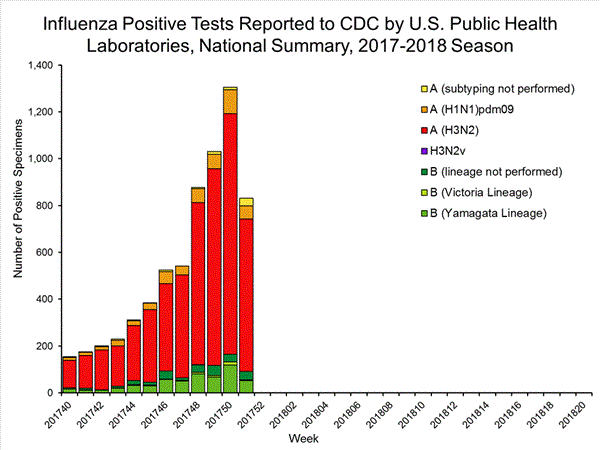
So far this flu season, influenza A (H3N2) viruses have been predominant in the United States (represented by the red bars in the graph below.) This information interests health officials as this particular strain is more concerning than others. Previous flu seasons when H3N2 led the pack were more severe, especially among young children and older adults. Between the years 2003 to 2013, the three flu seasons that were dominated by H3N2 strains of the flu had the highest mortality rates.

Flu season is ramping up and the cases that have already occurred are being used to make predictions on what will be coming down the pike when it peaks in a month or two.

So far this flu season, influenza A (H3N2) viruses have been predominant in the United States (represented by the red bars in the graph below.) This information interests health officials as this particular strain is more concerning than others. Previous flu seasons when H3N2 led the pack were more severe, especially among young children and older adults. Between the years 2003 to 2013, the three flu seasons that were dominated by H3N2 strains of the flu had the highest mortality rates.

What does the name H3N2 mean? There are many different flu strains and one place that they differ is in two major proteins on the outside of the virus - the Hemagglutinin (H) and Neuraminidase (N). For more on this, please read here.
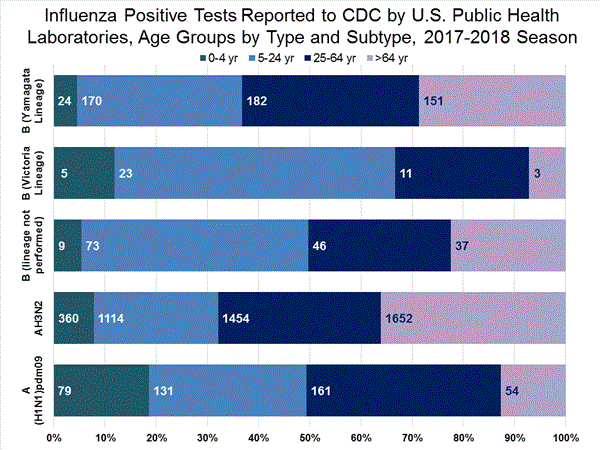
This news is most concerning to those affected by H3N2 which, according to the graph below, has been older people (shown in light purple.) The numbers of positive tests for H3N2 are shown on the fourth bar down and show that the group with the largest number of cases are in people greater than 64 years old (over 35%.)

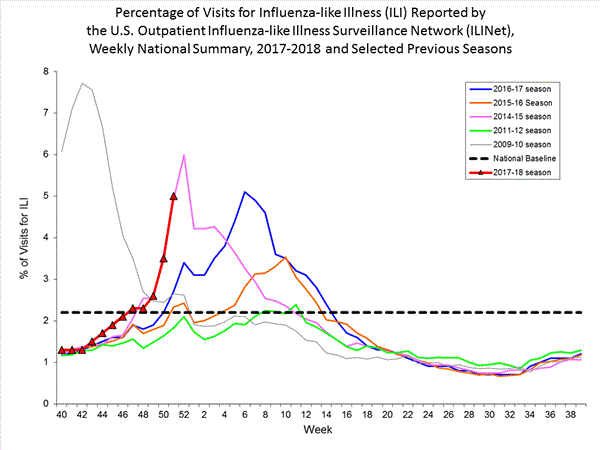
What should we expect in the next few months, then? Looking at the trends from the past few years, there is reason to be concerned. The graph below shows the number of visits for influenza-like illness (not confirmed cases) for the last few years. The bold, red line below shows the numbers for the current season - riding along the path of the early spiking 2014-2015 season. Only time will tell where the number of cases will take us from here, but, we're off to a very foreboding start.

Other data shows that the southern region of the United States is reporting more flu-like activity so far. This may be because they are seeing more of it, but, it also could be simply that they are reporting more of it.

Lastly, there are the heartbreaking stories emerging on social media of children who are dying from the flu. The CDC reports that the majority of children who die from the flu are not vaccinated. Even though the vaccine is not perfect, and is not a guarantee against all flu-like illnesses, what is known is that it will offer protection and it will lessen the course of the disease, even if you or your child contract influenza. And, it is not too late! It takes about two weeks for your body to build up immunity the virus after vaccination. Being protected come mid-January is important as that is when cases tend to increase. We will keep the updates coming here at ACSH, but, in the meantime, please take another look at these graphs, realize that this looks like its going to be a rough flu season, and protect yourself and your children.

 H1N1? H2N5? What Do Flu Names Mean?
 
By Julianna LeMieux — October 4, 2016   @ American Council on Science and Health

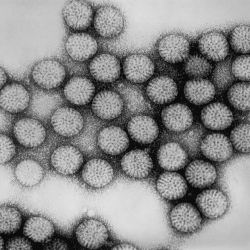
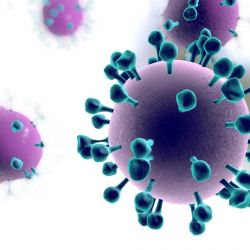
Influenza virus
The fall brings with it cooler days, apple picking and flu season.
We know what the symptoms of the flu are, how it is spread and the importance of getting a flu shot. What we may not know is the difference between the strains of the influenza virus and why are they referred to by the letters H and N - followed by numbers.

This may be a bit "inside biology" for some, but, in case you are wondering what these names mean and how they come about, here is a look into the virology behind the influenza virus.

Strains of influenza are characterized by two proteins that are on the outer surface of the virus: hemagglutinin and neuraminidase. This is where the "H" and "N" in the name come from. The proteins can be seen in the picture above, represented by the blue "spikes" on the outside of the virus. Both of these proteins are required for the virus to cause an infection and perform complementary functions. The hemagglutinin is critical for the virus to be able to attach to, and then enter the cell. Without hemagglutinin, the entire process of infection could not be initiated.

Once in the cell, the virus takes over the normal cell machinery and uses it to make many copies of itself.

Then, the neuraminidase enzyme comes into play. Neuraminidase is required for the newly made viruses to escape the host cell, where they can then perpetuate the infection. It's role is to clip the newly made viruses from the membrane of host cell and release them. Without neuraminidase, the new viruses would stay attached to the host cell, unable to infect new cells.

When a person becomes infected with influenza virus, their body's immune system responds by making antibodies to the H and N proteins. Then the antibodies bind to the H and N proteins, and block them from doing their job, stopping the virus in its tracks.

However, with influenza virus, the situation is even more complicated.

Influenza's complexity starts with the fact that there are 14 versions of H protein and 9 versions of N which means that there are a total of 144 varieties of flu. Not all of these 144 are infective.

Additionally, there are two major processes that create a complicated situation even worse. These are called antigenic drift and antigenic shift.

Antigenic drift means that either H or N change in a particular strain. This results in new strains, and this trips up the immune system. When H and N mutate, it is possible that they change so much that the antibodies may not bind to them anymore, leaving the virus fully infective.

The concept of antigenic shift is more complicated, but, stay with me for a moment. In order to understand antigenic shift, first we must understand how the genome of influenza is stored inside the virus. Influenza belongs to the orthomyxoviridae family of viruses. This means that, unlike our genes, which are made up of DNA, the flu virus's genome is made up of RNA - eight separate pieces of RNA. Flu is an example of an RNA virus with the hemagglutinin and neuraminidase genes are found on different pieces of RNA.

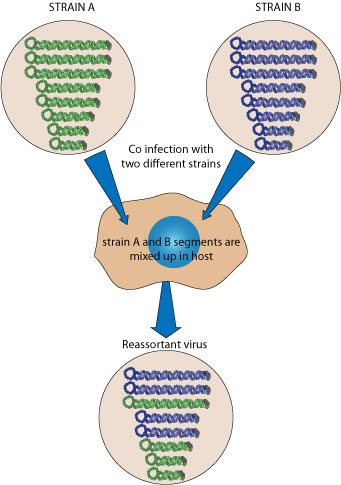
When two different strains of flu infect a cell at the same time, the pieces of RNA (eight from each virus) mix together. This is called reassortment and results in a new strain.

In looking at the figure below, let's say that strain A (with the green RNA) is an H1N1 virus and strain B (with the blue RNA) is an H2N5. In the figure, both of these viruses are infecting the same cell at the same time. When in the cell, the 16 pieces of RNA mix together and the virus that is released from the cell is different (a combination of some green RNA and some blue RNA) from either of the original ones that went in.

This process makes pandemics more likely because the strain that results from the reassortment may be a more dangerous strain and also one that no one has been exposed to before.

courtesy of viralzone.expasy.org

Within the past century, there have been four flu pandemics (worldwide epidemics.) They occurred in 1918 (H1N1 - swine flu), 1957 (H2N2), 1968 (H3N2) and 2009 (H1N1) and experts agree that it is not a matter of if, but when, the next pandemic will strike. It is not simple to predict which flu strain will be wreaking havoc next and the flu vaccine varies in how effective it is from year to year.

Knowing about the complexity of the influenza virus's genome and its ability to undergo antigenic shift and drift help us understand, at least to some extent, what we are up against each year.


Tuesday, September 26, 2017

In Exchange for $200 Million, UC Irvine Legitimizes Pseudoscience

By Julianna LeMieux — September 22, 2017

For some time, infusion clinics and naturopaths have been cropping up in between nail salons and hardware stores in strip malls across the country. But, integrative medicine crossed a line this past week that will allow it to be deeply and firmly rooted in a major, reputable academic institution.
This line was crossed with a $200 million donation made to University of California, Irvine - the seventh largest donation ever made to a public university in the United States.

The money, given by Susan and Henry Samueli, is given to develop "the nation’s first university-wide enterprise to embed integrative health approaches in research, teaching and patient care." With the money, UC Irvine will build a new facility and hire up to 15 new faculty members.

Not only that, but what this money does is to give alternative medicine - such as homeopathy and acupuncture - a leg to stand on. These practices are pseudoscience and, although popular, are not backed by scientific evidence. This move legitimizes these practices, which is not something that science has been able to do thus far.......To Read More.....

My Take - Overall - and this may seem a bit strange given my positions on most of this stuff - but I'm only emotionally in agreement with the conclusions of this article.  I'm probably seeing this a bit differently than most, and the reason why is I like the idea of doing research on "alternative" medicine, even if it's not peer reviewed.  Why? 

Because whatever they come up with will lead to clarity since eventually they will have to publish their work somewhere and when that happens - we'll get "citizen" peer reviewers like Julianna, the ASCH team and others, who are not part of the research group or the university but have expertise in what will be presented by these researchers.  And even if they're lying, they'll be exposed.  If they're not lying - then hooray for everyone - because either way - that will lead to clarity.  Acceptance of that clarity may be problematic, but truth will patiently wait for us.

Having said that - here's what I really take away from this article is how grant money is now the holy grail of science.  Not truth - grant money.  And 200 million bucks is a lot of grant.  And grant money has made scientific integrity an oxymoron. 

Sunday, September 24, 2017

Peer Review Congress Tries to Solve Publishing Issues

By Julianna LeMieux — September 18, 2017

The peer review process works - but it isn't perfect.  It's complicated, but, the process relies on its practitioners to spend large amounts of time and energy critiquing each others work in a thoughtful, meaningful and honest way. Peer review relies on human knowledge and ethics and, like humans, is flawed.

Last week, researchers and others took three days out of their busy schedules to travel to Chicago to think critically about the peer review process and ultimately, improve it. The meeting is called the Peer Review Congress (Eighth International Congress on Peer Review and Scientific Publication). The meeting, organized by The Journal of the American Medical Association (JAMA) and the BMJ has been held every four years since 1989. The motto of the meeting is to: enhance the quality and credibility of science.........To Read More.... 

Tuesday, September 12, 2017

Why Cholera Outbreaks are So Catastrophic

By Julianna LeMieux — September 8, 2017

The news of the cholera epidemic in Yemen is beyond comprehension. The disease is spreading with unprecedented speed. There are over 600,000 people infected and 2,000 dead - in about six months time.

In July, the numbers being reported were a staggering 5,000 new cases a day. Although the overall rate of newly infected has slowed recently, down to around 3,000 cases per day - that is certainly no reason for celebration. This still remains the most explosive cholera epidemic on record.

How does a bacterium that is micrometers long cause such devastation?

Vibrio cholerae naturally exists in two places - water and the human small intestine. The bacteria sets up an infection in someone after they consume water contaminated with Vibrio cholerae. This is more common in areas where sanitation is low and people are forced to resort to drinking the same water that they or others are bathing in. An example of such a situation is shown in the photo..........To Read More....

My Take - Good article, but I fear there's no fixing this from the outside. Yemen is poor and made poorer by those ruling the nation who keep them in this state. War, corruption and elitism is the order of the day in Yemen and any money sent there will probably be absorbed by the ruling class. We're not sitting back and watching it happen so much as there's not much "we" can do to fix it. And I’m not sure who the “we” are. This a common societal paradigm in much of the world. The Middle East is run by tyrants in nations that are in reality medieval tribal societies with modern weapons, communications and transportation. There’s no fixing that. But it is a good article as an argument against the greenies who've attempted to get chlorine removed from various nation's water systems.

Tuesday, August 29, 2017

Not Even Paltrow's goop Is Above The Law

By Julianna LeMieux — August 25, 2017

Gwyneth Paltrow's lifestyle company, Goop, may think that the products they sell are helpful but others disagree. The controversy has evolved into a formal complaint filed against Goop - a move that starts the legal ball rolling down Goop's vaginal egg lined path.

The complaint was made by two California district attorneys along with the non-profit Truth in Advertising (TINA). They claim that Goop has made “unsubstantiated, and therefore deceptive, health and disease-treatment claims to market many of its products.”.......Infertility - Trauma - Inflammation - Arthritis - Insomnia - Uterine prolapse - Hormone imbalance - Eczema - Psoriasis - Acne - Fevers - Depression - Anxiety - Panic attacks - Migraines - Hypertension - Autoimmune diseases - Cancer - Nerve pain - Constipation.........To Read More....

Sunday, July 30, 2017

Massachusetts Becomes the 20th State Where Naturopaths Can Hurt You

By Julianna LeMieux — January 14, 2017

A naturopath is not a physician, should not be able to substitute for one, act like one or even play one on TV.

However, in the last few weeks, the Massachusetts legislature passed bill 2335 "An Act establishing a board of registration in naturopathy," that will give the profession of naturopaths legitimacy - one of the worst moves that they could have made for the health of the people of the "bay state." 
The heart of the bill designates that a board will be instituted to determine the role of naturopaths and define their abilities and limits. The five person board will be made up of two naturopaths, one physician who works with naturopaths, one pharmacologist and a member of the public - which is absolutely ridiculous.

That is like a board on the regulation of cigarettes being made up two smokers, one person who sells cigarettes, one person who studies the effects of nicotine, and a random person from off the street.
The bill addressed more than the board, however. It also outlines the following regarding how naturopaths practice. It states that they can work to......To Read More...

Articles of interest:

Tuesday, November 22, 2016

Why 'Naturopathic Medicine' is an Oxymoron

By Julianna LeMieux

With more and more stories crossing my path of people (mostly children) being hospitalized or dying at the hand of a naturopath, I could not help but wonder.... what does it take to become a naturopath?

Like the profession, the training process to become a naturopath has been packaged to resemble actual medicine. The degree earned even contains the word 'doctor' - Doctor of Naturopathic Medicine.   Comparing the education that physicians and naturopaths obtain in order to prepare for their professions reveals a large difference between the two. Although both schools have a four year program - the similarities end there. One place where naturopathic and medical education are the same is the price tag. The average annual cost for a year at Bastyr University is $40K......To Read More.... 

The Test that Prevented Millions of Cancers

By Julianna LeMieux

In the 1970s, an assay was developed by Dr. Bruce Ames that revolutionized the ability to test if a compound causes cancer or not.  Since then, the Ames test has been used on everything from food dyes to pesticides. The power of the Ames test is not only that it is incredibly efficacious, but also that it is inexpensive and relatively easy to do.

The test is based on a brilliant observation made by Dr. Ames. He realized that there is a strong linkage between the ability to cause mutations in DNA and the ability to cause cancer. To simplify what is an incredibly complicated process, the more mutations that something creates (or, the more mutagenic it is) the more likely it is to cause cancer. Fewer mutations = less cancerous.

In order to understand whether or not something causes cancer, you have to understand how the Ames test works......To Read More....