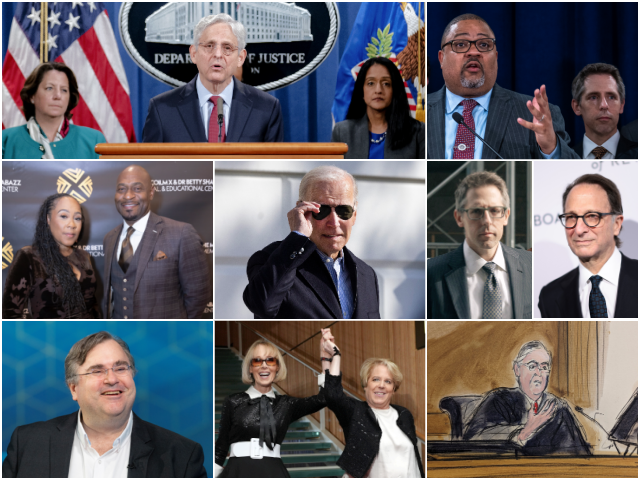
Donald Trump is now President of the United States for a second term, having survived an unprecedented campaign of lawfare that has included no fewer than four criminal prosecutions, two state and two federal, brought during the four years that he was out of office. All were brought by highly partisan Democratic Party prosecutors.
The four prosecutions of Trump are all now essentially dead. However, much of the process of killing off these prosecutions has occurred either since Trump’s re-election, or only because of the fortuity of Trump getting enough appointments to the Supreme Court during his first four years in office to have an effective majority on that Court.
To get an idea of how things might have gone differently for Trump, we need only look to the country of Brazil. There, a couple of weeks ago, on September 11, the prior President and leader of the opposition party, Jair Bolsonaro, just got sentenced to some 27 years in prison. According to the BBC, the charges against Bolsonaro included “armed criminal conspiracy,” “attempted abolition of the democratic rule of law,” and “attempted coup d'état.” In other words, the charges against Bolsonaro sound very similar to the charges against Trump in the Jack Smith Washington DC prosecution.
And yet the BBC also states that the subsequent and current President, known as Lula, “was sworn in without incident on 1 January 2023.” To be fair, there was unrest following the October 2022 election that was ultimately called for Lula, and on January 8, 2023, after Lula took office, Bolsonaro’s supporters staged a large protest in the capital of Brasilia, that turned violent. Bolsonaro himself was out of the country at the time, actually in Orlando, Florida.
The underlying merits of the case against Bolsonaro are almost impossible for an outsider to evaluate. However, the process employed against Bolsonaro is not difficult to evaluate: it had no semblance of fairness. Somehow the tribunal that rendered the verdict on Bolsonaro consisted of five Supreme Court justices, the majority of them closely allied with Lula. The head of the tribunal, one Alexander de Moraes, has made a name for himself taking on what he calls the “digital far right” in Brazil, and for shutting down “misinformation,” otherwise known as speech by political opponents. Among other things, de Moraes personally shut down Twitter/X in Brazil after Elon Musk took it over. Two other judges on the five-judge tribunal are close allies of Lula: a former Justice Minister in a prior Lula presidency, and a former defense lawyer for Lula in a corruption trial that he faced prior to his current term as President. Those three constituted a majority to convict Bolsonaro. One judge, a guy named Luiz Fux, voted to acquit Bolsonaro on grounds of insufficiency of evidence. Fux wrote a lengthy dissent.
Back here in the U.S., Jack Smith was the special prosecutor named by the Merrick Garland Justice Department to go after Trump while he was out of office. Smith brought two criminal cases against Trump — one in DC for conduct related to the January 6 demonstrations, and the other in Florida for alleged mis-handling of classified information. Smith did everything he could to get his cases to trial before Trump could get re-elected. In the DC case, that goal was frustrated by the Supreme Court ruling in Trump v. United States in July 2024, holding that Trump had immunity as President for any official acts he took while in office.
Trump v. United States was a 6-3 decision, along straight party lines. In other words, if Trump had not had his appointments to the Supreme Court, the case would likely have gone the other way, and he would have found himself a defendant before a DC jury in the Jack Smith prosecution. Irrespective of the merits, he could well have found himself in the position of Bolsonaro.
You may think that Jack Smith has completely disappeared since he got fired upon Trump resuming office. However, Mr. Smith re-emerged giving a lecture last week at George Mason University. Here are a few excerpts from a September 22 piece in the New York Sun reporting on Smith’s talk:
The prosecutor declared that “what I see happening at the Department of Justice today saddens me and angers me … the government, using the vast powers of the criminal justice system to target citizens for exercising their constitutional rights.” The special counsel, who was appointed by Attorney General Merrick Garland, reflected, “My career has also shown me how fragile” the rule of law can be. “As an international prosecutor, I have seen in other countries the rule of law erode. … One of my concerns is that we have had the rule of law function in this country for so long that many of us have come to take it for granted.” . . . Mr. Smith insisted until the end of his tenure that he could have convicted Mr. Trump “but for” his victory over Vice President Kamala Harris in the 2024 election.
According to the Sun, Smith got a standing ovation for his speech, which gives you a good indication how a DC-area jury may have viewed the case.









Why do we think that way we do? Machiavelli noted there are only two groups of people in the world. The privileged and the common people. The privileged only want to maintain their privileges, or expand them, and the common people only want security. They want to be able to house, feed, and clothe their families in safety. That is what molds everyone’s thinking, except for the misfits who hate both, and want to destroy both.
The issue isn’t why people think what they think, it’s how many think what they think in each category, and very often that’s a result of where we are in the stream of historical cycles. I've read three books on historical cycles and they all agree we're in an end cycle, which epitomized instability, economic downturns, and violence.
Turkish President Erdogan apparently believed the guy running against him had a good chance of winning, and that was just unacceptable, so he had his opponent arrested on trumped up charges. I’ve been following Erdogan's antics for some years. First, Turkish Islam has always been a bit different than traditional Islam, and it’s been far more secular, so pushing all this Islamic radicalism on Turkey and his tyrannical failures may have been part of the bridge too far construction against him. As a result, this action filled the streets thousands and thousands of demonstrators who are outraged at this act. Will there be a new president as a result?
The last time I remember a nation having this many people running wild in the streets over politics was Romania in 1989. That resulted in Nicolae Ceausescu being overthrown and very unceremoniously shot later on along with his wife. Erdogan is afraid, make no mistake about that, and he has reason to be.
If there is a new President, I’m of the opinion a new President would moderate a lot of Turkey’s policies that were promulgated by Erdogan, who created a lot of instability involving energy, trade, foreign policy, domestic stability, and economics, and that’s a big one, because Turkey’s economy is in trouble and is in very real need of stability, which I've stated for some years, and in opposition to all the "experts" who kept claiming Turkey was doing great and would be a big force in the Middle East. Experts entirely too often are expert at ignoring the basics, and embracing preconceptualism, which means ignoring the things known because they're inconvenient, and making up the things not known, just like Henry Kissinger. More Here, and Here.