Tax Policy Center
The
proposed Fair Tax rate is far too low to achieve its sponsor's stated
goal of deficit neutrality. As a fundamental tax reform, it is
essentially unworkable. In a deal that secured Kevin McCarthy the speakership, House Republicans plan to vote on the FairTax Act of 2023 (H.R. 25), which would replace almost all federal taxes with a 23 percent national retail sales tax,
create a “Family Consumption Allowance,” a type of universal basic
income, eliminate the IRS, and create a trigger to eliminate the sales
tax if the 16th amendment—which outlines Congress’s authority to levy an income tax—is not repealed in five years.
In a forthcoming study to be published in Tax Notes Federal,
we analyze the FairTax and find the proposed tax rate is far too low to
achieve its sponsors’ stated goal of deficit neutrality. The bill’s cited rate of 23 percent is “tax-inclusive,” meaning the
tax is 23 percent of the total after-tax price. This corresponds to a 30
percent “tax-exclusive” rate, or the markup at the cash register. These
rates, however, would be insufficient to replace current law income,
payroll, and estate and gift tax revenue...........To Read More....
My Take - What they're saying here pretty much sums up my views on FairTax, and how it can, and would be, manipulated as badly as what we have now. Dan Mitchell pushes for this tax, and my comments at the beginning of the article reflect positions in this piece saying:
I've never been impressed with the
Flat Tax/Fair Tax concept as it seems to me it would become as
complicated and convoluted as the income tax system we have now. But I
think this is worth looking at anyway. I still like the national sales tax.
Let's not be delusional. There's no taxing system that can't be
corrupted, and it will be corrupted. Stealing other people's money
under a "legal" framework is too entirely tempting for politicians to
resist. The big difference is, at least in my opinion, any corruption
taking place with a national sales tax will be more easily detected.
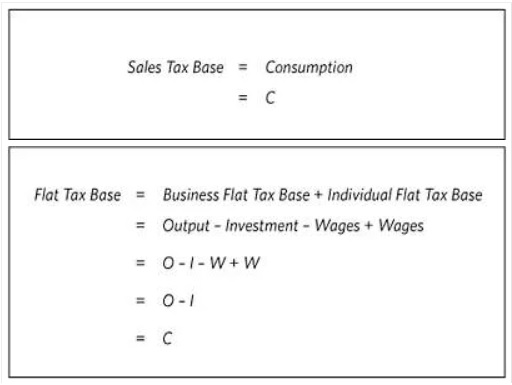
Indeed, the flat tax and a national sales tax (such as the Fair Tax) are basically different sides of the same coin.
The only big difference is the collection point. A flat tax takes a
piece of your income as you earn it while a national sales tax grabs a
piece of your income as you spend it.
Using the jargon of public-finance economists, both the flat tax and national sales tax are “consumption base” systems.
But that does not mean a tax that is collected at the cash register.
Instead, it simply means a system where there is no double taxation of
saving and investment (i.e., a system where all saving and investment
receives IRA/401(k)-type protection).
But just because two tax plans are economically similar does not mean that they have the same political appeal.
Over the past few decades, I’ve explained to many politicians the
best arguments for both the flat tax and national sales tax. I’ve also
warned them about the most likely attacks and how to respond.
Suffice to say that it’s much easier to sell the flat tax and defend it from demagoguery (usually revolving around class warfare or itemized deductions).
Which is why some pro-tax reform folks are trying to discourage House Republicans from supporting the Fair Tax.
Here are excerpts from a Wall Street Journaleditorial.
House Republicans may be…set to vote on a national sales
tax that won’t become law but will give Democrats a potent campaign
issue. The plan is called the Fair Tax and its premise is simple:
Replace every existing federal tax with a new national tax on sales.
…the true rate would be about 30%. The Fair Tax rate would be on top of
state sales taxes. …It would also eliminate the Internal Revenue
Service, but…replace it with a new Sales Tax Bureau and Excise Tax
Bureau.
…The Fair Tax is based on the reasonable theory that levies on
consumption distort the economy less than our current taxes on work and
investment. Killing the income tax also sounds good until you realize
that a future Congress could restore it if the Constitution’s 16th
Amendment isn’t repealed. …The point is that a consumption tax might
make sense if Congress were writing the tax code from scratch. But it
isn’t, and we could end up with both a national income and sales tax,
the later of which could evolve over time into a value-added tax. …the
Fair Tax has hurt GOP candidates before. When tea party Republicans ran
on the idea in 2010, Democratic groups ran ads that blasted the sales
tax… Few voters listen to a second sentence after they hear about a 30%
tax on everything they buy.
Opining for National Review, Ramesh Ponnuru is even more critical.
Any House Republican who backs this bill can accurately
be accused of voting for the following things: raising the price of
everything by a huge amount at a time when inflation is already high;
shifting more of the tax burden to the middle class;
instituting a large new wealth tax on senior citizens; increasing
federal spending by a massive amount; increasing the deficit; and
creating large black markets. …FairTax supporters have answers for most
of these charges. They are not…persuasive answers. But even if they were
right, Republicans who vote for the bill would be taking on a
formidable amount of defensive work. Those in competitive seats,
especially, should know what they are getting themselves into.
Last but not least, Grover Norquist of Americans for Tax Reform argues against the Fair Tax in an article for the Atlantic.
The bill proposes to abolish the Internal Revenue Service
and eliminate the federal income tax. So far, so good. Unfortunately,
the bill would replace the income tax with a 30 percent national sales
tax on all goods and services and establish a giant new entitlement
program.
…Under the bill’s plan, all households would receive a monthly check
from the federal government regardless of earned income. …In all but
name, in fact, the Fair Tax’s “prebate” system would establish a
universal basic income, one of the left’s favorite policies. …Fair Tax
proponents make two good points. They understand the need to end the
double taxation of savings and investment in the present system, and
they want to depoliticize the IRS workforce… None of this has stopped
Democrats from seizing the opportunity to claim that Republicans now
want to raise taxes on the poor and middle class. …the Fair Tax Act has a
long record of proving politically toxic.
P.S. While I recognize that a national sales tax has political
vulnerabilities, I actually think its biggest problem is the risk that
politicians would not actually get rid of the income tax. Or, maybe they would get rid of the income tax, but then reinstate that awful levy after a few years. This is why, in this video,
I explain that a national sales tax only should be considered after the
16th Amendment is repealed and replaced with something that
unambiguously prohibits the income tax from ever again plaguing the nation.
January 16, 2023 by Dan Mitchell @ International Liberty
(Editor's Note: I've never been impressed with the Flat Tax/Fair Tax concept as it seems to me it would become as complicated and convoluted as the income tax system we have now. But I think this is worth looking at anyway. I still like the national sales tax. Let's not be delusional. There's no taxing system that can't be corrupted, and it will be corrupted. Stealing other people's money under a "legal" framework is too entirely tempting for politicians to resist. The big difference is, at least in my opinion, any corruption taking place with a national sales tax will be more easily detected. RK)
As I said in the video, it would be nice to toss the current tax code in the trash and replace it with something that collects revenue is a less-damaging and less-corrupt fashion.
Not because one is theoretically better than the other, but because of two political reasons.
As noted in the above clip, I’m very worried about giving
untrustworthy politicians a new source of tax revenue without
unambiguously and permanently getting rid of the income tax (so that we
don’t repeat the European mistake of giving politicians a way of expanding government).
I also worry that a Fair Tax is vulnerable to demagoguery
since lawmakers will get hit with election-year ads stating they want a
big 30 percent tax on everything people buy (while overlooking that our
paychecks will be much bigger once income taxes and payroll taxes are
abolished).
And there’s plenty of less-friendly opposition. In an article for the Bulwark, Jim Swift pours cold water on the idea.
…nobody has ever taken the Fair Tax seriously. Not in the
years after the Tea Party wave… Not in 2011, when Texas Gov. Rick Perry
briefly campaigned in support of the Fair Tax, only to quietly walk
back his support and switch to a flat tax proposal.Not in 2017, when the
Republican-controlled Congress passed the Tax Cuts and Jobs Act. …Do
moderate House Republicans really want to be forced to vote on the Fair
Tax?
…In light of all this, why promise a vote on such a loser? Going
straight to the floor poses risks, given the slim GOP majority. It’s a
lose-lose situation: Vote yes, and the House Republican Conference looks
frivolous, to say nothing of the messaging gift they would give
Democratic speechwriters in 2024 (“Republicans want to instate a 30-plus percent federal sales tax!”).
Vote no, and invite primaries by far-right candidates who will accuse
you of siding with Democrats when given a chance to abolish the IRS.
…It’s possible that McCarthy agreed to a floor vote expecting moderates
to break ranks and the bill to fail by a spectacular margin. That would
drive a stake through the heart of the Fair Tax. …What’s likelier is
that McCarthy knew this was a promise he could break. He never said
anything about when he would bring the bill to the floor.
While I do worry about the political blowback against a Fair Tax, I hope Speaker McCarthy keeps his promise and there is a floor vote.
Not because I’m deluded about something good getting through the Senate or surviving a sure-veto from Biden.
But if tax reform becomes a big issue this year, that may set the
stage for a bigger debate in 2024 and maybe one of my fantasies will
come true and we’ll get something good in 2025.
P.S. Here’s another video from the archives, in which I discuss the flat tax and national sales tax./p>
P.P.S. Speaking of archives, here are my brief thoughts from 2011 about the various proposals for tax reform.
P.P.P.S. And click here, here, here, or here if you want to peruse my arguments for the flat tax.
Some 150 years
ago, Alexis de Tocqueville wrote: “The greatness of America lies not in being
more enlightened than any other nation, but rather in her ability to repair her
faults.”
Today,
America’s financial well-being is threatened by its continued reliance on an
antiquated regimen of tax laws and regulations to generate the revenue needed
to support our government’s spending priorities.
Many of these provisions
served their purposes well when enacted and implemented. For most, that time
has passed.
The House
Committee on Ways and Means recently examined itemized deductions for
charitable contributions as part of its tax reform deliberations.
Some will applaud
the committee for focusing on a high-visibility deduction such as charitable
giving. We at Americans For Fair Taxation feel strongly that by looking at
single provisions of the tax code, the committee is effectively abdicating its
responsibility to analyze and critique the current tax code as a whole to
determine whether it is the right tool to vouchsafe America’s economic
viability in the 21st century.
Instead, we
urge the committee to discard this aging taxation infrastructure and replace it
with the FairTax plan, an approach without the revenue-depleting deductions and
exemptions that are relevant to the economic needs of our nation today.....To Read More...
My Take –The only “fair” tax system is a national
sales tax that excludes nothing and no one.For a tax system to work properly everyone has to have skin in the
game.That acts as a restraint versus an
effort by politicians to generate class struggles for political gain.This should be a tax on the sale of all
products and materials, at each stage.The secondary benefit – and these are big - for society will the three
fold.The IRS will largely be
eliminated; the elimination of the need to file income tax returns; corporate
and death taxes will be eliminated.Corporate taxes are nothing more than a hidden tax on the poor and death
taxes are immoral.