Search This Blog

De Omnibus Dubitandum - Lux Veritas

Showing posts with label Income Tax. Show all posts

Monday, April 14, 2025

Mississippi Repeals its State Income Tax

April 12, 2025 by Dan Mitchell

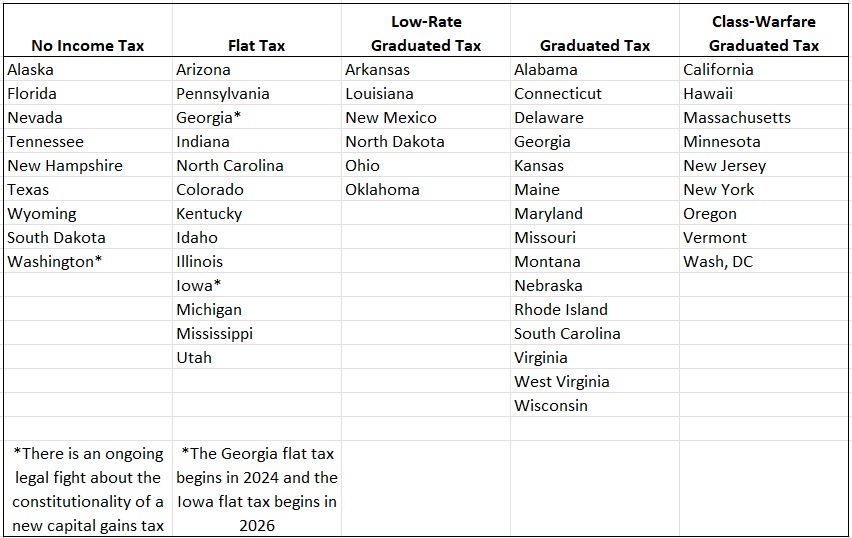
As illustrated by the changes in my state tax rankings between 2018 and 2023, there’s been a lot of progress.

Several red states have shifted to flat taxes and lowered tax rates, putting the class-warfare blue states at an even bigger disadvantage (and some of those left-leaning states actually want to make their tax regimes even less competitive!).

While I cheer the shift to better tax policy, I’ve been disappointed that no state in recent years (or recent decades) has made the ultimate leap and joined the no-income-tax club.
 

That may be about to change.

State lawmakers in Mississippi have passed a law designed to phase out the income tax over 15 years.

Alex Rosado of Reason has some of the details.

Mississippi has joined a small club of nine other states in passing legislation eliminating the state income tax—an outcome that will benefit Mississippians and hopefully encourage other states to follow suit. …The new legislation will gradually lower Mississippi’s state income tax, currently sitting at 4.4 percent, to 3 percent by 2030.

Further annual cuts depend on “growth triggers” linked to state revenue. …States with low-income taxes enjoy greater economic prosperity. Just compare Texas, which has no personal income tax, and Oklahoma, which has a top rate of 4.75 percent. Last month, the Tax Foundation found that Texas’ economy grew roughly 35 percent faster than Oklahoma’s over the last two decades, with Texas’ personal incomes and gross state product being notably higher too. A 2008 longitudinal study that analyzed economic growth in the States from 1964 to 2004 found that states with higher income taxes stifled economic growth, entrepreneurialism, and access to capital.

Douglas Carswell of the Mississippi Center for Public Policy played an important role in the reform.

In a column for the Foundation for Economic Education, he writes about this important development.

Mississippi has made history as the latest state (and the first since Alaska in 1980) to pass legislation banning a state income tax. …Beginning next year, Mississippi’s income tax rate will drop in 0.25% increments, sliding from 4% to 3% by 2030. After that, further reductions will hinge on the state’s budget surplus. Given Mississippi’s recent track record of substantial surpluses, the income tax could vanish entirely by the mid-2030s. …

The push to eliminate the income tax has been a cornerstone of Governor Reeves’s agenda, with serious legislative efforts kicking off in 2022 under then-House Speaker Philip Gunn. Gunn’s genius was to simplify the state’s variable tax rates into a flat 4% on income above $10,000. While this didn’t eliminate the tax outright, it leveled the playing field for Mississippi households, setting the stage for broader support of full elimination. …this is great news for our state. Already there is evidence that in 2024, by some measures, Mississippi performed well economically, and may have been one of the fastest growing states in America that year. This tax reform will only add to this Mississippi momentum.

Let’s also look at some excerpts from an editorial in the Wall Street Journal.

Gov. Tate Reeves signed a bill last month that puts Mississippi on a path to zero income tax, albeit in about 14 years. Yet the messaging is right, as the state tries to lure business investment. Mississippi is sandwiched between two economic powerhouses, Texas and Florida, which don’t tax their residents’ incomes.

Neither does Tennessee next door. …a law passed in 2022 is already set to cut that next year to 4%. But under the bill Mr. Reeves signed, the plan is to keep going to 3% by 2030. Reductions after that, until the tax is phased out, are conditioned on hitting revenue triggers. …The important point is that the path to zero is now enshrined in law, which is a big deal that workers and employers won’t fail to notice. The economic success of the eight states that don’t tax personal income has created a race in GOP-run states to join them, or at least to cut rates and get as close as politically possible.

Last but not least, Russ Latino’s column in National Review celebrates the abolition of the income tax and other good reforms.

Under the Build Up Mississippi Act, the Magnolia State will become the tenth state to operate without a tax on work. Only one other state, Alaska, has ever eliminated an income tax once in effect. The particulars aren’t all that sexy. The state’s flat income tax will phase down to 3 percent by 2030, marking an annual cut of some $647 million by conclusion of the phase-in.

From there, revenue growth triggers will be used to pare the rate down to zero. …Since the passage of Bryant’s education reforms in 2013, Mississippi leads the nation in both math and reading gains on the National Assessment of Education Progress tests. Once last, Mississippi’s fourth graders now rank ninth in reading and 16th in math. …When you start behind, there’s a lot of room for improvement. That certainly remains true here. Getting off the bottom requires taking risks that require intestinal fortitude. But conservative ideas are working, and Mississippi has momentum.

By the way, all of the above articles note that the bill contains a typo that actually makes it easy to meet the aforementioned revenue triggers.

I’ll close, however, by focusing on an issue that is far more important.

I like that the Magnolia State has a goal of eliminating the income tax. Such a reform would be great for jobs and growth.

But what will really determine success is not a typo in the bill, but rather a commitment to long-run spending restraint.

Here is a look at the state’s performance in recent years. As you can see, the fiscal constraint last decade evaporated this decade.
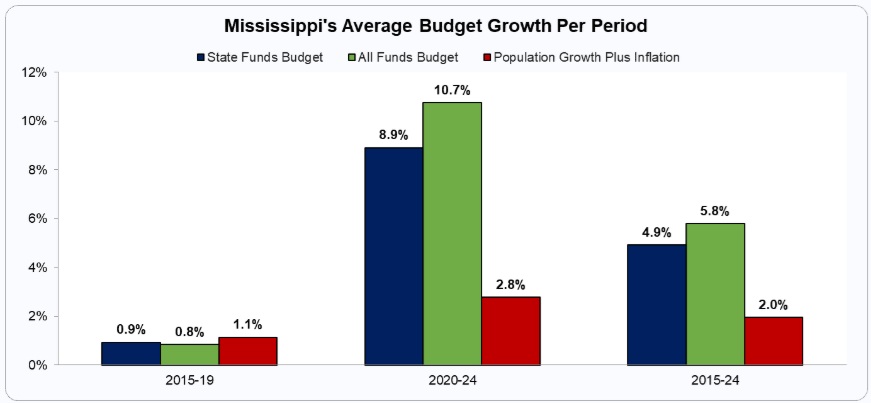
Looks like Mississippi needs a Colorado-style spending cap. Given TABOR’s strong track record, that would be the best way of making sure future politicians don’t mess things up.

P.S. Louisiana also is looking at how to abolish its income tax (once again, a TABOR-style spending cap is key).


Friday, March 10, 2023

(Even Better) State Tax Rankings

March 6, 2023 by Dan Mitchell

There’s been great progress in recent years with regards to state tax policy. When I put together my first ranking back in 2018, there were 9 states with flat taxes and and 3 states with low-rate graduated tax systems.  Today, there are 11 (soon to be 13) states with flat taxes and 6 states with low-rate graduated systems.


But one thing has not changed. The ideal state tax policy is to have no income tax and the 9 states in that category have not changed. Indeed, things may even be moving in the wrong direction since politicians in the state of Washington recently imposed a capital gains tax and they hope that the state’s top court somehow will decide it is constitutional. But there’s now a glimmer of hope that a few states will jettison their income taxes............To Read More....

Friday, January 20, 2023

National Sales Tax Update: Test Vote for the Fair Tax

January 16, 2023 by Dan Mitchell @ International Liberty

(Editor's Note:  I've never been impressed with the Flat Tax/Fair Tax concept as it seems to me it would become as complicated and convoluted as the income tax system we have now.  But I think this is worth looking at anyway.  I still like the national sales tax.  Let's not be delusional.  There's no taxing system that can't be corrupted, and it will be corrupted.  Stealing other people's money under a "legal" framework is too entirely tempting for politicians to resist. The big difference is, at least in my opinion, any corruption taking place with a national sales tax will be more easily detected. RK)

Fundamental tax reform is back on the agenda, with House Republicans promising a vote this year on a national sales tax, so I dug into C-Span’s archives so I could share a few of my thoughts from 2007 on the Fair Tax.

As you might suspect, the principles I believed in back in 2007 and the principles I still support in 2023.

If anything, I have even greater disdain for the IRS and our awful tax system.


Politicians have combined the worst of two worlds, giving us a tax code that simultaneously is filled with class-warfare provisions that punish success while also containing thousands of special tax breaks that benefit the well-heeled friends of politicians.

As I said in the video, it would be nice to toss the current tax code in the trash and replace it with something that collects revenue is a less-damaging and less-corrupt fashion.

For what it’s worth, I’ve always preferred the flat tax over a national sales tax.

Not because one is theoretically better than the other, but because of two political reasons.

  1. As noted in the above clip, I’m very worried about giving untrustworthy politicians a new source of tax revenue without unambiguously and permanently getting rid of the income tax (so that we don’t repeat the European mistake of giving politicians a way of expanding government).
  2. I also worry that a Fair Tax is vulnerable to demagoguery since lawmakers will get hit with election-year ads stating they want a big 30 percent tax on everything people buy (while overlooking that our paychecks will be much bigger once income taxes and payroll taxes are abolished).

Indeed, many sympathizers openly admit that the Fair Tax has vulnerabilities.

And there’s plenty of less-friendly opposition. In an article for the Bulwark, Jim Swift pours cold water on the idea.


…nobody has ever taken the Fair Tax seriously. Not in the years after the Tea Party wave… Not in 2011, when Texas Gov. Rick Perry briefly campaigned in support of the Fair Tax, only to quietly walk back his support and switch to a flat tax proposal.Not in 2017, when the Republican-controlled Congress passed the Tax Cuts and Jobs Act. …Do moderate House Republicans really want to be forced to vote on the Fair Tax? …In light of all this, why promise a vote on such a loser? Going straight to the floor poses risks, given the slim GOP majority. It’s a lose-lose situation: Vote yes, and the House Republican Conference looks frivolous, to say nothing of the messaging gift they would give Democratic speechwriters in 2024 (“Republicans want to instate a 30-plus percent federal sales tax!”). Vote no, and invite primaries by far-right candidates who will accuse you of siding with Democrats when given a chance to abolish the IRS. …It’s possible that McCarthy agreed to a floor vote expecting moderates to break ranks and the bill to fail by a spectacular margin. That would drive a stake through the heart of the Fair Tax. …What’s likelier is that McCarthy knew this was a promise he could break. He never said anything about when he would bring the bill to the floor.

While I do worry about the political blowback against a Fair Tax, I hope Speaker McCarthy keeps his promise and there is a floor vote.

Not because I’m deluded about something good getting through the Senate or surviving a sure-veto from Biden.

But if tax reform becomes a big issue this year, that may set the stage for a bigger debate in 2024 and maybe one of my fantasies will come true and we’ll get something good in 2025.

P.S. Here’s another video from the archives, in which I discuss the flat tax and national sales tax./p>

P.P.S. Speaking of archives, here are my brief thoughts from 2011 about the various proposals for tax reform.

P.P.P.S. And click here, here, here, or here if you want to peruse my arguments for the flat tax.


Thursday, January 19, 2023

Repeal the 16th Amendment, Fix Government, Advance Freedom

By Rich Kozlovich

On January 18, 2023 y Samantha-Jo Roth published this piece, Democrats hammer House GOP over national sales tax proposal, saying:

Democrats are slamming a deal House Speaker Kevin McCarthy (R-CA) reportedly made with conservative hard-liners to vote on a bill that would eliminate the tax code and replace income taxes with a 30% national sales tax.  Democrats are slamming a deal House Speaker Kevin McCarthy (R-CA) reportedly made with conservative hard-liners to vote on a bill that would eliminate the tax code and replace income taxes with a 30% national sales tax.

McCarthy agreed to give Rep. Buddy Carter's (R-GA) Fair Tax Act a first-ever floor vote as part of negotiations to become House speaker. The bill would abolish the IRS and eliminate national income, payroll, estate, and corporate taxes in exchange for a 30% national sales tax. Additionally, the legislation would send out “prebate” checks to help low-income families.

Why are these people opposed to a national sales tax...really?  After all, they love taxes, so why all this angst?  Because it replaces the Progressive Income Tax system that is stunningly complex, corrupt, plays favorites, hides the fact the Capital Gains tax is a hidden tax on the poor, allows them to control industries, control people's actions, stops political action by their opponents, and most importantly, it will replace the IRS.  The greatest bureaucratic thug of the federal government, which makes up it's own rules and has it's own courts and is the greatest threat to American freedom in existence.  Even worse than the FBI, just a lot more subtle!

My accountant thinks this is a bad idea, and even said that tax would be over 25%, and he's right, but think about this.  Why are business people, and even non-business people paying untold millions of dollars a year to file our taxes?  Because the tax system is so complex even smart capable business people are incapable of filing those taxes correctly, including the quarterly estimated taxes, and if you make a mistake in your estimates, even if at the end of the year you correctly pay what's owed, they fine you for not estimating your tax correctly at the quarterly filings.  
 
Also, how much does it cost the American public to fund the IRS?  Many years ago I was in Washington and Bob Dole was the speaker, and he was asked if the Withholding Taxes taken out of our paychecks still only pays for the IRS.  I looked at the guy beside me and asked:  "What planet is this guy from?" Dole paused, thought for a second, and then said.   "I think so!" That was a shocker!!!
 
If it costs that much to keep the IRS in existence, then it's long overdue for them to go.  Think of the massive savings of getting rid of the IRS and not having to pay all those accounting fees?  That savings will eventually be passed down to the consumer.  Remember, American business have to compete for customers with other businesses, and price is always a factor in buying decisions by the consumer.
 
Most importantly, everyone will then have skin in the game. Currently over 45% of the public pay no federal income tax.  Is it any wonder they vote for those who demand more taxes, more spending, and less responsibility for those at the bottom of the economic spectrum?  But that's an illusion.
 
Remember when Leona Helmsley was attacked for saying, "only little people pay taxes"?  Well, she was right.  To the wealthy who own the businesses that create America's wealth, taxes are part of the cost of doing business, and they pass those costs on to their customers.  
 
Manufactures pass the cost down to the distributors, distributors pass those costs down to businesses that buy those products, and those business pass the cost down to the consumer, and if those consumers  don't own businesses, they can't pass those cost down to anyone, and that includes the poorest members of society.   
 
All those federal taxes are paid for by those who can't pass those costs on to someone else, and these hypocrites know it.  And if they don't know it, they may not be hypocrites, but that means they're too stupid to be in Congress making decisions about taxes.  And unfortunately, I think that's more true than not.  
 
Dan Mitchell recently wrote an article entitled, National Sales Tax Update: Test Vote for the Fair Tax, 
and where he outlines just  how bad the current system is and offers the Fair Tax as an alternative, I've never been impressed with the Flat Tax/Fair Tax concept as it seems to me it would become as complicated and convoluted as the income tax system we have now. 
 
But I think this is worth looking at anyway.  I still like the national sales tax.  Let's not be delusional.  There's no taxing system that can't be corrupted, and will be corrupted.  Stealing other people's money under a "legal" framework is too entirely tempting for politicians to resist. The big difference is, at least in my opinion, any corruption taking place with a national sales tax will be more easily detected.

Now, while I'm in favor of a national sales tax to replace income taxes, I'm not in favor of it unless the 16th Amendment is repealed.  Make no mistake.  If a national sales tax is imposed, and the 16th Amendment isn't repealed it won't be long before we have both.  An income tax and a national sales tax, and that will most likely be followed by a Value Added Tax (VAT),  just like Europe.

First things first.  Repeal the 16th Amendment, and then all good things will follow, and hopefully, followed by repealing the 17th Amendment.  Also, how about term limits for Congress and term and age limits for the federal judiciary? Big steps?  All it takes is brains and guts, and you can hire brains.  

Wednesday, June 8, 2022

Press Release From the Buckeye Institute

FOR IMMEDIATE RELEASE
June 7, 2022
Lisa Gates, Vice President of Communications, (614) 224-3255
Ohio Supreme Court Takes Buckeye’s Municipal Income Tax Case

Columbus, OH – On Tuesday, the Ohio Supreme Court announced that it will hear Schaad v. Alder, one of The Buckeye Institute’s five municipal income tax cases challenging Ohio’s emergency-based system.
 
“For more than 70 years, the Ohio Supreme Court has recognized that the Constitution prohibits local governments from taxing the income of individuals who neither live nor perform work in the taxing city—and, yes, the Constitution applies even during a global pandemic,” said Robert Alt, president and chief executive officer of The Buckeye Institute and one of the lawyers representing Mr. Schaad. “The Ohio Supreme Court finally has the opportunity to correct this Orwellian system in which the state forced people to work from home under threat of criminal penalties, but then also absurdly deemed that same work to have been performed where it wasn’t—often in higher-taxed office locations.”
 
The Ohio Supreme Court’s previous ruling in Hillenmeyer v. Cleveland clarified that local taxation of nonresidents’ compensation “must be based on the location of the taxpayer when the services were performed.”
 
Even before the pandemic, Josh Schaad of Blue Ash, Ohio, worked offsite multiple days per week for his employer, and—in years past—requested and received proportional refunds for work performed outside of Cincinnati. When the Ohio General Assembly passed House Bill 197 in 2020—which deemed all work performed elsewhere because of the health emergency to have been performed at the employee’s principal place of work for income tax purposes—Mr. Schaad’s Cincinnati municipal income tax bill increased even though he spent less time at his primary office location in Cincinnati than he had in the prior year.

# # #
Founded in 1989, The Buckeye Institute is an independent research and educational institution – a think tank – whose mission is to advance free-market public policy in the states.

The Buckeye Institute is a non-partisan, non-profit, and tax-exempt organization, as defined by section 501(c)(3) of the Internal Revenue code. As such, it relies on support from individuals, corporations, and foundations that share a commitment to individual liberty, free enterprise, personal responsibility, and limited government. The Buckeye Institute does not seek or accept government funding.
Support The Buckeye Institute by setting us as your designated charity through AmazonSmile. Every time you make a purchase, Amazon will donate 0.5% of the total to The Buckeye Institute at no extra cost to you!

AmazonSmile and the AmazonSmile logo are trademarks of Amazon.com, Inc. or its affiliates.


Tuesday, August 3, 2021

The History of the Income Tax in Just Seven Minutes

I recently explained the evolution of taxation – and the unfortunate consequences of income taxation – to a seminar in the country of Georgia. 

One of my main points was that income taxes are a relatively new source of revenue.


The first income tax was adopted in the United Kingdom in the mid-1800s and other nations followed over the next 50-plus years (the United States joined that unfortunate club in 1913).

And, as noted in the video, income tax enabled a massive expansion in the burden of government spending.

In a column for the Foundation for Economic Education, Martin Litwak explains how the U.S. and U.K. made the mistaken choice to impose income taxes.


…income tax is a rather recent “invention,”… Income Tax was first introduced by William Pitt in the United Kingdom in 1798, and it started to be charged in 1799. The aim was not to finance original expenses of the State but the Napoleonic Wars. …It was kept in force until the Battle of Waterloo. When the tax was annulled again, every document that referred to it was burnt, due to the sense of shame associated with having established and charged this tax. …Prime Minister Robert Peel reestablished it in 1841, not to finance a war but to cover the Government’s deficit. …the United States became independent from the United Kingdom in 1776…the country imposed the first income tax…to finance…the Civil War. …In 1872, the income tax was annulled, basically due to the pressure of taxpayers, who deemed it expropriatory… In 1894, the income tax was incorporated again, but the next year, …the Supreme Court declared it unconstitutional. …In 1909, the creation of this tax was proposed again… The 16th Amendment was introduced precisely to achieve this goal.

A sad column.

But it gets worse because politicians also then imposed payroll taxes.


Then they imposed value-added taxes.

Both of which helped to finance further expansions in the burden of government spending.

The bottom line is that it’s never a good idea to give politicians a new source of revenue.

Especially new taxes that are capable of generating a lot of revenue (or a medium amount or small amount of revenue).

P.S. Interestingly, many early advocates of income taxes in the U.K. and U.S. were not trying to finance a big welfare state, but rather wanted a new revenue source so they could lower or eliminate protectionist taxes on imports.

The moral of the story is to be careful of unintended consequences.

P.P.S. If you enjoyed watching a video about the history of the income tax, here’s a (much longer) history of economic policy in the 20th century.