Search This Blog

De Omnibus Dubitandum - Lux Veritas

Showing posts with label Tax Reform. Show all posts

Thursday, January 26, 2023

The Boring but Important Issue of “Tax Expenditures”

January 23, 2023 by Dan Mitchell @ International Liberty

It’s fun to write about big-picture tax issues such as tax reform (for instance, should we have a flat tax or national sales tax?).

It’s also fun to write about contentious issues such as whether there should be tax increases or whether the tax code should be based on class warfare.

Many tax topics, however, are tedious and boring. But they nonetheless involve important issues.

  1. Depreciation vs. expensing for new business investment.
  2. International tax rules and the choice of worldwide taxation vs territorial taxation.
  3. The debate on consumption-base taxation vs. Haig-Simons taxation.
  4. Choosing the right way of treating prior-years business losses.
  5. The fight over whether border-adjustable taxation should be part of tax reform.

Building on that list, today we’re going to wade into the boring topic of “tax expenditures.”

For those unfamiliar with the term, tax expenditures are special preferences in the tax code. In other words, tax loopholes.

But here’s the challenge: In order to figure out what’s a loophole, you first need to define a neutral tax system. And that means the debate over tax expenditures is actually a fight over consumption-base taxation vs. Haig-Simons taxation (the third item in the above list).

At the risk of over-simplifying, here’s what both sides believe:

  • Proponents of consumption-base tax believe you get a neutral system by taxing all income one time, but only one time (i.e., there should be no discriminatory extra layers of taxation on income that is saved and invested).
  • Proponents of Haig-Simons taxation, by contrast, believe that a neutral tax system also requires double taxation of income that is saved and invested (for all intents and purposes, taxing income and changes in net worth).

I’m motivated to write about this topic because the Committee for a Responsible Federal Budget put out a report last year entitled, “Addressing Tax Expenditures Could Raise Substantial Revenue.”

Since I don’t think our fiscal problem of excessive spending can be solved by giving politicians more revenue, I obviously disagree with the folks at CRFB about whether it would be desirable to “raise substantial revenue.”

For what it’s worth, I want to get rid of tax loopholes, but only if we use the revenues to facilitate lower tax rates. Indeed, that’s the goal of reforms such as the flat tax.

But let’s set aside that fight over tax increases and instead look at CRFB’s list of supposed tax expenditures. They rely on the Haig-Simons approach and thus include items (circled in red) that are not actually loopholes.
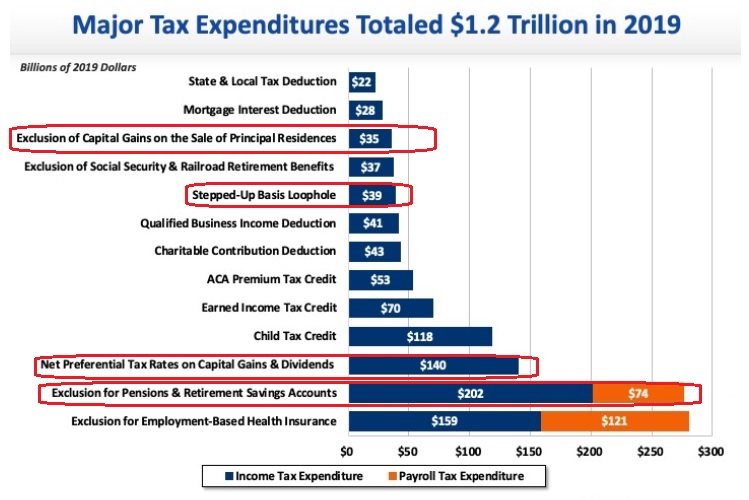
In a neutral tax system with no double taxation, there is no capital gains tax, no death tax, and no double taxation of dividends. In a neutral tax system, all savings is treated like IRAs and 401(k)s, which means the provisions circled above should be viewed as mitigations of penalties rather than loopholes.

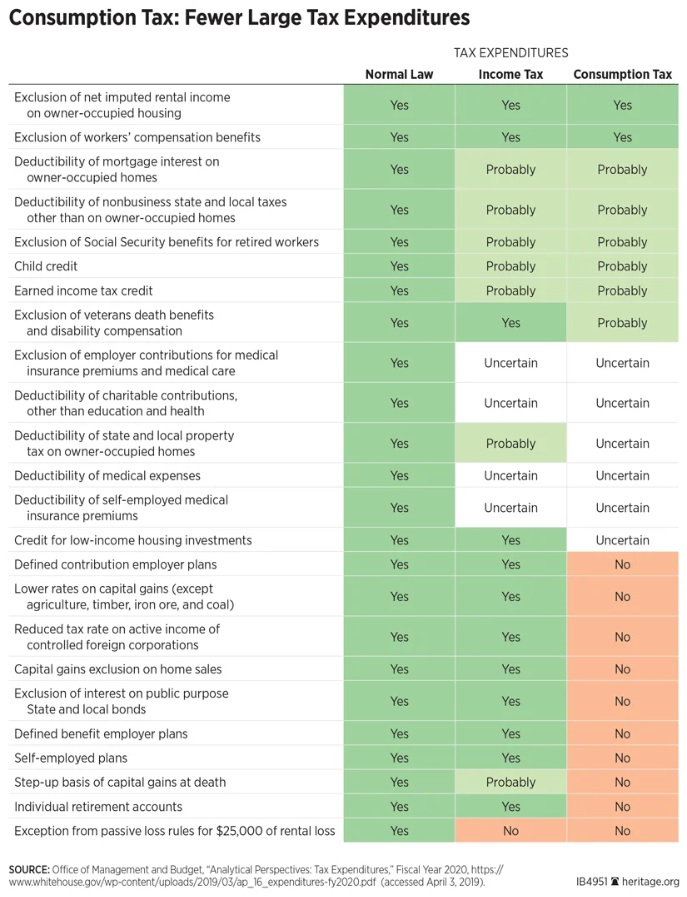
Adam Michel of the Heritage Foundation illustrated the differences between consumption-base and Haig-Smons taxation in a 2019 report.

Here’s his table looking at what’s a loophole under both systems and the bottom part of the visual is where you will see the stark difference in how both systems treat saving and investment.
I’ll close by observing that my friends on the left generally support double taxation because they view such policies as a way of getting rich people to pay more (or as a way of punishing success, regardless of whether more revenue is collected).

I try to remind them that saving and investment is what leads to higher productivity, which means it is the most effective way of boosting wages for those of us who are not rich.

Sadly, it’s not easy to get them to understand that labor and capital are complementary factors of production (apologies for the economic jargon).

P.S. While CRFB uses the wrong definition when measuring tax loopholes, they are not alone. The Joint Committee on Taxation,  the Government Accountability Office, and the Congressional Budget Office make the same mistake. Heck, you even see Republicans foolishly use this flawed benchmark.

P.P.S. Here’s my award for the strangest tax loophole.


Friday, August 20, 2021

Washington State’s Tax Revolt

Local municipalities balk at a new state levy they fear will hurt their economy.

Steven Malanga August 16, 2021 @ City Journal 

Tax revolts are usually led by citizens, sometimes banding together into taxpayer groups. But in Washington State, the latest tax revolt is being engineered by cities and towns objecting to the Democratic-led state legislature’s attempt to impose a capital gains tax. Local officials fear that the new levy, which faces a court challenge, would be a prelude to a state income tax that could hamper economic growth and opportunity. Right now, the Evergreen State is one of only seven states without an income tax and one of just nine without taxes on capital gains.

Five Washington communities—Spokane, Yakima, Spokane Valley, Granger, and Battle Ground—have passed resolutions in recent weeks pledging to outlaw income taxes at the local level if the state adopts income or capital gains taxes. More jurisdictions are promising to follow suit. Local officials are intent on sending the state a message. “Small businesses are the backbone of our local, regional, state, and national economy and it is imperative that the city not put unnecessary hurdles in the way of their success,” Battle Ground’s resolution declared. “Citizens want good government that is fiscally responsible,” Republican state representative Chris Corry argued at a hearing in Yakima. “Putting an income tax ban locally shows a commitment to being fiscally responsible.”

Washington lacks an income tax thanks to a 1932 state Supreme Court ruling that interpreted the state constitution as prohibiting the levy. Over the years, voters have rejected ten attempts to amend the constitution to institute an income tax. The last vote was in 2010, when nearly 65 percent of voters gave a thumbs-down to a ballot initiative heavily supported by the state’s public-sector unions and Bill Gates Sr. (Then-Microsoft CEO Steve Ballmer and Amazon founder Jeff Bezos helped lead the opposition.) Undeterred by these failures, Washington Democrats narrowly approved the tax on capital gains in a straight party vote this past May, arguing that it is not an income tax, though capital gains taxes are typically levied as part of an income-tax system. Citizens and groups have already filed lawsuits against the tax; arguments in the case are scheduled to be heard later this month.

The tax, amounting to a 7 percent levy on capital gains from the sale of stocks, bonds, and other types of investments where the profit exceeds $250,000, is projected to raise $415 million annually. Critics argue that it is both unconstitutional and unnecessary. Like many states, Washington’s tax revenues have bounced back robustly from last year’s economic lockdowns, and the state government, as well as localities and school districts, received about $10 billion from the Biden administration’s stimulus bill. Earlier this year, Washington legislators passed a two-year budget that increases spending by 12 percent. “With strong revenue projections and operating budgets already leaping—up to around $59 billion in 2021-23 from $32 billion just a decade ago—it’s difficult to justify a brand-new tax,” the Seattle Times complained in an editorial.

Opponents also say that the lack of an income tax has long given Washington a competitive economic advantage. They point out that the state’s economic-development agency touts the tax-friendly environment in ads to out-of-state businesses. Washington has among the lowest tax bites of states governed entirely by Democrats. A 2018 study by the Federation of Tax Administrators ranked it 26th among states in taxes as a percentage of personal income. “We are an economic powerhouse,” former state treasurer Duane Davidson, a Republican, has observed in arguing against the new levy.

Backers of the capital gains tax, however, argue that wealthy residents have a “moral imperative” to pay more, regardless of the state’s strong fiscal position. “We are asking the wealthiest Washingtonians to share in the responsibility of funding the needs of our communities and putting money back in the pockets of low-income families,” Seattle state representative Noel Frame said. The new levy makes Washington the third Democratic-governed state seeking to raise taxes amid an unexpectedly strong rebound in revenue. Earlier this year, New York raised taxes by $4.3 billion, and Democrats in Massachusetts have put a referendum on the ballot to amend the state constitution so that they can pass a $2 billion tax increase. By contrast, 11 states, mostly Republican-governed, have cut taxes in the wake of the lockdown rebound.

States typically raise taxes most aggressively after economic slowdowns that reduce government revenues. After the 2008 recession, they boosted taxes collectively by $29 billion in 2009, the largest one-year increase in state taxes up to that point. A new generation of progressive Democratic state leaders is now intent on raising taxes during times of plentiful government resources. They’ve framed the debate as a moral crusade, arguing that it’s righteous to require those who have earned more to pay more.

That begs the question: Just how much more will these legislators ask for the next time government revenues take a hit? The sky’s the limit, it seems. Taxpayers beware.


Friday, December 20, 2013

America needs the Fair Tax, not more fiddling with the tax code

By Robert C. McNair | DECEMBER 18, 2013
Some 150 years ago, Alexis de Tocqueville wrote: “The greatness of America lies not in being more enlightened than any other nation, but rather in her ability to repair her faults.”
Today, America’s financial well-being is threatened by its continued reliance on an antiquated regimen of tax laws and regulations to generate the revenue needed to support our government’s spending priorities.
Many of these provisions served their purposes well when enacted and implemented. For most, that time has passed.
The House Committee on Ways and Means recently examined itemized deductions for charitable contributions as part of its tax reform deliberations.
Some will applaud the committee for focusing on a high-visibility deduction such as charitable giving. We at Americans For Fair Taxation feel strongly that by looking at single provisions of the tax code, the committee is effectively abdicating its responsibility to analyze and critique the current tax code as a whole to determine whether it is the right tool to vouchsafe America’s economic viability in the 21st century.
Instead, we urge the committee to discard this aging taxation infrastructure and replace it with the FairTax plan, an approach without the revenue-depleting deductions and exemptions that are relevant to the economic needs of our nation today.....To Read More...
My Take – The only “fair” tax system is a national sales tax that excludes nothing and no one.  For a tax system to work properly everyone has to have skin in the game.  That acts as a restraint versus an effort by politicians to generate class struggles for political gain.  This should be a tax on the sale of all products and materials, at each stage.   The secondary benefit – and these are big - for society will the three fold.  The IRS will largely be eliminated; the elimination of the need to file income tax returns; corporate and death taxes will be eliminated.  Corporate taxes are nothing more than a hidden tax on the poor and death taxes are immoral. 

Saturday, May 7, 2011

Observations From the Back Row; 5-7-11

...
“De Omnibus Dubitandum”

When oil companies are making huge profits and you're struggling at the pump, and we're scouring the federal budget for spending we can afford to do without, these tax giveaways aren't right. They aren't smart. And we need to end them. –
Barack Obama, Weekly Radio Address

***Featured Article***

Why tax 'reform' talk is idle chatter

Let me begin with some background information: The United States Internal Revenue Code is 44,000 pages, 5.5 million words and has 721 different forms. A nightmare of unmatched complexity, it conceals, in undecipherable language, tens of thousands of favors, preferences and influence buying, bordering on corruption.


Arsenic Railroad: Next stop, heart disease If you remember the 2004 “May I please have some more arsenic in my water, mommy?” campaign directed at President George W. Bush, this story is for you. A new study in the British Medical Journal claims to link “moderate” exposures to arsenic in drinking water with increased risk of heart disease.

The study itself is not much to speak of as it is based on weak and/or statistically insignificant associations, only considered a few confounding risk factors (age, BMI, smoking status and education) and only followed study subjects for an average of six years. So it has a lot in common with other arsenic studies that the EPA relied on to (unjustly and expensively) tighten drinking water standards in 2001.

Adding his two cents in an accompanying commentary is Berkeley’s Allan H. Smith, a long-time pusher of the arsenic-in-drinking water scare. Interestingly, this study was funded by U.S. taxpayers — even though the study subjects were Bangladeshis and the average drinking water concentration of arsenic was more than six times the U.S. standard. It would seem that the National Institutes of Health ought to have more relevant things to do with our money. (Go to the original for the links. RK)

My Take – One thing is clear; we once again find a study with conclusions in search of data. A second thing is clear. There is entirely too much grant money being spread around.
I have tried to think of some way of stopping all of this “grant money is the holy grail of science” shtick that we see going on at universities all over the country. And I can’t! The thing that keeps coming up in my mind is any such system carries with it the potential for become corrupted and then stopping real science because it isn’t harmonious with the philosophical flavor of the day. You know….something like what already exists, except it isn’t official.

Once something takes on the mantle of officialdom it becomes even more onerous. So what to do? I think the answer is to stop funding studies by about 90%. Then, with so little money to spread around it becomes incumbent on the grantors to make sure they are spending it on real science. Then the grantors superiors can review the work and if they find that they are continuing to waste taxpayer money on junkscience they can further cut the grant money permitted by those who are wasting it.

Quite frankly, I have serious misgivings as to how much “real science” is coming out of any of these studies by government grantors. I would like to see it cut to 0% to see what happens. We can always go back up if necessary.

There is one thing that would be for sure if that happened. These junk science university researchers would have to go back and start teaching their classes. Then again….I’m not sure where they are more dangerous; Lysenkoian scientists in the lab spewing out destructive junk science or in the classroom corrupting young minds.

Science publishes Left-coast loons’ organic ag propaganda - Expert panel calls for ‘transforming US agriculture’ Changes in markets, policies and science needed for more sustainable farming - A group of leading scientists, economists and farmers is calling for a broad shift in federal policies to speed the development of farm practices that are more economically, socially, and environmentally sustainable.

Writing in the journal Science, they say current policies focus on the production of a few crops and a minority of farmers while failing to address farming’s contribution to global warming, biodiversity loss, natural resource degradation, and public health problems.

“We have the technology and the science right now to grow food in sustainable ways, but we lack the policies and markets to make it happen,” says John Reganold, a Washington State University soil scientist and the Science paper’s lead author. Starting in the late 1980s, Reganold pioneered several widely cited side-by-side comparisons showing organic farming systems were more earth-friendly than conventional systems while producing more nutritious and sometimes tastier food. His Science co-authors include more than a dozen other leading soil, plant, and animal scientists, economists, sociologists, agroecologists and farmers.

Junk Science Editor - Science‘s decent into eco madness is almost complete. Modern industrial agriculture is the more economically, socially and environmentally sustainable option and currently protects vast areas of marginal lands from the plow through high productivity. As Science should know before printing this kind of irresponsible pap there is no serious support for the assertion “organic” food is more nutritious even for trendy Left-coasters, unless you count feeding their delusions.

Much worse, however, is the fact that there is not sufficient land in all the world to support the livestock or grow the humus stock that would allow “organic” agriculture to produce anything like the quantities of food enabled by modern agriculture and how would you transport and apply all that compost even if you could produce it? The only way “organic” agriculture can “feed the world” is to fit the population to low-productivity, high input, labor-intense agriculture. In other words these are just another bunch of misanthropic cranks out to trim the human population – in the name of “sustainability”, of course.

Global Warming Hoax Weekly Round-Up, May 5th 2011 This week, George is at it again. He’s fearful of what sort of future greens have in a world that has abundant fossil fuels:…… Monbiot is slowly figuring out the green agenda is doomed, but can’t get past his belief in the new paganism of global warming to realize his fears of a planetary demise are greatly exaggerated.…. Donna Laframboise discovered that the IPCC hired another veteran from the NGO ranks, this time Michael Oppenheimer of the Environmental Defense Fund. Also, the IPCC uses climate modelers to evaluate climate models:……….. then again NoCarbonTax has spared no expense, time and supercomputer power to bring you a completely new Coupled Climate Change model that actually works!


Moving on…….Jolly Prince Chuckles saw his son married off to a commoner last week and headed to the USA for a visit. He intends to lobby congress about global warming, or eating meat. Or both. If Congress had any sense of history they might remind Chuck that he represents the old and busted version of America and that there was this revolution thing a while back. But they won’t……… Aussie activist Clive Hamilton wants more radicalism. And Mad Men reruns, but mostly radicalism……. Despite Brad Johnson’s hopes, NOAA shoots down the idea that global warming had anything to do with the record tornado storms last week…….Green math is unkind to solar power projects in New Jersey: (Please go to the article for the links…and there a lot of them so you may peruse any one of the issues highlighted in the article. (This Weekly Roundup is one of my favorite posts each week. I’m not sure what I like more about this weekly post….the links or the tongue in cheek way he presents them. RK)

"The time has come," the Walrus said,
"To talk of many things:
Of shoes, and ships, and sealing wax -
Of cabbages and kings,
And why the sea is boiling hot,
And whether pigs have wings."

###