Pat Buchanan, American Renaissance, January 3, 2020
If Western elites were asked to name the greatest crisis facing mankind, climate change would win in a walk. Thus did Time magazine pass over every world leader to name a Swedish teenage climate activist, Greta Thunberg, its person of the year. On New Year’s Day, the headline over yet another story in The Washington Post admonished us anew: “A Lost Decade for Climate Action: We Can’t Afford A Repeat, Scientists Warn.”............For many First World countries, there are more compelling concerns. High among them is population decline, and, if birth rates do not rise, the near-extinction of many Western peoples by this century’s end. Consider. The number of births in Japan fell in 2019 to a level unseen since 1874, around 900,000. But there were 1.4 million deaths for a net loss of 512,000 Japanese. An even larger loss in Japan’s population is expected this year........But it is Eastern Europe where the population crisis is most advanced............Since this writer published “The Death of the West,” nothing has happened to alter my conclusion as to where the West was destined:..............To Read More....
Showing posts with label Baltic States Demographics. Show all posts
Showing posts with label Baltic States Demographics. Show all posts
Sunday, January 5, 2020

Tuesday, June 11, 2019
The Baltic Nations, Demographics, and the Need to Shrink the Welfare State
May 8, 2019 by Dan Mitchell @ International Liberty
I’m a big fan of many of the economic reforms that have been implemented in Estonia, Latvia, and Lithuania. All three of the Baltic nations rank highly according to Economic Freedom of the World. Estonia and Lithuania are tied for #13, and Latvia isn’t far behind at #23. Rather impressive for nations that suffered decades of communist enslavement.
But this doesn’t mean I’m optimistic for the future of these countries.
Simply stated, they need a lot more reform to prepare themselves for demographic decline. And demographic decline is a huge issue, in large part because young people are moving away. Here are some excerpts from a Bloomberg report.
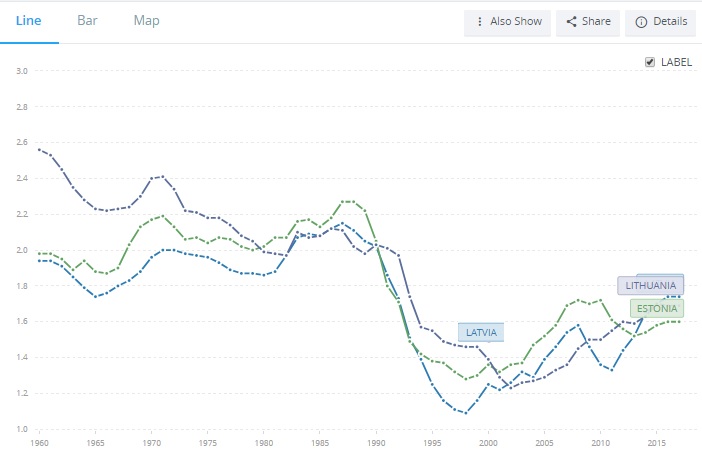
Here’s a chart from the World Bank showing that all three Baltic nations are way below the replacement rate.

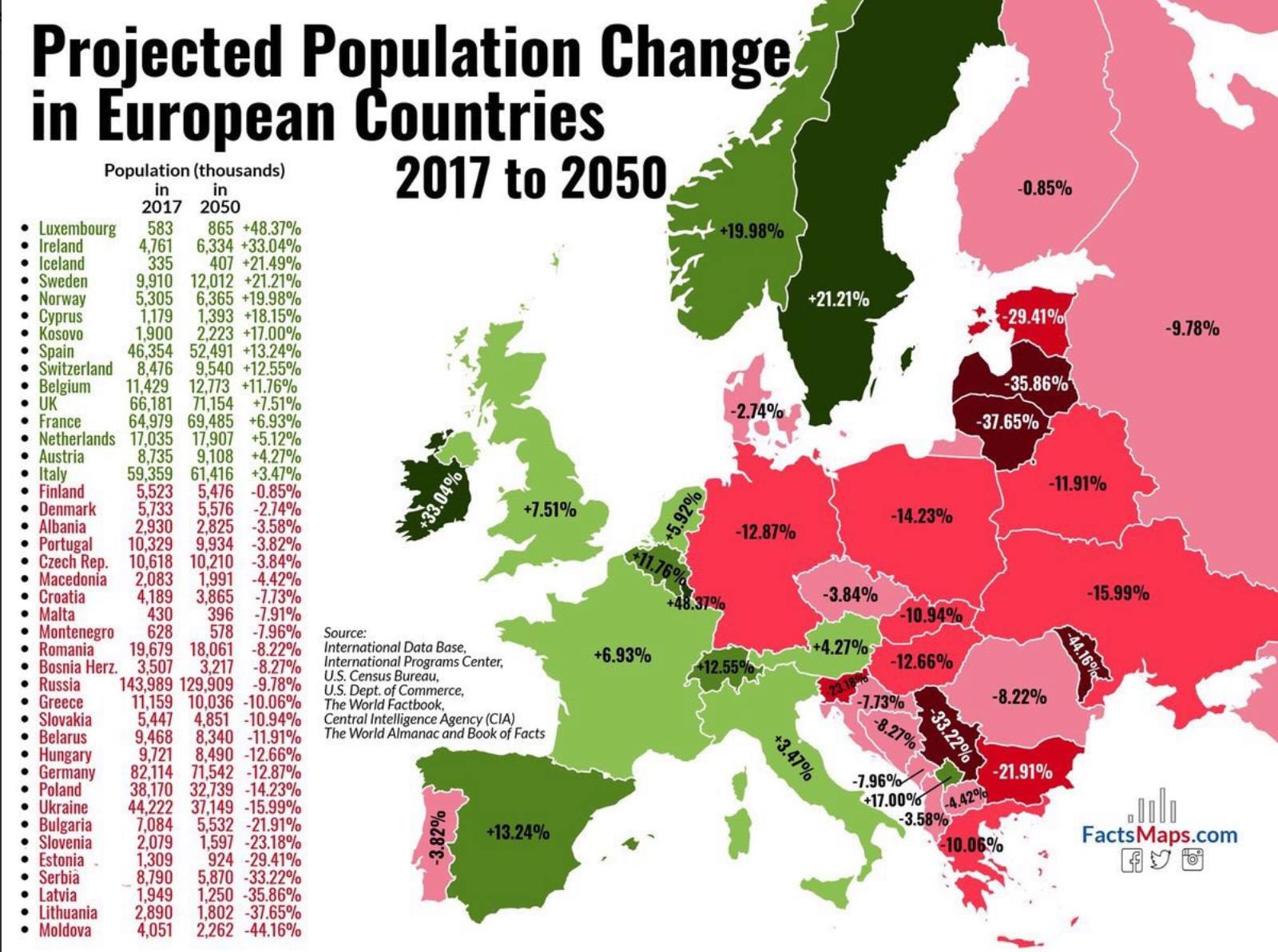
The combination of these two factors helps to explain this map. As you can see, the Baltics don’t quite face the same challenges as Moldova. But that’s the only silver lining in these grim numbers.

By the way, people should be free to emigrate. And women should be free to choose how many children to have. But when a country also has a welfare state and – over time – there are more and more old people and fewer and fewer young taxpayers, that’s a recipe for some sort of Greek-style fiscal crisis.
Fortunately, there is a solution to this problem.
The Baltic nations need to copy Hong Kong. Fertility rates are even lower there, but the jurisdiction doesn’t face a big long-run fiscal challenge since people mostly rely on private savings rather than tax-and-transfer welfare states.
P.S. One of the reasons I like the Baltic nations is that they cut spending (actual spending cuts, not fake DC-style reductions in planned increases) when they were hit by the global financial crisis last decade.
P.P.S. Even better, Paul Krugman wound up beclowning himself by trying to blame Estonia’s 2008 recession on spending cuts that occurred in 2009.
I’m a big fan of many of the economic reforms that have been implemented in Estonia, Latvia, and Lithuania. All three of the Baltic nations rank highly according to Economic Freedom of the World. Estonia and Lithuania are tied for #13, and Latvia isn’t far behind at #23. Rather impressive for nations that suffered decades of communist enslavement.
But this doesn’t mean I’m optimistic for the future of these countries.
Simply stated, they need a lot more reform to prepare themselves for demographic decline. And demographic decline is a huge issue, in large part because young people are moving away. Here are some excerpts from a Bloomberg report.
Part of the issue is also fertility.According to the UN’s Department of Economic and Social Affairs, nine of the world’s countries most at risk of losing citizens over the next few decades are former East bloc nations. Porous borders and greater opportunity in the west have lured people away. …The trend is hitting especially hard in the Baltics. Latvia, with a current population of 1.96 million, has lost about 25 percent of its residents since throwing off Soviet control in 1991. The U.N. predicts that by 2050, it will have lost an additional 22 percent of its current population…and by 2100, 41 percent. In Estonia, with a population of 1.32 million, the U.N. foresees a 13 percent decline by 2050 and a 32 percent drop by 2100. And in Lithuania, the current population of 2.87 million is expected to drop by 17 percent by 2050. By 2100, it will have lost 34 percent. …Latvian demographer Mihails Hazans said that, as of 2014, one in three ethnic Latvians age 25 to 34 — and a quarter of all Latvians with higher education — lived abroad.

Here’s a chart from the World Bank showing that all three Baltic nations are way below the replacement rate.
The combination of these two factors helps to explain this map. As you can see, the Baltics don’t quite face the same challenges as Moldova. But that’s the only silver lining in these grim numbers.
By the way, people should be free to emigrate. And women should be free to choose how many children to have. But when a country also has a welfare state and – over time – there are more and more old people and fewer and fewer young taxpayers, that’s a recipe for some sort of Greek-style fiscal crisis.
Fortunately, there is a solution to this problem.
The Baltic nations need to copy Hong Kong. Fertility rates are even lower there, but the jurisdiction doesn’t face a big long-run fiscal challenge since people mostly rely on private savings rather than tax-and-transfer welfare states.
P.S. One of the reasons I like the Baltic nations is that they cut spending (actual spending cuts, not fake DC-style reductions in planned increases) when they were hit by the global financial crisis last decade.
P.P.S. Even better, Paul Krugman wound up beclowning himself by trying to blame Estonia’s 2008 recession on spending cuts that occurred in 2009.
Subscribe to:
Posts (Atom)