Search This Blog

De Omnibus Dubitandum - Lux Veritas

Showing posts with label Air Pollution. Show all posts

Sunday, May 13, 2018

Stanford science reformer Ioannidis exposes himself as incompetent or insincere — take your pick

By Steve Milloy
I’ve always suspected that Stanford University professor John Ioannidis was only posing as a science reformer. His commentary in PLoS against the EPA science transparency rulemaking validates that.  Ioannidis pretends care about the quality of science. He has even published his claim that: 
"Currently, many published research findings are false or exaggerated, and an estimated 85% of research resources are wasted"  Yet in his new article attacking the Trump EPA’s science transparency proposal,


Ionnidis praises the very secret science and science fraud that brought the EPA proposal about:


As readers of this page and my Amazon.com best seller “Scare Pollution: Why and How to Fix the EPA” know, there is nothing remotely scientific or honest about the Harvard Six Cities and Pope ACS studies, or the alleged HEI review. The only thing that was “rigorous” was the fraud.

At the very least, Ioannidis has made no effort to learn the facts. At worst, he has been co-opted by Doug Dockery, Arden Pope and the EPA-funded air pollution mafia into aiding and abetting their fraud. Either way, Ioannidis has exposed himself.

SOURCE

Note from Jon Ray of Greenie Watch - I am certainly amazed that Ioannidis praises those rubbishy air pollution studies.  I have over time reviewed a lot of them (e.g. here and here and here) and found that they were all naive about controls to the point of making their findings at best moot.  A very simple demolition of the garbage mentioned above is here.  Note that the alleged 2005 confirmation of the original results was simply a re-analysis of the original data that did nothing to address the lack of basic controls -- JR

Wednesday, May 9, 2018

Chasing Perfection: Air Quality Improvements Have Slowed ... Because Our Air is Clean

By Hank Campbell — May 1, 2018  @ American Council on Scinece and Health  

A new paper in PNAS expresses concern that decades of progress in cleaning up U.S. air quality mean improvements for two pollutants have slowed in recent years.
 
That's to be expected. By any measure, American air quality is terrific (1), and despite the calls for more regulations on business, U.S. technology is way ahead of regulators. For example, in 2009 the U.S. government attended the United Nations Climate Change Conference in Copenhagen and pledged to reduce overall greenhouse gas emissions 17 percent by 2020. To do so, the White House directed the U.S. Environmental Protection Agency to slash carbon dioxide (CO2), which resulted in the Clean Power Plan (CPP) in 2015. That new regulation never came into force, nor was it needed. The free market has continued to cause CO2 emissions to plummet, so much so that in 2017 America reached the CPP’s desired 2025 target, eight years ahead of what government wanted.
 
Our huge gains in reducing emissions were not due to runaway solar or wind subsidies, those are barely a blip in energy production. It was due to modern natural gas extraction techniques such as hydraulic fracturing (fracking) which caused power plant emissions to decline from 2.7 billion tons in 2005 to 1.9 billion tons in 2017, a reduction of almost 30 percent.
 
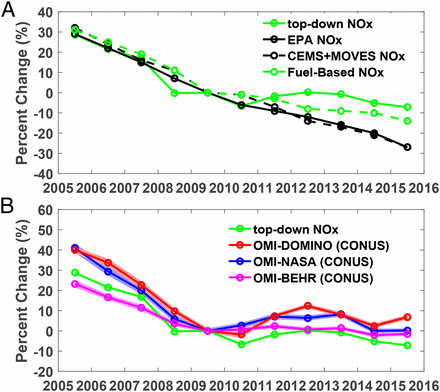
There are other measures of air quality, such as the nitrogen oxides and carbon monoxide that contribute to the formation of ground-level ozone, but those also look great. Using satellite and ground-based measurements of nitrogen oxides and carbon monoxide, Jiang et al. found that more improvements will be hard to achieve using regulations. They claim the slowdown was unexpected and perhaps it was (to them) but it was no surprise to people who recognize that the curve of reduction started to flatten because there is little new improvement to be made unless we completely ban cars and jobs. And as impartial scientists noted in the 1970s, and since, ozone will still happen even as constituent pollutants drop. It will never go to zero.
 
 Credit: Science 2.0, 2012.
 
The surprise of the PNAS authors is only going to happen if we don't recognize the problem with numerical models and estimates based on flawed statistics. Yes, the government can create a model showing ozone should go down in a linear fashion as individual compounds drop, but that doesn't make it a reality. And new models using their flawed estimates can claim that a flat-line of ground-level ozone and its constituents is a surprise, but only because they accepted government estimates as fact.
 
Ground-level ozone in the troposphere – basically what we see as smog – is created from a combination of natural sources and nitrogen oxides in the air. You can't regulate nature out of existence. The authors are worried EPA estimates were wrong. But it is making no difference in our air quality.
 
(
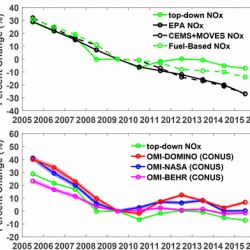
A) Percent changes (normalized at 2009) of top-down US anthropogenic NOx emission estimates from inverse analysis (green line), EPA’s emissions trends report data of NOx (black solid line), revised EPA emission estimates including CEMS and MOVES national-scale data (black dashed line, SI Appendix, Table S1), and revised industrial, on-road, off-road emission estimates using fuel-based methodologies (green dashed line, SI Appendix, Table S1). (B) Percent changes of top-down US anthropogenic NOx emission estimates and tropospheric OMI NO2 columns over CONUS. The shaded areas represent 1-σ uncertainties for random and sampling errors.
 
You can, of course, continue to regulate nitrogen oxide and carbon monoxide, but at some point it is making the perfect the enemy of the good. What will help instead is the continued evolution of technology by the private sector, such as three-way catalytic converters in automobiles and similar technology improvements in diesel.
 
Citation: Zhe Jiang, Brian C. McDonald, Helen& Worden,John R. Worden, KazuyukiMiyazaki,Zhen Qu,Daven K. Henze,Dylan B. A.Jones,Avelino F.Arellano,Emily V. Fischer, Liye Zhu, K. Folkert Boersma, 'Unexpected slowdown of US pollutant emission reduction in the past decade', Proceedings of the National Academy of Sciences Apr 2018, 201801191; DOI:10.1073/pnas.1801191115
 
NOTE:
 
(1) Even small micron particulate matter, which was blamed by the last administration's EPA based on one data set (which they refused to share), has plummeted. And it has never killed anyone. Obviously, America is all green when it comes to real pollution but even PM2.5 is almost non-existent today, according to the World Health Organization.


Monday, December 25, 2017

PM2.5: The Latest Air Pollution Scam

Steve Milloy @ Junk Science.com

C.Arden Pope, III’s latest exercise in secret epidemiologic junk science is a study claiming that PM2.5 causes heart attacks in people with blood types A, B, and AB but not type O (45% of the population). Pope didn’t even bother to publish the study, he just made a presentation at an American Heart Association meeting on November 14.

This is Pope’s usual statistical crap — minuscule and meaningless data dredged correlations built off imaginary exposure data, ignored confounding factors, zero biological explanation, and in defiance of reality.

As a checkpoint, where are all the heart attacks in India during the ongoing air pollution crisis where PM2.5 levels have been as high as 150 time average US air? There aren’t any.

The media release is below. Pope’s abstract is here.
People with certain blood types are at increased risk of heart attack during periods of pollution 
Individuals who have A, B, or AB blood types have an elevated risk of having a heart attack during periods of significant air pollution, compared to those with the O blood type, according to new research from the Intermountain Medical Center Heart Institute and Brigham Young University. 
The new study is unique in that it links increased risk of heart attack associated with small particulate pollution to increased risk of heart attack for people with certain blood types who have coronary artery disease. 
The ABO gene — which is present in people who have A, B, and AB blood types — is the only gene that’s been validated in large international studies to predict heart attacks among people with coronary disease. 
Previous studies have also shown links between small-particulate PM2.5 pollution and heart attacks, admission to the hospital with unstable chest pain, heart failure, and atrial fibrillation. This new study was designed to build on and tie together those findings and test the influence of one variation: the impact of an individual’s blood type. 
“We wondered, if someone has a specific variation in this ABO gene, are they more or less likely to experience a heart attack in times of higher pollution?” said Benjamin Horne, PhD, a clinical epidemiologist and lead investigator of the study from the Intermountain Medical Center Heart Institute in Salt Lake City. “The primary mutation we studied differentiates between O blood types and non-O, which includes positive and negative A, B, and AB blood types. The one that’s been found in genetic studies to be lower risk is O. The other three were higher risk.” 
Results of the study will be reported at the 2017 American Heart Association Scientific Sessions in Anaheim, CA, on November 14, at noon, PST. 
Dozens of genes have been shown in large international studies to predict the onset of coronary artery disease in people who are free of the disease. But the vast majority of people won’t have a heart attack unless they already have coronary artery disease. Nor is a heart attack a certainty even with heart disease. 
“You have to have other characteristics for coronary disease to progress to a heart attack,” Dr. Horne said. “The association between heart attacks and pollution in patients with non-O blood isn’t something to panic over, but it is something to be aware of.” 
Intermountain Medical Center Heart Institute researchers had already identified a level of pollution at which the increased risk occurred for people with non-O blood types, he said, and that threshold is 25 micrograms of pollution per cubic meter. 
“Two years ago we published findings that showed once you go above that, each additional 10 micrograms of pollution per cubic meter of air provided substantially higher risks,” he said. “At levels higher than 25 micrograms per cubic meter of pollution, the increase in risk is linear, while below that level there’s little if any difference in risk.” 
The clinical data used for the study came from Intermountain Healthcare patients seen between 1993 and 2007. C. Arden Pope, PhD, from BYU, and one of the study authors, provided the air pollution data. The analysis of air quality was done at BYU. 
During a winter inversion, the PM2.5 pollution level can occasionally reach as high as 100 micrograms per cubic meter, but 50-60 is more typical. 
Researchers found that people with type O blood also have higher risk of heart attack or unstable chest pain in times of high air pollution. But their level of risk is much smaller, at 10 percent instead of the non-O blood type’s 25 percent per 10 additional micrograms per cubic meter, Dr. Horne said. So at the 65 micrograms per cubic meter pollution level, a person with type O blood faces risk that’s 40 percent higher than if the air wasn’t polluted. 
“In the information we provide to our patients about pollution, we try to stress that they can do something about it to reduce their risks: Stay indoors out of pollution. Exercise indoors. And make sure they’re compliant with taking their heart medication to reduce their risk,” Dr. Horne said.

Saturday, December 23, 2017

Air Pollution Lowers IQs ... Of Reporters Who Write About It

By Josh Bloom — December 20, 2017 @ American Council on Science and Health
  
Journalism doesn't get a whole lot worse than this, boys and girls Photo: ifiscience.com
From the CityLab website:
"Through original reporting, sharp analysis, and visual storytelling, CityLab informs and inspires the people who are creating the cities of the future—and those who want to live there."
As you will see, the above statement isn't terribly accurate. Let's see if we can come up with a something more accurate:
"Through imaginary and/or deceiving reporting, innuendo, shameless manipulation, and visual storytelling, all ofwhich is absolutely devoid of science,CityLab misinforms and inspires the people who are creating the cities of the future to make up a whole bunch more BS that poses for science—and those who want to live in Screwball Land, a place that may or may not exist on a different astral plane."
If this sounds harsh it is because I just finished reading a seriously terrible article with a dreadful headline, which was based on an atrocious study. It is nothing more than speculation dressed up as science, and shameless manipulation. And a bunch of lies.

Teresa Mathew, who is an editorial fellow at CityLab, just wrote L.A.'s Air Pollution May Be Harming Teen Brains, should know better. Or maybe she does and wrote it anyhow. For whatever reason, she uses just about every trick in the book to draw an imaginary connection between air pollution (1,2) and brain development in teens.

Photo: Amazon.com
Let's take a look at the article and what is wrong with it. There is plenty.

"We already know that invisible elements of our environment can harm us: Lead exposure can lower a child’s IQ, and air pollution kills more than 3 million people a year."

Right off the bat, there are three problems:
  1. "Invisible elements" is the perfect phrase to frighten people. It is both true and false. Of course, there are elements in our environment that can harm us. There always have been. Arsenic is found naturally in well water. Volcanoes give off tons of sulfuric acid. Which invisible elements are we talking about? What is the exposure? The first twelve words of the article tell us nothing, but do a splendid job of planting invisible (and irrational) images in our minds.
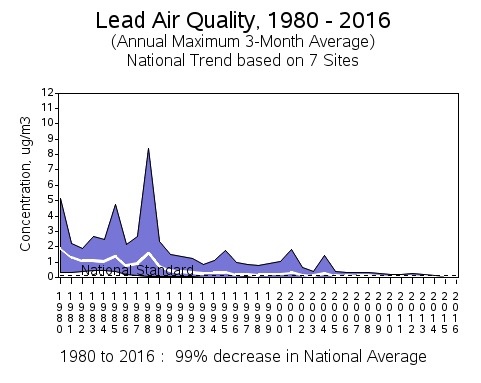
  2. The comment about lead is even worse. It suggests that we (and our children) are bathing in lead, which is lowering IQs all over the place. Left unstated is that since 1980 the levels of lead in the air in the US have declined by 99%. Yes, lead exposure can cause neurological problems in children (and the rest of us) but children are getting 100-times less lead from the air than in 1980 (Figure 1). 
Figure 1. Lead levels in air between 1980-2016 Source: EPA

       3. The claim about 3 million deaths is unsupported, out of context, and also suggests that we are choking to death (and getting stupid at the same time). But it's false. Except for the stupid part, maybe.
"Compared to 1970 vehicle models, new cars, SUVs and pickup trucks are roughly 99 percent cleaner for common pollutants (hydrocarbons, carbon monoxide, nitrogen oxides and particle emissions). New heavy-duty trucks and buses are roughly 99 percent cleaner than 1970 models."  
Source: Historic success of the Clean Air Act (EPA)

Here's the low point in the article (although this is a tough call). Just for dramatic effect, CityLab uses the following photo of Los Angeles from, I don't know when. I doesn't say:
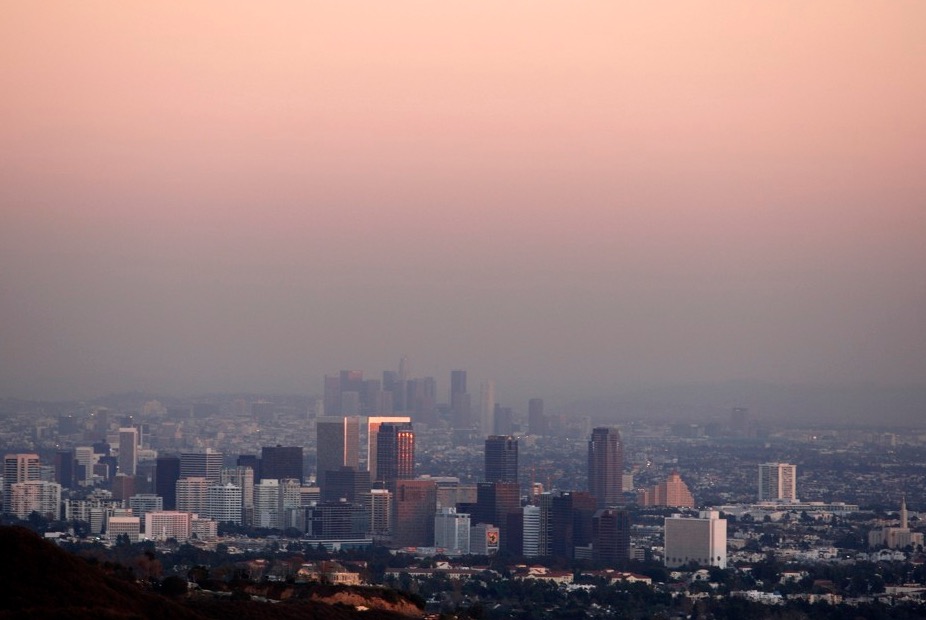
Photo of Los Angeles from CityLab (date unspecified)

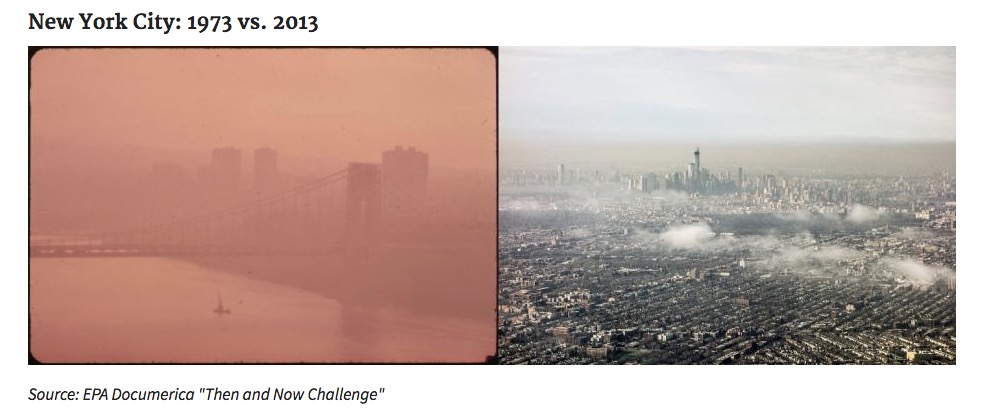
Let's compare this to a pair photos from the EPA site.


Given that ~100% of the lead and 99% of hydrocarbon emissions have been removed from automobile exhaust, you tell me which of these paints an accurate picture.

Assuming that readers want to live long enough to finish this article. I will just show only a few representative examples of half-truths, false associations and study confounders just to give you a flavor of how bad this article tastes.

Mathew bases her article on a supremely junky paper in the Journal of Abnormal Child Psychology by Diana Younan and colleagues. The article and the paper are both huge messes. I'll stick to the article for the sake of clarity.
The study, published last week in the Journal of Abnormal Child Psychology, followed 682 children in greater Los Angeles for nine years from the age of nine to 18. It concluded that air pollution may increase delinquent behavior in adolescents.
  • The study is based on four behavioral assessments over a 9-year period. They must be kidding.  There is no way that four questionnaires given over a 9-year period are going to measure anything real.  
From 2000 to 2014, researchers measured daily air pollution in Southern California. The pollution was measured as particulate matter or PM2.5, which refers to the maximum diameter, 2.5 microns, of the tiny particles measured
  • Of all the "stuff" floating around in the air one specific group of particles called PM2.5 was used as a proxy for all air pollution.  PM2.5 stands for particles that are 2.5 microns in size or smaller. Why just these particles?
To assess delinquency, researchers asked parents to keep a child-behavior checklist, where they recorded behaviors such as lying, stealing, and substance abuse.
  • There's recall bias and there's recall bias. I don't even know what to call this. Do we really believe that a 9-year list of a diverse set of behavioral problems is going to be accurate? And how often do teens tell their parents when they abuse drugs or steal? 
"Uh, Mom. I set a few neighbors on fire yesterday, but it's cool."
'[R]esearchers saw that air pollution estimates were higher in neighborhoods near freeways and with less foliage, and found that delinquent behavior was more prevalent among boys.
  • Duh. Who could have imagined? Poorer people live in less desirable areas and are more likely to suffer from behavioral issues. 
  • Double Duh. Teen boys behave worse than teen girls. 
"African Americans, adolescents from lower socioeconomic backgrounds, and those who lived in neighborhoods with limited green space... the effects of air pollution on delinquency were worsened by poor parent-child relationships and social stress."
  • Damn!  "[T[he effects of air pollution on delinquency were worsened by poor parent-child relationships and social stress." How about delinquency arises from poor parent-child relationships and social stress? Is this not more than enough to explain the entire paper. No, even though the study authors try to control for other variables that would contribute to behavioral problems:
“We saw that [air pollution] was still having an adverse affect, even after for controlling for all these variables,” said Diana Younan, the study’s lead author.
  • Seriously? ANY one of those variables (confounders) could be entirely responsible for whatever was measured (and it could easily be argued that nothing was being measured based on four assessments in 9 years.)
"The new study points out that both PM2.5 concentrations and crime rates have been falling in Southern California."
  • Now there's some damn fine evidence. The concentration PM2.5s  has fallen and so have crime rates. Therefore the particles MUST have caused the behavioral problems and lower IQs . Stranger still is that this made it into the article at all, because there is absolutely no mention of IQ in the Journal of Abnormal Child Psychology paper
What follows is just as valid:  Let's assume that the size of bunions correlates with the annual intake of key lime pie (3) then eating key lime pie will cause your bunions to get bigger. Or is it the other way around? Does hitting your foot with a ball peen hammer to enlarge a bunion (4) cause you to eat more key lime pie? Yeah, sounds stupid. But I can prove it. Check out Figure 2:
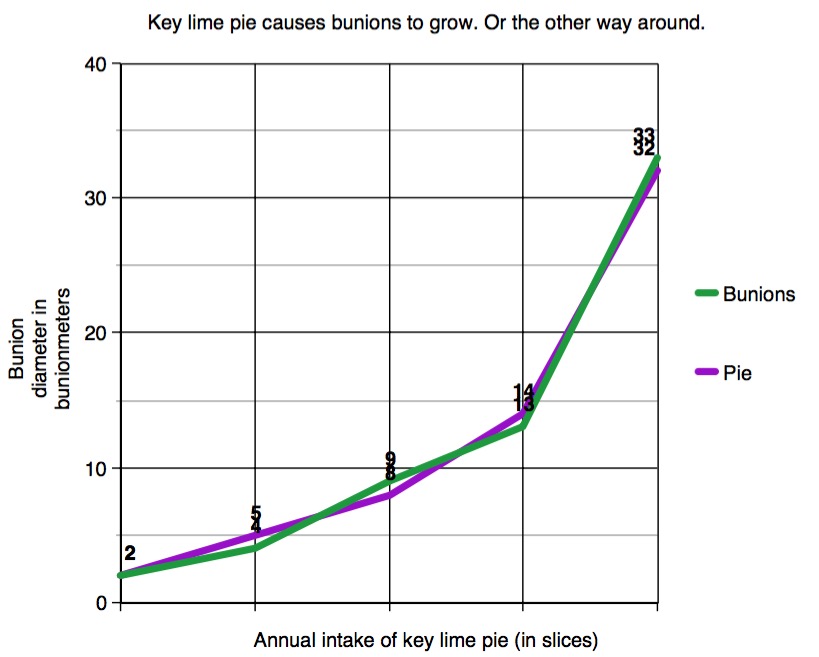
Figure 2. Definitive proof that key lime pie causes big bunions.
Or that big bunions cause you to eat more key lime pie

Perhaps the most ridiculous part of this ridiculous study is the attempt to correct for the following confounders:
  • Freeway NOx (nitrogen oxide gas)
  • Traffic density in 300 m area
  • Neighborhood greenspace in 250 m buffer
  • Ambient temperature
  • Urbanicity
  • Prenatal secondhand smoke exposure
  • Maternal depression
We are supposed to believe that someone can take out all those factors, measure exactly one class of a zillion particles and other pollutants, and come up with a valid conclusion?

No. We can't. At the American Council, we routinely pick apart junk studies and explain the factors that make them junk. I shouldn't even get paid for today. This one was just too easy.

NOTES:

(1) Despite this rant, I need to state that I consider the state of the environment to be hugely important, both personally and scientifically. I am a nature nut-chemist. But I am also a big fan of the truth, and if our air is bad we should address it honestly, not by creating spurious correlations that make for a good headline but also terrible science.

(2) Alex Berezow is our resident expert on air pollution. I suggest that you take a look at the following articles if you wish to be better informed about this topic. Both pieces are from October 2017. The second piece soundly (maybe even rudely) debunks rantings of Daniel Gardner, a history professor, who believes that air pollution in the US is responsible for 200,000 extra deaths per year. Gardner also claims the US should learn from (you gotta be kidding me) China about air pollution. Berezow isn't having any of that. A great read.
  1. Is Air Pollution Killing Millions? Not in the U.S. 
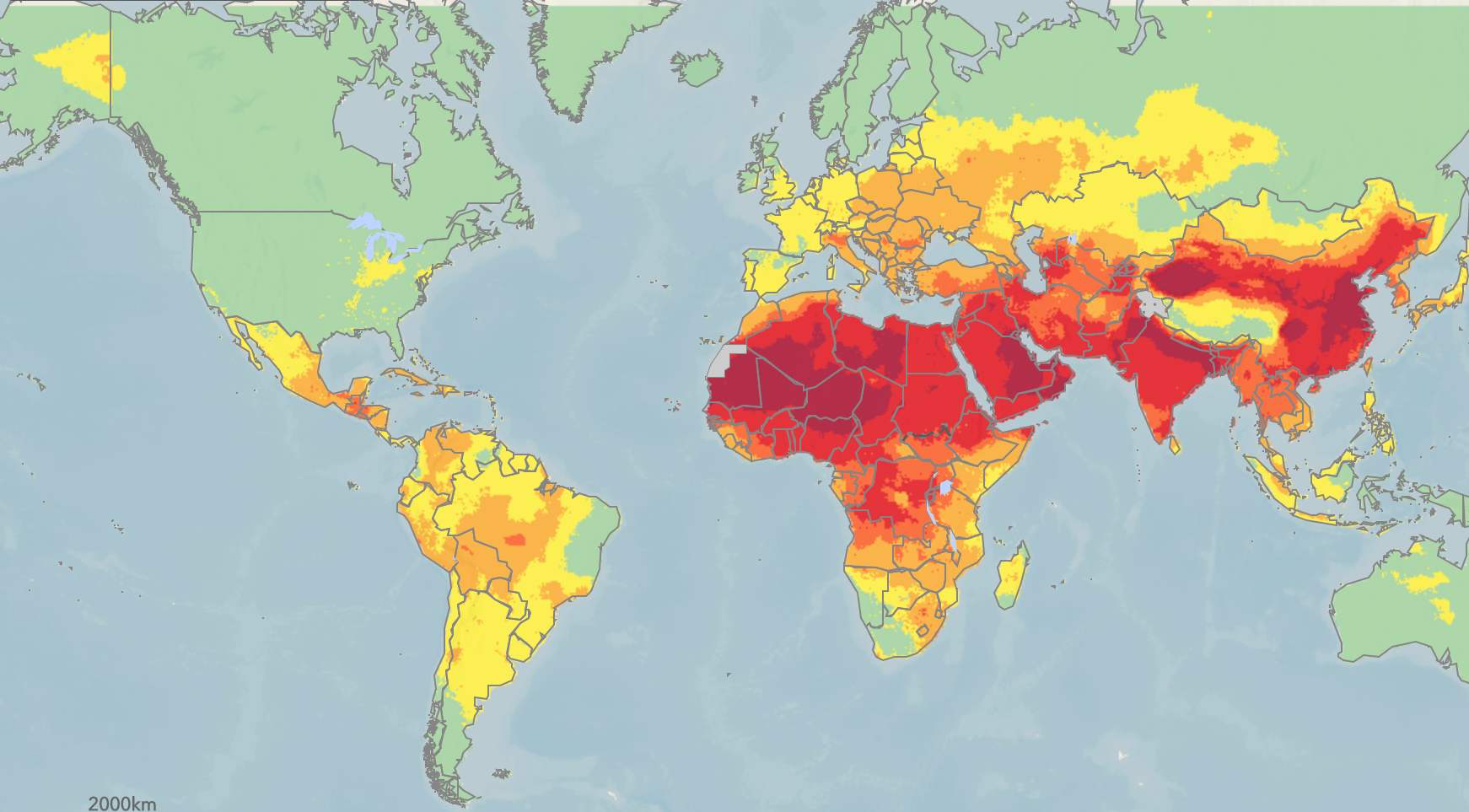
  2. Air Pollution: How to Deceive People with Maps
(3) Despite utter ineptness in the kitchen (assuming I can even find it) I make the world's best key lime pie. Derek Lowe, despite being brilliant in so many ways, thinks that his recipe is better. Pity the fool.

(4) Still better than eating kale.
 

Thursday, September 26, 2013

ACSH advisor asks: “What is the EPA hiding?”

Posted on by admin

A big shoutout to ACSH advisor (and junk science debunker extraordinaire) Dr. Geoffrey Kabat for his recent Forbes op-ed entitled “What Is Really At Stake In The House Committee on Science, Space, and Technology Subpoena Of EPA Data.”

This time, Dr. Kabat, a Senior Epidemiologist at the Albert Einstein College of Medicine and a member of ACSH’s scientific advisory panel, takes on the “science” of air pollution regulation. In reality, the science is really based on politics …….new regulations that will cost billions of dollars should be accessible to independent researchers and other groups, rather than hinging on the analysis and interpretation of a small group of academic researchers.”

ACSH’s Dr. Josh Bloom comments, “Fighting the pollution of science by special-interest groups and politics is one of the guiding principles upon which ACSH was founded. Dr. Kabat’s op-ed is a fine example of what we deal with all the time. I encourage you to read it, although any idealists out there who still believe that sound science is reliably transformed into sound policy better have a strong stomach.”….To Read More…. 

Friday, September 9, 2011

Observations From the Back Row: 8-10-11

...
“De Omnibus Dubitandum”


Everthing we are told should bear some resemblance to what we see going on in reality!
______________________________________

Quote of the Day

Ecology is sometimes called “the subversive science”. This is too generous because Ecology should not be grouped with the sciences at all – it is a religion. - William Kay


Check out Dr. Peter Valberg’s testimony at today’s House hearing on EPA regulatory overreach.

My Take - This has been an issue for some time. Where does EPA get these numbers?  They make them up!  Junkscience says “Show the bodies!” They make these broad predictions the same way they determine what chemicals, including pesticides, are suitable. First they guess. Then they create theoretical scenarios that have no basis in evidence and then call this mystical knowledge "risk assumptions". Then they lie. Then they turn their lies into law.

So then, why do you think we have bedbugs?

Stuff You Won't See on the News

"The time has come," the Walrus said,
"To talk of many things:
Of shoes, and ships, and sealing wax -
Of cabbages and kings,
And why the sea is boiling hot,
And whether pigs have wings."

###


Friday, July 22, 2011

Observations From the Back Row: 7-22-11

...
“De Omnibus Dubitandum”


MILLOY: Show us the bodies, EPA

By Steve Milloy

The House will soon vote to (slightly) rein in the Obama Environmental Protection Agency. But this much-needed baby step by Congress will only happen if Republicans have the knowledge and muster the courage to withstand a final bare-knuckles assault by EPA’s enviro allies.

The House Appropriations Committee passed last week the fiscal 2012 EPA budget that would cut the agency’s budget by $1.7 billion - 18 percent - and delay for one year several of its new and/or planned regulatory programs targeting coal-fired electric utilities. It’s hardly landmark legislation but it’s a start.

But the EPA and its allies aren’t taking such reasonableness lying down. Leading their pushback is the Environmental Defense Fund (EDF), which is making utility giant American Electric Power (AEP) the whipping boy example for Republicans and businesses that dare question - let alone rise against - EPA oppression………But like the EPA’s 17,000-lives-saved statistical fabrication, the ad is a fake…….The EPA says air pollution kills tens of thousands of people annually. This is on a par with traffic accident fatalities. While we can identify traffic accident victims, air pollution victims are unknown, unidentified and as far as anyone can tell, figments of EPA’s statistical imagination. It ought not to be too much to ask the EPA to produce some tangible evidence that air pollution is causing actual harm to real people.

Consider that the EPA and its enviro-buddies are essentially accusing coal-fired utilities of killing and injuring hundreds of thousands of people annually. Have you ever wondered why there are no class-action lawsuits against utilities for billions of dollars in damages? Apparently, even trial lawyers have no confidence that EPA science holds up to scrutiny……We can no longer afford the EPA’s clean air charade. The EPA has no clothes - if only congressional Republicans would open their eyes and notice.


My Take - Over years the EPA has come up with numbers of lives lost or saved that belie reality and when asked the prove those numbers they would just ramp them down; but they never justify them. Let’s stop kidding ourselves. These numbers are made up! Of course they call them estimates, but estimates and assumptions are the basis for much of what EPA does.

Let's face it; they make this stuff up!

Pesticides now have a 1000 fold safety factor to them. Originally it was a 10 fold safety factor then a 100 fold safety factor and now a 1000. Why and how? The way this worked was they added an intra-species 10X safety factor based on rat studies. The rationale is that since they didn’t test all species of rat they would add an “assumption” of 10X. This was interesting because the genetic groupings of rats they use for testing are prone to growing tumors on their own versus other rats which are seemingly much healthier. They added another 10X safety factor for inter-species concerns. The claim was that they knew what happened to rats, but rats aren’t humans, so what about humans and other animals? We now had a 100 fold safety factor tied up in pesticides and it was that way for many years.

I think this is even more interesting because they rate a chemical’s carcinogenicity based on rat studies and when challenged on the value of this kind of science claim that this is EPA policy. They then reject the concept when it suits them. After the Food Quality Protection Act was passed we were left with another 10X safety factor. The reasoning was that we “know” how this affects healthy people; but what about the sick, elderly and young? Thus they created a potential 1000 fold safety factor. There is not one iota of science to base this on. It is all based on the “risk assumptions” of an agency that was created to bring about a political decision on DDT irrespective of the facts. They haven’t changed in all these years.


"The time has come," the Walrus said,
"To talk of many things:
Of shoes, and ships, and sealing wax -
Of cabbages and kings,
And why the sea is boiling hot,
And whether pigs have wings."

###


###