Search This Blog

De Omnibus Dubitandum - Lux Veritas

Monday, October 4, 2021

Media Balance Newsletter: 10/4/2021

Guaranteed to be Interesting and Informative of Double Your Money Back

Welcome! We cover COVID to Climate, as well as Energy to Elections.

  • Note 1: Each issue now has a link, so it’s simple to share on social media. We’re also hoping that the new Newsletter format makes it easier to read.
  • Note 2: Our two recent powerful reports on COVID-19 are here and here.
  • Note 3: Please watch this thought-provoking short video:

Have You Heard the Buffalo Paradox? — and then pass it on! 


— This Newsletter's Articles, by Topic —


COVID-19 — Therapies:

COVID-19 — Vaccines:

COVID-19 — Vaccine Mandates:

COVID-19 — Models and Data:

COVID-19 — Misc:

Greed Energy Economics:

Renewable Energy Health and Ecosystem Consequences:

Wind Energy:

Solar Energy:

Nuclear Energy:

Fossil Fuel Energy:

Misc Energy:

Manmade Global Warming — Some Deceptions:

US Election:

US Election — Arizona:

US Election — Other State Issues:

US Politics and Socialism:

Religion Related:

Education Related:

Science and Misc Matters:

Please use social media, etc. to pass on this Newsletter to other open-minded citizens…

John Droz, Jr., Physicist & Citizen’s Rights Advocate

Revision 10/3/21

If at any time you'd like to be added to (or taken off) the distribution of our popular,  free Newsletter, simply send me an email saying that.


Note 1: We recommend reading the Newsletter on your computer, not your phone, as some documents (e.g. PDFs) are much easier to read on a large computer screen… We’ve tried to use common fonts, etc. to minimize display issues.

Note 2: For recent past Newsletter issues see 2020 Archives & 2021 Archives. To accommodate numerous requests received about prior articles over the twelve plus years of the Newsletter, we’ve put together archives since the beginning of the Newsletter — where you can search by year. For a detailed background about the Newsletter, please read this.

Note 3: See this extensive list of reasonable books on climate change. As a parallel effort, we have also put together a list of some good books related to industrial wind energy. Both topics are also extensively covered on my website: WiseEnergy.org.

Note 4: I am not an attorney or a physician, so no material appearing in any of the Newsletters (or the WiseEnergy.org website) should be construed as giving legal or medical advice. My recommendation has always been: consult a competent, licensed attorney when you are involved with legal issues, and consult a competent physician regarding medical matters.

Copyright © 2021; Alliance for Wise Energy Decisions (see WiseEnergy.org).

Biden’s Gambit: Actively Testing Americans’ Willingness to Assert Their Rights

Jon SandersJon Sanders  – September 29, 2021 @ American Institute for Economic Research

As a student in economics, I was fortunate to study the late Paul Heyne’s The Economic Way of Thinking (eighth edition). It was there that I encountered a distinction I hadn’t thought about before: people can have rights in practice that aren’t theirs in law, and they can also have rights in law that aren’t theirs in practice.

I’ve been thinking about that distinction a great deal lately, especially as President Joe Biden has taken to asserting powers that he openly acknowledges he doesn’t legally have.

Heyne presented the idea in just two paragraphs in his chapter on the distribution of income, after discussing property rights that are so affected by government regulation that they are effectively rights in name only for owners who cannot act as owners (e.g., rent controls preventing competitive price setting). After introducing that counterintuitive notion, Heyne wrote, “A useful distinction that can often help us agree on what we’re talking about is the distinction between actual, legal, and moral property rights.” He then added, “It is the people’s actual rights that govern their expectations and consequently determine how they will behave.”

People’s actual rights are what ultimately matter in social encounters. Legal rights matter — and converge with actual rights — insofar as they are enforceable and publicly accepted. Moral rights are normative declarations of what should be actual, legal rights. Ideally, of course, actual, legal, and moral rights would be the same rights.

Heyne gave a light-hearted example of a city park ordinance requiring dog owners to clean up after their pets. In the example, people have the legal right to go barefoot in the park without expecting an unpleasant squish. If dog owners resist and find city leaders unwilling or unable to enforce the ordinance, they discover an actual right to let their pets pollute. Dog owners and barefoot park goers likely both insist on a moral right to do as they prefer.

Heyne explained:

Because rights are social facts, they depend on acceptance by others of the appropriate obligations. Until dog owners accept the obligation to monitor their pets’ behavior — either to avoid legal penalties or to show consideration for others — park users will not enjoy the actual right to frolic fearlessly and will consequently keep their shoes on while strolling in the park.

Biden’s disruptive strategy

In this framework, Biden is openly asserting an actual right to do things he suspects or knows he has no legal right to do. He dares objectors to seek enforcement by the courts, telling them essentially to bring it on, knowing there are enormous costs in time, money, and hassle for them to do so. If they don’t, Biden has discovered an actual right. It’s a giant game of constitutional chicken, with ramifications that can affect generations by greatly expanding the power of the Executive Branch.

Consider, for example, Biden’s eviction moratorium, which he inherited from his predecessor but somehow made his own. In early August, when the Centers for Disease Control and Prevention (CDC) promulgated its 60-day emergency eviction moratorium, it did so even as Biden openly doubted the move was legal and said scholars had advised him it was likely unconstitutional. That followed a Biden administration spokesperson saying outright that the president lacked authority for the move, that “the president has not only kicked the tires; he has double, triple, quadruple checked.”

The president issued the order anyway, on this basis: “But at a minimum, by the time it gets litigated, it will probably give some additional time while we’re getting that $45 billion out to people who are in fact behind in the rent and don’t have the money.” As Aaron Blake characterized it for The Washington Post: “In other words: It might not be legal, but even if it’s not, we’ll get some good done in the meantime.” The U.S. Supreme Court blocked the moratorium in late August, decrying the administration’s attempt to give the federal agency “a breathtaking amount of power.”

I can’t help but think that the eviction moratorium would be a sterling addition to Heyne’s section on government regulation removing actual property rights from nominal property owners.

With his vaccine mandate, however, Biden has shown the eviction moratorium was merely a warm up act for assuming something is unconstitutional but doing it anyway. The Biden administration’s Safer Federal Employees Task Force June guidance (recovered from the Memory Hole via the Internet Archive) stated that “At present, COVID-19 vaccination should generally not be a pre-condition for employees or contractors at executive departments and agencies (agencies) to work in-person in federal buildings, on federal lands, and in other settings as required by their job duties” (emphasis added).

In late July, however, Biden was asking the U.S. Department of Justice if the federal government could mandate the Covid-19 vaccines. Nevertheless, he said, “It’s still a question whether the federal government can mandate the whole country. I don’t know that.”

His statements notwithstanding, it was becoming obvious that he not only believed he had a moral right to issue such an unprecedented order, but also that he was going to assert an actual right to do so, regardless of the legal right. Furthermore, given that Biden was asking the Biden administration if the Biden administration could do something Biden wanted, the answer was bound to be a yes in some form or fashion.

There’s no reason to think this is the last time Biden will go this route. Rather, it bespeaks a dangerous pattern. Again, the Biden calculus for knowingly announcing a legally questionable and likely unconstitutional order included telling those threatening to sue over it: “Have at it.”

It’s essentially the dog owners’ approach to the park ordinance. You really want to police the dogs crapping all over the park? Fine, go ahead, let’s see.

But like the defiling dogs, the Biden administration’s current and future orders against the Constitution can work only if we the people let them and don’t rein them in. If Biden’s gambit succeeds in people no longer challenging his power grabs, legal rights will diverge from actual rights. The legal rights will become quaint, a curiosity, a “Did you know, actually,” nothing more. The complaints by the American subjects, formerly the American people, will fall to toothless assertions of moral rights. The president’s strategy will have resulted in accruing to his terrible office actual rights that were never imagined from the first days of the Republic until the moment the president announced them.

Do you really have a right if you don’t behave as if you do?

Happily, this framework also points the way forward for the American people. If we continue to assert our legal rights, and in so doing resist Biden’s impositions whose very legality even he questions, then our legal rights will realign with our actual rights. Witness the defeat of the eviction moratorium via the CDC, for example. Do so and let Biden, his power-mad bureaucrats, and his media tagalongs be the ones whining about moral rights while Americans, backbones and rights intact, go about living our lives.

News from Michigan offers some more encouragement. In the early months of Covid, Gov. Gretchen Whitmer’s executive orders were notorious for their overreach and for being arbitrary and capricious. For example, the Institute for Justice called her out for “permitting grocery stores to sell vegetables, fruits, and herbs, but prohibiting nurseries and garden centers from selling plants so that Michiganders can grow their own vegetables, fruits, and herbs” (emphasis in original). Whitmer’s dictates were challenged, and in October 2020 the Michigan Supreme Court ruled that Whitmer’s Covid-based executive orders beyond April 30, 2020, lacked authority in Michigan law.

Fast forward to this month, when the Whitmer administration and legislative leaders agreed to a new budget. As reported by the Detroit Free Press on Sept. 21, the budget agreement “bans any state entity from requiring or creating vaccine passports, establishing or publicly releasing any COVID-19 vaccine database or retaliating against someone who chooses to not get vaccinated” and “expressly prevent state and county health departments from enforcing any mask mandates on anyone who is 17 or younger.”

The lesson here is, if you have moral rights and legal rights, defend them so that they are also your actual rights. As John Stuart Mill observed, “Bad men need nothing more to compass their ends, than that good men should look on and do nothing.”

Jon Sanders

Jon Sanders

Jon Sanders is an economist and the senior fellow of regulatory studies and research editor at the John Locke Foundation in Raleigh, North Carolina.

Jon researches a broad range of areas, including energy and electricity policy, occupational licensing, red tape and overregulation, alcohol policy, executive orders and overreach, poverty and opportunity, cronyism and other public-choice problems, emerging ideas and economic growth, and other issues as they arise.

Get notified of new articles from Jon Sanders and AIER.


Choice: Real and In Extremis

Donald J. BoudreauxDonald J. Boudreaux  – September 29, 2021 @ American Institute for Economic Research

A hypothetical routinely used to probe the limits of freedom of contract involves a person in extremis who is thereby led to agree to a bargain on terms that would otherwise be firmly rejected. A familiar example is extremely thirsty Smith who, wandering through a desert, encounters Jones who offers to sell to Smith a jug of fresh water at an exorbitant price – say, $100,000. If Smith refuses the offer she’ll die. Only if Smith accepts Jones’s offer will she survive. Is Smith obliged, should she accept the offer and drink the water, to then pay to Jones the $100,000?

All of our intuition screams ‘No!’ We despise hypothetical Jones for being so cruel, while we pity hypothetical Smith for having to deal with a monster in order simply to get life-sustaining water.

The use of such hypotheticals is not without intellectual perils. Hypotheticals often leave unasked – and, hence, unanswered – important questions. Why was Smith wandering through the desert? Did her car break down? Or might she be an endurance runner who bet an acquaintance (Jones?!) a large sum of money that she could cross the desert without drinking water along the way? And what is Jones doing in the desert? Why is he there? What risks and costs did Jones incur in order to be able to offer to sell to Smith a jug of water? Further, how much water would Jones have left to himself if he sells a jug full to Smith?

Posing questions such as these obviously makes the hypothetical less stark and more interesting. By posing such questions we learn that our initial instinct, which seemed to be indisputably correct and universal, is not always a reliable guide for judgment. Real-world situations are always embedded in countless details, and these details matter.

Nevertheless, there is indeed an important truth revealed by the in extremis hypothetical. It’s this: A person who would suffer extremely serious consequences if he or she rejects some offer cannot really be said to consent to the terms of that offer in the same way that, say, an ordinary customer at a 7-11 in Tallahassee agrees to the terms on which that store sells a bottle of water. And this truth is only more tightly embraced if the person in extremis is put into that unenviable position against his or her will by the person who then takes advantage of the victim’s dire straits. If Jones kidnaps Smith, deposits her in the middle of the desert without water, and then offers to relieve her extreme thirst at a price of $100,000, everyone rightly sees Jones as a monster who is extraordinarily evil, while everyone rightly sees Smith as a victim who deserves extraordinary pity – and deserves also forgiveness of the obligation to pay Jones’s extortionate price.

The Nature of Government Commands

How very curious, therefore, that almost no one applies the same logic to government interventions into our private and commercial lives. After all, in nearly all cases when government acts in ways other than to enforce the common law of property, contract, and tort – and to enforce the criminal law that emerges from the common law – it puts individuals in extremis. Doing so is the very modus operandi of the interventionist state.

“Pay $20,000 in taxes or you’ll be locked in a cage. And if you resist being caged with sufficient obduracy, you’ll be killed.”

“Cease and desist braiding hair without a license or you’ll be fined, a penalty that you’ll be free not to pay if you’re willing instead to be caged.”

“You are free to stubbornly persist in trying to pay your workers less than the minimum wage if you’re also willing, as a consequence, to be locked in a cage.”

“As a professional baker you have the choice not to bake a cake for a gay wedding if you’re willing to pay a hefty fine.”

We need not here debate the merits or demerits of any of the policies that are enforced by government, threatening to put in extremis all individuals who do not agree to the terms that government unilaterally imposes. Even if we stipulate that all, or at least most, such policies are justified by some set of reasonable ethical criteria, curiosity continues to surround the fact that while everyone thinks Jones in the above hypothetical to be unambiguously monstrous, a sizeable number of these same people would react with aggressive disbelief to the suggestion that government is in any way akin to Jones. Indeed, many of these people view government that intervenes in these ways as a singular force for good.

Again, how very curious.

One accusation commonly hurled at those of us who advocate for free markets is that we mistake the mere formal availability of choice for the real availability of choice. A worker, it is said, of course has the formal right to quit his job, but this right is alleged to be meaningless in practice because the worker will suffer grievously if he chooses to quit. The worker, in other words, is alleged to be in extremis and, therefore, is being exploited by his employer who knows that this worker has no real option but to keep the job. Market outcomes are thereby alleged to be unjust and deserving of no deference because they are the result not of real choices but of choices made in extremis.

But if this reason for denouncing market outcomes is valid, then it applies with at least equal force to outcomes engineered by government. By putting individuals in extremis, government denies to them real choice. And if the possibility of finding another job is, as is said by market opponents, to be only an illusion of real choice and control over one’s fate, then so too, surely, is the possibility of a citizen affecting government policy by voting also an illusion of real choice and control over one’s fate.

I don’t have to explain to readers of this column that I reject the notion that market choices are made in extremis. These choices are, I believe, very real and meaningful. But it’s flabbergasting that many of the market opponents who denounce the market on the grounds that the choices it leaves open to individuals are not real – that these choices are largely made by people in extremis – look upon the outcomes of government coercion with such fondness and favor.

Donald J. Boudreaux

Donald J. Boudreaux

Donald J. Boudreaux is a senior fellow with American Institute for Economic Research and with the F.A. Hayek Program for Advanced Study in Philosophy, Politics, and Economics at the Mercatus Center at George Mason University; a Mercatus Center Board Member; and a professor of economics and former economics-department chair at George Mason University. He is the author of the books The Essential Hayek, Globalization, Hypocrites and Half-Wits, and his articles appear in such publications as the Wall Street Journal, New York Times, US News & World Report as well as numerous scholarly journals. He writes a blog called Cafe Hayek and a regular column on economics for the Pittsburgh Tribune-Review. Boudreaux earned a PhD in economics from Auburn University and a law degree from the University of Virginia.

Get notified of new articles from Donald J. Boudreaux and AIER.


An Armor Conspired: the Global Shipping Freeze

Peter C. Earle Peter C. Earle  – October 2, 2021 @ American Institute for Economic Research

Despite numerous personal shortcomings, Jim Morrison of The Doors regularly evinced considerable writing talents. In the poem-song Horse Latitudes, he describes the conditions under which stalled galleons would, drifting listlessly at certain latitudes, jettison cargo so as to make their craft more susceptible to the slightest winds............Cargo vessels no longer raise sails or require wind to fill them, but doldrum-like conditions are rapidly manifesting near ports all over the world. Last week, 

[s]ixty-one vessels were anchored offshore on Thursday [September 23rd] waiting to unload cargo as the Port of Los Angeles and the Port of Long Beach…In addition to the anchored ships, 29 were adrift up to 20 miles offshore, meaning they were so far from the coast that their anchors could not reach the ocean floor.

And in the east on Sunday, September 26th,

[The] Port of New York and New Jersey appears to be facing similar issues as West coast ports…Around 24 cargo ships and oil tankers [were] stuck waiting to dock off the coast of Long Island, New York…As of 9pm local time Saturday, the ships appeared to have been stuck in place for hours.

Explanations for the increasing delays include slow loading/unloading times, rising costs of shipping, and capital shortages. All of those explanations are correct but incomplete and insufficiently descriptive. To uncover the root causes and trace their evolution, we must go back to the very beginning.

Nominal Rigidities

First, the foundations. While bottlenecks are occurring everywhere, at present US ports are disproportionately affected. Docking locations along US coasts are among the slowest in the world: not because of size or technological capacity but collective bargaining hindrances. As Dominic Pino recently wrote, 

Why are our ports so far behind? Not because we don’t spend enough on infrastructure, as the Biden administration would have you believe. The federal government could spend a quadrillion dollars on ports, and it wouldn’t change the contracts with the longshoreman unions that prevent ports from operating 24/7 (as they do in Asia) and send labor costs through the roof. (Lincicome finds that union dockworkers on the West Coast make an average of $171,000 a year plus free healthcare.) The unions also fight automation at American ports today, “just as they fought containerized shipping and computers decades before that.”

Before the public hysterics, lockdowns, and stay-at-home orders, and even before the first offloading was delayed, nominal rigidities had ossified US port operations and made them particularly vulnerable to even the slightest kinks in supply chains. 

Where It Began

As is well documented by now, the effects of nonpharmaceutical interventions sent measures of economic activity plummeting throughout the second quarter of 2020. Unemployment skyrocketed to levels not seen since the Great Depression. The US government countered with stimulus payments via the CARES Act (March 2020), the Consolidated Appropriations Act (December 2020), and the American Rescue Plan (March 2021). Although state governors adopted independent pandemic postures, the spectrum of stringency ran a gambit from less to more binding as exemplified by Florida and North Dakota versus Hawaii and California. 

The sudden strangulation of in-person commercial activity, coupled with weeks to months of veritable isolation at home, with trillions of dollars being mailed out led to a consumption binge. This was both well documented and empirically verifiable. Where in normal circumstances modern US consumers tend to purchase services more than goods, the circumstances arising of isolation at home for prolonged periods led to a decisive shift toward purchasing goods: electronics, furniture, exercise equipment, home improvement items, and so on...........To Read More.....


The Costly but Deliberate U.S. Labor Shortage

Richard Salsman Richard M. Salsman  – September 28, 2021 @ American Institute for Economic Research

For more than a year, due mainly to illiberal policies associated with Covid-phobia and lockdowns, the U.S. has experienced various types and magnitudes of labor shortages. In short, the quantity of labor demanded by would-be employers has exceeded quantities supplied by would-be employees, especially in the service sector. The phenomenon is neither accidental nor temporary. Joblessness has been both mandated (by shutdowns of “nonessential” businesses) and subsidized (with lucrative and extended “jobless benefits”), which makes it difficult for many businesses to attract and hire labor of sufficient quantity, quality, reliability, and affordability.

People usually complain about shortages, especially if they are persistent and prove harmful to them as buyers of necessities like food, gas, or housing. Yet few people today, except for labor-begging business owners, complain about the labor shortages. Indeed, many people, being labor suppliers who disdain the greed of profit-oriented labor hirers, like the shortage. They prefer that their labor not be a necessity, so they aren’t beholden to “the man” (aka, capitalist “exploiter”). They prefer more leisure (as we all do), especially when politicians pay them to engage in it. The point of state-based unemployment insurance benefits is that they ensure unemployment. 

Hundreds of thousands of American businesses that have survived the year-and-a-half of Covid-based policy assaults are having a difficult time finding and keeping good, reliable, and affordable labor. Much of the labor pool—especially in services—has become a stagnant swamp. Millions of people prefer to stay home and take a government subsidy. 

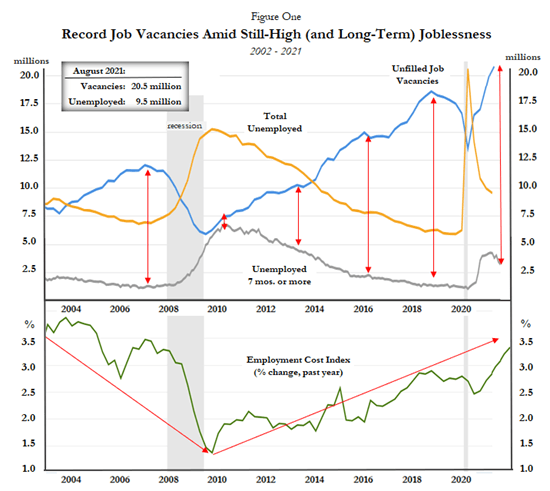
Figure One illustrates the extent of the current labor shortage in the U.S. Notice how job openings (vacancies) far exceed the number of unemployed workers – and the gap has widened over the past year or so. Worse, the long-term unemployed have become a larger share of the total unemployed. Vacancies are at record levels (20.5 million) even amid high joblessness (9.5 million). The gap between vacancies and the number of people living idly in long-term joblessness (seven months or longer) is also the widest on record. Figure One also shows employment costs rising, which ultimately trenches on profitability. 

The unemployed depicted in Figure One are not those who’ve dropped out of the labor force but those who claim, while applying for and renewing their jobless benefits, that they’re looking for work but somehow can’t find it. How can they not find it, when job vacancies are at record highs? In truth, they can’t find a job that pays more than they believe they’re worth to some employer and they won’t bother taking even a slightly-lesser-paying job, because they’re now paid above-normal jobless benefits from Covid bailout spending and federal largess. This supplements what the 50 states pay in jobless benefits. Yes, some states are now decreasing or terminating jobless benefits, but the data still show a large labor shortage.

Basic economics teaches that when markets are left free, they “clear,” which means prices help equilibrate supply and demand. Neither surpluses nor shortages become material or chronic, for surpluses entail quantities supplied exceeding quantities demanded while shortages entail the reverse. Sellers facing surpluses and preferring sales and profits to excessive inventories will gladly reduce their stocks by lowering prices. Likewise, buyers who face shortages and prefer to obtain more product than not willingly pay higher prices.

Material or chronic surpluses and shortages reflect not “market failure” but the failure of governments to let markets clear. It is believed that “fairness” requires that certain prices be higher or lower than the equilibrium level. Politicians proceed to tax, regulate, price-set, and subsidize. In democracies, where majorities dominate, electorally astute, vote greedy politicians necessarily favor the larger population of employees versus employers (except to the extent they peddle their influence, via rent-selling, to extort campaign contributions from the latter). Instead of being seen for what they are – labor market manipulators – populist politicians can pose as benefactors aiding that quintessential economic contradiction, the non-working worker. 

As Paul Krugman put it recently, “Workers Don’t Want Their Old Jobs on the Old Terms,” so they welcome politicized, non-economic policies that use taxpayer funds to pay the voluntarily jobless to hold out for higher wage rates than they’d otherwise deserve or obtain from the perspective of marginal productivity. For Krugman and his acolytes, this is better even than a minimum wage mandate (which Krugman also supports), as it doesn’t require employers to pay the above-market wage rate (i.e., they’re not – yet – compelled to hire overpriced labor; they can use more capital instead, as occurs at banks, gas stations, toll booths, airline check-in counters, fast-food restaurants, with automated tellers, toll takers, and kiosks). 

Daniel Alpert, senior fellow in macroeconomics and finance at Cornell Law School, concurs with Krugman and declares that “Americans Don’t Want to Return to Low Wage Jobs.” Alpert blithely assumes that wage rates (all wage rates?) are “too low” and will be until and unless government intervenes forcibly to rectify the “market failure.” He fails even to relate low-wage jobs to less-skilled jobs, or to acknowledge that the problem is best rectified by introducing still more and higher-quality capital (“labor-saving devices”), not by boosting “jobless benefits” or by imposing a still-higher minimum wage rate which rational, profit-maximizing employers shouldn’t bother to pay.

Labor market “experts” have recently confirmed and fueled such anti-employer biases. A recent New York Times Op-ed by MIT economics professor David Autor was titled: “Good News: There’s a Labor Shortage.” That was the online title; the print edition was titled “The Labor Shortage Has Empowered Workers.” This assumes workers lack bargaining power under normal conditions, as when markets “clear,” supply equals demand. How can professional economists believe such nonsense? Why applaud market disequilibrium? Autor, a co-director of “the MIT Task Force on the Work of the Future,” has spent years reprising the undue fears of early 18th-century British economist David Ricardo (1772-1823) – a devotee of the socialist “labor theory of value” (LTV) – about machines displacing physicalist labor. Fear of all fears! Barack Obama, in his last major address as president in January 2017, echoed Autor’s (and Ricardo’s) themes, claiming that automation was deleterious and divisive because skilled workers who can operate technology are better paid. But of course they’re better paid; they have a skill not everyone has. Echoing the fears of many, President Obama suggested that this may justify slowing and impeding capital formation and deployment. But that favors the cronies no one dares mention: unskilled laborers perpetually on the public dole. Autor, Obama, and countless others are more concerned with achieving equity than prosperity. 

By now it should be obvious, especially to experts and Presidents, that more and better capital increases labor productivity, real wages, and living standards; it also should be clear by now that capital isn’t the alien, alienating, or impoverishing force, but a frozen form of human labor – the embodied labor of brainiacs, inventors, engineers, and entrepreneurs. Capital isn’t “dead labor,” but vital, perpetual-motion labor, powered by energy and kept vibrant by maintenance and upgrades. Capital, and profit, its income, isn’t “blood-sucking” parasitism, but the lifeblood of a dynamic and flourishing capitalist economy. 

Why is so much of this unclear even to people who should know better? It’s not because they don’t know basic economics, the meaning of equilibrium, or the problem of shortages. They are clearly, unambiguously, and ideologically anti-capitalist; only derivatively are they anti-employer, because they can’t deny that most employers are capitalists at least financially (if not always ideologically). Channeling Marx, those suspicious of employers today believe capitalists profit by underpaying workers what they’re “really worth” and by charging customers more than what’s proper per that unicorn model in academic economics known as “pure and perfect competition.”

The many economists who emulate Marx today remain convinced that wage rates in a capitalist system are determined not by someone’s net contribution to the total market value of goods and services created by commercially-viable enterprise – i.e., by their “marginal productivity – but arbitrarily, by employers who pay whatever they wish (including bare-bones “subsistence wages”) – and by policies that sustain a vast “reserve army of the unemployed” that’s easily exploited, because starving workers are eager to accept any job on any terms. The “army” metaphor reflects the Marxist premise that workers are conscripted and regimented in a hierarchy under the thumb of capitalists. 

Short of revolution – an overthrow of capitalism itself – “democratic socialists” seek first not to prevent widespread joblessness, but to ensure that joblessness exists (especially among the less skilled) where it didn’t previously exist at all, namely, in a freer, non-emergency setting (see 2019). Next, they seek to make taxpayers – which, in their “progressive” tax code of graduated rates, means mostly the rich and corporations – will pay the jobless not to work. They believe capitalists will be induced or compelled to “do the right thing” and finally raise wage rates. A “reserve army of the unemployed” still exists in this model, but is kept “off the market” by the equivalent of a public bribe. Thus, the jobless are “liberated” from “greedy capitalists” but come to depend on politicians.  

Socialists, who believe that laborers are exploited by capitalists, fight to make economies unfree. Their goal is to “turn the tables” and “expropriate the expropriators,” to ensure that capitalists (employers) are exploited by laborers (employees). Socialists accuse capitalists of paying labor next to nothing for doing something great, but their “solution” is to force taxpayers to pay greatly for labor that does next to nothing.

These themes illuminate the aims of the Biden administration and its allied Democratic socialists in the U.S. Congress; they seek to spend an additional $3-5 trillion over the coming decade—on top of their already reckless and wasteful spending over the past 18 months—on “human infrastructure.” This entails spending on labor that doesn’t work (jobless benefits, family leave, etc.), on public schooling that doesn’t work (except to corrupt and erode human capital), and on energy that doesn’t work (more costly, less reliable “renewables”). The goal is to have as many American citizens and non-citizens alike dependent on government handouts for as long as possible, dependent on politicians directly and taxpayers indirectly. It’s a deliberate policy of subsidized parasitism. Covid “lockdowns” are the ideal policy for promoting this non-labor, anti-employer agenda. Lockdowns weren’t necessary to curb the spread of Covid; they caused more harm than good. Yet millions of people today are still compelled or induced by Covid policy to stay home, shutter businesses, and take jobless subsidies. 

Today’s U.S. labor shortage is both uneconomic and unnecessary, yet nonetheless what appears to be a deliberate policy aim. Sadly, the same can be said about a wide range of other anti-capitalist policies being advanced by the Biden administration.

Richard M. Salsman

Richard Salsman

AIER Senior Fellow Richard M. Salsman is president of InterMarket Forecasting, Inc. and a visiting assistant professor of political economy at Duke University. Previously he was an economist at Wainwright Economics, Inc. and a banker at the Bank of New York and Citibank. Dr. Salsman has authored the books Gold and Liberty (1995), The Collapse of Deposit Insurance and the Case for Abolition (1993) and Breaking the Banks: Central Banking Problems and Free Banking Solutions (1990), all published by AIER, and The Political Economy of Public Debt: Three Centuries of Theory and Evidence (2017).  His fifth book – Where Have all the Capitalists Gone? Essays in Moral Political Economy – was published by AIER in 2021.

Dr. Salsman earned a B.A. in economics from Bowdoin College (1981), an M.A. in economics from New York University (1988), and a Ph.D. in political economy from Duke University (2012). His personal website is https://richardsalsman.com/

Get notified of new articles from Richard M. Salsman and AIER.


Liberalism Then and Now

Habi ZhangHabi Zhang  – October 3, 2021 @ American Institute for Economic Research

Kenneth Minogue’s The Liberal Mind first appeared in the 1960s, an era when “the young and the radical in the Western world were in a restive condition.” As Minogue correctly diagnosed, the restiveness had two sides, “one cynical, the other sentimental.” Six decades later, the modern liberals’ restiveness has become far more vexatious, and their cynicism and sentimentality far more hysterical. I sense that Minogue’s book bears larger significance now than in the Sixties.

According to Minogue, around the 16th century in the English-speaking world emerged Lockean liberalism—a political philosophy that rests upon the natural rights of man. At its birth, this liberal morality was tolerant, egalitarian, and peace-loving; liberals exercise great self-control and excel in compromise. For Minogue, this was a political system that unleashed previously repressed individual energy and allowed for responsible political opposition, which led to prosperity and stability.

Modern liberalism, in contrast, “is a new understanding of politics;” it treats politics “as a technical activity like any other.” All social problems are thus turned into political problems, “inviting a solution by state activity.” Plan, control, command, and mobilization, all those large-scaled and all-encompassing state activities, have turned liberalism from a political philosophy, one built on the doctrine of natural rights, to a political movement that sees political life only as a struggle aimed at ultimately making society more just and equal. Or, to use the 21st-century parlance among our cultural elite, “we” are building a DEI world: Diversity, Equity, and Inclusion.

Cynicism and sentimentality are the trademarks of the modern liberal mind.

“The cynical side was irresistibly seductive,” says Minogue, and rightly so. Parodists and satirists of the 1960s, in both America and Britain, established themselves by mocking “censorship, respectability, prudery, and the rule of old man.” The swaggering Bohemians of the Sixties went to universities, believing that to think was to question or criticize, and taking conceit in ridiculing the pomposities of the Establishment.

Decades later, probably having realized that derision has exhausted its original novelty and hence its appeal, the same people now carve a niche for themselves in “decomposition”—to dismantle the Western civilization to ground zero, as evinced in the latest ludicrous debate on whether two plus two equals four that was sparked by woke tweets claiming such statements “reek of white supremacist patriarchy.”

At once vitriolic and compassionate, the liberal mind seems to be constantly angry at the world only because “it (the world) contains suffering,” Minogue aptly observes. The cynic lashes out at the world with contempt and even hatred, whereas the sentimentalist propagates his tears “as proof of a compassionate sensibility.” The liberal mind presupposes that suffering is ubiquitous, entirely externally-induced, and categorically bad; hence to eradicate it is the highest calling. To use Minogue’s much apt metaphor, the liberal “St. George” hurls his lance immediately at the sight of a dragon (i.e., the suffering situation), real or phantom.

To relieve the sufferings of others is a natural human disposition, but the liberal mind has standardized this sensibility, elevating it into a principle of politics, which renders it less an admirable altruism but more a tyrannical moralism. As Minogue so eloquently wrote, “Liberalism is goodwill turned doctrinaire; it is philanthropy organized to be efficient.” This standardization requires abstraction, treating humans not as real beings but “generic men” that can be conveniently put into the camp of “oppressors” or “victims.” Ironically, the suffering situations must undergo constant transmogrification in order to keep the dragon alive and feisty—and thus more satisfying to slay. With standardized sentimentality and cynicism together, according to Minogue, one has “the politics of melodrama of victims and oppressors.”

When reading Minogue’s anatomy of the moral character of the liberal mind, I recalled an exchange I had with a classmate three years ago. She is a former journalist and proudly-avowed global citizen—a modern liberal one might say. She mentioned that her home country, Switzerland, accepted most immigrants but her countrymen rarely interacted with them or helped them. When I asked her why individual Swiss exhibited so little personal compassion, she shrugged her shoulders: “There is government.” The truth is, as Minogue reveals, the people who focus on cultivating feelings or crafting images that provoke either hatred or tears are usually not those who actually help the needy around them. Thus, an unintended consequence of the excessive exploitation of real or crafted “suffering situations” of the classes of people taken to be “oppressed” is apathy among the masses.

A puzzle remains; namely, what has transformed liberalism from the staunch preserver of liberty, with John Stuart Mill being its most celebrated spokesman, to “St. George,” the righteous zealot, who vows to slay all human sufferings? Minogue’s devastating dissection of the liberal mind offers us some hints.

Following T.E. Hulme, Minogue differentiates between two views of life, one classical and the other romantic, in order to better explain why liberalism is “a thin and narrow doctrine.” Classical view understands humans as beings with limited capacities and shaped by social and political institutions. Established institutions take precedence over individuals. We ought to treat them with great care. The romantic view sees innocent individuals, born free and endowed with unlimited capacities, “but everywhere they are in chains.” We must, therefore, unchain ourselves from the bonds of the past so that we may live a “full life.”

Moreover, liberalism conceives of humans as desiring, rational, and calculating individuals who see the world only in terms of “function, end, satisfaction, rights, and the rest of the rationalist vocabulary.” This romantic doctrine of humans makes the liberal mind “implacably hostile to any notion of permanent natural differentiation between individuals.”

The corollary of such a theorization is an ethics of progress, a politics of needs, and above all, human happiness as distributing benefits. The perennial task for the liberal mind is what Minogue calls “the standardization of the notion of a full life.”

This obsession with a full life cannot but result in self-pity and self-reproach, says Minogue. Self-pity and self-reproach are universal emotions but the “self” of the liberal mind may concern others beyond the individual—they may be anybody for whom the liberal weeps. In a word, the self can be a collective self. Minogue’s insight sheds light on why ten years ago, Barack Obama would embark on months-long international confession tours to apologize for America’s sins, and why ten years later, Greta Thunberg would condemn all carnivore humans for ignoring the thoughts and feelings of fish (yes, the fish!), feeling justified and morally superior.

Are those two liberals arrogant or righteous? Take your pick. But Minogue reminds us that the full life that liberals think is, or ought to be, universalized is “a kind of life which is, in fact, lived by a minority of people mostly situated in the western world.”

Liberalism has for five centuries anchored the imagination of its Western descendants to a hypothesis of human nature that would make sense only insofar as we situate humans in a state of nature, stripped of all accidental attributes. But is it true? Some people like Patrick Deneen boldly claim that liberalism has failed. For Deneen, liberalism has failed because the logic of the Lockean liberalism inevitably leads to the demand for the complete liberation of the individual from a particular time, place, and relationships. This total liberation has in effect rendered “emancipated” individuals rootless and atomized, drifting in a sea where common experiences have lost their force. People are alone and powerless and permanently chained to the state.

Minogue seemed to remain ambivalent, as revealed in the 1999 preface to the Liberty Fund Edition, though he was optimistic decades ago when he had confidence in the commonsense of his world. Most significantly, he believed in 1963, because institutions were still mostly intact at that point, such as universities, churches, the military, and cultural academies, all of which were powerful checks on liberal ideas.

But it seems to me that those institutions are nothing if not the engine of the liberal mind.

Reprinted from Law & Liberty

Habi Zhang

Habi Zhang

Habi Zhang is a doctoral student in Political Science at Purdue University. She holds a master’s in public policy from Pepperdine University.

Her main research interests are political thought, political culture, and quantitative methods.

She is currently researching totalitarianism, political tolerance, and public opinion.

Get notified of new articles from Habi Zhang and AIER.

What Can We Learn by Comparing Taiwan and Cuba?

October 3, 2021 by Dan Mitchell @ International Liberty

Economists of all types agree with “convergence theory,” which is the notion that poor countries should grow faster than rich countries.

Though they are usually wise enough to also say “ceteris parisbus,” which means the theory applies if other variables are similar (the translation from Latin is “other things equal”).

I’m very interested in this theory because we can learn a lot when we look at nations that don’t have “equal” policies.

And the biggest lesson is that you have divergence rather than convergence if one nation follows good policies and the other one embraces statism.

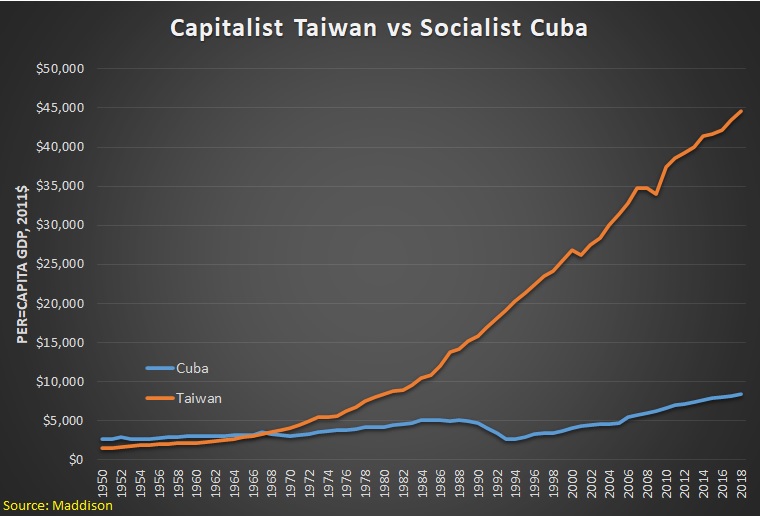
Take a look, for instance, at what’s happened to per-capita economic output (GDP) since 1950 in Taiwan and Cuba.

The obvious takeaway from these numbers from the Maddison database is that Taiwan has enjoyed spectacular growth while Cuba has suffered decades of stagnation.

If this was a boxing match between capitalism and socialism, the refs would have stopped the fight several decades ago.

By the way, some folks on the left claim that Cuba’s economic misery is a result of the U.S. trade embargo.

In a column for the Foundation for Economic Education, Emmanuel Rincón explains the real reason why these two jurisdictions are so wildly divergent.


…the Communist Party of Cuba has blamed the United States for Cuba’s misery and poverty, alluding to the “blockade” that the U.S. maintains against Cuba. However, …the rest of the world can trade freely with the island. …Taiwan’s economy is one of the most important in the world, with a poverty rate of 0.7%, as opposed to Cuba, which has one of the most depressed economies on the planet and 90% of its population living in poverty. What is the difference between the two islands? The economic and political model they applied in their nations. …Taiwan has the sixth freest economy according to the Index of Economic Freedom… While Taiwan took off with a capitalist model, Cuba remained anchored in the old revolutionary dogmas of Fidel Castro… With popular slogans such as redistribution of wealth, supposed aid to the poor, and socialism, Fidel Castro began to expropriate land and private companies to be managed by the state…today the GDP of the Caribbean island is five times less than that of Taiwan, and 90% of its population lives in poverty, while in the Asian island only 0.7% of its population is poor. It is definitely not the fault of the “blockade”, but of socialism.

To be sure, Cuba would be slightly less poor if there was unfettered trade with the United States, so maybe Taiwan would only be four and one-half times richer rather than five times richer in the absence of an embargo.

The moral of the story is that there’s no substitute for free markets and small government.

P.S. Though I appreciate the fact that our friends on the left are willing to extol the virtues of free trade, at least in this rare instance.


When the Taliban Teamed Up With Bill Gates and UNICEF

October 03, 2021 

When the Taliban set up their political operation in Doha, under the aegis of the Islamist state of Qatar, it wasn’t just the Americans and the Europeans who came to negotiate with the terrorists.

Last winter, UNICEF, the United Nations Children’s Fund, conducted its own negotiations with the Taliban. The UN agency, like many other non-profits, wanted to operate in Taliban territory and the representatives of the Islamist killers were willing to listen. What the Jihadist organization wanted from the UN was the same deal that Hamas got from UNRWA.

UNICEF would enable an ad-hoc school system that would operate under Taliban control.

While we often talk about terrorists indoctrinating children, few realize that our tax dollars and our non-profit organizations fund educational systems that are under the control of terrorist groups. The UN’s aid agencies routinely enable these operations, most notoriously in Gaza, where UNRWA schools are not only staffed by Hamas members, but have been used as bases for rocket attacks against Israel. But Gaza’s UNRWA setup is actually fairly typical of the UN.

The Helmand Sangin Workplan deal between the Taliban and UNICEF was said to have created 4,000 classes while reaching 140,000 Afghan children. There’s no way to know how true these numbers are, but the most significant part of the agreement was also the least reported part.

As a quarterly report from the Special Inspector General for Afghanistan Reconstruction noted, "the Taliban will recruit the teaching staff, who must then be able to pass a test set by the MOE."

And since the Taliban took over Kabul, the Ministry of Education is now under Taliban control.

But throughout the year, UNICEF was helping the Taliban run an educational system. These classes often took place in mosques. And the only ones to know for sure what was being taught in these "informal classes" were in the room. It’s not clear if USAID was providing any funding to the Taliban’s educational system, but some American non-profits appeared to be doing so.

The Bill & Melinda Gates Foundation was reported to be picking up some of the cost.

An “inspiring” UNICEF photo feature from earlier this year shows a female teacher in a burka that leaves only her eyes exposed teaching a group of women in burkas while a scowling man stands at the door. The classes are supposed to be taking place somewhere in Kandahar, and the funds are coming, at least in part, from the Bill & Melinda Gates Foundation.

The Helmand Sangin Workplan is scheduled to run until December 2021. The Biden administration has announced an additional $64 million in humanitarian aid to Afghanistan. Some of this appears as if it will be routed through UNICEF and other UN agencies.

Will American taxpayers be funding a Taliban school system? The answer is we likely will.

The Taliban have often been portrayed as hostile to education, but the Jihadis who built the organization were the product of Madrassas, Islamic schools set up in Pakistan that were funded by Saudi Arabia. The name “Taliban” even means students in the Pashtun tongue.

The Islamic educational system is a military institution whose primary subject is Jihad. Its teachings focus on the need to defeat infidels and impose Sharia law on the human race. The Madrassa system is the means by which the Jihadis indoctrinate the next generation of killers.

The Taliban are not against educating boys or even necessarily girls. They run madrassas aimed at girls in some areas. What they are against is any educational system that they don’t control and can’t use to indoctrinate children into functioning as the next generation of their cause. And the United States and Americans appear to be willing to fund the Taliban schools.

What is the distinction between Taliban madrassas that were already in place and UNICEF schools? The UN wants to ensure that the Taliban teach math, science, and assorted secular subjects to students. Whether or not Taliban teachers end up doing this, no one can really know.

But that’s also hardly the point.

The United States should not be funding a Taliban education system or allowing it to be funded.

Two decades after the 9/11 Commission had warned about the dangers of the Madrassa system, the Biden administration and its donors may actually be helping to fund Islamic schools that will indoctrinate a new generation to hate and kill non-Muslims.

The Biden administration is not alone in this treasonous madness.

Former British Prime Minister Gordon Brown wrote an op-ed urging G-7 nations, a group that includes the US, to commit $8 billion to Afghan education even after the Taliban takeover of the country. "Aid should be distributed based on the work already done by UNICEF who to their great credit negotiated an agreement last December to cover 120,000 girls and to ensure they received home schooling in Taliban controlled areas," he argued.

The 120,000 number is nonsense. And with “ghost schools” a common phenomenon in Afghanistan and Pakistan, the actual number of students attending classes is unknown.

But more importantly throwing billions into a Taliban educational system is funding terrorism.

The Taliban has been known to “tax” teachers and non-profits. And when they select the teachers, they are bound to be either members of loyalist families, or those who have bribed them. Either way, funding schools controlled by the Taliban means funding the Taliban.

Tests, either of the teachers or students, are meaningless in a system controlled by the Taliban. Any metrics will be administered by the Taliban making them entirely worthless.

“Our obligation is to help the children of Afghanistan grow up to become the leaders of tomorrow,” Brown concluded. The question that he seems incapable of grappling with is the leaders of what? The current leaders of Afghanistan came out of Madrassas. And even if the Taliban go along with some sort of mass educational program for women, Iran, Pakistan, and Hamas have shown that Muslim women, just like men, can be indoctrinated to believe that their role in life is to raise children to kill non-Muslims or even to go ahead and carry out attacks.

The window when we might have helped educate the children of Afghanistan to believe anything else has closed. The Taliban won and their spoils include Afghanistan’s children.

The last thing we should be doing is funding the Taliban’s indoctrination efforts. Any money that the Taliban and its backers in Pakistan or Qatar spend on education is at least diverted from more direct forms of terrorism aimed at us. And the same holds true for all aid to Afghanistan.

The Taliban have taxed and regulated non-profits handing out aid in areas under their control. There’s every reason to believe that they will go on expecting Americans to feed their population even as they skim as much as they can from the millions in taxpayer money being used as aid.

Biden has claimed that he retreated from Afghanistan because the United States couldn’t keep spending money indefinitely on the failed country. And yet, as soon as he fled, abandoning Americans behind enemy lines, he’s spending another $64 million on Afghanistan.

And a percentage of that money will inevitably fall into the hands of Islamic terrorists.

America can pull out of Afghanistan, but our leaders refuse to stop funding the Taliban.

Daniel Greenfield is a Shillman Journalism Fellow at the David Horowitz Freedom Center. This article previously appeared at the Center's Front Page Magazine.

Click here to subscribe to my articles. 

Thank you for reading.

Author Image

About Daniel Greenfield
Daniel Greenfield is a journalist investigating Islamic terrorism and the Left. He is a Shillman Journalism Fellow at the David Horowitz Freedom Center