 Josh Hammer Feb 24, 2023 @ Townhall.com
Editor's Note: I've not asked or received permission to publish this in full. But I feel this needs wide distribution and if the author or Townhall object, I will break this down to a link. RK
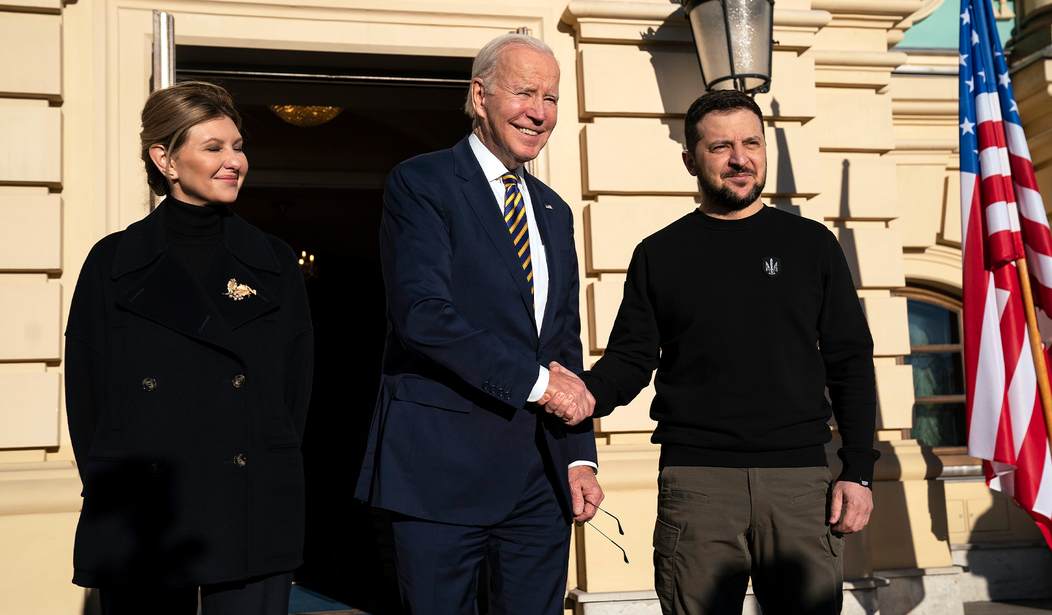
President Joe Biden's surprise visit to Ukrainian premier Volodymyr
Zelensky in Kyiv earlier this week was an unmistakable sign of
solidarity with Ukraine on the one-year anniversary of Russian kingpin
Vladimir Putin's reckless, unjust invasion. To the extent Biden's aim
was to send such a symbolic message to Moscow and its allies, he
succeeded.
Unfortunately, Biden's trip, especially seen in concert
with recent similar actions such as Zelensky's December speech before a
joint session of Congress and even Senate Minority Leader Mitch
McConnell's (R-KY) sartorial choice to wear a Ukrainian flag-colored
necktie to Biden's State of the Union address earlier this month, raises
a number of discomfiting questions about the Washington, D.C.
uniparty's seemingly interminable commitment to prolonging this Eastern
European quagmire. On the one-year anniversary of the culmination of
Europe's first extended land war since World War II, here are some
pressing questions for establishment politicians from both major
political parties.
No. 1: What is the meaning of "as long as it
takes"? In Kyiv, Biden reiterated that the U.S. "will remain with
Ukraine as long as it takes." This presumably entails both a moral and,
more relevant, fiscal commitment -- indeed, Biden promised a new tranche
of military aid to Ukraine, on top of the $113 billion in aid U.S.
taxpayers dispensed with in 2022, and on top of recently announced
top-tier materiel such as Patriot missile defense systems. But items
such as Patriot missile defense systems and M142 HIMARS rocket launchers
don't grow on trees; resources are necessarily scarce, and each
additional item we ship off into a proxy war against a nuclear-armed
hegemon necessarily depletes our own military arsenal. Furthermore,
America is massively indebted with soaring annual budget deficits. And
Chinese President Xi Jinping surely grins as America strips bare our
military and ships off the parts to Europe, not Asia. So how long is "as long as it takes" -- and, related, do we simply not care at all about the costs?
No.
2: Is the U.S. national interest in the conflict synonymous with
Ukraine's national interest? The bipartisan foreign policy
establishment's absolutist stand with Ukraine -- at seemingly all costs,
"as long as it takes," and so forth -- implicitly conflates the
national interests of the U.S. and Ukraine. After all, if the U.S. is that
existentially committed to Ukrainian "victory" -- whatever precisely
that entails, and however Zelensky defines it -- then it follows that
our national interest in the conflict is precisely coterminous with
Ukraine's own national interest. But although there is strong overlap,
this is simply not the case; the national interests are not coterminous.
Ukraine's national interest is indeed the maximalist stance Zelensky
espouses -- namely, refusal to countenance yielding even a square foot
of territory in the Donbas (or Crimea). The U.S. national interest, by
contrast, is definitely served by Zelensky's remaining in power in Kyiv
and not being toppled for an Alexander Lukashenko-style Moscow puppet;
crucially, however, there is exceedingly little (if any) U.S. interest
in where the exact national boundary lines are drawn in eastern
Ukraine, where the population is often closely divided between ethnic
Ukrainians and ethnic Russians. The crude post-Soviet dissolution
boundaries in this part of the world are not akin to Moses descending
Mount Sinai with the Word of God.
No. 3: Is the U.S. fearful of
all-out war with Russia? Russia is the country with the single most
confirmed nuclear weapons in the entire world: 6,255, as of 2021. (The
U.S. was second, with 5,550 at that time.) As Zelensky sometimes flirts
with openly calling for World War III, and continually endeavors to drag
NATO -- and thus, the U.S. -- further into the conflict, does the
prospect of cataclysmic nuclear war with Russia not cross the minds of
the Washington uniparty and bipartisan foreign policy "blob"? That fear,
if anything, should be exacerbated by Putin's de facto withdrawal of
Russia, over the past week, from the New Strategic Arms Reduction Treaty
(New START). Putin (loathsomely) speculates fairly openly about
deploying nuclear weapons -- all while the U.S., as well as European
nations such as Germany and Poland, ship off increasingly sophisticated
materiel. Is no one here interested in de-escalation and avoiding what Biden not-so-reassuringly referred to last October as nuclear "Armageddon"?
No. 4: Has the U.S. learned anything about "endless
wars"? The American public is naturally war-weary after decades of
failed regime change wars and moralistic nation-building crusade
boondoggles. There is simply no political appetite right now for a
dramatically prolonged military engagement -- especially one in Europe,
while our actual top geopolitical threat, China, flies spy balloons over
our continent unimpeded and tests nuclear-capable hypersonic missiles
around the world. The Washington uniparty's desire for escalation in
Eastern Europe may aid rapacious Beltway defense contractors, but it is
manifestly contrary to the expressed interests of the American people,
who would rather our elected officials focus instead on our own porous
southern border with Mexico. In every way, the Biden administration's
current approach is "America Last," not "America First."
No. 5:
What is the U.S.'s long-term plan to deal with Russia? It is unclear at
best whether anyone in a foreign policy decision-making capacity has
given a second of thought to what U.S.-Russian relations might possibly
look like when this war is finally over. At this rate, and absent a
course correction toward de-escalation and direct mediated negotiation
between the warring parties, Moscow will loathe America and Europe after
the conflict even more than they did prior to the conflict's onset. But
given that China, and not Russia, is this century's dominant threat to
America, a shrewder and more forward-looking approach to the conflict
would at least lay the groundwork for possibly peeling Russia away from
China and slightly closer to the Western sphere of influence
after the war is over. Unfortunately, there is thus far no reason to
believe this has a chance.
Political leaders of both parties
should be asked these important questions. The stakes, as Biden's
"Armageddon" slip of the tongue inadvertently revealed, could not
possibly be higher.
To find out more about Josh Hammer and
read features by other Creators Syndicate writers and cartoonists, visit
the Creators Syndicate webs
