Search This Blog

De Omnibus Dubitandum - Lux Veritas

Showing posts with label Rights. Show all posts

Saturday, April 27, 2024

Victimhood is an Oppressive System of Relative Rights

By @ Sultan Knish Blog  


We are two years and spare change away from the American semiquincentennial which will celebrate 250 years since some brave men ratified the foundational document of our nation.

The Declaration of Independence’s bold assertion that the people were “endowed by their Creator with certain unalienable Rights” is all the more relevant in the age of relativism where fewer people believe in a ‘Creator’ or in unalienable rights. That radical document is why America remains the only place on the planet where freedom of speech is absolute.

Other nations have their constitutions and human rights charters which run longer than an old-fashioned telephone directory, but their rights are granted by the government and then taken away by the government. Under the guise of buzzwords like ‘stakeholders’ and ‘evolving social contracts’ your rights are constantly reevaluated by committees according to leftist doctrine.

Unlike the absolute rights of the Bill of Rights, the reevaluation of rights follows a Marxist paradigm in which the existing state of rights is an imperfect system imposed by the privileged on the underprivileged, and must be constantly shaken up to liberate the new oppressed.

Your rights are not absolute, they are relative to how oppressed the committee thinks you are. And if you’re only as free as your oppression, then you have to be oppressed to have rights.

These rights are not a gift from the Creator, but from systemic racism, that you have rights is not something to be proud of or grateful for, but a mark of shame that indicts you for having benefited from whiteness, being adjacent to whiteness, the patriarchy, heteropatriarchy or cisheteropatriarchy, and the only way to atone is to cede your rights to the next group.

The clash between traditional feminism and the transgender movement clearly shows the difference between absolute and relative rights. In the absolute rights model, equality for women would have been a permanent victory, but in the relative rights model, by winning equal rights, women stopped being the oppressed and instead became the oppressors of transgender men.

Feminists have responded to the transgender movement with both absolute and relative arguments. The absolute argument is that womanhood is a fundamental biological reality and not a relative state of mind that can be redistributed to anyone who comes asking for it. The relative one is, like nearly all relative rights arguments, an assertion of unique victimhood.

The Marxist paradigm easily defeats past claims of victimhood. By the sixties, the old class warfare model had evolved to adopt and dispose of such past claims like an efficient factory, beginning with the original class of victims, the white working class, once the vanguard of the revolution, but quickly banished to the ranks of reactionaries and oppressors of the oppressed.

From the lofty progressive vantage point of the current year, every domestic group on whose behalf the leftists of a century ago had advocated, coal miners, factory workers, women, Italian and Jewish immigrants, the rural poor, have now become the contemptible enemies of mankind.

At the rapid pace of radicalization, everyone from white gay men to black men to lesbians, are being prepped for the social abattoir. By 2035, the only true victims may be groups so bizarre and warped as to be barely conceivable today. Before they too are exposed as the oppressors.

Under intersectionality, each right is also a wrong, and each liberation conceals another oppression. The process of liberation is a constant search for new wrongs, new minorities to liberate and then denounce in a constant upheaval of society that masks the oppressive transfer of power from the citizenry to a revolutionary vanguard that also doubles as the true ruling class.

The true oppression is a liberation movement that frees no one, only pits people against one another, giving each grievance its hour in the sun, before turning the aggrieved into the aggressors, so that only the revolutionaries can ever wield any meaningful power by arbitrating who the oppressors and the oppressed are at given moment.

And that is what relative rights look like.

When rights are dependent on defining who the oppressed and the oppressors are, then those rights are not truly inalienable rights given by the Creator or by a foundational document, but by the constantly shifting paradigms of academia and the accompanying leftist politics.

Who the oppressed and the oppressors are can change overnight, as feminists found out. Yesterday, women were the oppressed, today any man who puts on a dress is oppressed.

The difference between your rights being determined day to day by King George III or the editorial department of the New York Times is a preference for one tyranny over another.

Absolute rights, like those in the Declaration of Independence and the Constitution, build one achievement on top of another. And that is the rights that most Americans, even most liberals, thought that they were getting, but instead the oppressed groups of yesterday wonder why the revolutionary moment seems to have passed them by leaving them with less than they had.

What happened to the revolution, they wonder? What happened is that it’s a revolution.

A revolution is a state of instability. Freedom doesn’t come from revolutions, but from the order that emerges afterward. That’s why Americans commemorate July 4th, 1776 as Independence Day. July 4th was neither the first nor the final shot fired for independence. Like the French, we could have made an original violent confrontation, the Boston Massacre, into our Bastille Day. Or we could have made Evacuation Day, a mostly forgotten holiday marking the British departure from New York City and the end of British rule, into the date of our independence.

But instead we chose to commemorate the aspirational vision of the Declaration of Independence. Revolutions and battles come and go, but we wanted to build our independence around a new order of liberty, not around the perpetual revolution championed by some radicals.

In my book, Domestic Enemies: The Founding Fathers’ Fight Against The Left, I described the radical American leftists who wanted to perpetuate the revolution and saw France as a model.

“Eternal providence called on you, you alone, since the world began, to reestablish on earth the empire of justice and liberty,” Robespierre had rhapsodized. During the Reign of Terror, the French leftist had assured fellow radicals that it would all be worth it for, “by sealing our work with our blood, we may witness at least the dawn of universal happiness.”

Some American leftists plotted to topple George Washington and the Constitution to pursue a French style perpetual revolution that would, after enough bloodshed, offer universal happiness.

Today the “dawn of universal happiness” has been replaced by the “right side of history”, but both are revolutionary movements of relative rights that are always incomplete and seeking perfection. But human affairs are by definition imperfect. The American experiment offered the security of absolute rights while the leftist approach is to rob of everyone of their rights over and over in search of the perfect state, the empire of justice and liberty, and the right side of history.

The real struggle is still between the absolute rights guaranteed nearly 250 years ago by the Declaration of Independence, and the relative rights promised by the leftist revolutions which are still going on today. And it is this clash of rights that will determine the future of our rights. 
 
 
Daniel Greenfield is a Shillman Journalism Fellow at the David Horowitz Freedom Center. This article previously appeared at the Center's Front Page Magazine. Click here to subscribe to my articles. And click here to support my work with a donation.
Thank you for reading.

Thursday, April 11, 2024

Rights Are Not Grantings To Be Given or Taken Away!

By Rich Kozlovich 

This is an unending issue with the left, and I've written about this before but so much is in the news that obfuscates the truth I felt compelled to write about it again. If we want understanding we must first have clarity, and history is the clarifying agent.  On April 4th 2013 Ben Shapiro wrote an article titled, Obama: Constitution 'Constrains' Me. 

“In his pursuit of overarching gun control legislation in the aftermath of the Sandy Hook massacre, President Barack Obama has been dogged. He's been relentless. He's been demagogic, too, whether flanking himself with schoolchildren (the implication being that his political opponents don't care about dead kids) or suggesting that if just one life can be saved by his legislation, we ought to buy into it wholeheartedly (a proposition that would justify almost any sort of government overreach).” He continues by saying; “on Wednesday, President Obama took his gun control push a step further: He admitted that only the Constitution stands between him and full gun confiscation”

He further points out that:

“Government is not us. Government is a group of people elected by us, who then use their own judgment”, however he points out, “the founders stated that rights descend not from government — not from "us," as Obama would have it — but from God or nature.” Quite frankly it seems a worthwhile effort, considering the wider ramifications of this kind of thinking, to lay some historical foundation regarding gun ownership rights in America in order to understand this argument properly. First of all; the Second Amendment is what it says, nothing more and nothing less, yet at one point Attorney General Holder claimed "We have no right to possess guns!"………

So what does a person who believes that we shouldn’t “need” guns to do? Well, that depends if that person believes that we shouldn’t “have” guns or not. There is a substantial difference between “having” and “needing”, but in this case the "having" is based on the "needing". 

The fact of the matter is we live in a dangerous world, and when the general population is armed the world is substantially less dangerous because crime goes down when gun ownership goes up. Clearly that, at the very least, is the "need" to justify the "having".

Most importantly we really do need to understand that America's founding fathers didn't trust government so the second amendment was deliberately inserted in the Constitution for two reasons. One, to make sure you can defend yourself, your loved ones and your property, and two, to give the citizenry the ability defend the Constitution against a government gone wild and is based on English natural law as codified in the English Bill of Rights.

The English Bill of Rights became law after a politically difficult time (actually it was more religious than political…or if you will…. the religious issues generated the political issues) in English history where the common people overthrew King James and forced he and his successors, William III and Mary II in to accepting the English Bill of Rights. This was done as a result of a fight over the authority or the King to govern without consent of Parliament, and the King’s (who was Catholic) desire to disarm his Protestant subjects and maintain a “permanent standing army”, against the wishes of Parliament; clearly and attempt to keep them in line with no way to defend themselves.

It might be noted that this wasn’t a new right being demanded by Parliament from the ruling authorities. This was merely codifying what was always considered a ‘the natural right’ of all Englishmen, and the Supreme Court in District of Columbia v. Heller (2008) agreed by saying this regarding the English Bill of Rights "clearly an individual right, having nothing whatsoever to do with service in the militia". Furthermore, this was not a “granting of a new right”, but codifying forevermore a right they held without permission of the King, nor did the King have the right to disarm them.

The Second Amendment says; A well regulated militia being necessary to the security of a free state, the right of the people to keep and bear arms shall not be infringed.

So, who does everyone think this "well regulated militia" is made up of? The general population! The term “well regulated” merely defines the difference between legal and criminal behavior. Otherwise they would be a mob bent of murder, mayhem, destruction. When the Constitution was written a militia was not anything but the general population fighting as a civilian army, organized to their own likings and purposes. 

And they could go back to their regular lives and take their arms with them because they might be called upon to stand up to defend their community once again. And from where did this right originate? If this is a natural right then it didn’t originate with the King in England and it isn’t a “granting” to be given or to be taken away by the Government of the United States.

This isn’t about gun rights. It is about the definition of rights. This is a foundational issue with ramifications so deep and so profound it is now incumbent upon us to start understanding the foundational thinking that created the most incredible political document in human history. The United States Constitution!

I do wish that more people would read the Declaration of Independence, the Articles of Confederation, the U.S. Constitution, and at the very least read the commentaries regarding the Federalist Papers. These are foundational!

I have written about this before but so much is in the news that obfuscates the truth I felt compelled to write about it again.  If we want understanding we must first have clarity.  History is the clarifying agent. 

The Definition of Rights is the Real Issue!

By Rich Kozlovich
Recently Senator John Kennedy grilled a Biden judicial nominee, Nancy L. Maldonado, about a position she took on what's being commonly called,  "assault weapon bans", a position paper to the court that she signed off on, and it became clear she had no idea what she was taking about and ended up saying, "I'm not a gun expert".   Well, perhaps we need a little clarity.
Recently I wrote the article about gun control titled, Rights Are Not Grantings To Be Given or Taken Away!, explaining that this issue of gun rights isn’t really about guns at all, and even those who don’t own guns, don’t like guns, and don’t want guns in their homes have to understand the foundational issue.  It about the definition of rights – not about guns.  That makes this "gun rights" issue so much deeper and more profound. 
Today I received an e-mail from a friend outlining the consequences of "gun control" and what rights are left when “gun  control” leads to “government control”.  After that there will be no need to be able to define “rights” because they will cease to exist.   
I don’t know who Mark Lucas is, but it appears that he is the originator of the information in this e-mail.  Here is most of what was said:
The main topic of discussion these days is gun control.  Liberal progressive politicians are trying hard to convince people to give up their guns in order to stop violence. You know the mantra: Guns are bad and hurt people, so give up your guns while we all sing Kumbaya. Without guns it will be a safer world for everyone.
But there is a problem with this mantra: Do you really think criminals will give up their guns? Each gun law seems to just give birth to yet more gun laws. When the citizens guns are gone and only the government has guns, what then? We will be at the mercy and control of the prevailing regime of the time, with no means to resist. When this happens, the government is no longer the servant, but the master. It will then enact even more laws for “your protection” and the sheeple will have no choice but to fall in lock step and obey.

Consider the following historical facts:

1929,  the USSR established gun control. From 1929 to 1953, approximately
20 million dissidents, unable to defend themselves were rounded up and exterminated.

1911, Turkey established gun control. From 1915 to 1917, 1.5 million Armenians, unable to defend themselves, were rounded up and exterminated.

1928, Germany established gun control. From 1939 to 1945, 13 million Jews, Gypsies, homosexuals, the mentally ill and others who were unable to defend themselves, were rounded up and exterminated.

1935, China established gun control. From 1948 to 1952, 20 million political dissidents, unable to defend themselves were rounded up and exterminated.

1956, Cambodia established gun control. From 1975 to 1977 one million “educated”
people, unable to defend
themselves were rounded up and exterminated.

1964, Guatemala established gun control. From 1964 to 1981, one hundred thousand Mayan Indians, unable to defend themselves were rounded up and exterminated

1970, Uganda established gun control. From 1971 to 1979 three hundred thousand Christians, unable to defend themselves, were rounded up and exterminated

The body count is not yet in on the number of Serbs who were unable to defend themselves and were exterminated, but the television images should still be fresh in your mind. Adding the victims of genocide in Barundi, Darfur, and Iraq brings the total number of victims who lost their lives because of gun control to approximately 100 million people in the last century. These are cold, hard facts.

Every time gun registration has been enacted “for the safety of citizens,”
it has led to gun
confiscation.  We should learn from the mistakes of the past: the next time someone speaks out in favor of gun control, ask which group of citizens they want to see exterminated.

Rights are lost in small, insidious increments that seem inconsequential at the time, but they are never regained. Compare the erosion of rights to the Grand Canyon. The Grand Canyon was not formed in one fell swoop, but little by little, day by day, grain of sand by grain of sand until finally there was a gaping chasm. Rights that were paid for in blood are now being frittered away by a generation that has never had to sacrifices (with the exception of the few and the proud who voluntarily join the military). How many of these individuals has ever stood graveside to accept a folded flag “behalf of a grateful nation”
?

If you make a lie big enough and repeat it often enough, people will believe it and the myth becomes reality. Gun control is NOT for the “good of the people”, gun control is about one thing and one thing only, government control, and the ability to impose tyranny on people incapable of doing anything about it. 

Tuesday, August 8, 2023

Bidenomics Producing Disaster in Argentina

August 7, 2023 by Dan Mitchell @ International Liberty

The U.K.-based Economist calculated a few years ago that Taiwan has been the world’s fastest growing economy over the previous 100 years.

That’s not a big surprise since it started poor and is following the tried-and-true recipe for becoming rich.

Meanwhile, the world’s worst-performing economy over the same period has been Argentina.

And it seems that may be the case for the next 100 years (though Venezuela will be a strong contestant for that ignoble achievement).

Mary Anastasia O’Grady warns in her Wall Street Journal column that Argentina is on the verge of another economic meltdown.


Margaret Thatcher famously quipped that the trouble with socialism is that “you eventually run out of other people’s money.” …Argentina’s central bank is printing more pesos than the market wants to hold because the government, which is broke, needs them to pay its bills. This isn’t new in Argentina. Successive governments have generated repeated bouts of high inflation for decades. …Capital controls exacerbate shortages of hard currency. …Stagnating Argentine economic growth is no mystery. …On Aug. 13 Argentines vote in primaries for presidential candidates, and this issue is front and center. Yet promises of a cure are short on details, probably because it would mean upending the long tradition of Peronist populism that has bankrupted the country.

Why is Argentina such a mess? The short-run answer is modern monetary theory. The long-run answer is Peronism, named after the populist (and statist) Juan Peron, who took power in 1946.

Indeed, much of Argentina’s decline occurred after World War II (Argentina was one of the world’s 10-richest countries as recently as 1948).

The bottom line is that there is very little reason for hope, especially with the IMF subsidizing Argentina’s profligacy (and it does not help that the supposedly right-wing parties also like big government).

P.S. Writing for Law & Liberty, Marcos Falcone of Fundación Libertad explained that Argentina’s march in the wrong direction was aided and abetted by a constitution that evolved in the wrong direction.


…the 1853 Constitution…purposefully followed the model set by the American Founding Fathers so as to establish the kind of rule of law that a classically liberal society would need. …internal, bureaucratic barriers to free trade were to disappear; that no privileges would be extended by the government to anyone; and that private property was an inviolable right. …Ever since its inception, though, the Argentine Constitution has suffered from several changes…new articles incorporated into the Argentine Constitution have recognized social and collective ‘rights,’ the enforcement of which depends on increased government intervention. …Article 14 bis of the Constitution,…added in 1957…guarantees the existence of a minimum wage, mandates ‘fair’ salaries for workers, …and effectively bans the state from dismissing public employees. …The 1994 Convention…added the concept of ‘environmental rights’ in a way that implies proactive government intervention. 

P.P.S. Ms. O’Grady also wrote a must-read column in 2021 about the dependency problem in Argentina.

P.P.P.S. What’s tragic is that there is a success story on the other side of the Andes Mountains.

 Editor's Note:  Please take some time and review My Argentina File, which goes back to 2012.  RK

Monday, July 11, 2022

The Fourteenth Amendment Due Process Clause

By Nathan S. Chapman and by Kenji Yoshino @ National Constitution Center

Editor's Note:  I don't have permission to publish this in full, but given what's going on with SCOTUS all of a sudden discovering entirely too many decisions from the court over the decades have absolutely no basis in the Constitution, and the 14th Amendment is behind so much of it, I've chosen to publish this in full.  If the authors object, I will alter this to a link, but this is an important piece in fitting together the pieces of the puzzle of understanding over what's happened with regards to the decades of decisions convoluting America's values and rights creating rights and privileges out of thin air justifying those decisions with penumbras and emanations of the Constitution And important in understanding what might be part of future decisions in the effort to make the courts understand it's not their job to legislate from the benchRK

The Due Process Clause of the Fourteenth Amendment is the source of an array of constitutional rights, including many of our most cherished—and most controversial. Consider the following rights that the Clause guarantees against the states:

  • procedural protections, such as notice and a hearing before termination of entitlements such as publicly funded medical insurance;
  • individual rights listed in the Bill of Rights, including freedom of speech, free exercise of religion, the right to bear arms, and a variety of criminal procedure protections;
  • fundamental rights that are not specifically enumerated elsewhere in the Constitution, including the right to marry, the right to use contraception, and the right to abortion.

The Due Process Clause of the Fourteenth Amendment echoes that of the Fifth Amendment. The Fifth Amendment, however, applies only against the federal government. After the Civil War, Congress adopted a number of measures to protect individual rights from interference by the states. Among them was the Fourteenth Amendment, which prohibits the states from depriving “any person of life, liberty, or property, without due process of law.”

When it was adopted, the Clause was understood to mean that the government could deprive a person of rights only according to law applied by a court. Yet since then, the Supreme Court has elaborated significantly on this core understanding. As the examples above suggest, the rights protected under the Fourteenth Amendment can be understood in three categories: (1) “procedural due process;” (2) the individual rights listed in the Bill of Rights, “incorporated” against the states; and (3) “substantive due process.”

Procedural Due Process

“Procedural due process” concerns the procedures that the government must follow before it deprives an individual of life, liberty, or property. The key questions are: What procedures satisfy due process? And what constitutes “life, liberty, or property”?

Historically, due process ordinarily entailed a jury trial. The jury determined the facts and the judge enforced the law. In past two centuries, however, states have developed a variety of institutions and procedures for adjudicating disputes. Making room for these innovations, the Court has determined that due process requires, at a minimum: (1) notice; (2) an opportunity to be heard; and (3) an impartial tribunal. Mullane v. Central Hanover Bank (1950).

With regard to the meaning of “life, liberty, and property,” perhaps the most notable development is the Court’s expansion of the notion of property beyond real or personal property. In the 1970 case of Goldberg v. Kelly, the Court found that some governmental benefits—in that case, welfare benefits—amount to “property” with due process protections. Courts evaluate the procedure for depriving someone of a “new property” right by considering: (1) the nature of the property right; (2) the adequacy of the procedure compared to other procedures; and (3) the burdens that other procedures would impose on the state. Mathews v. Eldridge (1976).

“Incorporation” of the Bill of Rights Against the States

The Bill of Rights—comprised of the first ten amendments to the Constitution—originally applied only to the federal government. Barron v. Baltimore (1833). Those who sought to protect their rights from state governments had to rely on state constitutions and laws.

One of the purposes of the Fourteenth Amendment was to provide federal protection of individual rights against the states. Early on, however, the Supreme Court foreclosed the Fourteenth Amendment Privileges or Immunities Clause as a source of robust individual rights against the states. The Slaughter-House Cases (1873). Since then, the Court has held that the Due Process Clause “incorporates” many—but not all—of the individual protections of the Bill of Rights against the states. If a provision of the Bill of Rights is “incorporated” against the states, this means that the state governments, as well as the federal government, are required to abide by it. If a right is not “incorporated” against the states, it applies only to the federal government.

A celebrated debate about incorporation occurred between two factions of the Supreme Court: one side believed that all of the rights should be incorporated wholesale, and the other believed that only certain rights could be asserted against the states. While the partial incorporation faction prevailed, its victory rang somewhat hollow). As a practical matter, almost all the rights in the Bill of Rights have been incorporated against the states. The exceptions are the Third Amendment’s restriction on quartering soldiers in private homes, the Fifth Amendment’s right to a grand jury trial, the Seventh Amendment’s right to jury trial in civil cases, and the Eighth Amendment’s prohibition on excessive fines.

Substantive Due Process

The Court has also deemed the due process guarantees of the Fifth and Fourteenth Amendments to protect certain substantive rights that are not listed (or “enumerated”) in the Constitution. The idea is that certain liberties are so important that they cannot be infringed without a compelling reason no matter how much process is given.

The Court’s decision to protect unenumerated rights through the Due Process Clause is a little puzzling. The idea of unenumerated rights is not strange—the Ninth Amendment itself suggests that the rights enumerated in the Constitution do not exhaust “others retained by the people.” The most natural textual source for those rights, however, is probably the Privileges and Immunities Clause of the Fourteenth Amendment, which prohibits states from denying any citizen the “privileges and immunities” of citizenship. When The Slaughter-House Cases (1873) foreclosed that interpretation, the Court turned to the Due Process Clause as a source of unenumerated rights.

The “substantive due process” jurisprudence has been among the most controversial areas of Supreme Court adjudication. The concern is that five unelected Justices of the Supreme Court can impose their policy preferences on the nation, given that, by definition, unenumerated rights do not flow directly from the text of the Constitution.

In the early decades of the twentieth century, the Court used the Due Process Clause to strike down economic regulations that sought to better the conditions of workers on the ground that they violated those workers’ “freedom of contract,” even though this freedom is not specifically guaranteed in the Constitution. The 1905 case of Lochner v. New York is a symbol of this “economic substantive due process,” and is now widely reviled as an instance of judicial activism. When the Court repudiated Lochner in 1937, the Justices signaled that they would tread carefully in the area of unenumerated rights. West Coast Hotel Co. v. Parrish (1937).

Substantive due process, however, had a renaissance in the mid-twentieth century. In 1965, the Court struck down state bans on the use of contraception by married couples on the ground that it violated their “right to privacy.” Griswold v. Connecticut. Like the “freedom of contract,” the “right to privacy” is not explicitly guaranteed in the Constitution. However, the Court found that unlike the “freedom of contract,” the “right to privacy” may be inferred from the penumbras—or shadowy edges—of rights that are enumerated, such as the First Amendment’s right to assembly, the Third Amendment’s right to be free from quartering soldiers during peacetime, and the Fourth Amendment’s right to be free from unreasonable searches of the home. The “penumbra” theory allowed the Court to reinvigorate substantive due process jurisprudence.

In the wake of Griswold, the Court expanded substantive due process jurisprudence to protect a panoply of liberties, including the right of interracial couples to marry (1967), the right of unmarried individuals to use contraception (1972), the right to abortion (1973), the right to engage in intimate sexual conduct (2003), and the right of same-sex couples to marry (2015). The Court has also declined to extend substantive due process to some rights, such as the right to physician-assisted suicide (1997).

The proper methodology for determining which rights should be protected under substantive due process has been hotly contested. In 1961, Justice Harlan wrote an influential dissent in Poe v. Ullman, maintaining that the project of discerning such rights “has not been reduced to any formula,” but must be left to case-by-case adjudication. In 1997, the Court suggested an alternative methodology that was more restrictive: such rights would need to be “carefully descri[bed]” and, under that description, “deeply rooted in the Nation’s history and traditions” and “implicit in the concept of ordered liberty.” Washington v. Glucksberg (1997). However, in recognizing a right to same-sex marriage in 2015, the Court not only limited that methodology, but also positively cited the Poe dissent. Obergefell v. Hodges. The Court’s approach in future cases remains unclear.

Saturday, November 6, 2021

Is the Law Dead?

Is the U.S. Constitution Working? Or Has It Been Surrendered? 
 
By Matthew Andersson (posted by Mary Grabar November 5, 2021 @ Dissident Prof)

“He who possesses a right must, if need be, defend it, even to the utmost of his power. It is therefore in general a sign of weakness if one becomes so impartial that one is not only incapable, but will not even expose oneself to danger in defending one’s own right.” Thucydides

In 1970, former state department official and previous Dean of Yale Law, Eugene Rostow, organized a conference for the Association of the Bar of New York City, and the papers presented there, he edited into a book titled, “Is Law Dead?” 

The issues that preoccupied the conference were the Vietnam War and civil rights. The concepts of conscientious objection or civil disobedience were assumed to operate, potentially, within a still reliable, intact democratic architecture of government and law. Our social and economic waters may have been rough, but the ship of state was sturdy, upright, and ultimately reliable. If law was “dead,” then, it wasn’t due to our institutions, but to insufficient social will, or public passivity toward its own rights. 

Fast forward to 2021, and things are very different: our institutions themselves, such as police protection, the comprehensive rights spelled out in the Constitution, or state sovereignty itself, are under assault by a radicalized Left that is operating in our government. But more, the public is being “force-fed” with trade-offs such as mandated vaccination that purportedly presents safety, but asks us to give up constitutional rights in privacy, religious freedoms, association, education, and access to even basic public functions such as travel.

The birth of the written U.S. Constitution, “must on any neutral evaluation, count as the greatest triumph of political statecraft in the history of the world.” Indeed it is. The late Yale Law scholar, practicing lawyer and military veteran Alexander Bickel  asserted that “Under our Constitution, the United States would have great difficulty turning itself into a repressive society.”

Is Bickel still right? I don’t think he is: a repressive social order—fully welcomed or passively acceptable to the majority of America’s legal community, especially its law schools—is slowly encroaching on nearly all traditional American civil liberties.

In our current political economy of 2021, the twin pillars of separation of powers, or federalism, and the political and legal concept of consent, are under attack. They are threatened in a truly existential way, through executive orders and “emergency” measures, as the core governing architecture of America. As Judge Antonin Scalia reminded us, that architecture is the basis for a robust, living, Bill of Rights: 

“If you had to put your finger on what has made our Constitution so enduring, I think it is the original document before the amendments were added. Because the amendments, by themselves, do not do anything. What makes it work, what assures that those words (in the Bill of Rights) are not just hollow promises, is the structure of our government.” 

Our current Constitution has been weakened by a series of legal exceptions. Most are claims to “extraordinary” circumstances including the 2003 Patriot Act which in many ways eviscerated the Constitution. The 2020 claim to a pandemic established a further consolidation in federal government power, especially over state voting procedures, and further uncontrolled, unaccountable government spending.

What is the cause of this sudden frontal assault on U.S. constitutionalism in First Amendment terms especially? There are many complex causes. A primary one is the way we are training our law students, who then become our lawyers, our judges, our politicians and our legislators.

At a recent social event, a number of law students told me that

“Americans don’t have as many rights as they think they do, and they should be forced into accepting many mandatory demands including vaccines, and comprehensive restrictions on their personal consumption that can cause global warming.”  

When I pushed back that, in fact, Americans have more rights than they generally realize, I was viewed as an effective heretic. Where are young adults getting this kind of thinking from? Their professors. But law schools teach much more than what is transmitted in the classroom; like all institutes of learning, the larger culture or “shadow curriculum” that defines social assumptions and political outlook, also has profound cognitive and emotional “shaping” influences on young adults, including how they psychologically mirror their professors. 

This is reinforced by their subordination in the school hierarchy; by their dependence on professors for approval, and by their expectations for lifetime rewards in employment, and in social and economic status.  Law schools are our new socialist training camps that undermine America’s classical liberal Constitution.

The law school itself has become a massive edifice that is so complex, and so far removed from normal, day-to-day society, that it exists almost as a separate legal institution, and one that creates endless, complex interpretations and theories (like the “Pigouvian Constitution” or “Personalized Law”). This formalism, and legalism, is attractive to the political class of course, and creates the basis for political ‘lawfare” (or deception). 

In this way, law works as a kind of software (or malware) where social control is its object, and law itself is distorted beyond its normal purpose. As former law Dean at Nebraska and Harvard, Roscoe Pound, stated: “When men demand much of law, when they seek to devolve upon it the whole burden of social control, when they seek to make it do the work of the home and the church, enforcements of law comes to involve many difficulties.  The purposes of the legal order are then not all upon the surface.”

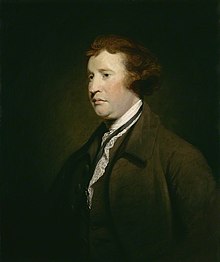
EdmundBurke1771Edmund Burke, in his 1775 Speech on the Conciliation with the Colonies, reports an American legal culture, and a law and law student culture, radically different than the one I describe today. Burke observed the “untractable” spirit of the early colonists who possessed the law as part of their powers of liberty, and were willing to actively advance these powers, rather than conform to perceptions of social custom: “This study [of law] renders men acute, inquisitive, dexterous, prompt in attack, ready in defence, full of resources. In other countries, the people, more simple, and of a less mercurial class, judge of an ill principle in government only by an actual grievance; here they anticipate the evil. They augur misgovernance at a distance; and sniff the approach of tyranny in every tainted breeze.” Do we still possess that instinct that can sense tyranny, or have we become numb and blind?

Echoing Burke, Alexander Bickel noted what is largely forgotten about constitutional law: the Supreme Court has limits to its most basic presumptions in authority (despite the Left’s determination to turn it into a super legislature): “No one is under any legal obligation to carry out a rule of constitutional law announced by the Supreme Court until someone else has conducted a successful litigation and obtained a decree directing him to do so. Any rule of constitutional law not put into effect voluntarily by officials and other persons who acquiesce in it, or not taken up by legislation and made more effective by administrative or noncoercive means—any such rule is not in our system an effective rule of law.” Judicial review is ultimately an authority of the people.

So, is law dead?  If it is, then it is only because our American adversarial culture is. That culture, however, lives loudly in every American who can summon the memory, mind, and muscle of our Colonial independence. It is also a culture of consent, and duty. As Thoreau said, “The law will never make men free; it is men who have got to make the law free.”

Where does all this leave us, then?

Since Eugene Rostow organized his conference in 1970, a major shift in current affairs is obvious, but it is also a shift in the fundamental organization of legal thinking, or the enframement, through which thinking occurs. The concepts of rights and liberties were still assumed to be reliable even in the 1970s, and safeguarded by our government and laws which were accountable under a separation of powers, and subject to broad review and appeal. Moreover, the state could not violate individual conscience: somewhere in the public domain, ultimately stood law, and ultimately, law and justice would be found. Therefore, citizens were operating in a known game with known rules.

But suppose those rules no longer hold? Suppose appeals to rights can no longer be made to a functional state, operating with a functional, coherent, and independent chief executive, judiciary and legislature? Suppose our government has broken down (or “imploded” into a central, federal authority) or has been taken over by special interests? Suppose the entire underlying social order that we have lived by, is upended (or such disruption is sought by a radical Left)? Suppose instead, an authoritarian dictatorship becomes the new social order, with only the symbolic remnants of a democracy and free market still remaining? (as Nobel economist Kenneth Arrow warned, “In ideal dictatorship, there is but one will involved in choice; there is no conflict of individual wills”).

This is where law itself indeed dies. Then, the only appropriate preemptive or corrective behavior is not merely disobedience, objection or protest within a political system, but classic American revolutionary behavior from outside it. America’s Revolutionary mind is an expression of moral law that flows from what John Adams called “the real American Revolution”—that Jefferson called “the American mind.” Whether this mind is still intact and whole is a question. If it is dormant, it is because it has fallen asleep from decades of comfort, complacency and even cultural decay:  

A living law cannot remain alive in a dormant host. 

Yet in the emerging authoritarianism of 2021, with its proposed comprehensive invasions into personal privacy, property, bank accounts, medical information, religious and political association, “carbon usage” and even thoughts, thinking and expression, this is precisely the risk of submission to a new China-style “social credit” scoring system of obedience, combined with a techno-medical tracking and control program (such as “health passports”). 

To my mind, this is exactly what the American Revolutionary spirit is made to fight and defeat—and it does so by keeping the Western legal order alive.  Justice may be blind, but law demands our eyes wide open.

MattAnderssonMatthew G. Andersson is a science and technology professional, former CEO, and author.  He attended the University of Texas at Austin and the University of Chicago. He is the author of the upcoming book "Legally Blind: How Ideology Has Captured the Law School, the Judiciary, and the Constitution,” and has testified before the U.S. Senate.

Thursday, December 3, 2020

Positive Rights vs Negative Rights

Dan Mitchell December 1, 2020 @ International Liberty

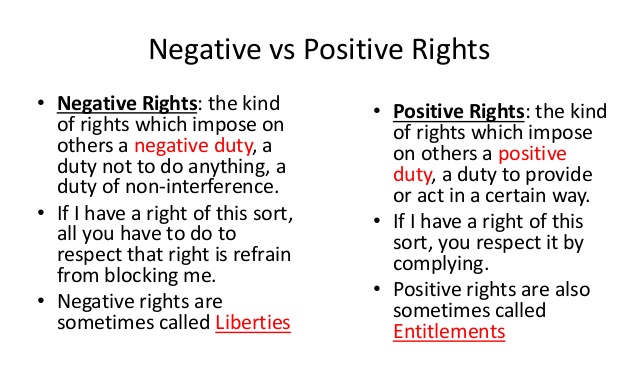
Back in 2017, I compared the welfare state vision of “positive rights” with the classical liberal vision of “negative rights.” To elaborate, here’s a video from Learn Liberty that compares these visions.

For what it’s worth, I don’t like the terms “positive rights” and “negative rights” for the simple reason that an uninformed person understandably might conclude that “positive” is good and “negative” is bad.

Needless to say, I don’t think it’s good for people to think they have a right to other people’s money.

That’s why I prefer Professor Skoble’s use of the terms “liberties” and “entitlements,” which we also find in this slide from Professor Imran Ahmad Sajid of the University of Pakistan.

As you might expect, there are plenty of politicians who try to buy votes with an agenda of “positive rights.” Bernie Sanders, for instance, constantly argued that people have a “right” to all sorts of goodies.

But he wasn’t the first to make the case for unlimited entitlements.

Franklin Roosevelt was one of America’s worst presidents, in part because his policies deepened and lengthened the Great Depression. But also because he pushed the idea that people have the right to get all sorts of taxpayer-financed handouts.


Let’s see what some other people have to say about this topic.

In his National Review column, Kevin Williamson looks at the logical fallacy of positive rights.

Positive rights run into some pretty obvious problems if you think about them for a minute, which is why so much of our political discourse is dedicated to moralistic thundering specifically designed to prevent such thinking. Consider, in the American context, the notion that health care is a right. Declaring a right in a scarce good such as health care is intellectually void, because moral declarations about rights do not change material facts. If you have five children and three apples and then declare that every child has a right to an apple of his own, then you have five children and three apples and some meaningless posturing — i.e., nothing in reality has changed, and you have added only rhetoric instead of adding apples. In the United States, we have so many doctors, so many hospitals and clinics, so many MRI machines, etc. This imposes real constraints on the provision of health care. If my doctor works 40 hours a week, does my right to health care mean that a judge can order him to work extra hours to accommodate my rights? For free? If I have a right to health care, how can a clinic or a physician charge me for exercising my right? If doctors and hospitals have rights of their own — for example, property rights in their labor and facilities — how is it that my rights supersede those rights?

And here’s what he says about “negative rights.”

A negative right is a right to not be constrained. The right to free speech, for example, implies only non-interference. The right to freedom of the press doesn’t mean the government has to give you a press. The good of negative freedom is, in the economic sense, not rivalrous — your exercise of free speech doesn’t leave less freedom of speech out there for others to enjoy

And Larry Reed opines on the issue for the Foundation for Economic Education.

America is a nation founded on the notion of rights. …Despite the centrality of rights in American history, it’s readily apparent today that Americans are of widely different views on what a right is, how many we have, where rights come from, or why we have any in the first place. …if you need something, does that mean you have a right to it? If I require a kidney, do I have a right to one of yours? Is a right something that can or should be granted or denied by majority vote?

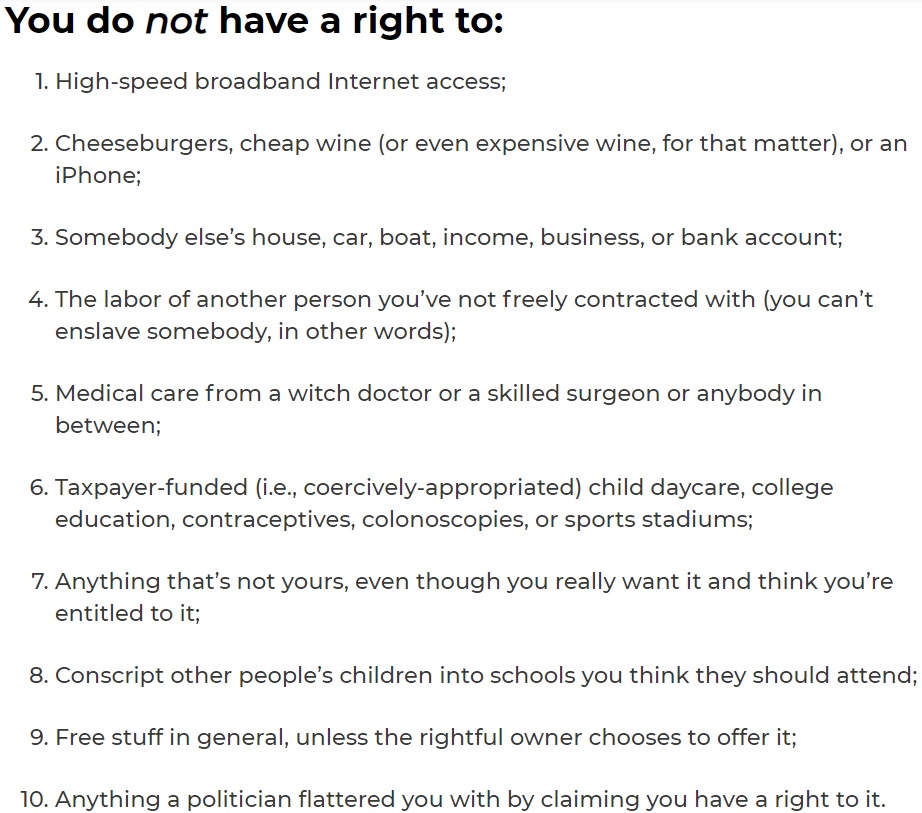
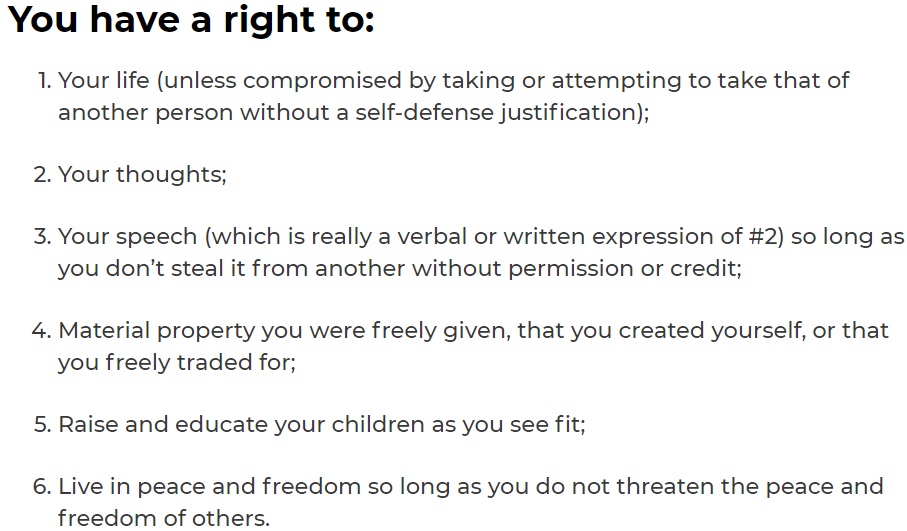
He helpfully provides a list of negative rights (a.k.a., liberties).

And he argues that positive rights (a.k.a., entitlements) are not real rights.

The bottom line, he explains, is that so-called positive rights impose obligations on other people.

Indeed, they can only be provided by coercion.

The first list comprises what are often called both “natural rights” and “negative rights”—natural because they derive from our essential nature as unique, sensate individuals and negative because they don’t impose obligations on others beyond a commitment to not violate them. The items in the second are called “positive rights” because others must give them to you or be coerced into doing so if they decline. …while I believe neither you nor I have a right to any of those disparate things in the second list, I hasten to add that we certainly have the right to seek them, to create them, to receive them as gifts from willing benefactors, or to trade for them. We just don’t have a right to compel anyone to give them to us or pay for them.

There’s not much I can add to this issue, given the wisdom contained in the video and in the articles by Williamson and Reed.

So I’ll close with the should-be-obvious point that a system based on entitlements only works if there are enough people pulling the wagon to support all the people riding in the wagon.

But that kind of society contains the seeds of its own downfall (think Greece or Venezuela) because it subsidizes dependency and penalizes production.

Which means, as Margaret Thatcher warned us, that positive rights can’t be provided when politicians run out of other people’s money.

Sunday, August 23, 2020

Rights, Religion, and Property

The State Department’s Commission on Unalienable Rights reveals an animus against natural liberties that betrays an aspiration to expand the reach of government even further.


The State Department’s Commission on Unalienable Rights has issued a report on the rationale to pursue human rights as a primary goal for American foreign policy. Rights have a bipartisan pedigree. In our modern history, it was the Democrat Jimmy Carter who first defined human rights as a U.S. foreign policy mission. But Republican Ronald Reagan and his Secretary of State George Shultz made rights advocacy a constant component of their hard-nosed negotiations with the Soviets.

Barack Obama took a different path. Reacting against his predecessor George W. Bush’s policy of democracy promotion, he and Secretary of State John Kerry proved largely oblivious to rights concerns—most egregiously in the disregard for human rights in their negotiations with Iran. 
It is surely time to bring rights back to the forefront of foreign policy—that is the context of the commission’s report.

There is also a second context: the evident fragility of the rights agenda around the world.......To Read More.......