July 29, 2020 by
Dan Mitchell @ International Liberty
My view of the U.S. economic policy often depends on whether I’m writing about
absolute levels of laissez-faire or relative levels of laissez-faire. If my column is about the former, I generally complain about
excessive spending,
punitive taxation,
senseless red tape,
easy-money monetary policy, and
trade protectionism.
(
Editor's Note:
Dan Mitchell and I are in agreement in that we both like open trade, but in the real world that just doesn't exist. If trade barriers are so bad, why then are all our trade partners imposing them? Why is it only America should not have trade barriers? World trade needs America. Does America need world trade? This isn't 1930, and this isn't Smoot Hawley, but it is an end of the Bretton Woods era. In the real world, the United States controls the game, and if they want to play in our game, they'll play by our rules. RK)
But if I’m writing about relative levels of economic liberty, I often turn into a jingoistic, pro-American flag-waver. That because – with a few exceptions such as
Singapore,
Hong Kong,
New Zealand, and
Switzerland – the United States enjoys
more economic freedom than other nations. And because of the
relationship between policy and prosperity,
this means that Americans tend to have much higher living standards
than their counterparts in other nations. Even when compared to people
in other developed countries. (Which is why it’s so disappointing that
many American politicians want to make the U.S.
more like Europe.)
Let’s examine some data. In
a column for
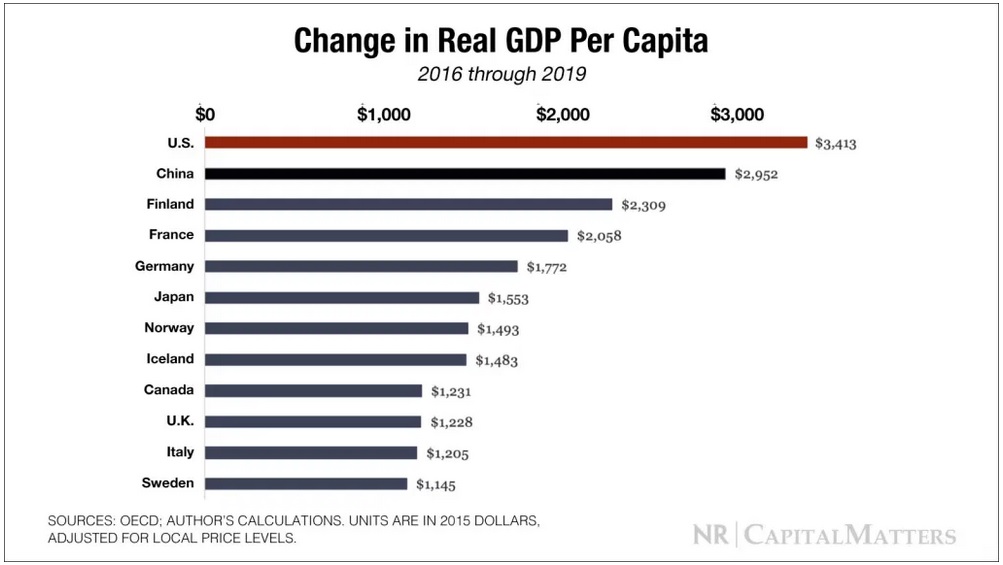
National Review, Joseph Sullivan compares recent increases in living standards for major nations.
 If you want to answer questions about how economic
wellbeing for individuals in a country has evolved, the actual change in
the value of real GDP per capita may tell you more than the rate of its
change. Why? Individuals
buy goods and services with dollars and cents — not the rates of change
that economists, politicians, and pundits tend to focus on when it
comes to growth. …By this metric, between 2016 and 2019, economic growth
in the U.S. was the best in its class. …The U.S. surpasses…its peers…by
no small margin. It bests the silver medalist in this category,
Finland, by $1,100. That is almost as big as the $1,160 that separates
the runner-up from the peer country that comes in dead last, Sweden.
If you want to answer questions about how economic
wellbeing for individuals in a country has evolved, the actual change in
the value of real GDP per capita may tell you more than the rate of its
change. Why? Individuals
buy goods and services with dollars and cents — not the rates of change
that economists, politicians, and pundits tend to focus on when it
comes to growth. …By this metric, between 2016 and 2019, economic growth
in the U.S. was the best in its class. …The U.S. surpasses…its peers…by
no small margin. It bests the silver medalist in this category,
Finland, by $1,100. That is almost as big as the $1,160 that separates
the runner-up from the peer country that comes in dead last, Sweden.
Here’s the chat from his article. The key takeaway is that Americans started the period with more per-capita GDP and the U.S. lead expanded.
That’s one way of looking at the data. A
2017 report
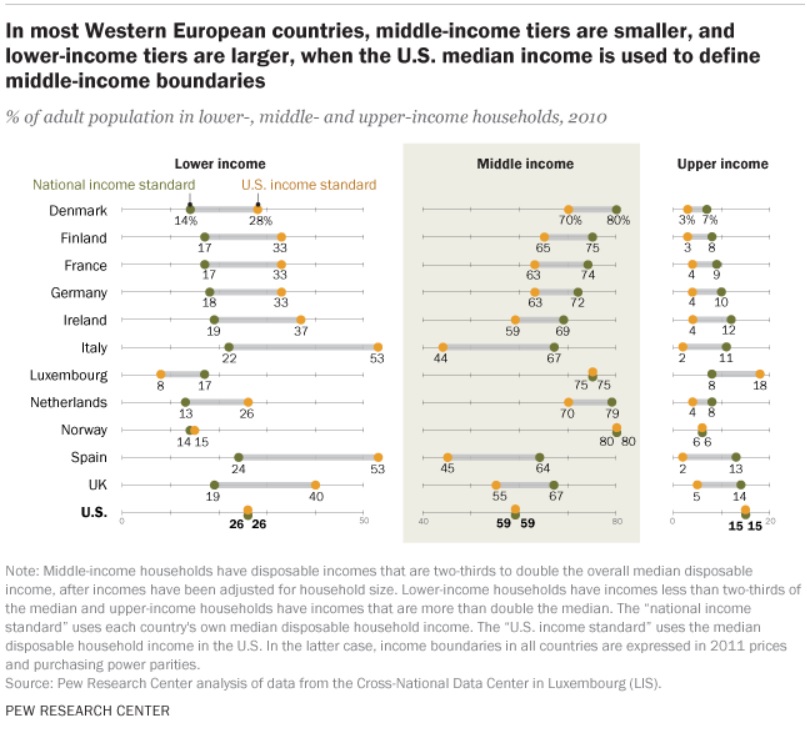
from the Pew Research Center also has some fascinating numbers about
the relative well-being of the middle class in different nations.
 …the middle class in a country consists of adults living
in households with disposable incomes ranging from two-thirds to double
the country’s own median disposable household income (adjusted
for household size). This definition allows middle-class incomes to vary
across countries, because national incomes vary across countries.
…That raises a question: What shares of adults in Western European
countries have the same standard of living as the American middle class?
…When the Western European countries the Center analyzed are viewed
through the lens of middle-class incomes in the U.S., the share of
adults who are middle class decreases in most of them. …In most Western
European countries studied, applying the U.S. standard shrinks the
middle-class share by about 10 percentage points… Applying U.S. incomes
as the middle-class standard also boosts the estimated shares of adults
who are in the lower-income tier in most Western European
countries… Overall, regardless of how middle class fortunes are
analyzed, the material standard of living in the U.S. is estimated to be
better than in most Western European countries examined.
…the middle class in a country consists of adults living
in households with disposable incomes ranging from two-thirds to double
the country’s own median disposable household income (adjusted
for household size). This definition allows middle-class incomes to vary
across countries, because national incomes vary across countries.
…That raises a question: What shares of adults in Western European
countries have the same standard of living as the American middle class?
…When the Western European countries the Center analyzed are viewed
through the lens of middle-class incomes in the U.S., the share of
adults who are middle class decreases in most of them. …In most Western
European countries studied, applying the U.S. standard shrinks the
middle-class share by about 10 percentage points… Applying U.S. incomes
as the middle-class standard also boosts the estimated shares of adults
who are in the lower-income tier in most Western European
countries… Overall, regardless of how middle class fortunes are
analyzed, the material standard of living in the U.S. is estimated to be
better than in most Western European countries examined.
The main thing to understand is that there’s a big difference between
being middle class in a rich country and being middle class in a
not-so-rich country. And if you peruse the chart from the Pew Report, you’ll notice that a
lot of middle-class Europeans would be lower-income if they lived in
the United States.
And if you looked at the issue from the other perspective,
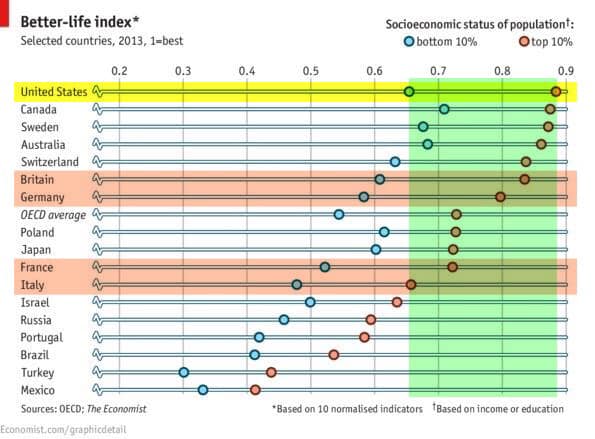
as I did last year, many poor Americans would be middle class if they lived in Europe. Let’s augment that analysis by looking at a graphic the
Economist
put together several years ago. It’s based on the OECD’s Better-Life
Index, which is a bit dodgy since it includes measures such as the
Paris-based bureaucracy’s
utterly dishonest definition of poverty. That being said, notice that the bottom 10 percent of Americans would
be middle class (or above!) if they lived in other nations.
I’ll close with
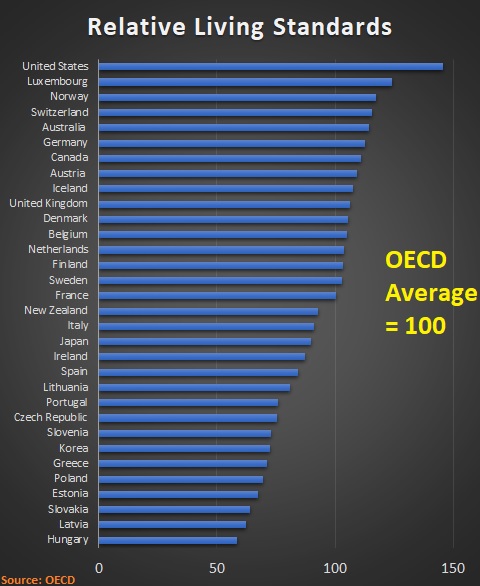
the data
on Actual Individual Consumption from the OECD, which are the numbers
that (I believe) most accurately measure relative living standards
between nations (indeed, I shared data from this source in
2010,
2014, and
2017). As you can see, the United States easily surpasses other
industrialized nations, with a score of 145.9 in 2017 (compared to the
average of 100).
My final observation is that all this data is contrary to
traditional convergence theory, which assumes that poor nations should grow faster than rich nations.
In other words, Europe should be catching up to the United States.
Indeed, that
actually happened for a couple of decades after World War II, but then many European nations
expanded welfare states in the 1960s and 1970s, while the U.S. for more economic freedom under both
Ronald Reagan and
Bill Clinton in the 1980s and 1990s.
And since policies diverged, convergence stalled. The bottom line is that rich nations can consistently out-perform poor nations if they have allow
more economic freedom.
P.S. Not only do ordinary Americans have a big edge over their European counterparts, they also
enjoy much lower taxes.