Monday, April 1, 2024

Friday, December 15, 2023
Senator Bill Cassidy, Senator Lindsey Graham, and other Pro-Tax Republicans
I’m a fan of the no-tax increase pledge for the simple reason that our greatest economic threat is the rising burden of government spending.
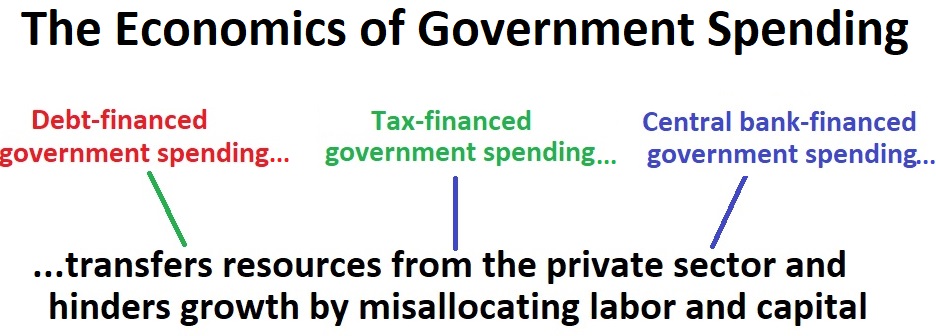
And since there are only three ways that politicians can finance spending (taxes, borrowing, and money-printing), I’m in favor of making those options more difficult.
Sadly, some GOP politicians don’t understand – or don’t care – about restraining the burden of government spending.
Using global warming as an excuse, they want a big tax on some imported goods.
The Wall Street Journal editorialized against the pro-tax wing of the Republican Party.
Too many Republicans these days have lost their economic bearings. Look no further than a GOP Senate bill that would enact a carbon tariff—i.e., a new tax. …The Foreign Pollution Fee Act, sponsored by Louisiana’s Bill Cassidy and South Carolina’s Lindsey Graham, could well have been written by the Sierra Club and AFL-CIO. …
The bill would expand the administrative state by creating a new bureaucracy with sweeping powers that would be hard for future Congresses to rein in. …the bill defines “pollution” as “greenhouse gas emissions.” This is a gift to Democrats who have been trying to codify the Supreme Court’s misconceived Massachusetts v. EPA (2007) ruling that let the Environmental Protection Agency regulate greenhouse gases as pollutants. This is the Administration’s legal justification for its back-door ban on gas-powered cars. …
The bill’s unstated purpose is to protect American businesses from foreign competition as they face rising energy costs at home owing to the government’s force-fed green-energy transition. Mr. Cassidy..’s right that rising energy prices could discourage U.S. manufacturing investment and undercut Washington’s industrial policy. But layering a carbon tax on top of sundry green-energy subsidies would raise U.S. manufacturers’ costs and create a Rube Goldberg contraption of economic distortions. …Senate Democrats last Congress introduced two carbon tariff bills, which have the added virtue for progressives of raising revenue they can spend.
Daren Bakst of the Competitive Enterprise Institute opined about this issue in a column for the Hill.

…new taxes, higher prices, punishing energy use, and giving foreign countries leverage over how the U.S. regulates. …a handful of Republicans are promoting a policy idea that will lead to those very outcomes. A carbon tariff is a tax on imported goods. It would result in American businesses and consumers paying higher prices. …
There are actually two taxes of concern with these bills: the tax on imports and a domestic carbon tax. Once an emissions measuring scheme for domestic and foreign products has been established to impose a carbon tariff, it will also put in place the structure necessary for domestic carbon tax advocates to impose this new tax on Americans.
It would be naïve to think otherwise. In fact, a domestic carbon tax would likely be required in order to impose a carbon tariff that complies with our international trade obligations. …a carbon tariff is a tax on the energy that makes modern life possible and keeps billions of people alive every winter.
Put more simply, it’s a tax on modern life. It would, among other things, make medical care, housing, communications, and transportation less affordable, especially for people who already struggle to pay their bills. …Policymakers, regardless of party, should reject anything connected to carbon tariffs. After all, higher taxes and higher prices are terrible policy and will undermine the economic wellbeing of all Americans.
I don’t like carbon taxes, but I don’t want to focus on that issue (you can read my thoughts here).
I don’t like carbon protectionism, but I don’t want to focus on that issue (you can read my thoughts here).
I don’t like any type of protectionism, but I don’t want to focus on that issue (you can read my thought here).
Instead, I want to stress a very simple point. The Republicans pushing this new tax could have made their plan fiscally legitimate – and perhaps even defensible – by including an offsetting tax cut.
In other words, if their proposed tax would generate X billion dollars, their legislation should also include provisions reducing other taxes by X billion dollars.
Depending on the size of their tax increase, it might generate enough revenue to get rid of the capital gains tax. Or the death tax.
There are many attractive and much-needed tax cuts. The fact that supporters did not propose offsetting tax cuts is a giant red flag.
P.S. Some supporters have tried to justify this tax increase by claiming that it’s just a way of punishing China.
But Daren Bakst debunked that claim in his column.
…if Cassidy is really concerned with China’s emissions, he should develop legislation that is specifically targeted at China, which doesn’t simultaneously torpedo America’s well-being. …There is something far more direct that Cassidy could do to address China’s emissions: propose that China no longer be considered a developing country in environmental agreements. China’s current designation as a developing country means that China doesn’t have the same emissions reduction obligations as the U.S.
P.P.S. Even though I said I wouldn’t address the issue of carbon taxes, I can’t resist making one final observation. Some of the supporters of carbon-based tariffs claim they are against carbon taxes. But this reminds me of the fight back in 2017 when some Republicans were pushing a “destination-based cash-flow tax” that would have set the stage for a value-added tax. The one big difference is that at least supporters of the DBCFT proposed offsetting tax cuts. So their hearts were in the right place. Too bad we can’t say the same for Republicans who are pushing for carbon protectionism today.
Wednesday, July 13, 2022
Court blocks Pennsylvania carbon pricing scheme
By
|July 12th, 2022|Energy|66 Comments @CFACT

“Don’t let activists who believe that putting Pennsylvanians out of work will help ‘save the planet.’ It’s time to confront the wannabe planet savers here in this room and this state and tell them not only NO, but HELL NO.”
That's what CFACT's Marc Morano declared before the Pennsylvania House of Representatives when Governor Tom Wolf tried to push The Keystone State into “The Regional Greenhouse Gas Initiative” (aka RGGI) scheme without authorization by law. A state court agreed and blocked Wolf's power grab as an attempt to establish an “unlawful tax.” The court said plaintiffs “raised a substantial legal question” since taxing is a power that is supposed to be wielded by the Pennsylvania General Assembly rather than the Executive. As reported by the AP, “The Power Pa Jobs Alliance, a coalition of industry and labor groups, said that power plant operators would have started paying what it called the ‘carbon tax’ on Friday had the court not issued its injunction. It contends the carbon policy will impose higher electricity costs on consumers. The group called Friday’s ruling a ‘significant win for working families.’” Winning court decisions are important and cause for celebration. But we must remind ourselves that oftentimes they’re only isolated “battles” and don’t necessarily determine the larger outcome. Take, for example, how the Biden Administration is brazenly moving forward on its climate agenda despite the fact the Supreme Court handed them a stinging defeat on regulating carbon dioxide emissions in West Virginia v. EPA. No sooner did the court wallop them, than Transportation Secretary Pete Buttigieg rolled out plans to regulate CO2 emissions from motor vehicles and boost his power over the states in ways Congress never intended. As CFACT senior policy analyst Bonner Cohen reported at CFACT.org:
“One week after the U.S. Supreme Court ruled that the Environmental Protection Agency could not regulate carbon dioxide emissions from power plants because the agency lacks congressional authorization to do so, the Biden Department of Transportation (DOT) proposed a rule targeting CO2 emissions from highway vehicles, for which DOT also has no legal authority.”
“In a rare moment of regulatory candor, the administration acknowledges in the docket supporting DOT’s proposed rule that DOT’s scheme will ultimately encourage Americans to switch from gasoline-powered cars to EVs.”
For those on the Left, court decisions are a useful tool if they propel their agenda forward -- but if they suffer a setback then they proceed on as though it’s just business as usual. They need to lose again and again to force compliance. Let's hope the courts continue to teach Governor Wolf, Secretary Buttigieg and their armies of bureaucrats a sorely needed lesson in constitutional checks and balances. For nature and people too! |
Thursday, June 27, 2019
Climate Crusaders Defeated in Oregon—For Now
The carbon tax that so disrupted Canadian and French politics is now threatening Oregon, and it brings with it all the controversy, political shenanigans, dishonesty, and public uproar that made it infamous.
The political debate over the carbon tax has become so underhanded and undemocratic that the entire state senate Republican caucus walked out in protest, making unexpected national news. The carbon tax appears finally to have imploded this week in no small part because of the protests.
Selling a carbon tax to Oregon voters has been difficult because Democrats cannot hide the fact that it would cost people 22 cents more per gallon at the gas pump (a $3 increase by 2050) and anywhere from 11 percent to 50 percent more in utility costs. It is a high price to pay for a state already saddled with one of the lowest carbon emissions standards in the nation. One of Oregon’s most famous lumber mills dating to the 1800s, Stimson Lumber, announced it would lay off all its workers and move to Idaho, in part, to escape the proposed taxes and regulations. That is how punishing the carbon tax is shaping up to be...........To Read More.....
Monday, February 4, 2019
Carbon Tax Salesmanship: A Case Study of Political Dishonesty
Maybe I’m just old-fashioned, but I don’t believe in using dodgy numbers or nonsensical analysis – even if that would help my side in a policy debate.
And it goes without saying that I also don’t like when the other side is dishonest. But I’m not talking about my left-leaning friends who have genuine (albeit misguided) views on things such as Keynesian economics or the minimum wage.
I’m talking about people who deliberately dissemble and prevaricate in hopes of advancing their policy agenda.
Consider, for instance, the new carbon tax that has been introduced by Congressmen Ted Deutch (D-FL) and Patrick Rooney (R-FL). The core features of the bill are:
- A $15-per-ton carbon tax that increases $10 each subsequent year until it reaches $100.
- A new entitlement program giving money to all legal American residents, including children.
- A new tax on consumers who buy imports from nations without similar taxes on energy usage.
- A supposed adjustment and easing of existing regulations governing carbon emissions.
But what irks me is that the sponsoring lawmakers are openly and deliberately lying about a key part of their plan. Here’s the relevant section from their talking points.

The claim about “revenue neutrality” is a stunning level of dishonesty, even by Washington standards.
At the risk of stating the obvious, if the government imposes a tax and then also creates a program to give money to people, that’s not revenue neutrality.
Was Obamacare “revenue neutral” because all the new taxes were balanced out by the handouts and subsidies that the law created for the big insurance companies?
Of course not.
And a new carbon tax doesn’t magically become “revenue neutral” because new revenues are matched by new spending.
To be sure, supporters can argue that their plan is “deficit neutral,” and that would be legitimate (even though I would argue that this wouldn’t be the case in the long run because of the adverse economic impact of new taxes and new spending).
But “revenue neutral” is a bald-faced lie.
The Daily Caller reported on this amazing example of deceptive advertising, citing the good work of Paul Blair of Americans for Tax Reform.
By the way, just in case anyone thinks I’m imposing some weird, libertarian-ish, meaning to “revenue neutral,” you may want to look at how the left-leaning Tax Policy Center defines the term.The bipartisan House Climate Solutions Caucus claims it is pushing a “revenue-neutral” carbon tax, but legislation proposed Thursday would hike taxes by at least $1 trillion over the next decade… Florida Reps. Ted Deutch, a Democrat, and Francis Rooney, a Republican, reintroduced a bill Thursday that would place a $15-per-ton tax on carbon emissions in 2019. The tax would rise by $10-a-year increments until it hits nearly $100 per ton. …Though Rooney claims the tax is “revenue-neutral,” the plain text of the bill does not include any reciprocal tax cuts to balance out the burden of the added tax on emissions… “Historically and for anyone engaged in tax policy, the definition of ‘revenue-neutral’ is and always has been if you increase a tax, the amount of revenue it generates must be offset by an equal tax cut elsewhere,” Blair said. …Blair said…that the “apology checks” sent as carbon dividends will be treated as new spending and do not negate a new tax burden.

Revenue-neutral. A term applied to tax proposals in which provisions that raise revenues offset provisions that lose revenues so the proposal in total has no net revenue cost or increase.I often disagree with the folks at the Tax Policy Center, but I’ve never questioned their honesty.
So when we both agree on the definition of ‘revenue neutral,” this is slam-dunk confirmation that it’s preposterously dishonest to count new spending as an offset to a tax increase.
P.S. Some of my friends and allies who supported the Fair Tax sometimes played fast and loose with the truth. That plan would have required the government to send “prebate” checks to households to partly compensate people for the new tax, yet supporters would argue that this expenditure shouldn’t count as a new entitlement program. While my first choice for tax reform is the flat tax, I certainly think a national sales tax would be a far better way to tax than the mess we have today, but that did not justify mischaracterizing the plan.
Wednesday, December 26, 2018
Fiscal Fights with Friends: If a Carbon Tax Is Imposed, Hauser’s Law Won’t Protect America from Bigger Government
- In Part I, I defended the flat tax, which had been criticized by Reihan Salam
- In Part II, I explained why I thought a comprehensive fiscal package from the American Enterprise Institute was too timid.
- In Part III, I disagreed with Jerry Taylor’s argument for a carbon tax.
- In Part IV, I highlighted reasons why conservatives should reject a federal program for paid parental leave.
They also claim that higher taxes don’t lead to more spending.…There have been numerous tax rate changes in the past 70 years, with the marginal income tax rate falling from a high of over 90 percent in the 1950s to as low as 28 percent in the late 1980s. Yet during this entire time period, federal tax revenue has stayed in a fairly narrow band when measured as a percentage of gross domestic product, never rising above 20 percent or falling much below 15 percent between 1950 and 2018. This phenomenon, which keeps federal revenues within a relatively narrow band, is known as Hauser’s law…the belief that any kind of new taxation introduces even greater government spending is based on very little actual evidence. Instead, Hauser’s law provides evidence that certain kinds of tax swaps, such as exchanging an income tax for a carbon tax, may actually increase the rate of economic growth without increasing the tax share of the overall economy.

…demand for government spending drives tax policy, not the other way around. This conclusion has important implications for the carbon tax debate. …The relative imperviousness of the gross domestic product tax percent equilibrium since the late 1940s suggests that spending pressures drive taxes and not the other way around.I have two responses to this analysis.
First, I very much want Hauser’s Law to be true. It would be very comforting if politicians in Washington could never seize more than 20 percent of the private sector’s output.
Sadly, that’s simply not the case. Just look at Europe, where central governments routinely extract far more than 40 percent of economic output.

All that’s required is taxes that target lower- and middle-income taxpayers. That’s happened in Europe because of harsh value-added taxes, punitive payroll taxes, onerous energy taxes, and income taxes that impose very high rates on ordinary people.
Needless to say, a carbon tax would be a step in that direction.
Second, the authors offer zero evidence that “government spending drives tax policy, not the other way around.”
By contrast, there is some persuasive data for the “starve the beast” hypothesis, which is based on the notion that higher taxes will encourage more spending.
In other words, Milton Friedman was right when he warned that “History shows that over a long period of time government will spend whatever the tax system raises plus as much more as it can get away with.”
Though I actually don’t think this causality debate is very important. The bottom line is that higher taxes are a bad idea if they trigger higher spending, and higher taxes also are a bad idea if they merely enable higher spending.
The column in the Hill is a spin-off from a recent study published by the R Street Institute.
Let’s look at that publication to further explore this issue. It starts with the basic hypothesis that a revenue-neutral carbon tax would be desirable.
I don’t object to the notion that a carbon tax would be theoretically desirable if it replaced a tax that did more damage per dollar collected, such as the corporate income tax.…a carbon tax…provides a source of revenue that can be put to beneficial purposes, such as funding cuts to other existing taxes. By using the revenue from a carbon tax to replace existing ones, such a revenue neutral “tax swap” would greatly reduce or eliminate the economic costs of the tax. Indeed, in some cases, even if benefits from reduced emissions are not considered, a tax swap could be a net positive for the economy. …many critics of a carbon tax are skeptical as to whether a revenue-neutral carbon tax could be enacted. Some critics go further, arguing that even if a carbon tax started out as revenue neutral, it would not remain so. …While there are no guarantees, the existing evidence suggests that a revenue-neutral carbon tax would not lead to larger government over the long term and could even shrink it.
My concern has always been such a swap is highly unlikely. Indeed, many proponents of the carbon tax are very explicit about wanting to use the revenues to create a new entitlement. That would be the worst outcome, assuming we want more growth.
And, as noted above, I don’t think Hauser’s Law would save us from higher overall taxes and a larger burden of government spending.
Interestingly, the study basically acknowledges the same thing.
…given that Hauser’s Law is not an iron law of economics, it would be imprudent to put too much weight on it when considering the effects of a tax swap.There are a couple of other parts of the study that deserve attention, including the assertion that politicians would have a hard time using the carbon tax as a money machine.
…a carbon tax has natural limitations that preclude it from being used to generate ever-increasing amounts of tax revenue. This is because higher carbon-tax rates induce a more rapid fall in greenhouse gas emissions. This, in turn, limits the overall revenue collected from the tax. In fact, unlike revenue from income, sales or property taxes, which tends to increase over time even at a constant tax rate, revenue from a carbon tax is likely to remain stable or fall gradually as emissions decline.Since I’m a fan of the Laffer Curve, I think this argument is very reasonable in theory.
In effect, the R Street Institute is making the same argument – excessive tax rates can reduce revenue – that Alexander Hamilton used when endorsing tariffs.
But where is the point where carbon taxes become excessive? I don’t know the answer, but I’m very worried that there would be ample leeway to collect a lot of tax revenue before getting close to the revenue-maximizing point (the Congressional Budget Office estimates that a $25-per-ton carbon tax would generate more than $1 trillion in the first ten years).
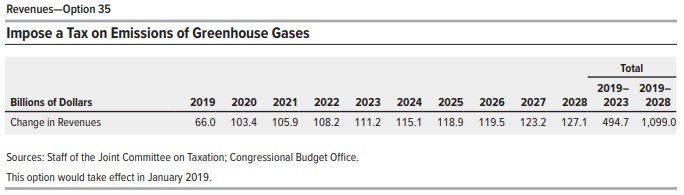
The bottom line is that I worry that a carbon tax likely would be akin to a value-added tax. Yes, there are negative feedback effects from a VAT, as I noted at the end of yesterday’s column. But that doesn’t change the fact that the revenue-generating capacity of the VAT helps to explain Europe’s bloated welfare states.
I understand how a carbon tax, in theory, might not enable bigger government. But I see no way, in reality, that politicians wouldn’t use this new levy to finance even more spending.
P.S. If you’re not already convinced that a carbon tax will mean bigger government, then all you need to know is that both the International Monetary Fund and the Organization for Economic Cooperation and Development support higher energy taxes for the United States.
Wednesday, December 12, 2018
Climate Interventionists Won't Stop with a Carbon Tax
Say what you will about the climate policy discussions at Vox, but they don’t mince words. They come right out and tell you how much they want to micromanage every last detail of your life. Vox’s resident expert, David Roberts, recently interviewed policy wonk and author Hal Harvey, to discuss which areas of society government should regulate in the name of slowing climate change.
Everything was on the table—ranging from building codes to auto fuel efficiency to diet to family size—with the only debate being over the relative results from the various interventions.
A Carbon Tax Is Not Enough
Let me validate the carbon tax claim first. Here’s the key exchange from the Vox interview...........To Read More....
Saturday, February 24, 2018
“Revenue neutral” nonsense
There are a lot of wacky schemes around for forcing people to stop using carbon-based energy, even though fire is still the basis for human civilization. The economists like carbon taxes, because in economics a tax is not a cost, just a transfer. Those who pay these taxes disagree, but no one ever said that economics is a sensible science.
Here the “revenue neutrality” idea is that the government does not get any new revenue from the tax, because it is offset somehow. On common proposal is to reduce some other taxes. But this does not work because there is no way to match these other tax cuts with what poor people spend on energy.
Instead we get various refund schemes, one of the best known being the so-called “Carbon Fee and Dividend” proposal. This little hummer is being flogged by a group called The Citizen’s Climate Lobby (CCL), which includes James “death trains” Hansen, one of the world’s leading climate alarmists.
The deception begins with the name. The tax is called a fee and the refund is called a dividend. Giving back money you have previously taken is not a divided and a tax on something that you could get without it is not a fee.
The funny thing about these tax and refund schemes is that if they work then they fail to meet their objective. If you jack up what the poor pay for energy, but pay them the difference, then they have no reason to change their behavior.
Nor can this scheme work because there is no way to track what people pay for energy, plus how much tax they paid, and correctly calculate their refund. The administrative costs, which are subtracted from the refunds, would be astronomical. Not to mention that everyone would have to report every energy related bill or charge that they paid. It would make the income tax, which is arguably the most complex reporting system ever created, look simple.
The CCL folks acknowledge this impossibility by using a simple “average household” refund scheme. That it does not work they admit this way:
“About two-thirds of households will break even or receive more than they would pay in higher prices.”
This means that fully one-third of households will receive less than they will pay in higher prices. So we can expect a lot of wealth redistribution.
Actually, given the administrative cost of collecting and redistributing the many billions of dollars envisioned in this scheme, it is not clear that anyone will benefit. Nor is this revenue stream likely to be left alone. Governments tend to want to use the money they get, rather than giving it back.
The tax itself is huge, which is what you would expect from climate alarmists out to change how people live. CCL puts it this way:
“We propose an initial fee of $15/ton on the CO2 equivalent emissions of fossil fuels, escalating $10/ton/year, imposed upstream at the mine, well or port of entry.”
$15/ton is a fairly standard proposal for a carbon tax, but this is on CO2 which more than triples it. But then it grows rapidly by $10/year, which puts it over $100 in a decade, $200 in twenty years and up it keeps going. The resulting price increases would be horrendous, especially for the poor.
It is also worth noting that generally speaking the earlier a price increase occurs in the supply chain the bigger it gets by the time the consumer buys the stuff. This is because each intermediate step tends to apply a constant percentage increase.
It is not surprising that CCL looks to be run mostly by a combination of greens and politicians. Their advisory board includes a number of top alarmists. They also have an indoctrination group called Citizens’ Climate Education.
So all things considered CCL is a heavy duty lobbying group out to tax the hell out of energy. Promising to give the money more or less back is a great vote getter when it comes to carbon taxes, but it does not make them any less dangerous, maybe even more so.
The greens are out to take over and control the global energy supply and this is just one of the many ways they are trying to do it. The siren song of “revenue neutrality” is still a scam.
About the Author: David Wojick, Ph.D. is a journalist and policy analyst. He holds a doctorate in epistemology, specializing in the field of Mathematical Logic and Conceptual Analysis.
Tuesday, September 26, 2017
Carbon tax war among conservatives heats up
A fight brewing beneath the surface over Republican support for a carbon tax is about to come to a head this week as Congress shifts its focus to tax reform and the climate policy gains traction inside conservative ranks.
A host of conservative groups such as the Americans for Tax Reform, led by Grover Norquist, are trying to discourage the GOP from entertaining a carbon tax or placing a price on greenhouse gas emissions, an idea that a handful of libertarian and conservative groups support.
The carbon tax would apply an across-the-board per-ton fee on carbon dioxide emissions, which proponents hope would send the markets a signal to reduce fossil fuel use and encourage clean energy development. Many scientists blame the burning of fossil fuels, which increase carbon dioxide emissions, for raising the average temperature of the Earth with potentially disastrous consequences.
Norquist and others such as Americans for Prosperity are trying to label at least two groups as liberals "masquerading" as conservatives by actively supporting the idea of a carbon tax or carbon price as a legitimate middle ground to liberal policies such as tax credits and subsidies........Hillary Clinton's recently revealed new book said that she is "fascinated" by the idea of a carbon tax, he said.
Graham's endorsement was evidence of the "liberal" conservative groups gaining a foothold in the Republican Party........Graham said......... "I'm a Republican. I believe that the greenhouse effect is real, that CO2 emissions generated by man is creating our greenhouse gas effect that traps heat, and the planet is warming," ..........Sen. John McCain, R-Ariz., also voiced support for addressing climate change in a pre-recorded message.........."The reality is … only a handful of organizations masquerading as a conservative organization" are pushing for a carbon tax, said Christine Harbin, vice president for external affairs at Americans for Prosperity.........."On the policy side, this is a way to raise revenue for government under the guise of helping the environment, but it's actually quite dangerous,"
He said that is one of the only areas where Norquist and others are accurate, "and they are right to be worried."............To Read More....
My Take - Graham and McCain are now and have always been a disgrace, it's just so much easier to see it now. The Republican Party is so fragmented with RINO's, liberal Democrats claiming to be Republicans - all claiming to represent conservative values, the Republican Party is a disgrace.
Then there are the likes of John Kasich, who I expect to see change parties after he's out of office in January of 2019, if not before, and then to announce he going to run for President on the Democrat ticket not long after.
As you peruse this article please note how these "conservatives" utilize what George Orwell called Double Think, a component of Newspeak, in his book 1984 where "War is Peace; Freedom is Slavery; Ignorance is Strength;" good is bad and bad is good and in this case - more government, more taxes and more regulations are conservative, capitalism and free market enterprise. Is it any wonder most people wish a pox on both parties?
I do wish more people had read 1984 and Animal Farm.
Saturday, October 22, 2016
Global Cooling: Stronger-Than-Expected La Niña May Be Brewing
Many have doubted forecasts calling for the onset of the first La Niña in almost five years, believing that its failure to materialize in convincing fashion last summer – as originally predicted – means that it may be off the table for 2016-17. But in recent weeks, the oceans and atmosphere have been pulling everything into place to facilitate a potentially stronger La Niña than previously thought, so those who follow commodities markets may want to take a second look. Cooling sea surface temperatures in the key Niño 3.4 region have touched the levels of early 2012. --Karen Braun, Reuters, 20 October 2016
The French government is set to drop plans to introduce a carbon tax, French financial daily Les Echos said on Thursday. The newspaper, quoting several sources, said the socialist government will not include the carbon tax in a draft 2016 budget update currently being discussed. Environment Minister Segolene Royal had said in May that France would unilaterally introduce a carbon price floor of about 30 euros ($33) a tonne with a view to kickstart broader European action to cut emissions and drive forward the December 2015 United Nations-led international climate accord. The plan had pushed power prices higher in the spring. --Reuters, 21 October 2016
France produced the most power from fossil fuels for September in 32 years to help meet demand as nuclear generation dropped. Output from coal and gas plants more than doubled as Paris-based Electricite de France SA was forced to keep reactors offline for inspections. French month-ahead power prices have risen to near the highest since 2009. “The availability of French nuclear continues to alarm market participants,” said Bruno Brunetti, managing director of global power at Pira Energy Group in New York. “With the lack of French exports supporting thermal generation, we have revised upward forecasts of coal-fired dispatching by roughly 5 terawatt-hours through 2017 in western Europe.” --Rachel Morison, Bloomberg 18 October 2016
The recent South Australian blackout has triggered a debate about the manifest risks of wind farms to the security of electricity networks. National Grid’s 2016/17 Winter Outlook reinforces previous concerns that low-carbon policy mandates are resulting in electricity systems that are likely to be fragile in the face of external shock, and are therefore more difficult and consequently more expensive to manage. Read together, National Grid’s UK Winter Outlook and AEMO’s reports on the South Australian case, suggest that systems heavily exposed to wind generation tend to be fragile, and rendering such systems adequately robust is both difficult and, crucially, expensive. --John Constable, Global Warming Policy Forum, 20 October 2016
The UK has joined Poland and a small group of other EU countries lobbying to delay tougher pollution rules for coal power stations ahead of discussions in Brussels on Thursday. In a letter seen by the FT, Thérèse Coffey, the UK’s environment minister, warned the EU environment commissioner, Karmenu Vella, that the “uncertain global economic climate” means new pollution regulations should not impose “a disproportionate financial cost or technical burden on industry”. Along with her counterparts from Poland, Greece, Finland and the Czech Republic, Ms Coffey believes more time should be given to a “comprehensive consideration” of the “significant” impact of new limits to be set under the EU’s main industry pollution law, the Industrial Emissions Directive. --Pilita Clark, Financial Times, 20 October 2016
Oil and gas companies are valued largely on reserves that will be produced over the next 15 years, meaning that their investors are not vulnerable to longer-term changes in energy markets, a leading industry adviser has said. Daniel Yergin of IHS Markit rejected warnings of a “carbon bubble” that could destabilise financial markets as policies to combat climate change hit fossil fuel producers, saying the transition to renewable energy would take decades and investors would have time to adjust their holdings. In a paper published on Wednesday, Mr Yergin argued that the concerns expressed by Mr Carney and others have been overdone, because investors generally look at relatively short time horizons when valuing oil and gas assets. --Ed Crooks, Financial Times, 19 October 2016
A former Greenpeace leader butted heads Tuesday with the anti-fracking movement by insisting that hydraulic fracturing is needed to help fight global warming. Stephen Tindale, who was executive director of Greenpeace U.K. from 2000 to 2005, said that fracking, used to extract natural gas and oil from underground rock, helps combat greenhouse-gas emissions by reducing reliance on coal. “[T]oday Britain faces its biggest environmental challenge ever — tackling global warming while still keeping the lights on,” Mr. Tindale said in the Tuesday article for the [U.K.] Sun. “And as a lifelong champion of the Green cause, I’m convinced that fracking is not the problem but a central part of the answer.” --Valerie Richardson, The Washington Times, 19 October 2016
Thursday, December 12, 2013
From Benny Peiser's Global Warming Policy Foundation

The American Meteorological Society seems to be upset by a survey that shows that only 52% of their members believe that global warming is mostly man-made. I am sure that is jolly inconvenient for them, but it is exactly what the results of their survey show. --Paul Homewood, Not A Lot Of People Know That, 6 December 2013
Britain’s unilateral carbon tax should be scrapped before it causes blackouts, pushes up household bills and makes the UK uncompetitive, ScottishPower argues. Keith Anderson, chief corporate officer, warns that the “carbon price floor” (CPF), which taxes companies for burning fossil fuels, will make Britain’s remaining coal plants “largely uneconomic by around the middle of the decade”. With Britain’s spare power margin already forecast to fall as low as 2pc by 2015, the carbon tax will force more closures and “threatens to make us even more vulnerable to the risk of blackouts”, he warns. --Emily Gosden, The Daily Telegraph, 9 December 2013
Most draining for [deputy Prime Minister] Nick Clegg has been keeping the Coalition on — as he sees it — the straight and narrow on green issues. George Osborne, eager to remove barriers to recovery and much influenced by Nigel Lawson’s sceptical writings, has grown increasingly impatient with the green agenda. Yet even this, Clegg presents as an example of how the Coalition works successfully. --Matthew D'Ancona, The Sunday Telegraph, 8 December 2013
The heightened political risk faced by the UK utility sector following the announcement of the Labour Party’s price freeze has materially impacted on the valuation of the sector and reversed the five year utility sector trade of Long UK / Short Europe. Total shareholder value lost so far amounts to between £7bn to £11bn. In our view, if the UK government is successful in politically neutralising Labour’s price freeze policy then some of this loss, but probably not all, could be regained. Some of the loss is likely to be permanent in our view because it is now apparent that UK politicians (like those in Europe) are unwilling to stand by the logic of their own energy policy and enforce the higher costs onto consumers that naturally follow from their de-carbonisation strategy. --Peter Atherton & Mulu Sun, Liberum Capital, 5 December 2013
It has long been obvious that by far the most delusional element in the Government’s shambles of an energy policy is how it subordinates all else to an obsession with building thousands of hopelessly inefficient and absurdly oversubsidised windmills. This is now only made worse by George Osborne’s bid to appease his backbenchers by transferring a fraction of the 100 per cent subsidy paid to those increasingly unpopular onshore wind farms to the giant offshore wind farms, which already receive a 200 per cent subsidy, making such electricity as they produce six times more expensive than that we get from coal. --Christopher Booker, The Sunday Telegraph, 8 December 2013
The Committee on Climate Change mistakenly believe that the UK’s post-2022 CO2 targets are legally binding under the Climate Change Act. This is not the case. When the fourth carbon budget was agreed in 2011, the government confirmed that these targets were conditional on the EU adopting similar targets. George Osborne has stated categorically that Britain will not “cut carbon emissions faster than our fellow countries in Europe.” Given the EU’s manifest reluctance to follow Britain’s lead, there is no chance that the government will adopt new unilateral targets. The decision on post-2020 CO2 targets is likely to be postponed until and unless there is a legally binding agreement at the 2015 UN climate summit in Paris. –Benny Peiser, The Global Warming Policy Foundation, 11 December 2013
Will temperatures on Earth be dropping until the year 2100 to Little Ice Age levels, as Horst-Joachim Lüdecke, a scientist at Germany's Saarland University, predicted last week? Or will the temperatures only plunge until 2060, as Habibullo Abdussamatov, the head of Russia's Pulkovo Observatory, recently predicted? Or has the cooling already begun, and might it end as soon as 2030, as claimed by Anastasios Tsonis, head of the Atmospheric Sciences Group at the University of Wisconsin? --Lawrence Solomon, Huffington Post, 10 December 2013
Spain changed environmental rules to speed approvals on industrial projects from pig farms to oil rigs and for the first time will regulate shale drilling. “This is a step in the right direction,” Lars Hubert, exploration manager for shale at San Leon Energy Plc (SLE), said by telephone from Poland. “It should make permitting easier.” The Dublin-based company has four Spanish licenses to prospect for shale rock and six more awaiting approval. --Todd White, Bloomberg, 10 December 2013