Search This Blog

De Omnibus Dubitandum - Lux Veritas

Showing posts with label Biofuels. Show all posts

Saturday, December 21, 2019

No end in sight for the biofuel wars

By | December 18th, 2019 |Energy|13 Comments

The Big Oil-Big Biofuel wars rage on. From my perch, ethanol, biodiesel and “advanced biofuels” make about zero energy, economic or environmental sense. They make little political sense either, until you recognize that politics is largely driven by crony-capitalism, campaign contributions and vote hustling.

Even now, once again, as you read this, White House, EPA, Energy, Agriculture and corporate factions are battling it out, trying to get President Trump to sign off on their preferred “compromise” – over how much ethanol must be blended into gasoline, how many small refiners should be exempted, et cetera.

This all got started in the 1970s, when publicly spirited citizens persuaded Congress that “growing our own energy” would safeguard the USA against oil embargoes and price gouging by OPEC and other unfriendly nations, especially as our own petroleum reserves rapidly dwindled into oblivion. Congress then instituted the Renewable Fuels Standard in 2005, when the Iraq War triggered renewed fears of global oil supply disruptions. The RFS requires that almost all gasoline sold in the USA must contain 10% ethanol – which gets a third fewer miles per gallon than gasoline and damages small engines.

Yet, we were told these fuels are renewable, sustainable, a way to prevent “dangerous climate change.”

It’s all bunk. In recent years, the horizontal drilling and hydraulic fracturing (fracking) revolution has given America and the world at least a century of new oil and natural gas reserves. America has become the world’s largest oil and gas producer and within five years could be producing far more oil and gas than any other country in the world. Terminals built years ago to import fuel from distant lands are being reconfigured to export abundant US oil, liquefied natural gas and refined products to distant lands.

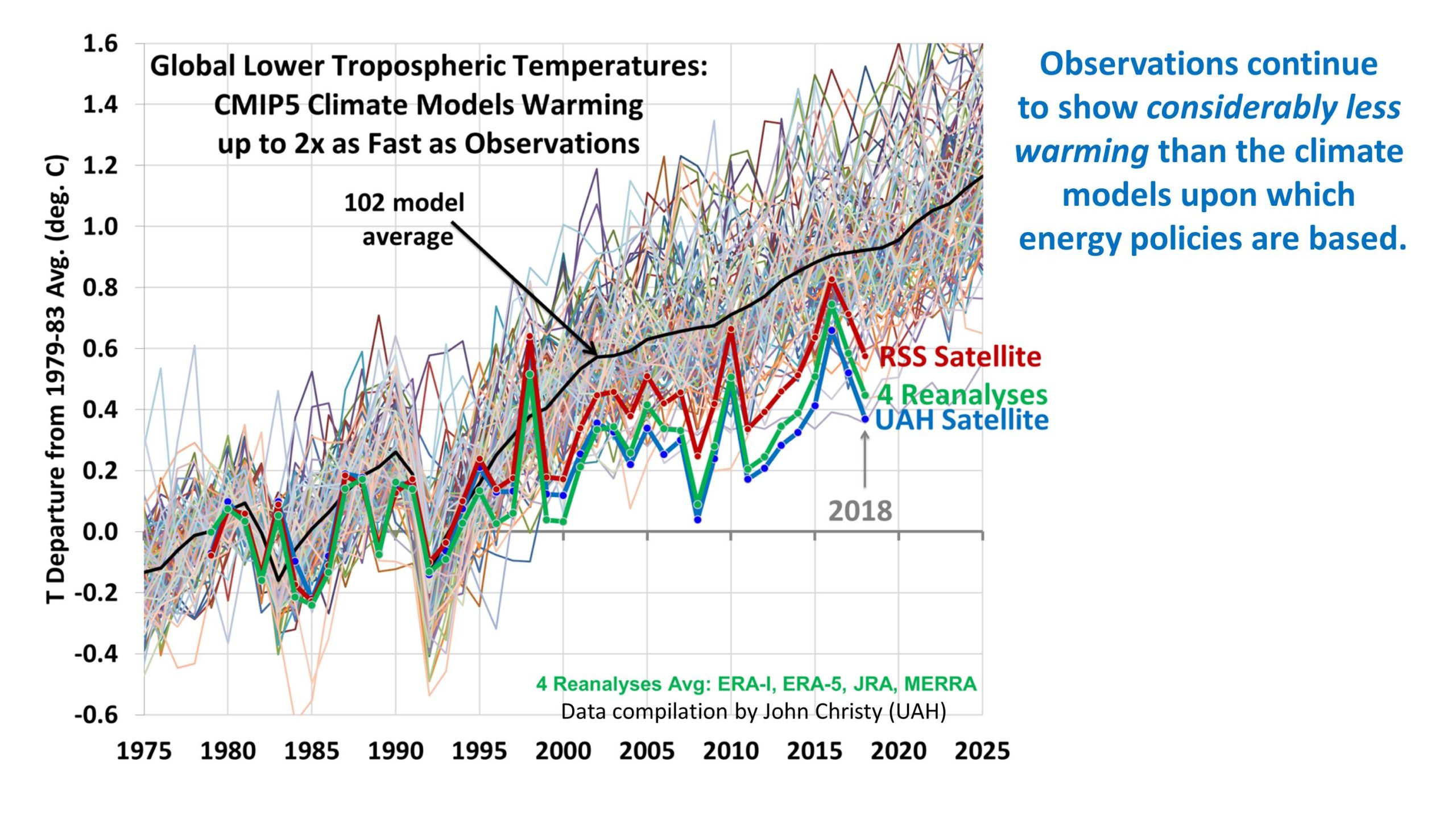
Average global temperatures – as actually measured by satellites and weather balloons – are now almost a full degree Fahrenheit lower than predicted by climate models (the average of 102 IPCC computer model forecasts) that also foretell the daily litany of climate and weather cataclysms.

However, hurricanes are less frequent and intense than a half-century ago, and Harvey was the first Category 3-5 hurricane to make US landfall in a record 12 years. Violent F4-5 tornadoes have also been less frequent over the past 34 years than during the 35 years before that, and not one F4-5 tornado hit the USA in 2018.

Over their full life cycle (from planting, growing and harvesting crops, to converting them to fuel, to transporting them by truck or rail car, to blending and burning them), biofuels emit just as much (plant-fertilizing) carbon dioxide as oil-based gasoline and diesel. Those biofuels also require enormous amounts of land, water, fertilizer, insecticides and energy. None of this is renewable or sustainable.

In fact, corn turned into E85 fuel (85% ethanol/15% gasoline) and grown where rainfall is insufficient requires irrigation – and up to 28 gallons of water from rivers or groundwater supplies per mile traveled!

US ethanol production utilizes 38% of America’s corn and 27% of its sorghum – grown on cropland the size of Iowa: 36 million acres, much of which would otherwise be wildlife habitat. And the fertilizers used to grow those crops, especially the corn, result in nutrient-rich runoff that increases nitrogen levels in the Gulf of Mexico, causing deadly algal blooms. When the algae die and decompose, they create low and no-oxygen zones the size of Delaware – killing marine life that can’t swim away quickly enough.

In short, biofuels have huge downsides and do nothing to address the scary scenarios that have either shriveled amid the winds of history – or were wildly exaggerated or imaginary to begin with. Yet once these biofuel programs were launched, they became permanent. They created a biofuel industry that wants to get bigger every year, and supports politicians who want to get re-elected year after year. That brings us back to the Executive Branch biofuel battles – and to issues that I myself struggle to comprehend, amid the morass of acronyms and conflicting policies and mandates.

Congress and the Environmental Protection Agency require that refiners blend “conventional biofuel” (mostly ethanol) into gasoline – and also meet various “advanced biofuel” and biomass-based diesel requirements. However, too much ethanol in gasoline damages engines in older cars, generators, garden equipment and boats; that puts a limit on how much ethanol can actually go in the fuel supply (the “blend wall”). As a result, while ethanol blending continues to increase gradually, American motorists have never been able to consume enough ethanol to satisfy applicable Renewable Fuel Standards.

However, biofuel interests want the government to keep mandating even more ethanol – a desire that faces multiple problems. Gasoline demand is decreasing, as people drive less, in more fuel-efficient cars, and in electric and hybrid vehicles (that are heavily subsidized under other laws).

Tariff wars with China and other countries have hurt corn and sorghum farmers, who want to be “compensated” via more biofuel mandates under the Renewable Fuels Standard – even though beef, pork and poultry farmers get hurt by higher grain prices resulting from so much corn devoted to ethanol.

Declining fuel demand and the blend wall mean refiners cannot mix all the mandated 15 billion annual gallons of ethanol into gasoline. They are thus forced to over-comply with the “advanced biofuel” part of the RFS mandate by buying expensive foreign biodiesel and “renewable” diesel. Refiners that do not control the point where biofuel can be blended into gasoline (eg, large distribution terminals or local gas stations) must buy “credits” called Renewable Identification Numbers (RINs) that show (or pretend to show)  the required (foreign) biofuels were mixed with the gasoline they make domestically.

This all gets really expensive, really fast, which is why the law allows exemptions to small refiners that  face “disproportionate economic hardship” from costs that have gotten so high that courts have ordered the EPA to grant more “small refinery exemptions” (SREs) – waivers from the RFS mandates.

However, biofuel has been blended into the fuel small refiners make anyway. This situation resulted in ample supplies of RFS compliance credits, and RIN prices have dropped from over 90 cents apiece to 12 or 20 cents over the past two years or even lower at times. Of course, this all angered the biofuel lobby, which has attacked the Administration for issuing SREs, falsely claiming the exemptions are   “destroying demand” for biofuel and “hurting American farmers.”

They levied these attacks on EPA, despite the fact that the Trump Administration granted the biofuel industry its biggest request in 20 years: an air quality waiver that allows E15 to be sold year round. So some in the Administration have proposed to “reallocate lost biofuel gallons” the biofuel industry says were caused by SREs. But there’s nothing to reallocate, since ethanol is being blended despite the SREs.

The reallocation proposal thus has the practical effect of increasing the biofuel mandate by over 700 million gallons above the 15-billion-gallon statutory ceiling on ethanol. That brings us back to the fact that America is not producing enough advanced biofuels, biodiesel or renewable diesel. That means refiners have to buy more foreign supplies of these fuels, from Argentina, Brazil, Indonesia, et cetera.

Of course, that does nothing to help American farmers. It just turns the Renewable Fuel Standard into a big foreign biofuel mandate. It also means President Trump is caught between trying to placate two of his core constituencies: farmers, primarily in the Midwest, and the oil and refining industry with all its jobs.

This is mind-numbingly complicated. But the bottom line is pretty simple: Every time Congress gets involved in trying to fix complex energy and economic problems – instead of letting free market industries and innovators sort things out – it creates a legislative, regulatory, legal and lobbying mess. Every attempted additional fix makes things worse. And trying to justify all the meddling, by claiming we’re running out of oil or face manmade climate cataclysms, just makes things worse.

We should end this crazy-quilt biofuel program. But anyone who thinks that will happen in Washington, DC or Des Moines, Iowa is smoking that stuff that’s now legal and widespread in Boulder, Colorado. But President Trump and his EPA should at least reduce – and certainly not increase – any biofuel quotas.


Author


is senior policy advisor for CFACT and author of Cracking Big Green and Eco-Imperialism: Green Power - Black Death.


Thursday, April 25, 2019

Do We Really Need To Burn Corn So We Can Drive 1/3 Less Miles To The Gallon?

Apr 23, 2019 Posted by @ America Out Loud

Biofuels, primarily ethanol in gasoline, provides 5% of our current energy use. Misguided environmental zealots believe it represents an ideal short-term solution for replacing fossil fuels for transportation and on-site energy generation. They argue that, because biofuels come from plants, they are natural, ‘green’ and nonpolluting. They claim that, in contrast to fossil fuels, biofuels are renewable and sustainable because they can be regrown every year.

Once one wakes up to reality, however, all of these arguments fail. The major losers in this current trend controlled by government regulation, which obviously benefits farmers who are suffering very low grain prices, is the public at large. Biofuels raise the price of transportation and our food concurrently. 
 
Here are some of the reasons why biofuels are not the answer to what some see as our energy problems (we drill down on each issue after this list):
 
1 – Numerous studies have proved that biofuels consume more energy than they produce.
2 – Biofuel production is extremely land intensive.
3 – Biofuels cost more than gasoline.
4 – Most cars and trucks can’t function using pure ethanol as fuel.
5 – Biofuel production competes with food production.
6 – Biofuel production and combustion creates more CO2 emissions than fossil fuels (though that should not matter). 
 
1 – David Pimental, professor emeritus of entomology at Cornell University, documented long ago that biofuels, primarily ethanol, consume more energy in their production than they produce. Pimental and others estimated that corn from an acre of land produces between 330 and 450 gallons of ethanol. As a gallon of ethanol only has 63% of the energy content of gasoline, 400 gallons of ethanol per acre is equivalent to about 250 gallons of gasoline. One has to account for the fossil fuels required to produce the energy needed to run the farm equipment used to plant, tend and harvest the corn, of course.  And, after harvesting, processing steps which include fermentation and distillation also require fossil fuels. The arithmetic shown in the original research articles calculates that 100,000 BTU of energy are required to produce a gallon of ethanol, which in turn will provide only 77,000 BTU. Clearly it makes no economic sense. 
 
2 – It takes a huge amount of our land to produce ethanol. We have about 320 million farmable acres in the conterminous 48 states. While it varies from year to year, we tend to use about 90 million of those acres to produce corn, and 40% of that corn goes to produce ethanol. That works out to about 10% of our farm land to produce an uneconomical fuel.
Replacing all currently used gasoline, 140 billion gallons, and diesel fuel, 143 billion gallons, would require 20 times the amount of ethanol that is being produced today. We would need 720 million acres of land to achieve this. Are you laughing yet?
3 – Biofuels cost more than gasoline, often much more. Ethanol is the cheapest biofuel available, and its disadvantage to gasoline is primarily its feed stock, which is corn. Its processing and transport costs are not dissimilar to that of petroleum. With corn around $4.00 a bushel, the feedstock cost of ethanol is about $1.60 per gallon.  However, it takes 1.5 gallons of ethanol to produce the same energy as a gallon of gasoline, which is to say, the same miles driven. This means that it costs $2.40 to produce an amount of ethanol that would create the same energy as a gallon of gasoline. 
The current cost for a barrel of oil (equal to 42 gallons) is $60 (it can vary by the day) leading to a feedstock cost of about $1.44.  After calculating that the barrel produces 19 gallons of gasoline and 12 gallons of fuel oil, the feedstock price comes to about $1.62, considerably less than that of ethanol. This price does not take into effect the extra costs to taxpayers for the subsidies granted to ethanol production, and in some cases, farm subsidies. Counting these hidden costs, the price of ethanol is easily twice that of gasoline. In either case, what you pay at the pump is usually considerably more due to taxes.
 
If you really want your blood to boil, consider that during the Obama Administration the President decreed that military transportation take advantage of biofuels in ships and airplanes. The early implementation of this order proved an economic as well as practical disaster.
 
4 – Ethanol is added to gasoline to improve performance. Although there is no problem with the current 10% ethanol in gasoline, efforts to increase that amount to 15% is being greeted with great resistance from the Automobile Association of America, which states that such a level will seriously overheat engines and damage many engine components, such as fuel pumps. Most cars and trucks can’t function at all using pure ethanol.
 
5 – Biofuel production competes with food production. Every acre of land now used for biofuel production was formerly used for food production, mainly as feed for livestock and poultry. Over 40% of US corn production has made the switch from food to fuel since 2005. Other crops including oats, barley, sorghum, wheat and hay have seen their acreage decrease as well in order to produce biofuel. This increases the prices of all these grains. Farmers are making these conversions away from food production because government subsidies promote ethanol, and the public pays those subsidies.
 
6 – While it should not matter (since man-made carbon dioxide (CO2) is almost certainly not a significant contributor to climate change), biofuel production and subsequent combustion has been shown to produce more CO2 emissions than gasoline alone. Biofuels are hydrocarbons, similar to the molecules found in gasoline which produce CO2 upon combustion. However, before getting to the ethanol stage, the sugars and starches in corn have to be fermented, which produces additional CO2. 
We should all appreciate our farmers for providing us with the most inexpensive and healthiest foods on our planet. The vagaries of weather and world grain production provide them with a roller coaster of good and bad years. We should all want to see them provided with a safety net to keep them going under the worst circumstances.  But having a safety net involving a nonsensical plan to make fuel from corn is clearly not the answer.
 
NOTE: Portions of this article have been excerpted with permission of the publisher and author of the 2018 book ‘The Mythology of Global Warming’ by Bruce Bunker PhD, published by Moonshine Cove. The authors recommend this book as an excellent source of information on the climate change debate.

Sunday, October 22, 2017

DC Swamp denizens strike back

Senators and crony corporatists deep-six proposed EPA reductions in biodiesel mandates

Paul Driessen

Despite what I thought were persuasive articles over the years (here, here and here, for example), corn ethanol and other biofuel mandates remain embedded in US law. As we have learned, once a government program is created, it becomes virtually impossible to eliminate, revise or even trim fat from it.

This year, it looked like this “rule of perpetuity” might finally change. The Trump-Pruitt Environmental Protection Agency proposed to use its “waiver authority” to reduce its 2018 biodiesel requirement by 15% (315 million gallons) and (possibly) lower the 2019 total down to the 1-billion-gallon minimum mandated by Congress. The proposed action would not affect corn or other ethanol production and blending requirements, despite growing problems with incorporating more ethanol into gasoline.

The biodiesel proposal reflects hard realities. Biodiesel costs over $1.30 more than regular diesel made from petroleum. Despite this far higher cost, it gets fewer miles per gallon than conventional diesel. Domestic US producers are unable to make enough biodiesel. In fact their output is at least 250 million gallons below the mandated amount; the rest is imported, keeping America reliant on foreign suppliers.

Some analyses conclude that domestic biodiesel output is actually one billion gallons below what the mandate explicitly and in reality requires. So the USA is truly reliant on imports to meet the quota.

Since biodiesel is made from soybean, palm, canola, flax, sunflower and other plant oils, those crops must be grown on millions of acres of land, using enormous amounts of water, fertilizer, pesticides and energy. (Biodiesel can also be made from waste vegetable oil and animal fat, but those are in minuscule supply.)

The demand for biodiesel is down. Volkswagen’s fraudulent emissions tampering reduced demand for diesel-powered cars, and more people are driving electric and hybrid vehicles. Fraud is also rampant over Renewable Identification Numbers that must be issued for every gallon of biodiesel produced and sold.

Moreover, the primary justifications for biodiesel (and all biofuels) are missing in action. Fracking and other technologies have ended worries about imminent depletion of petroleum supplies, and a growing body of evidence shows that climate chaos due to human emissions of (plant-fertilizing) carbon dioxide exists almost entirely in computer models and data manipulation – not in planetary reality.

Finally, foreign production often generates more social and environmental problems than biodiesel. Oil palm development in Indonesia, for example, causes deforestation, soil erosion, water and air pollution, habitat and wildlife losses, and social unrest. Plantation owners, investors and employees do well; some become very wealthy. Others, especially traditional landowners, suffer from reduced incomes and land use rights, takings of cropland they relied on for survival, rising land prices and other conflicts.

In addition, like any carbon-based fuel, biodiesel emits carbon dioxide when it is burned. In fact, over the entire life cycle of growing and harvesting crops, turning them into fuel, transporting and using them in vehicles, ethanol and biodiesel emit as much CO2 as petroleum – and require infinitely more acreage.

However, anyone who thinks reality, logic and common sense do or should play an essential role in public policy decisions has an abysmal understanding of how the Washington, DC Swamp operates. Programs, mandates and subsidies beget vocal beneficiaries, industries, lobbyists, and crony corporatist arrangements between them and elected representatives – who receive dinners, trips and campaign contributions in exchange for votes that perpetuate programs, mandates, subsidies and electoral success.

No sooner had EPA announced its intended biodiesel reductions, than the Swamp Denizens rose up in righteous wrath and united indignity. Several US Senators threatened to block confirmation of President Trump’s EPA nominees, unless the agency abandons its plans. Confronted with this reality, EPA caved. The biodiesel quotas remain, and will increase even further. The DC Swamp won – this round.

It’s pretty easy to understand why Illinois Democratic Senator Tammy Duckworth would battle EPA over biodiesel. Hers is a farm state, with a lot of Big Biofuel farmers and distillers, and her party has become solidly anti-hydrocarbon and anti-Trump. These days, Democrats line up largely in lockstep in opposition to domestic drilling, pipelines and refineries – though hardly on any personal actions to reduce fossil fuel use in their homes, offices, vehicles or especially air travel.

However, biofuel advocacy and confirmation blocking has become bipartisan. Senator Charles Grassley (R-Iowa) is leading the charge. The powerful Republican chairs the Judiciary Committee and serves on the Agriculture, Budget, Finance and Tax Committees. He was once a self-proclaimed “pig farmer,” but these days he and his family are mostly involved in growing corn for ethanol and soybeans for biodiesel.

Indeed, the Grassley family together collected $1.4 million in farm subsidies between 1995 and 2014.

Even Senator Joni Ernst (also R-Iowa) is on the nominee blockade bandwagon. She may have been raised on a pig farm and learned how to drain swamps, kill pork and make special interests squeal. (Recall the famous campaign ad.) But she is also on the Ag Committee, and Iowa is the corn state. Indeed, corn grown on acreage equivalent to her entire state (36 million acres) is converted to ethanol every year.

These senators (and many House and Senate colleagues) are determined that ethanol, biodiesel and other biofuel mandates and “targets” will always and only go in one direction: upward.

They are all convinced that any change, no matter how small or how focused on foreign imports of biodiesel, is a potential threat to the entire biofuel program, including their beloved corn ethanol program. (Even worse, the EPA proposal could threaten their future campaign coffers and reelection prospects.)

They’ve promised to “oppose any effort” to reduce blending levels for ethanol in gasoline or “undermine the integrity” of biofuel programs. They threatened to “vote down” the President’s EPA nominees, unless the agency totally scrubbed its plan to reduce biodiesel mandates and imports. They claim these actions are necessary to protect energy innovation, fuel diversity and jobs. Some still talk about biofuel preventing petroleum depletion and dangerous manmade climate change.

Perhaps they are all smoking that special tobacco product they sell in Boulder, Colorado. But they have powerful positions and powerful friends, and they mean business. So the EPA and White House capitulated.

The Renewable Fuels Standards (RFS) legislation began as an environmental program. But it has become a major farm subsidy program – and a vital campaign contributions program. It distorts markets by creating cash flows that people depend on for their livelihoods, lifestyles and lobbying fees.

In the case of ethanol, it involves growing corn that requires millions of acres of land, billions of gallons of water, and vast quantities of pesticides, fertilizers, tractor fuel and natural gas … to produce energy that drives up food prices, damages small engines, and gets one-third fewer miles per gallon than gasoline.

With biodiesel, we have congressionally mandated production levels that are unnecessary and unrealistic. They are far above what farmers have shown they can grow and produce here in the USA. The mandates are also well above the amounts of biodiesel we need. And yet the laws require that production from biodiesel, corn ethanol and advanced biofuels (from switchgrass, et cetera) climbs steadily year after year.

For once we have some people at EPA who might – and should – look into all of this, and implement practical, defensible reductions in these domestic and foreign biofuel levels. We should not saddle them with more politically driven mandates that hurt the environment and American consumers.

But we did. The Washington Swamp won. That’s how it operates. However, the battle is not over. It has merely been joined. Next time around, there may not be critical nominees to hold hostage.

Paul Driessen is senior policy analyst for the Committee For A Constructive Tomorrow (www.CFACT.org), and author of Eco-Imperialism: Green power - Black death and other books on public policy

Sunday, July 30, 2017

Biofuel Justifications are Illusory

It’s time to really cut, cut, cut ethanol and other renewable fuel mandates – maybe to zero

Paul Driessen

The closest thing to earthly eternal life, President Ronald Reagan used to say, is a government program.

Those who benefit from a program actively and vocally defend it, often giving millions in campaign cash to politicians who help perpetuate it, while those who oppose the program or are harmed by it are usually disorganized and distracted by daily life. Legislative inertia and obstruction of the kind so graphically on display in the Senate over the Affordable Care Act (Obamacare) also help to perpetuate program life.
The Renewable Fuel Standard (RFS), created under the 2005 Energy Policy Act and expanded by the 2007 Energy Independence and Security Act, is a perfect example. It has more lives than Freddy Krueger.
The laws require that refiners blend steadily increasing amounts of ethanol into gasoline, and expect the private sector to produce growing amounts of “cellulosic” biofuel, “biomass-based diesel” and “advanced” biofuels. Except for corn ethanol, the production expectations have mostly turned out to be fantasies. The justifications for renewable fuels were scary exaggerations then, and are now illusions.
Let’s begin with claims made to justify this RFS extravaganza in the first place. It would reduce pollution, we were told. But cars are already 95% cleaner than their 1970 predecessors, so there are no real benefits.
The USA was depleting its petroleum reserves, and the RFS would reduce oil imports from unstable, unfriendly nations. But the horizontal drilling and hydraulic fracturing (fracking) revolution has given the United States at least a century of new reserves. America now exports more oil and refined products than it imports, and US foreign oil consumption is now the lowest since 1970.
Renewable fuels would help prevent dangerous manmade climate change, we were also told. This assumes climate is driven by manmade carbon dioxide – and not by changes in solar heat output, cosmic rays, ocean currents and other powerful natural forces that brought ice ages, little ice ages, warm periods, droughts and floods. It assumes biofuels don’t emit CO2, or at least not as much as gasoline; in reality, over their full life cycle, they emit at least as much, if not more, of this plant-fertilizing molecule.
Moreover, contrary to the hysteria, computer models and Al Gore’s new movie, humanity and planet are not experiencing unusual or unprecedented climate or weather. Inconvenient to Mr. Gore’s theme, in fact not a single category 3-5 hurricane has struck the US mainland since October 2005, a record 11 years, 9 months. He simply presents a seemingly endless stream of weather calamities – what Australian science writer Jo Nova aptly refers to as “primal weather porn” and suggests that these events are unprecedented and caused by humans. The claim reflects deliberate distortion of the truth, abysmal grasp of science (by a man who received a C and a D in his only two college science courses), or both.
To get far more complete, factual, honest climate science, see the Climate Hustle documentary instead.
Moreover, with China, India, the rest of Asia, Africa, Poland and even Germany burning more and more coal – and more gasoline and natural gas – total atmospheric carbon dioxide levels continue to rise. But meanwhile, Greenland just had the coldest July temperature ever recorded in the Northern Hemisphere, and global average temperatures are back to the 1998-2017 hiatus they had before the 2015-16 El Niño.
Regardless, the immortal RFS is still with us. However, the Environmental Protection Agency has issued a previously unheard of proposal: to reduce the RFS total target for 2018 below its 2017 level. It’s a tiny 0.2% reduction, and EPA is not planning to roll back the 15-billion-gallon obligation for “conventional” biofuel, mostly ethanol from corn. But it suggests that a little healthy realism may finally be taking root.
The reduction is for cellulosic biofuel. The federal statutory target is 4.25 billion gallons in 2018. (Set a target, it will become reality, is the mindset.) EPA proposes to reduce the regulatory target to 24 million gallons for 2018, down from 31 million for 2017. But actual production and use of this fuel in 2015 was a meager 2.2 million gallons. This minuscule reduction is a good first step, but far greater reductions in statutory and regulatory targets are realistic and needed, along with a full overhaul of the RFS program.
A little over 15 billion gallons of corn-based ethanol were produced in 2016 – but only 143 billion gallons of gasoline were sold. That means using all the ethanol would require blends above 10% (E10 gasoline) – which is why Big Ethanol is lobbying hard for government mandates (or at least permission) for more E15 (15% ethanol) gasoline blends and pumps. Refiners refer to the current situation as the “blend wall.”
But E15 damages engines and fuel systems in older cars and motorcycles, as well as small engines for boats and garden equipment, and using E15 voids their warranties. You can already find E15 pumps, but finding zero-ethanol, pure-gasoline pumps is a tall order. Moreover, to produce ethanol, the United States is already devoting 40% of its corn crop, grown on nearly 40 million acres – along with billions of gallons of water to irrigate corn fields, plus huge amounts of fertilizer, pesticides and fossil fuels. 
Much of the leftover “mash” from ethanol distillation is sold as animal feed. However, the RFS program still enriches a relatively few corn farmers, while raising costs for beef, pork, poultry and fish farmers, and for poor, minority, working class and African families. Ethanol also gets a third less mileage per gallon than gasoline, so cars cannot go as far on a tank of E10 and go even shorter distances with E15.
Ethanol sales also involve the complexities – and sometimes fraudulent practices – of buying and selling Renewable Identification Numbers, or RINs: certificates and credits for ethanol. Large integrated oil companies blend more gasoline than they refine, so they collect more RINs than they need, allowing them to hoard RINs and drive up the prices they charge to independent refiners that must buy these RINs to comply with the law. Large retail businesses like Cumberland Farms, Sheetz, Wawa and Walmart blend fuel and collect RINs, but have no RFS obligation; they use RINs as subsidies and their large volumes to command lower prices from refiners, and thereby gain an unfair advantage over small gas station owners.
The net result is that small mom-and-pop gas stations are squeezed hard and often driven out of business. Small refiners, and those on the East Coast that don’t have large wholesale and retail businesses are forced to buy pricey RINs from integrated oil company competitors, which puts those smaller outfits at a disadvantage and threatens their ability to stay in business. That means steel and refinery jobs and employee benefits are at risk. All told, the RFS presents a lot of problems for illusory benefits.
All these hard realities almost persuaded the US Senate Environment Committee to vote on a recent bill that would have revised some of the outdated and outlandish RFS mandates. It didn’t happen, but the political machinations suggest that even some progressive Democrats are beginning to question the RFS.
Euthanasia and assisted suicide are becoming increasingly popular in some states and countries. To cite the perspective of “progressive ethicists” like Peter Singer, perhaps it’s time to apply the same principles to government programs that have outlived their usefulness or should never have been born.
At the very least, politically spawned, politically correct energy programs – founded on questionable, exaggerated or fabricated climate, environmental, consumer or security scares – should no longer get free passes on land use, habitat and wildlife impacts, environmental quality or consumer and employment issues. They need to be subjected to the same tough legislative, regulatory, activist and judicial assessments that we insist on for oil, gas, coal and nuclear programs
This should apply to wind and solar, electric vehicle and battery proposals, as well as to Renewable Fuel Standards. It would restore some much-needed integrity and accountability to our government.
(The opportunity for signing up to present oral testimony at EPA’s August 1 public hearing on the 2018 biofuel standards has passed. However, written statements and supporting information submitted to EPA by August 31 will be given the same weight as comments and materials presented at the hearing.)
Paul Driessen is senior policy analyst for the Committee For A Constructive Tomorrow (www.CFACT.org) and author of Eco-Imperialism: Green power - Black death.

Monday, April 16, 2012

Observations From the Back Row

By Rich Kozlovich

The all time top ten hit list comes from U.S., Germany, Canada, U.K., Russia, France, Australia, Netherlands, India, and Slovenia.

For a long time Canada and the U.K. were 2nd and 3rd by a long margin. Germany is now second on the all time list. However, the latest monthly listing it a bit different. Russia is 2nd, followed by Germany the U.K., Slovenia, France, Canada, Bulgaria, Israel and Brazil.

At this point if the trend continues my second and third biggest reading public will be in Germany and Russia…or visa versa, on all charts. And the answer to your question is …I don’t know!

Art Horn: We Live in Nineteen Eighty Twelve

In 1949 George Orwell published his now legendary book 1984 (Editor’s Note: For those who never read this book please follow the link, which takes you to the online publication.) The book told a story about a world run by three super governments. Those governments had complete control over the lives of the people who lived in them. In the county of Oceania where the story takes place “The Party” was the absolute ruler and made all laws and wrote all “truth”. The Party would simply write whatever it wanted to about anything so as to keep control over everything. All private property had been confiscated. There were no privately run companies. All of the so called truth was published and broadcast from the “Ministry of Truth”. In reality whatever truth was really out there was never published or broadcast. In effect there was no real truth, only convenient truth. The truth could be changed from day to day even hour to hour depending on how the Party wanted the “truth” to serve them.

Waterless fracking is Alberta firm’s answer to environment issues
By Dave Cooper

GasFrac’s propane technology an environmental winner - A rapidly growing Alberta firm has cornered the market for waterless fracking just as environmental issues begin to dominate the discussion of fracturing deep rock to free vast supplies of natural gas and oil.  Using propane instead of water, GasFrac Energy Services is able to inject a jelled-propane mixture under pressure that contains sand and chemicals into deep vertical and horizontal wells to open up cracks in a formation. When the pressure is off and the flow reversed, the propane changes to a vapour and moves to the surface with the reservoir’s natural gas or oil. At a separation facility, the propane can be removed and reused. Originally designed to improve the performance of low-pressure wells, the waterless process has become a winner in the environmental area.

“That has been the real surprise for us, an extra advantage,” said Doug McMillan, vice-president of GasFrac, which was one of several energy firms participating in NAIT’s Industry Day for its petroleum engineering technology students on Thursday.  “In areas of drought-stricken Texas, water is impounded and sold for traditional fracking,” said McMillan. “And in the eastern U.S., there are concerns about water disposal and population density, but we can work there and are even going to be in New York (which does not allow traditional fracking).”


Drilling method ignites environmental challenge
By Brian Nearing

Coalition opposes fracking technique that uses propane to extract natural gas - A coalition of environmental groups on Friday challenged state Environmental Conservation Commissioner Joe Martens over a new technique to extract underground natural gas using propane, rather than water. Amid reports that landowners in the state's Southern Tier have reached an agreement to allow a drilling company to use propane fracking, DEC has said it now could accept and review drilling permits, even as it continues to review its proposed guidelines for water-based hydrofracking. Propane fracking is a new technique that has had limited use in the Canadian provinces of New Brunswick and Alberta and in a smaller number of test wells in states that include Texas, Pennsylvania, Colorado, Oklahoma and New Mexico. Its developer, Calary-based GasFrac, is seeking a U.S. patent. More than a dozen environmental groups that oppose hydrofracking sent a letter to Martens urging him not to approve the alternative technique without adequate environmental review.

Clouds on Solar’s Horizon
By Diane Cardwell

Late Wednesday night, BrightSource Energy, a start-up formed to build solar thermal power plants, was forced to make a humbling admission: Despite a year of hopes and efforts, it could not find the market it wanted for its stock. The company canceled its initial public offering of shares just hours before trading was to begin. Not too long ago, the prospects for BrightSource seemed so limitless that the company incorporated the word into its logo. It had raised tens of millions of dollars from leading venture capitalists, struck partnerships with corporations like Google, Siemens and NRG Energy and secured a coveted $1.6 billion federal loan guarantee for its signature Ivanpah plant in the California desert. Supported by state policy that encouraged utilities to buy lots of solar power, BrightSource had also signed long-term deals to sell much of its planned electricity output to two large utilities.

Then prices plunged for power generated by competing energy sources like natural gas and traditional photovoltaic solar panels. Government subsidies dried up. And investors who once clamored to get a piece of any clean-energy company started shunning all of them.

My Take - For the record; all this green clatrap is going down the tubes; solar, wind, biofuels....all of it! I would like to point out to the greenie faithful out there; this was predicted years ago by those on my side of the argument. Get over it! RK


###