Search This Blog

De Omnibus Dubitandum - Lux Veritas

Sunday, April 12, 2020

Bernie's Defeat Shows Why Socialism Doesn't Work

Daniel Greenfield Sunday, April 12, 2020 0 Comments @ Sultan Knish Blog

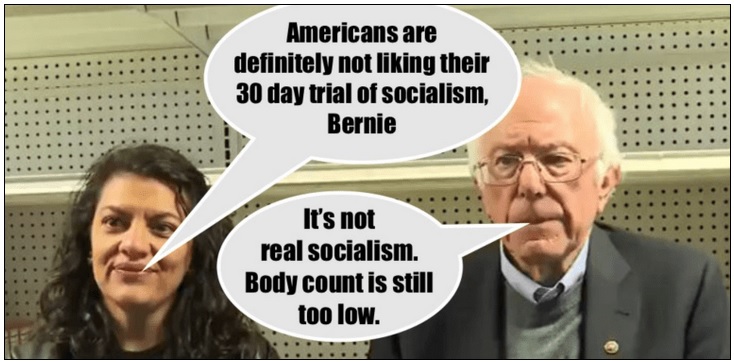
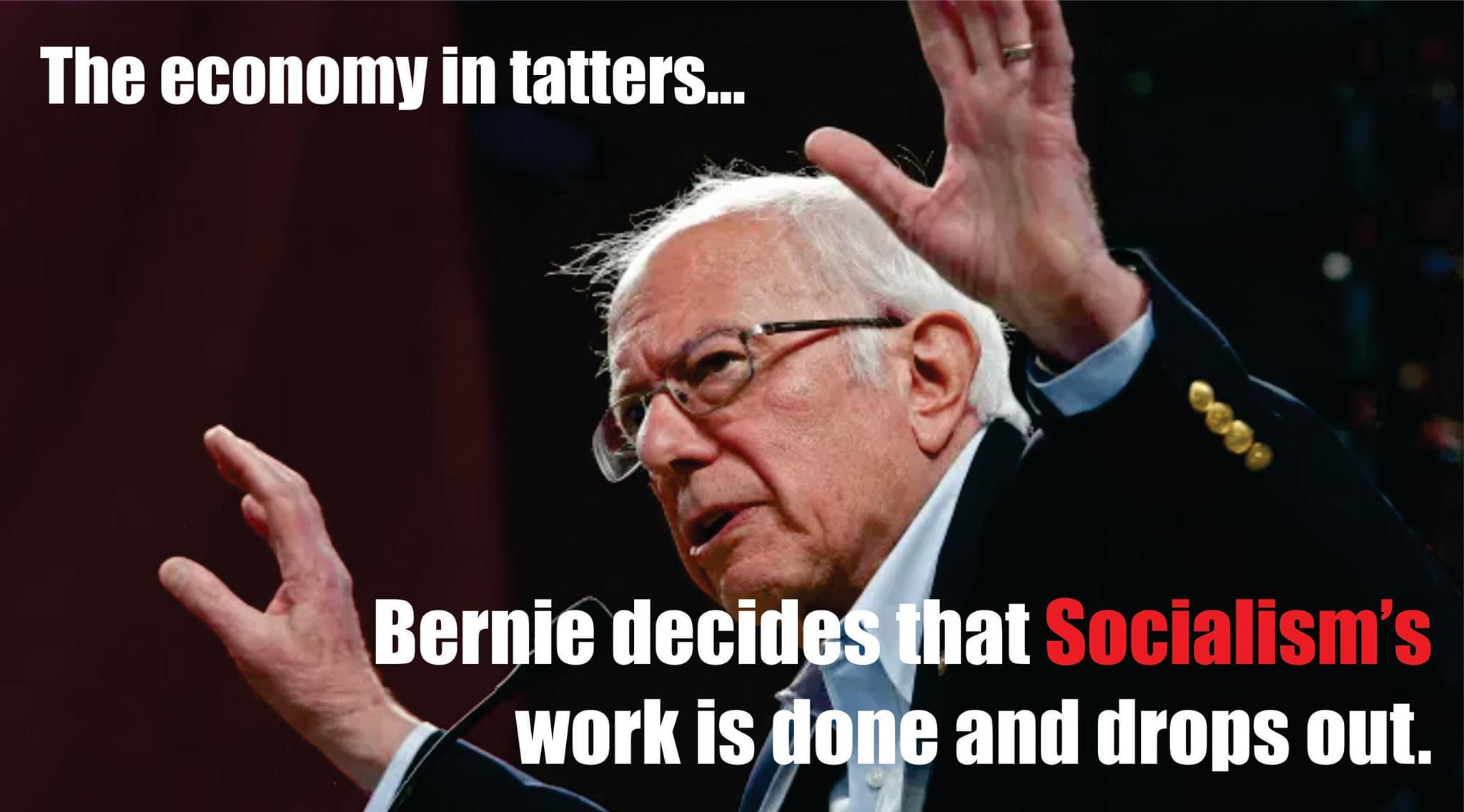
 Senator Bernie Sanders, berated his staff, forced female staffers to sleep in the same rooms as men, exposed them to sexual harassment, spread hate, allied with terrorists, all to win two elections he lost.
The only thing the socialist got out of his failed campaigns was membership in the 1 percent.

That and memories of flying around the country and the world on private jets, and his three homes, and bulging bank accounts paid for by an army of gullible idiots who believed in his cause more than he did.

Bernie Sanders or Elizabeth Warren could be locking up the Democrat nomination right now. Instead they wasted $300 million and lost to a crooked senile hack who can barely complete a sentence.

The two socialist candidates had raised the most money directly and through PACs, $182 million for Bernie, $151 million for Warren, had the most passionate supporters, and the best media coverage.

Why then did these two sprightly septuagenarian socialists lose? Because they’re socialists.

Socialists believe in redistributing other people’s things, but fiercely cling to their own. The greediest people in the world are lefties. The two socialist senators were full of big ideas for what to do with other people’s money, but don’t touch their homes and their millions. And don’t redistribute their voters.

When other Democrats dropped out and united behind Biden, Bernie and Warren couldn’t make way for each other. Even when Warren dropped out, she refused to endorse Bernie, dooming him to defeat.

Bernie and Warren were running on the same basic issues. When Warren refused to endorse Bernie, it was a suicide bombing that not only blew up his campaign, but took down her own platform with it.

It wasn’t about the issues. Bernie and Warren were really motivated by greed and ego.

Neither Warren nor Bernie could do what all the other candidates in the race did, drop out and endorse somebody else. The socialists stayed in and doomed each other in a political suicide pact because they were too petty and greedy to overcome their differences for a higher cause. That’s how socialism dies.

Socialists pretend that they want everyone else to sacrifice for the greater good, but they never do.

The Soviet Union’s Communist leadership reacted to Chernobyl by moving radioactive dairy products away from Moscow and to other parts of the country. China’s Communist leadership dealt with the coronavirus by lying to their people and to the rest of the world to maintain their regime’s credibility.

The EU has descended into infighting in every crisis, from Muslim mass migrant invasions to the coronavirus, over who has to make the sacrifices. New York City’s Mayor Bill de Blasio insisted on going to the gym, with an NYPD detail, while others were told to practice social distancing. Chicago’s Mayor Lori Lightfoot decided to get her hair cut even as the city’s small businesses were being closed down.

It’s easy for politicians to tell ordinary people to sacrifice while they live it up Masque of the Red Death style during a plague.

But what happens when a trolley problem of two top socialist politicians arrives, and they have to decide which of them makes the sacrifice for the greater good? The answer is deeply revealing.

Socialist leaders won’t sacrifice for each other. Not for the sake of their cause. Or for anything.

Ideology didn’t unite Bernie and Warren. Instead, one by one, the two socialist politicians were forced to drop out, leaving both of them alone with nothing. Socialism doesn’t unite us. It divides and isolates us.

Like the Chinese Communist virus.

Socialism doesn’t work because instead of the noble altruistic leaders the ideology calls for, it actually attracts meanspirited and greedy control freaks who use it to set up their own private fiefdoms. Once implemented, actual socialism never turns into a utopia of angels, disdainful of materialism, but descends into a hell of demons who fight each other over the last stale cookie on a tarnished plate.

That’s why idealistic revolutions end in cycles of purges fueled by ego, malice, and greed.

Bernie and Warren couldn’t put each other up against a wall, so they had to settle for the next best thing. He brought down her campaign and then she brought down his campaign. Neither would serve in heaven and won’t even have the opportunity, like Milton’s Satan, or Stalin and Mao, to rule in hell.

Before the two of them become footnotes in electoral history, there is a question they should answer.

How dare they demand that everyone else sacrifice for the greater good, when neither of them would? Where did these two socialists get the chutzpah to lecture Americans on everything from how much deodorant they use to how much taxes they pay? Where is their commitment to redistribution?

Bernie Sanders quadrupled his net worth since he began plotting to run for president in 2012. He made his millions from his national profile. And he also used that profile to funnel money to family members. Every time he ran for President on a platform of taking away everyone’s money, he came away richer.

Why did Bernie take so long to drop out? Because even ActBlue idiots wouldn’t go on paying for his private jets if he dropped out. It took a pandemic and the effective shutdown of the election for the scam to end. If it wasn’t for the Chinese Virus, Bernie would have dragged it out to the last million.

But there’s no private jet flights paid for by ActBlue donors to the Vatican in a pandemic.

Bernie’s campaign slogan, “Not Me, Us”, was the biggest lie since, “Hope and Change.”

It was always about “Me”. It was about Bernie, his book deals, his houses, his private jets, his interviews, and his fame. At his age, he knows that he will probably never run again and never cash in again.

None of that makes Bernie a hypocrite. Worse. It makes him a socialist.

Bernie Sanders has spent his entire miserable life figuring out a way to make money without working. The socialist lifestyle of collective farms wasn’t for him. He wanted to get into politics because he’s lazy, narcissistic, a control freak, abusive, greedy, and incompetent. Those character traits left him with two options: Hollywood and Washington D.C. And Bernie is a bad actor who can only memorize a few lines.

His career was built on pandering to the same radicals when he first got into politics and when he tried to crawl into the White House. Along the way he completely changed his views on any number of issues from immigration to gun control. But he never stopped figuring out how to cash in on his politics.

And now he’s done it.

Bernie leaves his great socialist crusade as a 1 percenter, a millionaire with three homes, despite accomplishing absolutely nothing. Socialism isn’t real for ordinary people, but it’s real for socialists.

“Not Me, Us”, Bernie claimed.

What have the “Us” gotten out of the Bernie campaign beyond the opportunity to pay for all his stuff? The same thing anyone gets under socialism: the privilege of paying for the lifestyles of their leaders.

Socialism isn’t about helping people. It’s about helping socialists.

Between the two of them, Bernie Sanders and Elizabeth Warren, brought down the socialist cause. But nobody destroys socialism like socialists. It was the Communists who really brought down the USSR and if the EU and Communist China’s leadership fall to the pandemic, it will also be entirely their own doing.

Lefties have always been the great destroyers of their own movements. Bernie and Warren followed in that proud tradition, sacrificing their own movement to their greed and egos, and leaving the dumpster fire of their campaigns with millions in book payments from the very corporations that they condemn.

And if you think they were a grifting disaster, wait until Rep. Alexandria Ocasio Cortez runs for president.

Daniel Greenfield is a Shillman Journalism Fellow at the David Horowitz Freedom Center. This article previously appeared at the Center's Front Page Magazine. Click here to subscribe to my articles. And click here to support my work with a donation. Thank you for reading.

The Constitution Says There's Only One Executive in the Federal Government. The President of the United States.

By Rich Kozlovich

On April 9, 2020 an editorial by the New York Sun entitled, Trump Is on Hallowed Ground in Challenging Inspectors General, discussing a letter from a "bipartisan" group of Senators wanting to know why the President of the United States fired an inspector general. Needless to say, Mitt Romney and Susan Collins were on board with that, but why is Grassley on board with this?  Because he bounces around like a ping pong ball. Grassley, as an ally, is at best a leaky vessel.   The man is 86 years old and needs to go home, along with Mitch McConnell, Lindsey Graham, and a host of others in Congress. 

The article clearly outlines what the Constitution says from the perspective of the one who was largely responsible for its writing, John Adams, who made it clear there was to be a separation of powers between the legislative, executive and judicial branches of this new government, and none them had the right to infringe on the rights, privileges and responsibilities of the other.

The article advised the President to respond to these Senators by saying he fired him "on the advice of John Adams."

The Constitution gives the President of the United States sole executive powers, and these Inspector General law steps on the separation of those powers designed by the founders by creating an office of the executive branch that has "divided and possibly inconsistent obligations to the executive and legislative branches, violate the doctrine of separation of powers and are constitutionally invalid.”

Please view what's known as "the Harmon Memo" regarding the very real Constitution conflicts this law creating the Office of the Inspector General.

Coronavirus Hysteria Will Soon Be Over: They're Making Cartoons Now


Friday, April 10, 2020

Stop the COVID-19 Insanity Now

By —— Bio and Archives--April 9, 2020, 40 comments

It is the gross overreaction of certain government and business leaders to the Wuhan coronavirus of 2020, otherwise known as COVID-19, that is the danger to the United States, not the virus itself. The abundance of data show that the virus is similar in danger to the seasonal flu, and the longer governments persist in their overreaction, the more severe damage they will do to the economy and the lives that depend on it.

Number of people who will die of COVID-19 illness will be a small fraction of those who die of the flu every season

The Center for Disease Control (CDC) estimates that from October 1, 2019 to March 28, 2020, approximately 24,000-63,000 have died of the flu out of 246,842 confirmed cases. That’s a confirmed case fatality rate (CCFR) of roughly 10% to 25%. As of April 8, there have been 14,831 reported fatalities among 435,553 confirmed cases of COVID-19 in the United States. That is a CCFR of about 3.4%—which is at most 34% of the CCFR of the flu. However, because most people with non-life threatening symptoms don’t present themselves to health facilities to be tested or counted for statistics, the CCFR for both illnesses vastly overestimate the actual chance of dying if infected: the infection fatality rate (IFR). To calculate the IFR, the number of fatalities is divided by the estimated number of people infected.

So how can we know what the IFR is for contracting COVID-19? If people who manifest similar symptoms are both hospitalized and tested for COVID-19 as they would be for the flu, then we can make a rough comparison between them. It is estimated by the CDC that about 39 to 55 million people have contracted the flu during the 2019-2020 season. If we divide the flu fatalities stated previously, by the estimated number of infections, it would mean a flu IFR that is at most 0.16%.

Left[ists] are already calling for using this opportunity to nationalize industries, socialize medicine, explode the debt, universalize the welfare state, and to violate constitutional rights........

A state-by-state examination of the graphs of COVID-19 confirmed cases and fatalities indicates no correlation between the imposition of business shutdowns and either the growth rate of infection or the growth rate of fatalities. On the other hand, it is well documented that economic decline leads to a decline in health and life expectancy.  That makes sense.  Wealth is dependent on productivity. 

Higher productivity creates a greater abundance of goods and services on which our health depends, which makes them more affordable: the basic resources we need, the quality of our medical care, the quality of our place of residence, greater freedom to engage in professions that are less hazardous or stressful, and time-off for relaxation and self-improvement. 

Sudden economic decline, particularly business failure, bankruptcy, and unemployment are also significant contributors to death by suicide.  Ultimately, our health depends on our ability to keep doing, without interference, what each one of us does best...................To Read More....

EU court rules three member states broke law over refugee quotas

Czech Republic, Hungary and Poland failed to comply with 2015 programme, ECJ says

Jennifer Rankin in Brussels Published on Thu 2 Apr 2020

Poland, Hungary and the Czech Republic broke European law when they failed to give refuge to asylum seekers arriving in southern Europe, often having fled war in Syria and Iraq, the EU’s top court has ruled.

The three central European countries now face possible fines for refusing to take a share of refugees, after EU leaders forced through mandatory quotas to relocate up to 160,000 asylum seekers at the height of the 2015 migration crisis.

Issuing its judgment on Thursday, the European court of justice said the three member states “had failed to fulfil their obligations under European Union law”. The Czech Republic took in just 12 asylum seekers, while Hungary and Poland refused to take a single person.

The court rejected the legal argument that Hungary, Poland and the Czech Republic were entitled to disregard EU law in order to maintain public safety, law and order. None of the countries had proved it was necessary to invoke that opt-out clause in the EU treaties, the court concluded.

The European commission is now entitled to embark on legal action to impose fines on the three member states.

The decision to impose mandatory quotas of asylum seekers was taken in the teeth of fierce opposition from Hungary and the Czech Republic. After the nationalist Law and Justice party was elected in October 2015, Poland joined its neighbours in opposing the scheme.

The quotas have come to be seen as one of the modern EU’s defining moments, which poisoned relations between central Europe and western member states, leaving divisions that continue to thwart a common EU asylum policy.

The previous head of the European council, Donald Tusk, said the scheme had been “divisive and ineffective”, but countries, such as Germany and Sweden, which took in large numbers of refugees, have argued it is unacceptable for member states to shirk the task of easing the strain on the most-affected EU countries.

In September 2015, EU leaders took two decisions to relocate 40,000, then 120,000 asylum seekers from Greece and Italy to other EU countries. More than 1 million migrants and refugees arrived on Europe’s shores in 2015, triggering a political crisis that continues to haunt the union......... To Read More...

Coronavirus: What IS True? Who To Believe?

Meanwhile, the ever elusive truth is out there somewhere, but don’t look for it in the mainstream or social media

By Judi McLeod —— Bio and Archives--April 3, 2020

Will New York City be Ground Zero for catching up with all the lies the media keep telling in order to keep the COVID-19 pandemic panic alive and kicking?  Where are all the coronavirus patients in the Big Apple has become a significant unanswered question.  People trying to get to the truth in regards to where the virus patients are, are being cut off from Facebook and Twitter.

‘Facebook removes Project Veritas video for violating policy against coronavirus information’, (Washington Times, April 1, 2020)................Bad Boy, Jimmy, for going on the hunt for the truth. (Project Veritas)

On Laura Ingraham last week, guest Dr. William Grace had this to say: “There is no hospital in NYC that is at capacity with patients. There are no patients in the Central Park hospital. And, on that huge hospital ship that can house 1,000 patients, there are presently 3 patients total.”

“Twitter, stepping up its enforcement of misleading and harmful coronavirus-related claims, required Fox News host Laura Ingraham to delete a tweet from 10 days ago that misrepresented details of an unproven treatment for coronavirus.” (Variety, March 30, 2020).............Bad girl, Ingraham, for trying to get the truth out there about the hype the media spreads on the virus.

Numbers about COVID-19 victims are starting to add up to suspicion............To Read More....

UN’s Irrelevance in Corona Crisis Invites a Rethink of the World Body

By , Special to the Sun | April 9, 2020
 
“If there were no United Nations we’d have to invent one” is an overused Turtle Bay cliche worth examining now, as the UN is MIA in the face of the worst global crisis since its founding 75 years ago.

As a pandemic threatens the globe with loss of life on a biblical scale and economic collapse, a behemoth that fancies itself as “the world body” is nowhere to be seen.

Start with the Secretary General, Antonio Guterres, who immediately sprang to “action,” vaingloriously calling for a global ceasefire to enable the world to focus on the pandemic. No major combatant heeded his call. So, next, he asked member states to fund a $2 billion UN-based initiative for a global humanitarian response. That fund is yet to materialize.

The Security Council, the UN’s most prestigious body charged with ensuring global peace and security, is also yet to respond. It failed to unite behind Mr. Guterres’ global ceasefire and couldn’t even muster a generic statement on the pandemic: China opposes any reference to the origin of an outbreak that America insists calling the “Wuhan virus.”

Instead, pre-coronavirus pet issues dominate the UN................To Read More....

My Take - If these countries really believed this China flu was as serious as is being touted by the media, why then are they ignoring this request? Four reasons.

First, the UN is the most incompetent and corrupt institution on the planet, and most of that money would be squirreled away, little of it being used for whatever purpose for which it was supposed to be used. As for the money that wasn’t diverted? It would be wasted.

Secondly, they know, as do I, this is hysteria, hyperbole and politics, not science, and not health care.  It's politics!!!!!  They understand no matter what the UN, or any other nation or institution does, this flu will have to run its course. 

Third, they looking down the road and seeing what’s ahead for the long range issues that really will impact they and their constituents. None of which are going away any time soon. Unlike these hysterical Chicken Littles who are incapable of seeing long term because they’re too devoted to the study their navels......... and feeding at the government trough, which seems to go hand in hand. 

Fourth, the UN agency that would be handling this is WHO and their director general is a guy named Tedros Adhanom Ghebreyesus, a radical communist.  He and WHO are more about politics than disease control.  "He was elected despite glaring shortcomings", and that was because of support from China, to whom he bows. 


California Sheriff Imposes Martial law – COVID-19 Hysteria Devolves in Madness

(Gateway Pundit) – Riverside County Sheriff Chad Bianco warned the public that his department has the power to fine and or arrest people for not wearing masks in public.

25 people have died from the Coronavirus in the entire county of millions and the Sheriff has gone into crisis mode.

“This is a valid order and enforceable by fine, imprisonment or both,” Bianco said on Monday in a video statement.

He added: “Not everybody’s getting the message It started with staying at home, social distance and covering your face. But now we change from saying that you should to saying that you must.”...........But the people of California aren’t living in a police state, just ask the Sheriff...........To Read More.....

Some states have refused to issue stay-at-home orders for COVID-19. Despite media criticism, their coronavirus projections are improving, too.

New data shows those states have had their death toll projections revised downward 

News April 08, 2020

Several states who have refused to completely shut down amid the coronavirus, despite mounting pressure from health experts and members of the media to do so, have seen their death toll projections revised downward in recent days. 

The new information undermines the notion that a national shutdown is necessary to defeat the virus and supports a geographically flexible approach to social distancing and shutdown measures.

What are the details? 

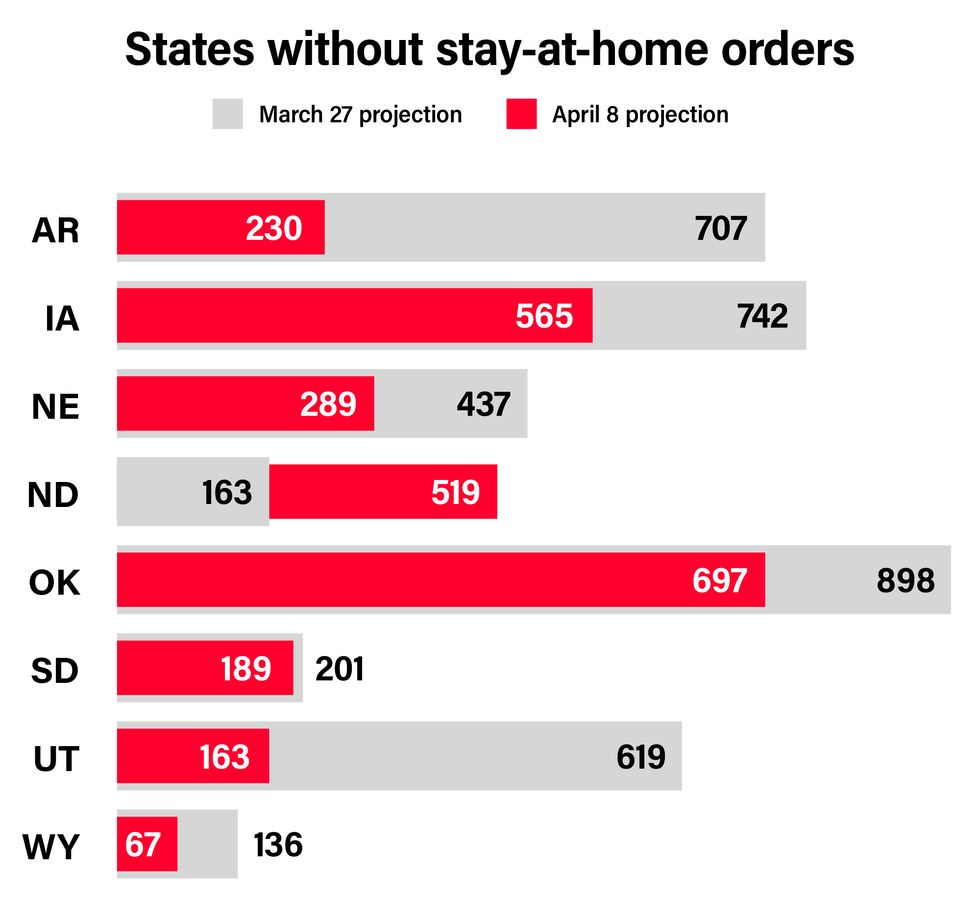
As of Wednesday (April 8), officials in eight remaining states have yet to issue full stay-at-home orders. Those states are Arkansas, Iowa, Nebraska, North Dakota, Oklahoma, South Dakota, Utah, and Wyoming. Officials in three other states — Alabama, Missouri, and South Carolina — only issued stay-at-home orders within the last few days after being resistant to enacting such a measure in the weeks prior.

Conventional wisdom would suggest that those states, due to their inaction, would reap the consequences in the form of higher COVID-19 death toll projections. But that has not been the case.

According to data from the Institute for Health Metrics and Evaluation, which tracks the coronavirus outbreak in each individual state, predicting its death toll and hospital resource usage, all but one of the states in question have downgraded their death toll projections.

On March 27, the the Institute for Health Metrics and Evaluation published a study detailing the projected death toll for all 50 states. Listed below are charts showing the March 27 projections alongside the revised projections from Wednesday.

https://assets.rebelmouse.io/eyJhbGciOiJIUzI1NiIsInR5cCI6IkpXVCJ9.eyJpbWFnZSI6Imh0dHBzOi8vYXNzZXRzLnJibC5tcy8yMjkyNDE4Ni9vcmlnaW4uanBnIiwiZXhwaXJlc19hdCI6MTYyNjQxOTIwMn0.XfeYt-EJ1edY2fg0oxL-jzGV7o3i0Iq-nCRwyqFPJ08/img.jpg?width=980

All of the states have had their death toll projections lowered, except one: North Dakota. But it was not immediately obvious as to why North Dakota had its projection raised. As of Wednesday, the state has only reported four deaths as a result of COVID-19.......To Read More....

Thursday, April 9, 2020

Horowitz: It’s time to end the great American COVID-19 police state

Daniel Horowitz· April 7, 2020
 
We now have the most severe, widespread, and protracted form of martial law in our nation’s history … except as it applies to dangerous criminals who are undeterred and released. How much worse will we allow this to get until we call a foul on these gross constitutional violations?
As I observed last week, states have wide latitude to forcibly quarantine individuals or groups of people from the general population. But they don’t have the power to shut down the entire general population. Also, as the Supreme Court has said many times, there are times when life, liberty, and property can be infringed upon, but it must be narrowly tailored to the least invasive means needed to achieve the compelling state interest. What is happening now is anything but narrow.

Consider the following:
  • A 19-year-old woman was given a citation and forced to go back home after a state trooper in York County, Pennsylvania, caught her simply “going for a drive.” She was alone in a car, the ultimate social distancing. There is no way under any emergency power that such a broad, arbitrary and gratuitous edict can be justified under the Constitution, given the severity of its restriction on personal liberty. Meanwhile, subways are still open!.......To Read More...

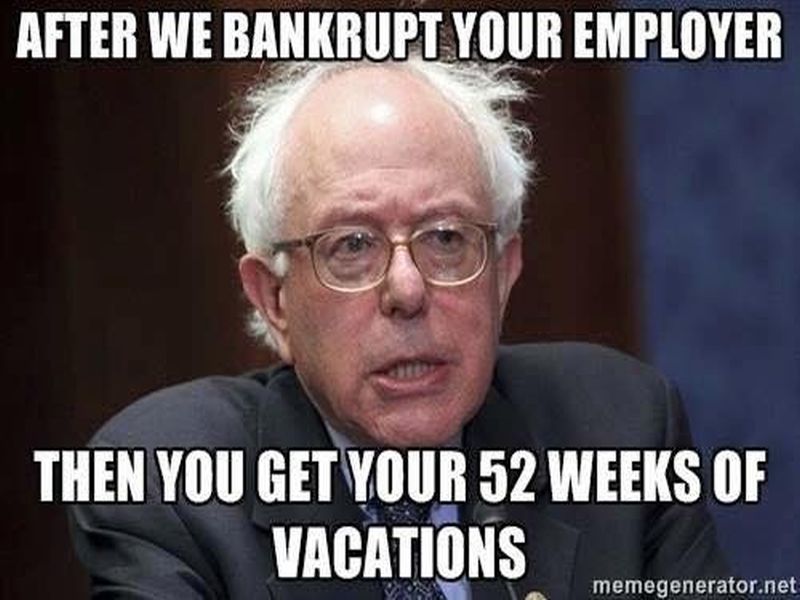
The Farewell-and-Good-Riddance Edition of Bernie Sanders Humor

April 9, 2020 by Dan Mitchell @ International Liberty
 

Say goodbye to “Crazy Bernie.” The socialist senator from Vermont has ended his bid for the Democratic nomination.

I have mixed feelings. Given his genuinely awful views about socialism, I’m glad there’s no risk Bernie Sanders will be in the White House next January.

On the other hand, he deserves credit for being honest about his agenda. And he was a wonderful source for satire and humor.

And that’s today’s topic.

We’ll start with some material about Bernie’s agenda and his campaign and then we’ll close with some jokes about his departure from the presidential race.

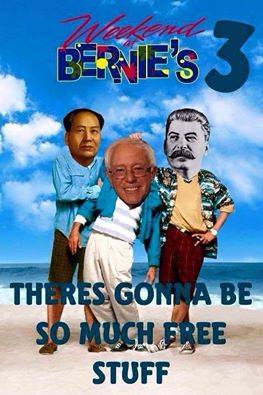
This one will only make sense if you’ve seen the 1989 comedy, Weekend at Bernie’s.

But Bernie was never just about free stuff.

He also had a soft spot for totalitarianism. Here’s a story published by the comedic geniuses at Babylon Bee before Bernie exited the race.
At a special campaign appearance abroad in Berlin, Bernie made waves with an ambitious new campaign promise to rebuild the Berlin Wall. …At the announcement, the crowd threw their soy lattes in the air and erupted in a rapturous chant of “Построить эту стену!” which is roughly translated as “build that wall!” Sanders looked out on a sea of hope-filled faces, giddy over the prospect of restoring the majestic landmark built by the German Democratic Republic. The cheering intensified as Bernie promised that not only will he build the wall, but that he will make Trump voters pay for it. …Current estimates say that construction of the wall will provide 2 million shovel-ready jobs and cost approximately 382 billion dollars per mile.

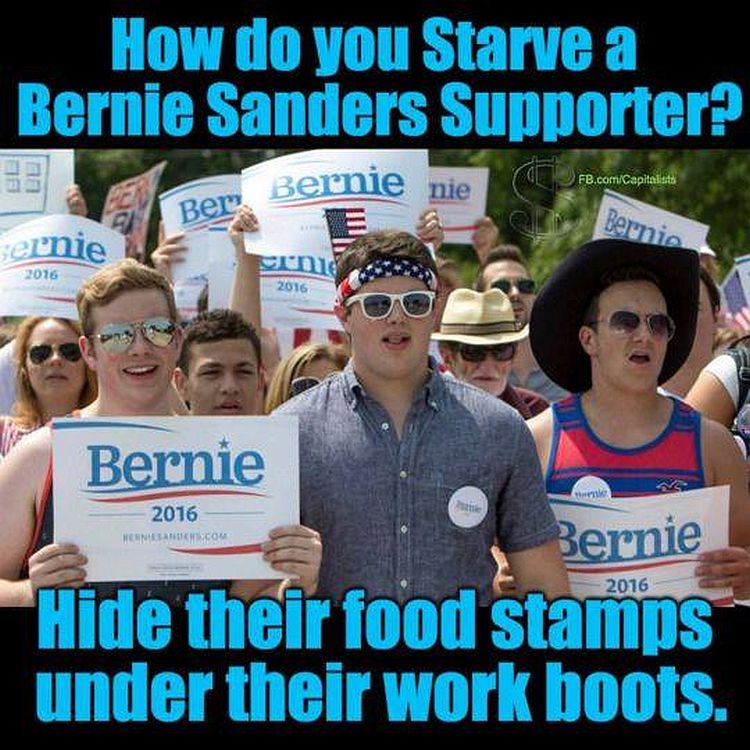
But who would fill those “2 million shovel-ready jobs”?  Not his supporters if this bit of satire is accurate.  As you can see from this image, his economic policies never made much sense.  The coronavirus crisis presumably didn’t help Crazy Bernie’s campaign.

The Babylon Bee reported that Bernie had a hard time maintaining social distancing.
Those suffering the mst are American politicians, who have been having quite a bit of trouble staying six feet away from citizens’ wallets. Bernie Sanders was hardest hit by CDC guidelines, as he struggled to stay away from Americans’ wallets, purses, and checkbooks. “These guidelines are ridiculous!” he shouted while feeding pigeons at the park… “How am I supposed to steal money to buy another hou — err, I mean, to give some of it to the 99% — when I can’t even get within six feet of anyone? It’s impossible!” Sanders tried using a makeshift fishing rod, casting it out toward purses left on park benches and reeling it back in.
And the disease may have helped to end his campaign by reminding people what life would like like in a socialist paradise.

Needless to say, it was a poignant moment when the Vermont socialist broke the news to his most avid supporters.

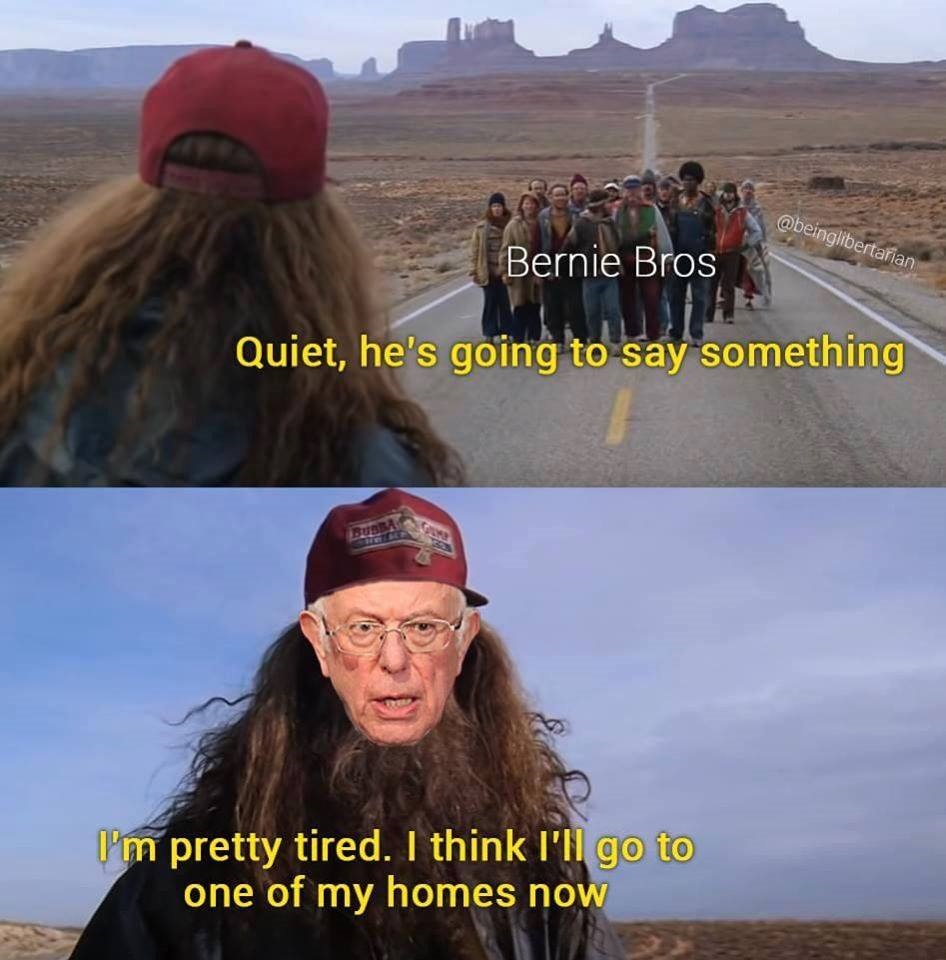
Speaking of his many houses, the Babylon Bee has the scoop on Bernie’s real motive for leaving the race.
Democratic presidential primary candidate Bernie Sanders has dropped out, announcing he wants to spend time with his many, many houses. “It just seemed silly to spend all this time campaigning when I’m neglecting my many houses,” Sanders explained to his supporters. “I’ve made a huge profit pushing socialism and amassed much real estate, and it’s time I enjoy it.” …Now that Bernie Sanders has dropped out, he’s endorsed Donald Trump, whom he refers to as an “idol,” and says he hopes to buy many more houses so he can have a real estate empire just like Trump.
Though maybe the real reason he dropped out is that he’s actually achieved his goals.
The Babylon Bee has the details.
As the coronavirus panic has already accomplished the aims of his socialistic policies, Sanders realized the country didn’t need his public service anymore. Unemployment has skyrocketed, grocery stores have empty shelves, and everyone is confined to their homes on penalty of arrest. This “idyllic paradise” is exactly what Sanders wanted in the first place, so he says he can leave the race satisfied that his vision has been achieved. “This once-in-a-lifetime deadly pandemic has already accomplished what socialism aims to do,” Sanders said in his concession speech. “Since my services are no longer required, I will be suspending my campaign and heading to my house. Well, one of my houses. I haven’t decided which yet. …Sanders also pointed out that his other main goals of hyperinflation and total dependence on the government are already on their way.
Which is also the message of this final addition to our collection of Bernie humor.

P.S. If you haven’t overdosed on Bernie humor, here are some prior columns focusing exclusively on that topic.
And we also have some one-off examples of Bernie humor:
We will miss mocking Bernie. Fortunately, his replacement already exists.


Chlorpyrifos: A Hostage of the Secret Science Rule?

By Michael Dourson — March 27, 2020 @ The American Council on Science and Health

In short, the public is often worried about chemical exposure, as they should be when such exposure exceeds a safe dose. The public’s interest is best served by trusting experts dedicated to public health protection and not by withholding scientific data from independent analysis.

By Michael Dourson,Bernard K. Gadagbui, and Patrician M. McGinnis

Many groups have weighed-in on EPA’s recent secret science rule. Generally missing from nearly all these opinions is the perspective(s) of risk scientists charged with protecting public health.

As scientists know well, results of any one study, especially one with significant societal impact, should be replicated because positive findings occur, on average, in one out of every 20 studies due to chance.  If a study cannot be replicated, then it (at least) needs to be consistent with the pattern of available data. Studies that are not replicated or that do not “make sense” in an overall pattern are still considered by EPA (and other authoritative agencies). Scientists within these agencies will often contact the authors(s) to obtain additional information in order to conduct their own analysis.

A case in point is the publication of a series of studies on a single human group from exposure to chlorpyrifos that shows an unexpected effect at extremely low exposures. This finding has not been replicated in other human studies and is in contrast to extensive animal and limited human studies that all point to changes in a blood enzyme (cholinesterase) as sentinel, at higher exposures. In this case, EPA scientists asked authors of studies from this single human group for the underlying data in order to confirm this lower effect. The authors demurred citing confidentiality concerns despite the fact that EPA has rigorous procedures in place to handle confidential information. Thus, EPA was not able to conduct its own analysis, and since EPA had neither confirmatory studies, nor information consistent with other studies, it chose not to use the information from this single human group.

A recent publication confirms the EPA decision. In brief, Rauh et al. (2011) reported evidence of neurological deficits in children at 7 years old as a function of prenatal chlorpyrifos exposures that were much lower than levels causing cholinesterase inhibition. Since the raw data had not been made available, Dourson et al. (2020) extracted data from published figures of Rauh et al. (2011), and plotted these extracted data as response versus log dose, a common risk assessment approach.

Surprisingly, a significant portion of the data was not found in these published figures. Moreover, the reported associations of chlorpyrifos levels were also not replicated in our analysis. Like EPA, Dourson et al. (2020) sent multiple requests to Rauh et al. (2011) for access to the data so that confirmation could be attempted. No response was forthcoming. This general lack of data, inconsistency with cholinergic responses in other research studies, and refusal by the authors to share data and to write an editor-invited letter to the editor, raises concerns about the lack of data transparency.

From our perspective as toxicologists and risk scientists, EPA’s decision not to use such studies where information is not provided, suitably redacted to protect confidential information, is correct. The public’s interest is best served when science is replicable and consistent. When studies cannot be replicated or are not consistent with other information, using such studies then depends on having access to the underlying data for independent analysis. If the underlying data are not provided, it is difficult to use such studies to make a credible scientific risk judgment, much less national rulemaking.

In short, the public is often worried about chemical exposure, as they should be when such exposure exceeds a safe dose. The public’s interest is best served by trusting experts dedicated to public health protection and not by withholding scientific data from independent analysis. Others have also had thoughts on this topic.

Authors: Michael L. Dourson, PhD., DABT, FATS, FSRA; Bernard K. Gadagbui, MS, PhD, DABT, ERT; and Patrician M. McGinnis, PhD, DABT of the Toxicology Excellence for Risk Assessment (TERA)

Authors: Michael L. Dourson, PhD., DABT, FATS, FSRA; Bernard K. Gadagbui, MS, PhD, DABT, ERT; and Patrician M. McGinnis, PhD, DABT of the Toxicology Excellence for Risk Assessment (TERA)

China's Energy Gauntlet and the Future of Oil

Peter Zeihan on April 8, 2020

Coronavirus has launched the greatest energy upheaval since the dawn of the petroleum age. In the short run, this means rock-bottom even negative prices for oil and a much-needed price break for the world's major energy consumers.

But nothing lasts forever.

Extended periods of low prices will destroy the productive capacity of many oil exporters, removing them from the market for years. Once the coronavirus crisis passes, that changed map of oil production and export will radically remake global energy flows. By far the largest loser will be China.

China today, as the world's largest oil importer, sources crude from quite literally everywhere it can. This map from my new book, Disunited Nations shows the diversity of sources and the risks to its oil supply chains posed by other countries.

Many of these producers will not be in the market a year from now. Their absence will add an energy security layer to China's already irrecoverable debt, finance, demographic, consumption, security, political, supply chain and trade problems.

To get the full story, join Peter Zeihan for a video-conference April 10 to explore the end of the era of global energy markets and the rise of a more regionalized "and far less stable" system.........To Read More....

Pandemic Hardening Can Make America Great

By Daniel Greenfield 0 Comments Tuesday, April 07, 2020 @ Sultan Knish Blog
After September 11, we began the long process of trying to build a society that would be hardened against massive terror attacks. Airports became grueling fortresses in which shoes, bottled water, and personal dignity had no place. A vast intelligence infrastructure was built to violate privacy. But the big decisions were never made. Instead, America became more vulnerable than ever to Islamic terrorism.

That’s why President Trump ran on, among other things, a travel ban from terrorist nations.

As the nation undergoes another shock, we are going to have to think about how to rebuild our society so that it will be hardened against another pandemic. That is going to require hard choices beyond throwing more money at the same alphabet soup government agencies that failed to protect us.

There are three key areas to think about: biological security, urban living, and domestic manufacturing.

The coronavirus, like September 11, was primarily a national security failure. The massive alphabet soup of government agencies, from the CDC to the FDA to the State Department to the CIA failed to correctly assess the problem, take action, coordinate, and keep the nation safe from an external threat.

The nature of the threat on September 11 flew under the radar because it was too big for security agencies and too small for the military, it didn’t fit the shape of what the FBI or Joint Chiefs did. And so we began the task of transforming both the military and security agencies into fitting that shape.

The Department of Homeland Security, in theory the sort of entity that might tackle multifaceted threats, which would include a pandemic, has failed to live up to expectations of basic competence.

The CDC meanwhile spends so much of its focus on social issues that it’s unfit for the job.

After the coronavirus, we will need a national security agency capable of tackling a pandemic. It will need to have intelligence gathering abilities, veto power over immigration, and the ability to quickly commandeer resources to meet a foreign disease outbreak by testing and quarantining suspects. And it must be able to plan both defensive and offensive biowarfare against hostile entities like the PRC.

Call it the Biological Security Agency.

Coronavirus took off in this country because the State Department was allowed to take the lead and it treated the virus not as a threat, but a transportation issue. Henceforth, pandemics must be the responsibility of a national security agency able to evaluate the threat and shut down travel. It should be tasked with maintaining stockpiles of medicines, protective clothing, and other resources needed to meet a biological warfare attack. Even if that’s not what the coronavirus was, it will come one day.

We need to be ready with a national security response to biological warfare.

Hardening America against a pandemic also requires rethinking the blue model. Dense urban areas can’t be defended against biological warfare. The farce of social distancing in New York City’s crowded subways is a structural problem. The denser an urban area is, the more impossible it is to maintain social distance. Density pushes out cars and sends price signals that force the maximum number of people into the same residential, and commercial areas, which are connected by crowded public transportation.

Before the coronavirus struck, progressive policy goals included upping urban density, eliminating single-family zoning, reducing lot size, annexing suburbs to cities, replacing cars with public transit, and using mass migration to boost the political power of cities at the expense of rural and suburban areas.

The coming of the coronavirus to New York City has made it all too obvious that’s a death sentence.

Hardening America against a pandemic requires sprawl, large lot sizes, spread out centers, multiple family cars, reduced immigration, smaller population sizes, and the ‘re-ruralization’ of America. Instead of massive malls selling a thousand flavors of Made in China, smaller businesses should be selling products manufactured in this country for a more decentralized shopping experience.

Federal and state governments made runaway urbanization possible by directing resources to the infrastructure, physical, economic, and social of massive cityscapes, while defunding rural areas.

This 20th century vision of the future stopped making sense with the arrival of the internet. The coronavirus showed that urban density is hazardous to our health and technologically unnecessary. Urban industries, cultural and technological, are the easiest to virtualize and decentralize. Colleges, dot coms, and financial firms don’t all need a massive physical footprint in one superdense neighborhood.

The growth of the city paralleled the rise of the factory. Post-industrial urbanization is cultural. It’s also physically and socially unhealthy, unsafe, and expensive. And, as we found out on 9/11: vulnerable.

Cultural urbanization has created elite castes and political divisiveness. The modern city is a dysfunctional apartheid zone with sharply divided upper and lower classes, but no middle class, a series of real estate bubbles, havens for foreign oligarchs and international gangs, and a national security hole.

The internet has eliminated the need for the modern city. Pandemics and terror make it too dangerous.

Federal and state governments incentivized the city with taxpayer money. That money should now be used to incentivize its decentralization with subsidies, investments, market signals, and tax policies.

Post-coronavirus America doesn’t need the cities it has too many of, it does need the factories it has too few of. Once the pandemic struck, cities became viral minefields with too many people and not enough goods. Too many of those goods, especially medical protective equipment, were far away in China.

In a pandemic, we don’t need a thousand Thai places within a dozen blocks of each other. We do need a hundred factories that can quickly make the products that we need in order to be able to survive.

Cultural urbanization is a dangerous luxury. Domestic manufacturing is a vital necessity.

The urban hubs with mass migration providing services to the elites are a suicide pact that this country can’t afford anymore. And we can’t afford to outsource manufacturing to corrupt foreign oligarchies that in a crisis will prioritize getting medical equipment and drugs to their people, not to our own.

The Obama administration invested endless billions in the green energy obsessions of urban residents. It’s now time to invest in the domestic manufacturing that, unlike solar panels, they actually need, even if they refuse to admit it until health care professionals are dying because of a lack of N95 masks.

Many European countries don’t have the space or scope to expand instead of contracting. The United States has vast territories and frontiers that are going unused because we have contracted to the coasts. The technology that could enable us to spread out is instead being used to further contract the country.

The United States has the resources and the territories to become the factory of the world once again.

If we are going to survive the next pandemic, that is what we need to do. Stockpiling equipment against the next crisis is an insufficient answer because the next crisis may not be a pandemic. After the Swine Flu outbreak, states rushed to build up supplies of masks and ventilators, and then disposed of them.

That’s human nature.

Domestic manufacturing gives us the flexibility to adapt to meet the demands of each new crisis. Without that ability, we always going to have to stockpile everything on the chance we may need it.

Interdependence and independence are two possible responses to the pandemic.

The official word is that we need to double down on interdependence: on global networks, on multinational organizations, on international supply chains, and mass migration. That’s the same globalism that got us into this mess, and that will leave us weaker, more vulnerable, and no wiser.

The alternative is to pursue independence, personal and national freedom with strong borders, local manufacturing, national defenses, and personal property for a great culture of prosperity.

This is how we get there.

If we learn the lessons of the pandemic, we will be hardened against the next one. If we don’t, we’ll make the same mistakes all over again. And we’ll emerge weaker, poorer, and more globalized.

The coronavirus is an opportunity to build a greater and stronger nation. We should not waste it.

Daniel Greenfield is a Shillman Journalism Fellow at the David Horowitz Freedom Center. This article previously appeared at the Center's Front Page MagazineClick here to subscribe to my articles. And click here to support my work with a donationThank you for reading.
Wednesday, April 8, 2020

Thought For the Day!

The media is fair and balanced, and can be trusted. Right?  During WWII they did ask Roosevelt why he called the attack on Pearl Harbor a "Japanese" attack didn't they?  They did consider that racist, didn't they?

But didn't they call Roosevelt a racist for putting all those Japanese American citizens in concentration camps? They did, didn't they? No? Imagine that!

Is it possible the media, which has always been corrupt, wasn't nearly as corrupt as they are now?  Nah... finding fault with the media is racist.  Right? Unless it's the conservative media.  That's okay, because they're part of a vast right wing conspiracy. 

Energy & Environmental Newsletter: April 6, 2020

By -- April 6, 2020

The Alliance for Wise Energy Decisions (AWED) is an informal coalition of individuals and organizations interested in improving national, state, and local energy, environmental, and education policies. Our premise is that technical matters like these should be addressed by using Real Science (please consult WiseEnergy.org for more information).

A key element of AWED’s efforts is public education. Towards that end, every two± weeks we put together a newsletter to balance what is found in the mainstream media about energy and the environment. We appreciate MasterResource for their assistance in publishing this information.

Some of the more important articles in this issue are:Crises and the collectivist temptation
13 Petroleum Products Crucial to the COVID-19 Pandemic
We gambled on the wrong threat — climate change
COVID-19 and Climate Change: The Parallels
The Coronavirus Pandemic vs the Climate Emergency
Massachusetts v. EPA: After 13 years, it’s time for climate policy review
Archive video: The War on Humans
Russia continues to influence America’s energy sources
Identity Politics Lied. New Yorkers Died
Dead-Of-Night COVID-19 Vote Gives Cuomo New Emergency Powers
Cuomo critics highlight years of waste, amid deepening COVID-19 crisis
A Scholar’s Lament
Soap-opera science
The Fed’s Cure Risks Being Worse Than the Disease
A free nation cannot long survive if its press takes sides
COVID-19:Latest version: A Summary of Suggestions and Commentary on COVID-19

PLEASE CHECK BACK FREQUENTLY and PASS IT ON WIDELY!

Greed Energy Economics:
Grand Theft: US Taxpayers Liable For $120 Billion In Subsidies to Wind and Solar
Wind and Solar Lobbyists letter to Democrats for COVID-19 Handouts
Renewable Energy Advocates Decry Lack of Handouts in Stimulus Bill
Why Dems were so bent on passing wind handouts amid COVID-19 crisis
France: Far more support for turbines that for medicine and hospitals
Renewable Energy Health and Ecosystem Consequences:Noise is still bad for health
BBC finally concedes: Green energy facilities threat to wilderness areas
Migratory Bird Treaty Act reform will clarify longstanding confusion
Solar Energy:Solar Capacity Low Where the Sun Doesn’t Shine – Who Could’ve Known?
California Pushes for Solar Panel Waste Policy
Natural Gas Energy:COVID-19 Virus Being Fought with Methane Control Technology
Short video: SHALEout!
Save America’s Oil And Gas Industry
Russia continues to influence America’s energy sources
Several states propose blocking cities from banning natural gas
Pipeline-Starved NYS Avoids Natural Gas Shortages this Winter, but the Future?
Energy Security Matters, As It Turns Out, And Fracking Is Key
New York State:Identity Politics Lied. New Yorkers Died
Dead-Of-Night Coronavirus Vote Gives Cuomo Sweeping New Emergency Powers
Cuomo critics highlight years of taxpayer waste, amid deepening COVID-19 crisis
Gov Cuomo to ram industrial wind, solar plants down locals’ throats
Cuomo’s coronavirus failure – the real reason for New York’s ventilator shortage
Short video: How NY Failed it’s Citizens
Short video: Are NY wind turbine workers “essential services”? and Part 2
Governor Cuomo and His Insatiable Appetite for Power
Pomfret (NY) tightens its wind law
NY Department of State to oversee renewable siting office
Miscellaneous Energy News: Surviving the Coronavirus? Thank Fossil Fuels.
13 Petroleum Products Crucial to the COVID-19 Pandemic
To Fight The Coronavirus, The World Returns To Fossil Fuels
Letter objecting to renewable handouts in US COVID-19 economics bill
Green New Deal Preview Offered by Wuhan Coronavirus
AI software to improve Nuclear reactor designs, performance, safety, lifetimes
China’s 2019 electricity generation reviewed
Trump Administration upgrades Obama-era fuel-efficiency standards
Nevada’s Renewable Energy Delusion
Developer of Hawaii wind project withdraws its bid (after 4+ years of resistance)
Manmade Global Warming — Some Deceptions:COVID-19 and Climate Change: The Parallels
The coronavirus pandemic vs the Climate Emergency
Archive video: The War on Humans
NASA and NOAA’s Latest Climate Warning Is a Result of Purposefully Flawed Data
Video: The Superbowl Of Data Tampering
Bandwagon Of Doom Washed Away By Tidal Wave Of Data
Throwing cold water on hot climate models
Climate Litigation: a Government Grab for Cash
Manmade Global Warming — Miscellaneous:Massachusetts v. EPA: After 13 years, it’s time for climate policy review
We gambled on the wrong threat — climate change
COVID-19 And Climate Change: Asia’s Policy Choices In The Age Of ‘Crisis’
People Will Be In No Mood To Stay In Panic Mode After COVID-19 Scare Ends
Is the COVID-19 Economic Downturn Affecting Atmospheric CO2? Data Says Not Yet
The Earth’s Temperature (going down!)Russia Pledges To Increase CO2 Emissions By 2030
Ocean Temperature Changes and Sea Level Changes
Causes and consequences of global warming, a natural phenomenon, a political issue, or a scientific debate?
Video: The IPCC is an inept organization that wastes its budget on Showbiz events
Report: Earth now warmest in 2,000 years, thanks to Sun not CO2
Education Related:A Scholar’s Lament
Soap-opera science
Higher Education Will Never Be the Same—And That’s Not All Bad
A Conversation with the Chancellor of UNC-Chapel Hill
How Tulsa University Was Turned into Toxic University
US Politics and Socialism:Crises and the collectivist temptation
Biden vs Sanders on the Green New Deal
Will coronavirus launch the second wave of socialism?
Other US Politics and Related:The Fed’s Cure Risks Being Worse Than the Disease
A free nation cannot long survive if its press takes sides
Response To COVID-19 Reflects Trump’s Plan To Radically Reform Health Care
Short video: What Was Revolutionary About the American Revolution?
Short video: Conservatives Are the Real Environmentalists

For Newsletter Archives, go here.

Civil Liberties Matter More Than Ever in a Pandemic

Daniel Greenfield,  Monday, April 06, 2020 1 Comments @ Sultan Knish Blog
Our response to the coronavirus represents the biggest challenge to the relationship between individuals and the government in this country since the Civil War, WW1 or WW2. These decisions will likely be debated by scholars and historians the way that the Habeas Corpus Suspension Act, the Espionage Act, Japanese internment camps, and other emergency decisions continue to be litigated.

A generation ago, the ACLU might have had something to say about the civil liberties implications of shelter-in-place orders. That was a different ACLU that at least pretended to care about civil liberties as an objective value, defending the civil rights of people it disagreed with. The new ACLU is an identity politics zombie whose only civil liberties concerns for the coronavirus response is that illegal aliens won’t be able to enter the country and that prison inmates should be released as quickly as possible.

The ACLU's position on the coronavirus is that, "individual rights must sometimes give way to the greater good. After all, when it comes to disease, we are not just individuals but also one big bio-mass."

"A disease cares little for our notions of individualism," the former civil liberties organization argues.

That is no doubt true. But we don't run our society from the perspective of a disease. And we don’t ask civil libertarians to mind-meld with viruses. Once upon a time, the ACLU might have asked what the Constitution thought of a policy. Now it asks what a disease thinks of the United States of America. And to the disease, the ACLU, and the Left, we're one big bio-mass collective with no room for individualism.

Meanwhile the ACLU has missed the civil liberties debate over what an “essential” establishment is. Shelter-in-place and other variants of the same term list the local definition of what is considered an essential or non-essential establishment. There is, as of yet, no formal federal definition.

Are liquor stores essential? They are in New York, New Jersey, St. Louis and Michigan. But not in Pennsylvania. Pot stores were deemed essential in California, New Jersey, and Massachusetts.

And in Pennsylvania.

But the “essential” debate is really blowing up when it comes to firearms.

Los Angeles County Sheriff Alex Villanueva freed 1,700 criminals from county jails and launched an aggressive push to force gun stores to shut down as non-essential.

“We will be closing them, they are not an essential function,” Villanueva insisted. "You have the mixture of people that are not formerly gun owners and you have a lot more people at home and anytime you introduce a firearm in a home... it increases fourfold the chance that someone is gonna get shot.”

Whether or not that’s true, it has nothing to do with whether gun stores are essential or not. Villanueva is wrongly conflating a gun control risk argument with defining what is an essential business.

And when thousands of criminals are set loose, firearms become more essential than ever.

Villanueva has since backed off, and Second Amendment groups have launched legal challenges to the 'non-essentializing' of firearms stores.

While Illinois had deemed firearms businesses to be essential, Pennsylvania did not. The state’s version of “essential” or “life-sustaining”, like California, covers marijuana, but not firearms. That’s a problem since Philly authorities had announced that they wouldn’t be arresting “non-violent offenders”.

Non-violent offenders, a highly misleading term for a wide variety of some, potentially quite hostile and dangerous criminals, includes car theft, burglary and other threats to personal property.

The Pennsylvania Supreme Court heard a case by a gun shop owner and split, with the majority upholding the Democrat shutdown of gun stores in the state, while a minority dissented, arguing, that it's, “an absolute and indefinite prohibition upon the acquisition of firearms by the citizens of this commonwealth — a result in clear tension with the Second Amendment”

Meanwhile, on the other side of the political dial, Louisiana, Ohio, and Texas classified abortions as non-essential, though Ohio abortion facilities don’t appear to actually be obeying orders to close down.

Are gun stores or abortion clinics essential?

To people on one side, one of them is the footprint of a murderous industry that shouldn’t even exist and on the other is a constitutionally protected right. Litigation over both sides and both industries has been fought endlessly, but is now being settled by fiat under the guise of emergency measures.

That’s the civil liberties problem with giving government unlimited emergency powers to shut down everything it wants to with very little scrutiny and no meaningful appeal against its decisions.

There is an emergency. But civil rights don’t disappear in emergencies. They matter more than ever.

The use of emergency powers allow government to strip away individual rights with very little oversight. And it’s inevitable that, as in Los Angeles County, those powers will be used for self-serving reasons.

In an emergency, it’s vital to keep government honest by questioning how it uses its powers, examining its motives for using those powers, and pushing to set limits on these emergency powers. The tension between emergency powers and civil liberties is the cauldron out of which freedom is constantly reborn.

When the government is gifted with the power to shut down anything in an emergency, its officials will make those decisions along the lines of their preconceived cultural, moral, and political views.

Even when the effect is to override existing civil liberties.

The debate over the shutdowns has been presented as a utilitarian contest between lives and the economy: balancing the risk to people and the risk to their ability to earn a living. But beyond the utilitarian debates and the numbers, of unemployment figures, and projected casualties, are the intangible moral and cultural factors that may well mark this nation even generations afterward.

Every emergency violation of civil liberties has left its scars on America. Including the Civil War. If this time is to be different, we must learn the lessons of those pasts before they turn into the new present.

No society is free all the time. But the difference between a free and unfree society is that a free society keeps asking challenging questions even during periods when civil liberties have been suspended. And by asking questions, its citizens work to keep this state of affairs an aberration, not the new normal.

When people become reflexively used to obeying orders, to jumping without asking any questions, then the crisis response becomes a new cultural norm. That’s why the fight to protect civil liberties from shutdown orders should not wait until the crisis is over. Even now may already be too late.

This is not the time to stop asking questions, but to start asking them.

Because civil liberties don’t stop mattering during a pandemic. They matter now more than ever.

Daniel Greenfield is a Shillman Journalism Fellow at the David Horowitz Freedom Center. This article previously appeared at the Center's Front Page Magazine. Click here to subscribe to my articles. And click here to support my work with a donationThank you for reading.

Coronavirus and the Threat of (More) Central Planning

April 6, 2020 by Dan Mitchell @ International Libety
 
The current crisis teaches us that excessive regulation and bureaucratic sloth can have deadly consequences.

Here’s John Stossel’s video with another lesson, explaining that we need more capitalism rather than more government.


This seems like a no-brainer, especially given the wretched economic performance of countries where the government owns or controls the means of production.

But not everyone agrees. The appropriately named Paris Marx wants government to have more power, making the case for nationalization of Amazon in an article for Jacobin.
The government needs to…respond to the needs of people across the country as the pandemic situation deteriorates. The response should be to nationalize Amazon and integrate it with the USPS. …Nationalizing the company would also allow Amazon workers to get covered by the same union as postal workers… Amazon isn’t just an online e-commerce marketplace. …Amazon Web Services (AWS) is a cloud computing platform…the cloud should be placed under public ownership. Taking control of AWS would allow the government to…ensure the cloud platform is serving the public good… We have a rare opportunity to fundamentally alter the economy to serve the needs of people instead of private profit, and it’s time to seize it.
Call me crazy, but if the government takes over Amazon and merges it with the Postal Service, I’m guessing that what emerges will have the inefficiency of the latter rather than the nimbleness of the former.

Just imagine a giant Department of Motor Vehicles (or, on a related note, the government’s track record on teaching kids to drive).

Which is why the U.K.-based Economist warned back in 2017 about the dangers of government-run companies.
Expanded state ownership is a poor way to cure economic ailments. For much of the 20th century, economists were open to a bit of dirigisme. …But in the 1970s economists came to see state ownership as a costly fix to such problems. Owners of private firms benefit directly when innovation reduces costs and boosts profits; bureaucrats usually lack such a clear financial incentive to improve performance. Firms with the backing of the state are less vulnerable to competition; as they lumber on they hoard resources that could be better used elsewhere. …economists saw in the productivity slowdown of the 1970s evidence that an overreaching state was throttling economic dynamism. …State-owned firms pose risks beyond that to dynamism. Government-run companies may prioritise swollen payrolls over customer satisfaction. More worryingly, state firms can become vehicles for corruption, used to dole out the largesse of the state to favoured backers or to funnel social wealth into the pockets of the powerful. As state control over the economy grows, political connections become a surer route to business success than entrepreneurialism.
The good news is that very few politicians are supporting explicit nationalization.

The bad news is that there’s plenty of support for intermediate steps involving cronyism, industrial policy, and various types of direct and indirect subsidies.

Including in the legislation recently approved in Washington (not that anyone should be surprised).

Professor Amit Seru from Stanford and Professor Luigi Zingales from the University of Chicago warn, in a column for the Wall Street Journal, that the U.S. has take a dangerous step on the road to central planning.
The need to help individuals and small firms has provided cover to the largest corporate subsidy program in U.S. history. Under intense pressure from lobbyists, the Cares Act allocates $510 billion to support loans for large businesses. A small chunk of this money ($56 billion) will be used directly by the Treasury to grant loans to airlines and other “strategic” firms (read: Boeing). The Treasury will then confer the rest ($454 billion) to the Federal Reserve to absorb losses the Fed might incur in lending to firms in the private sector. The expectation is that the central bank will leverage this money… This is the largest step toward a centrally planned economy the U.S. has ever taken. And it socializes only losses. Profits, when they come, remain private. …The urgency of the moment facilitated a giveaway to vested interests. Now that the Cares Act is law, policy makers need to find ways to impose restrictions on how the money is deployed. It isn’t only a question of fiscal prudence; the nature of American capitalism is at stake.
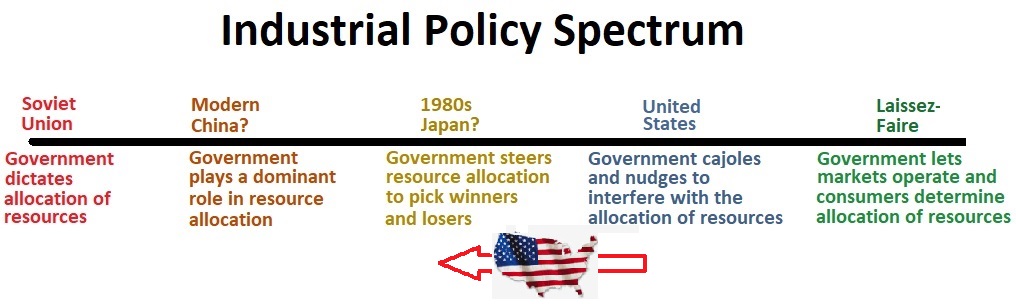
In other words, the U.S. is moving in the wrong direction on my “Industrial Policy Spectrum.”


The key unanswered question is whether the government’s new powers will be temporary or permanent.

There’s a legitimate argument for some form of intervention while the crisis in ongoing. But what happens once things go back to normal? Will politicians allow the “creative destruction” of capitalism, or will they use their expanded power to permanently interfere with market forces?
If they choose the latter, there will be less long-run prosperity.