Search This Blog

De Omnibus Dubitandum - Lux Veritas

Showing posts with label World Bank. Show all posts

Thursday, January 25, 2024

Harbinger of Things to Come, Part II

By Rich Kozlovich  (Part I appeared here)

For some time I've felt the world's economy will face a total collapse, and I further believe the EU will cease to exist by 2030, or ever earlier.  Geopolitical Futures recently published an piece entitled "Gloomy Outlook for the World Economy", saying, The World Bank expects economic activity to go from bad to worse, and published a chart from the World Bank, which I found largely meaningless.

While they found 2023 to be economically resilient, my view that's illusionary, and it appears it's in reality their view also, since they are expecting the Russo/Ukrainian War, all the Middle East issues, especially supply chain issues to put a serious economic damper on 2024.  I think that's the tip of the iceberg.  

The amount of conflict worldwide, either economic, military, political, or just plain crime and violence, is so ubiquitous all of that will have a bigger impact than they may be seeing on the surface.  Or at least willing to predict.  Especially regarding the over 300 trillion dollar worldwide government debt, much of which cannot be repaid. 

On Jan 15, 2024 Rachel Alexander  published this article,  Alarm Bells Increase, Warning of an Impending Huge Economic Collapse, saying:

Powerful voices in the financial and economic sectors are warning that the U.S. is headed for a gigantic economic collapse. The U.S. continues printing money to keep up with its financial obligations, spending way beyond its means. With Democrat Joe Biden as president, there is even less of a check on spending than under Republicans. The debt recently increased another trillion within 90 days, reaching 34 trillion. 

We're seeing activity from the World Economic Forum that's foundationally misanthropic, economically unsound, and morally defective, as notes:

Even as the useless COVID mask is making a comeback throughout some parts of Western Society, witches and wizards of the World Economic Forum are brewing up a new ‘plandemic’ at The 2024 annual meeting of the World Economic Forum in scenic Davos, Switzerland. No apologies from WEF’ers for the drastic loss of human life and widespread devastation caused by their response to the Coronavirus—still being felt—worldwide—when they released their pre-planned COVID-19 ‘pandemic’ on unsuspecting masses.

Currently there's another vast waste of money going on at Davos, with the World Economic Forum and they wish to "'Rebuilding Trust".  What load of horsepucky.  

It seems to me they intend to do that through censorship and surveillance.  All of which I find interesting as they've never admitted to any wrong headedness or actions, nor have the asked for forgiveness, implying a lack of repentance.  The word repentance means to "turn about", and it's clear they're never going to change direction.  So what trust is it exactly they're expecting to restore?  
Here's what we can expect from these arrogant, misanthropic, over educated, pampered, and catered to but blatantly stupid elitist freaks and how much the elite hate us, and the utter contempt to which they hold us.

They want to ration food, cut energy use, ban unnecessary air travel, and they will decide what's unnecessary, all predicated on preventing climate change, another false narrative full of junk science and corruption.  They will decide what information is misinformation and anything they don't like is to be censored, and most importantly, seriously restrict the freedoms of the American people

Ursula Vod Der Leven, "The Wicked Witch of Davos", really hates free speech, especially speech about the pandemic corruption and the deadly mandates they imposed on humanity. She's been in bed with the pharmaceutical companies for years, and get this, she's another plagiarist.  

Hmmmm, I wonder if she thinks charges of plagiarism against her counts as misinformation?

Although it was shown almost 45% of all the pages in her doctoral thesis suffered from plagiarism, she didn't cheat.  She had no intent to deceive! Oh no, it wasn't intentional!!! Amazing!!!   So, it was just forty five pages with a lot of accidents?   Yeah, right! 

So she kept her Ph.D. in medicine, and she gets to lecture the world about truth and integrity.  Now....that's just remarkable!  Don't you think? 

But she's not alone.  Representatives from Iran, Saudi Arabia, Qatar, Rwanda, and Azerbaijan lectured the world on human rights, all of whom have abysmal human rights records.

If she was alive in 1933 The Wicked Witch of Davos would have been in the streets of Germany sieg heiling with tears streaming down her face. But, then again, most likely so too would have Klaus Schwab if he was alive then.   Of course we may wish to suppose they would have been prominent then, and they may have been standing behind Hitler during the Parade Vor Dem Schopfer Grossdeutschland.  That's a concept I don't find far fetched.

We're descending into madness, all the traditional values are being destroyed, violence in the schools is being called the next ‘powder keg’.  Black students are out of control, and just recently 10 black teenagers beat to death a 17 year old white student in a planned attack  Ten of them!   And now at least 4 face murder charges.

A number of recent stories came rushing to mind:

  •  Brendan Depa, a 6-foot-6 and 270 pounds 17-year-old student who had three “battery arrests” before he pummeled and stomped a school employee (into unconsciousness) after she instructed him to put down the Nintendo Switch while he was in school. 
  • The “caught-on-camera” mass brawl in a North Carolina high school, which left a 15-year-old student knifed and bleeding out on the gymnasium floor—the unidentified victim quickly succumbed to his/her injuries.

And that's the tip of the iceberg.  Biden, the Democrats, leftists in government, in academia, the media, entertainment, and commence are destroying western civilization, and it's going to get a lot worse.

Saturday, January 8, 2022

World Bank Data: Comparing the U.S. and Europe

As I warned a few days ago, Biden’s so-called Build Back Better plan is not dead.

There’s still a significant risk that this economy-sapping plan will get enacted, resulting in big tax increases and a larger burden of government spending.


Proponents of a bigger welfare state say the President’s plan should be approved so that the United States can be more like Europe.

This argument is baffling because it doesn’t make sense to copy countries where living standards are significantly lower.

In some cases dramatically lower.

Let’s explore this issue in greater detail.

In a column for Bloomberg, Allison Schrager analyzes America’s supply-chain problems and the impact on consumption patterns.

But what caught my eye were the numbers comparing the United States and Europe.


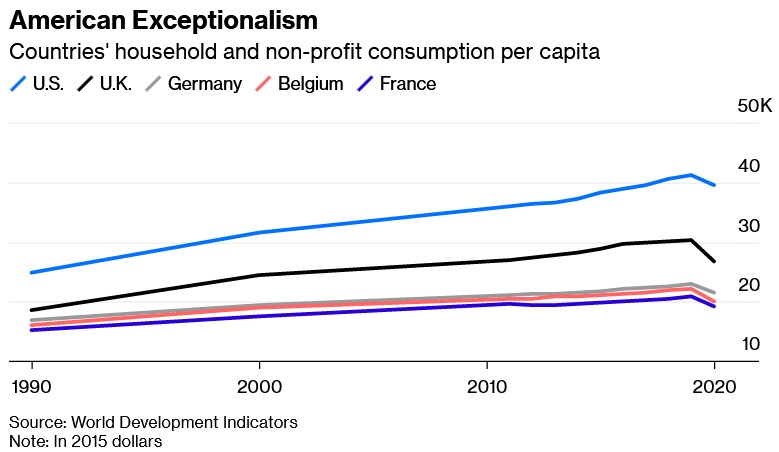
Americans can’t spend like they used to. Store shelves are emptying, and it can take months to find a car, refrigerator or sofa. If this continues, we may need to learn to do without — and, horrors, live more like the Europeans. That actually might not be a bad thing, because the U.S. economy could be healthier if it were less reliant on consumption. …We consume much more than we used to and more than other countries.  Consumption per capita grew about 65% from 1990 to 2015, compared with about 35% growth in Europe. …What would that mean for the U.S. economy? European levels of consumption coexist with lower levels of growth.

Here’s the chart that accompanied her article.

As you can see, consumption in the United States is far higher than it is in major European nations – about $15,000-per-year higher than the United Kingdom and about double the levels in Germany, Belgium, and France.

So when someone says we should expand the welfare state and be more like Europe, what they’re really saying is that we should copy nations that are far behind the United States.

Some of you may have noticed that Ms. Schrager is citing per-capita consumption data from the World Bank and you may be wondering whether other numbers tell a different story.

After all, if higher levels of consumption in America are simply the result of borrowing from overseas, that would be a negative rather than a positive.

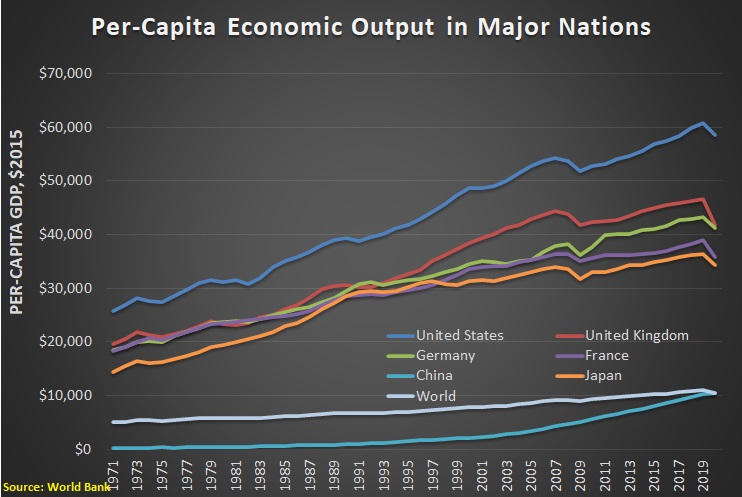
So I went to the same website and downloaded the data for per-capita gross domestic product instead. I then created this chart (going all the way back to 1971). As you can see, it shows that Americans not only consume more, but we also produce more.

For those interested, I also included Japan and China, as well as the average for the entire world.

The bottom line is that it’s good to be part of western civilization. But it’s especially good to be in the United States.

Since we’re on the topic of comparative economics, David Harsanyi of National Review recently wrote about the gap between the United States and Europe.


More than anything, it is the ingrained American entrepreneurial spirit and work ethic that separates us from Europe and the rest of the world. …Europe, despite its wealth, its relatively stable institutions, its giant marketplace, and its intellectual firepower, is home to only one of the top 30 global Internet companies in the world (Spotify), while the United States is home to 18 of the top 30. …One of the most underrated traits we hold, for instance, is our relative comfort with risk — a behavior embedded in the American character. …Americans, self-selected risk-takers, created an individual and communal independence that engendered creativity. …Because of a preoccupation with “inequality” — one shared by the modern American Left — European rules and taxation for stock-option remuneration make it difficult for start-up employees to enjoy the benefits of innovation — and make it harder for new companies to attract talent. …But the deeper problem is that European culture values stability over success, security over invention…in Europe, hard work is less likely to guarantee results because policies that allow people to keep the fruits of their labor and compete matter far less.

In other words, there’s less economic dynamism because the reward for being productive is lower in Europe (which is simply another way of saying taxes are higher in Europe).

P.S. The main forcus of Ms. Schrager’s Bloomberg article was whether the U.S. economy is too dependent on consumption.

It feels like our voracious consumption is what fuels the economy. But that needn’t be the case. Long-term, sustainable growth doesn’t come from going deep into debt to buy stuff we don’t really need. It comes from technology and innovation, where we come up with new products and better ways of doing things. An economy based on consumption is not sustainable.

I sort of agree with her point.

Simply stated high levels of consumption don’t cause a strong economy. It’s the other way around. A strong economy enables high levels of consumption.

But this doesn’t mean consumption is bad, or that it would be good for America to be more like Europe.

Instead, the real lesson is that you want the types of policies (free markets and limited government) that will produce innovation and investment.

That results in higher levels of income, which then allows higher levels of consumption.


Saturday, November 6, 2021

Doing Business, Indeed

As the demise of an influential World Bank ranking shows, multilateral institutions are prone to corruption. 

 Judge Glock November 5, 2021

From the United Nation’s Oil-for-Food Program to Interpol’s scandal-ridden contracts with Philip Morris and FIFA, international organizations have proved inept at management and undermined faith in the institutions they claim to support. The latest exhibit: the World Bank, which announced in September that it would stop publishing its Doing Business report, once an essential tool for ranking economic opportunity across the world. 

Internal and external audits showed that the report had become subject to political pressure, corruption, and ineptitude. The report’s demise is a tragedy, since its very success is what made it a target of manipulation. But the scandal also shows the danger of trusting such projects to international institutions like the World Bank, where malicious actors often punch well above their weight.

The World Bank created the Doing Business report in 2003 in response to a growing literature that showed the importance of small businesses to economic growth. Writers like Hernando de Soto had demonstrated that burdensome regulations not only hurt poor entrepreneurs but also kept entire economies poor. The Bank’s report soon became famous for an index that ranked all countries by ease of doing business there, based on measures such as how long it took to start a new company and how hard it was to get a construction permit.

The report had a surprising global impact. When Narendra Modi became prime minister of India, he promised to improve his country’s rank on the index to 50th. Vladimir Putin of Russia pledged to push Russia’s rank to 20th. The World Bank documented 3,800 reforms inspired by the rankings.  We now know that corruption undermined the report’s integrity. 

An outside audit of the 2018 and 2020...............To Read More....


Monday, April 15, 2019

Sanity and Humanity Return to the World Bank?

Paul Driessen Apr 13, 2019

President Obama infamously told Africans they should focus on their “bountiful” wind, solar and biofuel. If they use “dirty” fossil fuels to raise living standards “to the point where everybody has got a car, and everybody has got air conditioning, and everybody has got a big house, well, the planet will boil over.”

So when South Africa applied for a World Bank loan to finish its low-pollution coal-fired Medupi power plant, his administration voted “present,” and the loan was approved by a bare majority of other bank member nations. The Obama Overseas Private Investment Corporation refused to support construction of a power plant designed to burn natural gas that was being “flared” and wasted in Ghana’s oil fields.

As David Wojick and I have documented (here, here, here, here and here), eco-imperialist, carbon colonialist policies by the World Bank and other anti-development banks have perpetuated needless energy deprivation, poverty, disease and early death in Africa, Asia and beyond for much too long.
 
But now the World Bank’s executive board has unanimously approved President Trump’s nominee as its new president. Former Treasury Department Under Secretary for International Affairs David Malpass has long criticized the bank for its lack of transparency, multiple low-interest loans to China (even as China became an economic behemoth), and insufficient focus on private-sector development and a stronger, more stable global economy for all nations and families. He will serve a five-year term.

A few critics predictably asserted that Malpass had “committed economic malpractice” and would be “a disastrous, toxic choice.” However, others praised his experience, skills, free-market principles, and commitment to accountability and poor country development.

“Malpass is the ideal candidate to cleanse and modernize an institution charged with helping developing nations climb the economic ladder,” said Deroy Murdock, a Townhall columnist, whose travels have let him witness rampant poverty and malnutrition firsthand all across the globe.
A healthy dose of sanity and humanity is clearly in order. In recent years, the World Bank strayed far from its original 1944 mission of reducing global poverty, providing financial aid and guidance to needy countries, and giving “life-saving global health and humanitarian assistance” to “the world’s most vulnerable populations.” Instead, it increasingly focused on “fighting the effects of climate change,” supporting wind and solar energy projects, and combating emissions of plant-fertilizing carbon dioxide.

In 2018 alone, the World Bank provided $20 billion for such projects. Its cumulative loans to China now total more than $60 billion – even as the Middle Kingdom increasingly engaged in predatory loan practices. “Sri Lanka, for example, was forced to cede control of the strategic port of Hambantota to China Merchants Port Holdings Company, after falling into the ‘Chinese debt trap,’” Murdock wrote.

Other supposed multilateral “development” banks followed the World Bank’s callous lead. Most stopped financing coal-fired power plants, slashed or ceased funding for oil and gas exploration by poor countries, and emphasized “total de-carbonization” in their lending practices.
 
In their warped worldview, manmade climate change dangers forecast by computer models are a far more pressing concern than horrific real-world, present-day deprivation, disease and death.

Right now, around the world, over a billion people still do not have electricity; another 2 billion have electrical power only sporadically and unpredictably. In Sub-Saharan Africa, nearly 700 million people (the population of all Europe) rarely or never have electricity, and still cook and heat with wood, charcoal, and animal dung. In India, over 200 million people still do not have access to safe drinking water.
Every year, hundreds of millions become ill and 5 million die of lung and intestinal diseases from inhaling pollutants from open fires, and from lack of clean water, refrigeration, bacteria-free food and decent clinics. Largely because they lack electricity to power modern economies, nearly 3 billion survive on a few dollars per day, and more millions die every year from preventable or curable diseases.
 
But the anti-development banks still focus on “climate change mitigation” and financing “the shift in energy production to renewable energy technologies, and the shift to low-carbon modes of transport.”

Such as horses, oxen and walking, one supposes. People in those countries have been there, done that. They will no longer tolerate being told these banks will help them improve their lives only a little, only to the extent that doing so would conform to climate and sustainability guidelines, only as much as could be supported by wind, solar biofuel and geothermal energy.

Carbon colonialism is on its way out. It’s about time. Will the Malpass World Bank help lead the way?

In what can only be seen as a massive show of defiance and common sense, developing, emerging and modern economies have well over 215,000 megawatts of coal-fired generating capacity under construction: China 128,650 MW; India 36,158; Indonesia 11,466; Japan: 8,724; Pakistan 3,300; Philippines 2,890; Poland 4,170; South Africa 5,429; South Korea 5,429; Vietnam 9,705.

The Africa Development Bank also knows fossil fuels still represent the way forward to a healthier and more prosperous future – and will do so for decades to come. The AfDB is again financing coal and natural gas power generation projects, because it understands that abundant, reliable, affordable electricity is essential for real progress – and cannot possibly be achieved with expensive, inadequate, intermittent, unpredictable wind and solar power. The continent’s geothermal energy is woefully inadequate.

Africa has the lowest electrification rate in the world. Its per capital power consumption is a miserly 615 kWh per year, AfDB President Akinwumi Adesina emphasized. Compare that to 6,500 kWh per person per year in Europe, and 13,000 in the United States.
 
The mythical average African’s access to electricity is equivalent to the average American having this miraculous, all-purpose power available 1 hour a day, 8 hours a week, 411 hours per year – at totally unpredictable times. Try running your home, hospital, school, office, factory or film industry on that.

In reality, most of Africa’s electricity is generated in one country, South Africa, and the vast majority of the continent’s people still have zero, zip, nada electricity – except maybe enough photovoltaic power to charge their cell phones and power a single light bulb in their primitive huts.

Rep. Alexandria Ocasio-Cortez and her coterie of petroleum-denigrating socialists have no inkling of what life would be like without oil and natural gas. This short video gives a graphic clue of life under their Green New Deal. But in reality, even the metal, wood and cotton items the video leaves behind when petroleum is yanked away would disappear without oil and gas to get raw materials out of the ground and turn them into everyday products – and to grow, harvest and weave cotton into T-shirts and undies.

Botswana, Mozambique, South Africa, Zimbabwe and many other Sub-Saharan African countries have vast coal deposits that would last at least a century at rates necessary to electrify those countries. Many also have enormous oil and natural gas resources. Those fuels must no longer be ignored under the “keep it in the ground” mantra.

Of course, all this anti-fossil-fuel fervor is justified by cries of “climate change.” But the issue isn’t whether the climate or weather is changing. It’s whether humans and fossil fuels are truly causing any observed changes … whether any changes will be dangerous or catastrophic – and whether alarmist scientists have any evidence that could survive scrutiny by a Presidential Commission on Climate Change that they are scared to death President Trump might create.

Hopefully, David Malpass will set a more realistic, more human-rights-focused tone at the World Bank – and for the various multilateral development banks. Billions of lives hang in the balance.

Tuesday, June 1, 2010

World Bank incompetence and malpractice

Fiona Kobusingye-Boynes gave me permission to publish this in 2006 and all the information contained here-in is relative to that date.


by Fiona Kobusingye-Boynes

Date: June 16, 2006

Fiona Kobusingye speaks from horrible personal experience about the disease that has killed six members of her family and snuffs out the lives of a million Africans every year. It is so tragic, and so unnecessary. We could end this suffering and death, if we used every available weapon to stop malaria – not just insecticide-treated bednets, but insecticides, too, especially DDT. But politicians, environmental activists and bureaucrats promote programs that don’t work, tell Africans they mustn’t use DDT, and falsify data to make it look like their incompetent programs are working. The World Bank is a major offender. It should get out of malaria control – and do what it was created to do.

I have been struck down by malaria dozens of times. The vomiting, high fevers, dehydration, headaches, joint pain and disorientation were beyond belief.

If doctors hadn’t helped me even when I couldn’t pay, I would have been dead long ago – like my son, two sisters and three nephews, all victims of this vicious disease. Like the husbands and children of women who work with me, making beautiful purses to earn money for malaria medicines. Like 50 of the 500 orphan children who attended the school that my husband and I help sponsor – all dead in a single year!

It is an unspeakable tragedy. Malaria infects 400 million Africans every year, leaving them unable to work, attend school, cultivate fields, care for their families or build our nations. It costs Uganda over US$700 million annually in lost productivity, millions of hours spent caring for sick children and parents, countless potential Einsteins, Beethovens and Martin Luther Kings.

We could end this suffering and death, if we use every available weapon – not just insecticide-treated bednets, but insecticides, too, especially DDT. Unfortunately, too many politicians, environmental activists and bureaucrats promote programs that don’t work and tell Africans they can’t use DDT, which keeps deadly anopheles mosquitoes out of our homes for six months or more, with just one spraying on their inside walls.

Thankfully, President Bush and the U.S. Congress and Agency for International Development have begun spending more money – and using DDT and other insecticides in Uganda, Tanzania and Angola. Other agencies are also revising their policies and programs. But one is dragging its feet.

Six years ago, the World Bank promised to spend $300-500 million on malaria control in Africa. However, according to a study in The Lancet, the Bank has bungled the job.

The malaria experts who conducted the study said the Bank actually spent perhaps $100 million worldwide, and cut the number of recipient countries in half, and claimed progress where there was none. By counting eight months as a year, the Bank made it look like its programs had suddenly slashed malaria cases by 60% in Brazil. Refusing to provide evidence to support claims that are sharply contradicted by other data, it also said Bank programs had “dramatically” reduced India’s malaria deaths in just one year.

It refuses to spend Bank money on DDT in Eritrea, where thousands die from malaria every year, even though this chemical has reduced malaria by 75% in at least four African countries.

The Bank bought 100 million doses of chloroquine for use in India, where this drug fails to work 15-45% of the time – and children die as a result. Just imagine the malpractice charges and criminal indictments that would result if doctors did something like that in the United States. World Bank staff then argued that “chloroquine is 10-20 times cheaper” than Artemisia-based combination drugs – when even Bank documents specifically acknowledge that “artemisinin-based drugs are the only first-line anti-malarial drugs appropriate for widespread use that still work against chloroquine-resistant malaria parasites.”

The study also states that the Bank eliminated its entire malaria staff, but says it now has “three full-time professionals working on malaria” – for all of sub-Saharan Africa! This is completely inadequate and does nothing to alter the incompetent policies that continue to sicken and kill Africans.

Another study found that indoor spraying with DDT slashed malaria rates by nearly 75% in just a few years in Madagascar’s highlands. Indoor DDT spraying, combined with insecticide-treated curtains had similar results elsewhere in the country. Despite this life-saving success, the World Bank and Roll Back Malaria have pressured Madagascar to “progressively phase out DDT” and replace it with an “environmentally friendly” insecticide, even though no chemical has yet been found that is nearly as effective as DDT. I can only conclude that, in their minds, environmental considerations and “international criticism” about DDT take precedence over African lives.

Against all this and more damning evidence, the Bank’s Lancet response asserts that its “approach is driven by results.” Just imagine what would happen to doctors and corporate CEOs who got such “results.”

The Bank’s Lancet response did get one thing right. It said that, compared to the Global Fund for the Prevention of Malaria, Tuberculosis and HIV/AIDS, the Bank has a “comparative advantage in development economics, financing … capacity building and … implementation support.”

Put another way, the Global Fund is more competent than the Bank in disease control, and more transparent about its funding and results. It has superior staff, policies, programs and therapies. And it gives grants, which are attractive to African countries already saddled with debt – instead of loans like the Bank does.

Instead of pretending to be a disease expert, the Bank should focus on its comparative advantages. It should build new hospitals and clinics, get them electricity and clean water, support Global Fund malaria programs, and provide stipends for doctors and nurses, to keep them from leaving Africa for countries where salaries are higher, and obstacles less overwhelming. Let the Global Fund handle malaria control.

World Bank president Paul Wolfowitz has an opportunity to change this dismal situation, end the Bank’s shamefully defective malaria programs, refocus it to what it does best, improve healthcare delivery, and save lives.

I’m not a doctor or politician. I’m just an African woman with a dream: that we finally end a disease that is wiping out the future of Africa – our precious children. I truly hope Mr. Wolfowitz will rise to the occasion.