Search This Blog

De Omnibus Dubitandum - Lux Veritas

Showing posts with label Vouchers. Show all posts

Thursday, November 3, 2022

More Academic Evidence for School Choice

October 30, 2022 by Dan Mitchell @ International Liberty

Since teacher unions care more about lining their pockets and protecting their privileges rather than improving education, I’ll never feel any empathy for bosses like Randi Weingarten.


That being said, the past couple of years have been bad news for Ms Weingarten and her cronies.

Not only is school choice spreading – especially in states such as Arizona and West Virginia, but we also are getting more and more evidence that competition produces better results for schoolkids.

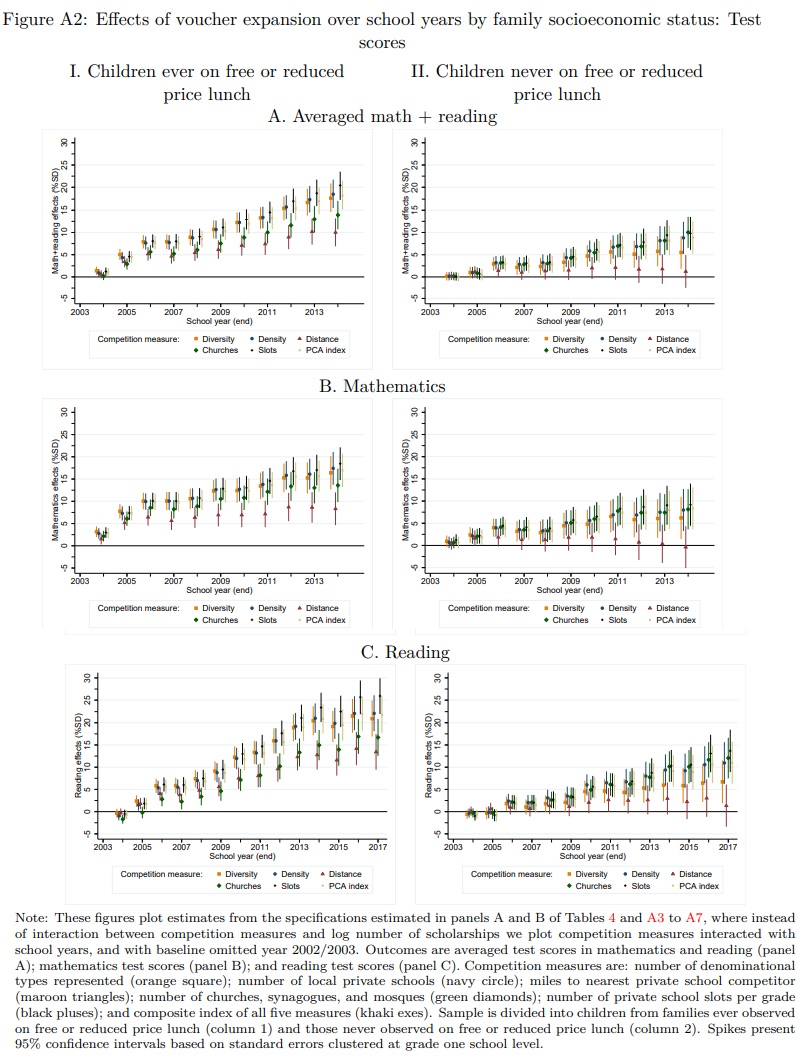
In a study published by the National Bureau of Economic Research, Professors David N. Figlio, Cassandra M.D. Hart & Krzysztof Karbownik found that school choice led to benefits even for kids who remained stuck in government schools.

They enjoyed better academic outcomes, which is somewhat surprising, but even I was pleasantly shocked to see improved behavioral outcomes as well.


School choice programs have been growing in the United States and worldwide over the past two decades, and thus there is considerable interest in how these policies affect students remaining in public schools. …the evidence on the effects of these programs as they scale up is virtually non-existent. Here, we investigate this question using data from the state of Florida where, over the course of our sample period, the voucher program participation increased nearly seven-fold.

We find consistent evidence that as the program grows in size, students in public schools that faced higher competitive pressure levels see greater gains from the program expansion than do those in locations with less competitive pressure. Importantly, we find that these positive externalities extend to behavioral outcomes— absenteeism and suspensions—that have not been well-explored in prior literature on school choice from either voucher or charter programs.

Our preferred competition measure, the Competitive Pressure Index, produces estimates implying that a 10 percent increase in the number of students participating in the voucher program increases test scores by 0.3 to 0.7 percent of a standard deviation and reduces behavioral problems by 0.6 to 0.9 percent. …Finally, we find that public school students who are most positively affected come from comparatively lower socioeconomic background, which is the set of students that schools should be most concerned about losing under the Florida Tax Credit Scholarship program.

It’s good news that competition from the private sector produces better results in government schools.

But it’s great news that those from disadvantaged backgrounds disproportionately benefit when there is more school choice.

Wonkier readers will enjoy Figure A2, which shows the benefits to regular kids on the right and disadvantaged kids on the left.

Since the study looked at results in Florida, I’ll close by observing that Florida is ranked #1 for education freedom and ranked #3 for school choice.

P.S. Here’s a video explaining the benefits of school choice.

P.P.S. There’s international evidence from Sweden, Chile, Canada, and the Netherlands, all of which shows superior results when competition replaces government education monopolies.


Tuesday, December 14, 2021

School Choice: A Win-Win for Students and Taxpayers

December 13, 2021 by Dan Mitchell @ International Liberty

I wrote two days ago about how the Supreme Court will be ruling in the next few months on a very important school-choice case, involving whether state and local governments should be allowed to discriminate against religious schools.


As part of that column, I mentioned that “government school systems cost a lot of money and do a bad job.”

Some readers emailed me and expressed disbelief. The common message was that private schools surely had to be more expensive.

There are some very costly private schools, to be sure, but the data clearly show that government schools, on average, consume a lot more money.

I want to build on this message today by calling everyone’s attention to a great report by Martin F. Lueken of edChoice.

Here are some of the key findings from the executive summary.

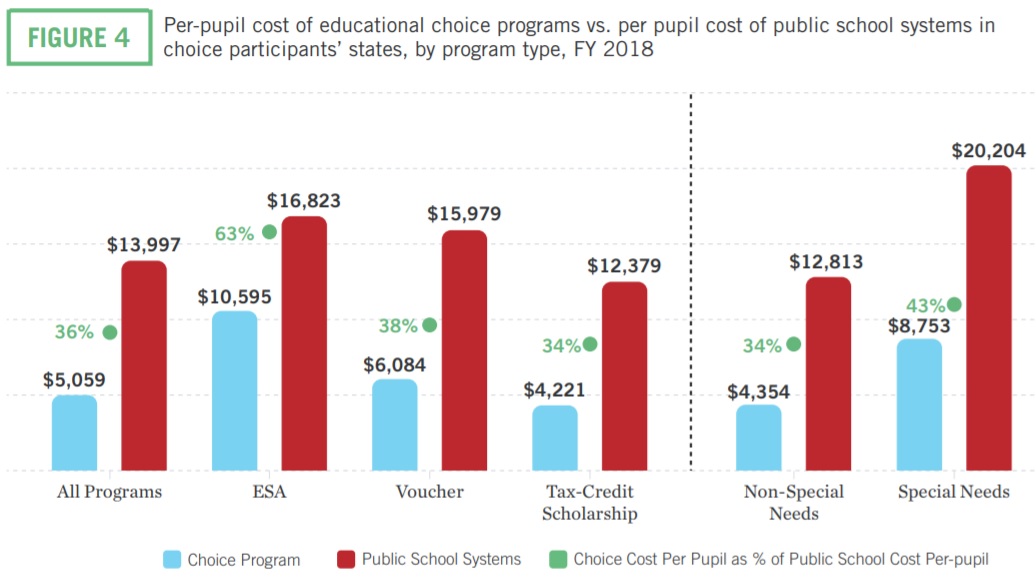
This study estimates the combined net fiscal effects of each educational choice program on state and local taxpayers… Through FY 2018, the 40 educational choice programs under study generated an estimated $12.4 billion to $28.3 billion in cumulative net fiscal savings for state and local taxpayers. This range represents $3,300 to $7,500 per student participant. …Educational choice programs generated between $1.80 to $2.85 in estimated fiscal savings, on average, for each dollar spent on the programs. These savings result from many of the students who exercised choice who would have been enrolled in a public school if these choice programs did not exist—and enrolled in public schools at a much larger taxpayer cost.

The report is packed with lots of data, including state-by-state estimates of how different choice programs save money.

But if you’re going to digest one set of numbers, Figure 4 tells you just about everything you need to know.

And remember, when you look at these cost comparisons, that private schools produce better outcomes, as measured by student achievement.

P.S. Here’s a must-see chart showing how more and more money for the government school monopoly has produced zero benefit.


Friday, July 2, 2021

Why School Choice Matters Beyond Academic Achievement!

Vincent Geloso Vincent Geloso  – June 26, 2021 @ American Institute for Economic Research 


With the pandemic-associated school closures in America, the level of parental discontent towards public schools has been growing. The response of teachers’ unions was particularly irksome to parents who turned in greater numbers to homeschooling and other educational arrangements. This has been accompanied by rising levels of support for school choice as witnessed by the new frequently shared bullet point of “funding students, not systems.” In some states, such as West Virginia, the discontent has allowed a bevy of legislation curtailing the powers of the teachers’ unions. 

The discontent has caused unions to push back to calm down criticisms. In addition to getting heavily involved in electoral politics (even at the city level) to promote union-friendly candidates, they have produced important talking points regarding the efficacy of school choice on securing better outcomes for children. More often than not, the rebuttal speaks to issues of cognitive development and schooling outcomes. Proponents of school choice have only been too happy to accept a debate on these narrow grounds. 

To be sure, there is now a wide body of empirical evidence on the effects of granting parents more choices in choosing the schools of their children. Many of these studies use top-of-the-line research methods to determine causality in their findings. The vast majority of the evidence suggests that there are important gains with regards to academic performance. There are some discordant notes. Some research papers contest the presence of performance gains for children. However, this minority part of the literature does not argue that school choice made outcomes worse. It tends to find near-zero effects on outcomes. Thus, the worst-case scenario is “no effect,” which is still a strong case for school choice as such programs appear to reduce total expenditures. On net, this worst-case scenario implies that the same outcomes can be secured at lowest costs. 

However, all of this constitutes an understatement of the benefits of allowing parents to choose schools for their children. Proponents of school choice have unwittingly selected to hinder the strength of their arguments! 

It is important to bear in mind that schooling is not only about academic achievements. There is much to it! Schooling serves to help children socialize and develop emotional control. These aspects of schooling are not of trivial importance. Just as cognitive development, they are associated with better outcomes in adulthood (e.g. higher levels of schooling persistence, higher levels of life satisfaction, higher levels of income etc.). Given the importance of these non-cognitive aspects of schooling, we should expect parents to care about a wider array of features than those captured by grades. 

As a result, allowing families to choose may allow parents to pick the mix of school features most suited for their children accordingly. Among the factors that parents will weigh are those that speak to the overall health and safety of their children, which are related to socialization and the development of emotional control. In turn, this would impact the later-life well-being in children. Most notably, as is argued in a recent article in School Effectiveness and School Improvement by Angela Dills and Corey DeAngelis, it could allow improvements in the “mental health” outcomes of children. 

The better matching of children to their schools may allow them to feel more at ease in their immediate environment. This would reduce distress and improve mental health. Second, school choice creates competitive pressures to entice families to enroll. As such, schools would attempt to compete with each other not only on academic outcomes but also on non-academic factors such as the policing of bullies or the psychological support offered to children. This would also improve mental health outcomes. Thus, mental health outcomes should improve in states that adopt school choice relative to states that do not. 

How to measure these improvements? In their article, Dills and DeAngelis propose that suicide rates by adolescents constitute a viable measure of the mental well-being of pupils. If school choice programs improve mental well-being, they hypothesize that suicide rates ought to fall (all else being equal). Concentrating on the United States, they find that states that adopted broad-based voucher programs (which are designed to give parents more choices) experienced declines in suicide rates. The effect they find represents a reduction of 10 percent in suicides among 15 to 19 years old. 

Unsatisfied by these results, Dills and DeAngelis also attempted to complement their results by using surveys of self-reported mental health outcomes. For example, these surveys asked respondents how many times, during the past twelve months, they were treated by mental health professionals. They also asked questions regarding eating disorders (e.g. anorexia, bulimia) or other emotional problems that affected school attendance. The answers to these questions can be taken as complementary to the issue of adolescent suicides. 

However, their survey data is a bit different than their suicide rates data: they only have cross-sections for a few given years and their variable of interest is whether a child was in a private school. This poses a problem of interpretation for any results as kids who go to private school could be going because they are more/less fragile to start with. To address this problem, Dills and DeAngelis control for the initial level of a child’s mental health at the time of enrollment. 

This method yields similar results as those for suicide rates: they find better mental outcomes where school choice exists. The likelihood of suffering from emotional problems is reduced by between 1.9 and 2.9 percentage points. Those numbers are not trivial, as the mean rate of mental disorder in their sample is 3% of the population. While these may appear small, these effects complement those Dills and DeAngelis found with regards to adolescent suicides.

These are important findings. In discussions of school choice, the focus is predominantly on academic achievements. As a result, the conversation is centered on whether or not test scores improve. However, it is always worthwhile to take account of the bigger picture. Schooling is not only about what government departments can easily measure; it is also about these harder to measure aspects of a child’s well-being which parents are often best incentivized to understand and identify. Bearing that in mind only strengthens the case for allowing more room for school choice. As the pandemic crisis unwinds, lessons about how to best proceed in the future should include this finding of Dills and DeAngelis.

Vincent Geloso

Vincent Geloso

Vincent Geloso, senior fellow at AIER, is an assistant professor of economics at King’s University College. He obtained a PhD in Economic History from the London School of Economics.

Get notified of new articles from Vincent Geloso and AIER.


Untying the Gordian Knot of Critical Race Theory

June 30, 2021 by Dan Mitchell

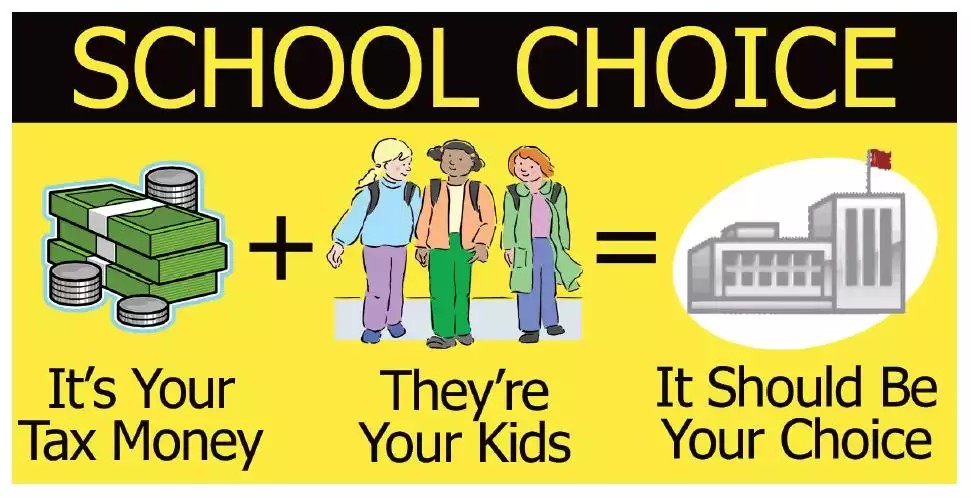
The most powerful argument for school choice is that children from poor families will be more likely to get a high-quality education. After all, these are the kids most likely to be trapped in failing government schools.

 https://danieljmitchell.files.wordpress.com/2013/04/school-choice-cartoon.jpg

But there are lots of secondary arguments for school choice.

Today, we’re going to add to this list by considering the current controversy over whether “critical race theory” should be taught in schools.

I won’t bother trying to put forth my own definition of CRT.

But, for what it’s worth, I think it’s a good thing if kids learn that the United States (like all nations) has an imperfect history, while it’s wrong if kids are brainwashed into believing that they are either oppressors or victims simply because of skin color.

But what about people who think differently? Should I decide what schools teach, or should other people make those choices?

The right answer is that we don’t need a one-size-fits-all approach. Either mine or anyone else’s.

In a column for Reason, J.D. Tuccille says school choice is a way of letting parents pick the schools that best reflect their values.

…some states are banning the teaching of CRT—an approach that threatens to turn advocates of the ideology into free speech martyrs fighting the entrenched establishment. …families that choose how their children learn—my own included—rather than defaulting to government-run institutions…have largely escaped these battles. By homeschooling, or micro-schooling, or picking private or charter schools, we can avoid curricula permeated with ideas we find toxic… Parents that…support CRT also have alternatives to battling over the content of schoolroom lessons. They can introduce their tykes to Ibram X. Kendi’s Antiracist Baby Picture Book, marinate their kids in CRT-infused homeschooling, or send them to one of many private schools that offer willing families an education steeped in the ideology. …if that’s what they want their kids to learn, let them do so in peace, and without zero-sum arguments about what children are taught in shared institutions.

Amen.

Critical race theory won’t be nearly so controversial if we let parents choose the type of education that’s best for their kids.

And the same is true for other contentious issues, ranging from phonics to prayer.

No wonder more and more states are shifting in the right direction on this issue.

P.S. If you want to learn more about school choice, I recommend this video.

P.P.S. It’s uplifting to see very successful school choice systems operate in nations such as Canada, Sweden, Chile, and the Netherlands.


Sunday, May 2, 2021

More Good News on School Choice

April 25, 2021 by Dan Mitchell @ International Liberty

I’m pessimistic about the direction of public policy, especially on fiscal issues such as taxes and spending.


But there is a silver lining to this dark cloud of statism. We’re seeing continuing progress on school choice, most notably a big expansion of educational freedom in West Virginia.

It appears more and more state and local policy makers are reaching the inevitable conclusion that government schools operate for the benefit of teacher unions rather than students.

And this is motivating many legislators to push for school choice, especially since there’s more and more evidence that school choice improves educational outcomes.

For instance, the Wall Street Journal opined last week about a new victory in Indiana.


Ten years ago in these columns, we hailed Indiana for its leadership in establishing one of America’s most ambitious school voucher programs. On Thursday the Indiana Legislature built on that achievement by approving a budget that will take the program to 48,000 students a year from about 37,000. …The teachers unions are unhappy. Their beef is that money to expand choice is taken from traditional public schools. And this year they lobbied local school boards to pass resolutions opposed to school choice. But that common union line about choice robbing public schools isn’t true. …92% of Indiana students will be in traditional public schools, and 93% of all education funding will go to these schools. …Since 2011, when Indiana pushed through its first voucher plan, more than a quarter-million Hoosier students have benefited. In an interview with Today’s Catholic, former Gov. Mitch Daniels explains the moral logic of choice this way: “Providing poor and minority families the same choice of schools that their wealthier neighbors enjoy is the purest example of ‘social justice’ in our society today.”

Meanwhile, Arkansas may be on the verge of adding to the good news.

Here are some excerpts from an article by Jason Bedrick in National Review.


In response to families demanding more educational options, six states have already passed new choice policies or expanded existing ones this year, and similar bills are still making their way through more than a dozen other state legislatures. …the Arkansas state senate…passed Senate Bill 680, which has the support of Governor Asa Hutchinson and the Arkansas Department of Education, by an overwhelming margin. Although only half the size of the previous proposal and limited only to low-income children, the bill still represents a major step toward providing broad access to educational choice. The Arkansas House now has another opportunity to do right by Arkansas families desperate for more educational options. …the Arkansas House Revenue and Taxation Committee voted to recommend that the full House pass the bill.

The superintendents of government schools are fighting to preserve the status quo. Their main argument is that choice will hurt outcomes for students stuck in their schools.

But competition encourages everyone to do better, and Jason shares some of the evidence about government schools doing better when there is school choice .

The research about the effects of educational-choice policies on public schools…overwhelmingly finds that such policies benefit not only participating students, but also the students who remain in their assigned district schools. Out of 27 studies, 25 find that students attending district schools improve their performance on standardized tests after the introduction of a choice program, while only one study found a negative effect, and one found no visible effect. …a recent study by the University of Arkansas found that states with robust educational-choice policies saw significant improvements on the National Assessment of Educational Progress (known as the “Nation’s Report Card”) over the last two decades. …The sky isn’t falling in any of the 29 states that have some form of private-school-choice program. Indeed, the sun is still shining on their public-school systems, which have not only not collapsed but are actually performing better than before.

Fingers crossed that Arkansas lawmakers do what’s right for kids rather than siding with the education bureaucracy.

Let’s conclude with this video from the Institute of Justice, which makes the point that school choice is especially critical for those with low incomes and other challenging backgrounds.

I shared a similar video back in 2016 as part of a column about why school choice is critical for black children.

P.S. If you want to learn more about school choice, I recommend this video.

P.P.S. It’s uplifting to see very successful school choice systems operate in nations such as Canada, Sweden, Chile, and the Netherlands.


Friday, April 30, 2021

School Choice and 2021’s Tweet of the Year

April 29, 2021 by Dan Mitchell @ International Liberty 

After three columns on the topic in the past five weeks (see here, here, and here), I wasn’t expecting to write again about school choice anytime soon, but this speech by State Senator Justin Wayne of Nebraska must be watched.


What a great idea! All politicians who vote against school choice have to send their kids to the crummy government schools in their states and districts.

That wouldn’t be good news for hypocrites like Barack Obama (and his Secretary of Education), Elizabeth Warren, Democratic congressional candidates, and the head of a teacher union.

Heck, we could create a giant list of all the rich leftists who exercise choice for their own children while voting to deny similar opportunities for kids from families that don’t have lots of money.

And this is why I’m overjoyed that we have seen a lot of progress on the issue this year.

And it’s continuing. Here are excerpts from an editorial in the Wall Street Journal about recent steps to expand choice in Florida.


Florida already has among the most expansive school-choice offerings in the nation, and this week the Legislature expanded private-school vouchers to more families. …The bill increases the eligible household income cap from 300% to 375% of the poverty level—about $100,000 for a family of four—though it prioritizes households under 185%. The enrollment cap will continue to escalate by 1% of public-school enrollment annually, allowing roughly 28,000 new students each year. …One of the bill’s biggest boons is extending scholarships to students already in private school. …Florida is a haven for overtaxed northerners, but it’s also an education refuge for low- and middle-income families.

Also in the Wall Street Journal, Paul Peterson of Harvard has a column on how government lockdowns have created an opening for expanded educational freedom.


President Biden wants credit for opening up the nation’s schools within 100 days of taking office. …The big news at the 100-day mark isn’t school opening but the revival of the school-choice movement. …school-choice advocates have scored big victories around the country. Indiana enlarged its voucher program. Montana lifted caps on charter schools. Arkansas now offers tax-credit scholarships to low-income students. West Virginia and Kentucky have funded savings accounts that help parents pay tuition at private schools. Florida, a movement leader, has enlarged its tax-credit scholarship programs. Even Rhode Island Gov. Dan McKee promises to veto a moratorium on new charter schools. …The pandemic is the driving force. The failure of the public schools to educate children in the past year has angered parents and policy makers. …the loss of learning and social connectivity produced by school closures has been devastating, especially for low-income minority children. …Survey data show a rise in the level of support over the past two years for vouchers, charters and tax-credit scholarships. Political leaders sense a change in the public mood. After aggressive unions and bewildered school boards shut down schools for a year, the choice bandwagon has begun to roll.

Let’s hope that choice bandwagon rolls further. It will be great for kids.  And, given the importance of quality education for competitiveness, it will be great for the nation as well.

P.S. I’m disgusted by the hypocritical politicians who send their kids to private schools while voting against school choice for the rest of us. But I’m even more disgusted – and baffled – that the NAACP opposes school choice when minority children have the most to gain.


Thursday, April 1, 2021

School Choice on the March!

March 31, 2021 by Dan Mitchell @ International Liberty

I wrote one week ago about a big victory for education in West Virginia. The Mountain State arguably now has the most extensive system of school choice in the country.

 https://danieljmitchell.files.wordpress.com/2013/04/school-choice-cartoon.jpg

This will be great for parents and children.

There’s a lot of research showing better educational outcomes when families have options other than low-performing, monopoly-based government schools.

Now we have some additional good news.

Kentucky legislators have just overridden the governor’s veto, meaning that students in the state will now have expanded educational opportunities. Eric Boehm of Reason has some of the details.

The new law, originally House Bill 563, allows students in Kentucky public schools to switch school districts, and it creates a new tax-advantaged education savings program for families to use for private school tuition, to pay for tutoring, or to cover other educational expenses. The most controversial part of the proposal was the creation of a $25 million scholarship fund—to be filled by donations from private businesses, for which they would receive state tax credits—that students in Kentucky’s largest counties can tap to help pay for private school tuition. …With the passage of the first school choice bill in state history, Kentucky is now the 28th state with some form of school choice.

Speaking of other states, the Wall Street Journal editorialized about the beginning of a very good trend.


The pandemic has been a revelation for many Americans about union control of public schools… That awakening is helping to spur some welcome reform progress as several state legislatures are moving to expand school choice. One breakthrough is in West Virginia, where the Legislature passed a bill creating the state’s first education savings account (ESA) program. …Meanwhile in Georgia, the House passed a bill last week that would expand eligibility for the state’s voucher program for special-education students. The Senate, which had already passed the legislation, voted to approve House amendments on Monday and the bill is headed to Republican Gov. Brian Kemp’s desk. In South Dakota this month, Republican Gov. Kristi Noem signed a bill that expands eligibility for the state’s tax-credit scholarship program to students already enrolled in private schools. …in Kentucky, where Democratic Gov. Andy Beshear vetoed a bill last week that would establish a new tax-credit scholarship program. But the state legislature voted late Monday to override the veto… Nearly 50 school-choice bills have been introduced this year in 30 states. It’s a testament to how school shutdowns have made the advantage of education choice more evident, and its need more urgent.

By the way, school choice has existed for a long time in Vermont. Yes, the state that regularly reelects Crazy Bernie has dozens of small towns that give vouchers to students. Laura Williams explains in an article for the Foundation for Economic Education.


Vermont’s “tuition towns”…distribute government education funds to parents, who choose the educational experience that is best suited to their family’s needs. If the school doesn’t perform up to parents’ expectations, they can take their children, and the tuition dollars they control, elsewhere. …Ninety-three Vermont towns (36 percent of its 255 municipalities) have no government-run school at all. …the funds local governments expect to spend per pupil are instead given directly to the parents of school-age children. This method gives lower- and middle-income parents the same superpower wealthy families have always had: school choice. …parents have the ability to put their kids in school anywhere, to buy the educational experience best suited to each child. …A variety of schools has arisen to compete for these tuition dollars. …Eligibility for tuition vouchers actually increased home values in towns that closed their public schools. Outsiders were eager to move to these areas… Having watched these models develop nearby, two more Vermont towns voted in 2013 to close their government-run schools and become “tuition towns” instead.

Rhode Island is another unexpected example. That deep-blue state recently expanded charter schools in Providence.

That’s not as good a genuine school choice, but it gives parents some ability to escape traditional government schools. The Wall Street Journal opined last year on this development.

…this particular hell may have frozen over, as last week the state’s education council voted to expand and open more charter schools to rescue students in the district. About 13% of Providence’s 30,000 students attend 28 charter schools, some in other districts. But demand far exceeds supply. Only 18% of the 5,000 or so charter school applicants were offered a seat this school year, according to the state education department. …The state education council last week gave preliminary approval for more than 5,700 new charter seats in Providence and other districts. Three of four new charters that applied got a green-light to open, pending final approval in the spring, and three existing charters (two of which serve Providence) are expanding. …The teachers union isn’t happy. In a letter to Gov. Gina Raimondo, three union leaders including American Federation of Teachers President Randi Weingarten complained… This is the usual rhetorical union trick. Charters are public schools, albeit without the barnacles and costs of union control.

Let’s now add to our collection of evidence about the benefits of school choice.

In an article for National Review, James Piereson and Noami Schaefer Riley discuss the track record of the Children’s Scholarship Fund.

Children’s Scholarship Fund enables low-income children to attend private schools — and thrive. …parents who receive financial aid from the organization…send their children to inner-city private (mostly Catholic) schools. …When it came to how satisfied they were with their children’s education, almost 90 percent graded their school a 4 or 5 out of 5. …Since its inception in 1998, the fund has helped more than 180,000 children attend private schools. CSF’s high-school graduation and college matriculation rates far surpass those of the urban public schools that surround them. In Philadelphia, for instance, 96 percent of CSF eighth-graders graduated from high school on schedule — compared with Philadelphia’s public-school graduation rate of only 62 percent. A study of CSF in Baltimore found that 84 percent of scholarship recipients were enrolled in college five to ten years after completing eighth grade, compared with fewer than half of students from local public schools. Nor are these high-priced private schools. The average tuition at these schools is about $5,300 per year, and the average scholarship award is $2,200.

Why do even low-cost private schools out-perform expensive government schools?

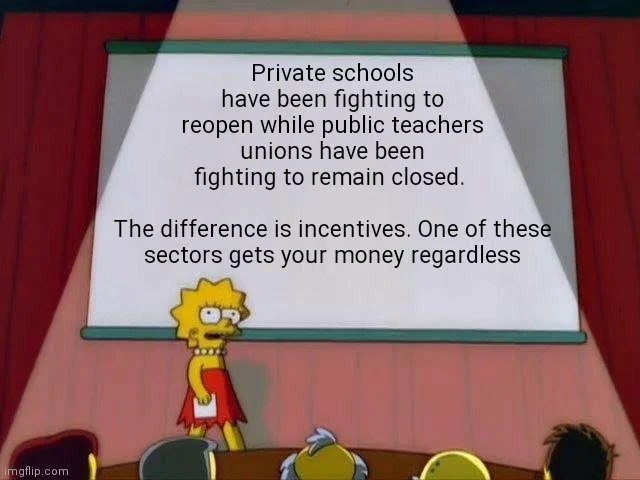
Because they have to deliver a good product. Either that, or parents will take their money elsewhere.

It’s a simple question of incentives, as illustrated by this meme about why private schools have been much better than government schools during the pandemic.
While the obvious argument for school choice is that it delivers better educational outcomes (and at lower cost), it’s worth noting that there are all sorts of secondary benefits.

As explained by W. Bradford Wilcox in an article for the American Enterprise Institute, private schools produce better families.
 

The public debate surrounding the efficacy of private versus public schools tends to revolve around their relative success in boosting test scores, graduation rates, and college admissions. …But there is more to life than excelling at school and work. For instance, there is the opportunity to be formed into a woman or man of good character, a good citizen, or a good partner and parent. …Until now, however, we have known little about how different types of schools are linked to students’ family life as adults. …In this report, we examine how enrollment in American Catholic, Protestant, secular private, and public schools is associated with different family outcomes later in life. …Adults who attended Protestant schools are more than twice as likely to be in an intact marriage as those who attended public schools. They are also about 50% less likely than public-school attendees to have a child out of wedlock. …Compared with public-school attendees, ever-married adults who attended a secular private school are about 60% less likely to have ever divorced. Catholic-school attendees are about 30% less likely to have had a child out of wedlock than those who attended public schools.

And Corey CeAngelis notes in this tweet that school choice reduces segregation.  And the Wall Street Journal editorialized last December about school choice improving mental health.


Teachers unions have pushed to shut down schools during the pandemic no matter the clear harm to children, just as they oppose charters and vouchers. Now comes a timely study suggesting school choice improves student mental health. Several studies have found that school choice reduces arrests and that private-school students experience less bullying. One reason is that charter and private schools enforce stricter discipline than traditional public schools. …The new study in the journal “School Effectiveness and School Improvement” is the first to…analyze the correlation between adolescent suicide rates and the enactment of private-school voucher and charter programs over the last several decades. They find that states that enacted charter school laws witnessed a 10% decrease in suicide rates among 15- to 19-year-olds. Private-school voucher laws were also associated with fewer suicides, though the change was not statistically significant. The effect would likely be larger if more students received vouchers. …The researchers also looked for any correlation between students who attended private school as teenagers and their mental health as adults. …individuals who attended private schools were two percentage-points less likely to report a mental health condition when they were roughly 30 years old.

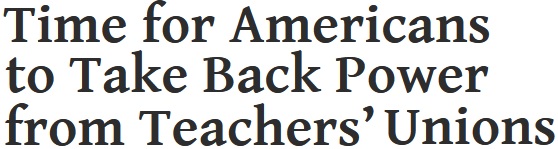
Let’s conclude with some excerpts from a strong editorial from National Review. The magazine points out that teacher unions wield power in blue parts of the nation and schools are run for their benefit rather than for the best interests of children.
 https://freedomandprosperity.org/wp-content/uploads/2021/03/Mar-31-21-NRO.jpg

…the interests of children and their families take a distant second place to the desires of the public-sector unions that dominate Democratic politics around the country and run the show practically unopposed in California. …unionized teachers…have turned up their noses at the children they are supposed to be serving and looked instead to their own two-point agenda: (1) not going to work; (2) getting paid. Randi Weingarten exercises more real practical political power than any senator or cabinet secretary, and her power is exercised exclusively in the interest of public-sector workers and the Democratic Party, which they effectively control. Perhaps it is time for Americans to take back some of that power.

And what’s the way to take back power?  It’s possible to reform labor laws so teachers don’t have out-sized influence. That sort of happened in Wisconsin under Governor Scott Walker.  But that’s difficult to achieve and difficult to maintain.  The best long-run answer is to have school choice so parents are in charge rather than union bosses.


Thursday, March 25, 2021

A Huge Victory for Education in West Virginia

March 24, 2021 by Dan Mitchell @ International Liberty

As a public finance economist, I’m a huge fan of fiscal reforms such as a spending cap or a flat tax.  But, if asked to pick the reform that would have the biggest positive impact for the United States, I’d be very tempted to pick school choice.


 Largely because of the pernicious effect of teacher unions, government schools are doing a poor job of educating children. Especially considering the record amounts of money that’s being dumped into the system.  Which is why I’m very excited that we’re about to see a massive expansion of school choice in West Virginia.  The state legislature has enacted and the governor is expected to sign (fingers crossed!) legislation creating education savings accounts (ESAs) providing $4,600 per child.

These accounts, called Hope Scholarships, will be available to all families with kids in government schools (and every single new kindergarten student). Parents then can use the funds for private school tuition, homeschooling expenses, and a range of other approved items.

The state’s leading think tank, the Cardinal Institute, has a primer on the issue.

ESAs allow parents to apply for eligible students to receive the state portion of education funds into a personal, parent-controlled account. Parents are then empowered to customize an education experience that meets the individual needs of their child, using their account to pay for approved services like tuition, therapy, tutoring, textbooks, and more.

…the bill would extend ESAs to students who are enrolled in a public elementary or secondary school… parents will only be able to purchase approved items and services. This makes ESAs as—if not more—transparent than any other form of education spending. …The key aspect that distinguishes ESAs from vouchers is parent control and customization. Instead of the state sending funds directly from the state to a specific private school, the state instead deposits funds into a parent-controlled account. These funds can then be spent on wide array of approved education services, not only tuition

Corey DeAngelis and Neal McCluskey address some of the hot-button issues in an article for Reason.


West Virginia’s public schools spend an average of $12,644 per child per year, while the estimated amount of funding that would follow the child under HB 2013 would be about $4,600. If the legislation becomes law, public schools would keep large amounts of funding for children even after they left, meaning they would end up with more money per child. …choice opponents in the state also are claiming that $4,600 is too low to cover private school tuition. But do those same people oppose Pell Grants just because they don’t cover the full cost of attending many universities? …And $4,600 would actually go a long way in West Virginia as the average private school tuition in the state is just $6,068 and the average elementary school cost is $4,890. …The worst thing about anti-school choice myths is that they disproportionately prevent the least advantaged from access to much-needed education options.

Amen to the last point.

School choice should be the civil rights issue of the 21st century since black and brown kids are the biggest victims of the government school monopoly.

I’ll close by observing that teacher unions traditionally have done a very good job of protecting their monopoly. Every time I think a state is poised to make progress on school choice (most recently in Pennsylvania and Colorado), the unions dump tons of money into campaigns so they can maintain their privileges.

Assuming West Virginia’s Republican governor, Jim Justice, doesn’t betray children by unexpectedly vetoing the legislation, the union win streak will have ended.

P.S. Here’s a video explaining the benefits of school choice.

P.P.S. There’s international evidence from Sweden, Chile, Canada, and the Netherlands, all of which shows superior results when competition replaces government education monopolies.


Thursday, October 2, 2014

October School Reform News: Heartland Institute

North Carolina Lawmakers OK
Choice for Waiting Kids

The October issue of School Reform News reports the North Carolina legislature approved a budget allocating more money for a new school voucher program and allowed more students to transfer to private schools on scholarships. I prayed that the other parents that didn’t get picked, that extra money would be available for them to get picked, because as passionate as I am, they are too, said one parent.

Also in this issue:

It’s been almost a year since Indiana and Pennsylvania officially withdrew from national Common Core standards, but the testing organization Partnership for Assessment of Readiness for College and Careers (PARCC) still lists the two states as members.

The full text of the issue is available online in Adobe Acrobat’s PDF format: October 2014 School Reform News.  All issues of School Reform News are archived here: School Reform News archive.  If you were sent this email by a friend or colleague, subscribe to be sure you don't miss an issue!


Friday, December 6, 2013

SCHOOL CHOICE WEEKLY #19:

LOCAL CONTROL MEANS CHOICE

It is highly unusual for government school employees to endorse school choice. But one public school superintendent in Fulton, Georgia gets it: There’s nothing more [in line with] local control ... than choosing where your kids go to school, Robert Avossa told the Atlanta Journal-Constitution.
Local control is a weasel phrase that in education often means union control. Liberal local control proponents often insist the ability to elect a school board means government schools reflect the will of the families they govern. In truth, school boards are typically elected in low-turnout elections during off-season times such as spring. This means special interests such as teachers unions and the education establishment determine the electoral outcome at the expense of kids and individual choice, as the Hoover Institution’s Terry Moe and others have exhaustively demonstrated.
Sullying the name and concept of local control, however, doesn’t mean it’s a bad idea, just as the prevalence of divorce doesn’t mean marriage is worthless and fake Rolexes don’t mean the real thing is low-quality. People who want others to accept bad ideas must cloak them, so they use a worthy name without its substance.
So local control, when it means freeing families to meet their needs as they determine them and not a cover for slightly smaller central planning and coercion, is a central feature of any good education system, just as Avossa says. It’s similar to the concept of subsidiarity, in which responsibility for any one person or concern belongs to the individual or organization as close to that person or concern as possible. For most children, the people appropriately responsible for their care and upbringing are their parents. That’s why local control in education should mean parent control, and thus school choice.
Avossa plans to listen some more to the parents who trust their children to his care and ultimately start a portfolio of schools that respond to their desires: Montessori, unified K-8 without a separate middle school, and so forth. That’s certainly a good start and, again, far closer to family freedom than most public school systems, which are often not acutely responsive to family concerns.
True local control, by the way, is why charter schools do not destroy representative government, because they cannot compel students to attend. Every family that chooses a charter school implicitly votes for its existence by bringing their government education funds to it. If they aren’t pleased, they can take their kids and their money to another school. If too few people vote for the school that way, it dissolves, with far less harm than Detroit is facing. The more people’s lives and preferences are subject to central planning, the worse the outcome when that planning ultimately fails.


IN THIS ISSUE:
  • School Choice Roundup
  • Common Core Watch
  • Education Today


School Choice Roundup


Common Core Watch


Education Today


Thank you for reading! If you need a quicker fix of news about school choice, you can find daily updates online under the Ed News Roundup at http://news.heartland.org/education.
We’re planning in earnest for our 2014 education projects. If you’d like Heartland Institute Research Fellow Joy Pullmann to keep up the good work ” on education issues, please consider making a contribution today! You can earmark your gift for our work on education issues by selecting that topic at the bottom of the online form, under ‘optional questions.’
Joy writes this e-newsletter, is managing editor of School Reform News, AND is available for speaking engagements on Common Core and other education topics. For more information, contact Heartland Events Manager Nikki Comerford at 312/377-4000, email ncomerford@heartland.org.