Search This Blog

De Omnibus Dubitandum - Lux Veritas

Showing posts with label Infrastructure. Show all posts

Wednesday, October 9, 2024

Biden Touts Infrastructure – What Does That Even Mean?

The president will crow about his bill, but there is very little to show for the billions spent.  

By Oct 8, 2024 @ Liberty Nation News, Tags: Articles, Business News, Opinion 
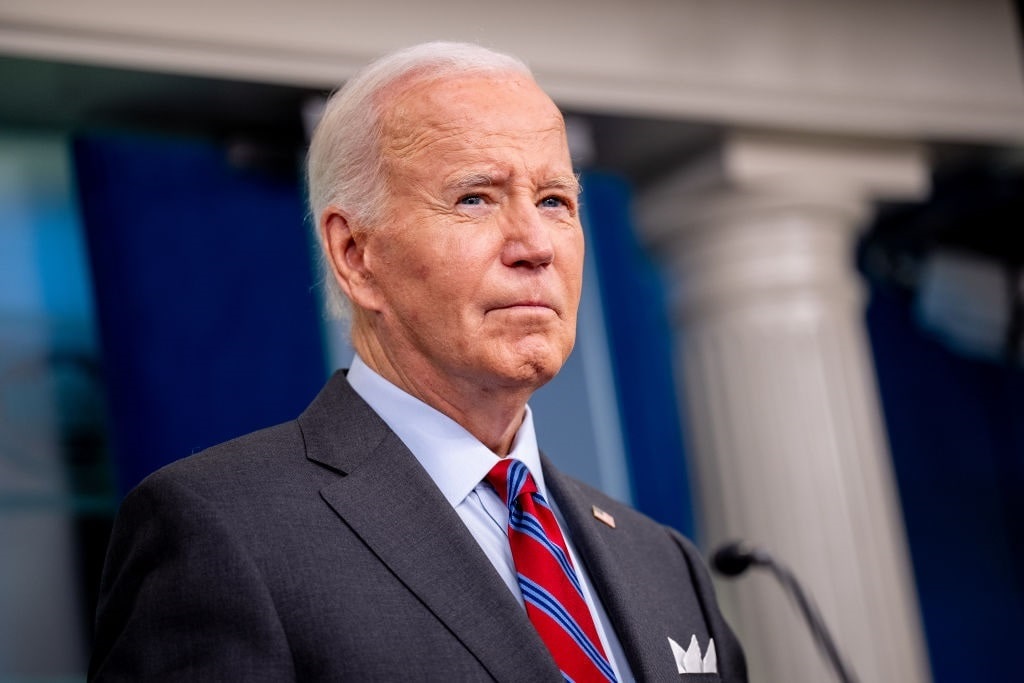
President Joe Biden will visit Milwaukee, WI, today (Oct. 8) to highlight the administration’s infrastructure campaign, nearly three years since the Infrastructure Investment and Jobs Act was signed into law. Biden is expected to champion the White House’s march to replacing lead pipes and creating jobs. Like other facets of Washington’s pursuit to build or rebuild America’s infrastructure, the government has slapped lofty timelines and expensive price tags. Progress will be key as the president’s efforts routinely generate negative publicity.

Biden Infrastructure — A Primer

In November 2021, Biden signed the $1 trillion Infrastructure Investment and Jobs Act, one of three landmark legislative initiatives under the current administration. The enormous domestic spending bill aimed to channel billions of dollars to states and local governments to build or upgrade bridges, broadband internet connections, roads, and public transportation systems. The legislation, which was championed as a bipartisan effort because it attracted just 13 House Republicans and 19 Senate GOP lawmakers, also prioritized anything related to green energy.

Biden and Vice President Kamala Harris also promised that the infrastructure law would create “millions” of jobs. However, the White House had to quickly clarify and confirm that officials were referring to “job years.” A job year equals one job for one year. If an individual is employed at a new job for two years, it would equal two job years rather than one.

“My message to the American people is this: America is moving again, and your life is going to change for the better,” Biden said in a South Lawn ceremony.

Three years later, has the administration delivered on its pledge to revitalize the nation’s infrastructure? Washington would claim it has been a resounding success because of all the state and local government applications to receive federal funds. Of course, any cash-strapped jurisdiction’s governor or mayor – Republican or Democrat – would undoubtedly tap free money from Congress for the opportunity to host a ribbon-cutting ceremony. So, results would make a better assessment.

EV Charging Stations

In June, Liberty Nation News reported on internal Department of Transportation (DoT) memos obtained from the Washington Free Beacon that confirmed “only seven or eight” electric vehicle charging stations had been installed. The Biden administration’s goal was to construct half a million charging stations by 2030, relying on $5 billion through the National Electric Vehicle Infrastructure (NEVI) program and $2.5 billion in Charging and Fueling Infrastructure (CFI) discretionary grant funding.

US government officials and left-leaning think tanks have attributed the sluggish building pace to various reasons, from complicated federal and state regulations to climate change. But a senior Transportation Department staff member, speaking on the condition of anonymity, told the Free Beacon that equity requirements “are screwing everything up. It’s all a mess.”

Administration officials have since tried to shrug off the abysmal number by announcing $521 million in grants to continue expanding the nation’s EV charging network. “Charging infrastructure is being built in rural, suburban, urban, and Tribal communities alike, supplementing private investment and filling critical gaps where charging is needed most,” the DoT said in an August press release.

Got Internet?

Inside the bipartisan infrastructure law was the Broadband Equity Access and Deployment (BEAD) program. This contained approximately $42 billion in federal funds “to connect everyone in America to reliable, affordable high-speed internet by the end of the decade.” While the Department of Commerce and its National Telecommunications and Information Administration (NTIA) are tasked with distributing BEAD funds, reports suggest that neither a single business nor household has been plugged in as part of the US government’s initiative.

This past spring, NTIA Administrator Alan Davidson confirmed to Congress that “this is really a 2025, 2026, shovels in the ground project.” Lawmakers say the president’s ambitious pursuit is hampered by the NTIA’s mountain of red tape and woke-minded commands.

Play Video
Give Cable TV the Boot – Check This Out!

In an April 2023 letter to Davidson, a chorus of GOP senators noted that regulations and mandates “would discourage participation from broadband providers while increasing the overall cost of building out broadband networks.” Upper chamber Republican officials alluded to a range of requirements, such as hiring “individuals with past criminal records” and “justice-impacted participants.”

So far, they are right. Telecommunications industry representatives told MinnPost in June that they had little interest in applying for the $652 million from Minnesota’s BEAD grants. Brent Christensen, president and CEO of Minnesota Telecom Alliance, told the newspaper: “None of them would bid for the federal grants because of the regulations that would come with it — especially the requirement to provide low-cost services to low-income households in exchange for grants that would allow internet providers to build out their networks.”

Well, at least the private sector is doing a great job in extending broadband internet access. Reports from the Federal Communications Commission (FCC) or OpenVault Broadband Insights suggest that most Americans already have access to broadband internet and enjoy at least 100 Mbps download speeds. If the US government actually wanted to succeed, it would have spent $42 billion to purchase Elon Musk’s Starlink dishes for 140 million individuals!

Everything Is Infrastructure

Are childcare programs infrastructure? Is minority business development infrastructure? Is turning school buses into electric vehicles infrastructure? Indeed, the law redefines the conventional yardsticks of what constitutes infrastructure. The New York Times contended three years ago that Biden’s plan “is a radical reimagining of what infrastructure means.”  And yet, as federal intervention in the childcare industry receives bipartisan support, the infrastructure package has not accomplished the goal of lower costs: According to the August Consumer Price Index report, daycare costs surged more than 6% from August 2023. It appears the government cannot even get non-infrastructure infrastructure spending right.

~

Liberty Nation does not endorse candidates, campaigns, or legislation, and this presentation is no endorsement.

 
 
Read More From Andrew Moran

Monday, May 29, 2023

Environmentalists Are Why We Can’t Have Infrastructure

By May 28, 2023 @ Sultan Knish Blog

California’s high-speed electric train has burned through nearly $10 billion, far more than its original $9 billion bond, without building a single mile of track.

Where did that money go?

$1.3 billion was spent on environmental impact clearances.

After over a decade, Brian Kelly, the CEO of the California High-Speed Rail Authority, cheerfully announced that, “we’re making true progress on nearing full environmental clearance for the entire Phase 1 high-speed rail project.” By the summer, the high-speed rail which hasn’t even begun construction might finally get its full environmental impact clearance. Perhaps.

California’s infamous high-speed train to nowhere, which began in 2009 and whose budget already tops $100 billion, financed by corrupt environmental cap-and-trade robbery that makes cryptocurrency seem legitimate by comparison, may seem like an outlier, but it’s not.

Every time presidents make a pitch for an infrastructure bill, they visit the Brent Spence Bridge over the Ohio River for a photo op.

“Mr. McConnell, help us rebuild this bridge,” Obama declared with his back to the bridge. “Help us rebuild America.

After Obama, Trump came to the bridge, and more recently Biden claimed that his infrastructure bill, which spent nearly three quarters of a billion on electric cars, and little on infrastructure, would finally fix the bridge. Over $10 million has been spent on environmental impact studies going back 18 years to explain why nothing much was being done about the bridge.

But why spend money on bridges when you can instead spend it on environmental reviews of hypothetical bridges? People can cross the former, but the politically connected get rich off the latter.

In Baton Rouge, Louisiana, $5 million was needed to fund an environmental impact study to build a new bridge, another $5 million to consider building a bridge in Mission, Texas. The current status of that bridge is unclear. After wasting millions and years on environmental impact studies, projects often never move forward due to changing finances or circumstances.

The endless environmental studies drain massive amounts of taxpayer money. For example, the Yeager Airport in Central West Virginia needed a $5.6 million grant for its environmental impact study. And the sheer scale of taxpayer money stolen by the green industry is not being tracked.

A 2003 Government Accountability Task Force suggested that a typical environment impact statement costs between a quarter of a million to 2 million dollars. DOE energy data place it at a median cost of $1.4 million. Industry estimates place the direct cost of environmental studies at between 0.5% to 3% of a project. The smaller the project, the higher the percentage of costs eaten up by environmental reviews.

But the indirect costs are much more severe. By slowing down projects, environmental impact statements kill promising proposals, starving them of resources or wasting money, like California’s high-speed rail, on nothing without actually building anything. Speculative technologies like the Hyperloop have to spend millions on environmental impact studies further sabotaging them. Delays and dead ends end up costing up far more than the review.

The massive green regulatory theft took off with the National Environmental Policy Act in 1969. Federal spending was tethered to environmental reviews. NEPA was a bipartisan disaster, introduced by Democrats, but voted into law with massive support from the liberal Republicans who infested the House and Senate at the time, and then signed into law by Nixon. Opposition was virtually non-existent with unanimous Senate approval and only 15 dissidents in the House.

In the decades since, NEPA was weaponized to virtually shut down development in the country. When Biden implemented a NEPA rule change that baked global warming considerations into every project, Senator Manchin joined Republicans in voting it down in the Senate. But Republicans haven’t even bothered proposing the elimination of the NEPA disaster.

And yet in the 70s, even Democrats were complaining that environmental impact statements were a disaster.

“Ah, precious Environment, how the heavy wheels of government churn in thy name!” a New York Times column jeered. “When the city of New York wanted to use Federal money to build an elevator for the handicapped at City Hall, it naturally had to conduct an environmental review. The result is a dossier half an inch thick, concluding that there will be no environmental impact. None, at least, worthy of the full treatment—an environmental impact statement. This takes, by a conservative estimate, six months to a year to complete, according to a city official.”

Such complaints long ago became politically incorrect. To point out that environmental impact statements took the United States from a first world nation to a third one is heresy. And true.

Other nations, that don’t jam environmental reviews into every screw, still build big things. And American architects, engineers and companies often execute those wonders that we see rising in rich Arab states or even in Asia, but such things cannot be allowed to rise in America.

Environmentalists intended to use environmental impact statements to slow and eventually shut down construction. And they have succeeded all too well. Projects not only cost a lot more, they are poorly thought out with gimmicks meant to serve ‘green’ rather than real world needs.

The tragically misbegotten One World Trade Center project not only failed to build grander and bigger than the fallen World Trade Center, but its obsession with being the ‘greenest’ using unworkable green technology led to disaster when Hurricane Sandy flooded its lower levels.

Every now and then someone asks why we can’t seem to build infrastructure anymore. The answer is that environmental gatekeeping is built to stop the building of new bridges, dams and anything that might interfere with the pristine state of nature.

Even the so-called green energy developments have been blocked by environmental reviews. Environmentalists claim that they need wind and solar to save the planet, but if so it’s environmentalism that is endangering the planet by blocking wind and solar projects.

Environmentalists believe that all human endeavors are bad. Green technology is not their solution, it’s just another obstacle that they have erected in the way of progress, but they have no commitment to it except as a way to stop gas, oil, coal and nuclear from giving us cheap, reliable energy. Given a choice between wind, solar and nothing, they’ll choose nothing.

And make us choose it too.

America’s productive capacity has been crippled by a disastrous regulatory framework from the sixties and seventies that has frozen the nation in time. While China moves forward, our infrastructure rots away, our buildings age and nothing gets done except through bribes.

We’ve become a third world nation because we were told it was the only way to save the world. But the world continues to build things while Americans navigate parasitic regulatory industries of which the environmentalists are only the first who have to be bribed for anything to happen.

The Empire State Building was famously built in a year. Today it would take decades and then wouldn’t be built at all. Years would be spent courting environmentalists, racial shakedown artists and every possible group with political power that could stop the project. The building would need years if not decades of environmental impact statements, and would nonetheless be sued by environmental organizations financed by government grants. Much like in California’s high-speed rail to nowhere, after years of the government financing lawfare against its own projects, there would be nothing but an empty skyline and a hole in the ground.

And that’s how environmentalists want it.  

Daniel Greenfield is a Shillman Journalism Fellow at the David Horowitz Freedom Center. This article previously appeared at the Center's Front Page Magazine.  Click here to subscribe to my articles. And click here to support my work with a donation. Thank you for reading.

Wednesday, August 11, 2021

Biden’s Bridge is Falling Down

August 09, 2021 @ Sultan Knish Blog

11 years ago, Obama came to the Ohio River, fussily shook hands with the construction workers now probably sporting MAGA hats and promised to rebuild the Brent Spence Bridge.

"Mr. McConnell, help us rebuild this bridge," Obama declared with his back to the bridge. "Help us rebuild America. Help us put this country back to work. Pass this jobs bill right away." The 'jobs bill' in question was the American Jobs Act which had as much to do with American jobs as Biden's infrastructure plan has to do with infrastructure.

Obama’s $447 billion bill plowed a fortune into green energy to benefit Democrat special interests and mega-donors. It had no money on tap for the Brent Spence Bridge which, as Obama’s spokesman explained, “is symbolic.”

Symbolic being a fancy way of saying a blatant lie.

Three years after Obama's visit, his transportation secretary refused to provide any assistance to rebuild the bridge. Transportation Secretary Anthony Foxx, who has since joined Lyft as a top executive, promised that if Congress passed Obama's latest $302 billion boondoggle, there might be money for the Brent Spence Bridge. And Lucy might not pull away the football.

But no matter how many billions flowed to green energy pork, the bridge stayed the same.

A decade after Obama declared the bridge “functionally obsolete”, I rode over it on an early weekday morning. The bridge was crowded, but it was not falling down.

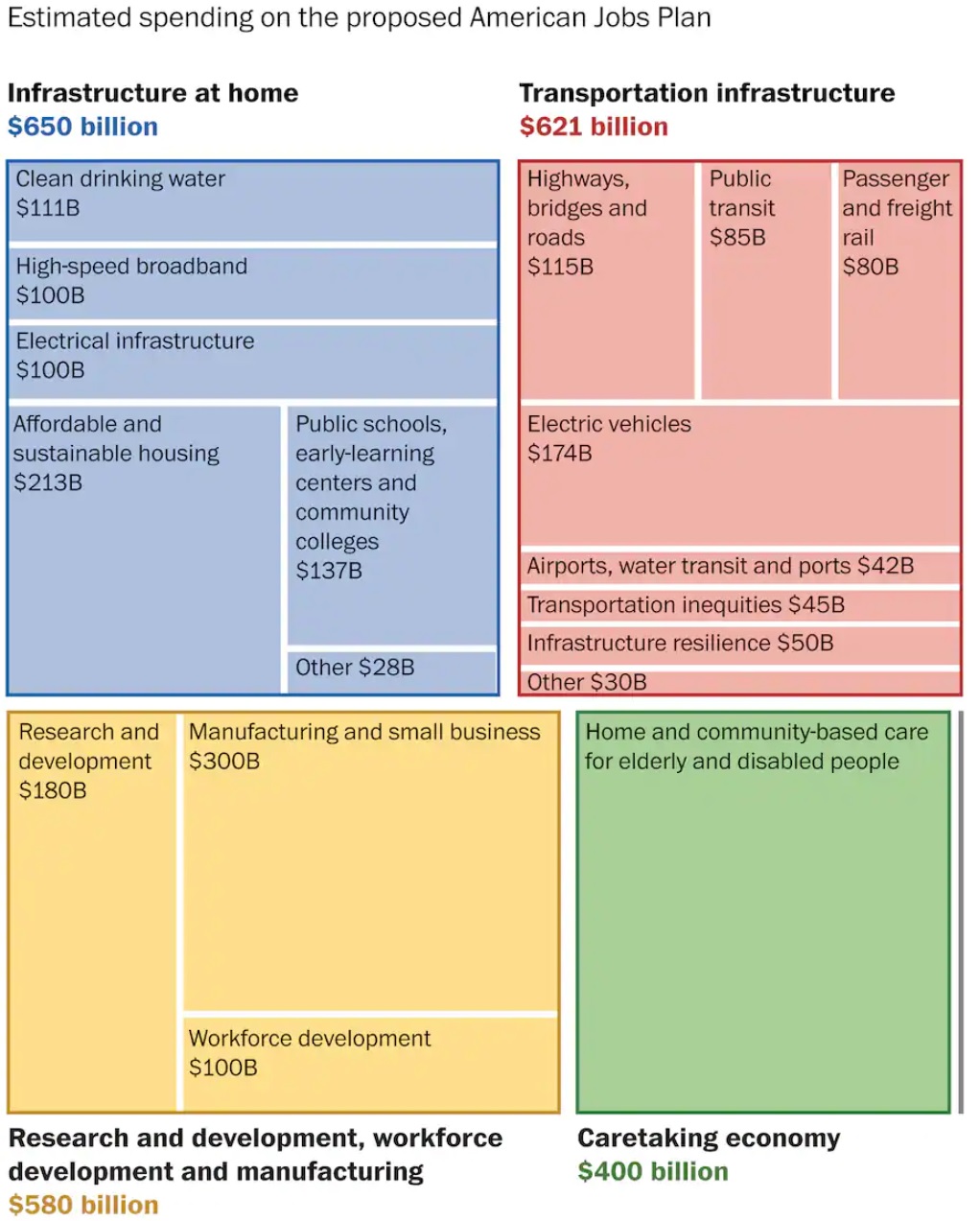
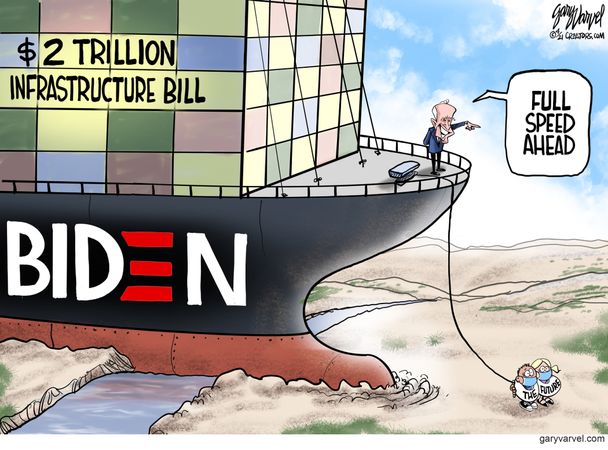
Now, Biden showed up at CNN’s Cincinnati Town Hall touting his $2 trillion infrastructure bill, which spends $115 billion on infrastructure and $174 billion on electric cars, along with a ton of other welfare state pork, waving the Brent Spence Bridge once again as his talking point.

“The individual elements of this plan to make sure we're going to fix that damn bridge here that is going into Kentucky,” Biden rambled to a tiny hand picked audience of sympathizers.

That “damn bridge” was supposed to be fixed 20 years ago.

Biden is promising to do the thing that his own boss had promised to do and then didn’t do.

“The two most recent presidents, past presidents have both campaigned using this region's Interstate 75 bridge, the Brent Spence bridge that crosses the Ohio River, as backdrops with a promise of an infrastructure bill that would help with the replacement,” a questioner mentioned.

“The answer is absolutely, positively yes,” Biden gushed. “I'm not just saying that. I'm not just saying that. You take a look at Ohio and Kentucky combined, there's well over -- there's thousands of bridges that need repair. Thousands. Thousands of bridges.”

Biden and the administrations he’s been part of have been promising this for a decade.

In 2011, it was Secretary of Transportation Ray LaHood reciting the mantra about "rebuilding the Brent Spence or any of the tens of thousands of bridges in America." Foxx, his successor, who would turn down the Brent Spence bridge, was also pitching plans to rebuild thousands of bridges.

Replacing the “damn bridge”, as Biden put it, would cost about $2.5 billion. Instead of rebuilding the bridge, Obama had poured a fortune into Big Green projects that failed.

Solyndra received a $535 million loan guarantee to build solar panels and went bankrupt. Abound Solar got a $400 million stimulus loan guarantee and went bankrupt. Tonopah Solar Energy got $737 million in loans and went bankrupt. Fisker got a $529 million stimulus loan to build electric cars and went bankrupt. A123 got a $249 million stimulus grant to build electric car batteries and went bankrupt.

Ener1 got a $118.5 million grant to build electric car batteries and went bankrupt. Biden had visited the company and hailed it as one of the "100 Recovery Act Projects That Are Changing America”, but he had also accidentally described it a little too accurately as "Enron One".

The bankrupt company was then taken over by an oligarch with ties to the Russian government. But 40% of the company's stock had already been controlled by a Russian state-owned bank as collateral for a mere $24 million in loans.

That’s why the “damn bridge” still isn’t fixed.

The Biden administration is throwing even more money at green energy scams than the Obama administration.

Sun Edison got $1.5 billion in government grants and subsidies, and went bankrupt. Biden put its founder in charge of the loan office at the Department of Energy.

Bridges are boring. Solar panels, electric car batteries, and wind turbines are exciting. And major donors stand to cash in from redistributing money from the working class and middle class taxpayers, like those whose livelihoods depend on Brent Spence Bridge, to the wealthy San Francisco donors who are invested in every new green company promising utopia.

Obama, Biden, and other Democrats go to Brent Spence Bridge when they need votes, but the rest of the time they’re signing off on subsidies for the green scams of their donor base.

Biden's American Jobs Plan demands 500,000 electric car charging stations at a cost of as much as $50 billion.

Biden could build 20 Brent Spence bridges for that money.

The price of individual car chargers may go as high as $260,000. The union bosses of United Mine Workers told their workers that the rare earth metals would be mined in America. But then once Biden was in power he decided to placate environmentalists by importing them instead.

The only American jobs being created by Biden’s jobs plan are at San Francisco environmental consulting firms. The Big Green that killed millions of American jobs and created the Rust Belt isn’t about to lift its birkenstocks and pleated khakis off the necks of the American working class.

While the Obama administration never did help build a new bridge, $8 million in taxpayer money was wasted on an environmental impact study on the bridge. This was in addition to previous environmental findings from 2012 and 2005. “Environmental justice will be a big, big issue," Jack Marchbanks, the head of the Ohio Department of Transportation, has assured.

Meanwhile the Brent Spence Bridge remains little more than a talking point.

After over a decade of White House Dems promising to fix the bridge, Biden is back with the same false promises. But every headline about Biden’s plan and the Brent Spence Bridge includes the word, “could”. The plan might fund it, it could fund it, but it probably won’t.

There’s a lot more campaign cash to be made in funding green energy and then showing up at the bridge that’s always on the verge of falling down and promising to fix it. Actually repairing, replacing, or doing something with the Brent Spence Bridge would take away a familiar campaign stop that White House Democrats make to push for their latest trillion dollar package while assuring voters that unlike all the other times, this time, they’ll fix the “damn bridge”.

But they’ll be damned if they do.

Daniel Greenfield is a Shillman Journalism Fellow at the David Horowitz Freedom Center. This article previously appeared at the Center's Front Page Magazine.

Click here to subscribe to my articles. 

Thank you for reading.

Tags: , ,
Author Image

About Daniel Greenfield
Daniel Greenfield is a journalist investigating Islamic terrorism and the Left. He is a Shillman Journalism Fellow at the David Horowitz Freedom Center


Friday, July 23, 2021

The $4 Trillion Forecast for Biden: ‘Go Woke, Go Broke’

By July 20, 2021

With all respect to President Biden — my criticisms are never personal but always based on policy — his statement yesterday on the proposals in his $4 trillion spending plan is malarky.

“If we increase the availability of quality, affordable child care, elder care, paid leave, more people enter the workforce,”.......... “These steps will enhance our productivity, raising wages without raising prices. That won’t increase inflation. It will take the pressure off of inflation.”

This is the most perverse economic recitation I can ever recall. His advisers have sold him a bill of goods — that so-called government investment, which is really a progressive euphemism for government spending. His idea is that, indeed, massive social spending without work requirements or employment incentives is somehow going to boost the economy...........

Governments don’t create inventive new business equipment and technology advancements. Governments don’t create new business start-ups. Governments don’t create new jobs and higher wages. Private enterprise does. The Biden model is so heavily taxing and regulating private enterprise that it will not pay after tax to work, invest, or take risks...........

The 46th president doesn’t believe in free enterprise.............Most troubling, though is that Mr. Biden shows no understanding of the kinds of criticisms that I and others are making. His top people are selling him a left-wing bill of goods and like all left-wing central planning and social engineering, it is doomed to fail. ...........To Read More....


Monday, July 19, 2021

Bureaucracy as Infrastructure

Robert Mulligan Robert F. Mulligan  – July 18, 2021 @ American Institute for Economic Research 


President Biden’s staggering $2.3 trillion requests for infrastructure appropriations tend to hide the extent Congress is further bloating them with their own wasteful earmarks. Congress is approving, and even expanding on, the president’s already far-reaching requests, though it’s doing so in installments—the House just sent a $715 billion “INVEST in America Act” to the Senate, where it’s all but certain to be packed with even more pork by legislators from both parties. The typical Orwellian-Kafkaesque title for this legislation—“INVEST”—is supposed to stand for “Investing in a New Vision for the Environment and Surface Transportation,” a title that both helps hide the rancid pork actually contained in the bill, as well as head off any responsible scrutiny or debate.

Hidden deep in the House version are numerous provisions for expanding the federal bureaucracy and government programs that have absolutely nothing to do with infrastructure, including doubling the size of the IRS .

It is especially fascinating that the federal government has such little difficulty spending more money, regardless of how focused or unfocused its aims—being driven mainly by politicians with planning horizons not extending past the next election—but the government has a real problem with raising taxes directly, because politicians fear the potential blowback. Their preferred solution is apparently to expand one of the least-liked sectors of the federal bureaucracy, in hopes of increasing revenues through heightened tax enforcement. Never mind that the IRS has recently exhibited extraordinary misconduct, including leaked confidential tax filings and playing politics with nonprofit tax exemptions. The IRS is one federal bureaucracy among many that needs to be reformed rather than expanded. Without meaningful reform, expanding the IRS’s enforcement budget will be tantamount to unleashing a plague of locusts on already overburdened taxpayers.

Federal income taxes already disproportionately punish the middle class. The purportedly progressive income tax exempts the poor, and the complexity of the tax code with its superabundance of special interest loopholes mainly benefits the rich who can use loopholes to minimize their tax liabilities. Virtually all other taxes paid by households, such as sales taxes, are strongly regressive, further penalizing the poor. Taxes paid by businesses are simply passed on to households in the form of higher prices, creating a further regressive impact which disproportionately falls on the poor. Large corporations both benefit from corporate welfare, which is not provided so generously to small businesses, as well as have access to strategies to book their income overseas in tax havens—something small businesses generally cannot do.

As high as social mobility remains in American society, there is little doubt it could be improved with the simplest and most basic tax reform. Government’s regulatory burden also falls disproportionately on the poorest, who have the least access to education, credit, healthcare, and housing, and can least afford to surmount burdensome occupational licensing and educational barriers that keep them from joining needed professions.

As a nation, we badly need to devote adequate resources to maintaining the infrastructure the federal government owns and operates like the interstate highway system, but the government needs to ensure its expenditures meet reasonable and sustainable cost-benefit standards. A large part of the president’s $2.3 trillion wish list is devoted to harebrained social engineering and poorly defined political goals. These may appeal to various special interest constituencies, but do not reflect actual citizens’ wants or needs.

The U.S. tax structure already penalizes productive citizens far too much, as well as incentivizes businesses to focus on unproductive tax avoidance strategies. We got where we are through an ostensibly “Republican” administration that acted as if the only way to address any problem was to throw money at it. Now we have a Democratic administration doubling down on this failed and discredited strategy, and digging us into an even deeper hole. Earmarks for special interests from both parties make it easier to get bipartisan support in Congress, but with wasteful spending spiraling out of control, it’s hard to see that as an advantage.

Robert F. Mulligan

Robert Mulligan

Robert F. Mulligan is a career educator and research economist working to better understand how monetary policy drives the business cycle, causing recessions and limiting long-term economic growth. His research interests include executive compensation, entrepreneurship, market process, credit markets, economic history, fractal analysis of time series, financial market pricing efficiency, maritime economics, and energy economics.

He is from Westbury, New York, and received a BS in Civil Engineering from Illinois Institute of Technology, and an MA and PhD in Economics from the State University of New York at Binghamton. He also received an Advanced Studies Certificate in International Economic Policy Research from the Institut fuer Weltwirtschaft Kiel in Germany. He has taught at SUNY Binghamton, Clarkson University, and Western Carolina University.

Get notified of new articles from Robert F. Mulligan and AIER.

Thursday, June 10, 2021

China’s Future in the Balance

By | Jun 9, 2021 |


There seems to be no limit to the arrogance and political greed of Chinese leader Xi Jinping or the amount of suffering he is willing to impose on his own people. From the brutal takeover of independence-loving Hong Kong; to the officially sanctioned imprisonment, torture, slavery, organ harvesting, and genocide of the Uyghurs, a people who make up nearly 50% of the population in China’s Xinjiang province; and the brutal persecution of followers of Falun Gong throughout China; Xi and his Chinese Communist Party (CCP) have created an industry of persecution, slavery, and genocide that should shock us all. But that is only the beginning.

The news about the source of the pandemic is finally emerging as real news, and not just the “conspiracy theory” that the Democrats have been deriding for well over a year. It’s all turning out to be true, as it always was.  ..............

History should have already taught us many powerful lessons about tyranny and the insatiable hunger of tyrants for power. Napoleon also once said, “If you wish to be a success in the world, promise everything, deliver nothing.” Xi is clearly a student of Napoleon. 

When we look at China today, the brutal purge and genocide of the Uyghurs, the persecution of the Falun Gong, the brutal suppression of the Chinese people throughout the COVID-19 crisis which the Chinese government itself caused, we should now understand that if Xi is willing to do this to his own people, what will he not be willing to do to us?

And yet, there is a small ray of light coming through the red curtain of China as Xi faces several crises of his own making:  

  • Fresh outbreaks of a new mutation of the coronavirus are erupting in China, the same virus that they created in their own labs; 
  • The massive Three Gorges Dam – the largest in the world – is now in danger of a catastrophic failure because of a corrupt construction process and this year’s record rainfall. If the dam fails, the calamity will put the lives of 40 million people in mortal danger;  
  • China’s economy is teetering on the brink of failure; 
  • Another year of terrible famine is looming large in the immediate future;
  • And new intelligence suggests that the Chinese government is in panic and may even be on the verge of a coup. 

And yet Xi and his comrades continue their efforts to expand their power so they can dominate and control the world..............To Read More...


Tuesday, May 4, 2021

Biden’s Infrastructure Boondoggle Will Undermine Growth

May 3, 2021 by Dan Mitchell @ International Liberty

President Biden has proposed a massive $2 trillion-plus infrastructure plan. Here are the two things everyone should understand.

  1. It will hurt growth because it will be financed with very harmful tax increases, most notably a big increase in the corporate tax rate that will undermine competitiveness.
  2. It will hurt growth because the new spending will divert resources from the productive sector of the economy, leading to inefficient allocation of labor and capital.

Actually, there’s another thing everyone should understand. As illustrated by this summary from the Washington Post, it’s not really an infrastructure plan. It’s a spend-money-on-anything-and-everything plan, presumably to reward various interest groups.

Though I guess we have to give the Biden Administration points for consistency. The President’s COVID relief plan from earlier this year had very little to do with the pandemic, so we shouldn’t be surprised to see that the infrastructure plan has very little to do with infrastructure.

The Wall Street Journal editorialized about this bait-and-switch scam.


Most Americans think of infrastructure as roads, highways, bridges and other traditional public works. That’s why it polls well… Yet this accounts for a mere $115 billion of Mr. Biden’s proposal. There’s another $25 billion for airports and $17 billion for ports and waterways that also fill a public purpose. The rest of the $620 billion earmarked for “transportation” are subsidies for green energy and payouts to unions for the jobs his climate regulation will kill. …The magnitude of spending is something to behold. There’s $85 billion for mass transit plus $80 billion for Amtrak, which is on top of the $70 billion that Congress appropriated for mass transit in three Covid spending bills. The money is essentially a bailout for unions… Then there’s $174 billion for electric vehicles, including money to build 500,000 charging stations and for consumer “incentives” on top of the current $7,500 federal tax credit to buy an EV.

Mr. Biden is also redefining infrastructure as social-justice policy and income redistribution. …His plan also includes $213 billion for affordable housing, $100 billion for retrofitting public schools, $25 billion for child-care facilities and $400 billion for increasing home-health care.

Michael Boskin, a professor at Stanford, is not optimistic that Biden’s plan will generate good results.


Joe Biden’s $2.3 trillion infrastructure plan would be many times larger than previous such bills, only about one-third of it would meet even a broad definition of “infrastructure.” …What could possibly go wrong? A lot. …federal spending would crowd out private and local government spending, with a substantial risk of boondoggles piling up along the way. …The Biden plan is rife with opportunities for earmarked pork-barrel projects (bridges to nowhere) and crony capitalist corporate welfare (next-generation Solyndras). Consider California High-Speed Rail, an infrastructure train wreck that will soon be begging for a bailout from the Biden administration. It originally used a grant from President Barack Obama’s 2009 “stimulus” package to pay, six years later, for a tiny initial rail line. Yet, because the project’s projected total San Francisco to Los Angeles cost has tripled to $100 billion.

And even if the plan was nothing but real infrastructure, that wouldn’t be a cause for optimism.  Kenneth Rogoff, a professor at Harvard, wrote late last year that governments have a terrible track record with cost overruns.


…perhaps the biggest obstacle to improving infrastructure in advanced economies is that any new project typically requires navigating difficult right-of-way issues, environmental concerns, and objections from apprehensive citizens… The “Big Dig” highway project in my hometown of Boston, Massachusetts was famously one of the most expensive infrastructure projects in US history. The scheme was originally projected to cost $2.6 billion, but the final tab swelled to more than $15 billion… The construction of New York City’s Second Avenue Subway was a similar experience, albeit on a slightly smaller scale. In Germany, the new Berlin Brandenburg Airport recently opened nine years behind schedule and at three times the initial estimated cost.

Amen. I wrote a column about the infamous Second Avenue Subway, and I’ve also repeatedly opined about how government projects always wind up costing much more than initial projections.  Let’s wrap up by looking at an economic analysis of Biden’s plan by the University of Pennsylvania’s Penn Wharton Budget Model.


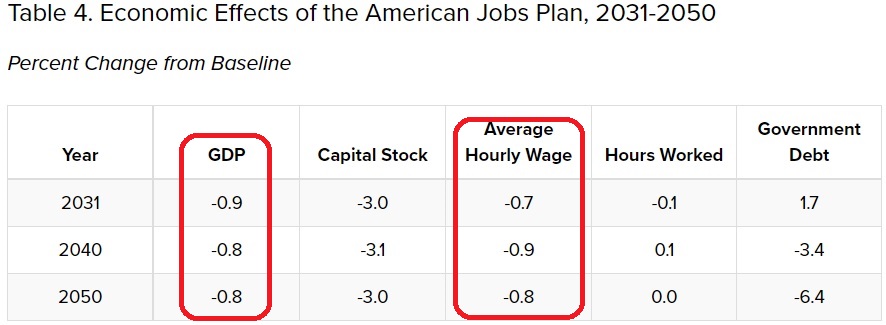
The overall macroeconomic effects of enacting the AJP, including both its spending and tax provisions, are shown in Table 4. …After the AJP’s new spending ends in 2029, however, its tax increases persist—as a result, federal debt ends up 6.4 percent lower by 2050, relative to the current law baseline. Despite the decline in government debt, the investment-disincentivizing effects of the AJP’s business tax provisions decrease the capital stock by 3 percent in 2031 and 2050. The decline in capital makes workers less productive despite the increase in productivity due to more infrastructure, dragging hourly wages down by 0.7 percent in 2031 and 0.8 percent in 2050. Overall, GDP is 0.9 percent lower in 2031 and 0.8 percent lower in 2050.

Here’s Table 4, which I’ve augmented by circling the two most important statistics.

The immediate lesson from all of this is that Biden’s plan is a boondoggle waiting to happen (just as would have been the case with Trump).  The longer-term lesson is that we should get the federal government out of the business of infrastructure.


Wednesday, April 21, 2021

The Tyranny of Meaninglessness

April 20, 2021 @ Sultan Knish Blog 

Joe Biden is always redefining things by Bidenizing them into random strings of gibberish like “lying, dog-faced pony soldier” or turning them into Bidenisms.  But these days his administration is ambitiously trying to redefine the entire English language.

“I want to change the paradigm,” Biden told reporters. “I would like elected Republican support, but what I know I have now is I have electoral support from Republican voters. Republican voters agree with what I’m doing.”

Like every other word that comes out of Biden’s mouth, that’s a lie. A Gallup poll in March found that Biden’s approval rating among Republicans is at 8%. That’s down from 12% in February.

“What’s become crystal clear is that Biden has redefined bipartisan," Obama crony Rahm Emanuel argued. "And Washington is slow to catch up to the Biden definition.”

The Biden definition of bipartisan is having the support of 8% of Republicans.

Not only is Washington D.C. slow to catch up to the Biden definition of bipartisan, but so is the dictionary. Biden’s advisers however argue that the dictionary’s arc bends toward Biden.

“If you looked up ‘bipartisan’ in the dictionary, I think it would say support from Republicans and Democrats,” Anita Dunn, who has advised Biden and Harvey Weinstein, argued. “It doesn’t say the Republicans have to be in Congress.”

It doesn’t say that the Democrats have to be in congress either if it’s a book club. But if it’s bipartisan governing, then it has to be Republican and Democrat elected officials.

“The Biden definition of bipartisanship is an agenda that unifies the country and appeals across the political spectrum,” Mike Donilon, a senior Biden adviser, argued. “Presumably, if you have an agenda that is broadly popular with Democrats and Republicans across the country, then you should have elected representatives reflecting that.”

The Framers also thought so which is why they put into place a system of elected officials chosen by the people to represent them. Biden would like to replace that with claiming that Republicans support him in a poll so he can eliminate the filibuster, pack the Supreme Court, add Puerto Rico, D.C., and his family home as states, and rule a one-party state.

Fresh off redefining ‘bipartisan’, the Biden administration also redefined ‘infrastructure’ to mean funding the Democrat welfare state.

“I mean, what is infrastructure? Historically, it's been: What makes the economy move,” Secretary of Energy Jennifer Granholm, contended.

Since everything makes the economy move, in one direction or another, then everything is infrastructure. But if everything is infrastructure, then nothing is infrastructure.

In the hands of lefty linguists, infrastructure, like the Constitution or bipartisanship, ceases to be tethered to the dictionary or the meanings imbued by a bunch of old white male racists, and becomes a universal concept.
Or as Granholm argued, “as the president said this week, that infrastructure evolves to meet the American people's aspirations.”

Infrastructure, like the living constitution, is constantly evolving to meet lefty aspirations. One day it’s a bridge, another day it’s abortion, and the end of free speech.

“We don't want to use past definitions of infrastructure, when we are moving into the future,” Granholm whined. Definitions are static. They exist in the past. But the party of progress, as embodied by a 78-year-old man who keeps stumbling over words and falling down, is using definitions from the future for Newspeak dictionaries that haven’t even been invented yet.

If ‘infrastructure’ or ‘bipartisanship’ mean whatever Biden says it does, then he’s an absolute dictator, and reality means whatever lying, dog-faced pony soldier decides it does this week.

But Biden is always redefining things.

The serial Democrat lecher started out, like Bill Clinton, by redefining sex. Except that Biden, in one of his first executive orders, redefined sex to mean some intangible psychologically subjective concept of sex not based on science or biology, rather than men and women.

Once you’ve redefined women out of existence, redefining bipartisan to mean a one-party state, and infrastructure to mean social services is easy. All it takes is the refusal to be bound by the narrow categories of the past and then bridges, gender, and tyranny can be surprisingly fluid.

Last year, Biden had already redefined being a Catholic.

“Biden Could Redefine What It Means to be ‘a Catholic in Good Standing,” the Washington Post argued. Predictably, the argument was all about a more fluid definition of Catholicism and “what kinds of Catholicism they think most urgently needs to be advanced”. The Biden brand involves “poverty, refugees and the environment” which has as much to do with Catholicism as Tikkun Olam’s emphasis on “poverty, refugees, and the environment” has to do with Judaism.

But when you’re already redefining the Constitution, gender, and the meaning of simple words, why not also redefine religion away from narrow categories of belief, and into an evolving religion of the future in which things mean whatever we want them to mean at any moment.

When words mean nothing, then ideas mean nothing, and it’s easy to redefine Catholicism and Judaism to mean Muslim immigration, Obamaphones, and subsidies for luxury ‘green’ SUVs.

As George Orwell rightly noted, the refusal to allow words to mean anything is tyranny.

Without objective meanings, there are no laws and therefore no rights. There are no restraints on the power of the state when it refuses to be bound by the mere definitions of words.

Democrats spent generations trying to nullify the Second Amendment of the Bill of Rights by arguing about the meaning of “arms”. Now they’re trying to do the same thing to the First Amendment by putting forward exciting new definitions of “speech” and the “press”.

Recent mainstream media editorials attacking free speech include "Why Is Big Tech Policing Free Speech? Because the Government Isn’t", "Free Speech is Killing Us" and “Why America Needs a Hate Speech Law.”

That last one was written by a Biden transition official, who sneered that, “the intellectual underpinning of the First Amendment was engineered for a simpler era” and that, “the framers believed that this marketplace was necessary” from which “magically, truth would emerge.” An important prerequisite for the emergence of truth is the magic of allowing people to speak and for words to mean something. When there’s no free speech or meaningful speech, truth dies.

In our exciting leftist future, we know that speech, like gender, infrastructure, and bipartisanship, have to be redefined to mean whatever the government has decided that it should mean.

The truth can only emerge from the government and its political media partners.

And if you doubt that, you probably believe that infrastructure means roads, that women exist, that free speech means the freedom to speak, rather than being told what you can say.

Bad speech “undermines the values that the First Amendment was designed to protect: fairness, due process, equality before the law,” the Biden transition official argued.

The only way to save the true values of the First Amendment is to destroy its literal meaning.

This is the same argument that you will find behind every Biden redefinition which insists on a definition so inclusive that it includes everything except what it actually means.

Catholicism and Judaism mean everything except their own traditional teachings. Sex means everything except men and women. Infrastructure means everything except roads and bridges.

And bipartisanship means everything except elected officials from two parties working together.

America also needs to be redefined from a country and a people to an idea that includes the entire world and everything in it, except its own citizens and a country with borders.

When America, like religion and words, means everything then it means nothing.

And who better than Joe Biden, who redefines sentences into incomprehensible word salads randomly assembled from a Scrabble session, to usher in the end of the English language.

Daniel Greenfield is a Shillman Journalism Fellow at the David Horowitz Freedom Center. This article previously appeared at the Center's Front Page Magazine. Click here to subscribe to my articles.  Thank you for reading.

Tags: , ,

Author Image

About Daniel Greenfield
Daniel Greenfield is a journalist investigating Islamic terrorism and the Left. He is a Shillman Journalism Fellow at the David Horowitz Freedom Center


Friday, April 2, 2021

Biden’s Big Bill Full of Nonsense Signifying Trouble

By Conrad Black, Special to the Sun| April 1, 2021

Wednesday, October 23, 2019

Great Powers Invest in Infrastructure. The West Was the Prime Example.

Ian Morris Board of Contributors

Highlights

  • How the West responds to its eroding strategic lead in building, updating and replacing infrastructure will do much to shape the 21st century.
  • As Western governments struggle to find ways to invest in infrastructure, China talks of spending up to $8 trillion in overseas projects through its Belt and Road Initiative.
  • The associated infrastructure costs of new technologies are great, the investment risky. But the payoffs are greater and the failure to invest is riskier.
For the past 250 years, it has been easier to move people, goods, capital and ideas around the West than anywhere else on earth. Western Europe and North America have led the way not just in inventing new technologies of transport and communication, but also — and equally importantly — in building the infrastructure without which these technologies would be useless. The West has sunk astonishing amounts of energy and capital into updating and replacing its infrastructure, over and over again, as new technologies have emerged.

Having the best infrastructure has been a key to global dominance since the 18th century, but in the early 21st, there are alarming signs the West is losing its strategic lead. Everywhere, infrastructure is creaking and crumbling. Every part of the system seems to be getting old at the same time. How the West deals with this challenge — or, perhaps, opportunity — will do much to shape the geoeconomics and geopolitics of the 21st century...........To Read More.....

Sunday, July 7, 2019

Karlifornia Crackdown

From Americans, according to their party, to illegals according to their needs.
 

Wednesday, November 16, 2016

Three Sensible Rules to Guide the Trump Administration’s Infrastructure Initiative

November 14, 2016 by Dan Mitchell @ International Liberty

During the election, Donald Trump promised a big package of infrastructure spending, twice as much new spending as Hillary Clinton was proposing.

During his victory speech the night of the election, he doubled down on this approach, promising that more infrastructure spending would be one his first priorities.

This sounds like bad news for advocates of limited government. And it may turn out to be bad news. Though if you look at what the Trump campaign actually proposed, there’s a lot of wiggle room.
I will work with Congress to introduce the following broader legislative measures and fight for their passage within the first 100 days of my Administration: …American Energy & Infrastructure Act. Leverages public-private partnerships, and private investments through tax incentives, to spur $1 trillion in infrastructure investment over 10 years. It is revenue neutral.
In other words, it’s possible that President-Elect Trump might give us an Obama-style stimulus scheme. Or he may take a radically different approach by removing roadblocks that hinder more private-sector involvement.

And my colleague Chris Edwards points out that the private sector already does most of the heavy lifting when it comes to infrastructure spending.
Hillary Clinton says that “we are dramatically underinvesting” in infrastructure and she promises a large increase in federal spending. Donald Trump is promising to spend twice as much as Clinton. …But more federal spending is the wrong way to go.  …let’s look at some data. There is no hard definition of “infrastructure,” but one broad measure is gross fixed investment in the BEA national accounts. …The first thing to note is that private investment at about $3 trillion was six times larger than combined federal, state, and local government nondefense investment of $472 billion. Private investment in pipelines, broadband, refineries, factories, cell towers, and other items greatly exceeds government investment in schools, highways, prisons, and the like. …if policymakers want to boost infrastructure spending, they should reduce barriers to private investment.
This is very helpful and interesting data. And one of the obvious conclusions is that the types of infrastructure that historically are the responsibility of the private sector (pipelines, cell towers, etc) are handled much more efficiently than those (highways, mass transit, etc) that have been monopolized by governments.

Trump presumably intends his infrastructure plan to focus on the latter type of infrastructure, so let’s consider three simple rules to help guide an effective approach for transportation.

1. More private-sector involvement

A key principle for good infrastructure policy is to harness the efficiency of the private sector.
Why? Because, as Lawrence McQuillan of the Independent Institute argues, governments naturally are inefficient and incompetent at building and managing infrastructure.
Government authorities view maintenance solely as a cost, rather than as an investment that can increase future revenues. As a result, roads remain riddled with potholes, bridges crumble, airports are overcrowded, water is contaminated, and we have classrooms with mold and falling ceilings. Moreover, without a profit motive, repairs are seldom done in a timely manner or at lowest cost. Instead of assets being owned and controlled by people who understand the economics of the industry and have the technical knowledge to operate and repair them efficiently, politicians (the majority of whom appear to be lawyers these days) and bureaucrats control them. This guarantees waste, inefficiency and cronyism, such as the greenlighting of white-elephant projects that are driven by politics rather than economics.
But there is some good news.

Chris Edwards explains that the private sector is taking a larger role.
Before the 20th century, for example, more than 2,000 turnpike companies in America built more than 10,000 miles of toll roads. And up until the mid-20th century, most urban rail and bus services were private. With respect to railroads, the federal government subsidized some of the railroads to the West, but most U.S. rail mileage in the 19th century was in the East, and it was generally unsubsidized. The takeover of private infrastructure by governments here and abroad in the 20th century caused many problems. Fortunately, most governments have reversed course in recent decades and started to hand back infrastructure to the private sector. …Short of full privatization, many countries have partly privatized portions of their infrastructure through public-private partnerships (“PPPs” or “P3s”). PPPs differ from traditional government contracting by shifting various elements of financing, management, maintenance, operations, and project risks to the private sector. …Unfortunately, the United States “has lagged behind Australia and Europe in privatization of infrastructure such as roads, bridges and tunnels,” notes the OECD. More than one fifth of infrastructure spending in Britain and Portugal is now through the PPP process, so this has become a normal way of doing business in some countries. Canada is also a leader in using PPP for major infrastructure projects.
2. Less involvement from Washington

To the extent that government must be involved, another important principle is to let state and local governments handle infrastructure.

That’s what I argued back in 2014.
…the Department of Transportation should be dismantled for the simple reason that we’ll get better roads at lower cost with the federalist approach of returning responsibility to state and local governments. …Washington involvement is a recipe for pork and corruption. Lawmakers in Congress – including Republicans – get on the Transportation Committees precisely because they can buy votes and raise campaign cash by diverting taxpayer money to friends and cronies. …the federal budget is mostly a scam where endless streams of money are shifted back and forth in leaky buckets. This scam is great for insiders and bad news for taxpayers. Washington involvement necessarily means another layer of costly bureaucracy. And this is not a trivial issues since the Department of Transportation is infamous for overpaid bureaucrats.
For a more detailed explanation, Professor Edward Glaeser of Harvard has some devastating analysis in an article for City Journal.
The most pressing problem with federal infrastructure spending is that it is hard to keep it from going to the wrong places. We seem to have spent more in the places that already had short commutes and less in the places with the most need. Federal transportation spending follows highway-apportionment formulas that have long favored places with lots of land but not so many people. …Low-density areas are remarkably well-endowed with senators per capita, of course, and they unsurprisingly get a disproportionate share of spending from any nationwide program. Redirecting tax dollars across jurisdictions is rarely fair—and it isn’t right, either, that poorer, lower-density regions should subsidize New York’s subway and airports. Washington’s involvement also distorts infrastructure planning by favoring pet projects. The Recovery Act set aside $8 billion for high-speed rail, for instance, despite the fact that such projects would never be appropriate for most of moderate-density America. California was lured down the high-speed hole with Washington support… Detroit’s infamous People Mover Monorail would never have been built without federal aid. Alaska’s $400 million Gravina Island bridge to nowhere was a particularly notorious example of how Congress abuses transportation investment. As the Office of Management and Budget noted, during the Bush years, highway funding was “not based on need or performance and has been heavily earmarked.”
3. Sensible cost-benefit analysis

Our third principle is that infrastructure should only be built if it makes sense. In other words, do the benefits exceed the costs?

In the private sector, the profit motive automatically generates that type of calculation.
With government, that effort becomes much more challenging.

Professor Michael Boskin at Stanford explains the problem in a column for the Wall Street Journal.
…a huge pot of additional money earmarked for infrastructure, on top of the recently passed $305 billion five-year highway bill, is sure to unleash a mad scramble in Congress to secure funds for the home turf. The logrolling and pork will get ugly without far tighter cost-benefit tests and oversight. …Most federal infrastructure spending is done by sending funds to state and local governments. For highway programs, the ratio is usually 80% federal, 20% state and local. But that means every local district has an incentive to press the federal authorities to fund projects with poor national returns. We all remember Alaska’s infamous “bridge to nowhere.” In other words, if a local government is putting up only 20% of the funds, it needs the benefits to its own citizens to be only 21% of the total national cost. Yet every state and every locality has potential infrastructure needs that it would like the rest of the country to pay for. That leads to the misallocation of federal funds and infrastructure projects that benefit the few at the cost of the many. …taxpayers generally don’t notice all the fiscal cross-hauling, sending their money to Washington to be sent back in leaky buckets to local jurisdictions. Since we all reside in a state and locality, it’s an inefficient negative sum game with complex cross-subsidies. If these local projects are so good, why aren’t citizens willing to finance the projects locally?
And don’t forget government infrastructure always is more expensive – sometimes far more expensive – than politicians first promise. Chris Edwards has the details.
Federal infrastructure projects often suffer from large cost overruns. Highway projects, energy projects, airport projects, and air traffic control projects have ended up costing far more than promised. When both federal and state governments are involved in infrastructure, it reduces accountability. That was one of the problems with the federally backed Big Dig highway project in Boston, which exploded in cost to five times the original estimate. U.S. and foreign studies have found that privately financed infrastructure projects are less likely to have cost overruns.
The challenge, of course, is getting governments to produce honest cost-benefit analysis. Bureaucrats respond to the people who control their jobs and control their pay. So if politicians want to squander more money, it’s quite likely that bureaucrats will concoct the numbers needed to justify the expansion of government.

To cite a high-profile example, I caught the IMF making up numbers to justify infrastructure boondoggles, even though that politically driven analysis contradicted the work of the bureaucracy’s professional economists.

Let’s finish with two additional points.

First, advocates of more infrastructure spending act like there’s some national crisis.
But if this is true, why does the United States get relatively high scores from the World Economic Forum?

Second, let’s consider the example of Japan. That nation has been stuck in a multi-decade period of stagnation, with very little expectation of an economic turnaround. But if infrastructure spending was some sort of elixir, that economy should be booming.
…a look at ailing Japan, which has spent over $6.3 trillion since 1981 on truly impressive bridges and bullet trains, suggests infrastructure isn’t always a cure for economic woes.
The bottom line is that Donald Trump should not follow the business-as-usual approach of simply dumping more money into a system that almost always produces poor results.
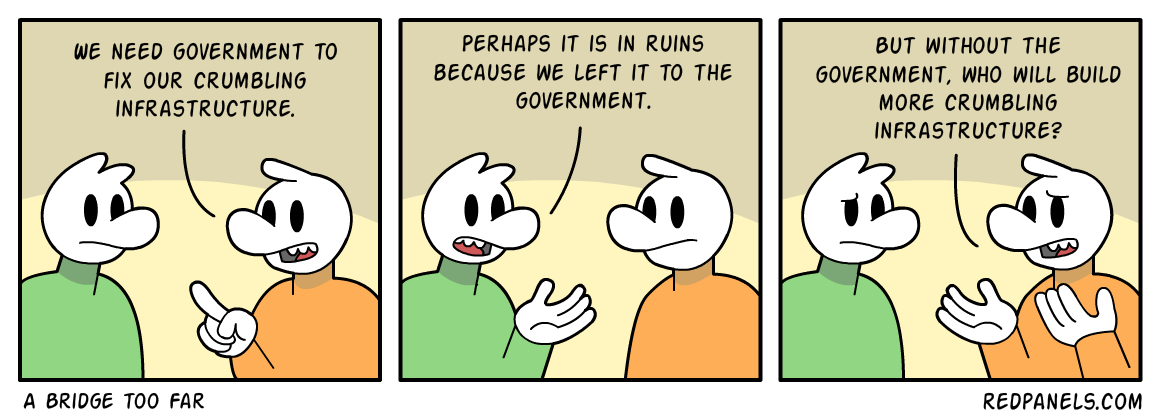
P.S. Whoever does the “Redpanels” cartoons is very clever. I’ve already shared ones on the minimum wage, universal basic income, and Keynesian economics. Now, here’s one on federal infrastructure.

 
P.P.S. I wrote two years ago about the guy in England who built a private road to help drivers avoid lengthy delays caused by poor government planning. We have an even more…um…interesting example from Russia of how the private sector can take over when the government founders.
Gangs smuggling goods into Russia have secretly repaired a road on the Belarussian border in order to boost business, the TASS news agency reported Monday. Smugglers have transformed the gravel track in the Smolensk region in order to help their heavy goods vehicles traveling on the route, said Alexander Laznenko from the Smolensk region border agency. The criminal groups have widened and raised the road and added additional turning points, he said. The road, which connects Moscow to the Belarussian capital of Minsk, is known to be used by smugglers wishing to avoid official customs posts.
This is like a libertarian fantasy. The private sector builds a road to help entrepreneurs avoid trade taxes. What’s not to love? And unlike the libertarian sex fantasy or my 1992 debate fantasy, it’s actually true!