Search This Blog

De Omnibus Dubitandum - Lux Veritas

Showing posts with label Inequality. Show all posts

Tuesday, October 29, 2024

The E-Myth

By Rich Kozlovich

Many years ago when I first started my business I tried to read as much about business start ups as I could, including what I think is a really eye opening book called "The E-Myth: Why Most Small Businesses Don't Work and What to Do About It", and the biggest thing I took away from this book was his observation, “Everybody who goes into business is actually three-people-in-one: the entrepreneur, the manager, and the technician”, and all three have different drives, goals, and motives that have to be merged in order to be successful.   I used this book title to try and emphasize the myths regarding economics in America are legion.

In spite of America being the most successful capitalist nation in the history of the planet, most Americans are stunningly ignorant about economics, and I blame the government's system of public education, and economists for that. 

As a retired business owner who was heavily involved in my industry's trade associations I can assure you one of the major problems we're facing is hiring people, and not because they're not there, it's because they don't want to work, if hired they can't be relied on to come to work, and when they do, they don't perform.

I subscribe to Joe Lonsdale's substack site because he was touted to me as an economic genius, and it's probably true,  but I've found I'm not really interested in much of what he writes about, but I didn't unsubscribe because you never know what very knowledgeable and accomplished people will produce, and today was one of those times with, Ep 99: The Myth of American Inequality with Senator Phil Gramm.  He notes the leftist media driven lie is:

The rich are getting richer, the poor are getting poorer. The wealthiest among us don't pay their fair share in taxes. The American Dream is disappearing... Are these claims true? What data are they based upon? And does it stand up to scrutiny?............He argues that we suffer, not from extreme inequality, but from welfare-driven equality that encourages huge numbers of low-and-middle income Americans to drop out of the workforce..........


Wednesday, April 13, 2022

Thomas Piketty: Bad Numbers and Bad Economics

April 12, 2022 by Dan Mitchell @ International Liberty

Thomas Piketty is a big proponent of class-warfare tax policy because he views inequality as a horrible outcome. But a soak-the-rich policy agenda, echoed by many other academics such as Emmanuel Saez and Gabriel Zucman, is fundamentally misguided.


If people really care about helping the poor, they should focus instead on reforms that actually have a proven track record of reducing poverty. The fact that they fixate on inequality makes me wonder about their motives.  And it also leads me to find their work largely irrelevant. I don’t care if they produce detailed long-run data on changes in inequality.

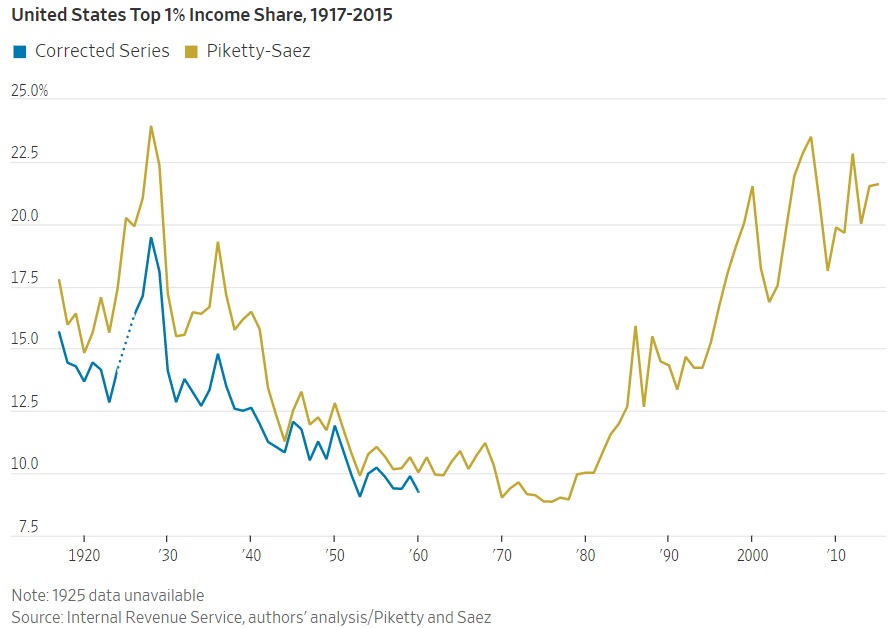
I prefer detailed long-run data on changes in poverty. That being said, it appears that some of Piketty’s data is sloppy. I shared some evidence about his bad numbers back in 2014. And, in a column for the Wall Street Journal, Phil Magness of the American Institute for Economic Research and Professor Vincent Geloso of George Mason University expose another glaring flaw


…the Piketty-Saez theory is less a matter of history than an accounting error caused by their misunderstanding of World War II-era tax statistics. …It’s true that income inequality declined in the early part of the 20th century, but the cause had more to do with the economic devastation of the Great Depression than the New Deal tax regime. …they failed to account properly for historical changes in how the Internal Revenue Service reported income-tax statistics. As a result, their numbers systematically overstate the levels of top income concentrations by as much as a third …Between 1943 and 1944 the tax collection agency shifted from tracking “net income” to “adjusted gross income,” or AGI…a truer depiction of annual earnings… Yet Messrs. Piketty and Saez didn’t bring pre-1944 IRS records into line with AGI accounting standards. Instead, they applied a fixed and arbitrary adjustment to all years before the AGI accounting change that conveniently scaled upward to the highest income brackets. …They used the wrong accounting definition for personal income and neglected to adjust their data for wartime distortions on tax reporting. When we corrected these problems, something stunning happened. The overall level of top income concentration flattened, and the timing of its leveling shifted away from the World War II-era tax rates that Messrs. Piketty and Saez place at the center of their story.

Here’s a chart that accompanied the column, showing how accurate data changes the story.

Since today’s column debunks sloppy class warfare, let’s travel back to 2014, when Deirdre McCloskey reviewed Pikittey’s tome for the Erasmus Journal of Philosophy and Economics.

She also thought his fixation on envy was misguided.


…in Piketty’s tale the rest of us fall only relatively behind the ravenous capitalists. The focus on relative wealth or income or consumption is one serious problem in the book. …What is worrying Piketty is that the rich might possibly get richer, even though the poor get richer too. His worry, in other words, is purely about difference, about the Gini coefficient, about a vague feeling of envy raised to a theoretical and ethical proposition. …Piketty and much of the left…miss the ethical point…of lifting up the poor…by the dramatic increase in the size of the pie, which has historically brought the poor to 90 or 95 percent of “enough”, as against the 10 or 5 percent attainable by redistribution without enlarging the pie. …the main event of the past two centuries was…the Great Enrichment of the average individual on the planet by a factor of 10 and in rich countries by a factor of 30 or more.

But she also explained that he doesn’t understand how the economy works.

The fundamental technical problem in the book…is that Piketty the economist does not understand supply responses. In keeping with his position as a man of the left, he has a vague and confused idea about how markets work, and especially about how supply responds to higher prices. …Piketty, it would seem, has not read with understanding the theory of supply and demand that he disparages, such as in Smith (one sneering remark on p. 9), Say (ditto, mentioned in a footnote with Smith as optimistic), Bastiat (no mention), Walras (no mention), Menger (no mention), Marshall (no mention), Mises (no mention), Hayek (one footnote citation on another matter), Friedman (pp. 548-549, but only on monetarism, not the price system). He is in short not qualified to sneer at self-regulated markets…, because he has no idea how they work.

And she concludes with a reminder that some of our left-wing friends seem most interested in punishing rich people rather than helping poor people.

The left clerisy such as…Paul Krugman or Thomas Piketty, who are quite sure that they themselves are taking the ethical high road against the wicked selfishness…might on such evidence be considered dubiously ethical. They are obsessed with first-act changes that cannot much help the poor, and often can be shown to damage them, and are obsessed with angry envy at the consumption of the uncharitable rich, of which they personally are often examples, and the ending of which would do very little to improve the position of the poor. They are very willing to stifle through taxing the rich the market-tested betterments which in the long run have gigantically helped the rest of us.

Amen. If you want to know what Deirdre means by “betterment,” click here and watch her video.

P.S. Click herehere, here, and here for my four-part series on poverty and inequality. Though what Deirdre wrote in 2016 may be even better.

P.P.S. I also can’t resist calling attention to the poll of economists at the end of this column.

Saturday, February 13, 2021

The Economics of “Lookism”

February 12, 2021 by Dan Mitchell @ International Liberty 

I repeatedly write about inequality, largely in hopes of helping people, especially my left-leaning friends, understand that we should instead focus on other issues, such as economic opportunity and poverty reduction. In other words, let’s try to help the less fortunate rather than tear down successful people

I specifically try to convince them that they shouldn’t be bothered if someone gets rich (assuming wealth is being earned rather than the result of handouts, bailouts, and subsidies from politicians). What matters is “growing the pie” so all of us have a chance to enjoy more prosperity.

But what if someone gets rich because of good luck? In other words, instead of becoming wealthy because of hard work, intelligence, or entrepreneurship, what if someone is simply the beneficiary of being attractive? Or being tall?

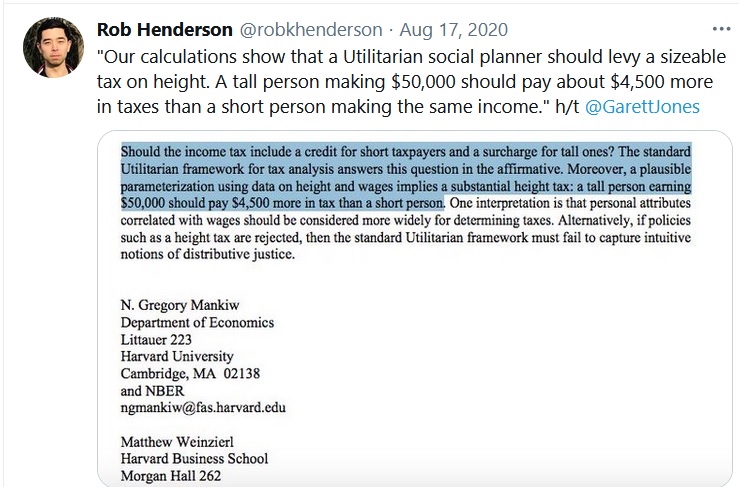
As captured by this tweet from Rob Henderson, this is not mere speculation.

I actually referenced Prof. Mankiw’s work when writing about this issue back in 2010.

And I periodically come across new research on the economic advantages enjoyed by attractive folks.


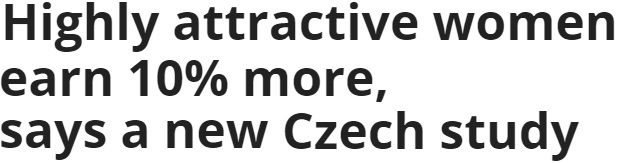
Highly attractive women’s salaries are one-tenth higher than the average even at similar education and competence levels, a low attractivity means a loss of 4 percent, according to a study presented by sociologist Petra Anyzova at a workshop based on a job market research project today. …Anyzova said that the results are similar to the findings of other studies and the trend suggests that men are disadvantaged if they display more feminine traits and women are disadvantages if they display more masculine traits.In the case of men, the impact of physical attractiveness on being able to secure a higher socio-economic status is significant.

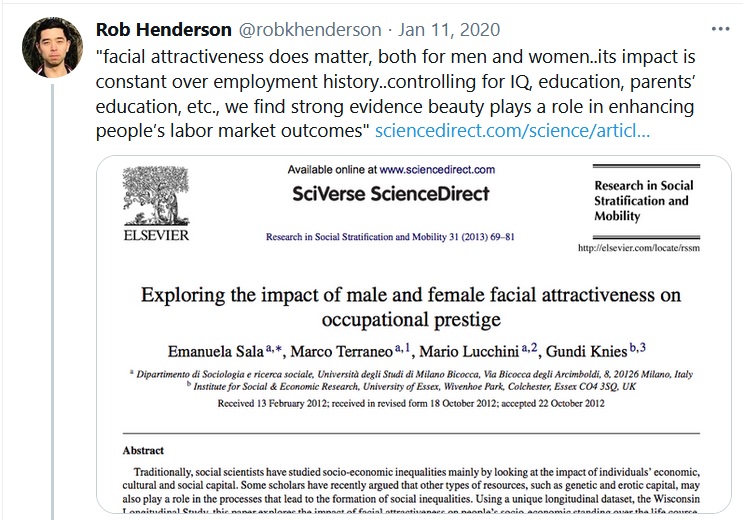
And here’s another study Henderson tweeted about.

So what are the policy implications of this research? And the other research that I cited back in 2018 and 2019?  As far as I’m concerned, there aren’t any.

Yes, some people are very lucky because of their looks or their height and they wind up with extra income because of those random characteristics, but that shouldn’t be a reason for government-coerced redistribution.  The same thing is true for those fortunate enough to be born into the right families.

As I wrote two years ago.

…taller people and better-looking people earn more money and have better lives. That’s genuine unfairness, just like having better parents is a source of genuine unfairness. Yet not even Bernie Sanders or AOC have proposed taxes to equalize those sources of real unfairness.

Yes, the research suggests that life isn’t fair.  But government intervention isn’t the answer, as I explained back in 2011.

The real issue is whether this discrimination is real and whether it justifies government intervention. …I don’t doubt that “lookism” exists. …But does that mean we should have some sort of government bureaucracy with the power to sue, fine, arrest, or otherwise harass based on whether people claim they didn’t get promotions because of their appearance?

Just imagine, for instance, if government tried to redistribute sexual opportunities, as suggested by this example of Elizabeth Warren satire?

I’ll conclude with the observation that if we don’t try to address inequalities caused by random luck, such as looks and height, then why would we want politicians to impose taxes and redistribution to deal with inequalities that are the result of attributes over which we have considerable control, such as diligence, productivity, responsibility, and effort?

P.S. For what it’s worth, research suggests conservatives generally are viewed as more attractive and stronger than folks on the left (though that research also suggests that libertarians generally are perceived as being dorks).


Tuesday, December 29, 2020

Part III: Poverty Is a Problem, not Inequality

Ethical people, regardless of ideology, should be motivated by an empathetic desire to help the poor rather than a spiteful thirst to punish the rich.

That was the message in Part I and Part II of this series. That’s also today’s message, and we’ll start with this video.

There’s a lot of information in this video, broken down into five thematic points.

  1. Profit (earned through voluntary exchange) is good, while plunder (obtained through government coercion) is bad.
  2. Because people are different, it is important to distinguish between equality of opportunity and equality of outcomes.
  3. People don’t understand inequality, and that leads many of them to overlook the important problem of poverty.
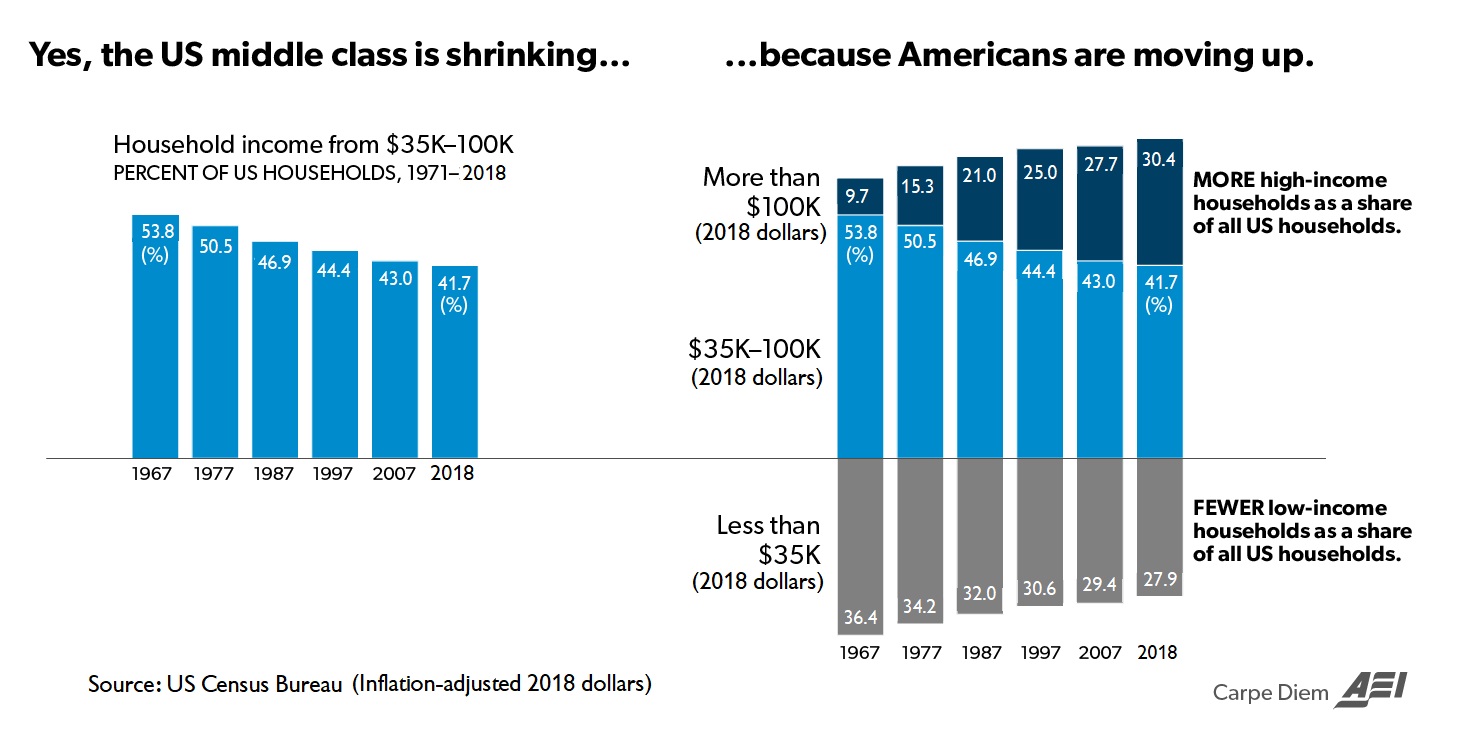
  4. We are getting richer over time, meaning that the middle class is only disappearing because some are becoming rich.
  5. Thanks to the spread of pro-market policies, the entire world is becoming more prosperous with better life outcomes.

For today’s column, let’s focus on item #3 and I want to specifically take this opportunity to explain why we should be aware of how a type of data known as the “Gini coefficient” is used (and sometimes misused).

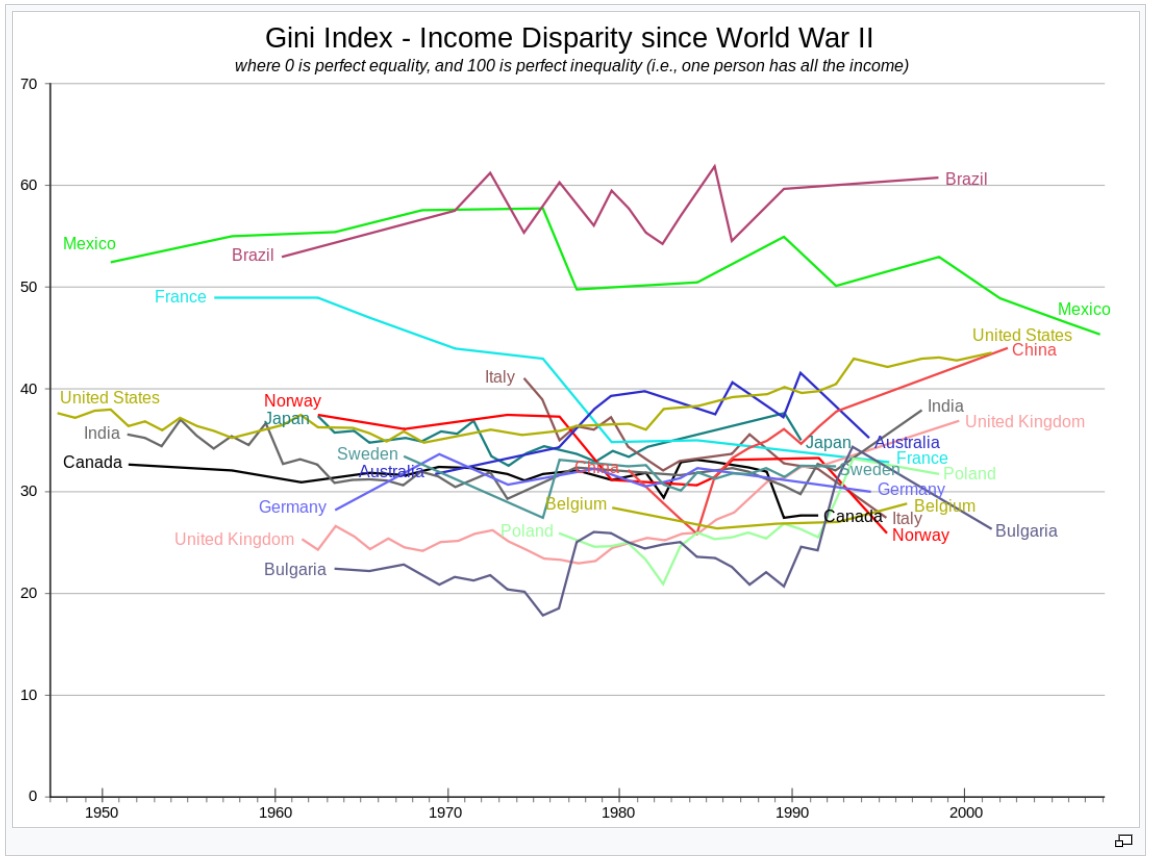
By way of background, the Gini coefficient measures the distribution of income in a society. As seen in this illustration from Wikipedia, a high coefficient means some people have a lot more income than others and a low coefficient means most people have similar levels of income.

I’ve never been a big fan of the Gini coefficient for three reasons.

First, it’s often used by folks on the left who want higher taxes and more redistribution. Though that’s actually an indictment of how the coefficient is misused.

Second, it doesn’t tell us whether inequality is the result of something good (some people getting rich by providing especially valuable goods and services) or the result of something bad (some people grabbing undeserved loot thanks because of bailouts, subsidies, protectionism, industrial policy, and cronyism).

Third, it does not tell us whether a society is poor or prosperous.

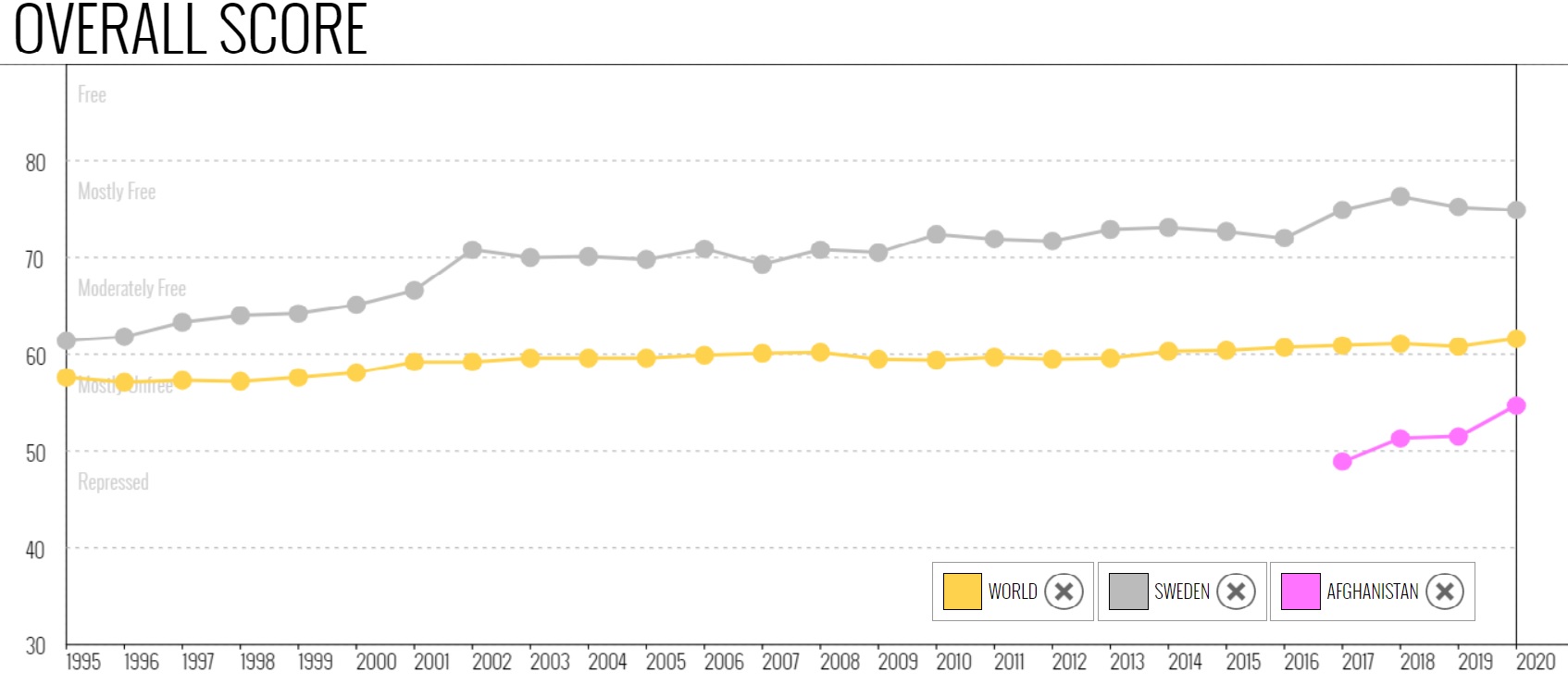
Regarding that final point, Professor Davies pointed out in the video that the most equal nations in the world are Sweden and Afghanistan.

But having similar Gini coefficients is utterly meaningless because it turns out that the similar scores are for radically different reasons – i.e., people in Afghanistan are equally impoverished and people in Sweden are equally prosperous.

And I can’t resist pointing out that Sweden’s superior results are surely correlated with the fact that Swedes enjoy far higher levels of economic liberty (Sweden is #22 and Afghanistan is #136 according to the Heritage Foundation’s Index of Economic Freedom).

You could also do a comparison between nations with very different Gini coefficients.

The United States, for instance, is much more “unequal” than Afghanistan. But I can’t imagine anyone in America wanting to trade places. After all, almost everyone in the U.S. is far richer than almost everyone in Afghanistan.

Or, if you prefer comparing developed nations, I’ve previously noted that poor people in the United States have the same amount of income as middle-class people in nations with lower levels of inequality.

I’ll close with one final bit of data that shows why Gini coefficients should be viewed with caution. Here’s another visual from the Wikipedia page, this one showing how world inequality increased substantially between 1820 and 2002.

Was that increase in inequality a bad outcome?

Of course not. It was simply a result of the Western world becoming rich because of limited government and the rule of law.

And now that developing nations are finally shifting to market-oriented policies, their incomes also are increasing (which, as a side effect, means global inequality is decreasing).

In other words, we should pay attention to the recipe for growth and prosperity, not the Gini coefficient.

P.S. While I’m not a fan of the Gini coefficient, the so-called trade deficit will always be my least favorite statistic.


Sunday, October 27, 2019

To Help the Poor, Focus on Poverty Reduction Rather than Inequality

September 21, 2019 by Dan Mitchell @ International Liberty

Here’s a simple quiz to determine whether you should support a candidate like Bernie Sanders or Elizabeth Warren: Would you embrace a policy that increased income for poor Americans by 10 percent if it also happened to increase income for rich Americans by 15 percent?

Normal people automatically say yes. After all, they don’t resent rich people and they want lower-income people to enjoy better living standards.

Some of our left-leaning friends (including at the IMF!), however, are so fixated on inequality that they are willing to deprive the poor so long as higher-income people have even larger losses (Margaret Thatcher nailed them on this issue).

Let’s look at some analysis of this issue.

The Wall Street Journal has an editorial that starts by highlighting some good economic news.
…low- and middle-income folks are reaping more economic benefits than during the Obama years. …Worker earnings increased by 3.4% while the poverty rate declined 0.5 percentage points to 11.8%, the lowest level since 2001. Benefit rolls are shrinking as low-income workers earn more. …the number of full-time, year-round workers increased by 2.3 million in 2018, and employment gains were biggest among minority female-led households. The share of workers in female-led households who worked full-time year-round increased by 4.2 percentage points among blacks and 3.6 percentage points among Hispanics. …The jobless rate for black women last month fell to a historic low of 4.4% and neared a nadir for Hispanic women at 4.2%. …The share of households making less than $35,000 in inflation-adjusted dollars has fallen 1.2 percentage points since 2016 while those earning between $50,000 and $150,000 and more than $200,000 have both increased by 0.8 percentage points.
It then makes to all-important point that policy makers should fixate on growth rather than inequality if the goal is to help he less fortunate.
Democrats focus on income inequality… What really matters for a healthy democratic society, however, are economic opportunity and income mobility. …The Obama policy mix, which Democrats want to return to only more so, put a priority on reducing inequality rather than increasing economic growth. But higher taxes, hyper-regulation and income redistribution resulted in slower growth and more inequality during the Obama Presidency. …This is a lesson for the left and those on the big-government right who want to use tax policy and subsidies to redistribute income to reduce inequality. Policies that hurt growth hurt lower-income workers the most.
José Ponce, in a column for FEE, sagely observes that “Gini” numbers can be very misleading because they tell us nothing about a society’s overall prosperity.
…inequality on its own is insufficient for any means of understanding. By definition, it measures the level of income or wealth that a group of people receive or own relative to another group of people within a society. The key word here is relative. That means it provides no information in regards to whether the bottom quintile has a low or high level of income or about the quality of life… For instance, Cuba, with a Gini index of 0.38 and Liberia with 0.32 have much less inequality than the highly-developed Singapore and Hong Kong, with Gini coefficients of 0.45 and 0.53, respectively. Citizens in a poor country with low inequality are equitably poor. …Elaborating on this point, rising inequality may not necessarily be a negative outcome just as declining inequality may not necessarily be positive. A developing society where both the rich and the poor have growing incomes, but the rich are rising faster than the poor, will experience a surge in inequality. However, since both the rich and the poor have increased incomes, everyone is better off than before.
Let’s close with a chart from Mark Perry showing that ever-greater numbers of Americans are climbing the income ladder.

P.S. This data from China is the most powerful and persuasive that I’ve seen on why growth matters far more than inequality.

P.P.S. This bit of satire also illustrates why inequality numbers are grossly misleading.

Monday, August 19, 2019

Statistician on a mission to end inequality in the U.S. finds the answer in 'fathers,' 'intact families' and 'social capital'

August 18, 2019 By Monica Showalter

The Atlantic features a marvelous and compelling profile of an Indian-American economist and statistician, Raj Chetty, on a mission to end inequality in the U.S.

It's a long, long read, and this being The Atlantic, I expected this would be another profile of one of the gee-whiz, Obama-era hipsterly types, the kind who came up with the theory of the "nudge" to entice low-information voters to choose socialist things on store shelves, or else one of those Democratic Party language manipulators such as this guy

Another Obama wiz-bang, whiz-kid. Even more suggestive of the trend, the guy comes from south India, the Tamil-Nadu part, which is a very socialist part  (not far from Kamala Harris's family's part, which gives you the flavor) and from a broader culture that places more value in collecting degrees and obtaining do-nothing government satrapies than actually producing things of value. Not a promising start. Less promising still, he was the kind of guy who got a lot of awards from the Ford Foundation types and academia, pillars of the far-left establishment as their fair-haired boy, so I wasn't optimistic -- here's his string of honors described by The Atlantic:.............To Read More...


Tuesday, January 9, 2018

Statist Policies Create Unjust Forms of Inequality, Part II

January 8, 2018 by Dan Mitchell @ International Liberty
 
The left’s fixation on reducing inequality is misguided. If they really care about the poor, they instead should focus on reducing poverty.

And that means pushing for more growth. We know from U.S. evidence and global evidence that better economic performance is the effective way to boost living standards for the less fortunate (I also recommend a look at the data from China).

Leftist Fairness

Unfortunately, many folks on the left pursue policies that undermine prosperity and actually exacerbate inequality. I put together some examples back in 2015, and now it’s time to expand that list.

A report from the left-leaning Brookings Institution looks at how regulations protect – and enrich – the top 1 percent.
The real cause of elite inequality is the lack of open access and market competition in elite investment and labor markets. To bring the elite down to size, we need to make them compete. …people working in the securities industry (which includes investment banks and hedge funds) earn 26 percent more, regardless of skill. Those working in legal services get a 23 percent pay raise. These are among the two industries with the highest levels of “gratuitous pay”—pay in excess of skill… Using microdata from the Census Bureau, I find that the “gratuitous pay” premium in certain industries has increased dramatically since 1980. …The accredited investor…rules contribute to inequality by giving the richest investors privileged access to the best investment strategies. …If the law was changed to allow mutual funds to offer hedge fund portfolios, hundreds of billions of dollars would be transferred annually from super-rich hedge fund managers and investment bankers to ordinary investors, and even low-income workers with retirement plans. …politicians and intellectuals often champion market competition—but what they mean by that is competition among low-paid service workers, production workers, or computer programmers who face competition from trade and immigration, while elite professionals sit behind a protectionist wall. …For lawyers, doctors, and dentists— three of the most over-represented occupations in the top 1 percent—state-level lobbying from professional associations has blocked efforts to expand the supply of qualified workers who could do many of the “professional” job tasks for less pay.
Matt Ridley, a columnist fo the U.K.-based Times, writes about the pernicious impact of cronyism, licensing, and industrial policy.
The history of industrial strategies is littered with attempts to pick winners that ended up picking losers. Worse, it is government intervention, not laissez faire, that has done most to increase inequality and to entrench wealth and privilege. For example, the planning system restricts the supply of land for housebuilding, raising property prices to the enormous benefit of the haves (yes, that includes me) at the expense of the have-nots. …Why are salaries so high in financial services? Because there are huge barriers to entry erected by government, which hands incumbent firms enormous quasi-monopoly advantages and thereby shelters them from upstart competition. …Why are lawyers so rich? Because there is a government-licensed cartel restricting the supply of them. …Our current “industrial strategy” for energy — to subsidise offshore wind, solar, biomass and nuclear — is responsible for the fact that domestic electricity prices are the seventh highest… Domestic electricity bills are a higher proportion of household budgets for the poor than for the rich, so this policy is regressive; doubly so, because the wind and solar subsidies mostly go to the rich. 
Let’s consider health policy. Folks on the left favor the healthcare exclusion in the tax code because government supposedly should play a role in encouraging health insurance. What’s the impact of this policy? Well, let’s peruse a Robert Samuelson column on health policy and inequality, which is based on a study from the Mercatus Center.
…add health care to the causes of growing wage inequality in America. There’s a largely unknown paradox at work. Companies that try to provide roughly equal health insurance plans for their workers — as many do — end up making wage and salary inequality worse. …It’s simple arithmetic… Paying for expensive health insurance squeezes what’s left for wage and salary raises. Economic inequality increases, because health insurance typically represents a larger share of total compensation for lower-paid than higher-paid workers. Their wages are squeezed the most. …Even though the company raised its compensation package by 5 percent for all workers, the wage and salary gap between the best- and worst- paid workers widened. Pursuing one type of equality (health coverage) inadvertently worsened another type of inequality (wages and incomes). …From 1992 to 2010, about half the increase in wage and salary inequality is explained by rising health costs.
We’ll close with a new study by an economist at the University of Michigan for the National Bureau of Economic Research.
The three major reforms that I will analyze are: (1) the state income tax introduction, (2) the introduction of withholding, bundled with the introduction of third-party reporting, and (3) the intergovernmental agreement between the federal and the state governments for coordinating auditing practices. …the introduction of the income tax raised the Atkinson inequality index by 0.015, which is about 7 percent of the sample mean, statistically significant at the 1 percent level. …The income tax introduction raised the Gini coefficient by 0.014, which is about 3 percent, significant at the 5 percent level. …All of the three reforms raised the Theil index in a statistically significant way, at least at the 5 percent level. The introduction of the income tax and of the withholding raised it by about 0.06… In other words, the fact that the only effect that these reforms had in common was raising the revenues from income tax and making the government bigger and the private sector smaller, suggest that a bigger government, at least in the recent history, had the effect of higher inequality.
Here’s a chart from Professor Troiano’s research. Note how the rich got richer at the point (“0”) the income tax was implemented.


And here’s a look at what happened to various measures of inequality. Again, pay attention to the point (“0”) where the income tax was imposed.


Writing for PJ Media, Simon Constable discusses some implications of the NBER report.
Income taxes don’t reduce income inequality. Instead they do quite the opposite, according to December-dated analysis published by the National Bureau of Economic Research. The paper looked at three major 20th century U.S. tax reforms and found that they did nothing to decrease income inequality and everything to increase it. …Why did income inequality increase when that wasn’t the goal of the reforms? …bigger government ends up retarding the private sector and reducing the size of the wealth pie. Naturally, the poorer come out worst in such a situation, while the well-heeled can get top tier advice to dodge the tax bullet. Hence, the rich get richer and the poor stay skint. …Nobody who believes in liberty, or public choice theory, will be surprised to learn that higher taxes lead to more inequality,” says Robert E. Wright, professor of political economy at Augustana University in South Dakota. The problem is that the elites in any society, including the U.S., control the government and they quite naturally take care of themselves first, he says.
The bottom line is that our statist friends claim that they’re shooting at the rich, but the poor tend to suffer the most damage.

If you want more evidence, look at what happened to income for various groups during the pro-free market era of the 1980s and 1990s compared to what’s happened so far this century.
P.S. The most twisted look at inequality was produced by the IMF, which implied that radically lower living standards would be acceptable if everyone was more equally poor.

P.P.S. The most satirical look at inequality comes from David Azerrad.

P.P.P.S. The most insightful comment on inequality comes from Johan Norberg, who reminds us that we should be upset by unfairness, not inequality.


Thursday, September 26, 2013

Liberty Delivers a Better World While Utopians Promise a Perfect One

Mises Daily: Wednesday, September 25, 2013 by Gary Galles
Why are unattainable utopian visions attractive and inspirational to so many while the promises of liberty, under which a vastly-improved society can actually be attained, are so often disregarded? Leonard Read, among America’s most prolific defenders of liberty in the 20th century, considered that question.
In Let Freedom Reign, Read argued that liberty’s failure to gain more adherents than utopian statism derived in substantial measure from the fact that the ends envisioned, rather than the means involved, often motivate people. Unlike the utopian visions, the freedom philosophy recognizes that a system of free markets is an “amoral servant” that does not claim to generate no objectionable results to anyone. For this reason, liberty faces an inspirational disadvantage.
A good illustration of utopianism’s “advantage” over freedom is the utopian’s assertion that he can deliver equality of results (implicitly assumed to be equality at a high level of prosperity). This in turn leads to rationalizations for cutting freedom off at the knees. Yet some forms of inequality are inseparable from astounding social benefits, particularly the massive gains from specialization among people with differing abilities and circumstances, coordinated through voluntary market arrangements.
As Read noted in Having My Way, rather than bemoaning any inequality of results, it would be more accurate to say, “inequality exists, fortunately!” as long as it is combined with freedom, which he called our“working handmaiden.”

[F]reedom and equality are ... mutually antagonistic. The equality idea…rests on the antithesis of freedom: raw coercion. It is ... impossible to be free when equality is politically manipulated ...

Not our likenesses, but our differences, give rise to the division of labor and the complex market processes of production and trade ... it is to our advantage to specialize and to trade with other specialists. ... By thus serving others — and becoming ever more skilled and outstanding (unequal) in the process — he best serves his own interest.....To Read More.....