Search This Blog

De Omnibus Dubitandum - Lux Veritas

Showing posts with label Floods. Show all posts

Friday, October 22, 2021

New York Times Threatens Senator Manchin With Witchcraft If He Obstructs Democrat "Climate" Agenda

/

It’s always been just a little odd that the guy the Democrats most need to get on board to get their big transformational plans enacted is Senator Joe Manchin of West Virginia, while at the same time the centerpiece of those plans is to put the most important industry of West Virginia, coal mining, completely out of business. That sounds like it’s going to be a tough sell. Is there any argument that might convince this guy to get with the program?

In one of the funniest articles I have read anywhere recently, the New York Times thinks that it has come up with the argument that will carry the day: threaten Manchin with witchcraft! The article, covering about half of the front page of yesterday’s print edition, tells Manchin that if he continues to “block” the Democrats’ plans to destroy the coal industry, a spell will be cast over his state and it will be inundated with floods. The headline is “Blocking Climate Plan With Hometown at Risk.”

The Times characterizes Mr. Manchin’s stance thusly:

Mr. Manchin, a Democrat whose vote is crucial to passing his party’s climate legislation, is opposed to its most important provision that would compel utilities to stop burning oil, coal and gas and instead use solar, wind and nuclear energy, which do not emit the carbon dioxide that is heating the planet. Last week, the senator made his opposition clear to the Biden administration, which is now scrambling to come up with alternatives he would accept. Mr. Manchin has rejected any plan to move the country away from fossil fuels because he said it would harm West Virginia, a top producer of coal and gas.

Seems reasonable. Better threaten the guy:

Others say that by blocking efforts to reduce coal and gas use, Mr. Manchin risks hurting his state.

And how exactly would that work? Simple: if Manchin remains intransigent, West Virginia will be destroyed by epic floods.

First Street [Foundation] calculated the portion of all kinds of infrastructure at risk of becoming inoperable because of a so-called 100-year flood — a flood that statistically has a 1 percent chance of happening in any given year. The group compared the results for every state except Alaska and Hawaii. In many cases, West Virginia topped the list. Sixty-one percent of West Virginia’s power stations are at risk, the highest nationwide and more than twice the average. West Virginia also leads in the share of its roads at risk of inundation, at 46 percent. The state also ranks highest for the share of fire stations (57 percent) and police stations (50 percent) exposed to a 100-year flood. And West Virginia ties with Louisiana for the greatest share of schools (38 percent) and commercial properties (37 percent) at risk.

But what, if anything, does any of this have to do with Mr. Manchin’s opposition to the destruction of West Virginia’s coal industry? The Times article does not say, other than repeatedly invoking the phrase “climate change,” as if that has something to do with flood risk from rivers in West Virginia. The article makes no attempt to demonstrate any relationship between climate change and river flood risk.

Perhaps we should look to see what we can find about trends in flooding and/or extreme wet conditions in the United States over the last century or so. That is the period when human “greenhouse gas” emissions have supposedly been warming the atmosphere. Here is, for example, this NOAA chart of what they call “very wet/dry” conditions in the U.S. from 1895 through September 2021:

Screen Shot 2021-10-19 at 5.18.49 PM.png

Can you detect the trend of increasing “extreme wet conditions” in that chart as the atmosphere has warmed (by maybe 1 deg C) over the time in question? Neither can I. How about U.S. flood damage as a percentage of GDP? Here is a chart presented to Congress by Roger Pielke, Jr. in testimony in 2015:

Screen Shot 2021-10-19 at 5.25.48 PM.png

That trend looks to be significantly down rather than up. Mr. Pielke’s comment:

The good news is U.S. flood damage is sharply down over 70 years.

How about the IPCC. Surely they can come up with something to scare us? Here is a 2018 IPCC document with the title “Changes in Climate Extremes and their Impacts on the Natural Physical Environment.” On the subject of floods, from page 175:

The AR4 and the IPCC Technical Paper VI based on the AR4 concluded that no gauge-based evidence had been found for a climate-driven globally widespread change in the magnitude/frequency of floods during the last decades (Rosenzweig et al., 2007; Bates et al., 2008).

In short, the evidence to date gives no reason to believe that there is any reason that floods have increased, or are about to increase, due to “climate change.” In other words, the threat against Mr. Manchin to destroy West Virginia with floods can’t really be based on that. It must be witchcraft!


Tuesday, August 10, 2021

Europe’s ‘unprecedented manmade floods’

Separating myth from reality about extreme weather events today and over the centuries

Paul Driessen 

Deadly floods in Germany and Belgium have put climate change back in the news in time for the COP-26 climate gabfest in Glasgow. Not surprisingly, government officials again blamed fossil fuels, greenhouse gases and manmade climate change for the calamities, to deflect attention from their official incompetence – as they did with SuperStorm Sandy and recurrent wildfires

They’re blaming the very fossil fuels that power Europe’s economy; build, heat and electrify homes; and power the boats, ambulances and other equipment that were used to rescue people, recover bodies, and nurse survivors back to health. 

They’re the same officials who could and should have prepared their communities for floods like those that hit Germany and Europe every few decades. But failed to do so. They were warned days in advance that the rains and floods were coming – and were told almost exactly where and when the rains and floods would hit. But did nothing. 

They were supposed to warn people – and get them out of harm’s way. But they failed to warn their citizens that they, their homes and their children would be swept away by raging waters, if they didn’t evacuate immediately. 

No wonder they want to blame manmade climate change – for almost every extreme weather event. They want to avoid accountability and protect their political and financial stakes in Climate Crisis, Inc. About the last thing they want people to see are the climate realities that would confound their myths and fear-mongering, put today’s extreme weather events into proper context, and keep their constituents from being bamboozled by future climate lies. 

FLOODS are not uncommon, they are not unprecedented, and they are not kind to people, civilization or nature. Indeed, devastating rains and floods occur with regularity, and the more concrete, asphalt and buildings we put in cities, the less drainage we have, and the more flooding we get – in Europe, Houston, New York City and everywhere else. 

The great Arno River flood of 1966 impacted much of Florence, Italy and damaged or destroyed many magnificent works of art. The 2002 Vltava River flood left high water marks 10 feet up on buildings, and 30 feet above the river’s normal water line; 1784, 1845 and 1997 Czech floods were even worse. 

What caused all those floods? the deadly German floods of 1790 and 1910? the Johnstown, Ohio Flood of 1889? the 1976 Big Thompson Canyon flash flood that roared down a narrow Colorado gorge, leaving residents and campers few avenues of escape? All those floods were natural, but today’s are manmade? 

HURRICANES are also common, recurring, devastating and deadly. It’s fashionable to blame Harvey and Irma and other recent hurricanes on fossil fuels, carbon dioxide, and us humans. But it’s ridiculous. 

Between Hurricane Wilma in 2005 and Harvey and Irma in 2017, the United States enjoyed a 12-year major hurricane drought: 12 years without one Category 3-5 hurricane making US landfall. It was the longest period in recorded history that America was not hammered by a major hurricane. 

If we’re going to blame every modern era hurricane on fossil fuel emissions – shouldn’t we also thank fossil fuel emissions for that unprecedented 12-year absence of truly deadly hurricanes? (It wouldn’t be honest science, but it would be honest politics.) A far better approach would be to prepare better for all of Mother Nature’s future onslaughts. 

US property damage in raw dollars from hurricanes has certainly increased – because more people are building more expensive homes along our coasts, where hurricanes strike with regularity and intensity. But death tolls are way down, because buildings are built better, and (unlike in Germany and Belgium recently) people get warned far enough in advance to get out of harm’s way. 

Equally positive, global property damage from weather-related disasters, as a proportion of global gross domestic product, went down significantly since 1990, largely for the same reasons. Deaths are down too. 

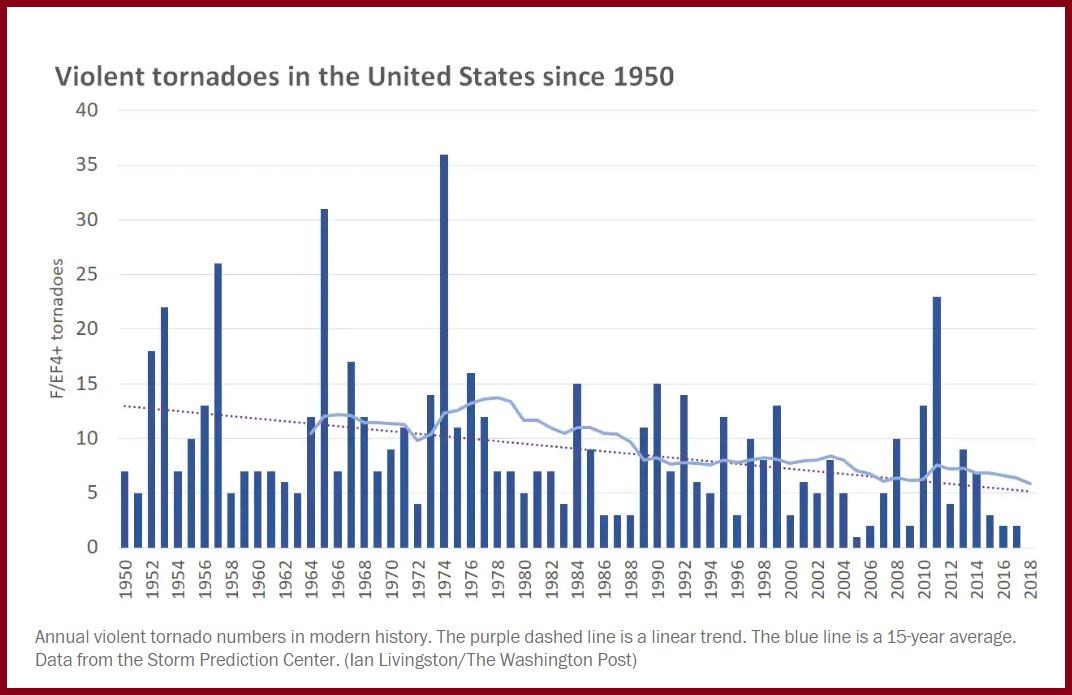
TORNADOES. A Washington Post chart makes it abundantly clear that violent F4 and F5 tornadoes have been less frequent the last 35 years than they were during the 35-year period 1950-1985. Even more amazing, for the first time in history, the United States was not hit by a single violent twister in 2018. Was that because of fossil fuel emissions? 

Indeed, very few tornadoes compare to the horrific Gainesville, Georgia tornado of 1936, which killed 450 people – or the even more horrendous, record-setting the Tri-State Twister of 1925. That one lasted 3.5 hours, traveled 220 miles, obliterated entire towns, and killed nearly 700 people

BLIZZARDS are also common. But predictably, almost every big winter storm nowadays gets blamed on “carbon” (CO2) emissions, and we’re told to expect far more if we don’t end fossil fuel use. 

Climate con artists want us to forget the Nebraska School Children’s Blizzard of January 1888, when a relatively warm day, with snow melting all around, suddenly became a vicious storm. In less than three hours, Midwestern temperatures plummeted from plus-35 to minus-20 and even minus-40. Winds howled down from the North, bringing several feet of heavy snow. The storm killed some 500 people across several states, most of them in Nebraska. Many were children trying to get home from collapsing schoolhouses, and parents out looking for their children. 

That blizzard made US and international news. But it was soon overshadowed by the Great Mid-Atlantic Blizzard of March 1888. That one buried New York City and much of the East Coast under mountains of snow, and killed over 400 people. Dozens of New Yorkers weren’t found until days later, when their frozen remains were dug out of massive snow drifts. 

TEMPERATURES. The dawn of the industrial age coincides with the end of the Little Ice Age, so the warming is mostly natural. Climate models predict much higher temperatures than we’re experiencing. And average global temperatures have barely budged since 2002, except during El Niño events. 

People once learned important lessons from extreme weather events. Midwesterners invested in stronger homes and schools, developed better weather forecasting, made sure they kept winter clothing with them and their kids even when the weather looked balmy, and built tornado warning systems and shelters. New York City built a subway system, enabling people to travel underground, safe from deadly cold and snow. 

Today, too many government officials prefer to collude with activists, subsidy-seekers and media sidekicks to blame “manmade climate change” for every disaster. They ignore their own roles in the property damage and death from natural disasters like SuperStorm Sandy. They pretend they can control the climate and weather – while getting richer and more powerful embracing anti-fossil fuel policies. 

After countless millennia of natural disasters, we’re supposed to believe extreme weather events are now manmade, and temperature changes, droughts and storms are now our fault. At humanity’s most technologically advanced level in history, we’re supposed to be unable to cope with, adapt to or recover from climate and weather events. 

We cannot afford to be bamboozled by climate con artists – who for their own selfish reasons claim we must immediately get rid of the fossil fuels that provide 80% of America’s and the world’s energy ... and then magically replace those fuels with expensive, intermittent, weather-dependent, land-intensive and  raw materials-hungry wind, solar and battery power. 

If we let ourselves get deluded, electricity prices will skyrocket, blackouts will become commonplace, our jobs will disappear, our living standards will plummet, our lives will be at greater risk, our environment will be destroyed – and we’ll deserve what we get. It’s time to fully and honestly reassess “the science” behind this supposed “climate crisis.”

Paul Driessen is senior policy analyst for the Committee For A Constructive Tomorrow (www.CFACT.org) and author of books and articles on energy, climate change, human rights and economic development.


Tuesday, July 20, 2021

Calling Europe's Floods "Climate" is Unscientific Propaganda

By Craig Rucker President of CFACT

"When all you have is a hammer, everything looks like a nail." To the warming-Left, every natural weather event looks like "climate."  Europe has been hit by devastating floods with the death toll reaching 188 and rising.  Of course the usual suspects are exploiting this genuine, heart-rending tragedy to advance their climate agenda.  

German Chancellor Angela Merkel said that Germany must "be faster in the battle against climate change." 

"Belgian Prime Minister Alexander De Croo said the link with climate change was clear."

No less an expert than teenage high school dropout Greta Thunberg posted:  

Deadly heatwaves, floods, storms, wildfires, droughts, crop failures...  This is not "the new normal."  We're at the very beginning of a climate and ecological emergency, and extreme weather events will only become more and more frequent.  After the catastrophic recent developments - especially in Western Europe - everyone seems to be talking about the climate emergency, and rightly so. But as soon as these tragedies are over we'll most likely forget about it and move on like before.  Unless we treat the crisis like a crisis all the time, we will not be able to halt the climate emergency.

All three of them, along with the rest of the politicians, media and pressure groups attributing Europe's flooding to climate are shamefully wrong.

Does anyone rationally believe that Europe's floods, or the heatwave in the western U.S. for that matter, were meaningfully worse because the temperature of the Earth warmed slightly, far less than climate models projected, almost entirely last century?

Australia's intrepid Joanne Nova did her usual no-nonsense job of showing that Europe's floods, devastating though they may be, are historically normal. In fact, in 1714 Europe flooded on Christmas Eve killing 14,000!  "It's as if European history doesn't exist," she writes (posted at CFACT.org).

Every so often Europe's rivers will inevitably flood.  The flooding will be worse when, as happened this time, pressure systems leave the weather lingering in place, rather than pushing the storm rapidly through.  This is how Hurricane Dorian devastated the Bahamas two years ago.  This type of extreme weather event cannot be prevented through taxation, redistribution, carbon trading, windmills, solar panels, or electric vehicles. 

We can, however, protect people and property from extreme weather through forecasting, early warning, preparedness and response.

This is where Europe's bureaucrats devastatingly dropped the ball.  This is the preventable man-made disaster.

The London Times reports that the reason for the flood's terrible loss stems from  a "monumental failure of the warning system."  Excerpts via the U.K.'s GWPF at Climate Depot: 

The first signs of catastrophe were detected nine days ago by a satellite orbiting 500 miles above the tranquil hills around the Rhine river. 

Over the next few days a team of scientists sent the German authorities a series of forecasts so accurate that they now read like a macabre prophecy: the Rhineland was about to be hit by "extreme" flooding, particularly along the Erft and Ahr rivers, and in towns such as Hagen and Altena. 

Yet despite at least 24 hours warning that predicted, almost precisely, which districts would be worst afflicted when the rains came, the flood still caught many of its victims largely unawares... 

 "People should have been receiving warnings; people should have understood the warnings. It's no use having massive computer models predicting what's going to happen if people don't know what to do in a flood." 

Instead, the overwhelming majority of people in the path of the floods carried on with their everyday lives, oblivious to the danger, as the waters began to rise .Western Europe had all the infrastructure it needed to protect its people.  It failed to use it.

Don't let Europe's failed bureaucracy wiggle off the hook by shifting the blame to "climate."  Europe was going to flood whether you drove to work and used electricity or not.  The weather warnings were clear, but not shared with the public.  Tragic.

There are a few particularly onerous weasel words the global warming campaign uses when natural disaster strikes.  Warming makes extreme weather "more likely" and "more severe," they say.  The fact that global temperature did not make the disaster meaningfully more likely or severe they leave out entirely.  This is where the media fails its responsibility and declines to ask the relevant questions.

The New York Times reports that team warming is planning to use "rapid attribution" of natural weather events to climate in an attempt to preempt those of us prepared to present the scientific and historical evidence that falsifies their claims.  

That's how human behavior leads to weather that kills -- as it did in Europe.

For nature and people too, 

Friday, October 31, 2014

Rhode Island flooding not West Virginia’s fault

Whitehouse is misguided on sea level rise: seacoasts won’t be flooded due to coal burning

Tom Harris & Bob Carter

It must have taken the patience of Job for West Virginia Senator Joe Manchin to participate in Rhode Island Senator Sheldon Whitehouse’s climate change tour of the Ocean State on October 10. Whitehouse promised Manchin that he would go to West Virginia to learn about the coal industry if Manchin would come to Rhode Island to view the supposed effects of global warming on sea-level.

It is important to put the concerns of the two senators in perspective.

On the one hand, Manchin is fighting for the survival of West Virginia’s coal sector, his state’s most important industry, the source of 95% of its electricity, and the foundation for thousands of jobs in dozens of communities. The state’s use of abundant, domestically mined coal gives West Virginia the 7th lowest electricity costs in America – at about one-half the price in California, New York, Rhode Island and several other states.

But West Virginia’s coal sector is under siege from increasingly damaging Environmental Protection Agency (EPA) rules. Those rules have meant total coal production in West Virginia declined 9% between 2012 and 2013, a period during which 17% of the Mountain State’s coal mines closed, and coal employment decreased 6.4% for a loss of 3,457 jobs already. Even before the EPA’s new Clean Power Plan regulations, which Whitehouse promotes, come into force, the EPA and Obama Administration’s “war on coal” has already cost West Virginia billions of dollars.

Senator Manchin, in other words, is concerned about the immediate, real-world impacts of climate change regulations on real people, families and businesses in his state.

Senator Whitehouse has a different perspective and is apparently not concerned about the cost of EPA emission regulations. Rhode Island gets none of its electricity from coal, having chosen less-carbon-intensive natural gas as its preferred source of power.

As a result, the state has the 7th highest electricity prices in the continental United States. The impact of these high prices on hospitals, schools, churches, businesses and families is significant.

The White House, of course, shares Senator Whitehouse’s perspective. Neither seems worried that, under the EPA rules, electricity prices will “necessarily skyrocket,” as Obama put it when describing his energy plans as Democratic candidate for president in 2008.

Mr. Whitehouse is, however, worried about the hypothetical future impact of carbon dioxide (CO2) emissions from coal-fired power stations on “global temperatures.” He believes this will cause “dangerous” sea-level rise along Rhode Island’s coast. Mr. Whitehouse does not hide the fact that, because of these beliefs, he sees his mission as “more or less” to put the coal industry out of business.

If it were known with a high degree of probability that dangerous human-caused sea-level rise was right around the corner, then Mr. Manchin might have reason to sacrifice his constituents’ livelihoods to help save Rhode Islanders from being submerged. But this is not the case.

The September 2013 report of the Nongovernmental International Panel on Climate Change states: “Sea-level rise is not accelerating. The global average sea-level continues to increase at its long-term rate of 1–2 mm/year [0.04-0.08 inches/year] globally” – or four to eight inches over the next century.

As it happens, sea-level rise on the coast of Rhode Island is slightly faster than the global rate – about a tenth of an inch per year in Newport, for example – or ten inches over the next 100 years. Nonetheless, such a slow rate of rise is relatively easy to adapt to, and certainly not worth ruining West Virginia’s economy on the off-chance that it would make any difference to coastal conditions in Rhode Island.

Bear in mind that sea levels have already risen nearly 400 feet since the end of the last Pleistocene Era ice age some 12,000 years ago.

The conflict between the two senators arises because of Mr. Whitehouse’s outmoded belief that rapid CO2-driven global warming is occurring. This, he believes, will cause accelerated glacial melting, the ocean volume to expand, and global sea-level to rise quickly. That in turn would subject low-lying coastal areas of Rhode Island to increasingly intense peak-tide or storm-surge flooding.

Drastically reducing our CO2 emissions is necessary to avoid this looming crisis, he asserts.

However, every step in Whitehouse’s chain of reasoning is either wrong or misleading and based on computer models that falsely assume rising atmospheric CO2 levels will cause rapid global warming. In reality, no global (atmospheric) warming has occurred for the last 18 years, even though CO2 levels have risen 9% during this time.

Neither has there been significant ocean warming since at least 2003. As a consequence, the ocean is not expanding and cannot be causing extra sea-level rise. In fact, the global rate of sea-level rise has actually decreased over the last decade.

The only way the sort of sea-level rise feared by Mr. Whitehouse is possible is if massive quantities of the Antarctic and Greenland ice-caps melted. Not only did that not happen even during the two-degree warmer Holocene Optimum, five to nine thousands years ago, but both the Greenland and Antarctic ice fields have been expanding in recent years.

Moreover, rates of modern sea-level change are controlled by the volume of water in the ocean (which is dependant on worldwide volumes of land ice at any given time), by dynamic oceanographic features such as movements in major ocean currents, and by the uplift or subsidence of the solid earth beneath any measuring station. Humans control none of these factors.

Senator Whitehouse should recognize that Rhode Island’s coastal management problems are his own state’s responsibility, not those of West Virginians. As sea-level continues its natural slow rise along Rhode Island’s coast, flooding due to peak tides and storm surges will continue much as it has for the past century. The way to cope with any small increase in the magnitude of these events is to apply and strengthen current strategies that increase coastal resilience.

In his June 4, 2008 speech on winning the Democratic primaries, President Obama said, “If we are willing to work for it, and fight for it, and believe in it, then I am absolutely certain that, generations from now, we will be able to look back and tell our children that this was the moment ...when the rise of the oceans began to slow and our planet began to heal.”

Senator Whitehouse may still believe this pious dream. However, Senator Manchin must resist the nonsensical demand that West Virginians sacrifice their livelihoods and living standards in a vain and King Canute-like attempt to stop the seas from rising.

_____________
Tom Harris is Executive Director of the Ottawa, Canada-based International Climate Science Coalition (www.ClimateScienceInternational.org). Bob Carter is former professor and head of the School of Earth Sciences at James Cook University in Australia.