Search This Blog

De Omnibus Dubitandum - Lux Veritas

Showing posts with label Bacteria. Show all posts

Tuesday, August 27, 2024

CO2 Has Been Indicted by Consensus, Not Real Science or Critical Thinking

The differences between these are enormous

 August 26, 2024 By John Droz, Jr. @ Critically Thinking About Select Societal Issues 

When asking those who believe that CO2 is a major climate antagonist to make their strongest argument, their most common response is: “CO2 has been identified as the primary Climate culprit by the majority of experts (e.g., climatologists) and scientific organizations (e.g., the IPCC).” This is clearly a consensus claim.

I’ve repeatedly warned that one of the major fights we are in, is to defend genuine Science, as its enemies are actively trying to replace it with political science. This situation is a dead giveaway, as consensus is the currency of politics, NOT Science!

Put another way, the claim of consensus is deference to authority. They are saying don’t ask any questions! Just be quiet as others know a lot more about this matter than you do. Further, they continue, it’s not possible that all those experts would be lying to us!

Both of these are very reasonable viewpoints. However, whether or not they should end the conversation is the question. Let’s look at a recent very close Science parallel for enlightenment. Here is a layperson’s history of what happened…

There are roughly 8 Billion people on the planet who periodically experience stomach ailments (i.e., gastrointestinal distress). The concern often is: will these common human pains turn into something much more major — like an ulcer?

An ulcer is a perforation of the stomach lining, which is a serious matter, and there are about 4 Million cases of these in the US, every year — so it is relatively common.

For nearly 200 years the medical establishment believed that stomach ulcers (technically peptic ulcers) were caused by stress. The hypothesis was that stress produced excess (gastric) acid in the stomach, which (in turn) eventually ate away some of the stomach’s lining. (The first connection between these was made in 1822.)

In this case when I say “medical establishment” I mean worldwide 100% of relevant PhDs, MDs, RNs, PAs, etc. Also 100% of hospitals (like the Mayo Clinic). Also 100% of universities and medical schools (like Johns Hopkins). Also 100% of medical textbooks. Also 100% of medical journals (like the Lancet, and NE Journal of Medicine). Also 100% of medical organizations (like the AMA). Also 100% of government medical agencies (like the FDA, CDC, DOH). Also 100% of pharma-ceutical companies (like Pfizer, Merck, Johnson & Johnson, Bristol Myers Squibb). This was also the position of the MD’s bible: the Physician’s Desk Reference.

As a point of reference, the combined number of worldwide medical experts here is roughly a hundred times the amount of worldwide anti-CO2 experts.

They were ALL wrong!

The basic reason that these many thousands of highly educated people were wrong, is that none of them actually applied the Scientific Method to the accepted and sensibly sounding hypothesis about the cause of stomach ulcers! Instead of taking the time and effort to perform a genuine Scientific assessment of this common worldwide issue, they relied on intuitionplus the fact that other experts were on board. (This is very similar to what is going on regarding Climate and the faulting of CO2.)

 What’s the Truth?

The Truth regarding stomach ulcers was discovered when two Australian scientists (Dr. Robin Warren and Dr. Barry Marshall) decided to apply the Scientific Method (!) to the medical establishment’s ulcer hypothesis. (Note that what we still have regarding CO2 is a scientifically unproven hypothesis as to its full relationship with Climate.)

The short story is that in 1982 Drs Warren and Marshall proved that most stomach ulcers are caused by a bacteria: H. pyloriNOT stress-induced excess acid production! (Read sample stories here, here, and here.) Note that this scientific finding is not even remotely similar to the stress/acid hypothesis that tens of thousands of medical experts had fully bought into, for many decades…

This was a VERY BIG DEAL. This NIH study says about their work: “Advances in drug therapy for peptic ulcer have had a significant impact on quality of life and work potential of many millions of affected persons and have contributed to a remarkable decrease in the prevalence of the disease, frequency, and severity of complications, hospitalizations, and mortality.

Why this Catastrophic Failure of Experts?

This failure is particularly hard to understand regarding pharmaceutical companies, which have thousands of qualified experts (e.g., PhD Biologists and Chemists). Why didn’t those scientists figure out the truth through scientific experiments, since they have the experts, labs, and money?

Because, exactly like the IPCC, they started with an unproven assumption. In this case, it was that excess acid was causing most ulcers (and that stress was causing the acid)… A cynic would say that there is a second major reason: they didn’t want to get to the Truth, as that was not in their financial best interest!

 In any case, following the unproven ulcer hypothesis, pharmaceutical companies produced two types of “solutions”: 1) drugs to reduce stress (anti-anxiety meds like Xanax and Valium) plus 2) drugs to reduce stomach acid (Nexium, Tums, etc.). But neither of these do anything meaningful to address the primary cause of ulcers! 

There is an exact parallel with industrial wind energy and solar proposed (by experts) as “solutions” for the climate issue, as neither of those has genuine scientific proof that they work (i.e., save a consequential amount of CO2).

What happened after this Discovery?

What followed Drs. Warren’s and Marshall’s published peer-reviewed study is also instructive. To begin with, there was great skepticism by the medical establishment (aka the “experts” who have been wrong for many years). In 1996 (14 years after Drs. Warren’s and Marshall’s findings were published and verified) the FDA finally approved the first antibiotic for treatment of ulcer disease. In a 1997 study (15 years after their findings were published and verified), data show that about 75 percent of ulcer patients were still treated primarily with antacid type medications, and only 5 percent receive antibiotic therapy!

This shows the powerful resistance by “experts” to accept the Truth — especially when it exposes the fact that said experts were totally WRONG, for decades…

Prompted by this study, in 1997 the CDC, with other government agencies, academic institutions, and industry, launched a national education campaign to inform health-care providers and consumers about the link between the H. pylori bacteria and ulcers. Drs. Warren and Marshall subsequently won the 2005 Nobel Prize in Medicine for following the Science.

What’s the Takeaway?

Please reflect on the original question: can tens of thousands of well-educated experts, universities, medical journals, textbooks, medical organizations, pharmaceutical companies, and government agencies, be dead wrong? Absolutely YES!!! 

Is this because they are ignorant? (Not in general, but they certainly were ignorant about how Science works.) Is this due to a conspiracy? (Hard to say.)

Summary: the experts were wrong as they lazily went with intuition, plus the comfort of consensus of their peers Furthermore, they decided it was too much trouble to apply scientific rigor via the Scientific Method to their ulcer hypothesis. Lastly, for some of the medical experts, it was in their financial interest to not reveal the truth.

 Today we have an almost identical situation with the hypothesis against CO2…

PS — A strong argument can be made that the same departure from Science (short-cutting) happened with COVID-19. That will be another commentary.

Here are other materials by this scientist that you might find interesting:

Check out the Archives of this Critical Thinking substack.

WiseEnergy.orgdiscusses the Science (or lack thereof) behind our energy options.

C19Science.infocovers the lack of genuine Science behind our COVID-19 policies.

Election-Integrity.infomultiple major reports on the election integrity issue.

Media Balance Newsletter: a free, twice-a-month newsletter that covers what the mainstream media does not do, on issues from COVID to climate, elections to education, renewables to religion, etc. Here are the Newsletter’s 2024 Archives. Please send me an email to get your free copy. When emailing me, please make sure to include your full name and the state where you live. (Of course, you can cancel the Media Balance Newsletter at any time - but why would you?

Leave a comment

Share

Thanks for reading Critically Thinking About Select Societal Issues! Please pass a link to this article on to other associates who might benefit. They can subscribe for FREE to receive new posts (typically about once a week).


Friday, October 11, 2019

Viewpoint: ‘Superbugs’ are here to stay. That doesn’t mean scientists are powerless to fight back.

Antibiotic resistance is here to stay, but that doesn’t mean we can’t do anything to stop it.

, | October 9, 2019

A headline that always catches my attention is that antibiotic resistance is on the rise. Underlying these headlines is that the disease-causing bacteria that make us sick are becoming less responsive to treatment by our most common antibiotics. If you read past the headline, you will see that the World Health Organization (WHO) predicts that by the year 2050, there will be 10 million deaths annually from antibiotic resistant bacteria (ARB). This would place ARB ahead of cancer as a leading cause of death worldwide. Those headlines assume that the world cannot do anything to intervene.

I am a physician scientist trained in infectious diseases who has had a front row seat as ARB has been on the rise. I am also a member of a group of researchers who are developing bacteriophages – viruses that kill bacteria – as alternatives to antibiotics as an additional means to limit ARB in the U.S. and worldwide.

To understand why ARB is approaching crisis levels, it is important to understand the limitations of the antibiotics and what trends are contributing to it.............To Read More....

Wednesday, May 16, 2018

'Double Trojan Horse' Drug Tricks Bacteria into Committing Suicide

A Game Changing Approach To New Antibiotics: Thanks To Chemistry


This fundamental anatomical difference has a profound medical implication: The types of antibiotics that can kill Gram-positive bacteria are likely ineffective against Gram-negative bacteria and vice versa. A major reason is the cell wall: An antibiotic may be able to penetrate one type but not the other. This is why, for instance, that the drug vancomycin is prescribed to treat Gram-positive infections, such as Staphylococcus, but is completely useless against Gram-negative infections, such as E. coli.

Finding new ways to sneak antibiotics past these cell wall barriers is one way that microbiologists are fighting antibiotic resistance. Now, researchers have shown that a synthetic "double Trojan horse" drug can fool bacteria into willingly accepting a toxic antibiotic, essentially causing them to commit suicide.

Fool Me Once

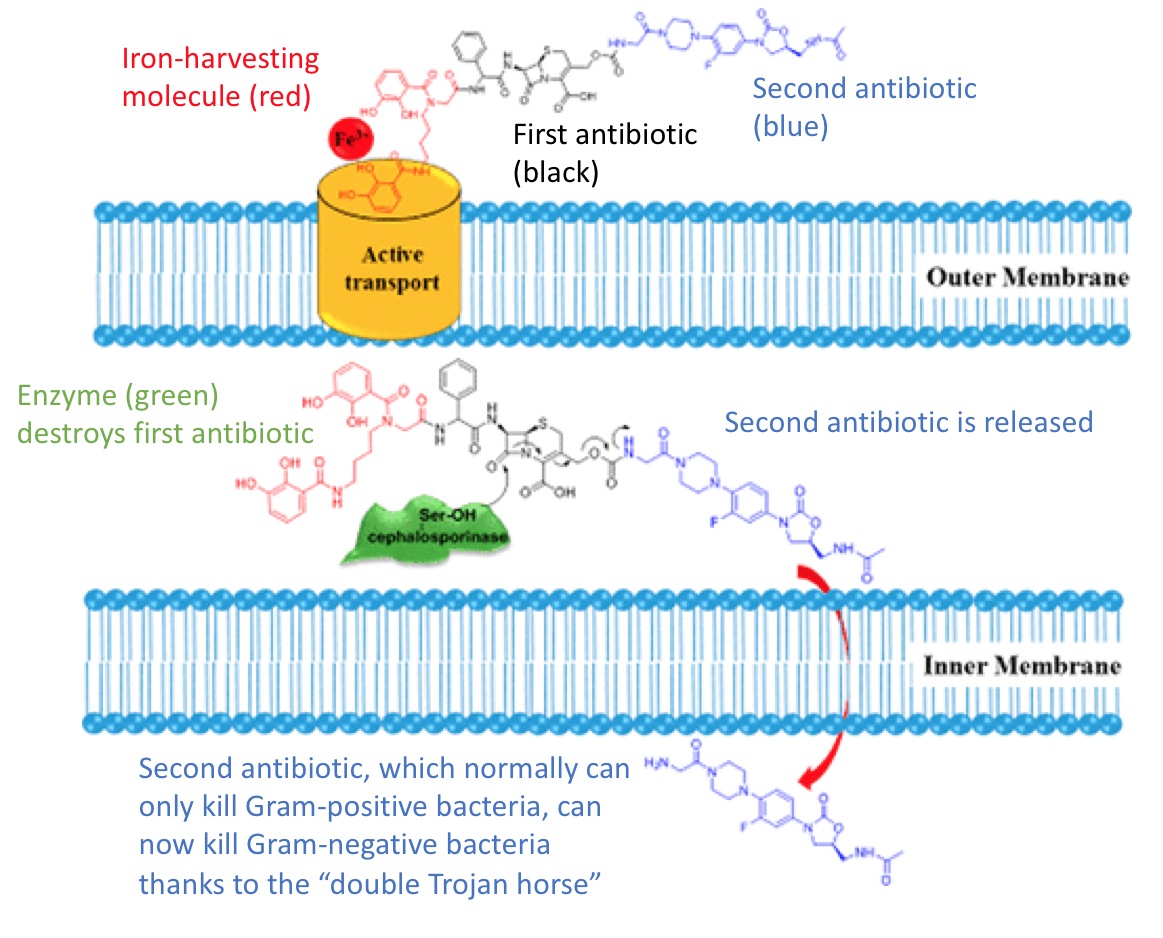
Like all cells, bacteria require nutrients to survive. Iron ions are not easy to come by, so some bacteria have evolved an elaborate mechanism to gather them. They secrete specialized iron-harvesting molecules into the environment and, upon binding an iron ion, the molecules are recaptured and actively transported back into the bacteria via specific protein channels. By hijacking this process, an iron-harvesting molecule can be turned into a deadly Trojan horse.

This is done by sticking an antibiotic onto an iron-harvesting molecule, creating what is known as a sideromycin. When the unsuspecting bacterium gobbles it up, expecting a healthy iron ion, it also gets a dose of antibiotic. These sideromycins have been synthesized by scientists and, surprisingly, by clever bacteria as well. (Microbes create antibiotics as a form of biological warfare against other microbes; they don't create them for our benefit.)

As might be expected, some bacteria have evolved defense mechanisms against such tricks. There are multiple mechanisms by which bacteria can evade antibiotics, and one of them involves destruction of the antibiotic. The Gram-negative bacterium Acinetobacter baumanii -- colloquially known as "Iraqibacter" and which has gained notoriety for causing antibiotic-resistant infections in American troops -- possesses an enzyme that destroys certain types of antibiotics.

So, scientists incorporated a second antibiotic into the Trojan horse molecule. Now, when the enzyme wielding bacterium destroys the first antibiotic, it unwittingly unleashes the second antibiotic, for which it has no defense. (By analogy, it would be as if the act of defusing a letter bomb detonated a second bomb.) In other words, the bacterium was tricked into committing suicide by a "double Trojan horse."

Fool Me Twice

The diagram below (which has been modified from the original) shows the mechanism by which the double Trojan horse drug works.

The bacterium, in this case the Gram-negative Acinetobacter, actively transports the double Trojan horse molecule across its first membrane. The bacterium is anticipating an iron ion, but it also gets two antibiotics along with it. It has an enzyme capable of destroying the first antibiotic (in this case, cephalosporin). But the act of destroying the first antibiotic releases the second antibiotic (in this case, oxazolidinone).

Normally, oxazolidinone is incapable of killing Gram-negative bacteria because it cannot get past the two membranes. But through this double Trojan horse mechanism, scientists have devised a way to sneak it in. Ironically, from the bacterium's perspective, the very enzyme that it uses to protect itself from antibiotics becomes complicit in its own demise.

Source: Rui Liu, Patricia A. Miller, Sergei B. Vakulenko, Nichole K. Stewart, William C. Boggess, and Marvin J. Miller. "A Synthetic Dual Drug Sideromycin Induces Gram-Negative Bacteria To Commit Suicide with a Gram-Positive Antibiotic." J. Med. Chem. 61 (9): 3845-3854. Published: 19-March-2018 DOI: 10.1021/acs.jmedchem.8b00218

A Game Changing Approach To New Antibiotics: Thanks To Chemistry


This will only get worse. Bacterial resistance is a one-way street. Once an antibiotic stops working against a particular pathogen, it will not work again.

But, thanks to an unexpected observation, finding new antibiotics may be a whole lot easier, because, in a Nature paper, chemist Michele Richter and colleagues at the University of Illinois tell us what to look at and what to avoid. This one is mighty strange, but it could also be exceedingly important.

The primary reasons for the absence of new antibiotics today are:
  • Foolish policies enacted by the FDA, which made clinical trials of new antibiotics unfeasible.
  • Drug companies abandoning research in this area because of those new rules.
  • The "easy" classes of antibiotics (aka "the low hanging fruit") had already been discovered, mostly in soil (1). The difficulty of finding a new class can be illustrated by the 30-year gap between the discovery of quinolones (1968) Streptogramins (1998).
  • The new economics of developing drugs.
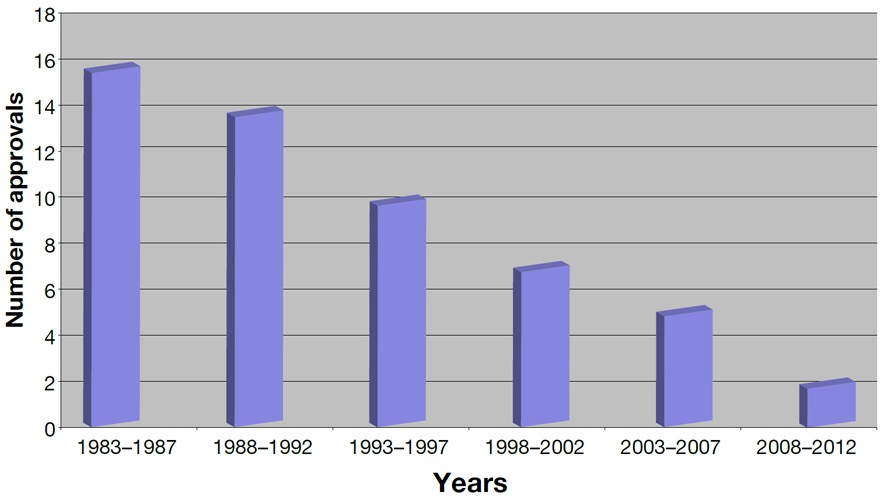
The downturn in the discovery of new antibiotics is clearly shown in Figure 1.
Source: Nature Although this graph is obviously dated, it illustrates the magnitude of the decline in the approval of new antibiotics. Fortunately, the FDA has become more cooperative, and research in this area is on the uptick. There have been six new antibiotics approved since 2012.

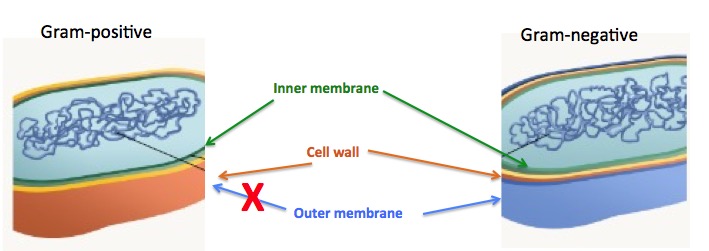
There are two broad categories of bacteria: Gram-negative bacteria, which have a liposaccharide-coated membrane on their outer surface, while their Gram-positive counterparts, which do not. This second membrane, which keeps many drugs out of the cell, makes the discovery of Gram-negative antibiotics more difficult. Finding antibiotics against resistant Gram-negative bacteria is harder still.
The outer coating of Gram-positive (left) and Gram-negative (right) bacteria. The outer membrane (blue), which exists only in Gram-negative organisms makes it more difficult for drugs to enter the cell. Image adapted from Schmoop.com

The findings of Richter's group may make the design and development of antibiotics to treat Gram-negative bacteria a whole lot easier. It is based on something that has plagued all of us medicinal chemists forever - cell permeability. (See: Hepatitis C: Academia And Industry Work Together To Find A Cure). Drugs must be able to get inside the target cell. If there is a barrier to prevent this, the drug will not work. Cell permeability is routinely measured even before the experimental drug is tested in any functional assay.

The ability to predict permeability across the outer membrane of Gram-negative bacteria is potentially a huge advance, but it also reshapes the ideas that have been drummed into in the heads of trained medicinal chemists forever.

Time after time during our careers we would discover a chemical compound that looked great in in vitro (outside the body) tests, only to flop entirely when it was given to an animal. Pfizer's Chris Lipinski came up with the "Rule of Five" in 1997. The "Lipinski rules" are useful for identifying the properties of drugs that will be able to be taken in pill form rather than by injection. There are exceptions, but the rule is a very handy guideline. Its message: molecules that have a better change of being oral drugs will preferably 1) be small (have a molecular weight of 500 or less), and 2) have both water solubility (polar compounds) and fat solubility (non-polar compounds). There are three other parameters. The properties that enable a molecule to be orally active are not terribly different from those that make it permeable to cells, at least until now.

Unlike standard permeability assays, where human cells are used (2), the Richter group studied permeability across the two membranes and one one cell wall that make up the outside of Gram-negative bacteria. This was done by exposing the bugs to a drug and measuring how much of it could be found inside the cell. One particular class of organic molecule stood out in a big way— primary amines.

Apologies in advance for the chemistry lesson:

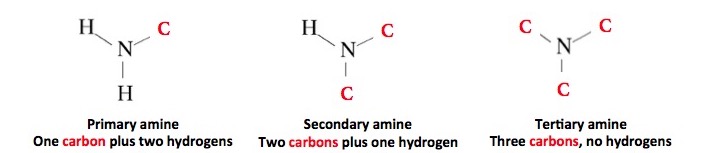
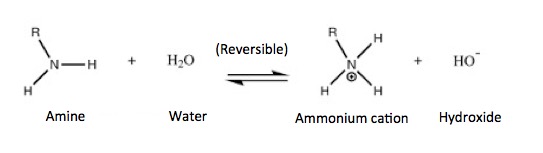
Primary amines are derivatives of ammonia where one of the hydrogen atoms is replaced by carbon. Secondary amines have two carbon atoms bound to nitrogen, and tertiary amines have three carbons and no hydrogen. All three sub-classes of amines have one thing in common—they are basic and will react with water. Here is the reaction:
The acid-base reactions of an amine and water. The nitrogen "steals" one of the water's hydrogen atoms, giving two ions, one positive (an ammonium cation aka amine salt, which is positive, and hydroxide, which is negative. As with all ions, both species have an electric charge.

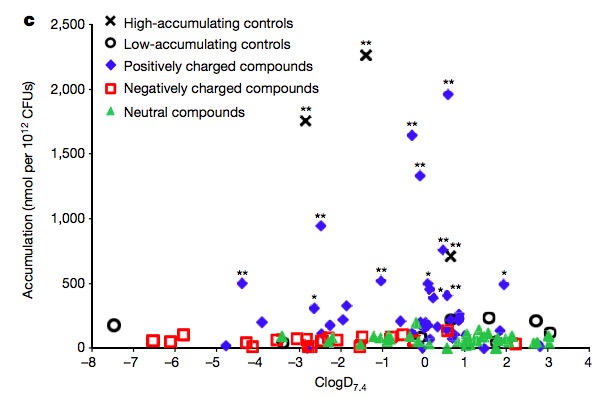
Any organic chemist will tell you that all three types of amines are basic, and will undergo this reaction. He/she will also tell you that the properties of the amine salt (ammonium cations) that are formed will behave mostly the same, regardless of whether they are derived from a primary, secondary, or tertiary amine. He or she should have had a talk with E. coli bacteria. They have a very different idea of how they are supposed to behave. The scatter plot below shows that only amines (which exist as positively charged ions at physiological pH because of their reaction with water) accumulate within the cell. Neither neutral nor negatively charged molecules will accumulate inside the E. coli - only those that bear a positive charge (these are also called cations or ammonium cations).

A scatter plot of the accumulation of drug inside E. Coli. Note that only positively charged drugs (blue diamonds) accumulated inside the bugs. The black X marks represent positive controal—antibiotics that are already known to accumulate within E. Coli. Source: "Predictive compound accumulation rules yield a broad-spectrum antibiotic." M.F. Richter, et al. Nature (2017) Published online May 10, 2017 
 
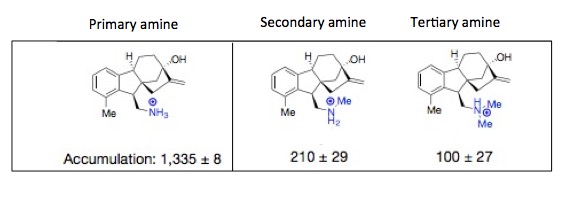
Whenever dealing with biological systems, it is very rare to see an effect that is so clear, and without variability, yet the scatter plot shows both. But, what is really strange is the difference in the behavior of the three classes of amines. In organic chemistry, with a few exceptions, all three classes behave more or less the same. But not here.  The outer membrane of E. coli will gleefully let in primary amine salts but gets pretty fussy after that. They want nothing to do with other types of amines. Pretty snobby if you ask me. This effect is both strange and unexpected, but it is clearly real, as shown below.
The difference in accumulation in E. cole in a primary (left), secondary (middle), and tertiary (right) version of the same molecule. Only the primary amine analog accumulates. This trend holds true for other examples in the paper. I have never seen anything like this.

The authors go into a detailed explanation and present theories explaining this effect. These are far beyond the scope of this article. But, what is clear is that these experiments can tell scientists what to aim for and what to avoid—a tool which should give a significant boost to new antibiotic discovery and development—something that is sorely needed.

Notes:

(1) The trouble with searching for antibiotics in soil is that you keep discovering the same drug over and over. Natural products chemists find this to be especially frustration.

(2) Caco-2 cells are "descendants" of a colon cancer cell line that was developed at Sloane Kettering. The cells form a monolayer, which has properties similar to the cells that line the intestine—a physiochemical barrier that allows only certain chemicals to pass through. Caco-2 monolayers are a standard assay used in drug development, since they are a reliable method of predicting absorption into the intestine.  Cancerous cells are used because they are immortal. Normal cells would die. 

Tuesday, September 19, 2017

Discovered: 4th Major Mechanism for Antibiotic Resistance to Spread

By Alex Berezow — September 8, 2017

Unlike animals, bacteria can readily share genetic information with other bacteria, even those of entirely different species. Because of this, one clever microbiologist likened bacteria to smartphones and genes to apps. When bacteria share "apps" that encode antibiotic resistance, it poses trouble for humanity.

As individual bacterial strains are exposed to antibiotics, natural selection favors the survival of those that have mutated to become resistant. That hard-earned resistance can then be given to other bacteria. Microbiologists have long known of three major mechanisms by which this occurs: Transformation, transduction, and conjugation.

Transformation occurs when a bacterium dies and sheds its DNA into the environment. Some bacteria are capable of snatching it up and incorporating it into their own DNA. This process was discovered nearly 90 years ago when harmless bacteria were mixed with dead, but lethal, bacteria and injected into mice. The mice died. It was eventually ascertained that the harmless, living bacteria took up the DNA from the dead, lethal bacteria and were transformed into lethal, mouse-killing microbes.......To Read More.....


Monday, September 30, 2013

Man dies from seawater bacteria in Volusia Co

Central Florida health officials warn of seawater bacteria after man's death
Salt water was his life, according to the family of Henry "Butch" Konietzky, who died Monday night after he was exposed to bacteria in the Halifax River. "It's just horrifying, it's just totally horrifying," said Debbie Stack, Konietzky's sister-in-law.  Stack said it took just 28 hours for the bacteria to kill Konietzky.  "They tried multiple antibiotics, but nothing was touching it -- nothing even phased it," Stack said.
Konietzky, 59, was walking knee deep in the river on Saturday, setting crab traps.  The next day, he woke up and noticed what looked like a bug bite on his leg.  "They did not take it serious until it started festering and quickly, and then he started feeling ill," said Stack.  Konietzky was in the emergency room by Sunday night. On Monday, he was gone.
Doctors said Konietzky was exposed to Vibrio vulnificus, a bacteria that quickly spread through his body and shut down his kidneys and liver.  Experts said the bacteria lives in warm brackish or seawater.  Two cases of the same illness that killed Konietzky, have been reported in Volusia and Flagler counties in the last month.  Health officials are now urging people to avoid eating raw shellfish and going into the water with open wounds…..To ReadMore….
My Take - So, the greenies want us all to "return to nature, and become one with the biosphere".  If that style of living was so great then why did anyone ever abandon 'all natural' living.  So now, would someone like to explain to me why we want to return to nature?  Nature isn't loving, it isn't hateful, it has no emotions or feelings.  Nature is a biological machine and doesn't care about us in the least.  Furthermore, nature is trying to kill us and has done so forever.  Get over it.  
However, for those who really thinks that going 'back to nature' will create utopia, I encourage them to move to countries where they're already living that way; in poverty, misery, squallor, disease , suffering and early death.  So please feel free to walk your talk.    

Friday, July 19, 2013

We need to check organic crops for bacteria, to ensure they really are healthy – and safe to eat

By Mischa Popoff
The United States Department of Agriculture (USDA) prohibits synthetic nitrogen fertilizer in organic production and encourages natural compost. But it does not test for un-composted feces, relying instead on record-keeping and record-checking. …..At least 140 people across eight states have now fallen ill after consuming hepatitis-A-infected certified-organic frozen berries and pomegranate seeds; 61 were still in hospitals in mid-July.
For some strange reason, this outbreak is being linked in the media to improper hand washing instead of composting, landing this on the lap of the Food and Drug Administration (FDA) instead of the USDA. The Centers for Disease Control and Prevention meanwhile has made no such determination.
With almost a quarter-million 3-lb. bags recalled, improper hand washing is entirely implausible. Workers could never infect so much product and, in any case, no infected workers have been found. Un-composted feces (human or animal) spread across an entire field should not be eliminated as a possibility (by the media or anyone else), before less obvious theories are investigated……. Section §205.203 of the USDA National Organic Program (NOP), stipulates manure cannot “contribute to contamination of crops [or] soil” and details proper composting procedures. …..A fecal coliform test costs only $20, but the USDA hasn’t observed its own rules since the NOP became law in 2002….To Read More….

Wednesday, June 1, 2011

Observations From the Back Row: 6-1-11

...
“De Omnibus Dubitandum”

In Thucydides’ History of the Peloponnesian War, an Athenian ambassador refutes the Spartans’ claim that they are going to war with Athens on the principle of justice.
"Calculations of interest have made you take up the cry of justice––a consideration which no one ever yet brought forward to hinder his ambition when he had a chance of gaining anything by might"
Thucydides presents here a permanent truth of interstate conflict: when force will not get a people what they want, they will often cloak their ambitions in lofty principles like justice in order to gain sympathy, buy time, and win allies. - Bruce Thornton
Please think about this for a while. This is an appeal to the ideals of those they are attempting to destroy; and doing so by misleading them with their own values in order to attain that goal. The keys to worthwhile critical thought are collection of information, retrieval of information and correlation of information. In other words, read it, remember it and put it together properly based on the idea that everything we are told should bear some resemblance to what we see going on in reality. The green movement is constantly changing itself “into and angel of light” in order to keep everyone believing they are working to mankind’s benefit. Nothing could be further from the truth. RK

Now it's bugs!
Bacteria often leave their hosts feeling under the weather. And even when the hosts are high-altitude parcels of air, microbes can be a source of inclement conditions, a Montana research team finds. Cloud-borne bacteria might even pose climate threats by boosting the production of a greenhouse gas, another team proposes……So his team dissected the icy balls, along with hundreds of smaller ones collected during a July hail storm south of campus. Michaud now reports finding germs throughout, with the highest concentrations by far — some 1,000 cells per milliliter of melt water — in the hailstones’ cores…………Moreover, certain cloud-borne bacteria — the French team identified at least 17 types — degraded organic pollutants to carbon dioxide at least as efficiently as the sun did. Amato’s team reported these findings online February 9 in Atmospheric Chemistry and Physics Discussions……..This microbial transformation of pollutants to carbon dioxide occurs even in darkness.

My Take - There are some really interesting findings discussed in this article, but what struck me most of all was the pollutant degrading qualities of bacteria. It has been clear for some time that industrial pollution can be taken care of by the planet’s self curing qualities, after all, the planet Earth is capable of a substantial amount of self pollution. Volcanic activity is one such example. Bacteria are one of those cures. While still being responsible, and showing responsible care for our planet we can certainly ignore all the scare mongering by the greenies. Remember there is a difference between an environmentalist and an environmental activist. An environmentalist is defined as someone who is concerned about the environment, which is pretty much, everyone. An environmental activist is concerned about power, control and money. Concern expressed about environment by these people is merely the tool used to attain those goals.

Human Sacrifice on the Altar of Gaia

In the past thirty years, scientist James Lovelock, Fellow of the Royal Society in England and originator of the Gaia Theory, has published several books on Gaia. It was around 1970 that Lovelock first came up with the name "Gaia" for the Earth (he usually puts a capital E on Earth). In his latest outing, The Revenge of Gaia: Why the Earth is Fighting Back -- and How We Can Still Save Humanity, he assures us several times that he uses the name as a metaphor. But it turns out that for him a metaphor is not just a rhetorical device: He finds Gaia a "useful metaphor" because the present ecological crisis "requires us to know the true nature of the Earth and imagine it as the largest living thing in the solar system." Here the metaphor Gaia turns out to be the way to know the true nature of the planet. Then Lovelock invites us to a change of "heart and mind" so that we may "instinctively sense" Gaia as a living planet. How can we instinctively sense a metaphor? Evidently, Gaia is for him far more than a trope. While he admits that the name offends the "scientifically correct," he declares that he is "unrepentant" about using it because this metaphor is a "path to the primitive feelings of the unconscious part of our minds." That's the part he thinks we can use to contact Gaia.

Lovelock speaks of our planet's evolution as the story of a female who has grown "old and has not very long to live." In the last century, she was "enlightened" in her "seniority" when human beings let her see herself from outer space "while she was still beautiful." The implication here is that our planet is alive and self-aware, and that she sees herself through our eyes

My Take – This may seem a little loony (and it is)  to those who haven’t followed the green movement or looked deeply into what they actually stand for, but he isn’t alone and the “deep ecology” loons really do believe mankind is a “virus” that has to be eradicated from the planet; either entirely or decimated to the point where mankind’s population has been seriously reduced. Even those who don’t want mankind eradicated would like to see 90% less people alive. Once again….this is who and what they are! So when they demand legislation that restricts pesticides, or any other modern technology that makes life easier, by claiming that it is “for the children” we can be assured this is horsepucky that is nothing more than an emotional hook to lure the unsuspecting.

We need to get this!  Everything the green movement has promoted or stood against generated dystopia everywhere in the world. Why would we believe that isn’t what they really want? We shouldn’t!

Everything we are told should bear some resemblance to what we see going on in reality.


"The time has come," the Walrus said,
"To talk of many things:
Of shoes, and ships, and sealing wax -
Of cabbages and kings,
And why the sea is boiling hot,
And whether pigs have wings."

###