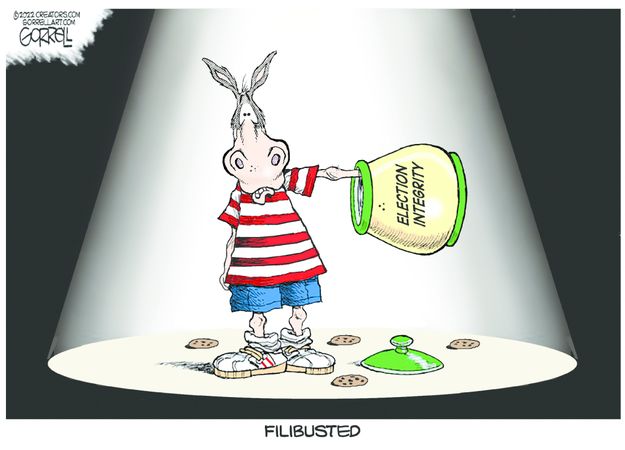
From the outset, the Democratic talking point about the 2020 presidential election has been that there is “no evidence” of widespread fraud, and that election fraud is in any event extremely rare. At the same time, Democrats have done everything in their power to obstruct and undermine any attempts to investigate whether fraud occurred, and if so how extensive it may have been. This is the kind of contradiction that strongly piques my curiosity.
As a prelude, let me say that I think that efforts to overturn the 2020 election are a waste of time, and that former President Trump only hurts himself with his obsession over how the election was stolen. Republicans are far better off focusing on the future. And anyway, the stunningly incompetent Biden Administration and the radical Democratic Congress are probably the best things that could have happened for the long term prospects of the conservative and libertarian movements.
But not wanting to re-litigate the prior election is not the same thing as not wanting investigations of credible allegations of systematic fraud. Absolutely such investigations should be done, and done thoroughly, not the least for purposes of identifying election procedures that are so vulnerable to fraudsters that they must be prohibited legislatively. The 2020 election was rife with new and risky measures in many jurisdictions, particularly to reduce limitations and controls on absentee and mail-in voting. Did these procedures open up the system to widespread fraud, or not? The citizenry deserves to know.
And now comes along on March 1 a major Report out of Wisconsin with the long title “Office of the Special Counsel, Second Interim Investigative Report On the Apparatus & Procedures of the Wisconsin Elections System.” The Report’s main author is Michael Gableman, a retired Justice of Wisconsin’s Supreme Court, who was appointed Special Counsel by Wisconsin’s (Republican-controlled) legislature. A good summary of the Report can also be found by Margot Cleveland at the Federalist on March 3 here. Although the Report (as indicated in its title) is still “interim,” it has definitely struck pay dirt on several items of what are clear systematic frauds.
The single biggest area of fraud identified in the Report is exactly where I would have expected it to be found, which is in a very different place from the most highly publicized allegations that have been leveled by Trump’s lawyers. Trump’s lawyers have spent vast efforts on a theory that new voting machines in key jurisdictions were subject to software manipulation or hacking that altered vote totals. I always thought that this allegation was implausible, because as long as a paper trail exists vote totals can be double-checked and verified by a hand count. If you were a fraudster looking to swing 20,000 or 50,000 votes to change the result in a swing state, you would be very unlikely to choose this route as your preferred method of fraud.
Rather, I have always thought that the likely route of major vote fraud would be through nursing homes, elder care facilities, assisted living facilities, homes for the mentally incompetent, and so forth. Many of the residents of such facilities would be incompetent to vote or otherwise uninterested in voting. Fraudsters working with insiders could track who had not voted and then arrange to get favorable votes in the names of those people, either by “helping” them fill out a ballot or by just forging the ballot entirely.
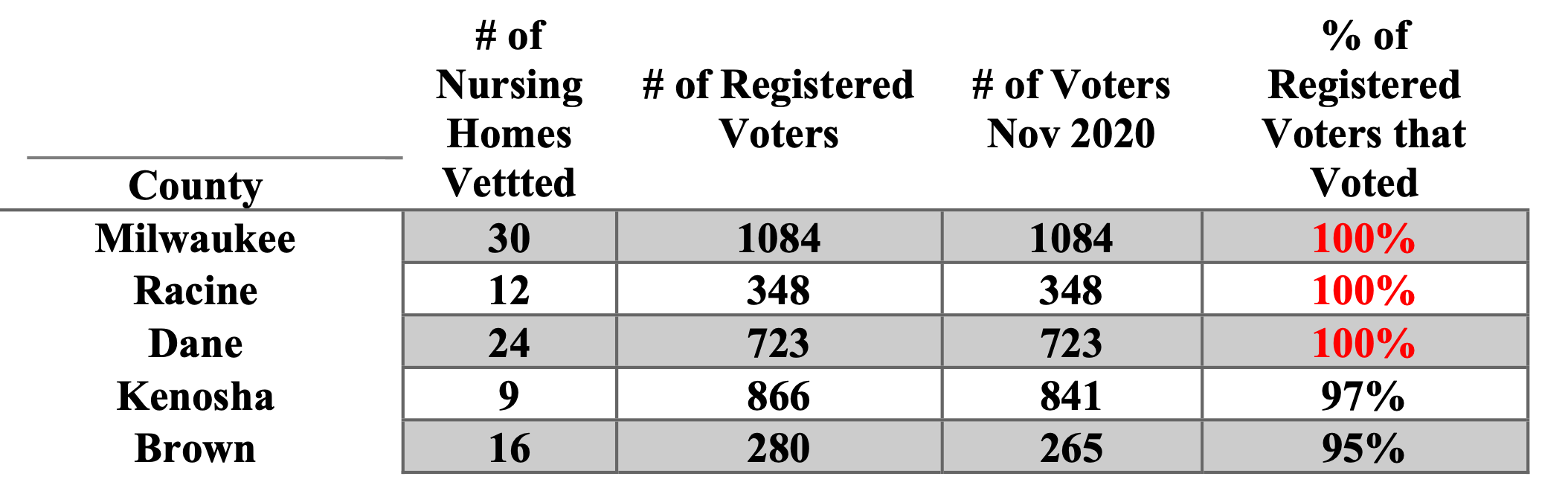
Gableman’s Report has eleven different sections, but as to outright fraud the heart of it is Section 7, with the title “The Wisconsin Elections Commission (WEC) Unlawfully Directed Clerks to Violate Rules Protecting Nursing Home Residents, Resulting in a 100% Voting Rate in Many Nursing Homes in 2020, Including Many Ineligible Voters.” Here’s the gist:
Rampant fraud and abuse occurred statewide at Wisconsin’s nursing homes and other residential care facilities in relation to absentee voting at these facilities. This fraud and abuse was the ultimate result of unlawful acts by WEC’s [Wisconsin Election Commission] members and its staff. . . .
It seems that the Wisconsin statutes contain very specific procedures with respect to absentee voting by nursing home residents. In a procedure that appears specifically designed to prevent staff or political operatives from putting undue pressure on vulnerable nursing home residents, the Wisconsin statutes state that absentee ballots from such residents must be filled out in the presence of trained state representatives known as Special Voting Deputies, or SVDs. In 2020, the Wisconsin Election Commission purported to waive those procedures (supposedly in light of Covid), and indeed instructed nursing homes simply to mail the ballots in. Suddenly, dozens of nursing homes known to have large numbers of mentally disabled people recorded voting rates of 100%. Here is a chart from page 90 of the Report: