June 26, 2022 by Dan Mitchell @ International Liberty
In Part I, I warned that “stakeholder capitalism” is not just empty virtue signaling. Some advocates are using the concept to promote a statist agenda.
For Part II, let’s start with this video.
The main message of the video is that ethical profits are good for shareholders, but also good for everyone else (the supposed stakeholders).
By
contrast, companies that don’t prioritize profits wind up hurting
workers and consumers, not just the company’s owners (i.e.,
shareholders).
Let’s dig deeper into this topic.
Stakeholder theory reflects the more interventionist approach of
continental Europe’s “civil law” while the shareholder approach is more
consistent with the “common law” approach of the Anglosphere (the United
Kingdom and many of its former colonies, including the United States).
That’s a key observation in Samuel Gregg’s column for Law & Liberty, which reviews a book by Professor Nadia E. Nedzel.

…stakeholder theory reinforces continental European rule
through law inclinations and vice-versa, not least because of shared
hard-communitarian foundations. …Such goals undermine the ability of
corporations to produce prosperity. An emphasis on stability and
maintaining levels of employment, for instance, exacts a cost in terms
of organizational dynamism, not least by discouraging risk-taking and
entrepreneurship.
…
Without such adjustments, however, a business will become complacent
and uncompetitive. Eventually it will disappear, along with all the jobs
once provided by the business. Likewise, if boards of directors are not
focused on delivering shareholder value because profit is considered
only one of many company objectives, a decline in earnings is sure to
follow. …
To the extent that stakeholder theory draws upon
hard-communitarian principles which it shares with continental European
rule through law models, it risks undermining already fragile
commitments to rule of law in America and elsewhere. That’s just one
more reason to shore up the priority of shareholder interests throughout
corporate America. These priorities help explain the weaker economic
performance of many corporations in civil law jurisdictions compared to
those businesses located primarily in the Anglo-American sphere.
Allison Schrager of he Manhattan Institute wrote for the City Journal
that Biden is on the wrong side and that his mistake, along with
others, is failing to understand that so-called stakeholders benefit
when companies are profitable.

…one thing that stood out was Biden’s vow to “put an end
to the era of shareholder capitalism.” …disdain for the notion that a
corporation’s primary objective is to maximize value for its
shareholders has
united the disparate likes of Elizabeth Warren and Bernie Sanders and
the Davos/Larry Fink crowd. It’s no surprise that Joe Biden is against
it, too. …Maximizing shareholder value…does not create conflicts between
different stakeholders, because economic success is not zero-sum.
…long-term success requires happy and loyal employees, a healthy
relationship with the community, and a thriving environment.
In a column for the Wall Street Journal, Lucian A. Bebchuk and Roberto
Tallarita shared their research showing that CEOs who pontificate about
stakeholders don’t actually change their behavior.
…we dug deeper, investigating an array of corporate
documents for the 136 public U.S. companies whose CEOs signed the
statement. …we found evidence that the signatory CEOs didn’t intend to
make any significant changes to how they do business. …We’ve
identified almost 100 signatory companies that updated their corporate
governance guidelines by the end of 2020.
We found that the companies
that made updates generally didn’t add any language that elevates the
status of stakeholders, and most of them reaffirmed governance
principles supporting shareholder primacy. …We also found that about 85%
of the signatory companies didn’t even mention joining the “historic”
statement in their proxy statements sent to shareholders the following
year. Among the 19 companies that did mention it, none indicated that
joining the statement would cause any changes to how they treat
stakeholders.
Speaking of insincere hypocrites, that’s a good description of the
Davos crowd. Matthew Lesh of the Adam Smith Institute wrote about their
trendy support for stakeholders in a column for CapX.

…the man behind the World Economic Forum has declared
that Covid warrants a ‘Great Reset’. With tedious predictability, Klaus
Schwab’s bogeymen are the twin menaces of “neoliberal ideology” and
“free market fundamentalism”. …he’s also calling for a “stakeholder
model of corporate capitalism”…
But it’s an idea based on a false
dichotomy. A business that fails to return a profit to its shareholders
cannot do anything for its other stakeholders,
such as providing useful products to customers, paying its staff,
procuring from suppliers… Delivering for shareholders is ultimately
indivisible from benefiting your other ‘stakeholders’ because you can’t
do one without the other. …
Shivaram Rajgopal of Columbia Business School
has found that top European companies who brandish their social and
environmental credentials do no better in these criteria than American
companies. But the European firms are much worse at ensuring good
corporate governance. For example, worker representation on Germany’s
supervisory boards has often meant worker representatives teaming up
with managers to push against new technology and methods. In the longer
run, this undermines returns to shareholders, but also means poorer
products for customers, lower salaries for employees.
The bottom line is that there are lots of misguided attacks against capitalism, but none of the criticisms change the fact that free enterprise is the only system to ever deliver mass prosperity to ordinary people.

And that’s true even if big companies don’t support the system that enabled their very existence (perhaps because they fear they will got knocked from their perch by the the forces of “creative destruction“).
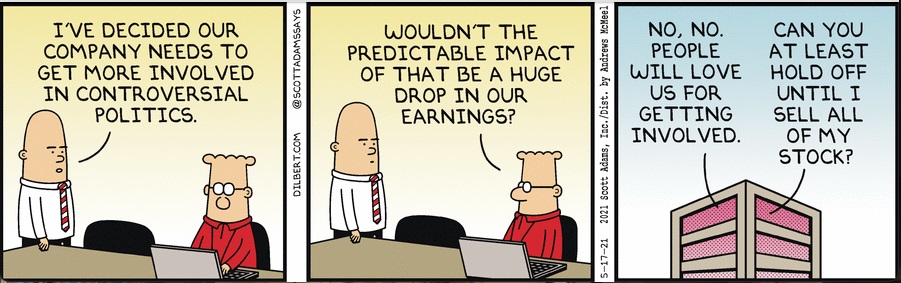
P.S. Just like yesterday, I can’t resist adding this postscript about
the left-leaning executive who thought he was rejecting Milton
Friedman, but actually did exactly as Friedman recommended.