August 11, 2022 by
Dan Mitchell @ International Liberty
I’m a policy wonk rather than a political pundit.
But since part of my job is educating politicians, I can’t simply rely on arguments about what’s best for the country.

I also have to convince them that they can enact good policy while also keeping their jobs.
And that’s why I developed my Fourth Theorem of Government back in 2017.
The simple message is that ordinary people enjoy more income if and when politicians make wise policy choices.
And that’s a very effective strategy for winning reelection.
The obvious example is Ronald Reagan, who won a landslide in 1984 even though (or, actually, because) he aggressively fought to reduce the burden of federal spending.
But not everybody agrees with me.
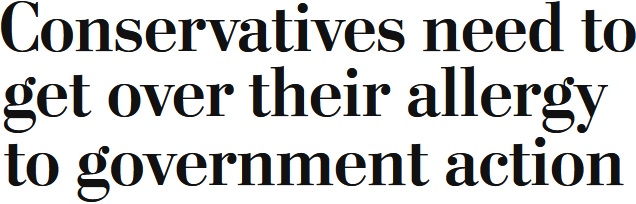
In a column for the Washington Post, Henry Olsen argues that the Republican Party needs to ignore libertarian ideas and embrace activist government.
Many conservatives recognize that attracting a new,
diverse, working-class voter base also entails a new, non-libertarian
approach to economics. …Liberty-minded intellectuals might rail against widespread
government involvement in the economy, but voters like free public
education, subsidized health care and generous pensions. …voters…prefer
the Scylla of tax increases to the Charybdis of entitlement cuts as
aging populations put fiscal pressure on health-care and retirement
programs. …The Chips package should serve as a symbol of what government
will need to do to reinvigorate an economy that builds things.
I’ll make my main points about taxes and entitlements at the end of
the column, but I can’t resist some editorializing on two things from
the above excerpt.
First, Henry says voters like free public education. Maybe that’s true, but they seem to like the ultra-libertarian idea of school choice even better.
Second, he argues that the recently enacted Chips law is a role model. But if industrial policy was a good idea, why did Japan stagnate? Why has China’s growth slowed?
Let’s now look at more of the column.
Past Republican efforts to limit the growth of
entitlement spending after GOP landslides in 1994 and 2010 backfired
politically, helping to reelect presidents Bill Clinton and Barack
Obama. The fact is that 63 percent of Trump voters care more about
keeping Social Security benefits than preventing tax hikes, and 45
percent care more about giving seniors on Medicare what they need than
about controlling program costs. …Any serious effort to retain these
largely working-class voters — and attract more in the future — must
come to grips with these views. …Modern conservatism needs to refine
Reagan’s insights and explicitly adopt a theory of when government
should act to enhance people’s lives.
My first instinct is to ask for examples of how and when government
enhances people’s lives. Or to provide examples of where Reagan thought
government did a good job.
That certainly does not seems to fit with Reagan’s message in this video, this video, or the second video from this collection.
Or this video!
But maybe Reagan’s own words were insincere. That seems to be what
Olsen thinks since he wrote that “the conservative idol implicitly
sanctioned government action if it helped people live dignified lives of
their own choosing.”
So let’s forget about words and look at the track record.
What we find is that Reagan was remarkably effective in fighting big government. Indeed, what separates Reagan from every other Republican in recent history is that he successfully fought to constrain the burden of government spending.

But don’t believe me. The data from the Historical Tables of the Budget unambiguously show that Reagan was far better than any other president in the past 50-plus years.
I’ll close by questioning Olsen’s claim that voters prefer tax increases over spending restraint.
I very much suspect that is only the case if they think someone else’s taxes are being increased.
If you don’t believe me, I invite you to look at this polling data from left-wing supporters of Bernie Sanders. And if hard-left voters are not willing to pay more to finance European-sized government, what are the odds that Republican voters are willing to pay more?