Search This Blog

De Omnibus Dubitandum - Lux Veritas

Showing posts with label Roman Warming Period. Show all posts

Wednesday, September 20, 2023

2,500 years of wild climate change in southern Europe

By September 17th, 2023 174 Comments @CFACT

The new study on stalagmites in caves of the Pyrenees shows that modern climate change is nothing compared to normal fluctuations in the last 2,500 years when it was, at times, much hotter, colder, and more volatile. Rapid shifts between temperatures were common.

The researchers looked at eight stalagmites in four caves and local lake levels, but they also compared their results with other European temperature proxies and reconstructions, and the pattern is consistent across the region. The Roman Warm Period was much hotter than today, and for hundreds of years as well, even though coal plants were rare. Apparently, there was a reason Romans were dressed in togas.

The Dark Ages were very cold, especially around 520 – 550 AD — which may be related to what the researchers call a “cataclysmic” volcanic eruption in Iceland in 536 AD. It was followed by two other massive volcanic eruptions in 540 and  547 AD. This effect is visible in European tree rings, which showed “an unprecedented, long-lasting and spatially synchronized cooling”.

Indeed, the researchers declare that volcanoes and solar variability appear to be the main drivers of the climate in South Western Europe.

So, finally, we see one long continuous proxy record from ancient Greek times through until 2010. The big question is why these sorts of studies are not done everywhere and all the time. It’s not like we don’t have plenty of caves with stalagmites to analyze. If the climate really was “the biggest threat to life on Earth”, why are these extraordinary datasets not the top item on the wish-list of every institution claiming they care about the climate?

There will be more to say about this remarkable paper:
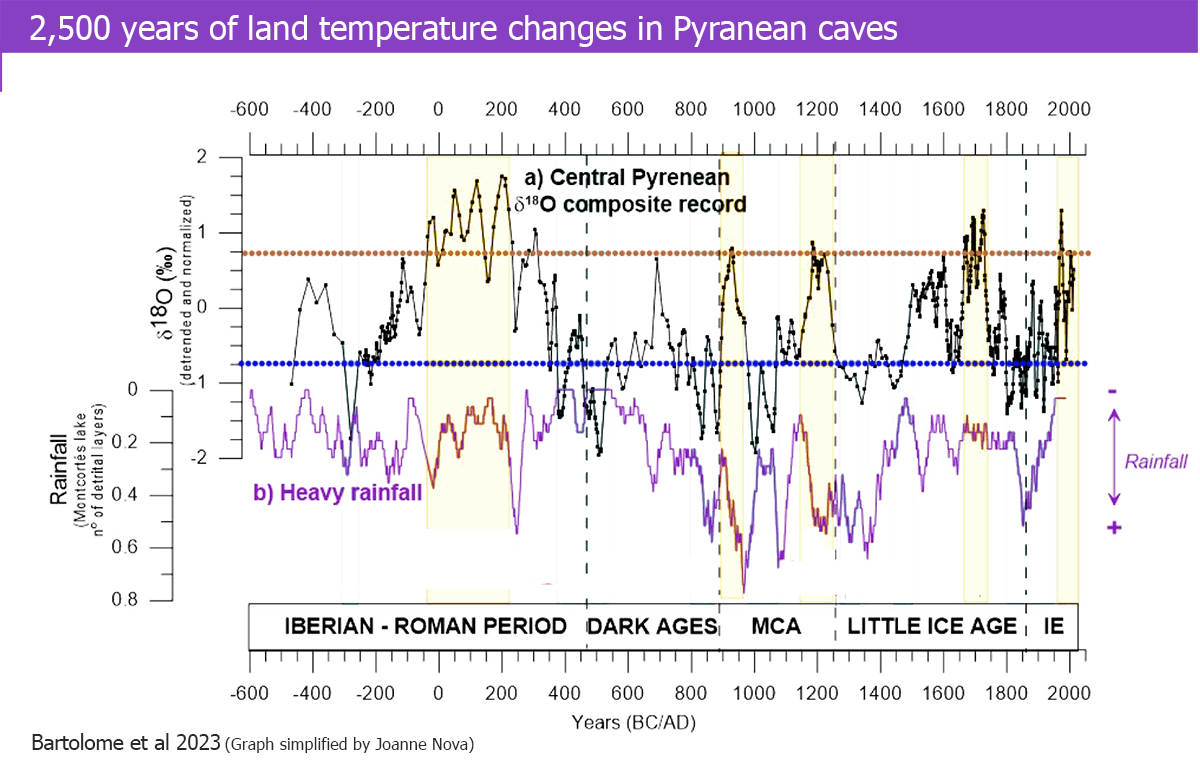
Pyrenes, Cave, Medieval, Little Ice Age, Roman Times. Temperature.

Click to enlarge. Oxygen isotopes are used to estimate temperatures.

Some passages from the paper discuss how these results match other studies from Europe:

The cold event at ca. 540 AD (the coldest of the speleothem record) may be related to a cataclysmic volcanic eruption that took place in Iceland in 536 AD and spewed ash across the Northern Hemisphere, together with the effect of two other massive eruptions in 540 and 547 AD (Sigl et al., 2015). An unprecedented, long-lasting, and spatially synchronized cooling was observed in European tree-ring records associated with these large volcanic eruptions, corresponding to the LALIA period (Büntgen et al., 2016).

Some passages from the paper discuss how these results compare with many other European studies and stark moments in history.

5.2.2. Temperature variability in W Europe and the W Mediterranean during the last 2500 years
There are very few high-resolution speleothem records in Europe covering the CE (Comas-Bru et al., 2020). We compare the Central Pyrenean speleothem composite with nine selected speleothems records in Europe and northern Africa which cover with robust chronology and decadal resolution of the last 2500 years (Fig. 5). One of these records is interpreted as NAO variability (Baker et al., 2015), three are paleo-precipitation reconstructions (Ait Brahim et al., 2019; Cisneros et al., 2021; Thatcher et al., 2022) and the other five are reflecting paleo-temperature variations (Affolter et al., 2019; Fohlmeister et al., 2012; Mangini et al., 2005;  Martín-Chivelet et al., 2011; Sundqvist et al., 2010). Considering these differences in the interpretation and the fact these records are from different regions with different climates (from Sweden to Morocco), dissimilar profiles of paleoclimate variability can be expected. Still, some features are comparable and can be discussed to obtain a super-regional picture.

A. The Roman period in Europe-W Mediterranean. In Europe, particularly in the Mediterranean region, the RP is well-known as a warm period (e.g., McCormick et al., 2012). The average sea-surface temperature in the western Mediterranean Sea was 2°C higher than the average temperature of the late centuries (Margaritelli et al., 2020). Our composite, with high values of normalized  18O values during the whole RP, and particularly from 0-200 AD, agrees with the scenario of warm temperatures (Fig. 5i). Speleothem data from the Balearic Islands (Cisneros et al., 2021) indicate a transition from humid to dry conditions along the Iberian-RP (Fig. 5c). The dry period at the end of the RP in the Balearic record appears in agreement with a new speleothem record from northern Italy (Hu et al., 2022), suggesting that the observed drying trend was a possible contribution to the collapse of the Roman Empire in 476 AD. Record from Morocco (Ait Brahim et al., 2019), contrarily, marks a humid trend at the end of the RP (Fig. 5d). Similarly, an increase in humidity was observed in southern Iberia during the Iberian-Roman Period (Jiménez-Moreno et al., 2013; Martín-Puertas et al., 2009) thus reflecting a large spatial heterogeneity in precipitation during the RP when comparing records from the north and south of the Mediterranean basin.

REFERENCES

Bartolomé, M., Moreno, A., Sancho, C., Cacho, I., Stoll, H., Haghipour, N., Belmonte, Á., Spötl, C., Hellstrom, J., Edwards, R. L., and Cheng, H.: Reconstructing land temperature changes of the past 2,500 years using speleothems from Pyrenean caves (NE Spain), Clim. Past Discuss. [preprint], https://doi.org/10.5194/cp-2023-54, in review, 2023.

Author

  • Joanne Nova

    A prize-winning science graduate in molecular biology. She has given keynotes about the medical revolution, gene technology and aging at conferences. She hosted a children’s TV series on Channel Nine, and has done over 200 radio interviews, many on the Australian ABC. She was formerly an associate lecturer in Science Communication at the ANU. She’s author of The Skeptics Handbook which has been translated into 15 languages. Each day 5,000 people read joannenova.com.au


Monday, May 18, 2020

The real climate science deniers

Manmade climate crisis promoters reject inconvenient evidence of natural climate change 

Paul Driessen 
 
Fifty years ago, I helped organize Earth Day #1 programs on my college campus, calling attention to serious pollution problems that afflicted uch of the USA. Over the ensuing decades, laws, regulations, and changed attitudes, practices and technologies reduced most of that pollution, often dramatically.
I didn’t buy into the 1970 end-is-nigh, doom-and-gloom, billions-will-die hysteria that Ron Stein and Ron Bailey summarize, including the manmade global cooling crisis. I don’t buy it today, either – certainly not this year’s Earth Day focus on the alleged manmade global warming crisis, also blamed on emissions of carbon dioxide, the same gas that humans and animals exhale, and plants use to grow. We’re told the crisis is unprecedented, and poses existential threats to humanity and planet. What nonsense. 
 
But what I find fascinating in all this is the steadfast, often nasty determination of scientists, politicians and interest groups promoting alarmist themes – and profiting immensely from them – to reject and deny any science, history and evidence that undermines their claim that nothing like this ever happened before.

The “highest ever” temperatures are a mere few tenths or even hundredths of a degree above previous records set many decades ago. The United States recently enjoyed a record 12-year respite from Category 3-5 hurricanes, ended finally by Harvey and Irma in 2017. Violent tornadoes were far fewer during the last 35 years than during the 35 years before that, and the complete absence of violent twisters in 2018 was unprecedented in US history. Modern day floods and droughts were certainly no worse than past floods or the multi-decade droughts that devastated Anasazi, Mayan and other civilizations.

However, alarmists insist, Earth’s climate and weather were stable and unchanging until humans began using coal, oil and natural gas. We must eradicate fossil fuels now, they say, regardless of what biofuel, battery, wind and solar replacements (and mining for raw materials to manufacture them) might have on wildlife, scenery, environmental values or human rights. Their disconnect from reality is astounding.

Equally fascinating is the notion that melting glaciers are something new. It amounts to asserting that everything was just peachy until American, European and Greenland glaciers started melting a few decades ago, threatening us with catastrophic sea level rise. It amounts to claiming the glacial epochs never happened; their mile-high ice sheets never blanketed a third of the Northern Hemisphere, multiple times, with warm periods in between; and seas haven’t risen some 400 feet since the Pleistocene ice age, leaving the entrance to Cosquer Cave and its Paleolithic paintings 115 feet beneath the Mediterranean.

It amounts to claiming the Roman and Medieval Warm Periods never happened, and weren’t followed by the Little Ice Age, when priests performed exorcisms, asking God to keep glaciers from inundating villages in the Alps of Europe. It’s as though we couldn’t possibly be finding what we are finding today.

In the latest example, government and university researchers recently found numerous Viking-era artifacts along a Norwegian mountain pass that had been heavily traveled for at least 700 years, but then was buried beneath the ice and lost to history for 1,000 years. Locals used the rough 2,200-foot-long pass to travel between summer and winter lodgings, while long-distance trekkers used it as a trade route.

 Within the treasure trove were tunics, mittens, horse shoes and bits, remnants of sleds used to haul food and gear over winter snow, a small shelter, and even the remains of a dog with a collar and leash. They all came to light because the glacial ice is again receding, as Earth continues its post Little Ice Age warming.

Alarmists insist the warming is due to fossil fuels, and deny that it is just part of natural climate cycles. And much more evidence of past warming and cooling periods has also come to light in recent years.

In 1991, German hikers found the incredible mummified and heavily tattooed remains of “Oetzi the Ice Man” sticking out of the ice in the Oetzal Alps near the Italian-Austrian border, at an altitude of some 10,000 feet. A partial longbow, bearskin hat and other artifacts were found nearby. He had died about 5,300 years ago from an arrow wound and had the blood of four different people on his clothes and weapons. He is further evidence of human habitation in these alpine areas during past warm periods.

Tourists and archeological teams have also discovered parts of shoes, leather clothing, fragments of a wooden bowl and numerous other items from 3000 to 4500 BC (BCE) that have emerged from the alpine ice. They are among the oldest objects ever found in the Alps. A Bronze Age pin, Roman coins and early Medieval artifacts have also been found. They show how these mountain passes and trails, impassible during cold, more glaciated periods, served as vital trade routes in periodic warmer centuries.

Norwegian ice fields show shrinkage and growth patterns similar to those of the alpine glaciers, says Norwegian glacial scientist Atle Nesje. The archaeological findings “seem to fit quite nicely with our glacier reconstructions,” he adds, which helps us understand past, present and future climate changes.

 Years of research by Swiss and other scientists have produced similar findings – sometimes human artifacts, but also plant and animal remains, in areas of newly melted ice. In one location in the Swiss Alps, University of Berne geology professor Christian Schluechter found pieces of wood 12-24 inches thick and the remains of a moor. Melting waters had flushed them out from under the glacier. That means the ice there is hardly “perpetual,” he says. There were multiple periods of warmer weather and less ice.

In fact, carbon-14 dating shows ten “clearly definable time windows” over the last 10,000 years – periods when glaciers were limited to regions up to 1,000 feet higher in the Alps than today. This means that, for multiple long streches of time, “the Alps were greener than they are today,” Schluechter concludes.

Inca children sacrificed 500 years ago in Argentina’s Andes have also emerged from melting glaciers.

Off the Florida coast, the Mel and Deo Fisher archeological diving team didn’t just find the famous Spanish galleon Nuestra Señora de Atocha, which sank during a ferocious 1622 hurricane, or only the British slave ship Henrietta Marie, which went down during a 1700 hurricane, after leaving 190 Africans in Jamaica to be sold as slaves. They also found charred tree branches and pine cones from a forest fire 8,400 years ago, when this ocean area 35 miles from Key West was still well above present day sea levels!

Even an entire forest has been discovered, protruding from the melting Mendenhall Glacier near Juneau, Alaska – an area I visited several years ago. Roots, stumps and large segments of entire upright spruce or hemlock trees have already been found across several acres. They are the remains of a forest that thrived there for as long as 2,350 years, until it was buried by glacial ice around 1,000 years ago.

The chronicle of amazing discoveries yielded by melting glaciers goes on and on. Their most important lesson is that our current climate is but a snapshot in time, on a vibrant planet where climate change and extreme weather have been “real” since time began. Only a science-denying climate alarmist would refuse to recognize this. Simply put, there is nothing “unprecedented” about what we are seeing today.

This is dangerous stuff – sacrilegious, even. It pulls the rug from under demands for a post-Coronavirus Green New Deal. It must be suppressed. And frightened climate science deniers are doing their best to keep it out of “mainstream” and social media. Realists must do their best to disseminate climate facts.

Of course, it may be that these past climate changes were caused by carbon dioxide and water vapor from wheezing, snorting horses, oxen and humans – laboring at the edge of exhaustion, doing what our fossil-fuel-powered vehicles and equipment do for us today. But it’s far more likely that the changes were due to a complex and still poorly understood combination of solar and other powerful natural forces.

Climate alarmists may not want to recognize or discuss these natural fluctuations and causes. But the rest of us should, and this historic evidence must be a central part of that discussion.

Improving our knowledge of what these forces are and how they work together will enable us to better predict, prepare for and adapt to future climate changes. Continuing to focus on carbon dioxide and other “greenhouse gases,” as the primary or sole cause of climate changes and weather events, will ensure that we never get beyond the politically driven climate and energy battles in which we are now engaged.


Paul Driessen is senior policy analyst for the Committee For A Constructive Tomorrow (www.CFACT.org) and author of Eco-Imperialism: Green power ● Black death and other books and articles on energy, environment, climate and human rights issues. 

Sunday, July 7, 2019

Global warming boosted the Roman Empire, then global cooling weakened it

By | June 6th, 2019|Climate|1 Comment

A May 31 article in New Scientist, titled “Ancient Roman air pollution caused climate change in Europe,”  is resuscitating the myth that “climate change” brought down the Roman Empire. To the extent global climate forces impacted the health of the empire, it was not generic climate change that harmed the empire. Instead, warming temperatures assisted the rise of the empire and subsequent cooling temperatures weakened it. By and large, climate change only weakens civilization when that change takes the form of cooling temperatures.

The Roman Empire rose and prospered during a time of beneficial global warming. The New Scientist article asserts that the empire played a role in bringing about subsequent cooling temperatures that ultimately contributed to the empire’s downfall. According to the article, soot from Roman fires blocked sunlight and cooled Europe. Deforestation as the empire expanded also cooled temperatures, according to the article. The message of the article is that climate change can and does bring down empires and civilizations.

The New Scientist message is not new. NBC News, PBS, BBC, Reuters, Discover Magazine, Smithsonian Magazine, and Vox are just a small sampling of media outlets that have linked climate change with the fall of the Roman Empire. Almost without exception, the headlines and messaging of these media reports ignore or mention only in passing that cooling temperatures were the specific form of climate change that coincided with the decline and fall of the Roman Empire. When climate change took the form of warming temperatures, the Roman Empire – and human civilization as a whole – prospered.

The lead paragraphs of a Reuters article on the topic are typical of the media coverage, with the media emphasizing that “climate change” is scary, even while subtly acknowledging that warming temperatures have historically benefited human health and welfare:
“Climate change seems a factor in the rise and fall of the Roman empire, according to a study of ancient tree growth that urges greater awareness of the risks of global warming in the 21st century. 
“Good growth by oak and pine trees in central Europe in the past 2,500 years signaled warm and wet summers and coincided with periods of wealth among farming societies, for instance around the height of the Roman empire or in medieval times. 
“Periods of climate instability overlapped with political turmoil, such as during the decline of the Roman empire, and might even have made Europeans vulnerable to the Black Death or help explain migration to America during the chill 17th century.”
As even Reuters subtly acknowledged, warming is beneficial and cooling is harmful.

For a good summary of how and why global warming has historically benefited human civilizations, while global cooling has harmed them, watch Dennis Avery’s presentation in Katowice, Poland, coinciding with the United Nations Conference of the Parties (COP25) in Katowice last December.

Author

  • CFACT, founded in 1985 by Craig Rucker and the late (truly great) David Rothbard, examines the relationship between human freedom, and issues of energy, environment, climate, economics, civil rights and more.

Saturday, December 14, 2013

Study: Earth was warmer in Roman, Medieval times

Michael Bastasch 12/13/2013
If you think the Earth is hot now, try wearing plate armor in the Middle Ages.  A Swedish study found that the planet was warmer in ancient Roman times and the Middle Ages than today, challenging the mainstream idea that man-made greenhouse gas emissions are the main drivers of global warming.
The study, by scientist Leif Kullman, analyzed 455 “radiocarbon-dated mega-fossils” in the Scandes mountains and found that tree lines for different species of trees were higher during the Roman and Medieval times than they are today. Not only that, but the temperatures were higher as well.......the temperature spikes were during the Roman and Medieval warming periods “were succeeded by a distinct tree line/temperature dip, broadly corresponding to the Little Ice Age.”...... there was an alleged scientific consensus that the Earth was warming due to humans releasing greenhouse gases into the air — primarily through burning fossil fuels. However, temperatures stopped rising after 1998, leaving scientists scrambling to find an explanation to the hiatus in warming.
Increasingly, scientists are looking away from human causes and looking at solar activity and natural climate variability for explanations of why the planet warms and cools.....To Read More....

Wednesday, July 11, 2012

Roman and Medieval Warming Periods Were Warmer!

...

IPCC has got it all wrong, say boffins
By Lewis Page

Americans sweltering in the recent record-breaking heat wave may not believe it - but it seems that our ancestors suffered through much hotter summers in times gone by, several of them within the last 2,000 years……"We found that previous estimates of historical temperatures during the Roman era and the Middle Ages were too low," says Professor-Doktor Jan Esper of the Johannes Gutenberg-Universität Mainz, one of the scientists leading the study. "Such findings are also significant with regard to climate policy….According to the scientists' new paper, published in hefty climate journal Nature Climate Change, the cooling effect of orbital shifting on the climate has been up to four times as powerful as anthropogenic (human-caused) warming pressures.