Search This Blog

De Omnibus Dubitandum - Lux Veritas

Showing posts with label Public Policy. Show all posts

Thursday, September 7, 2023

The Three-Headed Monster Giving Us Lousy Public Policy

Art CardenArt Carden  August 24, 2023 @ American Institute for Economic Research

We have made fantastic strides in our understanding of how the physical and social worlds work. While the Great Enrichment of the last three centuries or so that happened because we adopted the Bourgeois Deal of “Leave Me Alone and I’ll Make You Rich” has lifted us to standards of living our ancestors could not have imagined. However, the prosperity we enjoy is constantly under attack by a political monster that never stops putting obstacles along the road to riches. The monster is a powerful beast with three heads: ignorance, avarice, and arrogance. Together, they help us understand why public policy is not much better.

Ignorance 

First, we don’t know what to do. It is a revelation to many economics students that policies like minimum wages, rent controls, laws against “price gouging,” and tariffs on goods made in foreign countries hurt the people they are intended to help. People don’t appreciate how well markets work, they don’t know how poorly communism has fared, and they don’t understand just how much better off we are than our ancestors were. We try to correct this with education, but economics is not easy–and for the individual citizen, learning the ins and outs of supply and demand analysis is not likely to do much to change public policy.

Second, we don’t know what is being done. This isn’t because we’re lazy or failing in our civic duty; rather, it’s because public policies generate concentrated benefits but dispersed costs. Sugar tariffs, for example, are worth many millions to U.S. sugar producers, but they probably don’t cost an individual family enough for it to be worthwhile to even measure the burden. A quick glance at the Federal Register on Friday, August 4 contained a front-page link to this request for 

comment on a proposal to update the National Highway Traffic Safety Administration’s New Car Assessment Program (NCAP) to provide consumers with information about crashworthiness pedestrian protection of new vehicles. The proposed updates to NCAP would provide valuable safety information to consumers about the ability of vehicles to protect pedestrians and could incentivize vehicle manufacturers to produce vehicles that provide better protection for vulnerable road users such as pedestrians. In addition, this proposal addresses several mandates set forth in section 24213 of the November 2021 Bipartisan Infrastructure Law, enacted as the Infrastructure Investment and Jobs Act.

How many people know section 24213 of the November 2021 Bipartisan Infrastructure Law? How many people had a reminder in their task manager that they needed to submit a public comment (the deadline was July 25, by the way)? Few and fewer, I suspect, because it’s exceedingly unlikely that taking the time and energy to concentrate on this is going to change the course of public policy. Of course, auto manufacturers probably have someone whose job is to know because there might be millions of dollars at stake.

Avarice

Why live at your own expense when you can live at someone else’s? This, incidentally, is precisely how Frederic Bastiat defined government, as “the great fiction through which everybody endeavors to live at the expense of everybody else.” A lot of us may not realize we’re doing this. People would recoil in horror at the idea of breaking into a neighbor’s house and stealing the cash in his wallet. They vote enthusiastically, however, for policies that take a slice out of his paycheck. Reining in avarice requires constitutional checks that oblige us to respect others’ rights. It also requires a cultural change whereby we reject the ancient notion that other people exist to serve us and recognize that they have their own prerogatives we may not know or approve of but that are literally none of our business.

Even when rules, regulations, and spending programs look like they are there to protect the innocent, they usually have support from a special interest that stands to make a lot of money from it. Consider the New Car Assessment Program mentioned above. Incumbent automakers can make it harder to compete by mandating new safety equipment that is there to protect pedestrians. We get more expensive cars and automakers get higher profits because they have fewer competitors. And due to the Peltzman effect, pedestrians might not end up being much safer.

Arrogance

Arrogance is our political beast’s third head. Arrogance comes with thinking the world is a simple place that would be easy to fix if we only had the political will to put the right people in power or make the right policies. Experts in international economic development tend toward arrogance: It is easy to see the cures for all that plagues Southeast Asia, Africa, and Latin America from a comfortable office at an American or European university.

Modern noblesse oblige demands that those of us who know better boss around the benighted fools who do not share our enlightened worldview. Maybe it is for their own good. Maybe it is because we among what Thomas Sowell called “The Anointed” are burdened with glorious purpose like Loki in the Marvel Cinematic Universe. Doesn’t everyone know that we are going to change the world? Historically, it might have been because someone was chosen by the local deity. Nowadays it might be because we are experts in The Science™, which is settled. Regardless, the world has not yet realized that we should be in charge, and they would gladly hand us our rightful scepters and crowns if they knew what was good for them.

Can we slay this three-headed monster? Doubtful, but there is reason to be optimistic. The last three centuries of rhetorical, institutional, and cultural change have clapped it in irons to the benefit of a world that is rapidly making poverty history. Even with these handicaps, it still does a lot of damage; however, if we can bind the monster even faster by eschewing political relations and embracing commercial relations, we can reduce its threat to our freedom and flourishing.

Art Carden

Art Carden

Art Carden is a Senior Fellow at the American Institute for Economic Research. He is also an Associate Professor of Economics at Samford University in Birmingham, Alabama and a Research Fellow at the Independent Institute.

Get notified of new articles from Art Carden and AIER.

Tuesday, August 3, 2021

Let’s Not Repeat the Same Mistakes With the Delta Variant

Ethan Yang Ethan Yang  – August 2, 2021 @ American Institute for Economic Research

Covid-19 has mutated into the Delta variant, which is substantially more contagious and severe than the other versions. Cases are on the rise as it spreads with greater efficiency and of course the media is having a field day. The CDC, as if anyone even trusts them anymore, has recently released new guidance suggesting fully vaccinated people should wear masks. It has called for universal masking in schools, albeit it recommends students return to in-person classes for the fall. I’m looking at you, teachers’ unions. If you simply google “Delta Variant” you’ll get results like this recent CNN article essentially forecasting doom and gloom. It even ends with a rather hyperbolic quote from President Joe Biden about people dying. Now, there is no denying that the Delta variant is a new issue. However, that doesn’t mean we get to repeat the same level of insanity we inflicted upon ourselves last year. 

Viewing Delta in Context

The first thing that everyone needs to do is take a deep breath and turn off the TV. Media companies, although ideologically predisposed to a certain narrative, also profit off of hysteria. Yes, cases are on the rise, yes, Delta is more contagious, but it isn’t the end of the world. Getting Covid-19 is not pleasant and the Delta variant does seem to be more severe. However, we live our lives around countless diseases, many far more deadly.


The United States is almost fully reopened and returning back to normal so of course, the new variant will spread quickly. We also know that people will voluntarily start to practice social distancing and other mitigation measures if they feel it is necessary. These decisions should be left to individuals to decide for themselves based on their own risk assessment. 

After a year and a half under house arrest, many people would likely choose the risk of infection over isolating themselves again. This is especially true for young people who have been disproportionately harmed by lockdowns. We must also remind ourselves that Covid-19 does not pose a real risk of fatality except for those with comorbidities and elderly populations, who are now more than 70 percent vaccinated. Vaccination provides a significant boost, but not complete protection, to infection, severe symptoms, and death, which is great news for preventing new deaths. The CDC has made this point very clear yet they still forecast doom and gloom. 

What the CDC seems to keep neglecting to admit are the benefits of natural immunity, which is perhaps one of the greatest ongoing medical blunders of the pandemic. Harvard medical professor Martin Kulldorff, Stanford professor Jay Bhattacharya, and Oxford professor Sunetra Gupta write

“If scientific leaders do not acknowledge immunity from natural infection, public confidence in vaccines and public health institutions will further deteriorate, imposing great harm to the public’s well-being.”

This is not a prescription to go lick a doorknob; this is simply a statement of the obvious. That is, having immunity, whether it is through vaccines or natural infection, provides protection against pathogens. This is what we learned in grade school biology. At the time of this writing, the reported total Covid-19 infections in the US stand at over 34 million, with around 50 percent of the population fully vaccinated and another 8 percent partially vaccinated.

Preventing death from ever happening is a losing proposition and a nonstarter. The objective of a sound public health response, not just with diseases, but with any issue, is harm reduction. That is minimizing damage while allowing society to function as normally as possible. Doctor Donald Henderson, who led the eradication of smallpox, articulated this basic principle in a paper available here.

That is why we should not be alarmed with the results we are seeing today because even as the more contagious and more dangerous Delta variant spreads, deaths have stayed flat.


The media will continue to pump out information lacking context about a surge in cases and the increased severity of the Delta variant. Although that information may be factually correct, they fail to communicate that with many of the vulnerable populations vaccinated, and more than half of the general population having acquired immunity, the virus poses far less of a threat. At this point, as it should have been from the start, it should be up to individuals to take appropriate precautions based on their own risk assessments. Sowing fear and despair is the last thing we need right now.

The Public Health Establishment is Losing Its Credibility

In May of 2021, a study published by the Robert Wood Johnson Foundation and the Harvard Chan School of Public Health noted that only about 50 percent of Americans trust the CDC. That is quite understandable given their track record not just on Covid but historically. However, it is clear that recent events have dealt a serious blow. For example, they stubbornly asserted that lockdowns were necessary, only to be humiliated by Florida’s reopening policies. Dr. Fauci has also arbitrarily changed his position on a number of topics throughout the pandemic. Dr. Vinay Prasad comments on the most recent mask guidance by writing,

“Anyone who considers themselves a scientist should be embarrassed by our collective failure to generate knowledge, and this failure is once again looming large. The CDC is again recommending vaccinated people to wear cloth masks in indoor public spaces, at least in locations where COVID is surging. The CDC director calls this “following the science,” but it is not. It is following the TV pundits.”

Finding the CDC and the public health establishment to be ridiculous has moved from being a fringe position to a rather mainstream and even an expert position. If we are going to have a public health establishment, it would be best that they not only be trustworthy but also not encourage destructive behavior. That is because at the end of the day, as silly as their edicts may sound, there are plenty of people in power whether that be in the government or in the private sector who are willing to follow them. 

A report from the Cato Institute provides a nuanced perspective on how to proceed forward when it comes to science. It stresses that in many cases, we need to understand what is a scientific fact, such as how social distancing may slow the spread of Covid-19, and what is a normative position, such as whether we should implement strict guidelines. 

Sometimes, science can be more than just science; it could be politically charged, such as when many experts stated that social justice protests would not spread Covid but anti-lockdown protests somehow would. Finally, we must also understand that we do not know everything and should be humble. Science is very important to the prosperity and health of society, which makes it important that we use it properly. 

In light of all this, the CDC and others in positions of authority should take note of the failures of the past and also learn from areas where we saw success. As a society, we must understand that the social order is full of economic, legal, and sociological factors that cannot be disregarded. Cases and deaths will rise and fall. This fall and winter we may see a resurgence in cases, as that’s what tends to happen. The bright side is that we have built up immunity, through both vaccines and natural infection, which will significantly mitigate the damage. There is no reason to sow unnecessary fear and there is certainly no excuse to reimplement disastrous policies such as lockdowns, school closures, and otherwise intrusive mandates. 

Key Takeaways

I don’t want to consider myself a voice on Covid-19 or lockdowns, even though I have been researching and writing on the topic. Much like every other person at AIER and other organizations who have taken a stand against the prevailing narrative, we did it because it’s important. If you’ve read my most recent work from the past couple of months, you’ll quickly notice I actually have research focuses that aren’t public health. However, the response to the pandemic has seeped into practically every inch of public and private life. 

It is truly dispiriting to see that the same chattering voices have not lost any bit of enthusiasm when it comes to cramming down narratives of death and despair. It’s as if we have not learned a single thing from the past year and a half. Although the Delta variant is certainly more contagious and more severe, society is also far more resistant than before and it shows in the minimal increase in deaths. The real danger with all of this is whether or not we are going to get the same incoherent set of impositions on our lives as the first few waves. Those in power should tread lightly because they truly have worn our patience thin for what is becoming far too long.

Ethan Yang

Ethan Yang

Ethan Yang is an Adjunct Research Fellow at AIER as well as the host of the AIER Authors Corner Podcast.

He holds a BA in Political Science with a concentration in International Relations with minors in legal studies and formal organizations from Trinity College in Hartford Connecticut. He is currently pursuing a JD from the Antonin Scalia Law School at George Mason University.

Ethan also serves as the director of the Mark Twain Center for the Study of Human Freedom at Trinity College and is also involved with Students for Liberty. He has also held research positions at the Cato Institute, the Connecticut State Senate, Cause of Action Institute and other organizations.

Ethan is currently based in Washington D.C and is a recipient of the 13th Annual International Vernon Smith Prize from the European Center of Austrian Economics Foundation. His work has been featured and cited in a variety of outlets from online media to radio broadcast.

Get notified of new articles from Ethan Yang and AIER.


Monday, April 5, 2021

Disease Is the Newest Excuse for Segregation

Jeffrey A. TuckerApril 3, 2021  @ American Institute for Economic Research

Walking through several airports to catch planes this week, I stepped on hundreds of stickers with the exhortation “Keep a Safe Distance. Stay 6 Feet Apart.” 

 https://www.aier.org/wp-content/uploads/2021/04/shutterstock_1685631415-800x438.jpg

It’s just a silly sticker at this point, an embarrassing relic of the great 2020 disease panic during which our usual sensibility that people have inherent dignity and rights was displaced by the phobia that human beings are mere disease vectors and spreaders of killer germs. 

There was never any science behind it. “It’s almost like it was pulled out of thin air,” Linsey Marr of Virginia Tech told the New York Times (which miraculously printed the comment). 

By now, no one pays attention to these exhortations. It’s an impossible rule to follow. We are used to hearing and reading it and strangely overlook it as the latest goofy thing. 

The truth is more serious. The notion that separation is safer than integration is dangerous and contrary to the good life as we’ve come to understand it over half a millennium. 

Staying separate as a slogan has gradually mutated into a whole philosophy of life, one with a pernicious history and deeply troubling implications for social life. The idea that we can separate in order to stay clean has found its way into some of the more grim policies of our history, including eugenics, Jim Crow laws, segregation, and much more. 

The vaccine passport adds to the idea that we – the rich, the privileged, the medically certified as clean – can gather with each other, while excluding the unclean, the poor, the uncertified, the unvaccinated. If we do this, we can live better healthier lives. Keep people apart, they say, and the pathogens can’t get to us. 

If you think this is a caricature or an exaggeration, consider the recent writings of a person whom I would argue is the nation’s most influential lockdowner, Donald J. McNeil, Jr. He was the New York Times reporter most responsible for ginning up disease panic back in late February 2020. He has an authoritative-sounding voice. He has journalistic experience but no medical training. Still he seems to know what he is talking about, so when he predicted 4-plus million deaths in the US from SARS-CoV-2, people got very scared. 

The Times gave him the platform he needed. He has since been fired from the Times, not for his preposterously irresponsible “journalism” but for saying an inappropriate word while on a Times-sponsored student trip to Peru in 2019. Since then, he has started his own Medium account. I’m glad for that because he can thereby reveal all. 

As it turns out, the Times was restraining him. I wish there were more polite terms but now we can discover the real truth: what he favors would wreck life as we know it. 

Consider his latest blast: Ground the Planes. He is not kidding. “What may be the most effective way to stop huge surges in infections during a pandemic?” he asks. “Ground the planes.” 

Not the next pandemic. This one. Now. 

“Last Thanksgiving, I actually did write a note suggesting this to the editors of The New York Times editorial page. It was deemed a bit crazy,” he admits. “I don’t think it is.”

The whole piece gets weirder and weirder. He doesn’t want to stop travel just for now. He wants to stop it permanently, including driving in cars from state to state. Not just for the coronavirus but for purposes of all disease prevention. 

Listen to this:

Normally, viruses tend to stay within networks of people.

We know this from many diseases, including H.I.V. — it can enter a country like Kenya, Thailand or the United States and smolder along for a while at a low level, undetected. Then, suddenly, when it hits a network where there is lots of unprotected sex or lots of sharing of contaminated needles, it can explode to infect the majority of those in that network. Famous studies of sex workers in Nairobi, drug injectors in Bangkok and gay men in San Francisco have demonstrated that again and again.

But the virus often then stays largely within that network. It does not necessarily spread to the rest of the population.

We see that with other viruses too — even ones that are far easier to transmit than H.I.V. The more insular the community, the most likely the virus is to stay contained. The last polio outbreak in the United States, in 1979, stayed largely within the Amish communities who had imported it from a global Mennonite convocation. The 2019 measles outbreak in New York City and its suburbs stayed almost entirely within the ultra-Orthodox Jewish community even as [it] travelled back and forth between Brooklyn and other ultra-Orthodox communities in Israel, Britain and Ukraine.

Even SARS-CoV-2, despite being globally disseminated, and for which there was no vaccine until fairly recently, has spread through networks.

It is well-known that, in the first wave in New York City in the spring of 2020, the virus hit some communities especially hard, including black and Hispanic New Yorkers with front-line jobs. But it also hit Hasidic Jews, who had just celebrated Purim together. It hit Filipino nurses, who often worked in hospitals and nursing homes short on personal protective gear. It hit ambulance crews of all races who had to transport the sick. It hit transit workers of all races. And so on.

Outside of New York City that spring, it hit almost nowhere in the Mountain States — except in one unique type of setting: skiers and ski resort workers in Sun Valley, Idaho; Vail, Colorado and a dozen other Rocky Mountain ski towns fell sick and died. Presumably, that was the virus moving from the Italian and Austrian Alps to America using wealthy skiers as vectors.

Normally, networks don’t cross very much. People tend to hang out with like-minded people. Hasidic Jews attend services with Hasidic Jews, ambulance drivers eat lunch with other ambulance drivers, skiers drink mulled wine with other skiers, sorority sisters and fraternity brothers attend the same parties, and so on.

But mass gatherings send diseases leaping from one network to another. Historically, the hajj to Mecca has spread many epidemics, including cholera and polio. A Catholic youth conference in Australia in July 2008 — high flu season in Australia — remixed influenza strains all over the world.

When we cancel basketball games and cruise ship sailings, we recognize that mass gatherings are dangerous. But those are fairly localized.

We need to recognize that mass gatherings on a national scale are even more dangerous. Events like spring break are just the kinds of opportunities that viruses seek out. We would be smart to get ahead of them however we can. Cutting off or tightly constraining air travel at crucial moments could be one way to accomplish that. Hard as it would be on some parts of the economy, a failure of our vaccines would be far harder on our nascent recovery and send us rapidly backwards.

I quote the whole passage just so that you know I’m not exaggerating. What we have here is a completely different worldview from that which built modernity. There is always a pathogen. There is always a new pathogen. There is always a bug, a germ, and sickness, and yes, they can always spread and they do, which is one reason we have such strong immune systems. We’ve embraced exposure, through trade, travel, socializing, and mixing. 

His theory, in contrast, is that we shouldn’t mix. Jews in a small community should stay there. Same with Islam: this Mecca pilgrimage has to go. So too with Catholic international events. The Amish should keep their diseases to themselves. (His obsession with religious groups here is a special kind of pathogen.) 

Don’t leave your community. Don’t leave your kind. Break all networks. Stop physical gatherings. Use the law to keep people only among their own kind. This is the path to help. Let’s just call the plan extreme physical distancing. It’s the reductio ad absurdum of what we’ve been through for the last year. Leave it to McNeil to take the logic all the way through to the end, to romanticize a world in which life was short, boring, and brutal.

To celebrate this amounts to a rejection of almost all progress in civilization since the end of the Middle Ages, when roads became passable, when people first could leave their feudal estates, when people obtained money and could make choices of where and with whom they wanted to live. 

I suspect that McNeil would not regard this as a criticism. He is the author of the earlier pro-lockdown blast from the New York Times (February 28, 2020): “To Take On the Coronavirus, Go Medieval on It.” 

“The medieval way, inherited from the era of the Black Death, is brutal,” he explained in what is surely one of the most astonishing articles ever printed by the paper. “Close the borders, quarantine the ships, pen terrified citizens up inside their poisoned cities.”

His latest call fully to reinstate state-managed segregation of everyone only completes that vision. 

Sunetra Gupta is fond of saying that we need to completely rethink our relationship between each other, our political order, and the presence of pathogens. Long ago, we evolved an implicit social contract. We would grant human rights, the freedom to travel and mix, to risk exposure in exchange for the possibility of progress, to live with new pathogens in exchange for which we gradually realize the ideal of universal human dignity. 

The answer is not fear, not segregation, not lockdowns, not the imposition of medieval rules and castes. The answer is freedom and human rights. Somehow those institutions served us well over many hundreds of years, during which time the human population has mixed ever more, and has grown ever healthier with longer lives. The segregationist path will doom us all. 

 
 https://www.aier.org/wp-content/uploads/2017/12/headshot-wpv_254x234.jpg

Jeffrey A. Tucker

Jeffrey A. Tucker is Editorial Director for the American Institute for Economic Research.

He is the author of many thousands of articles in the scholarly and popular press and nine books in 5 languages, most recently Liberty or Lockdown. He is also the editor of The Best of Mises. He speaks widely on topics of economics, technology, social philosophy, and culture.

Jeffrey is available for speaking and interviews via his emailTw | FB | LinkedIn

Get notified of new articles from Jeffrey A. Tucker and AIER.

Sunday, October 25, 2020

The Biden Family Green New Deal

Some will profit, while most people’s life, living standards and environment take a big hit

Paul Driessen

Some 90% of all US wells are now hydraulically fractured. Fracked wells in shale formations open up vast supplies of oil, natural gas and petroleum liquids that previously were locked up and inaccessible. Fracking conventional wells expands and prolongs production, leaving less energy in the ground.

Joe Biden, Kamala Harris, AOC, the Democrat Party and US environmentalists are determined to make climate change, the Green New Deal, and replacing fossil fuels with wind, solar, battery and biofuel power the centerpiece of their foreign and domestic policies. They would ban fracking outright – or price and restrict it out of existence through a slow, painful death of a thousand regulatory cuts.

That would cost up to 19 million jobs and billions of dollars in annual royalty and tax revenues, send energy prices soaring, and end America’s newfound status as the world’s foremost oil and gas producer.  

It would also hammer environmental quality, especially in sunny and windy locations, such as Western, Midwestern and coastal states. Their fossil fuel revenues would disappear; their wind and sunshine would be exploited; their open spaces, scenic areas and wildlife habitats would be blanketed with wind turbines, solar panels, transmission lines, and warehouses filled with backup power batteries.

But some would benefit greatly – including those with financial and other interests in mining, mineral processing and manufacturing related to wind, solar and battery technologies. Hunter Biden’s email trove and growing cascades of other evidence continue to reveal fascinating Biden Family connections to China, Russia and Ukraine: countries that would profit mightily from a US Green New Deal, because they supply most of the metals, minerals and components that are absolutely essential under any GND vision.

Many news media, social media and search engines routinely spike, censor or bury stories that could harm the Biden candidacy, sow doubt about manmade climate chaos, or undermine claims that the GND transition would be easy, affordable, ecological, sustainable and painless. It would not be.   

Wind and sunshine are certainly clean and renewable. Harnessing them to power America is not.

Fossil fuels still provide 80% of US energy. In 2018, they generated 2.7 billion megawatt-hours of electricity. Another 2.7 billion MWh worth of natural gas powered factories, emergency power systems, and furnaces, ovens, stoves and hot water heaters in restaurants and homes. Cars, trucks, buses, semi-trailers, tractors, bulldozers and other vehicles consumed the equivalent of another 2 billion MWh.

That’s 7.4 billion megawatt-hours per year that the GND would have to replace! We’d also have to generate another 142 million MWh per year to charge batteries for each week of windless, cloudy days.  

The more we try to do so, the more we’d have to put turbines and panels in low quality wind and solar sites, where they’d generate electricity only 15-20% of the year: 80-85% below “nameplate capacity.”

That means this transformation to an all-electric nation would require millions of onshore wind turbines, thousands of offshore turbines, billions of solar panels, millions of vehicle battery modules, billions of backup energy storage battery modules, thousands of miles of new transmission lines, millions of vehicle charging stations, tens of billions of tons of concrete, steel, copper, plastic, cobalt, rare earth elements and countless other materials – and digging up hundreds of billions of tons of overburden and ores!

Even if the United States and world could somehow mine, process and smelt enough metals and minerals – and manufacture, transport and install all those turbines, panels, batteries and transmission lines – the GND would require the greatest expansion of mining, manufacturing and land use in human history.

With Democrats and Greens still adamantly opposed to mining anywhere in the USA – even though the USA likely has all those metals and minerals literally beneath our feet – America would be dependent on China, Russia and Ukraine for the critical materials that make wind turbines, solar panels and rechargeable batteries possible. US foreign and domestic policies would be held hostage.

Nearly all this mining, processing and manufacturing would require gasoline, diesel, natural gas and coal ... in foreign countries ... because those operations cannot be conducted with wind, solar and battery power. Global CO2 and other emissions would increase. Global atmospheric carbon dioxide levels would continue to rise. They would simply come from locations outside the USA.

Moreover, that overseas mining, processing and manufacturing would mostly take place under nearly nonexistent workplace safety, fair wage and child labor laws. The horrors we already see Africa’s Congo region would be minor compared to what would accompany GND demands for cobalt and other materials.

Replacing oil and gas for petrochemicals, pharmaceuticals and plastics would require importing those feed stocks or planting millions of acres in canola, soybean and other biofuel crops. The water, fertilizer, pesticide, tractor, harvester, processing and transportation requirements would be astronomical.

The wind, solar, battery and biofuel facilities would impact hundreds of millions of acres of America’s croplands, scenic areas, and plant and animal habitats. Raptors, other birds, bats, and forest, grassland and desert wildlife would suffer substantial losses and even be driven into extinction in many areas.

The GND would also mean ripping out perfectly good natural gas appliances, replacing them with electric models, installing rapid charging systems for vehicles, and upgrading household, neighborhood, state and national electrical systems to handle the extra loads. That would require still more raw materials.

Would Biden AOC & Co. require “responsible sourcing” for all GND materials and components, meaning certified compliance with all US wage, workplace safety, child labor and environmental laws?

Would they require that wind and solar companies go through an extensive, multi-year NEPA environmental review process for every industrial installation and transmission line? Demand compliance with the Endangered Species Act, Bald and Golden Eagle Protection Act, Migratory Bird Treaty Act, Clean Water Act and other laws that have been strictly enforced for decades for other industrial facilities?

Or will they claim all those turbines, panels, batteries and power lines are needed to “save the planet from imminent climate cataclysms,” and thus must be exempted from wildlife and environmental laws? Will they claim killing birds, bats and other wildlife is “inadvertent” and “unintentional,” and thus should be excused or legalized – exempting even the massive slaughter associated with GND-scale installations?

Families, factories, hospitals, schools and businesses accustomed to paying 7-11¢ per kilowatt-hour for electricity would pay 22¢ per kWh as they already do in “green” US states – or even 35¢ a kWh as families now pay in Germany. Gasoline and natural gas prices would also skyrocket, until the GND banished those fuels. How many businesses would survive? How many jobs would disappear? How many people would have to join the ranks of those who must choose between heating and eating?

When electricity supplies cannot meet demand, or when California-style rolling blackouts hit, who would get cut off first? Politicians who imposed the GND and Deep State bureaucrats who operate it? Big Tech servers? Environmentalist groups and schools whose teacher unions backed the Biden-Harris-AOC Deal? Or innocent hospitals, factories, workers and families? Who would get to make those decisions?

If states or counties are forced to erect wind turbines, solar panels and transmission lines, can they decide to meet their own needs during shortages, before exporting electricity to progressive states and cities? Could they declare themselves fossil fuel sanctuaries and refuse to close mines and power plants?

Who will design and enforce the GND income confiscation and redistribution schemes, in the name of “social, environmental and economic justice” – with much of the redistribution likely going to ruling elites and their corporate and activist allies? Do we really want to further enrich the originators of COVID?

All these issues demand open, robust debate – which too many schools and universities, news and social media outlets, corporate and political leaders, and Antifa mobs continue to censor and cancel. America deserves answers, before November 3, and before any actions are taken on any Green New Deal.

Paul Driessen is senior policy advisor for the Committee For A Constructive Tomorrow (www.CFACT.org) and author of books, reports and articles on energy, environmental, climate and human rights issues.


Wednesday, September 30, 2020

The “Public Option” and the Future of Employer-Provided Health Insurance

September 30, 2020 by Dan Mitchell  @ International Liberty

Last night’s train-wreck debate reinforced my disdain for politicians.

But let’s ignore the immature theatrics from Trump and Biden and focus on one of their policy disagreements.

The two candidates squabbled over whether creating a government-administered health plan (see page 31 for a description of Biden’s so-called  “public option“) would lead to the demise of the current system of employer-provided health insurance.

For what it’s worth, there are two big reasons why I’m not a fan of the current employer-based system.

That being said, I’m very aware of the fact that politicians are always capable of making things worse (the “lather-rinse-repeat cycle” of government failure).

So let’s consider this key question: Government intervention has made our health system expensive and inefficient, but would a “public option” make things better or worse?

About two months ago, I shared this video which explains why the so-called public option will wind up being an expensive boondoggle.

Given the track record of health entitlements, I think the video you just watched is correct. A public option would be a fiscal nightmare.

But does that mean it also would be a threat to the employer-based system of private health insurance?

I think the answer is yes, largely because the subsidies that will make the system more expensive are also the subsidies that will make the public option seem like a good deal.

Let’s use two analogies to get this point across.

  • Fannie Mae and Freddie Mac dominate housing finance, not because government-created entities are efficient, but because they use subsidies from the federal government to under-price private competitors.
  • Parents know private schools produce much better educational outcomes than government schools, but most families opt for the inferior option because it’s already being financed by their tax dollars.

 I fear the same thing will happen with the so-called public option. Politicians (in their never-ending efforts to but votes) will keep increasing the subsidies. That will make employer-based health plans seem less attractive by comparison.

And there will also be political pressure to provide an ever-more-extensive set of benefits (as illustrated by the cartoon). That will also make employer-based health plans seem less attractive by comparison.

 http://freedomandprosperity.org/wp-content/uploads/2020/09/Sep-30-20-Cartoon.jpg

The net result of all this is that even though the vast majority of workers are happy with their current employer-provided health plans, Biden’s public option will slowly but surely squeeze them out of the market.    The bottom line is that we’ll wind up with single-payer, government-run healthcare, but politicians would be sneaking it in the back door.

Thursday, July 30, 2020

Biden's Civil War

July 30, 2020 By William L. Gensert 

A victorious President Biden will move from his Delaware basement to the cellar of the White House, where he will remain only to be seen by the public in prerecorded, televised “Messages to the People.”

The riots will stop. After which, the suspiciously trained, organized, and supplied “grassroots Antifa rioters” will be “unofficially” incorporated into the Biden administration as “Local Policy Councils” financed by leftist dark money and tasked to root out disobedience and dissent. Thereby, Jerry Nadler’s Antifa “myth” will be in a position to enforce the much needed “hope and change” Biden has said he wishes to bring back.

Despite a distinct lack of promise in his future, Joseph Biden is a man who makes many promises. There was, however, one promise he made in the Democratic debates that is suspiciously absent from his recent professions of intent.

Biden (or whoever is pulling his strings) will have full control of the legislative branch of government -- either by the Democrats keeping the House, and winning the Senate in 2020, or through persuasion by Local Policy Councils of certain Republican senators, congressmen, and their families -- which of course, corporate media will ignore. The filibuster will be eliminated to grease the path of progressive legislation.

He will spend the first two years consolidating control of Congress. The census redistricting, as modified by the Local Policy Councils and intimidated state legislatures, will ensure Democrat control of both houses of Congress by a landslide in the 2022 midterms. Perhaps, even securing the two-thirds of both Houses necessary for the elimination of the electoral college............. To Read More

Saturday, October 5, 2019

Belated Applause for the “Washington Consensus”

October 4, 2019 by Dan Mitchell @ International Liberty
 
Last century, I remember reading about the “Washington Consensus,” which was a term that was used to describe the kind of policy advice in those days provided to (or imposed upon) the developing world by the IMF, World Bank, and U.S. Treasury.

I never studied the topic since I was focused at the time on domestic issues such as tax reform, Social Security reform, and the economic effect of government spending.

But I recall thinking that the Washington Consensus was pro-market, but nonetheless a bit timid because it did not include a plank to limit the size of government.

Wikipedia helpfully lists the 10 policies that defined this consensus.
  1. Fiscal policy discipline, with avoidance of large fiscal deficits relative to GDP;
  2. Redirection of public spending from subsidies (“especially indiscriminate subsidies”) toward broad-based provision of key pro-growth, pro-poor services like primary education, primary health care and infrastructure investment;
  3. Tax reform, broadening the tax base and adopting moderate marginal tax rates;
  4. Interest rates that are market determined and positive (but moderate) in real terms;
  5. Competitive exchange rates;
  6. Trade liberalization: liberalization of imports, with particular emphasis on elimination of quantitative restrictions (licensing, etc.); any trade protection to be provided by low and relatively uniform tariffs;
  7. Liberalization of inward foreign direct investment;
  8. Privatization of state enterprises;
  9. Deregulation: abolition of regulations that impede market entry or restrict competition, except for those justified on safety, environmental and consumer protection grounds, and prudential oversight of financial institutions;
  10. Legal security for property rights.
With the benefit of hindsight, I now want to praise the Washington Consensus.

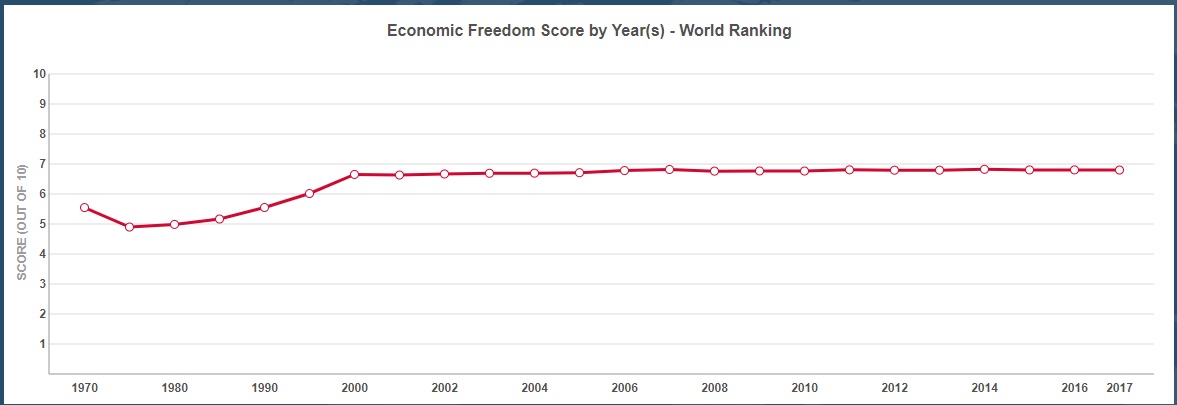
Yes, it would be nice if there had been some focus on the size of government, but all of the advice on trade, regulation, monetary policy, and quality of governance was very sound. And those policies account for 80 percent of a nation’s grade according to Economic Freedom of the World.
Moreover, the planks on fiscal policy were good, even if they didn’t go far enough.

Additionally, it was good to have multilateral institutions such as the International Monetary Fund and World Bank using their leverage to push for pro-market reforms (unlike today, when international bureaucracies often push a statist agenda).

So what was the effect of – to use the terms of opponents – this emphasis on “neoliberalism” or “market fundamentalism”?

Well, it seems to have made a difference. Here the data from the Fraser Institute on economic freedom for all nations. As you can see, economic liberty around the world increased significantly between 1980-2000, the years when the Washington Consensus was most influential.


But did that period of pro-market reform lead to better outcomes?

The answer is a resounding yes, at least in my humble opinion.

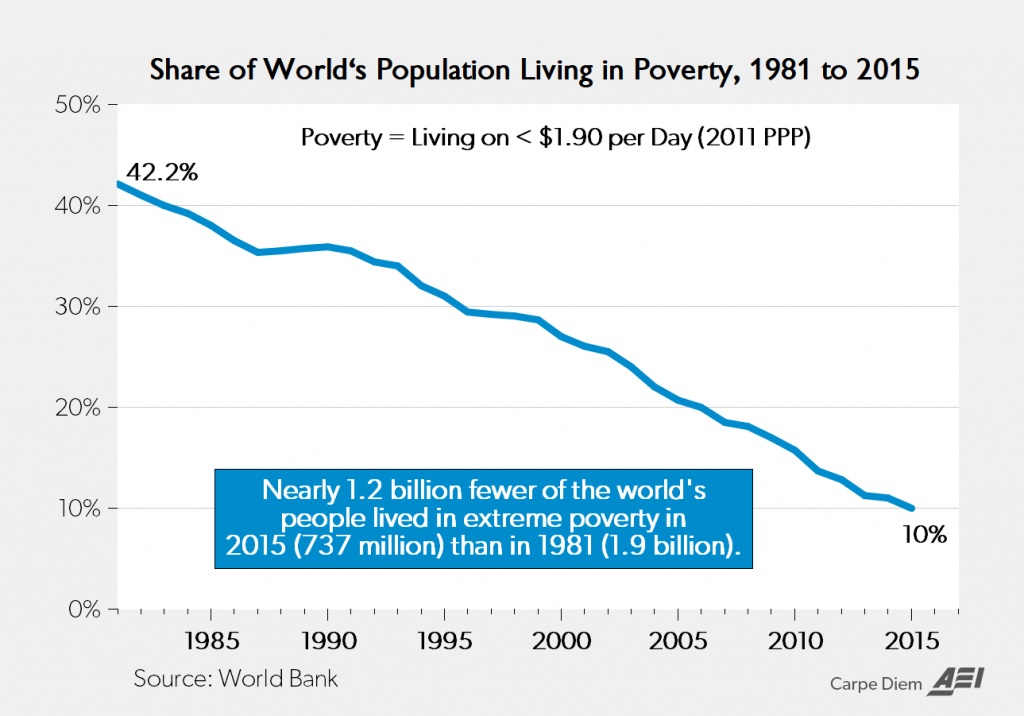
Here’s the most persuasive evidence, showing the dramatic decline in extreme poverty.


Let’s also look at some new research from Professor William Easterly, who worked for many years as an economist at the World Bank.

He notes that many people think the Washington Consensus was a failure. So he took a fresh look at the data.
Many authors…have proclaimed the failure of a package of market-oriented reforms proposed in the 1980s and 1990s — variously known as the Washington Consensus, …globalization, or neoliberalism. This paper seeks to update the stylized facts on policies and growth that influenced this verdict. …The earlier stylized facts featured the zero or low per capita growth in the regions that were the focus of reform: Africa and Latin America. …these stylized facts have not been updated in the literature, as much more data have become available with the passage of time. …This paper will report new stylized facts. First, there has been additional and quite remarkable progress on reform outcomes since the late 1990s — this is a principal finding of this paper. Earlier judgments on the reforms often happened before the reform process was complete and/or had enough post-reform growth data to evaluate reforms. …The second stylized fact is that there is a strong correlation between improvements in policy outcomes and changes in growth outcomes. The third stylized fact is that growth has recovered in Africa and Latin America in the new millennium, and the regression of growth on policy outcomes explains a substantial part of the growth recovery. …This paper will extend the method of analyzing extremely bad and moderately bad policy outcomes to other policies, specifically — in addition to inflation — the black market premium on foreign exchange, overvaluation of the domestic currency, negative real interest rates on bank savings deposits, and abnormally low trade shares to GDP. Updating the data on these outcomes is not trivial and constitutes one of the main contributions of this paper.
And what did Prof. Easterly discover?

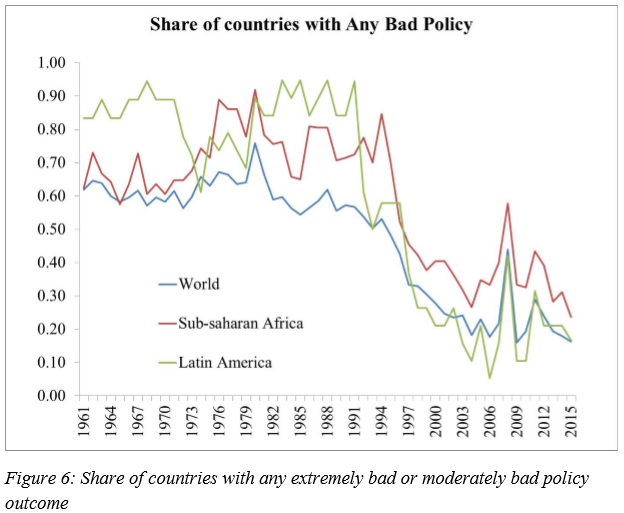
It turns out that the prevalence of bad outcomes has declined.
Figure 6 shows a summary measure of share of countries with any bad policy. Any bad policy is defined as having any of the moderate or extreme policy dummies set to one, with a minimum of 4 policy observations available for that country-year. The summary measure shows a downward trend in bad policy outcomes worldwide, in Latin America, and in Sub-Saharan Africa. The sharpest break is around the mid-1990s, somewhat after the formulation of the Washington Consensus and the first negative reactions it received.
Here’s the aforementioned Figure 6.


And he also looks at the prevalence of extremely bad poliicy.
Figure 7 shows a similar graph to Figure 6, but now limited to extremely bad policy outcomes. It shows if any of the extremely bad policy dummies is set to one, for the sample with a minimum of at least two out of five policy outcomes available. The decline in the prevalence of any extreme policy is even more dramatic beginning in the early 1990s, going from surprisingly common (above 35 percent of countries up to the early 1990s) to almost non-existent for the world. The same pattern is even more striking for Africa and for Latin America.
Here’s Figure 7.


Most important, these better outcomes also are associated with stronger growth.
This paper showed these changes in policy outcomes – especially away from extreme policies — were accompanied by growth increases. It documented that the policy reforms can explain the growth increases in the regions most emphasized earlier – Africa and Latin America. We have seen that the old data available through 1998 was indeed consistent with the reform pessimism, partly because of weaker results on growth payoffs associated with reform outcomes and partly because less reform had happened.
Prof. Easterly acknowledges that there are still many issues to investigate and that his research is just one slice at a big pie.

But the bottom line is that we now have some good evidence that the Washington Consensus led to better results. Simply stated, capitalism produces more growth and less poverty. Too bad the IMF and other international bureaucracies have forgotten this lesson.