Search This Blog

De Omnibus Dubitandum - Lux Veritas

Showing posts with label International Taxation. Show all posts

Tuesday, April 13, 2021

Global Taxes Are the Latest Ploy to Destroy Sovereignty

The Biden Administration has discovered a new issue for its vast globalist ambitions. It might surprise many, but it shouldn’t. Taxation is ripe for a global takeover so the whole world can suffer from the highest tax rates, collected and administered by a world government agency like the United Nations.

None other than Treasury Secretary Janet Yellen, Biden’s siren Wall Street mistress of finance, announced the plan last week. Like her boss, Yellen wants to do away with differences in tax structures, rates, and regimes not only between states but among all countries. This is the biggest socialist grab since 1917.  As economist Stephen Moore suggests, “For the last four decades, the left has sworn on a stack of Bibles that taxes don’t influence behavior and that high tax rates are no disincentive to growth. In fact, Biden’s gang of economists argue no negative impact from raising tax rates to their highest level since the 1970s.”

This is obviously untrue and absurd, and even the Left doesn’t believe it anymore. Does any thinking person really believe that the ongoing and real exodus from New York to Florida isn’t driven by 13 percent income tax in one place and zero income tax in the other? The same could be said for California and Texas. The numbers prove the point and people, like firms, are voting with their feet.......To Read More....

Sunday, April 11, 2021

IMF Goes All-In for Class Warfare

April 10, 2021 by Dan Mitchell @ International Liberty 

The International Monetary Fund’s dogmatic support for higher taxes and bigger government makes it “the dumpster fire of the global economy.”  Wherever IMF bureaucrats go, it seems they push for high-tax policies that will weaken growth.

Call me crazy, but I’m baffled that the IMF seems to think nations will grow faster and be more prosperous if politicians seize more money from the economy’s productive sector. Unfortunately, the IMF has been especially active in recent months. In a column for the U.K.-based Guardian, Larry Elliott writes about the IMF using the pandemic as an excuse to push for higher taxes.


the IMF called for domestic and international tax changes that would boost the money available to expand public services, make welfare states more generous… “To help meet pandemic-related financing needs, policymakers could consider a temporary Covid-19 recovery contribution, levied on high incomes or wealth,” the fiscal monitor said. …Paolo Mauro, the deputy director of the IMF’s fiscal affairs department, said there had been an “erosion” of the taxes paid by those at the top of the income scale, with the pandemic offering a chance to claw some of the money back. “Governments could consider higher taxes on property, capital gains and inheritance,” he said. “One specific option would be a Covid-19 recovery contribution – a surcharge on personal tax or corporate income tax.”

Mr. Mauro, like most IMF bureaucrats, is at “the top of the income scale,” but he doesn’t have to worry that he’ll be adversely impact if politicians seek to “claw some of the money back.”  Why? Because IMF officials get tax-free salaries (just like their counterparts at other international bureaucracies). Writing for the IMF’s blog, Mr. Mauro is joined by David Amaglobeli and Vitor Gaspar in supporting higher taxes on other people.


Breaking the cycle of inequality requires both predistributive and redistributive policies. …The COVID-19 crisis has demonstrated the vital importance of a good social safety net that can be quickly activated to provide lifelines to struggling families. …Enhancing access to basic public services will require additional resources, which can be mobilized, depending on country circumstances, by strengthening overall tax capacity. Many countries could rely more on property and inheritance taxes.  Countries could also raise tax progressivity as some governments have room to increase top marginal personal income tax rates… Moreover, governments could consider levying temporary COVID-19 recovery contributions as supplements to personal income taxes for high-income households.

Needless to say, the IMF is way off base in fixating on inequality instead of trying to reduce poverty.  Meanwhile, Brian Cheung reports for Yahoo Finance about the IMF’s cheerleading for a global tax cartel.


The International Monetary Fund (IMF) says it backs a U.S. proposal for a global minimum corporate tax. IMF Chief Economist Gita Gopinath said that the fund has been calling for international cooperation on tax policy “for a long time,” adding that different corporate tax rates around the world have fueled tax shifting and avoidance. “That reduces the revenues that governments collect to do the needed social and economic spending,” Gopinath told Yahoo Finance Tuesday. “We’re very much in support of having this kind of global minimum corporate tax.” …Gopinath also backed Yellen’s push forward on an aggressive infrastructure bill… As the IMF continues to encourage countries with fiscal room to continue spending through the recovery, its chief economist said investment into infrastructure is one way to boost economic activity.

Based on the above stories we can put together a list of the tax increases embraced by the IMF, all justified by what I call “fairy dust” economics.

https://i1.wp.com/freedomandprosperity.org/wp-content/uploads/2020/12/Dec-29-20-My-Tweet.jpg

  • Higher income tax rates.
  • Higher property taxes.
  • More double taxation of saving/investment.
  • Higher death taxes.
  • Wealth taxes.
  • Global tax cartel.
  • Higher consumption taxes.

And don’t forget the IMF is a long-time supporter of big energy taxes.  All supported by bureaucrats who are exempt from paying tax on their own very-comfortable salaries.

P.S. I feel sorry for two groups of people. First, I have great sympathy for taxpayers in nations that follow the IMF’s poisonous advice. Second, I feel sorry for the economists and other professionals at the IMF (who often produce highquality research). They must wince with embarrassment every time garbage recommendations are issued by the political types in charge of the bureaucracy.

P.P.S. But since they’re actually competent, they will easily find new work if we shut down the IMF to protect the world economy.


Monday, February 17, 2020

European Tax Greed and American Tech Companies

January 24, 2020 by Dan Mitchell @ International Liberty
 
There are many boring topics in tax policy, such as the debate between expensing and depreciation for business investment.

International tax rules also put most people to sleep, but they’re nonetheless important.

Indeed, the United States government is currently squabbling with several European governments about the appropriate tax policy for U.S.-based tech companies.

A report from the New York Times last July describes the controversy.
France is seeking a 3 percent tax on the revenues that companies earn from providing digital services to French users. It would apply to digital businesses with annual global revenue of more than 750 million euros, or about $845 million, and sales of €25 million in France. That would cover more than two dozen companies, many of them American, including Facebook, Google and Amazon. … 
Mr. Lighthizer said the United States was “very concerned that the digital services tax which is expected to pass the French Senate tomorrow unfairly targets American companies.” …France’s digital tax adds to the list of actions that European authorities have taken against the tech industry…  
And more regulation looms. Amazon and Facebook are facing antitrust inquiries from the European Commission. …Britain provided further details about its own proposal to tax tech companies. Starting in 2020, it plans to impose a 2 percent tax on revenue from companies that provide a social media platform, search engine or online marketplace to British users.
For the latest developments, here are excerpts from an article in yesterday’s New York Times.
A growing movement by foreign governments to tax American tech giants that supply internet search, online shopping and social media to their citizens has quickly emerged as the largest global economic battle of 2020. …At the core of the debate are fundamental questions about where economic activity in the digital age is generated, where it should be taxed and who should collect that revenue. … 
The discussions, which are expected to last months, could end with an agreement on a global minimum tax that all multinational companies must pay on their profits, regardless of where the profits are booked. The negotiations could also set a worldwide standard for how much tax companies must remit to certain countries based on their digital activity. … 
Mr. Mnuchin expressed frustration on Thursday in Davos that a digital sales tax had become such a focus of discussion at the World Economic Forum. …American tech firms are eager for a deal that would prevent multiple countries from imposing a wide variety of taxes on their activities.
Daniel Bunn of the Tax Foundation has an informative summary of the current debate.
In March of 2018, the European Commission advanced a proposal to tax the revenues of large digital companies at a rate of 3 percent. …The tax would apply to revenues from digital advertising, online marketplaces, and sales of user data and was expected to generate €5 billion ($5.5 billion) in revenues for EU member countries. The tax is inherently distortive and violates standard principles of tax policy. Effectively, the digital services tax is an excise tax on digital services.  
Additionally, the thresholds make it function effectively like a tariff since most of the businesses subject to the tax are based outside of the EU. …the European Commission was unable to find the necessary unanimous support for the proposal to be adopted. The proposal was laid aside… the French decided to design their own policy. The tax was adopted in the summer of 2019 but is retroactive to January 1, 2019. Similar to the EU proposal, the tax has a rate of 3 percent and applies to online marketplaces and online advertising services. …The United Kingdom proposed a digital services tax at 2 percent as part of its budget in the fall of 2018. The tax has already been legislated and will go into force in April of 2020. … 
The tax will fall on revenues of search engines, social media platforms, and online marketplaces. …The OECD has been working for most of the last decade to negotiate changes that will limit tax planning opportunities that businesses use to minimize their tax burdens. …The reforms have two general objectives (Pillars 1 and 2): 1) to require businesses to pay more taxes where they have sales, and 2) to further limit the incentives for businesses to locate profits in low-tax jurisdictions. … 
This week in Davos, the U.S. and France…agreed to continue work on both Pillar 1 and Pillar 2… The burden of proof is on the OECD to show that the price the U.S. and other countries may have to pay in lost revenue or higher taxes on their companies (paid to other countries) will be worth the challenge of adopting and implementing the new rules.
At the risk of over-simplifying, European politicians want the tech companies to pay tax on their revenues rather than their profits (such a digital excise tax would be sort of akin to the gross receipts taxes imposed by some American states).

And they want to use a global formula (if a country has X percent of the world’s Internet users, they would impose the tax on X percent of a company’s worldwide revenue).

Though all you really need to understand is that European politicians view American tech companies as a potential source of loot (the thresholds are designed so European companies would largely be exempt).
For background, let’s review a 2017 article from Agence France-Presse.
…are US tech giants the new robber barons of the 21st century, banking billions in profit while short-changing the public by paying only a pittance in tax? …French President Emmanuel Macron…has slammed the likes of Google, Facebook and Apple as the “freeloaders of the modern world”. …According to EU law, to operate across Europe, multinationals have almost total liberty to choose a home country of their choosing. Not surprisingly, they choose small, low tax nations such as Ireland, the Netherlands or Luxembourg. … 
Facebook tracks likes, comments and page views and sells the data to companies who then target consumers. But unlike the economy of old, Facebook sells its data to French companies not from France but from a great, nation-less elsewhere… It is in states like Ireland, whose official tax rate of 12.5 percent is the lowest in Europe, that the giants have parked their EU headquarters and book profits from revenues made across the bloc.  
…France has proposed an unusual idea that has so far divided Europe: tax the US tech giants on sales generated in each European country, rather than on the profits that are cycled through low-tax countries. …the commission wants to dust off an old project…the Common Consolidated Corporate Tax Base or CCCTB — an ambitious bid to consolidate a company’s tax base across the EU. …tax would be distributed in all the countries where the company operates, and not according to the level of booked profit in each of these states, but according to the level of activity.
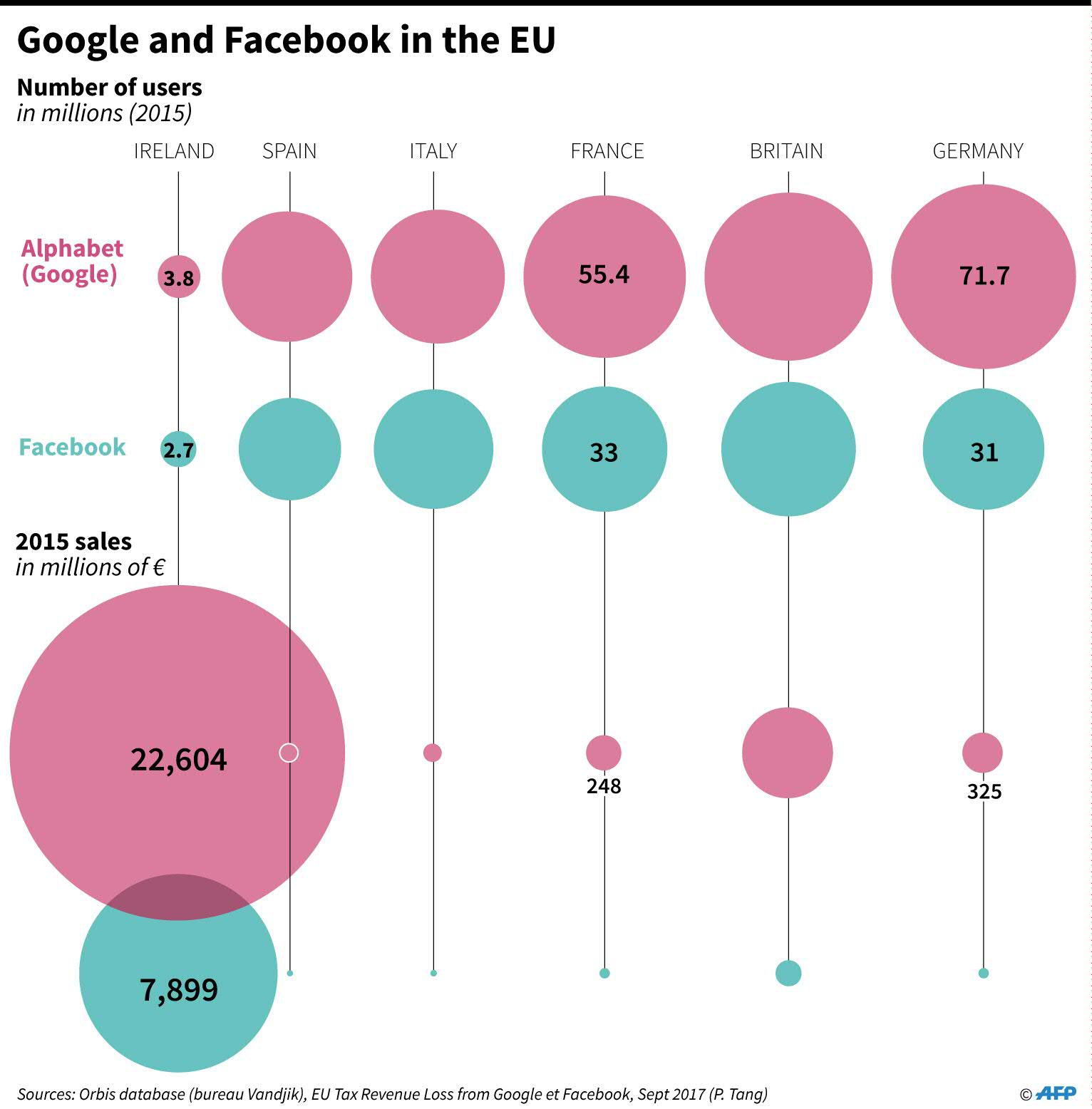
This below chart from the article must cause nightmares for Europe’s politicians.

As you can see, both Google and Facebook sell the bulk of their services from their Irish subsidiaries.


When I look at this data, it tells me that other European nations should lower their corporate tax rates so they can compete with Ireland.

When European politicians look at this data, it tells them that they should come up with new ways of extracting money from the companies.

P.S. The American tech companies are so worried about digital excise taxes that they’re open to the idea of a global agreement to revamp how their profits are taxed. I suspect that strategy will backfire in the long run (see, for instance, how the OECD has used the BEPS project as an excuse to impose higher tax burdens on multinational companies).

P.P.S. As a general rule, governments should be free to impose very bad tax policy on economic activity inside their borders (just as places such as Monaco and the Cayman Islands should be free to impose very good tax policy on what happens inside their borders). That being said, it’s also true that nations like France are designing their digital taxes American companies are the sole targets. An indirect form of protectionism.