Search This Blog

De Omnibus Dubitandum - Lux Veritas

Tuesday, June 1, 2021

Media Balance Newsletter

June 1, 2021 by John Droz, Jr.

Welcome to the latest issue of our Media Balance Newsletter, which covers a wide range of nation interest topics: from COVID to Climate. (For all 2020 Newsletters, go here. For all 2021 Newsletters, go here.) (FYI, Our Election Integrity Reports have a new url: Election-Integrity.info. Please pass that onto your social media contacts...)

COVID-19: Therapy —

COVID-19: Vaccines —

COVID-19: Misc —

Wind Energy: Offshore —

Wind Energy: Other —

Solar Energy —

Nuclear Energy —

Fossil Fuel Energy —

Misc Energy —

Manmade Global Warming: Some Deceptions —

Manmade Global Warming: Misc —

US Elections:

US Elections, Arizona Issues:

US Elections, Other State Issues:

US Politics and Socialism —

Other US Politics and Related —

Education Related —

Science and Misc Matters —

Please use social media, etc. to pass on this Newsletter to other open-minded citizens…

John Droz, jr.

physicist & citizen’s rights advocate

Note 1: It’s recommended to read the Newsletter on your computer, not your phone, as some documents (e.g. PDFs) are much easier to read on a large computer screen…  Common fonts, etc. have been used to minimize display issues.

Note 2: To accommodate numerous requests received about prior articles, we’ve put together detailed archives — where you can search by year, or over the ten+ years of the Newsletter. For a detailed background about the Newsletter, please read this.

Note 3: See this extensive list of reasonable books on climate change that complements the Newsletter. As a parallel effort, there is also a list of some good books related to industrial wind energy. Both topics are also extensively covered on our WiseEnergy.org website.

Note 4: If you'd like to join the 10,000+ worldwide readers and get your own free copy of this periodic Newsletter, simply send John an email saying that.

Note 5: John is not an attorney or a physician, so no material appearing in any of the Newsletters (or the WiseEnergy.org website) should be construed as giving legal or medical advice. His recommendation has always been: consult a competent, licensed attorney when you are involved with legal issues, and consult a competent physician regarding medical issues.

Copyright © 2021; Alliance for Wise Energy Decisions (see WiseEnergy.org)


The Warrior's Tale

May 31, 2021

The warrior's tale is a simple enough thing. Strong as steel, but fragile as chance. It is the wind in his soul and the wall we build around ourselves to tell us who we are.

Before there were cities or nations, and railways and airports, computers and telephones-- the tale was told around campfires. Acted out in pantomime, dressed up in animal furs and cave paintings. But the tale was the same. The people were confronted with a threat and they called upon the best and strongest of their men to go out and fight it. These were their warriors. What they did in the face of that threat is the tale.

The tale has many variations. Sometimes there are many warriors, sometimes only a handful. They march into the village of the enemy in triumph, or they make a last stand on a rocky outcropping, spending the last of their heart's blood to buy time they will never know. There is the weak man who becomes strong, the strong man who becomes weak, the woman who mourns the man who will never return, and the man who goes off to battle with nothing to lose. These tales have been told countless times in the ages of men, and they will be told again for as long as men endure.

It is not only the warriors who need the tale, or those left behind. Future generation learn who they are from this tale. "We are the people who died for this land," is the unseen moral of each tale. "We bled for it. We died for it. Now it is yours to bleed and die for."

The warrior's tale tells each generation that they stand on the wall against a hostile world. And that the wall is made not of stones, but of their virtues. Their courage, their integrity and their craft.  Theirs is the wall and they are the wall-- and if they should fail, then it will fail. And the land and the people will be swept away.

What happens to a people who forget the warrior's tale and stop telling it around their campfires? Worse , what of a people who are taught to despise the figure of the warrior and what he represents? They will not lose their courage, not all of it. But they will lose the direction of that courage. It will become a sudden unexplained virtue that rises to them out of the depths of danger. And their wall will fail.

It is the warrior's tale that makes walls. That says this is the land that we have fought for, and we will go on fighting for it. It is sacrifice that makes mere possession sacrosanct. It is blood that turns right to duty. It is the seal that is above law, deeper still to heritage. Anyone can hold a thing, but it is sacrifice that elevates it beyond possessiveness. And it is that tale which elevates a people from possessors of a land, to the people of the land.

Universalism discards the warrior's tale as abomination. A division in the family of man. Their tale is of an unselfish world where there are no more divisions or distinctions. Where everyone is the same in their own way. But this tale is a myth, a religious idea perverted into totalitarian politics. It is a promise that cannot be kept and a poison disguised with dollops of sugar. It lures the people into tearing down their wall and driving out their warriors.  And what follows is what always does when there is no wall. The invaders come, the women scream, the children are taken captive and the men sit with folded hands and drugged smiles dreaming of a better world.

The warrior's tale explains why we fight in terms of our own history. The Great Swamp Fight. The Shot Heard Round the World. The Battle of New Orleans. Gettysburg, San Juan Hill, Belleau Wood, Pearl Harbor, Heartbreak Ridge, the Tet Offensive, Kandahar, and Fallujah. Generations of sacrifices must be defended. And those who wage war on us must be made to pay.

Universalism demands that war must answer to universal aims and objectives. That there is a universal law higher than war. But this is a children's story. The laws of men derive from their own interests. Those who can rule by force or coalition make their laws to serve their own ends. This is the way of the world.

Those who pretend to live by universalism will still fall to the law of steel. Rhetoric is no defense against fire and lead, and international codes have no defense against those who will break them. The talk may go on, but it is the warriors who will end it. It is still the warrior's tale to tell, even if all others have forgotten it.

The warrior's tale is no happy thing. It is bitter as bile and dark as death. But it is also a grand and glorious thing. For even in its full naked truth, it is the story of perseverance in the face of every agony and betrayal. It is the tale of how we live and why we die.

Even when all others forget their tale, the warriors remember. Even when they are called peacekeepers and turned into an army of clowns for the satisfaction of their political masters. The armies may decay, but warriors still remain in their cracks, on their edges-- men who are not wanted, but are needed because they are the only ones who can do the grim work and do it well. They may only be a hundredth of an army, or a thousandth. A fraction of a fraction. But without them there is no army, only empty uniforms.

When the warrior's tale is forgotten, then they become shadows. Dangerous men despised and feared. Thought of as killers, dismissed as monsters and stared at like beasts in a cage. But the society cannot deny them. It cannot deny that part of them. When the warrior diminishes, the energy is directed elsewhere. Sport becomes an obsession and matches end in bloody violence. Crime increases. Prisons fill up. So do police forces.

As the external war fades, the internal one begins. Barbarians come from without. Buildings burn, mobs rage and there is a savagery in the air.

No law can protect a society that has forgotten the warrior's tale. It will turn outward, and adopt the warriors tales of outsiders. The samurai will replace the cowboy. The sports star will be an outsider. Its heroes will become foreigners. Men who will do understand the virtue of violence and will do what their own have been forbidden. Who have the vital energy that a society without a warrior's tale lacks.

When a people give up their own warrior's tale for that of others, they lose the ability to resist them. For each people's warrior's tale says that we are people, and they are enemies. We are warriors and they are murderers. When a people have no other warrior's tale but that of their enemies, they will come to believe that they are monsters. And that their enemies are brave warriors.

The day will come when they are asked who they are, and they will not know. They will point to their possessions and the names of their streets and cities. They will speak of higher ideals and cringe for not living up to them. They will be asked why they fight, and they will say that they do not want to fight. That all they want is peace at any price.

Even the most powerful of civilizations with the mightiest of cities becomes prey when it forgets the warrior's tale. It takes more than weapons to defend a city, it demands the knowledge of the rightness of their use. It is no use dressing men in uniforms and arming them, if they are not taught the warrior's tale. And it is nearly as little use, sending them off to watch and keep, if the men above them discard the warrior's tale as violent and primitive gibberish.

An army of millions is worth little, without the warrior's tale. Strategy is technique, firepower is capacity, both begin and end with the human mind. "Why do we fight," is the question that the warrior's tale answers far better than any politician could. "We fight because this is ours. It is our honor, our duty and our war. We have been fighting for hundreds and thousands of years. This is what makes us who we are."

We are the people, says the warrior's tale. But we are every people, says the universalist's tale. All is one. There is no difference between us and them. And we will prove it by bringing them here. Then the walls fall and it falls to the warriors to make their last stand. To tell another warrior's tale with their lives.

This is the quiet war between the philosopher merchants who want trade and empire, and the warriors who know that they will be called upon to secure the empire, and then die fighting the enemy at home. It is how the long tale that begins with campfires and ends with burning cities goes. The story that begins with cave paintings and ends with YouTube videos. Whose pen is iron, lead and steel. And whose ink is always blood.

We have been here before. Told and retold the old stories. The forest, the swamp, the hill and the valley. And behind them the lie, the maneuver and the betrayal. The war that becomes unreasoning and the people who forget why they fight. And one by one the warriors slip away. Some to the long sleep in the desert. Others to secluded green places. And still others into the forgetfulness of a people's memory. The hole in the heart of a people who forget themselves and become nothing. Tags:
Author Image

About Daniel Greenfield
Daniel Greenfield is a journalist investigating Islamic terrorism and the Left. He is a Shillman Journalism Fellow at the David Horowitz Freedom Center


You Cannot Eat Bitcoin

Joakim BookJoakim Book  – May 31, 2021 @ American Institute for Economic Research

As a once-devout environmentalist, I have a T-shirt with a slogan heavily used by activists. Often credited to the Abenaki Alanis Obomsawin, it speaks directly to our modernity-hating followers in the Church of Climate: 

When the last tree is cut, the last fish is caught, and the last river is polluted; when to breathe the air is sickening, you will realize, too late, that wealth is not in bank accounts and that you can’t eat money.

Only a little derogatory we might say: yes, it took monetary economics many centuries of hard work and laborious testing to figure out that we indeed cannot eat money. Though – and this is the Earth-shattering point – we can trade other things for stuff we can eat, and money is a civilizational-changing vehicle for that, as it moves value both across time and place. The political battles over Britain’s Corn Laws in the 1840s featured many debates over what today would be called “food sovereignty,” with the conclusion that crops can better be grown elsewhere – and ever since, Britannia has relied on the rest of the world to feed her, in exchange for the goods (but mostly services) that she provides them. 

The Exchange Rate Risk of Monetary Networks

It is hard to be a consistent fan of Nassim Nicholas Taleb, the author, public intellectual and former trader, as the quality of his written and spoken word fluctuates as much in value as the cryptocurrency he loves to lambast. He has written astonishing books, particularly the ones included in the Incerto series – of which The Black Swan and AntiFragile might be the most well-known. On the negative side, he has said a number of remarkably inane things about the pandemic, and like Elon Musk, he’s also done a one-eighty on bitcoin: from an eager fan and promoter, to a hostile critic.

Mixed bag, in other words. 

In a series of tweets and much-shared comments on social media, Taleb hit both Bitcoin and libertarians, insisting that mutually beneficial trade is of nobody else’s concern (I am unable to find references to them, as Taleb has long since blocked me, but I’m sure the reader is more than capable of finding some stark Taleb-rant on why bitcoin is terrible). He writes that for a person to purchase consumption goods with bitcoin, she must have an income in bitcoin; but for her to receive (parts of) her salary in bitcoin, the employer must receive at least some bitcoin in revenue; and the seller of consumption goods must obtain at least some raw materials in bitcoin. 

Of course, this is terribly wrong; yet, he’s also profoundly right – in an almost trivial way. 

Unless currencies are fixed against one another or redeemable in the same outside money, purchasing and selling items in a currency different from the one in which you pay your expenses or earn your incomes exposes you to exchange rate risk. This is trivial, and obvious to anyone who has ever spent time in another monetary network from their own (or tried to buy/sell something from those monetary networks). If my incomes are in dollars, but my regular expenses are in euros, the exchange rate between euros and dollars changes on a daily (or hourly) basis my real purchasing power. Most international travelers or multinational corporations don’t mind much since these fluctuations are usually quite small, can be insured against via efficient and deep financial markets, and often reverts themselves over time: companies pocket currency windfalls one quarter only to face currency headwinds another. 

In this sense, bitcoin is just another monetary network, with exchange rate risk to incomes or purchases of goods and services in other networks. Much to the ire of bitcoiners and libertarians alike, Taleb has a point: when you opt into any monetary network, you’re not just making an isolated transaction between yourself and whoever sold you the money, but a bet on the future exchange rate of that money vis-à-vis other items. 

Money, long known to monetary economists from Cantillon to Mises, has the strange property that it’s acquired not to be used and consumed, but to be given away later. That means when I give up valuable goods and services – electricity when I mine bitcoin, my time and labor when I work for it, my entries in another monetary network (dollar or euros) when I buy it on an exchange – for a place on the global ledger that is bitcoin, I am not just giving up these resources, but making a gamble on the future state of that network. 

I am acquiring a risk that, firstly, I won’t be able to use the token for something I desire, as the seller of that good or service must also accept my bitcoin; and secondly I don’t know at which exchange rate I will receive that good or service. (This holds even if I just trade it back for dollars later.)

The sneaky comment that underpins Taleb’s entire argument arrives at the end of his rant: for all of us to make transactions in bitcoin – be paid in bitcoin, or be able to pay others in bitcoin – “requires a parity bitcoin-USD of low enough volatility to be tolerable and for variations to remain inconsequential.” The key word is ‘tolerable,’ as every monetary network faces these same issues. As above, travelers to Mexico (pesos) or France (euros), or multinationals purchasing inventory from Brazil (reais) or China (yuan) accept the inherent current risk because they judge the benefits to outweigh those risks. 

Acquiring and holding bitcoin also exposes individuals and companies to exchange rate risks: between what you’re giving up for fiat currency today and what goods and services your future self wants. For the dollar, that risk is usually quite low and ostensibly at least quite predictable: at 2% inflation a year, you know that $100 will get you about $98 worth of goods this time next year and about $96 the next. But, says the monetarily conversant bitcoiner, you don’t actually know that: you’re entrusting that prediction to an increasingly aggressive and increasingly fickle board of Federal Reserve Governors. It also depends on what your future consumption bundle looks like: if you’re looking to buy a computer, cell service, or clothes, you’re probably fine just holding the $100 bill; if your future consumption includes college expenses, medical care, or a house, not so much. 

If we assign high enough probability that these Governors won’t deliver on their promise, and take into account their counterparties in an even more spending-prone Treasury, what a “tolerable” volatility is might be quite a lot. Lots of people who hold bitcoin indeed deem the risk of government mismanagement to be larger than the risk that their bitcoin holdings get them fewer goods and services when they finally convert them into consumption goods.

What’s so ironic here is that the very bitcoiners who detest being pushed into stocks or commodities for long-term monetary savings (the only vehicles left when cash holdings just slowly depreciate), don’t have a problem being pushed into even riskier exchange rate risk down the road. Bitcoin’s exchange rate is unanchored in the sense that we can’t make a decent prediction as to where it’s going to be forty years hence – in contrast to how an NGDP target would or the classical gold standard did. 

Sure enough, objects the still conversant bitcoin theorist, the supply is capped and the demand is infinite, so the price must go to the moon – but what ensures that? You need a very cynical view of government and an inability of creative markets and progress to overcome them for the argument to make sense. And you’re still making the goldbug’s mistake: For decades, goldbugs like Jim Rickards and Peter Schiff have said that gold is immutable and will keep its value, because in a hundred years’ time that gold coin will be exactly the same as it is now. Physically, yes, but not economically. What matters for the holder of gold is what gold gives him in that far-off future. What a risk-averse time-traveling saver is after isn’t something that is physically the same as what he put in, but economically the same – and that’s pretty impossible, as economies, values, and production technologies change. 

When bitcoiners rant against the horrors of forcing people into investment vehicles they are ill-equipped to manage or understand, they miss this fundamental aspect of our monetary economies: price risk and currency exchange risk does not disappear. By introducing a new outside monetary commodity (i.e. without counterparty risk, where your monetary surplus is nobody else’s liability) you ensure that – bar hacks and loss of private keys – the bitcoin saved away today remains the same number of sats when financing future consumption. But you do not ensure that those same number of sats will purchase the retiree the goods and services equal to, or above, the savings.

You cannot eat bitcoin, or dollars, or bank balances, which means that whatever vehicle you use to move value across time has an exchange rate risk. Many bitcoiners’ mistake is to think that their preferred asset avoids this; Taleb’s mistake is to think that others can have a different view of government than him. 

Joakim Book

Joakim Book

Joakim Book is a writer, researcher and editor on all things money, finance and financial history. He holds a masters degree from the University of Oxford and has been a visiting scholar at the American Institute for Economic Research in 2018 and 2019.

His work has been featured in the Financial Times, FT Alphaville, Neue Zürcher Zeitung, Svenska Dagbladet, Zero Hedge, The Property Chronicle and many other outlets. He is a regular contributor and co-founder of the Swedish liberty site Cospaia.se, and a frequent writer at CapX, NotesOnLiberty, and HumanProgress.org.

Get notified of new articles from Joakim Book and AIER.

The Woke Takeover of the U.S. Military Endangers Us All

A lieutenant colonel was dismissed from his post after bashing and critical race theory. 

  Dakota Wood Senior Research Fellow, Defense Programs

Lt. Col. Matthew Lohmeier was fired this month as commander of a U.S. Space Force unit. His “offense”? Speaking the truth about critical race theory’s rapid inroads among America’s armed forces.  The woke left views the military as a crucial ideological battlefield. And much of the brass and civilian leadership at the Pentagon are prepared to fight—on behalf of the woke cause. Lohmeier, it seems, was an early casualty in this ideological offensive, but likely not the last.

Imposing anti-American racial ideologies on our troops directly threatens our national security, by spreading ideas that undermine confidence in the principles underpinning our Constitution, trust in our system of government and traditional values that promote unity, cohesion and equality among service members.That’s classic CRT.....................

As a reward for blowing the whistle, Lt. Gen. Stephen Whiting, the head of Space Operations Command, reportedly ­removed Lohmeier as commander of the 11th Space Warning Squadron................He “recognized those narratives as being Marxist in nature.”................The firing has served one useful purpose, however: It has drawn attention to the administration’s apparent intent to introduce wrong-headed and highly inflammatory Marxist ideologies into military ranks..............

The Defense Department is now reportedly considering hiring a private company to monitor the free speech of military personal on social media, using key words or algorithms that by their very nature reflect the perspective of those who select the words and write the algorithms..............It should not be tolerated..............To Read More....


Another Minority Convert to Gun Rights

May 31, 2021 by Dan Mitchell @ International Liberty 

Charles Blow is a doctrinaire left-wing columnist for the New York Times. But I applauded him late last year for expressing sympathy for black gun ownership.


He’s certainly not a full-blown supporter of the Second Amendment. And I don’t think he realizes that many of the first gun control laws had racist motivations. But I’m not going to nit pick. I welcome converts, even half-hearted ones.  Which is why today’s column will cheer another newcomer to the cause.

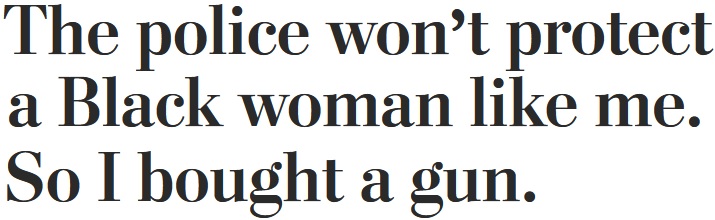
In a column for the Washington Post, Danielle King describes her decision to become a gun owner.


I never thought I’d own a gun. But there I was, in Hazard, Ky., in the middle of a pandemic on a Saturday, buying a .38 snub-nosed revolver. I’m not your stereotypical gun owner…as a Black woman, I am a statistical rarity… But I had come to believe that I had two choices: take steps to protect myself, or become a victim. I decided I needed to be armed. …it wasn’t until one night last April at my Kentucky home that I decided to become a gun owner myself. The brightness of the living room light startled me from my sleep. …The rustling sounds confirmed that we had an intruder. …The invader eventually made his way to the bedroom door. …The intruder slammed against the door like a battering ram in an attempt to take it down. He nearly succeeded, shattering the frame, but my husband held the rest of the door shut while I hid on the balcony and called the police.It took officers more than 45 minutes to arrive… I realized we needed protection. …Three days after the break-in, with my husband’s encouragement, I went to the gun store and purchased my revolver and some hollow-point bullets.

Ms. King notes that many other blacks are joining her and becoming gun owners.

The National Shooting Sports Foundation reported a 58 percent surge in gun purchases by Black men and women in the first six months of 2020 compared with the same period in 2019, citing a survey of gun retailers. Of all purchasers, 5.4 percent were Black women. I strongly support private gun ownership and the Second Amendment… To be honest, I am still afraid of having guns in my home — and even of having one in my possession. But we are products of a violent nation, and ultimately, I don’t feel like the police can or want to protect me. …My first practice shot was a couple of feet from my backyard, bordering the woods. My husband created a target for me to practice on. …Terrified, my hands trembling, drenched in sweat, I anxiously grasped the revolver’s handle while searching for the trigger. Then, lining up the target while calming my breath, I pressed the trigger to hear a POP. Now, I thought, we are protected.

By the way, I hope what she wrote about the police isn’t true. I’d like to think they want to protect her and her family.

But Ms. King is definitely correct to fear that the police may not have the ability to protect her. Just consider the fact that it took 45 minutes for cops to arrive when her family was threatened by an intruder.

And it would be especially foolish to rely on the government for safety during a pandemic. Or during a period of civil strife.

If you read Ms. King’s full column, it’s clear that she hasn’t embraced the full libertarian view on gun ownership. But just as was the case with Charles Blow, I welcome her shift in the correct direction.

P.S. Here are the other columns celebrating folks on the left who have had epiphanies on gun rights.

  • In 2012, I shared some important observations from Jeffrey Goldberg, a left-leaning writer for The Atlantic. In his column, he basically admitted his side was wrong about gun control.
  • Then, in 2013, I wrote about a column by Justin Cronin in the New York Times. He self-identified as a liberal, but explained how real-world events have led him to become a supporter of private gun ownership.
  • In 2015, I shared a column by Jamelle Bouie in Slate, who addressed the left’s fixation on trying to ban so-called assault weapons and explains that such policies are meaningless.
  • More recently, in 2017, Leah Libresco wrote in the Washington Post that advocates of gun control are driven by emotion rather empirical research and evidence.
  • Last but not least, Alex Kingsbury in 2019 acknowledged the futility of gun control in a column for the New York Times.

P.P.S. Here’s a column on race and gun control.

P.P.P.S. If you want unintentional comedy, here’s a column by a British leftist who equates gun ownership and slavery.


Victor Davis Hanson Commentary: The New Regressive Dark Ages

by Victor Davis Hanson

Once upon a time long ago, we agreed there were certain immutable laws of human nature. These laws were based on facts, reality, and data.

In other words, we accepted common sense about the way the world worked according to logical and even “scientific” principles. That assumption defined us as “enlightened” rather than Dark Age reductionists and ideological- or myth-driven zealots.

Not now. “Progressives,” especially the media, are most often regressive, anti-Enlightenment, and intolerant people, who start with a deductive premise and then make the evidence conform to it—or else.

Regressives

For example, we used to believe that if the government printed more money without commensurate sudden rises in population or economic output, inflation followed. And money cheapened in value all the more so if the government simultaneously both incentivized labor non-participation through over generous entitlements, and promised or enacted higher taxes and more regulations. The latter inevitably would discourage production as demand from a stimulated economy rose.

In 100 days, we’ve either done all of those things or, at least sent messages to producers that we shall do so shortly. Why then are we surprised that monthly consumer prices are spiking after nearly 20 years of very low inflation? Why are our essentials such as lumber, gasoline, housing, appliances, and food skyrocketing? Is the current idea that there is no science of economics? Or is inflation good by “spreading the wealth” through decreasing the value of money for those who have too much of it?

Deterrence is also an ancient law. Humans make instant cost-benefit analyses and act accordingly—from nation states that weigh the advisability of war to potential criminals who gauge the chances of their arrest and punishment.

In deterrent terms along the border, what happens if the United States signals Latin America and Mexico that it will cease construction on an effective border wall, promise in advance blanket amnesties, reinstate “catch and release” rules, stop prior efforts to recalibrate easy “refugee status,” and pull back from detaining unlawful border crossers? Logically, would not potential illegal immigrants believe that the rewards of U.S. healthcare, safety, housing subsidies, entitlement support, education, and even affirmative action outweigh the increasing unlikelihood of meeting resistance at the border—or any later consequences for residing illegally in the United States?

The result is now true “chaos” at the border. Tens of thousands of unvetted immigrants illegally stream into the United States, in a fashion that is not diverse, not legal, not meritocratic, and not measured—the old foundations of rapid melting-pot assimilation.

Did the Biden Administration simply by fiat declare that such obvious human laws did not apply to their superior moral impulses? Or did it deliberately violate them to change the demography of the American southwest in ways that eventually will benefit the hard Left? Likewise, could it be that rising crime is due to efforts to defund or cut back police forces, or allowing criminals to be freed without bail, or district attorneys not prosecuting crimes deemed matters of social justice.

Nation-states, like people, acknowledge the laws of deterrence. Signal to the Middle East that crippling sanctions against Iran are ending. Assure the world that the United States will be cutting back on domestic fossil fuel development and thus inevitably will become more dependent on others who produce “dirty” oil and gas. Assume that America now trusts Iranian negotiators and thus will reenter the Iran nuclear deal. Attest that the Palestinians are again front and center in all Middle East diplomacy. Act as if Israel no longer enjoys the full support of the United States, as money pours into Palestinian coffers without audit. Deride the Abraham Accords. And, finally, treat Iran, Hezbollah, and Hamas as if they are the Middle East intersectional counterparts to marginalized people of color in the United States (Israel playing Derek Chauvin to Hamas’s George Floyd). Is not all that logic assurance that there would be a war within 100 days?

Surely, even the woke Biden Administration knows something about deterrence. So was it naïve—or simply “leveling the playfield” to ensure Shiites and Persians were affirmed to receive their “fair share” of Middle East respect and influence, while Israel and the Gulf States surrendered their unearned privilege?

The War Against Science and Logic

To violate natural laws requires mocking empiricism, science, and data, or at least reducing them to irrelevance—for political, careerist, or ideological agendas.

Take the now infamous and pseudo-scientific “Steele dossier” and the “Russian collusion” mythography. From 2016 to 2018 Christopher Steele’s high school-like, jargon-filled, mish-mash folder was cited as near scientific “proof” of Trump’s perversions, treason, and various corruptions.

Steele, we were told, was a Russian “expert.” He was a “seasoned” British intelligence officer, albeit “retired,” with access to impeccable (though anonymous) sources.

CNN and MSNBC wheeled out all sorts of former FBI and CIA “professionals”—headed by ex-CIA chief John Brennan, and former Director of National Intelligence James Clapper, both previously known for admitting to lying to Congress under oath.

All our experts periodically “confirmed” Steele’s impeccable “credentials.” And then suddenly, 22 months after Special Counsel Robert Mueller’s investigation was jump started in part by a leaked “dossier,” it folded. There was no evidence of actionable “collusion.” Abruptly, “expert” spy Christopher Steele offered no sources to substantiate his “data” or “revelations.” The cable news heartthrob quietly was reduced to the status of Ponzi-schemer Bernie Madoff. There were no more media “bombshells” and “walls are closing in” Steele dossier revelations.

Mueller, the architect of the dream team special investigation and himself a former FBI director, suddenly claimed under oath he had no idea who Christopher Steele even was, much less what his dossier said. James Comey, yet another revered ex-FBI director, whose leaks jump started the Mueller special counsel probe, claimed more than 250 times under congressional oath he could not remember, or did not know much of anything—often in reference to the information in or used as a result of the dossier. In the end, the sum total of the science, the dossier, the data, and the experts proved only to be what a group of corrupt bureaucrats, media ideologues, and Clinton partisans found useful for their own agendas.

Do we remember last year’s “science” behind the origins of the Wuhan virus? Our alphabetized bicoastal “medical professionals” followed the “science” in assuring us that the virus originated with bats—or were they pangolins?—in a “wet” meat market. The scientific chorus echoed the “impossibility” that the “viral sequencing” could ever have been altered by humans. To suggest so, was racist, xenophobic, Trumpian, and backward.

A lab origin theory was left only to Neanderthals and the-earth-is-6,000-years-old deplorables, of an “anti-science,” know-nothing sort. Yet just a short distance away from the supposed ground-zero wet market, there was coincidentally a Level-4 virology lab with ties to Chinese military. And it was known to engage in “gain of function” viral research of the most dangerous sort. The lab’s sloppiness had gained the attention of visiting U.S. medical professionals.

No matter. The unlettered who do not read the New York Times or the Washington Post, or follow the fact-checkers, or listen to NPR were further roundly disregarded when they wondered why, if the virus sprung naturally from innocent meat peddlers, did the Chinese Communist government go to such great lengths to lie about the dates of the virus’s likely birth, and the nature of its transmission? Why were they ostracizing, censoring, or “disappearing” any of their own scientists capable of giving an accurate account of what, if any, might be the connections between the lab and the virus?

For good measure, our own “scientists” and “professionals,” from the mendacious Dr. Anthony Fauci to multibillionaire tech wizard Bill Gates, assured us that China was transparent. They had no reason to hide anything, they added. And, indeed, China was doing its best as a good global citizen to join in the global effort to stop this naturally occurring virus—albeit from time to time lying that the lab “hoax” was mostly either a racist Trump Administration talking point or a cover-up of the U.S. military’s creation of the virus.

Then suddenly . . . poof!

The faith-based “science” melted. Reason returned. The lab was suddenly seen as much more logically the birthplace of the SARS-CoV- 2 virus. Despite his protestations and denials from authority, Fauci, our epidemiological and virology “expert,” really did approve U.S. funds to be routed through Dr. Peter Daszak’s EcoHealth Alliance to help conduct gain-of-function research at Wuhan, despite Congress banning such funding.

We also learned, mirabile dictu, that Daszak had assembled an “international team of experts” to reassure the world that the Chinese research at the Wuhan lab—that he supported and had financially enhanced—had nothing to do with the COVID-19 pandemic. That “scientific,” explanation, a euphemism for an ideological and careerist-based cover story, is now inert. And Daszak has joined the likes of Fauci and WHO’s director Tedros Adhanom Ghebreyesus as those “experts” whose scientific judgment cannot be fully trusted because they proved all too human in their worries over careers, reputations, and politics.

The Dark Age Mind 

What can learn from the rise of this new Dark Age mindset?

1) Ignoring reason is easier than abiding by it. Printing money, for example, is easier than paying it back later—but easiest of all when we swear that there is no longer a need to pay it back at all.

2) Falsifying knowledge is always justified by higher moral purposes—in our case progressivism substituting for religious doctrine. Laws of human nature and logic are merely constructs when it is a matter of welcoming in the oppressed from Latin America or substituting race-based quotas for meritocratic criteria, or comparing Israelis to racist 1980s apartheid South Africans or Nazis.

3) Modernism is a poor cloak of age-old ignorance. Living in the 21st century is no guarantee that humans will not act as if they are in the 16th. Our modern-day inquisitors share the same anti-science fury as those who put Galileo under house arrest for the crime of Copernicanism. Claiming that “white supremacists” are responsible for current epidemics of violence against Jews and Asian-Americans—when most data and evidence point, in the former case, to Hamas supporters, and, in the latter, most frequently to African-American males, is our version of institutionalized geocentrism.

4) “Authority” is often a construct, if it is not based on, and continually audited by, meritorious achievement. Letter combinations like B.S., M,S,, Ph.D., M.D., a string of alphabetically abbreviated agency affiliations, and name-dropped university ties are no substitute for humility, common sense, and a disinterested mind. Anthony Fauci is no more immune from Juvenal’s age-old warning “Who will police the police?” than is Derek Chauvin, or, for that matter, the Marxist real estate investor and her fellow grifters at Black Lives Matter.

5) Balzac’s famous platitude “Behind every great fortune lies a great crime” can be applied to false knowledge: “Behind all pseudoscience is an agenda.” Christopher Steele really did despise Donald Trump. Steele felt his lies were noble as long as they empowered Hillary Clinton and his firewall employers. Ditto the legions of his aiders and abettors. The decision of our international pharmaceutical companies, and their government enablers, to insist that those with acquired antibodies from a prior COVID infection still needed to be vaccinated promptly—when available vaccinations were scarce in January and February and Americans were still dying in droves—was not predicated by the “science,” but either by groupthink or financial considerations.

6) The scientific/unscientific establishment stymies outsiders and claims they pay no attention to “proven science.” In classics, some of the greatest breakthroughs in knowledge about the ancient world came from Heinrich Schliemann, George Grote, Milman Parry, and Michael Ventris. All were eccentrics, and often non-classicists. Take away the supposed “nuts” like Generals William Tecumseh Sherman, Curtis LeMay, George S. Patton, and Matthew Ridgway and the United States would have lost tens of thousands of more lives in its wars as we listened to their supposedly more sober and judicious betters.

7) The enemy of science is always dogma. In the medieval period, dogmas were often ossified Aristotelian concepts that were institutionalized by the Church on the theory they enhanced Christian exegesis and ritual, or, if lost, would eventually lead to an erosion of authority. In our era, the new religion is progressivism that prohibits free discussion of most of the major issues of modern life: When is life established in the womb? What is the degree of man-made climate change versus natural, cyclical climate change? Which groups are most likely to commit hate crimes? Is sex biologically determined or culturally constructed? What is the role of cultural attitudes in crime and social dependency?

It may seem a stretch to suggest that the Left is leading us back to the pre-Enlightenment, given its corporate wealth, academic monopolies, Silicon Valley technological wizardry, and progressive sanctimoniousness. But arrogance, wealth, and received authority are always the super-spreaders and force-multipliers of false knowledge, and none more so than in the present age.

– – –

Victor Davis Hanson is a distinguished fellow of the Center for American Greatness and the Martin and Illie Anderson Senior Fellow at Stanford University’s Hoover Institution. He is an American military historian, columnist, a former classics professor, and scholar of ancient warfare. He has been a visiting professor at Hillsdale College since 2004. Hanson was awarded the National Humanities Medal in 2007 by President George W. Bush. Hanson is also a farmer (growing raisin grapes on a family farm in Selma, California) and a critic of social trends related to farming and agrarianism. He is the author most recently of The Second World Wars: How the First Global Conflict Was Fought and Won and The Case for Trump.