Search This Blog

De Omnibus Dubitandum - Lux Veritas

Showing posts with label Housing. Show all posts

Thursday, June 12, 2025

Perhaps Rube Goldberg Can Fix The Woes Of the New York City Housing Authority

June 10, 2025 @ Manhattan Contrarian  

Editor's Note: Make sure to read the comments. RK

Over the years I have returned repeatedly to the subject of the New York City Housing Authority, or NYCHA. Begun with great optimism prior to World War II, NYCHA expanded rapidly in the 1960s and 70s, until it housed around 500,000 people. The economic model was always pure unmodified socialism — the government owns everything, rents are tied to income (“to each according to his needs”), and any shortfalls in paying costs fall on the taxpayers. But after all, we will save oodles of money because there will be no profits for the evil developers. For a few of my prior posts, see here, here and here

The socialist economic model always lacked any mechanism to renew the capital investment in the buildings as they aged. After 2000, buildings were turning 30, 40 and even 50 years old. Beginning in the 2010s, NYCHA started regularly announcing large sums of money that it claimed it needed urgently for major repairs to these buildings. These numbers started at $17 billion in 2015, but escalated rapidly, first to $25 billion, and then to $32 billion in 2021. In 2023 there was a new “audit,” and suddenly the number became $78 billion. In the New York Post article at that last link, Mayor Adams is quotes as saying “[O]nly the federal government can provide the level of funding needed to overcome decades of disinvestment in the hundreds of thousands of New Yorkers who call public housing home.”

I don’t think that will happen in the Trump administration.

So at this point there is only one remotely feasible way forward for NYCHA, which is privatization in some form or another. I have repeatedly proposed the most obvious and workable route: give the buildings to the residents. No charge. I’d even be OK with a relatively slow real estate tax phase-in. Once they own the buildings, the residents can, if they wish, use their equity to borrow to make the needed improvements. But honestly, in most cases, the buildings are in such bad shape that the residents/new owners will be smarter to sell, take the money, and move somewhere else. In the case of many buildings which now find themselves in desirable neighborhoods, the residents will become millionaires. Meanwhile, the buyers in all likelihood would knock the buildings down and build something much better.

Adopting this proposal would be a huge win for both the residents and the taxpayers. Essentially, it manufactures and unlocks large amounts of wealth currently suppressed in the socialist ownership model. As long as the buildings are owned by the City, the apartments cannot be bought or sold, and have zero value. As soon as they can be traded, the apartments — or the buildings as a whole — will have values comparable to other buildings in their neighborhoods. In most Manhattan neighborhoods, that will mean values in the range of $1 - 2 million per apartment, and even substantially more in some cases.

Needless to say, this proposal is complete anathema to everyone involved, at least to the politicians, the bureaucrats, and the residents. To all of those, the starting point for any possible reform is that the existing tenants get to keep their existing economic arrangements for life without any change. That means that they don’t get to be owners. Somehow, it seems, the tenants are ready to go along with that. Maybe once you have been lulled into government dependency, any small level of economic risk in life becomes unbearable, even if you stand to become a millionaire.

And thus we get a proposal for restructuring some housing authority properties that could only have come from the mind of Rube Goldberg.

The first two NYCHA projects up for the proposed restructuring model are known as the Fulton Houses and the Chelsea-Elliott Houses. Here is an aerial view of Chelsea-Elliott:

 https://images.squarespace-cdn.com/content/v1/503a5bade4b0b543ed240317/c6bbc418-df47-4ff7-98c1-2213230f6545/Screenshot+2025-06-10+at+11.47.05%E2%80%AFPM.png?format=2500w

Fulton and Chelsea-Elliott are located in the Chelsea neighborhood of Manhattan. When they were built (mostly in the 1960s), the Chelsea neighborhood, and particularly the western part of it where these projects are found, was a backwater of mostly underused warehouses that had been built to serve the port that since had moved away. But in the intervening years, Chelsea has become chic and valuable. There is lots of value here to be unlocked.

The restructuring program for Fulton and Chelsea-Elliott has been in the works for several years, and is only now getting ready to start implementation. As of this time, there has been no actual construction on any of the buildings that I am aware of. The proposal for how to proceed is laid out in this NYCHA Board Presentation document from last October. To greatly simplify, they will start by gradually moving all the residents of one building into apartments in other buildings in the complexes as they become vacant. Eventually, this first building will be completely vacant, at which point it will be demolished and replaced with a much larger building. Then residents of a couple of other buildings will get moved into this new building, and those other buildings will then be demolished and replaced with much larger buildings. The process will continue until there are new apartments for all the existing residents, plus lots of new apartments for new residents, mostly paying market rates. That last piece is where a developer gets to make some money. The whole thing is projected to take about 15 years, which sounds optimistic to me.

Oh, and according to this New York Post article from June 1, the NIMBYs in the Chelsea neighborhood are now organizing to keep the scheme from moving forward. They don’t want 15 years of construction across the street from their multi-million dollar homes. I can’t say I blame them.

Because there is no such thing here as a simple sale to the highest bidder, the “privatization” consists of bringing in a couple of well-connected developers to run the process for years on end. Those have been named via a non-competitive process called an RFP (request for proposals). The named entities are Related Companies and Essence Development. Lord knows what levels of graft were involved in their selection.

There is talk of doing something comparable at several other NYCHA locations. But because the economic model here is so complicated, and leaves a lot of locked-up value still locked-up, the potential for replicating this approach at all NYCHA projects is limited. Without real privatization or a massive bailout (that is completely unrealistic from any source), NYCHA will likely continue gradually deteriorating for the rest of my lifetime.

Wednesday, January 24, 2024

Little Hope For Fixing New York's Housing Situation Any Time Soon

January 23, 2024 @ Manhattan Contrarian 

Read any few articles of your choosing on the status of New York’s residential housing market, and you will quickly learn that it is in “crisis.” The vacancy rate is minuscule, the prices are astronomical, many apartments are small and/or in poor condition, and everyone with any kind of normal job is completely priced out.

The funny thing is that the “crisis” has existed ever since the onset of the post-World War II economic boom in the late 1940s, or in other words for some 75+ years. While other states and cities have let the markets sort out matters of housing supply and demand, our politicians have promised to use the magic of government edicts to deliver better solutions. The “solutions” they have implemented are all one form or another of government central planning — price controls, subsidies, and mandates. A slight and gradual loosening of these restriction occurred during the several decades from the 80s to the 00s; but the last few years have seen a newly emboldened progressive-controlled state legislature re-imposing and tightening every restriction they can think of.

So how is it working out? The answer is, about the same as central planning always works out. Any comparisons to my favorite topic of energy policy are completely intended.

Here is a compilation on a New York City website of some of the tightened rent regulations enacted by the state legislature effective in 2019: no more de-control of regulated rents, or permitted rent increases, on apartment vacancy; near complete elimination of rent increases allowed after major capital improvements; and so forth. That’ll show those greedy landlords!

An immediate effect of the tightening of these regulations has been that many landlords figure they cannot profitably rent apartments that become vacant, so they just hold them off the market. How many apartments have gone into that status? 

That’s a subject on which it is near impossible to get good data. A 2023 Report from the City’s Independent Budget Office estimated the number at 13,000, which would be about 1.5% of the City’s stock of rent-regulated apartments; but a 2022 estimate from the City’s Department of Housing Preservation and Development put the figure at more like 89,000, or almost 10% of the regulated housing stock. Which is closer to right? It’s anybody’s guess. And you can’t expect the landlords to be forthcoming about this, because as soon as they admit they are doing it there will be some sort of crackdown. (The logical reason a landlord would do this is that if he can induce a vacancy of an adjacent unit, he can combine the two and take the position that the new enlarged unit is not subject to regulation.). 

Whatever the reason, and whatever the number of apartments involved, it is clear that a principal result of the tightening of rent regulations has been to remove some large number of apartments from the market, and to increase rents for remaining available units.

And thus we have an artificially-suppressed apartment vacancy rate. A mid-2023 piece in the Commercial Observer puts the New York City residential vacancy rate at 3.1%. That compares, for example, to a vacancy rate of 8.7% in Atlanta, 9.9% in Houston (“New supply additions have exceeded demand every quarter since Q4 2021; vacancies could continue to expand if demand remains subdued. Houston’s consistent ranking among the leading metros for employment and population growth has continued to attract apartment developers.”), and 8.0% in Phoenix. It’s amazing what a mostly-unregulated rental housing market can accomplish.

And it’s not just rent regulation. Other roadblocks to housing construction range from restrictive zoning to a complex building code to a “warranty of habitability” making landlords responsible for all apartment repairs. Or how about landmarking? That one seems reasonable in moderation, but of course we have carried it to extremes.

To see how landmarking can hinder efforts to expand the supply of housing in New York, consider a piece from Crain’s New York Business dated January 15, 2024, headline “Upper West Side church gives up, for now, on controversial demolition plan.” (Behind paywall — sorry, but it is getting harder and harder to find things that are not.). The church in question is West Park Presbyterian, on Manhattan’s Upper West Side at 86th Street and Amsterdam Avenue. According to Crain’s, the congregation of the church has dwindled to all of 12 members. They have been given a price tag to repair the church of some $50 million. Here is a picture from Google Maps:

A developer has offered the church $33 million to buy the property and construct condos. The proposed building would then contain space for the congregation, such as it is, to hold services. But unfortunately, the building is landmarked, so politicians have the power to hold up any change. The congregation made an application to the Landmarks Commission for permission to demolish the building as a matter of “hardship.” Of course, the local politicians oppose that. It seems that, at least for now, under political pressure, the West Park congregation has paused its demolition plan. From Crain’s:

[P]reservation-minded neighbors opposed to the plan have enlisted celebrities like Mark Ruffalo and elected officials including City Council member Gale Brewer to pressure the city against [the plan]. . . . {Brewer] said in an interview that she is “absolutely thrilled” that West Park is pausing its demolition plan, since the new building would have contained high-end condominiums rather than affordable housing. “We need affordable housing on the Upper West Side. We don’t need condos,” Brewer said.

Brewer advocates what the Manhattan Contrarian has repeatedly described as the worst possible public policy: subsidizing a handful of lucky people to the tune of approximately $50,000 - $100,000 per year per family to live in one of the most expensive neighborhoods in the country. Since nobody is going to put up the $50 million to preserve the church, likely the current standoff will persist until a coerced “agreement” is reached to add some small number of “affordable” (i.e., subsidized) apartments to the proposed new building; and the project will then proceed. But the government can never conceivably come up with enough money in the form of subsidies or tax breaks to solve the overall housing shortage by forcing construction of “affordable” housing in the most expensive neighborhoods. And meanwhile the lucky families who get the subsidized units in the fancy buildings will not receive any of their hundred thousand dollar annual subsidy in cash, and will continue to consider themselves to be “low income.”

In an environment where the whole idea of just letting the market do its work is unthinkable, we then resort to new rounds of government tax breaks or subsidies to mitigate the bad effects of the last rounds of government restrictions. Eric Kober of the Manhattan Institute has a piece with some suggestions in the New York Post on January 20. Kober’s proposal number 1 is reinstatement of what we call the “421a” tax abatement. This is a scheme whereby developers who put up new residential buildings get reduced real estate taxes for several years, but also must commit to making a certain number of apartments “affordable,” and also to subjecting some or all of the new apartments to the rent regulation regime. Kober:

The city needs three specific pieces of legislation, of which the most important is the reinstatement of the Section 421a tax exemption for new apartment buildings that include a percentage of units at below-market rents.

This proposal only makes any sense in a world where we have completely given up on the sensible approach of freeing up the housing market from rent regulations and lowering taxes for all. But I can’t blame Kober for making the proposal in the current environment. With the legislature in thrall to ever more and tighter rent regulations, there is little hope for fixing New York’s overall housing situation any time soon.

Tuesday, May 9, 2023

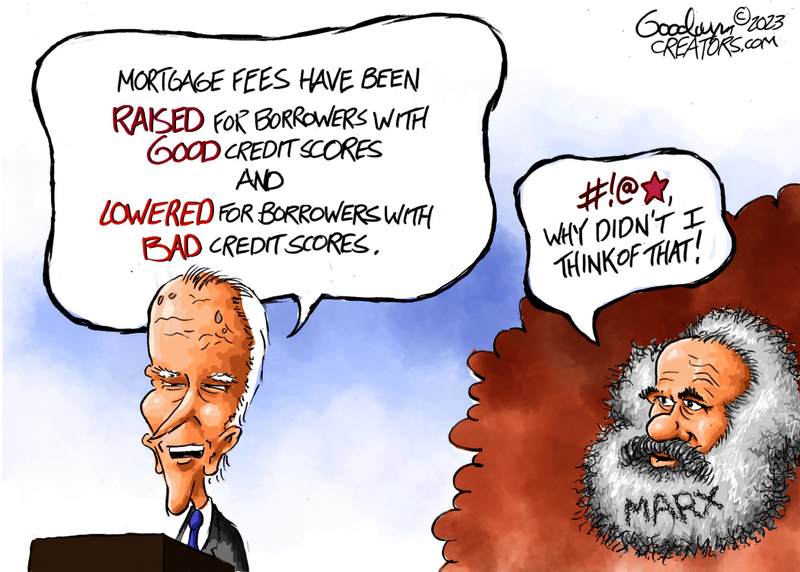
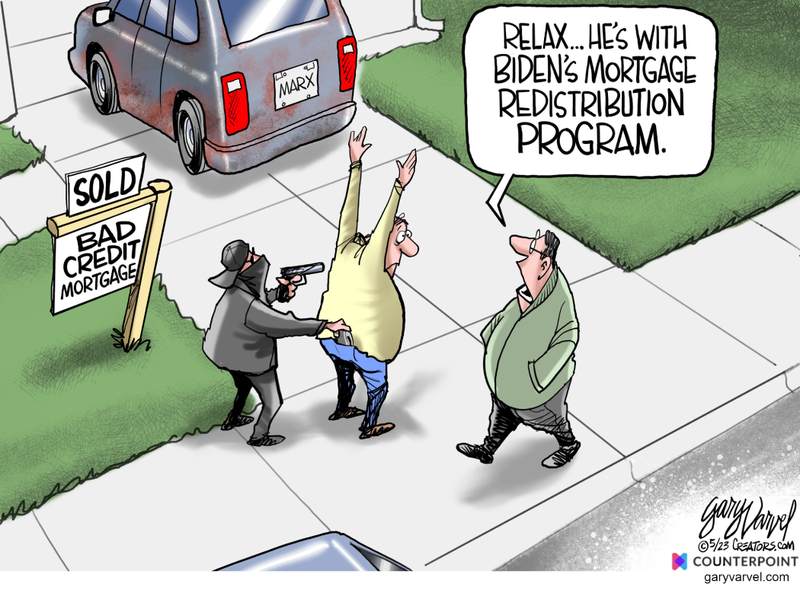
How the Feds are Fueling a New Mortgage Crisis

Perhaps you have already heard about the latest welfare gimmick from team Biden: the great shift in loan costs from high-risk borrowers to low-risk borrowers. Effective May 1, 2023, the Federal Housing Finance Agency (FHFA) approved a new schedule of upfront fees to be charged by two of its regulated entities, Fannie Mae and Freddie Mac.  In the table below, which pertains to home mortgage loans, the “X” axis shows the size of the down payment, with the amount getting smaller as we move from left to right. The “Y” axis shows the borrower’s credit score, with the top representing high credit scores and the bottom representing low scores...........To Read More....


Wednesday, January 11, 2023

New York City Housing Follies, 2023 Edition

January 09, 2023 @ Manhattan Contrarian 

Mostly I write about energy policy; but another important topic for this blog is housing policy, particular as practiced here in my home town of New York. For reasons that might not be immediately obvious, these topics of energy and housing policy are closely related. Both involve ignorant politicians promising to supplant the imperfect freedom-based economic system and achieve utopia by using their coercive powers to order that it shall be so. Yet somehow, utopia continues to elude us, and the government mandates only make things worse. And no lessons are ever learned.

Today’s topic is the latest in New York housing policy, and its inevitable consequences. Currently, both houses of our State Legislature, as well as the Governorship, are in the hands of the progressive wing of the Democratic Party. We have a rent regulation regime that dates all the way back to World War II (with many modifications along the way), and a resulting situation that is universally described as a “housing shortage.” Available apartments are scarce and expensive. Small amounts of new housing are built annually, but largely for a small slice of the market at the very top.

To our reigning politicians, the solution is obvious: order that rents be restricted and that the housing that gets built be made “affordable” and allocated by government lotteries to income-restricted beneficiaries. How are these policies working out?

Consider first the restrictions on rent levels. From the 1970s to 90s, we had an extremely tight rent-regulation regime, where landlords had almost no ability to raise rents, even in times of high inflation and even on apartments that had been vacated. The number of new apartments built during this time was barely above zero. In the 90s, a Republican-controlled State Senate and a Republican Governor were able to achieve a number of significant loosenings of the restrictions, the most important of which were: (1) on vacancy, a landlord could raise the rent 20% as of right, (2) if a landlord did what were called “major capital improvements” on the apartment, he could increase the allowed rent to recover the amount invested over 15 years, and (3) if the allowed rent went above $2500 as a result of (1) and (2), then the apartment was removed from the control system entirely. All these regulations made for a very cumbersome system, but nevertheless led to the rate of new construction multiplying by around a factor of seven.

In the 2018 election, the progressive Democrats were able to re-take full control of the Legislature and the Governorship for the first time in decades. One of their first priorities (along with “climate” legislation) was to get rid of the 1990s rent regulation reforms, particularly items (1), (2) and (3) of the previous paragraph. In June 2019 they passed an act called the Housing Stability & Tenant Protection Act of 2019. The 20% vacancy allowance was eliminated. The “major capital improvement” recovery was restricted to a fraction of what it previously was, and with a cap of $15,000 for any apartment. The “luxury decontrol” provision was eliminated. That’ll show those evil landlords!

By the summer of 2022, some preliminary results were in. A local newspaper for the real estate industry called The Real Deal had a piece on July 5 with the headline “In housing-starved NYC, tens of thousands of affordable apartments sit empty.” Excerpt:

[Thousands] of rent-stabilized apartments . . . now sit unoccupied and unavailable in a city desperately in need of low-cost housing. . . . The Housing Stability and Tenant Protection Act, a sweeping rent reform passed by the state Legislature in 2019, dramatically limited landlords’ ability to increase rents on stabilized apartments. The measure ended the vacancy bonus that had allowed owners to raise rents 20 percent when stabilized units became unoccupied. It also reduced to $15,000 over 15 years the renovation costs that landlords can recover by hiking rents.

How many apartments now sit vacant as a result of these restrictions?

In April, CHIP [Community Housing Improvement Program, a landlord trade organization] launched a campaign to call attention to the city’s unrentable housing stock. The group estimated that 20,000 rent-stabilized apartments in the city were empty because renovations were not economically feasible. In May, the city’s Department of Housing Preservation and Development released a more staggering number: nearly 43,000 vacant but unavailable units.

To show how the incentives have been undermined, the Real Deal interviews a small landlord named David Eshaghoff:

Eshaghoff’s empty apartments — about a dozen of his 200-unit portfolio — need repairs. Collapsing ceilings, disintegrating plumbing and shoddy electrical work render them uninhabitable. But he said that because of New York’s [2019] rent law, there is no economic rationale to fix them — even if he could afford to.

But don’t worry — New York’s politicians think they have the answer to where the additional low-cost apartments are going to come from. They’re going to order them to be built.

On December 8 Mayor Adams announced what he called his “moonshot” program, with a “bold three-pronged strategy,” to get some 500,000 new apartments built. The program does include some useful items, like permitting reform, but nothing to get rid of the legislature’s destructive new rent restrictions, nor anything to rein in the ability of local politicians, particularly City Council members, to hold projects ransom for their own extortionate demands.

So consider this next piece from The Real Deal, with a date of January 5, headline “Pol who sank Harlem housing project rallies against truck lot on property.” It seems that a developer named Bruce Teitelbaum controls a largely-vacant property at 145th Street and Lenox Avenue — right on top of a major subway station. He proposed to build a two-tower project on the property, containing over 900 apartments. In accordance with official New York religion, he proposed to make half of the apartments “affordable,” aka subject to income and rent-level restrictions:

The developer had offered to set aside half of the proposed complex’s 917 apartments as affordable to win Richardson Jordan’s support for the project — a vital prerequisite under the City Council’s tradition of deferring to the local member on land-use issues in a given district.

But the local City Council member, Kristin Richardson Jordan, objected, demanding that 100% of the apartments be made “affordable”:

Richardson Jordan . . . argued that the units would not be sufficiently affordable for her constituents and said she would not budge unless 100 percent of the units were income-restricted.

Result: Teitelbaum has decided to make the site into a truck parking lot instead, which he can do as of right under existing zoning. The Real Deal quotes him as follows:

“[Richardson Jordan] explicitly said that she actually preferred us to develop the site for parking, storage or our other as-of-right permissible uses, unless we built 100 percent of the apartments for folks earning an average of about $40,000 or less which she knew was impossible,” Teitelbaum said in a statement, going on to accuse the Council member of “trying to create a false narrative to justify her failure.” “We never had another choice,” Teitelbaum added.

I wouldn’t count on seeing Adams’s 500,000 units of new housing any time soon.

Friday, July 29, 2022

The Ongoing Disaster Of NYCHA: Why It's A Mistake Ever To Start Down The Road To Socialism

December 08, 2021 @ Manhattan Contrarian  

Editor's Note: This was tucked away in my draft file and forgotten, until now, and is still worth viewing.  RK

NYCHA — the New York City Housing Authority to local cognoscenti — has been one of my favorite topics over the years. For a sampling of prior posts see here, here, here and here.

Multiple factors make NYCHA a core subject matter for this blog. First, it is one of the most prominent and largest examples in the U.S. of a major enterprise that operates on a very pure socialist model, with full public ownership of the assets and distribution of the “benefits” (deeply discounted housing units) on the basis of perceived “need.” Second, NYCHA has failed catastrophically, and for all the reasons that socialist endeavors are always doomed to inevitable failure. Third, NYCHA has demonstrated an ability to coerce for itself one taxpayer-funded rescue after another, making it an excellent illustration of the seeming inability to ever get rid of, or even scale back, a socialist failure, no matter how obvious or how disastrous it may be or how much it costs to keep it going. And finally, NYCHA illustrates the exploitation of ongoing failure as a way to enrich the well-connected cronies of politicians.

Previous posts here have reported how, after a few decades of incompetent and/or deferred maintenance and upgrades, NYCHA had managed to dig itself into a huge financial hole. In 2015 NYCHA came out with a report admitting that it had an immediate need for about $17 billion to fix its buildings, and no way to collect that from tenants through rents. With around 170,000 apartments, this would be around $100,000 per apartment. But then the $17 billion started to grow, first to $25 billion, and then to $32 billion, and in the most recent iteration to about $40 billion. Now we are at well over $200,000 per apartment. I have seen reports that Senator Schumer has inserted a $40 billion earmark into the so-called “Build Back Better” reconciliation bill to cover this full amount. But that massive giveaway may or may not ever pass.

So now for the latest: A week ago, on December 1, New York City announced a deal with two developers to do a comprehensive rehabilitation and upgrade of two specific large NYCHA projects in the West Chelsea neighborhood of Manhattan. The two NYCHA projects in question are the Robert Fulton Houses and the Chelsea-Elliott Houses. The headline of the City press release reads:

 “THE NEW YORK CITY HOUSING AUTHORITY AND RESIDENT LEADERS ANNOUNCE THE SELECTION OF ESSENCE DEVELOPMENT AND THE RELATED COMPANIES TO PROVIDE APPROXIMATELY $366 MILLION IN COMPREHENSIVE REPAIRS AND INVESTMENTS FOR 2,054 APARTMENTS IN THE CHELSEA SECTION OF MANHATTAN THROUGH THE PACT PROGRAM.”

Wow! That sounds great. What’s not to like? Actually, everything about this deal is terrible for the City and its taxpayers. Nor is the deal anything good for the residents of the projects, but that is another issue — they have been bought into permanent dependency. Nevertheless, in the real world, I will probably be the only person speaking out against this.

First, some background that will be particularly informative for readers not familiar with Manhattan. The Chelsea neighborhood is on the West Side of Manhattan from about 14th Street to 34th Street. It was developed in connection with the commercial port activities that were the dominant industry in New York in the 19th and early 20th centuries. After World War II, the port went into rapid decline, as did the associated businesses and buildings in the blocks near the Hudson River. By the 1960s — that’s when the Fulton and Chelsea-Elliott Houses were built — the area was a mostly-derelict backwater.

But at some point Chelsea became increasingly fashionable. The older buildings got upgraded, and fancy new condos got built. Today, you would be hard-pressed to find a two bedroom apartment in Chelsea for under $3 million to buy, or $4000/month to rent. Diagonally right across the street from the Fulton Houses at 9th Avenue and 16th Street we have the New York headquarters of Google (previously the very largest of the warehouse buildings of the area, built by the New York Port Authority).

According to this website covering New York City commercial real estate, the assessment of this building is over $1 billion (market value would probably be well over $2 billion), and the property taxes on this one building for the 2021-22 year come to some $48.5 million. If you used Google today, I thank you as a New York City taxpayer.

And then, literally right across the street, we have the Fulton Houses. This morning I wandered over there (it’s about a 10 minute walk from where I live) and took this picture of a part of the complex:

Aside from being painfully ugly and in poor condition, the most remarkable thing about this project is that it has no value. And by no value, I mean zero. Hey, this is socialism. Apartments there cannot be bought or sold for any price, but instead get handed out by government functionaries according to some socialist concept of fairness. (Go through a 25 year waiting line, or alternatively try to jump the queue by making yourself homeless.) While Google pays nearly $50 million in property taxes per year for its 3+ acres across the street, these buildings (along with Chelsea-Elliott), sitting on as much or more land, pay no property taxes at all, and instead have a declared need for almost $400 million in rehabilitation that must be paid by someone else. Rents from existing tenants won’t pay any meaningful part of that.

And thus the newly announced deal. Two developers have been “selected” through a politicized process to rehabilitate the buildings. The cost is said to be $366 million for a little over 2000 apartments — more than $180,000 per apartment. The developers will do the renovations, and after those are completed, will manage the projects.

The lead developer is Related Companies, one of the City’s biggest, and best-connected, developers. The other developer is an MBE (Minority Business Enterprise) that Related cleverly brought into the process.

Are the developers putting in even a dime of their own money? Funny, but nothing in the press release mentions a thing about that, or about where the money is coming from, other than that this is part of the New York City PACT (“Permanent Affordability Commitment Together”) program. Here’s an article from Real Estate Weekly on December 1 with some more information. Again there is no suggestion that the developers are putting up any of the $366 million. Instead, that will come from City and federal funds:

New York City Housing Development Corporation (HDC), the local housing finance agency, will assemble the financing and provide asset management and compliance for the PACT transactions. The balance of the repair bill will come via PACT through the federal government’s Rental Assistance Demonstration program, or RAD, an Obama-era program that allows private companies to manage public housing, giving them responsibility for maintenance, repairs and rent collection.

So Related puts up nothing, and undoubtedly gets fees for the rehab, plus an ongoing management contract. Oh, and then there’s the right to put up a new building, and potentially several more such, on the NYCHA land.

Once the work is done to the tenants’ satisfaction, the developers will get to build a new 100-unit apartment building on West 27th Street . . . While today’s announcement only confirmed one new ground-up building that will rise on 27th Street, NYCHA has said in the past that potential new developments could add up to 700 units to the four sites that make up the complexes, half of which, under the deal, would be income-restricted affordable housing.

And what about property taxes on the new building(s)? Funny, there’s no mention of that either. Draw your own conclusions. These people from Related are very well-connected, and they are not stupid.

So Related puts up nothing and makes out like a bandit. New York has lost for at least another generation the opportunity to get rid of these eyesore buildings and use this very valuable land for some productive economic purpose. And a few thousand people get to live a deeply-subsidized life in one of the wealthiest neighborhoods in the country, but as permanent dependents of the state.

The subsidy to the existing tenants, if measured by the prices of comparable rental apartments in the neighborhood, would come to at least $50,000 per year per apartment, or $100 million per year for the 2000 apartments in question. Between that loss and the foregone property taxes, there would be plenty of money here to buy out all the existing tenants at prices they would be happy to take, and remove them from state dependency. Maybe buy each of them a fully-paid no-mortgage house in a low cost market like upstate Syracuse or Utica.

But that’s not how it works here. For us, it’s a moral imperative to provide “permanently affordable” apartments at enormous cost in ridiculously expensive neighborhoods. Why? I don’t know.

Even the New York Post this morning was on board with praising this deal:

The deal is a definite “win” for the tenants at Fulton-Chelsea Houses and another success for [NYCHA head] Russ as he strives to save NYCHA . . . .

What about this is worth saving?

Friday, May 21, 2021

Pandemic Pressures Unwinding in Housing

Bob Hughes Robert Hughes  – May 18, 2021 @ American Institute for Economic Research 


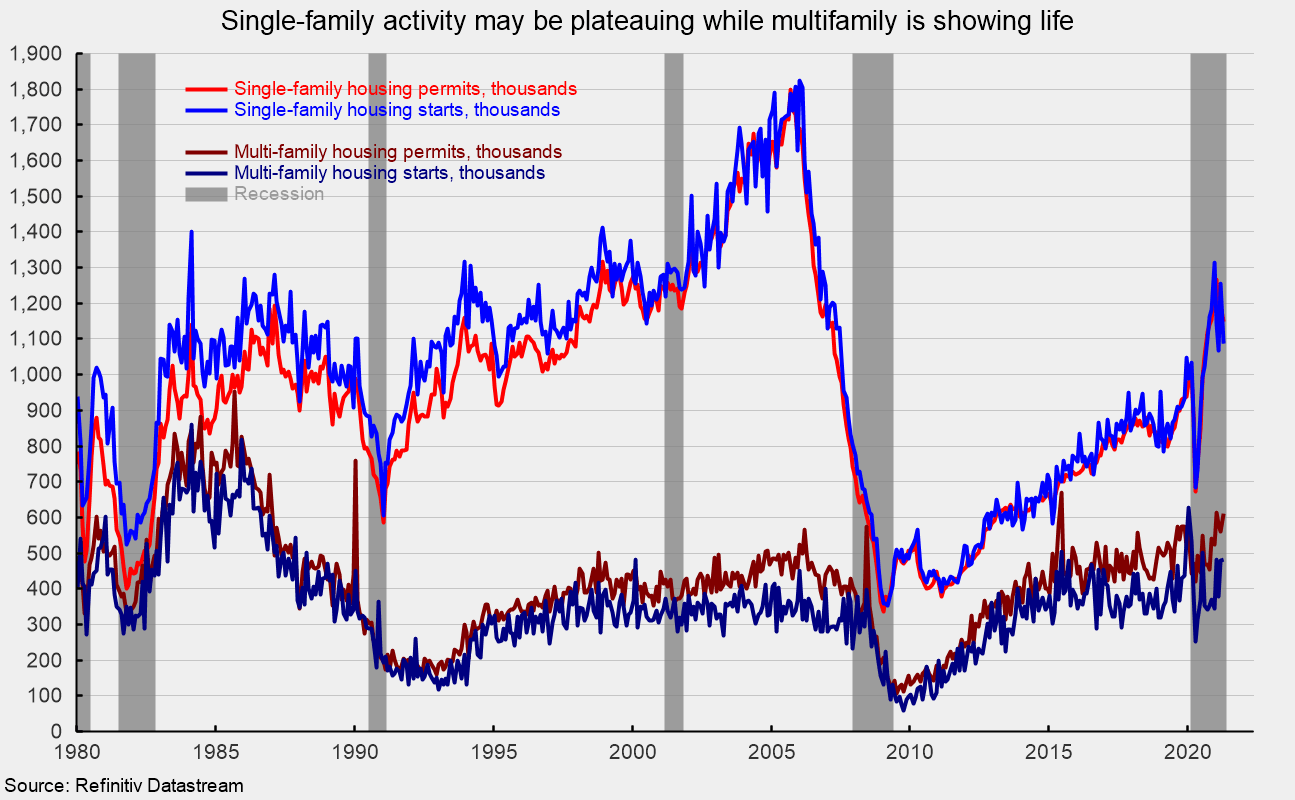
The various segments within housing construction had widely varying results in April. Total housing starts fell to a 1.569 million annual rate in April from a 1.733 million pace in March, a 9.5 percent decrease. From a year ago, total starts are up 67.3 percent. For housing permits, total permits rose 0.3 percent to 1.760 million in April from 1.755 million in March. Total permits are 60.9 percent above the April 2020 level.

The dominant single-family segment saw starts fall 13.4 percent for the month to a rate of 1.087 million but are up 58.7 percent from a year ago. Single-family permits were off 3.8 percent at 1.149 million (see first chart).

Starts of multifamily structures with five or more units rose 4.0 percent to 470,000 and are up 95.7 percent over the past year and starts for the two- to four-family-unit segment plunged 53.8 percent to 12,000.  Multifamily permits for the 5-or-more group rose 11.1 percent to 559,000, a rise of 44.4 percent from a year ago, while permits for the two-to-four-unit category dropped 10.3 percent to 52,000. Combined, multifamily permits were 611,000, up 8.9 percent for the month (see first chart), and just the fourth month above 600,000 since the mid-1980s. 

Single-family home construction had been one of the strongest parts of the economy last year and excluding the plunge in activity during the government-enforced lockdowns in early 2020, single-family housing activity has been on an upswing for most of the last decade, recovering from the housing bubble and collapse of the late 2000s (see first chart). 

The post-lockdown recovery has been supported by a surge in demand as consumers sought less dense housing.  However, since October 2020, multifamily permits have staged a strong recovery, gaining 34.6 percent and since December, single-family activity has been trending slightly lower. It may be that some of the rush to less dense housing that drove single-family activity in 2020 is starting to ease as the economy opens, more people get vaccinated, and workers return to offices.


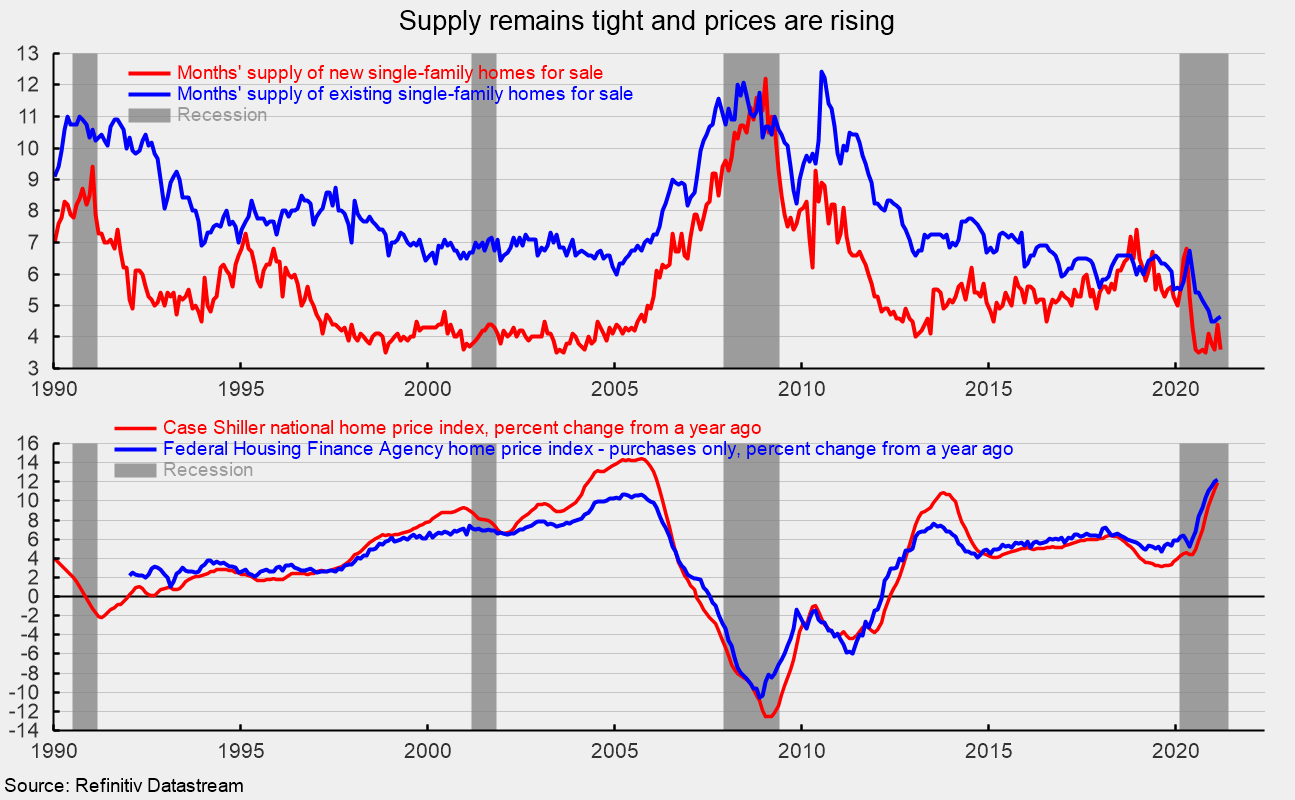
Despite some possible reversing of home ownership preferences, home prices continue to post strong gains amid continuing tight supply. If the recent trends continue, price increases are likely to decelerate and supply constraints should begin to ease.

Overall, housing may have enough momentum to grow at a solid pace in 2021 but the combination of reverting home preferences and rising home prices will likely lead to some cooling.

Robert Hughes

Bob Hughes

Robert Hughes joined AIER in 2013 following more than 25 years in economic and financial markets research on Wall Street. Bob was formerly the head of Global Equity Strategy for Brown Brothers Harriman, where he developed equity investment strategy combining top-down macro analysis with bottom-up fundamentals.

Prior to BBH, Bob was a Senior Equity Strategist for State Street Global Markets, Senior Economic Strategist with Prudential Equity Group and Senior Economist and Financial Markets Analyst for Citicorp Investment Services. Bob has a MA in economics from Fordham University and a BS in business from Lehigh University.

Get notified of new articles from Robert Hughes and AIER. 

Monday, April 12, 2021

Biden’s Infrastructure Bill Includes Making ‘Diverse’ Neighborhoods Across America Through Zoning Laws

By Penny Starr 11 Apr 2021 

The focus of  President Joe Biden’s $2.3 trillion infrastructure bill is allegedly to address aging infrastructure across the country, but the massive bill covers a vast amount of other spending, including money for “diversifying” neighborhoods.

This portion of Biden’s American Jobs Plan would change zoning laws to end single family home neighborhoods and allow for multiple unit “affordable” or low-income rental housing.

According to the White House Fact Sheet, the housing effort is “an innovative new approach to eliminate state and local exclusionary zoning laws, which drive up the cost of construction and keep families from moving to neighborhoods with more opportunities for them and their kids”:..........To Read More...

My Take -   First, let's get the obligatory caveat out of the way so I won't  have to repeat it.  There are many fine Americans who happen to be black.  Okay, happy?

In the meanwhile, do you like your nice quiet suburban neighborhood with low crime and little traffic? Biden aims to destroy it.  And we're surprised at this why?

When the federal government got involved in private real estate transactions and forced desegregation of neighborhoods this was inevitable, and in point of fact, this isn't a new innovation, it's been done before, with disastrous results.  It's political pandering and social engineering to appease the unappealing.

Racist? Discrimination? Prejudice?  Words that are all constantly being misused for political gain in order to 'shame' whites and impose white guilt on America. Here's what those words really mean.
  • A racist simply hates people for the race to which they belong, just like that lady who was a co-founder of BLM who hates whites and wants to kill them. 
  • Prejudice means to prejudge.
  • Discrimination means to evaluate and decide what you like or dislike.
Here's the reality.  Not liking someone for the way they act isn't racism.  I don't dislike black people, however, I do dislike black culture, which has destroyed entire cities like Detroit in America.  
 
I didn't prejudge that culture, I evaluated that culture based on reality and found it wanting.  I find a culture that's filled with crime and abortions. I find that culture is filled with single parent families with multiple illegitimate out of control children, from different absentee fathers, who refuse to attend school and when they do they refuse to learn but are great at perpetrating violence, not only against weaker students, especially if they're white, but also against black students trying to learn for "acting white", and teachers.  
 
Black culture is a culture with a 70% illegitimacy rate,  grown men standing around on street corners in the middle of the day instead of on a job, and on the government dole.  A culture with a crime rate out of control per ratio to their population.

Bureau of Justice Statistics released its 2018 survey of criminal victimization. According to the study, there were 593,598 interracial violent victimizations (excluding homicide) between blacks and whites last year, including white-on-black and black-on-white attacks. Blacks committed 537,204 of those interracial felonies, or 90 percent, and whites committed 56,394 of them, or less than 10 percent............Blacks are also overrepresented among perpetrators of hate crimes—by 50 percent—according to the most recent Justice Department data from 2017; whites are underrepresented by 24 percent. This is particularly true for anti-gay and anti-Semitic hate crimes.
 
 In Color of Crime the author noted:
 
According to the Missouri Uniform Crime Report (MUCR), 408 suspects were arrested for murder and non negligent manslaughter in 2018. Two hundred eighty, or almost 69 percent, were black.  One hundred twenty-six, or just under 31 percent, were white, despite the 83 percent white population.  This means blacks were 15.5 times more likely than whites to be arrested for murder—and in this case, Hispanics are lumped in with “whites,” so the black/white difference is probably even greater.

It would be hard to argue that arrests of blacks reflect some kind of “police bias.” Murder is the crime all police departments take most seriously. The idea that the authorities are rounding up innocent blacks or deliberately letting off white killers is ridiculous.

There are many homicides in St. Louis, which had an estimated 135,150 non-Hispanic whites (about 42.9 percent) and 149,895 blacks (about 47.6 percent), with much smaller numbers of Hispanics, Asians, and mixed-race people.

Who’s doing the killing?

The city’s police department reports that in 2013, 2014, and 2015, over 95 percent of homicide suspects were black. The 2018 report listed 187 homicides, and over 83 percent—or 156—of the victims, were black. Twenty-six were white with one Hispanic and one “other.”
 
 You may wish to view my files on
 
 And I should think all that's fine?  Well, I don't! 
 
Now, for all those who have always lived in white neighborhoods, never travel in or through black neighborhoods, don't do business in black neighborhoods, never attended a black dominated school, don't send their children to black dominated schools, and would never in a million years live in a black neighborhood who wish to insist I'm a prejudiced discriminatory racist.  Well, I'm long past caring.
 
There's a reason why blacks want to live in white neighborhoods and why whites don't want to live in black neighborhoods.  And it's much like why citizens of communist nations will do anything to come to America and no one except lunatics want to live in communist controlled countries.  But if they did, there's no line to stand in if you want to live in Russia, China, Venezuela and that's true of where people want to live in America also.  
 
Let's not confuse pandering by calling it reality, fairness, equality or anything other than it is.  Hate filled leftist pandering, and it would be well to remember hate is one of the foundations of the Democrat party.  
 
They used to hate blacks and kept them as slaves.  No Republican ever owed a slave.  Then when it became popular, and politically convenient, they hated the Japanese and violated their Constitutional rights.  Now, it's convenient for them to hate whites and would more than happily end the Constitution to get what they want, and that's to end the American identity, American culture, American economy, destroy the Constitution and impose a tyrannical system of governance in it's place.
 
It isn't that they just hate whites, it's merely convenient.  After that, they can hate all of America.....openly!  Because the left is irrational, misanthropic and morally defective. 

Sunday, July 7, 2019

California’s Regulatory Hostility Prevents More New Homes

By Edward RingJuly 2, 2019

The median home price in Los Angeles County is $618,000. In Santa Clara County it’s $1.2 million. In the entire state of California, including the somewhat more “affordable” inland counties, the median home price is $548,000.

The national median home price? $227,000.

There’s a reason for this. For decades, California’s state and local governments have made it harder and more expensive for any builder to construct new housing. In most other states, the governing agencies want more housing and they try to make it easier for builders. In California, the exact opposite is the case.

The consequences of this hostile shake-down of builders by California’s state and local governments are a housing shortage, unaffordable homes, an exacerbated homeless crisis, and increased calls for rent control (which will create even more disincentives for home builders).........To Read More....

Wednesday, November 21, 2018

Real estate trouble: reverse mortgages deplete FHA insurance reserves

November 21, 2018 By Chriss Street

The Federal Housing Administration’s 2018 audits revealed that losses from real estate reverse mortgages destroyed about a third of the taxpayer-guaranteed insurance reserves.

The FHA Mutual Mortgage Insurance Fund on November 15 reported an $8 billion profit with a $1.26 trillion portfolio of loan guarantees for the fiscal year ending September 30. FHA’s traditional single-family home loan portfolio program is very profitable due to the housing boom and has a positive economic net worth of +$46.8 billion. But its reverse mortgage program for seniors, called Home Equity Conversion Mortgage (HECM) that represents only 6 percent of FHA guarantees, disclosed its economic net worth plunged to a negative -$13.6 billion, almost triple the prior year’s negative net worth of -$5 billion.

FHA mortgage insurance now allows private lenders to make home loans for up to $679,650 to borrowers with poor credit risk of repayment FICO Scores of between 500 to 579 to obtain loans with 10 percent down payments, and borrowers with fair credit risk of repayment scores of 580 and above to obtain loans with just 3.5 percent down payments.

At the bottom of the real estate crash in 2012, FHA’s mortgage insurance fund had estimated taxpayer losses of up to $150 billion. But the Obama administration cut the taxpayer bailout cost to $1.7 billion by its Justice Department forcing the five biggest U.S. banks into $25 billion in settlements for making mortgage loans, hit banks for another $7 billion in False Claims Act fraud settlements, and pocketed billions more in penalties under the Financial Institutions Reform, Recovery and Enforcement Act.

Unwilling to make new FHA guaranteed loans and then being sued again under the False Claims Act, most large banks exited the program during the Obama administration and were replaced by undercapitalized small banks and mortgage brokers.

Congress still allows the FHA portfolio to be leveraged up to 50 times with a minimum capital reserve ratio of 2 percent. The roaring bull market in real estate has pushed up the FHA insurance fund up to an economic net worth of +$34.8 billion at the end of September, but FHA’s capital reserve ratio is just 2.76 percent, a 36 times leverage.................Read more

My Take - With the Community Reinvestment Act they forced the banks to give out loans the banks knew couldn't be paid and then punished them for doing it when the housing bubble exploded and took the nation and much of the investing world down in the last economic crash. 

Wednesday, October 10, 2018

Ending the Credit Rating Agency Racket

Stephen Moore Oct 09, 2018

This month marks the 10-year anniversary of the housing market meltdown that led to the Great Recession. Is another crisis looming around the corner?    Hopefully not, but it is worrisome that a decade later Washington is engaged in the same derelict behavior that caused the crisis. Government agencies are still issuing taxpayer guarantees on more than 90 percent of mortgages -- many with less than 5 percent down payments. Yikes.

Worse, the biggest conspirators in the meltdown, the duopolistic credit rating agencies Moody's and S&P, which gave sterling AAA grades on these bonds up nearly to the date they collapsed into financial rubble, are still dominating 80 percent of the credit rating market. Why are they even still in business?

Throughout 2007 and 2008, these agencies encouraged investors to snatch up hundreds of billions of dollars of mortgage-backed securities. They told investors these mortgages were "virtually risk-free" and stamped them with AAA ratings. Thanks to this incompetence, millions of Americans lost their life savings, and America suffered one of the greatest financial disasters in our history...........To Read More......

Tuesday, July 25, 2017

Dictatorship of the Landlords - The Green Roots of the Housing Crisis

William Kay
 
The methodology underpinning this posting consisted of a representative survey of land-use and housing documents published by leading free market advocacy groups. Of the 100 groups investigated, 21 were found to have both prominence within the pro-market advocacy community, and to have devoted conspicuous resources to the land/housing issue. From these 21 groups (Cato Institute, Heartland Foundation, Fraser Institute, Frontier Centre, Institute for Public Affairs et al), 33 reports and 35 articles were dissected. To clarify certain statistics, several additional articles and reports from the mainstream media and from government agencies were summoned. A recent Harvard study on housing and a paper on commercial property from the Journal of Real Estate Management also proved helpful. To keep things germane, the canon was restricted to documents published during the last decade.
 
From the 2,000 pages of free market think tank literature perused, some preliminary observations can be made. The groups surveyed self-identify as advocates of: deregulation, privatization, free enterprise, limited government, property rights, individual liberty, lower taxes, and competitive entrepreneurialism. While some hold up this agenda as an end unto itself, most promote this agenda as a means to achieve: economic growth; poverty alleviation; efficient resource use; and the general enhancement of opportunity, innovation, and prosperity.
 
While this entire community could be categorized as “classical liberal,” only the UK’s Adam Smith Institute keeps the “liberal” flag flying. The word “liberal” has been anathematized across the English-speaking world’s pro-market community, especially in the USA. Despite this, surprisingly few of the surveyed groups embrace the term “conservative.” Most prefer epaulette collages wherein “free market” and “limited government” find salience......To Read More...