In my recent column listing the “Best and Worst News of 2021,” I included Joe Biden’s global tax cartel as one of the awful things that happened in the past 12 months.
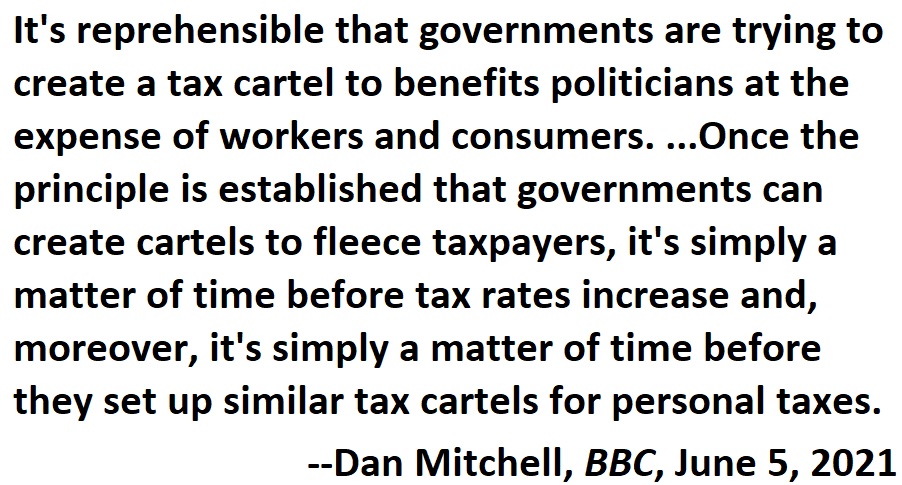
It’s bad news for workers, consumers, and shareholders that politicians approved a system that will require all nations to have a corporate tax rate of at least 15 percent.
From the perspective of politicians, it’s easy to understand why they want a tax cartel. it’s a way for them to get their hands on more money. Just as gas stations would want a system that rigs gas prices at a high level. Or grocery stores would want a system to rig high food prices.
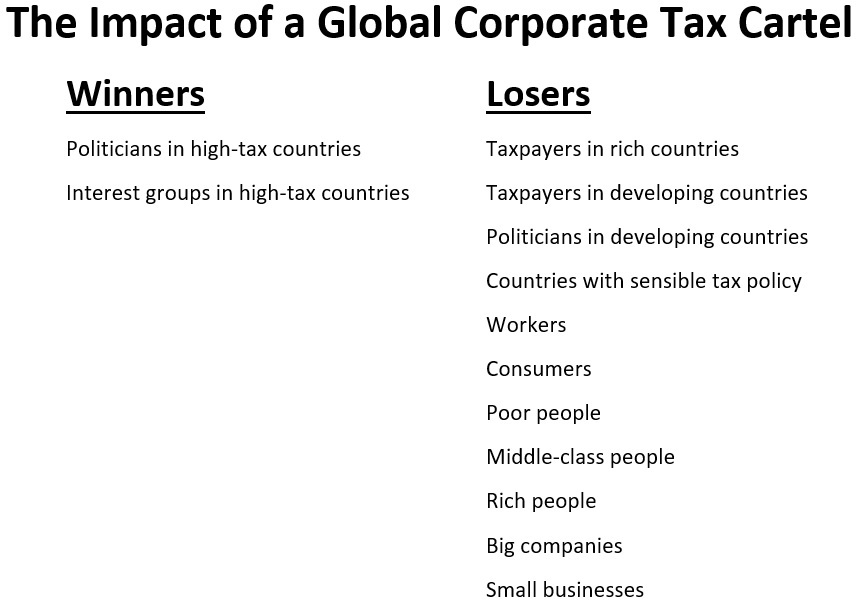
From the perspective of taxpayers, however, tax competition is much better. Politicians have a much harder time raising tax rates (and in many cases feel pressure to lower tax rates) when they know that jobs and investment can shift across borders from high-tax nations to low-tax nations.
As illustrated by this visual.

To explore this issue in greater detail, let’s look at a new article, written by Sven Larson for the European Conservative.
First, a quick history of the global campaign against low taxes. …it has been spearheaded by the Organization for Economic Cooperation and Development, OECD. This government-funded international think tank has built an international cartel of more than 130 governments to battle tax competition.
…People who want to keep more of their own money, and who want to enjoy strong privacy laws, are being told by the OECD and the tax cartel that their financial planning is “harmful.” The purpose behind the OECD-led campaign is both sinister and transparent: to make sure taxpayers in high-tax countries have no low-tax options. …It won a big victory this past summer when the countries in the G-7 group complied with the directives of the OECD and agreed to create a global minimum corporate-income tax.
This is spot on.
The OECD is a pro-statism international bureaucracy that looks after the interests of politicians rather than citizens.
Sven also makes a great point about how the corporate tax cartel is just the beginning.
This tax cartel is only the beginning. Once countries with costly governments have created a Berlin Wall around their high-tax jurisdictions, they will be free to collude on other taxes beyond the corporate income tax. Personal income taxes, wealth taxes, death taxes… there is no end to the imagination of a government that does not have to worry about tax competition.
Also spot on.
You should read the entire article. But for purposes of my column, I’m going to highlight one additional point – which is Sven’s observation about how human rights are better protected in a world where people can safely invest their money where national governments can’t grab it.
There are also reasons related to individual freedom to preserve low-tax jurisdictions. To take just one example, in 2017, …Turkish President Erdogan accused investors of “treason” if they moved their assets out of the country. Erdogan’s comments, France24 explains, came on the heels of Turkish prosecutors seizing the assets of an investor who had testified in a court in New York on how a Turkish bank circumvented U.S. sanctions against Iran. The asset seizure easily comes across as retaliatory and meant to send a signal to others who might act in ways that would displease Mr. Erdogan. A total of 23 individuals were affected by the asset seizure. If these individuals had been able to shield their assets from the Turkish government, they would have been free to oppose the Erdogan regime while working, investing, and developing their businesses.
Another argument that is spot on.
The bottom line is that low-tax jurisdictions should be celebrated rather than persecuted.
If the goal is better lives for ordinary people, policy makers should be criticizing tax hells rather than tax havens.

Especially when you consider that politicians have a very strong tendency to over-tax and over-spend (leading to goldfish government) in the absence of some sort of external constraint.
Or, to be more blunt, we need to restrain the “stationary bandit” that leads to “predatory government.”
P.S. Click here or here to learn about the economics of tax competition (and click here to see how many winners of the Nobel Prize agree).
P.P.S. Click here, here, and here for interesting examples of what happens when you oppose the left’s anti-tax competition agenda.
P.P.P.S. Leftists who don’t like tax competition occasionally can be clever.