Search This Blog

De Omnibus Dubitandum - Lux Veritas

Showing posts with label Free Trade. Show all posts

Wednesday, April 9, 2025

My Way or the Highway: How Trump Makes World Leaders Play Ball

Everyone talks a big game – until they get kicked off the US gravy train.

by | Apr 7, 2025 @ Liberty Nation News, Tags: Articles, Opinion, Politics

Other nations aren’t beholden to America – but they aren’t entitled to US access or money, either. President Donald Trump is spreading that message loud and clear across the globe. From Mexico to Ukraine, and from South America to South Sudan, he has come up with a handy way to push foreign leaders into playing ball. It’s a simple choice: Do it our way or do without. So far, it seems quite effective.

It’s a Southern Thing?

Having won independence from Sudan in 2011, South Sudan is the newest nation in the world. It’s also the latest foreign government to run afoul of the president’s deportation policies. In 2025, the small African nation has taken a page out of Colombia’s book and is refusing to accept flights of South Sudanese deportees from the states. And, just as it did with Colombia, the Trump administration has a solution.

Secretary of State Marco Rubio announced Saturday that all visas held by South Sudanese nationals will be revoked, and no new ones will be issued. “Enforcing our nation’s immigration laws is critically important to the national security and public safety of the United States,” the US Department of State said in a statement. “Every country must accept the return of its citizens in a timely manner when another country, including the United States, seeks to remove them.”

The policy may be reevaluated once South Sudan is “in full cooperation,” the statement said.

It wasn’t too long ago that a South American country tried the same thing. As Liberty Nation News Editor-in-Chief Mark Angelides wrote in January, “Colombia made a big show of refusing to accept flights of returning illegal migrants from the United States.” President Gustavo Petro had made a series of X posts demanding deportees be treated with the “dignity that a human being deserves.” Such virtue signaling was clearly just posturing. “Trump was far from amused and immediately put the full power of the executive to work,” Mark reported. “From tariffs to sanctions – surprise, surprise – it worked. By Sunday afternoon, just a couple of hours after Trump’s response, President Petro sent his presidential plane to pick up the deported individuals in Honduras.”

From Mexico to Ukraine, the Dollar Reigns Supreme

Volodymyr Zelensky, president of war-torn Ukraine, came to America in February, ostensibly to sign a deal giving rare earth minerals to the US. The idea was that having American personnel on the ground – even civilians – would secure a ceasefire with Russia simply because Vladimir Putin wouldn’t risk killing them and instigating all out war with an actual superpower.

Instead, he seemed to try to renegotiate the deal at the White House, in front of the press, and he got quite heated in the process. President Trump and VP JD Vance were having none of it. Zelensky left with his proverbial tail between his legs – only to post on X shortly after thanking Trump for the visit and expressing his desire to work with America. Now Ukraine is scheduled to send a team to DC next week for talks on a new mineral deal.

Liberty Nation depends on the support of our readers.

Trump threatened Mexico with increased tariffs if the southern nation didn’t do something to stop the flow of illegal immigrants and drugs into the US. President Claudia Sheinbaum Pardo said on social media: “We categorically reject the White House’s slander of the Government of Mexico alleging alliances with criminal organizations, as well as any intention to interfere in our territory.” She went on to say that Mexico doesn’t want fentanyl to reach the US – or anywhere else.

But just a couple of days after this, Mexico lauded a massive fentanyl bust near the border – the largest such bust in the nation’s history, allegedly. As many said at the time – including Trump – if they can do it now, they could have done it before. So why didn’t they?

Teddy Roosevelt often said, “speak softly and carry a big stick.” Somewhere along the way, one of America’s presidents sat that big stick down somewhere and too few have been able to find it since. Perhaps President Trump found it or maybe he brought his own to Washington but, either way, he isn’t afraid to swing it.

~

Liberty Nation does not endorse candidates, campaigns, or legislation, and this presentation is no endorsement.

Read More From James Fite Editor-at-Large

Monday, June 10, 2024

Global Trade Means More Prosperity

June 8, 2024 by Dan Mitchell @ International Liberty

Editor's Note:  I love much of what Dan produces when it comes to taxes, regulations, free speech, education, and a host of conservative issues.  In this article there's much here that's true, but there's much here I disagree with, but I'm running it in conjunction with my article,  Libertarians and Groucho Marx.  Libertarians live in a dream world where free trade is ....welllll.... free.  It isn't!  Here's my analysis of Libertarianism as a whole.  After reading this article and my analysis ask yourself:  Do you really believe Dan's going to vote for the Libertarian candidate? 

In 2019, the Center for Freedom and Prosperity released this video documenting the benefits of free trade.

The case for free trade between nations is the same as the case for free trade between states. Or between cities. Or between households.

http://freedomandprosperity.org/wp-content/uploads/2017/01/Trade-poll-economists.jpg

Economists from the right and left agree that we all become richer when there’s more competition and more specialization.

Sadly, this common-sense understanding of trade is not very popular in Washington. Both Biden and Trump are protectionists, either because they don’t understand economics or because they want to get votes and money from special interests.

To understand the cost of Biden-Trump protectionism, let’s look at a recent study by the Peterson Institute for International Economics.

The authors, Gary Clyde Hufbauer and Megan Hogan, calculated what global trade has meant for American prosperity. Here are just a few of the highlights.


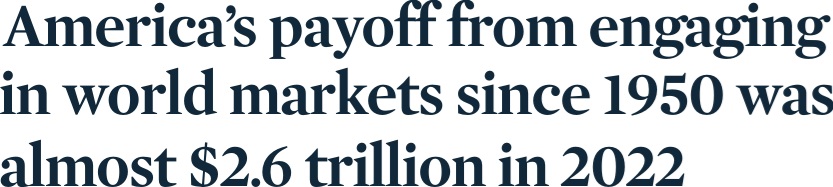
This Policy Brief updates previous estimates of the payoff from globalization to the American economy… The bottom line, argued here, is that post-World War II engagement with the world economy by the United States generated cumulative gains over several decades that, in the year 2022, lifted annual US GDP by 10 percent in that year, about $2.6 trillion… The $2.6 trillion in gains in 2022 work out, on average, to about $7,800 per person and $19,500 per household.18 Average gains in 2022 would have been considerably larger but for political headwinds that have slowed trade expansion.

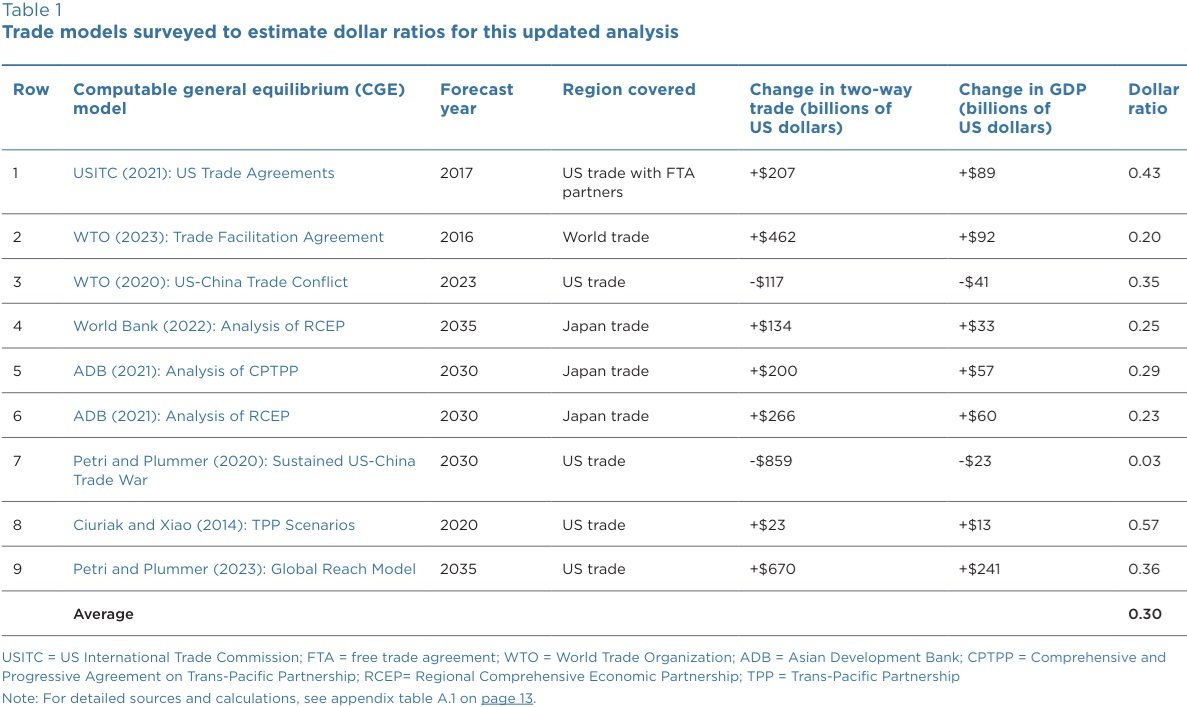
For wonky readers, here’s Table 1 from the report.

As you can see, every bit of economic analysis concludes that free trade leads to a bigger economic pie, while protectionism produces the opposite result.

Sadly, there are big headwinds against pro-growth global trade today.

It’s not just Biden and Trump. The European Union wants to use global warming as an excuse to impose huge trade taxes.

Backsliding on trade is bad news for rich people and rich countries. Even worse, it’s bad news for poor people and poor countries. Simply stated, copying Herbert Hoover (or copying North Korea!) is not a good idea.

P.S. Makes me miss Reagan even more than usual.

P.P.S. I sometimes disagree with the Peterson Institute.

Thursday, December 15, 2022

Are Free Traders Guilty of Naïve Globalism

Donald J. BoudreauxDonald J. BoudreauxDecember 12, 202 @ American Institute for Economic Research

(Editor's note:  I published this piece because think this is well done, however, while in principle I embrace the concept of free trade, I recognize for free trade to be universally beneficial, it must be foundationally capitalistic, and must rely on the idea that "everyone" in the world of trade also embraces capitalism and free trade, which is the flaw in this piece.  The rest of the world does not!  I don't consider free traders as naive, I think they're foolish.  Ergo, I favor beneficial and equitable free trade.  That's the very foundation for solidly capital generating societies.  RK)

Samuel Gregg’s 2022 book, The Next American Economy, is an important and brilliant achievement. Gregg eloquently champions the free, commercial society against its many detractors. Among these detractors, of course, are today’s so-called “national conservatives” (some, but not all, of whom might fairly be described as Trumpian). But no less hostile to the liberal economy that Gregg ably defends are Progressives. While on many fronts national conservatives and Progressives have significant differences, on the economics of international trade, both groups commit the same slew of factual and theoretical errors.

Gregg’s manner of exposing these errors is so scholarly, so fair-minded, and so patient that the reader is surprised to realize, upon reaching the book’s end, that he or she just encountered an absolute evisceration of the modern case for protectionism, and of its fraternal twin, industrial policy.

Gregg also wisely counsels his fellow champions of free trade on how best to make their case to the general public. Specifically, Gregg advises taking account both of the reality of the nation-state and of people’s affections for their country. The pleas of radical libertarians who treat national borders as phenomena that are either unreal or irrational will fall on deaf ears.

I agree with all Gregg says about the prominent place occupied in people’s minds and hearts by the nation-state. And of course I also agree that the nation-state isn’t going away any time soon. These facts are of the sort that Frank Knight and James Buchanan described as “relatively absolute absolutes.” Like them or not, these facts are best taken as given.

But on my reading, the liberal case for a policy of unilateral free trade has from the start (and ever since) not been much infected with naïve globalism. It has focused overwhelmingly on the benefits of free trade to people of the home country. Arguments that might be described as ‘global cosmopolitanism’ have never played a role that’s more than peripheral role in the liberal campaign for free trade.

Yet the false impression that liberal advocates of free trade naively ignore the salience of the nation-state is indeed widespread. This impression is created, however, not by free trade’s liberal supporters, but instead by free trade’s illiberal opponents. Whether out of ignorance or cunning, a familiar protectionist tactic is to falsely accuse advocates of free trade of putting the interests of foreigners on a par with, or even ahead of, the interests of fellow citizens.

A few years ago, for example, just before he and I were to debate free trade at Hillsdale college, the outspoken protectionist Ian Fletcher asked me why American libertarians are so willing to put the interests of foreigners over the interests of Americans. Fletcher seemed genuinely to believe that free-traders’ foundational argument is that free trade enriches poor countries by more than it impoverishes rich countries and, therefore, free trade is justified by a cosmopolitan utilitarian calculation.

If we free traders really made our case on such grounds, we would indeed deserve much of the blame for whatever skepticism the public has of free trade.

But in fact, the core case for free trade has never taken such a form. Both the theoretical and practical cases for a policy of free trade have always emphasized the gains bestowed by free trade, I repeat, on the people of the home country. Read Adam Smith. Read Frédéric Bastiat. Read Henry George. Read William Graham Sumner. Read Gottfried Haberler, Milton Friedman, Leland Yeager, Jagdish Bhagwati, Arvind Panagariya, Russ Roberts, Dan Griswold, Scott Lincicome, and Doug Irwin. Read any remotely prominent proponent of free trade – or read even me – and you will find, front and center, arguments that demonstrate that free trade is a boon to the home country, whether that country be rich or poor, big or small, industrial or agricultural.

You will, in addition, it’s true, often find arguments about how home-country moves toward free trade help also to enrich foreigners. But such arguments are not central to the case for free trade, and for good reason: trade is positive-sum. Whenever trade is made freer in the home country, net economic gains are created both for fellow citizens and for foreigners. There’s simply no need to justify free trade by resorting to a utilitarian calculus in which net gains to foreigners are weighed against net losses to fellow citizens, for such losses are mythical.

The fact that the case for free trade is mistakenly regarded by so many people to be rooted in global cosmopolitanism is a cheap public-relations victory for protectionists. They incessantly repeat untruths about free trade, such as that free trade with low-wage countries lowers American workers’ wages. Another false, but frequently heard, accusation is that America runs trade deficits only because foreign countries engage in “unfair” trade practices, or because insufficiently patriotic American leaders allow foreign countries to take advantage of ordinary Americans. These and similar untruths convey the impression that American supporters of free trade are either dupes who are blind to the damage done to the U.S. economy by free trade, or are starry-eyed globalists willing to sacrifice the interests of fellow Americans to those of foreigners.

Aiding and abetting this misperception of the case for free trade is much of the familiar language used in discussions of trade. The term “trade deficit” itself suggests that countries that run such deficits lose to their trading partners. Some familiarity with economics is required to understand this suggestion’s profound error. Most people aren’t sufficiently familiar with economics to detect the error, so protectionists successfully portray America’s nearly half-century-long unbroken string of annual trade deficits as evidence that free trade is inflicting on the US economy serious damage. In turn, free-traders who oppose protectionist policies that are peddled as means of reducing US trade deficits are easily cast as haughty or ​​naïve globalists.

Such misperception is furthered by language, even in official documents, that commonly describe a government’s decision to lower the import barriers it has erected against its own citizens as a “trade concession.” (An example occurs in this “Glossary of Terms” issued by the World Trade Organization: “Free-rider: A casual term used to infer that a country which does not make any trade concessions but profits, nonetheless [from] tariff cuts and concessions made by other countries negotiating under the most-favoured nation principle.”)

How can misunderstanding not be spread by official language that describes reductions in trade barriers as “trade concessions”? Concessions, it’s natural to ask, to whom? Well, to foreigners. It follows, in this bizarro view of trade, that free traders who advocate that home-country trade barriers be unilaterally lowered plead with the home government to ‘concede’ benefits to foreigners without receiving similar benefits in return. Free traders thus appear, falsely, to be utopian globalists who are insufficiently attentive to the sentiments and welfare of fellow citizens.

Ludwig von Mises summarized well the core liberal case for free trade:

However, the inference from [David] Ricardo’s free-trade argument was irrefutable. Even if all other countries cling to protection, every nation serves its own interest best by free trade. Not for the sake of foreigners but for the sake of their own nation, the liberals advocated free trade.

Free trade does indeed enrich the world. But it also, and chiefly, enriches the people of each country that practices it, regardless of the policies pursued elsewhere. This latter fact alone suffices to justify each government pursuing a policy of unilateral free trade.

Donald J. Boudreaux

Donald J. Boudreaux

Donald J. Boudreaux is a senior fellow with American Institute for Economic Research and with the F.A. Hayek Program for Advanced Study in Philosophy, Politics, and Economics at the Mercatus Center at George Mason University; a Mercatus Center Board Member; and a professor of economics and former economics-department chair at George Mason University. He is the author of the books The Essential Hayek, Globalization, Hypocrites and Half-Wits, and his articles appear in such publications as the Wall Street Journal, New York Times, US News & World Report as well as numerous scholarly journals. He writes a blog called Cafe Hayek and a regular column on economics for the Pittsburgh Tribune-Review. Boudreaux earned a PhD in economics from Auburn University and a law degree from the University of Virginia.

Get notified of new articles from Donald J. Boudreaux and AIER.

 

Saturday, May 14, 2022

Don’t Sweat the Trade Deficit

Editor's Note:  I've posted this in response to Dan's article: My Take on Dan Mitchell's "Don’t Sweat the Trade Deficit".  RK

When the Commerce Department announced in February that the United States had a record trade deficit for 2021, I shared this video to help make the point that those trade numbers were that year’s “least important economic news.”

The main thing to understand is that a trade deficit is simply the flip side of an investment surplus.

When Americans use dollars to buy goods from other nations, those dollars are only valuable to foreigners because they can use them to buy things from America.


In many cases, they buy American goods and services. But they also use many of those dollars to invest in the U.S. economy.

That’s generally a positive thing. It’s a vote of confidence about America’s economic future.

Jeff Jacoby of the Boston Globe shares my viewpoint. He recently opined on this issue, echoing the important insight about the link between trade flows and investment flows.


The US trade deficit hit an all-time high in March, widening to nearly $110 billion as the nation imported considerably more goods than it exported. That can’t be good, right? Actually, it’s fine. …It’s not an indication of actual economic weakness. …Quite the contrary: All things being equal, imports are usually evidence of economic vitality and success. …The dollars Americans spend on imports aren’t “lost.” They are exchanged for desirable and affordable goods, services, parts, and commodities that strengthen Americans’ economy while elevating their US lifestyle. Better still, those dollars then come back to the United States, where they are used to invest in American assets or buy American exports, creating even more value and putting even more Americans to work. …a trade “deficit” isn’t a debt we owe. It is an accounting entry that tells us how much more we were enriched by foreigners than they were by us. ..the US economy has some real problems. Happily, the trade deficit isn’t one of them. Imports are good. And more imports? They’re good too.

This does not mean, however, that everyone is a winner.

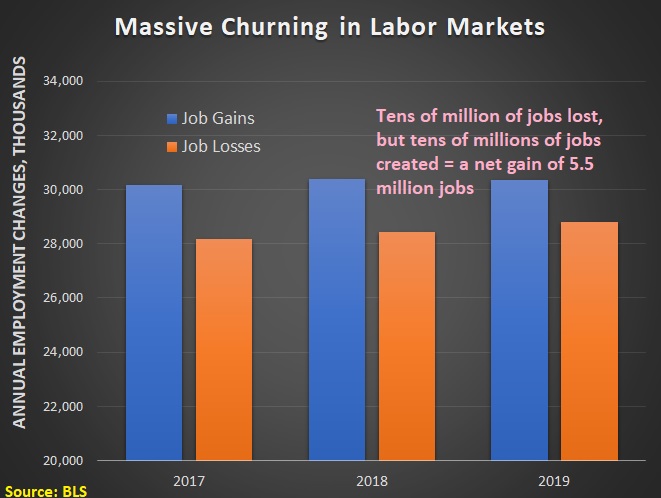
As I explain in this video, jobs are destroyed when there is trade between nations. But I also point out that jobs are destroyed by trade inside a nation’s borders.

That’s bad news for workers in sectors that are dying (such as typewriter makers after personal computers hit the market).

What’s important is whether the new jobs that are created  exceed the number of jobs that are lost.

This is what is called “creative destruction.” It’s painful, but it is why we are much richer today than we were in the past.

The good news is that this usually happens…at least if politicians resist the temptation to over-tax, over-spend, and over-regulate.

The bottom line is that free trade is much better for long-run prosperity than protectionism.

Unless, of course, you think it’s a good idea to copy the policies of Herbert Hoover.

My Take on Dan Mitchell's "Don’t Sweat the Trade Deficit"

By Rich Kozlovich

Dan Mitchell gave me permission to publish his stuff years ago, and most of his views on economics and social constructs are extremely well thought out and well referenced.  And of course I know they're well thought out because he agrees with me on them.    How could he be wrong......right? But Dan's a Libertarian, and there are times they take positions that makes me wonder what planet they're from.  Their views on "free trade" falls into that category. 

In short, I don’t really often agree with his positions on what he and others call “free trade”, and while some of his points are valid, mostly I find the rest are logical fallacies.  But he makes interesting points so I ran his piece, Don’t Sweat the Trade Deficit, and while normally I just ignore his pieces on tariffs and free trade - today I really ran it so I could rant against it.

While in principle I agree with the concept of free trade, and I totally agree that “Creative Destruction” is economically and intelligently normal and natural, and even though jobs are lost, more and better jobs are created, and ultimately it makes everyone’s lives better over the long haul. And if government keeps their nose out of all this, “Creative Destruction” creates marvelous advancements, and is unstoppable, because people are always wanting to find something better than what they have.

However, referencing Herbert Hoover, which involves the Smoot Hawley tariff bill is misleading.  After the stock market collapse of 1929 the unemployment rate went from around 2% to just 8%.  After passage of Smoot Hawley, it shot up to 15%, which has clouded our vision of tariffs ever since.  The world's economy was widely different then. We needed the world in 1930. Today, America “is” the world’s economic back bone. If they can’t sell here, they’re pretty much out of the game.  And we need to get this.   It's our game, and if it is our game - and it is - then we need to manage the game to our benefit.  That means making the rules to benefit us.  Define those rules to benefit us, and that includes defining free trade to our benefit.

America has the only true capital generating system in the world.  Let's try and get this right.  America is the only country in the world that can feed itself, fuel itself, arm itself defend itself, create it's own internal market and pay off it's national debt.  We don't need them and before all this plays out American companies will be returning to the United States, which will have the only stable society left in the world at some point.  

As for Dan’s positions in the past claiming “Trump’s damage to international trade will take years to repair”:  That's a load of horsepucky.  These countries are incapable of creating their own national markets in order to survive. We don’t need them, they need us, even with the totally destructive, almost treasonous mismanagement of the Biden administration.

Trump’s tariffs and trade restrictions weren’t merely for economic purposes, they were for geopolitical purposes to stop aggression, especially China and Russia, and they were working. The worst thing that happened in the 20th century was when Nixon opened China up to world trade.

If Nixon hadn’t done that it’s quite possible the Chinese Communist Party may well have ended up on the ash heap of history because Mao had destroyed their economy and their social construct with his murderous insanity, which is still being practiced by the CCP.

The result?

The west has been financing this morally defective and internationally destructive government and their military buildup for decades, and now they’re trying to destroy the west, especially the United States. And so the “free trader” solution is to keep doing what’s destroying us?  Does anyone besides me think that's insane?  That certainly was not Trump’s solution, because it isn’t “free trade”.  

So who has benefited from all this free trade with China and other tyrannous nations? Certainly not the people, since most of them are just above poverty.  So, while Dan's arguments may be valid for America, they're a logical fallacy on how all societies benefit because they're invalidated by the reality of those people's existence.  They are not America.   When the Russians invaded Ukraine, the Russian soldiers were murdering and raping their civilian population, they were also raiding and pillaging the Ukrainian's homes, and they were shocked at the luxury.  Luxury I tell you!  They found Nutella in their cupboards!!!!   Imagine that. 


Nutella in their cupboards.  A chocolate hazelnut spread.  Can you imagine such extravagance?   Well, yes, I can, because you can probably find it in any grocery store in America for a few bucks.  But in Russia, that's extravagance.  So who benefited from all that "free trade"? 

The other reason was to stop the illegal actions of these countries at America’s expense, often involving patent theft. If tariffs and trade restrictions are so bad, why are the nations who are selling so much to the U.S. such major practicers of trade restrictions? If they’re practicing trade restrictions, and they are, isn’t that now part of the capitalist system of competition? If it is, and it is, then why is it intelligent economic practice to ignore all their restrictions and have "one way free trade” at our expense? After all, if they practicing trade restrictions, how can that be defined as free trade? It can’t!

American capitalism is the greatest economic gift ever bestowed on the world. American capitalists are the world’s greatest enemy. Their unbridled greed molds all they do and say, and would easily sell the world down the river for a good quarterly profit.

One caveat to all the above is the Biden administration.  Virtually everything they've done is destructive to the nation's social construct, economy and military.   Along with this insane "free trade" rationale, that's what will take years to repair, not Trump's economic policies.