Search This Blog

De Omnibus Dubitandum - Lux Veritas

Showing posts with label Chile. Show all posts

Sunday, January 2, 2022

Chile Elects A New Left-Wing President

/

Chile held a presidential election yesterday. This was a run-off between the two top vote-getters in a prior round. The candidates were José Kast of the Republican (conservative) Party, and Gabriel Boric of the Social Convergence (leftist) Party. Boric won easily, by about 56/44, and Kast promptly conceded and offered congratulations. Boric will replace Sebastián Piñera, a conservative.

Chile is one of the most prosperous countries in Latin America, with per capita GDP for 2020 estimated at $13,232 by the World Bank. In Central and South America, only Uruguay tops it, and just barely. And that $13,232 figure likely represents a Covid-induced downward blip, with Chile previously having hit per capita GDP (again, World Bank figures) of almost $16,000 in 2018. Granted, the $13,232 is sad by comparison to the U.S. (2020 per capita GDP of $63,544); but still, Chile has experienced enormous economic growth since the 1960s, and its current level of prosperity (again as measured by per capita GDP, World Bank figures) puts to shame its main rivals in Latin America like Mexico ($8,347), Argentina ($8,442), and Brazil ($6,797).

You would think that the Chileans, being there in Latin America, could look around themselves, see the failures of leftism everywhere staring them in the face, and want to have nothing to do with it. For example, there’s Venezuela. That’s where Hugo Chavez came to power in 1998 promising a vast program of nationalizations and redistributions to end poverty and reduce income inequality. Chavez’s successor Nicolás Maduro continues to cling to power today. Go to that World Bank chart and you will find a per capita GDP figure for Venezuela of $16,056. Oh, but that’s for 2014. Up to 2014, the World Bank was using Venezuela’s official numbers, which were completely fake; but then in that year Venezuela stopped publishing statistics entirely. For more realistic and updated data, try the Statista website. Here is their chart of Venezuela’s per capita GDP since 1985:

Commentary from Aaron O’Neill at Statista:

In 2019, Venezuela’s estimated gross domestic product (GDP) per capita dropped to 2,299 U.S. dollars from 3,404 U.S. dollars the year before. The country's GDP has been on a continuous downswing for about a decade now. . . . Currently, a major economic crisis is shaking Venezuela, resulting in hyperinflation, food and water shortages, and unemployment. Venezuela’s inflation rate has skyrocketed to over 900,000 percent in 2018, and the economy is suffering, with the Venezuelan GDP growth decreasing substantially each year since 2014.

I guess that whole leftism/socialism thing didn’t work out too well for Venezuela. Or consider Chile’s northeastern neighbor, Bolivia. That’s where socialist President Evo Morales came to power in 2006, again with a program of addressing poverty and income inequality through nationalizations and redistributions. Morales himself got ousted in a disputed election in 2019, but a 2020 re-run saw his socialist party again returned to power. The World Bank has 2020 GDP per capita in Bolivia as $3,143.

None of this stopped Chile’s voters from electing a guy promising the same kinds of policies. From a (sympathetic) BBC summary of Boric’s platform:

Mr Boric has promised to address [income] inequality by expanding social rights and reforming Chile's pension and healthcare systems, as well as reducing the work week from 45 to 40 hours, and boosting green investment. "We know there continues to be justice for the rich, and justice for the poor, and we no longer will permit that the poor keep paying the price of Chile's inequality," he said. The president-elect also promised to block a controversial proposed mining project which he said would destroy communities and the national environment.

I particularly like Boric’s pledge to tackle “climate change” by “green investment.” With population under 20 million, Chile represents less than 0.25% of the world total. How anything that Chile does is going to affect world climate is a mystery, but perhaps no more of a mystery than how a program of redistribution and “social justice” is going to bring the country the prosperity that has so far eluded it.

The same BBC article reports that after Boric’s election Chile’s stock market immediately fell by 10%.

Despite the election of this leftist ideologue, I would not give up hope for Chile quite yet. Since the departure of Augusto Pinochet in 1990, Chile has had mostly leftist presidents, including the avowed socialist Michelle Bachelet from 2006 to 2010, and again from 2014 to 2018. Indeed, the departing President, Piñera, who served from 2010 to 2014 in addition to his current term, may be the only avowed free-market President in the 30 years since Pinochet. Yet Pinochet’s economic reforms, including the privatized pension system, remain substantially in place. According to this summary at Wikipedia of the legislative election results from November, Boric’s party did not win an absolute majority in either house, and the legislature is very closely divided between left and right.

Still, I find it disconcerting to see images of legions of young supporters of Mr. Boric celebrating their great “victory.” Every four years a new cohort completely ignorant of the failures of socialism comes of age just in time to get involved in politics and inflict their fresh new idealism on the rest of society. And thus is the cycle of poor economic performance, and needless levels of poverty, continues in Latin America.


Saturday, January 1, 2022

Chile Election Week, Part VI: Wrecking the Constitution?

December 21, 2021 by Dan Mitchell @ International Liberty

Now that a socialist has been elected (with open support from the Communist Party), what comes next for Chile?

Lots of bad policy, for sure, but Axel Kaiser warns that the left also wants to replace the country’s pro-liberty constitution.

Axel, who is President of Fundación para El Progreso and also a Senior Fellow for the Atlas Center for Latin America, just scratches the surface in this short video. He told me that there are many other desirable provisions, including school choice.

So it shouldn’t be surprising that the left in Chile is so determined to replace it with a document that empowers politicians.

I wrote about this issue last year, citing experts (including folks on the left) who all agreed that giving politicians new powers over the economy was the clear purpose of a new constitution.


This is basically a fight about whether to replace rights with entitlements (or, in the language of philosophers, whether to replace “negative rights” with “positive rights”).

By the way, there’s research showing that a society based on liberties is the best way of generating the prosperity needed for higher living standards (i.e., the access to goods and service that proponents of positive rights claim to support).

And, earlier this year, I showed how that works conceptually.

But you don’t need empirical research or theoretical analysis. Just open your eyes and look around the world. The nations based on socialism and so-called positive rights have produced economic misery and deprivation.

By contrast, there’s a much better track record – especially for ordinary people – in countries where government plays a smaller role.

It’s tragic that Chilean voters chose the redistribution approach in Sunday’s election. If they opt for a new constitution next year, the nation will be doomed.

P.S. By the way, here are some excerpts from today’s Wall Street Journal‘s editorial about the election.

Latin America, or much of it, is moving to the populist left, and Chile became the latest example by electing socialist Gabriel Boric… He’s the most leftist politician to win in Chile since Salvador Allende in the 1970s. His major theme was reducing economic inequality, which he proposes to do through state power. Mr. Boric wants to raise taxes, eliminate the country’s highly successful private pension system and increase government spending and regulation.

He supports the constituent assembly now rewriting the constitution, and his goal is to give government more control over just about everything. …Foreign investors and Chileans with money and property are nervous. From the end of 2019—when the left launched riots demanding a new social contract—until August 2021, Chile’s central bank says some $50 billion (15% of Chilean GDP) fled the country. About half was investment capital and half from businesses and households. …on Monday the Chilean peso fell 2% against the U.S. dollar while the broader stock market plunged 10%. …The world is watching closely to see if the new president will…take Chile in the direction of such failing Latin states as Argentina or Peru, or worse.

Amen.

The best case scenario is that Chile is copying Argentina. The worst case is that it is copying Venezuela.

P.P.S. There was a president in the United States who wanted to remake society on the basis of “positive rights.” Fortunately, he did not succeed.


Wednesday, December 15, 2021

The Most Important Election of 2021

December 14, 2021 by Dan Mitchell @ International Liberty

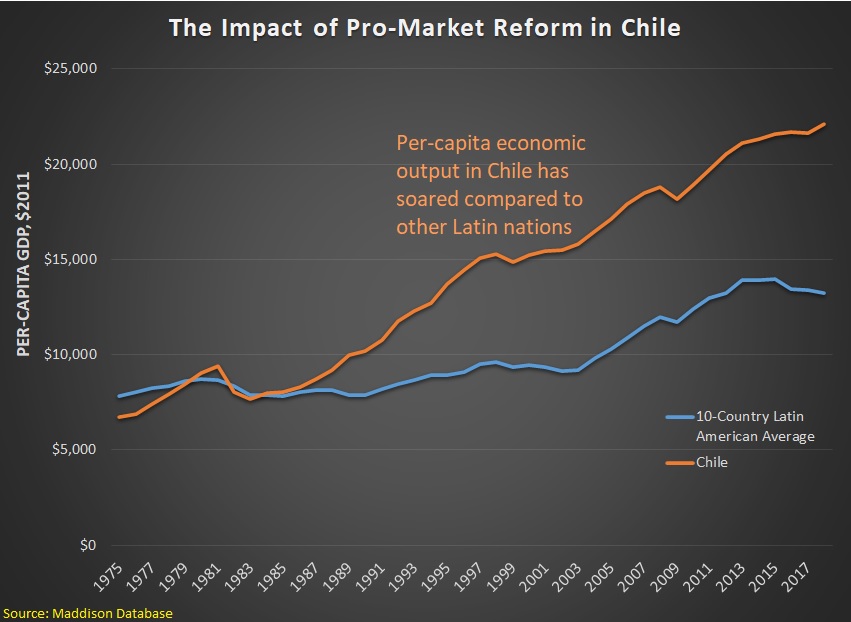
If you want visual proof of Chile’s “improbable success,” this chart tells you everything you need to know.  Thanks to free-market reforms in the 1980s and 1990s, growth exploded, Chile became the Latin Tiger and poverty plummeted.

It’s remarkable how quickly per-capita GDP has increased compared to the average of other major Latin American economies (Argentina, Bolivia, Brazil, Colombia, Ecuador, Mexico, Peru, Paraguay, Uruguay, and Venezuela).  Some folks on the left (including editors at the New York Times) bizarrely think Chile’s “neoliberal experiment” has been a failure. Given their upside-down perspective, they probably think Venezuela is a smashing success.

But today’s column is not about what’s happened in the past. It’s about what may happen in the future because of an upcoming presidential election.  Let’s start with this article from the Economist, which expressed concern back in November that the first round of the presidential election would lead to a stark ideological choice between the hard left and hard right.

…stable Chile disappeared two years ago, in an explosion of massive and sometimes violent protests…In a vote for the constitutional convention in May (in which only 43% turned out), support surged for the hard left while drying up for mainstream parties. 
As a result, the convention has become a theatre of wokeness, with calls to wage war against pivotal industries…, alongside…for a bigger role for the state in pensions, health care and green regulation. …pessimists fear a Utopian list of unaffordable rights and anti-capitalism. …Gabriel Boric, the candidate of the hard left, has seemed poised to win the presidential election. A former student leader, …some of his allies…include the Communist Party… 
Mr Boric wants to expand tax revenues by 8% of gdp over six to eight years (impossible, say many economists) and review trade agreements in order to engage in industrial policy. 
…That is why support has grown for José Antonio Kast of the hard right. …Whereas Mr Boric promises the most left-wing government since the chaotic Socialist-Communist administration of Salvador Allende, Mr Kast offers the most right-wing one since the dictatorship of General Augusto Pinochet.

Sure enough, the November election put Boric and Kast in a runoff, which is scheduled for December 19.  I don’t know if it would be accurate to say this is akin to a hypothetical Rand Paul-Bernie Sanders contest, but a report in the Wall Street Journal suggests that are very big economic implications.

After years of protests and political upheaval that seemed certain to shift Chile’s politics sharply to the left, voters in the first round of a presidential election largely backed candidates who support the country’s free-market economy…

More than half of the ballots in the Sunday vote went to three right-wing candidates who support the market economy, led by first-place finisher José Antonio Kast with 28% of the vote. Gabriel Boric, the leftist candidate who backs dismantling a private pension system and creating a state-run lithium company, finished second with 26% of the votes…

“People didn’t buy the idea that Chile needs to dismantle the market-friendly model, they just want a stronger social safety net,” said Patricio Navia, a Chilean political scientist at New York University. …

The future of Chile’s once-lauded economic model that bolstered foreign trade and slashed poverty over the last three decades has been in doubt since mass protests erupted two years ago… Mr. Kast, a 55-year-old former lawmaker…, says he is a democrat who is offering Chileans economic prosperity and freedom.

By the way, the presidential election isn’t the only big thing that’s about to happen in Chile.  The article also acknowledges something I wrote about last year, which is the possibility of a new constitution based on entitlements rather than liberties (i.e., positive rights vs negative rights).

The election is being held as a special assembly made up of mainly leftist delegates is writing a new constitution, which could weaken investor protections and expand social rights. The constitution is expected to be finished next year when it will be put to a referendum.

A Washington Post column published yesterday by Professor Michael Albertus summarizes what’s at stake.

Chile’s presidential runoff election on Dec. 19 is the country’s most important election since its return to democracy in 1990. …Chile’s election pits José Antonio Kast, a bombastic far-right politician whom many liken to Donald Trump and Jair Bolsonaro, against Gabriel Boric, a far-left lawmaker and former student organizer. …The stakes couldn’t be higher. Chile’s ongoing constitutional convention is poised to propose next year the biggest overhaul to the country’s political system since the Pinochet dictatorship.

Prof. Albertus points out that the election isn’t just about economics. There are big fights about immigration, law and order, abortion, and indigenous rights. For those of us who care a lot about prosperity, Mary Anastasia O’Grady of the Wall Street Journal opined two days ago on the implications of Chile’s upcoming choice.

The stakes are high in Chile’s Dec. 19 runoff presidential election pitting the free-market former Congressman José Antonio Kast against socialist Congressman Gabriel Boric. The country has been trending left for years. But Mr. Kast’s surprise first-place finish in the election’s first round—with 28% of the vote—and the center-right’s strong showing in legislative elections suggests that Chileans are reconsidering national suicide....

If the vote goes left, Chileans can expect policy geared toward greater redistribution of the existing wealth-and-income pie—higher taxes, nationalization of pensions, populism, etc. If the vote goes right, there will be a chance to restore the fast growth of the 1990s by deepening the liberal economic agenda. …there’s something much bigger at stake.

That is the survival of the democratic institutions protecting the pluralism, property rights and public order that have made Chile one of Latin America’s richest countries. Mr. Boric is backed by a coalition—Approved Dignity—heavily influenced by the Communist Party and other hard-left groups. …If Mr. Boric wins the runoff, you can bet they will demand their pound of flesh.

Ms. O’Grady’s column notes that Chile’s free-market reforms dramatically reduced poverty (for more details, see here, here, and here).

The market economy has been enormously successful in Chile. The share of Chileans living in poverty fell to 8.6% in 2017 from 68.5% in 1990, according to official data. Extreme poverty over the same period dropped to 2.3% from 48.8%. It’s a development record that few countries in the world have achieved.

Last but not least, she makes a very important point that Chile’s recent performance has not been very impressive.

…the clamor for change isn’t irrational. According to Chilean economist and investor José Luis Daza, …In the five years before the pandemic in 2020, the country grew at an average annual rate of 1.9%, less than half that of the world economy. “After 2000,” he told me in a phone interview from Santiago last week, “there has been zero productivity growth. In fact, it has been marginally negative.” …It was in the midst of this economic malaise in October 2019 that extreme-left militants burst onto the scene in Santiago. …Mr. Daza recently put his work in New York on hold to join Mr. Kast’s economic advisory team with a focus on growth.

I’m not surprised. There has not been any meaningful pro-growth reform this century. Indeed, the opposite is true. Policy has actually drifted in the wrong direction. But if Boric wins this weekend, a drift in the wrong direction could become a tidal wave, washing away the Chilean Miracle.  The last thing Latin America needs is another Venezuela. Milton Friedman will be rolling over in his grave.

P.S. I’m especially concerned that a victory for the left could lead to the repeal of some of Chile’s best policies, including social security personal accounts and nationwide school choice.


Monday, October 7, 2019

Chile goes right on the anniversary of Allende's election

The leftist message does not play well in a country like Chile

By Silvio Canto, Jr.

Forty-six years ago, my father and a couple of friends from Chile were monitoring election reports from Chile on the Spanish short wave service of Voice of America. As I recall, the election results went late into the evening and the next few days. In the end, Salvador Allende was elected president in a four-way race. Eventually, the Chilean Supreme Court had to decide because the winner was under 40%.

  It did not take long for Mr. Allende to show his true colors. Allende extended diplomatic recognition to North Vietnam, North Korea, and Cuba. He also went after U.S. companies like ITT and Kennecott Copper. It did not take long before Chile's very stable political system fell into a political and economic crisis. Mr. Allende was eventually overthrown by General Pinochet in 1973. On Sunday, Chile went to the polls again and the right did well in the regional elections as reported by Reuters:......... To Read More

Saturday, November 25, 2017

If Chile’s “Neoliberal” Experiment Is a Failure, Why Is the Nation More Prosperous than the Rest of Latin America?

November 24, 2017 by Dan Mitchell

One of the interesting things I’ve noticed in my world travels is that supporters of free markets and small government generally are known as “liberals” everywhere other than North America.

I think the rest of the world has the right idea. After all, folks like Adam Smith are considered “classical liberals,” so it’s bizarre that “liberal” now is used to describe anti-capitalists in America.

To muddy the waters even further, it’s not uncommon for modern supporters of capitalism to be called “neoliberals.”

Though I wonder if that’s supposed to a be a term of derision. When I’m called a neoliberal in other countries, it’s always by someone who is criticizing my support for economic liberty.
Professor Dani Rodrik of Harvard, in a column for the U.K.-based Guardian, is not a fan of neoliberalism. He acknowledges that the term is ill-defined, but recognizes that it means a less power for government.
…neoliberalism…denotes a preference for markets over government, economic incentives over cultural norms, and private entrepreneurship over collective action. …The term is used as a catchall for anything that smacks of deregulation, liberalisation, privatisation or fiscal austerity. …That neoliberalism is a slippery, shifting concept, with no explicit lobby of defenders, does not mean that it is irrelevant or unreal. Who can deny that the world has experienced a decisive shift toward markets from the 1980s on? Or that centre-left politicians – Democrats in the US, socialists and social democrats in Europe – enthusiastically adopted some of the central creeds of Thatcherism and Reaganism, such as deregulation, privatisation, financial liberalisation and individual enterprise?
Rodrik then proceeds with a lengthy discussion of the weaknesses and limitations of conventional economic analysis.

Much of what he writes is perfectly reasonable. The economy is not a machine and people are not robots, so mechanistic economic concepts – while useful – have limited value.


Moreover, culture and institutions make a big difference, and it’s rather difficult to capture those concepts in economic models.

Moreover, he makes some interesting observations on how various nations such as China have liberalized in ways that defy easy analysis.

Which is certainly a fair point.

But then he finishes up his column with two examples that simply don’t make sense.
First, Rodrik cites Mexico as a supposed example of neoliberal reform.
Following a series of macroeconomic crises in the mid-1990s, Mexico embraced macroeconomic orthodoxy, extensively liberalised its economy, freed up the financial system, sharply reduced import restrictions and signed the North American Free Trade Agreement (Nafta). These policies did produce macroeconomic stability and a significant rise in foreign trade and internal investment. But where it counts – in overall productivity and economic growth – the experiment failed. Since undertaking the reforms, overall productivity in Mexico has stagnated, and the economy has underperformed even by the undemanding standards of Latin America.
My reaction is “huh?”

I spend a lot of time combing through international data in hopes of finding success stories to publicize and I’ve never come across anything to suggest Mexico is a good example. Instead, I found evidence a few years ago suggesting the country is a bad example.

Here’s the Mexican data from Economic Freedom of the World. You can certainly argue that Mexico did some good reforms in the late 1980s. But where’s the evidence for sweeping liberalization after the mid-1990s?


There was a very slight increase in Mexico’s score after 1995, which is better than nothing. But I’m not surprised that it didn’t yield impressive results since the rest of the world was liberalizing at a much faster rate.

Indeed, Mexico dropped from #49 to #69 between 1995 and 2000 because other nations were the ones with “extensive liberalization,” not Mexico.

Second, he takes a shot at Chile.
Chile’s neoliberal experiment eventually produced the worst economic crisis in all of Latin America.
“Huh?” would be an understatement. I was flabbergasted by this assertion.
But not the first part of that sentence. He’s correct that Chile is a poster child for market-friendly reform.

Here’s a chart from Economic Freedom of the World showing how the nation’s score dramatically improved between 1975 and 1995.


But I was shocked by the second part of the sentence. Chile had “the worst economic crisis in all of Latin America”?

Since I’ve written several times about the Chilean economic boom, I was totally baffled. What was Rodrik talking about?

So I took another look at a couple of sources to see if I had overlooked something.

Here’s the IMF data on per-capita GDP for Chile and the rest of Latin America. The numbers are only available back to 1980, but everything we see underscores my argument that Chile is a great success. It used to have living standards only slightly higher than the average for Latin America and now the people are more than twice as rich as their peers. If that’s a “worst economic crisis,” we should all be lucky enough to have similar problems.


Then I looked at the Angus Maddison dataset, which allows us to go back to 1970.

His numbers are adjusted for inflation, so the lines don’t rise as rapidly, but we see the same long-run pattern. Chile is getting richer at a much faster pace than other countries from Latin America. Once again, if this is a “crisis,” other nations should hope for a similar fate.


So what did Rodrik mean by “worst economic crisis”?

His article doesn’t provide any details, but if you look at the Maddison data for the early 1980s, there was a downturn, with per-capita output dropping in Chile from about $6,000 to about $5,000. And that reduction was noticeably larger than the average reduction for the rest of Latin America.

I’m guessing this is the supposed “crisis” that he mentions in the article.

But if that’s true, he’s guilty of an egregious example of “cherry-picking” data. Sort of like saying the record-setting 1998 Yankees were a failure because of a four-game losing streak in late August that year.


Honest analysis requires a look at the overall record, and all data sources show that Chile’s economic performance is far superior to its peers.

The bottom line is that Rodrik is on solid ground when he points out the limitations of conventional economic analysis. But when he then decides to criticize pro-market reforms, he concocts two examples that are – at best – sloppily inaccurate.

P.S. By the way, I can’t resist commenting on one additional assertion in Rodrik’s column.
The use of the term “neoliberal” exploded in the 1990s, when it became closely associated with…financial deregulation, which would culminate in the 2008 financial crash and in the still-lingering euro debacle.
This is another “huh?” moment.

The “neoliberals” were the people who opposed the policies – artificially low interest rates from the Federal Reserve and the corrupt Fannie Mae and Freddie Mac subsidies – that led to the financial crisis. And people like me were very opposed to the excessive government spending that led to the European fiscal crisis.