#Special to ACSH.
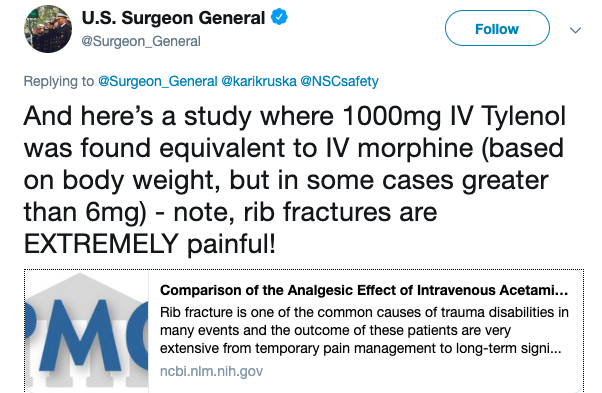
ACSH friend Dr. Aric Hausknecht, a New York neurologist and pain management physician, has taken issue with the July 4th advice tweeted by Surgeon General Jerome Adams, M.D., which recommended the use of IV Tylenol for post-op pain.
Dr. Hausknecht gave us exclusive permission to print his response to Dr. Adams.
I am writing in response to recent comments made by the U.S. Surgeon General, Jerome Adams, regarding the use of intravenous acetaminophen for anesthesia and post-operative pain relief. The Surgeon General implies that acetaminophen (Tylenol) is equally efficacious to intravenous (IV) opioids for pain relief. Apparently, his comments are based upon, Comparison of the Analgesic Effect of Intravenous Acetaminophen and Morphine Sulfate in Rib Fracture; a Randomized Double-Blind Clinical Trial, Emerg (Tehran). 2015 Summer; 3(3): 99–102. The authors of this paper concluded, "The findings of the present study showed that IV acetaminophen and morphine have the same therapeutic value in relieving the pain of rib fracture."
However, this study was carried out on a limited population group, 54 patients in total, and the statistical analysis is of questionable validity. At best, this study establishes a need for further inquiry, but in no way does this study provide adequate evidence to use IV acetaminophen as a substitute for IV opioids.
In another related paper, Intravenous versus Oral Acetaminophen for Pain: Systematic Review of Current Evidence to Support Clinical Decision-Making, Can J Hosp Pharm. 2015 May-Jun; 68(3): 238–247, the authors performed a literature review from 1948-2014 and "summarized and evaluated the available published literature describing efficacy, safety, and pharmacokinetic outcomes of randomized studies assessing oral versus IV dosage forms of acetaminophen." The authors concluded, "For patients who can take an oral dosage form, no clear indication exists for preferential prescribing of IV acetaminophen." On the basis of this comprehensive review, the authors concluded, "Therefore, on the basis of current evidence, if a patient has a functioning gastrointestinal tract and is able to take oral formulations, IV formulations (of acetaminophen) are not indicated."
Additionally, IV acetaminophen is FDA approved for use in the management of mild-to-moderate pain and moderate-to-severe pain with adjunctive opioid analgesics. It is not clear why a physician who is in a position to shape public policy would recommend standards of care that suggest that IV acetaminophen is equally efficacious to IV opioids when: 1) that premise is unproven, 2) there is strong evidence that oral acetaminophen is equally efficacious to IV acetaminophen, 3) IV acetaminophen should probably not be administered to a patient that can tolerate oral administration, 4) IV acetaminophen is not FDA approved as a stand-alone analgesic agent for mild-to-moderate pain and moderate-to-severe pain, and, 5) it is contrary to good and accepted medical practice that has established that opioids are more efficacious than acetaminophen for postoperative pain and for moderate-severe pain.
I remain,
Aric Hausknecht, MD
Diplomate American Board of Psychiatry and Neurology
ACSH friend Dr. Aric Hausknecht, a New York neurologist and pain management physician, has taken issue with the July 4th advice tweeted by Surgeon General Jerome Adams, M.D., which recommended the use of IV Tylenol for post-op pain.
Dr. Hausknecht gave us exclusive permission to print his response to Dr. Adams.
I am writing in response to recent comments made by the U.S. Surgeon General, Jerome Adams, regarding the use of intravenous acetaminophen for anesthesia and post-operative pain relief. The Surgeon General implies that acetaminophen (Tylenol) is equally efficacious to intravenous (IV) opioids for pain relief. Apparently, his comments are based upon, Comparison of the Analgesic Effect of Intravenous Acetaminophen and Morphine Sulfate in Rib Fracture; a Randomized Double-Blind Clinical Trial, Emerg (Tehran). 2015 Summer; 3(3): 99–102. The authors of this paper concluded, "The findings of the present study showed that IV acetaminophen and morphine have the same therapeutic value in relieving the pain of rib fracture."
However, this study was carried out on a limited population group, 54 patients in total, and the statistical analysis is of questionable validity. At best, this study establishes a need for further inquiry, but in no way does this study provide adequate evidence to use IV acetaminophen as a substitute for IV opioids.
In another related paper, Intravenous versus Oral Acetaminophen for Pain: Systematic Review of Current Evidence to Support Clinical Decision-Making, Can J Hosp Pharm. 2015 May-Jun; 68(3): 238–247, the authors performed a literature review from 1948-2014 and "summarized and evaluated the available published literature describing efficacy, safety, and pharmacokinetic outcomes of randomized studies assessing oral versus IV dosage forms of acetaminophen." The authors concluded, "For patients who can take an oral dosage form, no clear indication exists for preferential prescribing of IV acetaminophen." On the basis of this comprehensive review, the authors concluded, "Therefore, on the basis of current evidence, if a patient has a functioning gastrointestinal tract and is able to take oral formulations, IV formulations (of acetaminophen) are not indicated."
Additionally, IV acetaminophen is FDA approved for use in the management of mild-to-moderate pain and moderate-to-severe pain with adjunctive opioid analgesics. It is not clear why a physician who is in a position to shape public policy would recommend standards of care that suggest that IV acetaminophen is equally efficacious to IV opioids when: 1) that premise is unproven, 2) there is strong evidence that oral acetaminophen is equally efficacious to IV acetaminophen, 3) IV acetaminophen should probably not be administered to a patient that can tolerate oral administration, 4) IV acetaminophen is not FDA approved as a stand-alone analgesic agent for mild-to-moderate pain and moderate-to-severe pain, and, 5) it is contrary to good and accepted medical practice that has established that opioids are more efficacious than acetaminophen for postoperative pain and for moderate-severe pain.
I remain,
Aric Hausknecht, MD
Diplomate American Board of Psychiatry and Neurology
US Surgeon Gen. Backpedals on Flawed Tylenol Study. Cause of ACSH.
Dr. Jerome Adams celebrated Independence Day by trumpeting a study which concluded that Tylenol worked as well as morphine for controlling the pain from a broken rib. But the study was complete nonsense. ACSH caught the Surgeon General and now he's backpedaling like the woman in the bicycle scene from The Wizard of Oz (played backward of course)..............To Read More.....
Please Help Fund Our Work - If you follow our work, you know that we here at ACSH go after the fraudsters, the hucksters and the snake-oil peddlers. And when we're not debunking their misleading or dangerous junk science, we're always aiming to give you the most accurate and dependable health news. But we can only continue to do that with support from our readers and friends who value what we do. So if you can ... Please Donate. Thank you.