Search This Blog

De Omnibus Dubitandum - Lux Veritas

Showing posts with label Ohio Star. Show all posts

Sunday, March 21, 2021

EXCLUSIVE: One Year Into Mandates Ohio Still Can’t Back Up Policies When Under Oath, Maurice Thompson Says

March 19, 2021

COLUMBUS, Ohio – Monday will mark one year since Ohio Governor Mike DeWine announced the statewide stay at home order signed by then-Director of the Ohio Department of Health Dr. Amy Acton.

Soon after, the 1851 Center for Constitutional Law began litigating to challenge the lawfulness of the orders, “winning many cases,” according to Maurice Thompson, an attorney for the firm.

“One year later, the Department of Health – when under oath – still cannot justify the Director’s ‘Stay at Home Orders,’” said Thompson in a press release similarly titled that he shared exclusively with The Ohio Star on Friday morning.

The 1851 Center is a nonprofit, nonpartisan legal center dedicated to protecting the constitutional rights of Ohioans from government abuse. The 1851 Center litigates constitutional issues related to property rights, regulation, taxation, and searches and seizures.

The press release states that the 1851 Center won a preliminary injunction in 2020 stopping the state from forbidding the opening of amusement parks. During that case, the State of Ohio was asked to provide responses to legal questions under oath and penalty of perjury.  Those responses were just recently provided.

In them, Thompson contends, it is displayed that “the State remains unable to provide evidence supporting policies, failed to track relevant data and was at times outright ‘bluffing’ to the public.”

The full press release can be viewed below. The summary of its points is as follows:

  • Ohio Department of Health (ODH) stands by Ohio Attorney General’s statement to a federal court that 29% of confirmed COVID cases result in hospitalizations and approximately 4% result in death;
  • ODH still maintains no evidence that “non-essential” businesses and activities increased the risk of COVID, cannot identify a single instance of COVID-related harm caused by non-essential businesses and presented only “rational speculation” as reasoning behind the related mandates.
  • ODH asserts stay at home orders reduced serious harm based solely on the assertion that cases statewide never reached initial “guesstimates” Amy Acton provided at the beginning of the pandemic.
  • Despite saying regulations were driven by hospital capacity, ICU bed capacity and hospital staffing, ODH concedes it has no metric or benchmark to determine what constitutes an “overwhelming” and “no information” as to capacities of hospitals.
  • Despite providing no evidence that non-essential businesses and activities constituted a risk, Governor DeWine and the Attorney General’s office deride Ohioans wishing to open and operate, saying they are putting profit over the lives and health of employees and patrons.
  • State continues to declare that non-essential business restrictions did not cause any public or private health harm or economic harm.
  • ODH concedes it failed to track data related to coincidence of hospitalizations and deaths with comorbidities, such as obesity.
  • ODH evidence in support of the efficacy of the mask mandate and the curfew policies is “evidence of reduced cases, hospitalizations and deaths after mask and curfew orders went into effect.”
  • ODH refuses to disclose to Ohioans the process involved in producing orders, who writes them and who reviews them, citing “attorney client privilege.”
  • The end-date of the pandemic will be determined by the Governor alone and not public health experts.

A recent study revealed effects of COVID misinformation – particularly the deep misunderstanding of the severity of the virus for the average infected person and the misrepresentation of deaths per age group.

According to the report, the percentage of people infected needing hospitalization is somewhere between one percent to five percent.

The essence of the finding is that COVID knowledge, policy preference and behavior is shaped by political alignment and media consumption.

Despite early warnings that COVID would be 10-times to 20-times deadlier than influenza, the fatality rate is much lower, measuring  0.1% – 0.35% per the Center for Evidence-Based Medicine; while the CDC estimates a rate of .0003% to 5.4% (based on age).

“We have not faced an enemy like we are facing today in 102 years. You have to go back to the 1918 influenza epidemic,” DeWine said in a briefing the day the order was issued.  He compared the state response to a war and said it was a crucial time in the battle – the order was issued to slow the spread of COVID so healthcare systems would have time to treat COVID patients and others needing care.

In the order, Acton chose essential businesses and shuttered those she deemed nonessential; the order was set to expire two weeks later.  Businesses closures were not designed to be punitive but were also “not a suggestion,” said DeWine.

Just prior to issuing the stay-at-home order DeWine declared a public health state of emergency, saying “I wouldn’t read too much into the state of emergency,” that it was a “legal necessity” making it easier to procure medical supplies without going through the required state bidding process.

Dr. Acton’s modeling drove policy decisions in March 2020.  The Health Director guessed that the medical community could face 62,000 cases per day by mid-to-late March if Ohioans didn’t follow mitigation strategies. According to Acton and DeWine, if people heeded State of Ohio guidance, cases would be spread out and lessened,  predicting a peak in mid-April of 10,000 cases per day. A third guess revised that number down to 2,000 cases per day.

DeWine said hospitals would need  to scale up their capacity to double or triple their norm in order to handle the rush. According to Ohio COVID dashboard data, cases were registering over 300 in March and around 500 per day in April (with one blip due to concentrated prison testing).

Nonetheless, an emergency was declared, shelter-in-place ordered, nonessential businesses closed, an election canceled and in-person education stopped.

An early investigative article pinpointed the economic dangers of closing businesses, the mental health impact of stay-at-home orders, the certain spike in suicides and the differences between COVID and the 1918 flu pandemic.

However, shut-it-all-down policies were implemented instead of exact measures that protected the most vulnerable, accounted for economic, emotional and physical consequences of focusing only on COVID.

A study of all 50 states and the District of Columbia ranked each locale by mandates and COVID outcomes. Ohio came in at number 23 of 51 despite being one of the first states to intervene and impose mandates with legal consequences for violations.

There were states with fewer restrictions that did better at handling the virus – but the opposite was also true.  A set of findings that proves the words of Ohio Senator Terry Johnson (R-District 14) during his floor speech in favor of Senate Bill 22 (providing legislative oversight of Governor and agency orders).  Johnson said stopping the virus is like telling the waves to stop or stopping the wind; and the varied results around the world given different mitigation strategies proves the efficacy of strict mandates are “a farce.”

In Ohio, the statewide mask mandate was imposed July 23 when cases were already on a downward slope.

The Star reported, according to Ohio Department of Health records, the high point in cases occurred on November 30, 2020 when the state logged 13,468 – this after a statewide mask mandate had been in effect for 131 days with the Ohio Investigative Unit measuring mask compliance at well above 90% around the state.

While the mask mandate was in effect with high compliance, Ohio racked up its worst numbers in cases, hospitalizations and deaths according to the Ohio COVID dashboard.

The U.S. Centers for Disease Control and Prevention (CDC) recently released results of their tracking project spanning March – December 2020 that showed masking stopped COVID spread by two percent.

Thompson said that one of the State’s arguments was that their mitigation efforts resulted in fewer cases and helped deter the early estimate that Ohio would lose more than 100,000 people to death from COVID.

However, the State’s case estimates without mitigation were astronomically inaccurate (62,000 at a high point) and their case estimates with mitigation were still exponentially incorrect. Additionally, there isn’t a state in America near a death toll of 100,000 people, regardless their mitigation strategies. In fact, a couple states near the top in death toll – California, New York and Pennsylvania – enacted comparatively strict mandates.

However, DeWine still urges Ohioans to mask, even after vaccination – guidance echoed by President Biden.

The Ohio Restaurant Association estimated 60% of Ohio establishments would close and never re-open. The Star reported on four non-essential businesses and the impact to their businesses, employees and families.

60 minutes came to Columbus to report on the “unequal recession” caused by the shuttering of non-essential businesses (restaurants, hotels, theaters, shops, to name just a few) and how those policy decisions disproportionately affected women and minorities – and how the Congressional Budget Office estimates the first to lose their jobs will be the last to recover, reporting it will take until 2024.

Ohioans filed more unemployment claims in 2020 than they did the previous five years combined. To make matters worse, school closures exacerbated unemployment woes – unemployment is 12% higher for parents whose children learn remotely as compared to parents whose kids learn in-person.
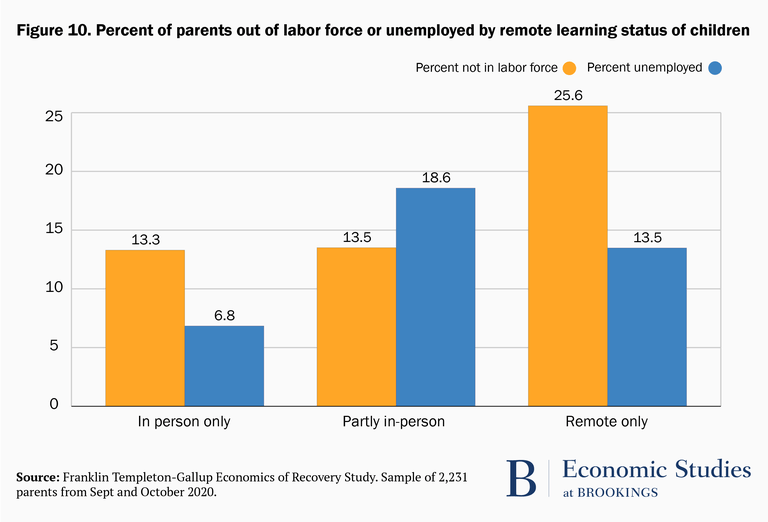
This despite the American Academy of Pediatrics pleading for kids to get back in the classroom, the CDC repeatedly indicating that kids were not extending the transmission of the virus and a large amount of data showing very low COVID infections among enrolled school children (and evidence that teachers contract the virus at rates similar to their non-teaching contemporaries).

Meanwhile, a crisis from COVID policies grips our kids – masses of students from Mason to Hilliard were hospitalized for suicide ideation, mental struggles and a prestigious medical journal reported that 13.8 million of years of life will be lost in kids aged five to 11 due to education disruption from, not COVID, but COVID policies.

Read the full statement by the 1851 Center for Constitutional Law:

– – –

Jack Windsor is the Statehouse Reporter at The Ohio Star. Windsor is also an independent investigative reporter. Follow Jack on Twitter. Email tips to jwindsor@theohiostar.com.
Photo “Small Business” by spurekar. CC BY 2.0.


Wednesday, September 2, 2020

New CDC Admission Could Slash Ohio’s Death Toll


The Centers for Disease Control and Prevention (CDC) Weekly Index disclosed “[F]or 6% of deaths, COVID-19 was the only cause mentioned.”

That means of the 183,000 U.S. deaths attributed to COVID as of the release of this article that 10,980 people died from COVID.  The remaining 172,000-plus deaths occurred with COVID.
In a text exchange with Dan Tierney, Press Secretary for Governor Mike DeWine, The Ohio Star asked Tierney if Ohio distinguishes “between someone who dies from the virus and someone who dies with the virus.”

Tierney’s responded, “CDC is entity that has established cause of death reporting guidance. [Ohio Department of Health] ODH has not adopted separate guidance.”

The revelation raises questions about Ohio death tolls and policies.

On Monday, August 31,  The Ohio COVID site listed 4,138 deaths.  That means if the CDC finding applies in Ohio, the total number of Ohioans who died from COVID is 248 and the number of people who died with COVID totals 3,890.
 
In the U.S., people who died with COVID on average, had “2.6 additional conditions or causes per death” according to the CDC index.

Per the CDC, the top causes of death with COVID as an accompanying condition are:
  • Influenza and pneumonia
  • Respiratory failure
  • High blood pressure
  • Diabetes
  • Brain damage and impaired blood flow
  • Cardiac arrest
  • Heart failure
  • Kidney failure
  • Suicide, homicide and domestic violence
  • Other adverse events – medical treatment mishaps – and other medical conditions
It makes sense that the top two additional causes of death that are accompanied by COVID may be exacerbated by the existence of the virus in the system. However, without knowing the viral prevalence in the deceased it is difficult to determine whether the death was caused by COVID that manifested downstream in the other conditions or whether the virus was in the system but not a major contributing factor.

Yet, it is difficult to understand how a drowning, shooting or suicide can be counted as COVID and trumpeted as part of the epidemic’s death toll.

In an interview with The Star, Warren County Sheriff Larry L. Sims said that one of the deaths in his county attributed to COVID is a woman who was in jail that was released and committed suicide. Detractors of the idea that deaths ‘with COVID’ were being counted dismissed the anecdote. Now, it proves true.

People who never showed symptoms of a COVID infection and may have never known they were infected with COVID  – but died from other ailments  such as suicide, high blood pressure, auto accident, diabetes –  are all counted as COVID deaths.

Since the inception of the state’s response to COVID worst-case scenarios have been the guidepost for public policy. In March, Ohio Director of Health (ODH) Amy Acton guided Ohio Governor Mike DeWine in crafting statewide policies based on estimates that at its peak Ohio would record 62,000 COVID cases a day and that 2 million Americans would succumb to COVID.

Acton’s estimates, and exponentially incorrect modeling,  were based on the Imperial College Model and ended up being the foundation of  ODH orders – orders that multiple courts around Ohio have ruled arbitrary and unconstitutional.

Governor DeWine, with the help of Ohio State University Dr. Andrew Thomas, Chief Clinical Officer, eventually scrapped Acton’s plans and built the Ohio Public Health Advisory System , a forecasting tool based on “what if” instead of “what is” with respect to COVID.

Early requests for compliance revolved around sheltering and shutting down in order to buy time so hospitals could ramp capacity and flatten the curve.

Hospitals not only never came close to capacity – in fact hospital admissions for influenza-like illnesses peaked in February at 1,200 in a week before state intervention – the state continues to act as if COVID is the 1918 Spanish Flu.

The assertion is incorrect on several fronts. The two biggest – COVID does 90% of its fatal damage in people 60 years or older with almost three underlying conditions, whereas the Spanish Flu was fatal to all age ranges; COVID death totals pale in comparison to the 1918 epidemic – one century ago the virus took 675,000 American lives (U.S. population was 103 million).

The most recent information from the CDC regarding annual death numbers in Ohio is from 2017 and is as follows:
  1. Heart disease – 28,008
  2. Cancer – 25,643
  3. Accidents – 8,921
  4. Chronic lower respiratory disease – 7,312
  5. Stroke – 6,425
  6. Alzheimer’s disease – 5,117
  7. Diabetes – 3,740
  8. Influenza/Pneumonia – 2,243
  9. Kidney disease – 2,237
  10. Septicemia – 2,066
Last week the CDC flip-flopped – not an uncommon practice – with respect to testing. On Monday, August 24 the organization said “If you have been in close contact (within 6 feet) of a person with a COVID-19 infection for at least 15 minutes but do not have symptoms: You do not necessarily need a test unless you are a vulnerable individual or your health care provider or State or local public health officials recommend you take one.”

Three days later – after receiving verbal retaliation from some politicians and scientists -CDC Director Robert Redfield walked-back the strength of his Monday comment saying “[t]esting is meant to drive actions and achieve specific public health objectives. Everyone who needs a COVID-19 test, can get a test. Everyone who wants a test does not necessarily need a test; the key is to engage the needed public health community in the decision with the appropriate follow-up action.”
While national spokespersons and political leaders iron-out their ever-changing positions on the virus, one thing is unchanging: policies have wrecked emotional health in our youth, skyrocketed anxiety in adults, crippled entire business segments and left our dying seniors isolated without loved ones.

This is the raw end of the deal for a population that began compliant and has been guilted, shamed and reprimanded while uncovering facts: COVID is not as deadly as initially projected; initial models were embarrassingly wrong; the consequences of COVID policies will damage more people than the virus itself; constituents are required to adjust their lives – with huge emotional and financial losses resulting – while political leaders and government employees are insulated from the need to change course and the comparative economic impact of their policies.
– – –
Jack Windsor is Managing Editor and an Investigative Reporter at The Ohio Star. Windsor is also an Investigative Reporter at WMFD-TV. Follow Jack on Twitter. Email tips to jackw@wmfd.com.
Background Photo “Mike DeWine” by Mike DeWine.


Thursday, August 27, 2020

Commentary: Four Life-Threatening Unintended Consequences of the Lockdowns

by Brad Polumbo

When policymakers across the country decided to “lock down” in response to the March outbreak of the novel coronavirus, they took a leap into the unknown. Not only did we know little about COVID-19 itself at that time, but we knew almost nothing about how shutting down nearly all of society would affect people.

Policymakers focused on their models predicting how lockdowns could help limit the spread of COVID-19; an important factor, to be sure. So, too, many acknowledged the negative economic ramifications of lockdowns. But in the months since, we’ve seen many other dire consequences stem from the unprecedented shutdown of society.

Future public health policy should take these four life-threatening unintended consequences of COVID-19 lockdowns into account.

 1) Massive Spikes in Suicide Rates and Mental Health Crises.........
 2) Uptick in Drug Overdoses and Substance Abuse............
 3) Economic Devastation Leads to Hunger.........
 4) Surge in Domestic Violence Under COVID-19 Lockdowns...........

 These dire unintended consequences of COVID-19 lockdowns are tragic, but frankly, they aren’t so shocking. We have long known that sweeping government interventions have ripple effects that extend far beyond their intended goals.

Why? Because of what economic philosopher Friedrich Hayek called the “knowledge problem.”........ Simply, the knowledge problem means that central planning efforts are doomed to fail. Only those closest to a problem know the ins and outs of it..............The deadly unintended consequences of sweeping COVID-19 lockdowns remind us why.............To Read More.....

Ohio Representative Jena Powell: ‘Ohioans Deserve Better Than They Are Getting Now’

August 22, 2020 Jack Windsor

Representative Jena Powell (R-Arcanum) is a freshman legislator from Ohio’s 80th District with the tenacity of a rookie and the strategic thinking of a veteran. During a Friday afternoon phone call with The Ohio Star, Powell said “everyone can speak on things, but it takes a plan to get there. I am not the kind of person that says ‘open Ohio’ and doesn’t have a plan – you have to have a plan to get to the endpoint.”

Powell laid out a plan she believes will get Ohioans to the endpoint they want – an open Ohio.

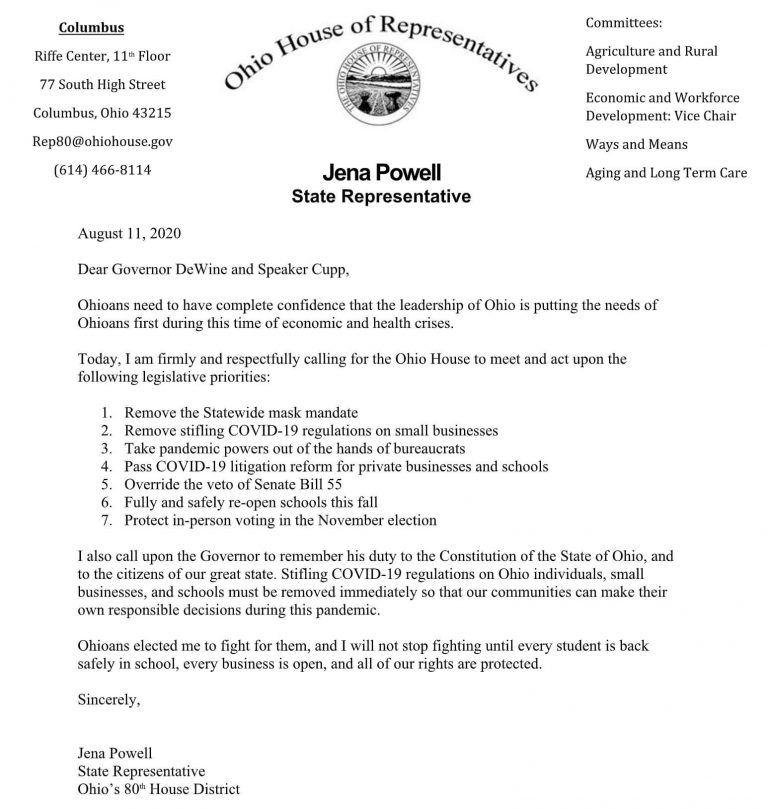
Her plan is comprised of seven legislative priorities – initiatives crafted after talks with District 80 business owners, non-profit directors, church leaders and families. “These changes will be good for our district and they also make sense for all of Ohio,” she said...........“Whether you agree with Governor DeWine or not, the governor has taken his hand at legislating and the legislators need to be involved – to get bills into committees and onto the floor to debate and then get them passed on behalf of our constituents,” she said............ “I can’t get 99 people to change their minds, but I believe a frank discussion needs to happen in the House on these points.” The freshman representative has encouraged Ohio Speaker of the House Bob Cupp (R- Lima) to call representatives back before their scheduled September date. Once back, Powell believes the following legislative priorities best address the most pressing needs facing Ohioans.

 https://theohiostar.com/wp-content/uploads/2020/08/Seven-Policies-Letter-768x809.jpg Remove mask mandate...........
Remove stifling COVID-19 regulations on small businesses..........
Take pandemic powers out of the hands of bureaucrats.......
COVID-19 litigation reform for private businesses and schools.............
Override veto of Senate Bill 55...........
Fully and safely re-open schools this fall.........
Protect in-person voting in November election......... To Read More....

Monday, August 17, 2020

Seattle Mayor Appeals Judge’s Decision That Could Result in Her Removal from Office

August 16, by Jake Dima

Democratic Seattle Mayor Jenny Durkan urged the state supreme court Wednesday to overturn a lower court decision that allows efforts to remove her from office to proceed.

King County Superior Court Judge Mary Roberts has permitted a recall effort that could effectively remove Durkan from office, according to the Seattle Times. A total of five Seattle residents submitted the petition due to the mayor’s handling of the police response to protests and a weeks-long encampment in the city formerly known as the Capitol Hill Organized Protest (CHOP), the Times reported.

Durkan appealed to the Washington Supreme Court after Roberts refused to reconsider her stance, according to the local outlet. Her most recent effort to avoid the potential removal simply asks the higher court to reconsider and offers no new arguments, the Times reported.

The five residents alleged Durkan “endangered the peace and safety of the community and violated her duties,” according to a court document. The recall process could be extensive, as the petitioners would have to collect over 50,000 signatures — one-fourth of the total voters in the last mayoral election, The Times reported.

Durkan’s spokesperson Kelsey Nyland insists the accusations are unfounded.

“In the midst of unprecedented challenges for the city, Mayor Durkan has consistently acted to protect the public health and safety of residents during the pandemic, economic devastation, and demonstrations for justice,” Nyland told the Times.

In the beginning stages of the CHOP incident, Durkan tweeted that the seized zone is “a place for free speech, community and self expression.” The area occupied by CHOP included an abandoned Seattle police precinct.

A total of six people were shot in the occupied area before it was disbanded by law enforcement weeks later, according to the New York Times.