Search This Blog

De Omnibus Dubitandum - Lux Veritas

Showing posts with label Collectivism. Show all posts

Wednesday, July 3, 2024

Who Raises A Banner That Says: I Stand For Consensus!

Rich Kozlovich

This article is based thoughts of my own, and a series of quotes from others I've acquired over the years.  But, not all of this is mine alone.  So, with that understanding, enjoy!

In our modern world pragmatism and consensus are the in fashion promoting all sorts of clabber, especially about this pandemic fraud, and the mandates that went along with it.  Let's understand, consensus isn't science, it's politics!  To embrace consensus is a process of abandonment.  One must abandon the values, principles beliefs  you hold dear and embrace those things you disagree with but society refuses to fight against them.  A condition that prevent real solutions. 

We all bear a level of responsibility for maintaining societies good.  That means wading in on issues to prevent disaster.  People will always be people, such as acting in their own best interests, but unfortunately entirely too many people are complacent and acquiescent afraid to vigorously engage what's going on intellectually.  Whether we choose to or not, every human being is impacted by the decisive battles going on in our lives.  

In the movie Lord of the Rings Frodo says to Gandalf: I wish it need not have happened in my time. Gandalf responds:  “So do I, and so do all who live to see such times. But that is not for them to decide. All we have to decide is what to do with the time that is given us.”

We're now facing an unending thrust toward authoritarian collectivism, and it's being led by the very government that's stood against that for almost 250 years has been the beacon of freedom for the world. The United States.  We're facing an organized effort to keep Americans in a state of panic in order to get Americans to willingly acquiesce our rights and accede power to politicians and government bureaucrats who will then "lead" us to safety.  This is an unending assault on our senses and intelligence, of scare mongering and hobgoblin imagery, with just enough reality to convince the misinformed and uninformed, but it's not reality.  

Unfortunately the misinformed and the uninformed numbers are massive, at that point our goal "is not to be on the side of the majority, but to escape finding oneself in the ranks of the insane."

The study of history is a powerful antidote to contemporary arrogance. It is humbling to discover how many of our glib assumptions, which seem to us novel and plausible, have been tested before.  Not just once but many times and in innumerable guises; and discovered to be, at great human cost, wholly false. I have said more than once that history never repeats itself: what happens is that people keep forgetting it . Show me someone who doesn't read books and I will show you someone lost in the fog of propaganda, manipulation, and the lies that pass for the news of the day. Books can tell you who you are, what you believe, and why. They always leave you changed in some fashion.

Fortunate, or delusional, is the person who can look back at his or her life and say, "I would do it all again, the same way.” Most of us mortals have made mistakes, sometimes too many to count. Some mistakes have to do with career. Some have to do with money. Some have to do with other poor decisions and poor choices – reconsidered, of course, with the benefit of hindsight. But the ones that cause the most regret and the most pain have to do with the treatment of other people – especially those who loved and trusted us. 

We finally discover the value and worth of what we once had and failed to appreciate. Let all living understand we're on the stage of history, and no matter whatever our station may be, or whatever part we play, great or small, our conduct will be scrutinized, not only by history, but by our friends, associates, acquaintances, and our own descendants .

The object in life is not to be on the side of the majority, but to escape finding oneself in the ranks of the insane . Losing liberty over a theoretical threat is the main concern here (no one has ever been killed by manmade global warming, because there is no way to distinguish manmade warming, if such a thing exists, from natural, which we know....absolutely know is cyclical. 

We have all been lied to by a shameless confederation of scientists, their professional publications, their formal organizations, and politicians seeking to use this big scare of "climate change" to advance their careers and agendas. The problem for all of them is that the real science doesn't support anthropogenic global warming and never did. Real scientists, branded dissenters, skeptics, and deniers, held true to the principles of science, knowing that it would eventually end this vast and terrible hoax.  Time and truth are on the same side, but it takes guts, endurance, and fortitude to be right, and stand for right.

We keep hearing outrageous statements from the greenies claiming that modern living is killing us and they repeat things they know are false over and over again. The Bolsheviks discovered truth does not matter so long as the lie is repeated often enough. The greenies understand that, and have no difficulty whatsoever in countering a fact with lies repeated often enough and loudly enough, until it becomes accepted by the people .

We live in a world where the 'doers" are the enemies, and the talkers who complain unendingly are the heroes. 

Greenies don't like tidal power, it might upset the fish.  Coal, nuclear and hydroelectric are positively evil, windmills kill bats and birds, and tidal power might upset the whales. There's just no such thing as a happy Greenie . What is the alternative? What will make the greenies happy? Make no mistake, living green is really about eliminating between four and five billion people.

Journalists have generally given up on seeking to understand science, but instead look for the next scientist who will say something strange so that they have a “story” . Credibility has to be earned, and once it’s squandered may never be recovered , and with the internet we have discovered that the media squandered any credibility they had many years ago.

Let’s just take Global Warming scares promoted by the media. Newspapers should think about the damage they are doing to many persons, particularly young kids, by spreading the exaggerated views of a human impact on climate. As far as I can see the IPCC 'Global Temperature' is wrong. Temperature is fluctuating but it is still most places cooler than in the 1930s and 1940s.

It will take about 800 years before the water level has increased by one meter" Changes in solar irradiation have been the dominant causes of changes in climate. Volcanic eruptions can have caused some cooling events and greenhouse gases may have contributed to the increase in temperature over the last decades. However, the influence of solar variability has been the major forcing factor and will probably also remain so in the future .

Every totalitarian regime needs its defining myth. With the Nazis, it was the “Aryan” fantasy of racial purity. With the USSR, it was the dictatorship of the proletariat. With secularized, semi-pagan Western societies in historic decline, it is global warming .

Environmentalists-even mainstream environmentalists are less concerned about any crisis posed by global warming than they are eager to command human behavior and restrict economic activity. Their true plans and ambitions: to stop economic development and return mankind centuries back. They are interested in their businesses and their profits made with the help of politicians” . Take away the grant money and they will go away.

Why are economic conditions chaotic? The reason is simple. Americans no longer possess the freedom to produce the goods and services required to maintain their former standard of living. Taxation – both direct and indirect through currency inflation – runaway government regulation and government-sponsored-and-encouraged litigation have reduced the productivity of Americans below that required to maintain their way of life. This tyranny – this economic slavery – has been produced entirely by the federal and state governments of the United States .

Science has traditionally been held in high esteem. That clearly is no longer the case. What has changed? The Holy Grail for most scientists is not truth but research grants. And the global warming scare has produced a huge downpour of money for research. Any mystery why so many scientists claim some belief in global warming? In science, refuting an accepted belief is celebrated as an advance in knowledge; in religion it is condemned as heresy , yet those who dared question the “consensus science” of the warmers were declared, skeptics and deniers such as the holocaust deniers. In short…they were called heretics.

What is the mission of the environmentalists? To spread the truth! No matter how many lies it takes. Green activists will always be outraged about something. What outrages them on any given day will depend on the emotions they are feeling on any given day . This is where I really have a problem with modern-day environmentalism; it confuses opinion with what we know to be true, and disguises what are really political agendas with environmental rhetoric . Those who talk about climate change are the same ones who occupy the tenth circle of Hell for many Americans: Politicians, the Media, Scientists, Educators, Hippies, and Showbiz types. So it’s a moral imperative to be against what they’re for .

“The environmental movement I helped found has lost its objectivity, morality and humanity. The pain and suffering it is inflicting on families in developing countries must no longer be tolerated. Eco-Imperialism is the first book I’ve seen that tells the truth and lays it on the line. It’s a must-read for anyone who cares about people, progress and our planet.” – Patrick Moore, Greenpeace co-founder

It’s bad enough that politicians and scientists have been drinking the Kool-Aid, what is truly amazing is how many corporate types have been imbibing and buying into these anti-business Corporate Social Responsibility scenarios. When the corporate Neville Chamberlains ultimately forfeit their salaries, bonuses and their jobs thanks to their spineless leadership and the anti-capitalism cabal that now inhabits wine and cheese bars in the District of Columbia, I hope to be around to ask this simple question: “So, how'd all that hope and change work out for you?"

Climate change is not a scientific problem that found political support; this is about eco-activists and politicians who found a scientific issue they feel can leverage them into power and control. The environment is a great way to advance a political agenda that favors central planning and an intrusive government. What better way to control someone’s property than to subordinate one’s private property rights to environmental concerns . If the congressional, administration and activist conspirators behind this massive deceit were in the private sector – peddling bogus drugs, rather than bogus science – they’d quickly become convicts. Instead of jail time, though, they’ll probably get bonus checks . It is time to clean out the climate cesspool, and bring integrity, transparency and accountability back to science, law and public policy .

There is one good thing about the lunatic "global warming" catechism now taught our youth in the mandatory government youth propaganda camps : When they are finally forced to admit that the globe has been cooling again, not warming, for the past decade, yet proceed to demand precisely the same remedies for "global cooling" (which they will cleverly dub "climate change") as they did for "global warming" -- that is to say higher electric bills, more government controls, taxes sufficient to cripple our industrial economy and generally lower our standard of living in keeping with the world socialist doctrine that America and particularly the "capitalist rich" must be "punished" and "made to sacrifice" in penitence for our former prosperity -- there is finally a decent chance they'll simply be laughed out of town .

Thomas Sowell once said:  

Recently I was foolish enough to try to reason with an environmentalist. But it became obvious that he had his mind made up and didn't want to hear any evidence to the contrary. The Pope is more likely to have read Karl Marx than an environmentalist is to have read even a single book that criticized environmentalism.

The EPA's muddled machinations should not come as a surprise, because the agency long has been a haven for scientifically insupportable policies perpetrated by anti-technology ideologues in career and appointed positions. It has a sordid history of incompetence, duplicity, and pandering to the most extreme factions of the environmental movement, all of which appears to be accelerating . The environmental movement has become so radical as to be an easily identified hazard to American life, and the EPA is not on my list of favorite agencies .

There is no dealing with the greenies. They will never be satisfied and as for those who wish to define green and adopt it as a business model and make the green movement partners of some sort; let me help you! Green is a mixture of blue and yellow. That is the only factual definition of green that will stand the test of time. After that; any other definition is a corruption of a perfectly nice color. 

Remember, when you dance with the Devil you won’t call the tune, you won’t choose the dance, you won’t lead, you can’t change partners and you may not be allowed to leave the dance.


Monday, September 6, 2021

The Soviet Union Is Gone, but the Young Yearn for Socialism


This August marks the 30th anniversary of the beginning of the end to the Soviet Union. During August 19-21, 1991, hardline members of the Soviet Communist Party and the KGB attempted a coup d’état in Moscow to prevent the political and economic reforms introduced over the prior five years from going any further. The coup failed, and on Christmas Eve, 1991, the Soviet Union was dissolved and disappeared from the political map of the world.

The events of those days are especially imprinted on my mind because I was in Moscow at the time, watching and, indeed, even participating in those August 1991 events. Frequently traveling to the Soviet Union on privatization and market reform consulting work, especially in the, now, former Soviet republic of Lithuania and in Moscow, I witnessed the failed coup attempt and its immediate aftermath.

The Soviet regime had ruled Russia and the other 14 component republics of the U.S.S.R. for nearly 75 years, since the Bolshevik Revolution in November 1917 led by Vladimir Lenin and his communist cadre of Marxist followers. During that almost three-quarters of a century, first under Lenin and especially Joseph Stalin and then their successors, historians have estimated that upwards of 64 million people – innocent, unarmed men, women and children – died at the hands of the Soviet regime in the name of building the “bright, beautiful future” of socialism. 

Mass Murder and Slave Labor Under Soviet Socialism

The forced collectivization of the land under Stalin in the early 1930s, alone, is calculated to have cost the lives of nine to twelve million Russian and Ukrainian peasants and their families who resisted the loss of their private farms and being forced into state collective farms that replaced them. Some were simply shot; others were tortured to death or sent to die as slave laborers in the concentration and labor camps in Siberia or Soviet Central Asia known as the GULAG. Millions were slowly starved to death by a government-created famine designed to force submission to the central planning dictates of Stalin and his henchmen. 

Millions of others were rounded up and sent off to those prison and labor camps as part of the central plan for forced industrial and mineral mining development of the far reaches of the Soviet Union. In the 1930s and 1940s, Stalin’s central plans would include quotas for how many of the “enemies of the people” were to be arrested and executed in every city, town and district in the Soviet Union. In addition, there were quotas for how many were to be rounded up as replacements for those who had already died in the GULAG working in the vast wastelands of Siberia, northern European Russia and Central Asia. (See my article, “The Human Cost of Socialism in Power.”)

By the 1960s, 1970s, and early 1980s the Soviet system had become increasingly corrupt, stagnant, and decrepit under a succession of aging Communist Party leaders whose only purpose was to hold on to power and their special privileges. In 1986 a much younger man, Mikhail Gorbachev, who had worked his way up in the Party hierarchy, was appointed to the leading position of General Secretary of the Communist Party of the U.S.S.R.

Gorbachev’s Attempt to Save Socialism

Gorbachev believed that the Soviet Union had taken several serious wrong turns in the past. But he was not an opponent of socialism or its Marxist-Leninist foundations. He wanted a new “socialism-with-a-human-face.” His goal was a “kinder and gentler” communist ideology, so to speak. He truly believed that the Soviet Union could be saved, and with it a more humane collectivist alternative to Western capitalism.

To achieve this end, Gorbachev had introduced two reform agendas: First, perestroika, a series of economic changes meant to admit the mistakes of heavy-handed central planning. State enterprise managers were to be more accountable, small private businesses would be permitted and fostered, and Soviet companies would be allowed to form joint ventures with selected Western corporations. Flexibility and adaptability would create a new and better socialist economy.

Second, glasnost, political “openness,” under which the political follies of the past would be admitted and the formerly “blank pages” of Soviet history – especially about the “crimes of Stalin” – would be filled in. Greater historical and political honesty, it was said, would revive the moribund Soviet ideology and renew the Soviet people’s enthusiastic support for the reformed and redesigned bright socialist future.

However, over time the more hardline and “conservative” members of the Soviet leadership considered all such reforms as opening a Pandora’s Box of uncontrollable forces that would undermine the Soviet system. They had already seen this happen in the outer ring of the Soviet Empire in Eastern Europe.

The Beginning of the End in Eastern Europe

In 1989 Gorbachev had stood by as the Berlin Wall, the symbol of Soviet imperial power in the heart of Europe, had come tumbling down, and the Soviet “captive nations” of Eastern Europe – East Germany, Poland, Czechoslovakia, Hungary, Romania and Bulgaria – that Stalin had claimed as conquered booty at the end of the Second World War, began to free themselves from communist control and Soviet domination. (See my article, “The History and Meaning of the Berlin Wall”.)

The Soviet hardliners were now convinced that a new political treaty that Gorbachev was planning to sign with Boris Yeltsin, president of the Russian Soviet Federative Republic and Nursultan Nazarbayev, president of the Soviet republic of Kazakhstan, would mean the end of the Soviet Union itself. 

Already, the small Baltic republics of Estonia, Latvia, and Lithuania were reasserting the national independence they had lost in 1939-1940, as a result of Stalin and Hitler’s division of Eastern Europe. Violent, and murderous Soviet military crackdowns in Lithuania and in Latvia in January 1991 had failed to crush the budding democratic movements in those countries. Military methods had also been employed, to no avail, to keep in line the Soviet republics of Georgia and Azerbaijan. (See my article, “Witnessing Lithuania’s 1991 Fight for Freedom from Soviet Power”.)

Communist Conspirators for Soviet Power

On August 18, 1991, the hardline conspirators tried to persuade Gorbachev to reverse his planned political arrangements with the Russian Federation and Soviet Kazakhstan. When he refused he was held by force in a summer home he was vacationing at in the Crimea on the Black Sea. 

Early on the morning of August 19, the conspirators issued a declaration announcing their takeover of the Soviet government. A plan to capture and possibly kill Boris Yeltsin failed. Yeltsin eluded the kidnappers and made his way to the Russian parliament building from his home outside Moscow. Military units loyal to the conspirators ringed the city with tanks on every bridge leading into the city and along every main thoroughfare in the center of Moscow. Tank units had surrounded the Russian parliament, as well. 

But Yeltsin soon was rallying the people of Moscow and the Russian population in general to defend Russia’s own emerging democracy. People all around the world saw Yeltsin stand atop an army tank outside the parliament building asking Muscovites to resist this attempt to return to the dark days of communist rule. 

The Western media made much at the time of the apparent poor planning during the seventy-two-hour coup attempt during August 19th to the 21st. The world press focused on and mocked the nervousness and confusion shown by some of the coup leaders during a press conference. The conspirators were ridiculed for their Keystone Cop-like behavior in missing their chance to kidnap Yeltsin or delaying their seizure of the Russian parliament building; or leaving international telephone lines open and not even jamming foreign news broadcasts that were reporting the events as they happened to the entire Soviet Union. 

The Dangers If the Hardliners had Won

Regardless of the poor planning on the part of the coup leaders, however, the fact remains that if they had succeeded the consequences might have been catastrophic. I have a photocopy of the arrest warrant form that had been prepared for the Moscow region and signed by the Moscow military commander, Marshal Kalinin. 

It gave the military and the KGB, the Soviet secret police, the authority to arrest anyone. It had a “fill-in-the-blank,” where the victim’s name would be written in. Almost 500,000 of these arrest warrant forms had been prepared. In other words, upwards of a half-million people might have been imprisoned in Moscow, alone. The day before the coup began, the KGB had received a consignment of 250,000 pairs of handcuffs. And the Russian press later reported that some of the prison camps in Siberia had been clandestinely reopened. If the coup had succeeded possibly as many as three to four million people in the Soviet Union would have been sent to the GULAG, the notorious Soviet labor camp system. 

Another document published in the Russian press after the coup failed had the instructions for the military authorities in various regions around the country. They were to begin tighter surveillance of the people in the areas under their jurisdiction. They were to keep watch on the words and actions of everyone. Foreigners were to be even more carefully followed and surveilled. And their reports to the coup leaders in Moscow were to be filed every four hours. Indeed, when the coup was in progress, the KGB began to close down commercial joint ventures with Western companies in Moscow, accusing them of being “nests of spies,” and arrested some of the Russian participants in these enterprises. 

Fear Underneath the Surrealism of Calm

During the coup attempt Moscow had a surrealistic quality, as I walked through various parts of the center of the city. On the streets around the city it seemed as if nothing were happening – except for the clusters of Soviet tank units strategically positioned at central intersections and at the bridges crossing the Moscow River. Taxi cabs patrolled the avenues looking for passengers; the population seemed to go about its business walking to and from work, or waiting in long lines for the meager supplies of everyday essentials at the government retail stores; and motorists were as usual also lined up at the government-owned gasoline stations. Even with the clearly marked foreign license plates on my rented car, I was never stopped as I drove around the center of Moscow. 

The only signs that these were extraordinary days were the grimmer than usual looks on the faces of many; and that in the food stores many people would silently huddle around radios after completing their purchases. However, the appearance of near normality could not hide the fact that the future of the country was hanging in the balance. (See my article about everyday life under Soviet socialism, “Socialism-in-Practice was a Nightmare, Not Utopia”.)

Russians Run the Risk for Freedom

During the three days of that fateful week, Russians of various walks of life had to ask themselves what price they put on freedom. And thousands concluded that risking their lives to prevent a return to communist despotism was a price they were willing to pay. Those thousands appeared at the Russian parliament in response to Boris Yeltsin’s appeal to the people. They built makeshift barricades, and prepared to offer themselves as unarmed human shields against Soviet tanks and troops, if they had attacked. My future wife, Anna, and I were among those friends of freedom who stood vigil during most of those three days facing the barrels of Soviet tanks.

Among those thousands, three groups were most noticeable in having chosen to fight for freedom: First, young people in their teens and twenties who had been living in a freer environment during the previous six years since Gorbachev had come to power, and who did not want to live under the terror and tyranny their parents had known in the past. Second, new Russian businessmen, who realized that without a free political order the emerging economic liberties would be crushed that were enabling them to establish private enterprises. And, third, veterans of the Soviet war in Afghanistan, who had been conscripted into the service of Soviet imperialism and were now determined to prevent its return. 

The bankruptcy of the Soviet system was demonstrated not only by the courage of those thousands defending the Russian parliament, but also by the unwillingness of the Soviet military to obey the orders of the coup leaders. It is true that only a handful of military units actually went over immediately to Yeltsin’s side in Moscow. But hundreds of Russian babushkas – grandmothers – went up to the young soldiers and officers manning the Soviet tanks, and asked them, “Are you going to shoot your mother, your father, your grandmother? We are your own people.” The final act of the coup came when these military units refused to obey orders and seize the Russian parliament building, at the possible cost of hundreds or thousands of lives. 

Freedom! Freedom! Freedom!

On the clear, warm Thursday of August 22, the day after the coup attempt collapsed, thousands of Muscovites assembled in a large plaza behind the Russian parliament stood and listened as Boris Yeltsin told them that that area would now be known as the Square of Russian Freedom. The multitude replied in unison: Svaboda! Svaboda! Svaboda! – “Freedom! Freedom, Freedom!”

A huge flag of pre-communist Russia, with its colors of white, blue and red, draped the entire length of the parliament building. The crowd looked up and watched as the Soviet red flag, with its yellow hammer and sickle in the upper left corner, was lowered from the flagpole atop the parliament, and the Russian colors were raised for the first time in its place. And, again, the people chanted: “Freedom! Freedom! Freedom!”

Not too far away from the parliament building in Moscow, that same day, a large crowd had formed at Lubyanka Square at the headquarters of the KGB. With the help of a crane, these Muscovites pulled down a large statue of Felix Dzerzhinsky, the founder of the Soviet secret police that stood near the entrance to the KGB building. In a small park across from the KGB headquarters, in a corner of which rests a small monument to the victims of the Soviet prison and labor camps, an anti-communist rally was held. A young man in an old Czarist Russian military uniform burned a Soviet flag and played pre-revolutionary patriotic songs on an accordion while the crowd cheered him on. 

The seventy-five-year nightmare of communist tyranny and terror was coming to an end. The people of Russia were hoping for freedom, and they were basking in the imagined joy of it. Russia’s history since then has not met any of those euphoric hopes of August 1991, yet, it nonetheless stands as an important moment marking a symbolic end to the collectivist nightmare of the 20th century. 

American and British Young Know No History and Want Socialism

Fast forward to today, thirty years later. It is as if the last hundred years of the socialist chamber of horrors, not only in the Soviet Union but in all other places around the world in which governments have widely nationalized the means of production and imposed forms of centralized planning, has practically never happened. The brutality and barbarity of the National Socialist (Nazi) regime in Hitler’s Germany has been rightly highlighted in many movies and documentaries in the decades since the end of the Second World War. But compare these with the paucity of similar films and documentaries about the Soviet Union and similar socialist regimes and their disastrous central planning systems, with all their tyranny, cruelty, mass murder, corruption and gradations of privileges and perks for the huge network of Party members and elite bureaucrats who ran all facets of the command and control economy.

Recent opinion surveys by the Victims of Communism Memorial Foundation in the United States on, “U.S. Attitudes Toward Socialism, Communism, and Collectivism,” (October 2020) and by the Institute of Economic Affairs in the United Kingdom in a report, Left Turn Ahead? Surveying Attitudes of Young People Towards Capitalism and Socialism (July 2021) about people’s views about the socialist and capitalist systems, especially among the younger segments of the population, make it clear that knowledge and understanding about what socialist reality has been like has gone down an Orwellian memory hole. 

In the United States, a quarter of those surveyed, 26 percent, said that they would like to see the end of the capitalist system and its replacement with a socialist economy. Among those under 40 years of age, the number preferring a socialist society rose to between 31 and 35 percent. Ten percent in this age group consider the ideas in Marx’s Communist Manifesto to be a better guarantor of a free and equitable society than the ideas in the Declaration of Independence. About 30 percent of those below 40 said that Marxism is a “positive” movement against injustice and for management of the economy for the good of all. 

When asked, “What is a socialist system?” 31 percent said it involves government ownership of the means of production, while another 32 percent said private enterprise plus government regulation and the welfare state. Six percent said that socialism is a “new system” that has never been tried. 

In the United Kingdom, 67 percent of those in the younger categories of the British population said they would like to live under a socialist economic system, and identified socialism with the words, “workers,” “public,” “equal,” and “fair.” Capitalism was identified by 75 percent in the survey with global warming, destruction of the planet, and racism, and 73 percent said that capitalism fosters “greed,” “selfishness,” and “materialism,” compared to socialism, which cultivates “compassion, cooperation, and solidarity.” A large majority said that socialism had never really been tried and that places like Venezuela have been instances in which the socialist idea was simply poorly implemented and therefore not a real test of a socialist system.

These attitudes and beliefs among the younger generations on both sides of the Atlantic do not bode well for the future of freedom. The ideas of one generation often become the implemented policies of the next one. If neither knowledge of, nor appropriate lessons from the reality of socialism-in-practice over the last one hundred years are learned, we may very well be condemned to repeat the past with all of its social, economic, and politically damaging consequences. (See my article, “Socialism: Marking a Century of Death and Destruction”.)

Richard M. Ebeling

Richard M. Ebeling

Richard M. Ebeling, an AIER Senior Fellow, is the BB&T Distinguished Professor of Ethics and Free Enterprise Leadership at The Citadel, in Charleston, South Carolina.

Ebeling lived on AIER’s campus from 2008 to 2009.

Books by Richard M. Ebeling


Wednesday, March 27, 2019

Nazis, Communists, Fascists, Socialists, and other Flavors of Collectivism and Authoritarianism

March 26, 2019 by Dan Mitchell @ INternational Liberty
I’ve written about how totalitarian ideologies such as communism and Nazism have a lot in common.

Both subordinate the individual to the state and both give the state power over the economy. And both slaughter millions of people.

My buddy from grad school, Matt Kibbe, has a great video on this issue.


Needless to say, I agree with Matt’s characterization.

The battle is not right vs. left. It’s statism vs. individualism.

Let’s look at some writings on this issue.

We’ll start with an article by Bradley Birzer, published by Intellectual Takeout. He worries that totalitarianism on the left is making a comeback.
In 1936, you had three choices: National Socialism, international socialism, or dignity. In 2018, we find ourselves in similar circumstances… Why is this happening now…?  First, we scholars have failed to convince the public of just how wicked all forms of communism were and remain. …Almost all historians ignore the most salient fact of the 20th century: that governments murdered more than 200 million innocents, the largest massacre in the history of the world. Terror reigned in the killing fields, the Holocaust camps, and the gulags. …Second, an entire generation has grown up never knowing such things as the Soviet gulags or even the Berlin Wall. …most younger defenders of communism buy into the oldest propaganda line of the Left—that real communism has never been tried.
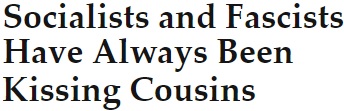
He explains that fascism and socialism are two sides of the same coin.
That the National Socialists embraced socialism is factually accurate. …they did nationalize very vital industry in Germany, even if by outright intimidation rather than through the law. In his personal diaries, Joseph Goebbels wrote in late 1925: “It would be better for us to end our existence under Bolshevism than to endure slavery under capitalism.” Only a few months later, he continued, “I think it is terrible that we and the Communists are bashing in each other’s heads.” Whatever the state of the rivalry between the two camps, Goebbels claimed, the two forces should ally and conquer. …The Italian fascists had even closer ties to the Marxists, with Mussolini having begun his career as a Marxist publicist and writer. A few Italian fascists even held positions in the Comintern.
Richard Mason makes similar points in a piece he wrote for the Foundation for Economic Education.
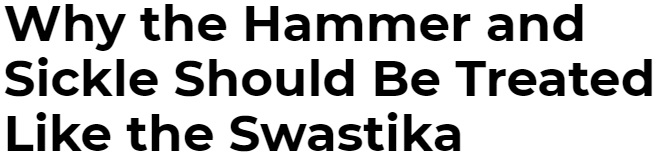
…how do we react to the hammer and sickle? I don’t have to write an article explaining the millions of deaths that occurred at the hands of communist regimes; like the Holocaust, the gulags of the Soviet Union and killing fields of Cambodia are widely known. Yet journalists in the UK openly and proudly advocate communism. Statues of Karl Marx are erected. …there is no justifiable way a fascist could argue ‘That wasn’t real Nazism.’ The same is not true for communism. …Since Karl Marx never implemented communism himself, the leaders of communist states always have that get-out-of-jail-free card. Any shortcomings, tragedies, or crises a communist regime faces can always be blamed on a misapplication of Marx’s infallible roadmap… The communist ideology in its purest form might be separated from its implementations, but at what point does its awful track record discredit any attempts to advocate it? …The history of communism is as bloodstained as that of Nazism; much more so, actually. It’s time we treated it as such.
Amen. I’ve weighed in on that issue, and I strongly recommend what Jeff Jacoby wrote on the issue as well.

And Sheldon Richman expands on this theme.
…fascism is socialism with a capitalist veneer. The word derives from fasces, the Roman symbol of collectivism and power: a tied bundle of rods with a protruding ax… Where socialism sought totalitarian control of a society’s economic processes through direct state operation of the means of production, fascism sought that control indirectly, through domination of nominally private owners. …Where socialism abolished all market relations outright, fascism left the appearance of market relations while planning all economic activities. Where socialism abolished money and prices, fascism controlled the monetary system and set all prices and wages politically.
He explains the vast gulf between capitalism and fascist economics.
…Entrepreneurship was abolished. State ministries, rather than consumers, determined what was produced and under what conditions. …Fascism is to be distinguished from interventionism, or the mixed economy. Interventionism seeks to guide the market process, not eliminate it, as fascism did. …Under fascism, the state, through official cartels, controlled all aspects of manufacturing, commerce, finance, and agriculture. Planning boards set product lines, production levels, prices, wages, working conditions, and the size of firms. Licensing was ubiquitous; no economic activity could be undertaken without government permission. …“excess” incomes had to be surrendered as taxes or “loans.” …since government policy aimed at autarky, or national self-sufficiency, protectionism was necessary: imports were barred or strictly controlled…fascist governments also undertook massive public-works projects financed by steep taxes, borrowing, and fiat money creation.
These are not new observations. Here’s what Ludwig von Mises wrote on this topic back in the 1940s.
The Marxians have resorted to polylogism because they could not refute by logical methods the theories developed by “bourgeois” economics, or the inferences drawn from these theories demonstrating the impracticability of socialism. As they could not rationally demonstrate the soundness of their own ideas or the unsoundness of their adversaries’ ideas, they have denounced the accepted logical methods. …The German nationalists had to face precisely the same problem as the Marxians. They also could neither demonstrate the correctness of their own statements nor disprove the theories of economics and praxeology. Thus they took shelter under the roof of polylogism, prepared for them by the Marxians. Of course, they concocted their own brand of polylogism. …Neither Marxian nor Nazi polylogism ever went further than to declare that the logical structure of mind is different with various classes or races. …Polylogism is not a philosophy or an epistemological theory. It is an attitude of narrow-minded fanatics.
And those fanatics are motivated by hate. The Nazis hate people of different races and religions, while the Marxists hate people of different incomes and classes.

Given the various articles cited above, this meme from The Matrix is spot on.


Well, we now know what happens when someone learns about the common characteristics of statist ideologies. The Daily Caller has a report on a student who got very upset after learning that the National Socialist Workers Party was…yes, socialist.
Social justice warrior and history major Shelby Shoup was arrested for throwing chocolate milk at a fellow student and College Republican tabling at Florida State University while saying “nazis weren’t socialists.” She has been charged with battery.
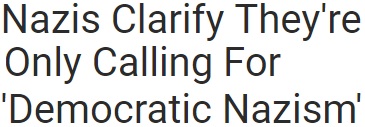
Since we’ve detoured into humor, this is a good opportunity to share this satire from the clever folks at the Babylon Bee.
At a press conference on Thursday, American Nazi Party leader Emmett Scoggins told reporters that his group is not trying to instate full-on Nazism, but a much better system called “democratic Nazism.” …Scoggins was questioned about the use of the word “democratic” and how democratic Nazism was any different from plain-old Nazism. “The main difference is we add the word ‘democratic’ on there because people like that word a lot more than just plain ‘Nazi,’” Scoggins said. …The conference ended with a long speech from Scoggins about…how “real” Nazism has never been tried.
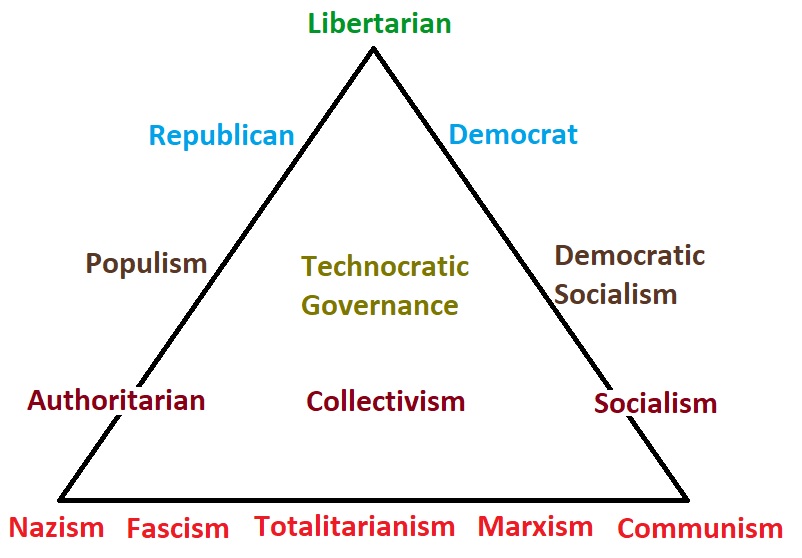
I’ll close with my amateur attempt to classify various ideologies.
In the above video, Matt used a circle.

I’m wondering if a triangle makes more sense, with freedom at the top and totalitarianism at the bottom.


Here are a couple of additional observations on the triangle.
  • Back in 2017, I differentiated between liberal socialism and Marxist socialism. The same is true across the board. We could add a line right above authoritarian, collectivism, and socialism and assert that ideologies above the line are democratic and that ideologies below that line are dictatorial.
  • Given the difference between the technical definition of socialism (government ownership, central planning, price controls) and the everyday definition (lots of redistribution), I’m wondering whether I should use “welfare state” rather than “democratic socialism”? The end result isn’t pretty, regardless.
  • If we just focus on economic policy, I think my “statism spectrum” suffices.
  • If we just focus on the left, my Bernie-inspired classification system still holds up.
P.S. I like to think that there aren’t any civilized people willing to tolerate the Nazi ideology. But I do worry the same can’t be said about communism. The head of the European Commission recently helped celebrate Marx’s birthday, companies like Mercedes-Benz glorify racist murderers in their advertising (part of the Che death cult), and even symphonies use communist symbols.

How high does the death toll need to get before people realize that communism, like its sister ideology of Nazism is despicably evil?